
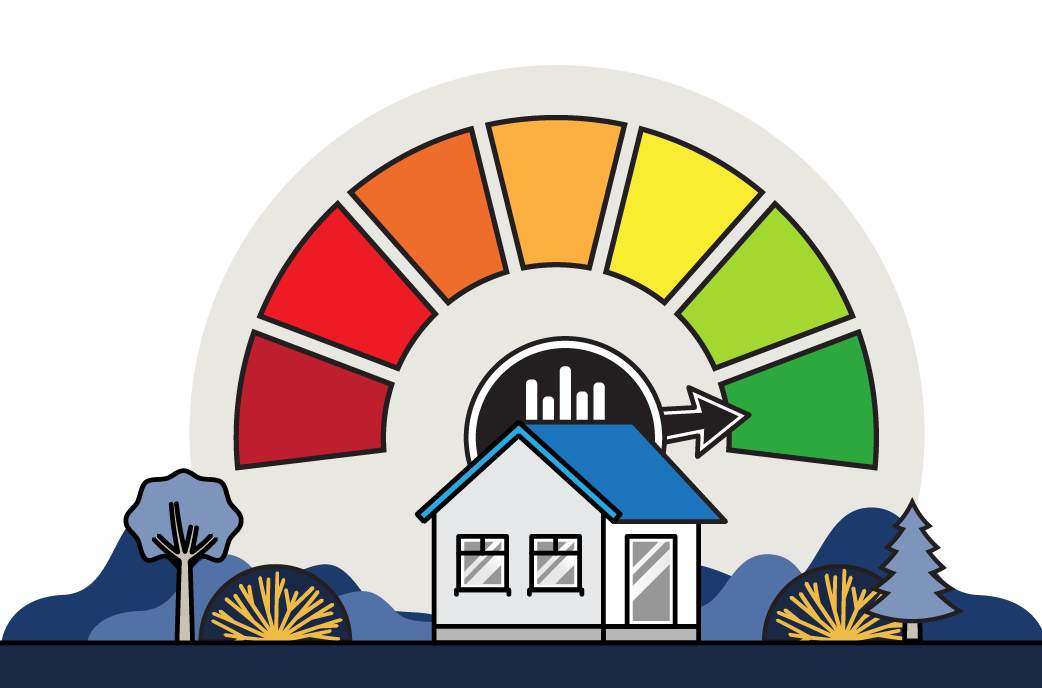
Home energy labels help tell the story of energy use in our homes.
A well-designed home energy label can:
- Provide trusted information that can help people understand how each home uses energy
- Make it possible to compare energy consumption and emissions of similar homes
- Support consumers making major decisions to purchase or rent a home, or invest in improvements
- Demonstrate the value of a home’s energy efficiency and climate resiliency for homebuyers
- Allow builders to highlight the energy performance of newly constructed homes
- Guide homeowners and renters towards a more efficient, affordable, comfortable and healthier home
- Suggest retrofit choices with the biggest energy, emissions, and cost savings
- Include climate resiliency information to help make homes more resilient against climate events like wildfires, flooding, and extreme heat
- Help governments assess the housing stock and develop more targeted and effective policies and programs.
Home labelling resources and information
Home labels and home labelling services, why they are important and how to understand them
Home labelling programs in Canada
Programs available to support home labelling activities in Canada
Home labelling funding and projects
Funding and projects that are advancing widespread home labelling
Government and industry partners, roles and responsibilities
Home labelling data and research
Data and research available to support home labelling work and partners
Glossary of useful and frequently used terms in home labelling
About the National Approach to Home Labelling
In Budget 2024, the Government committed $30 million over five years to develop a National Approach to Home Labelling (NAHL). The NAHL initiative has the following goals:
- Provide guidance and tools to jurisdictions to help them implement home energy labelling programs or policies that meet their objectives
- Foster consistency and comparability across all Canadian home energy labelling approaches
- Increase the number of households that know how their home, or prospective home, uses energy and what they can do to improve its energy performance, climate resiliency and affordability.
The vision for the NAHL is to create a consistent approach that supports labelling for all homes across Canada with energy performance ratings, energy efficiency recommendations and climate resilience information.
Priorities for the national approach
The NAHL enables home labelling through collaboration and partnerships between governments, industry and others with a role to play. Natural Resources Canada (NRCan) is offering support to these partners through new guidance and resources. The current priorities are listed below.

National Home Labelling Website
This website provides home labelling guidance and resources to jurisdictions and industries to support their home labelling initiatives. It offers best practices that encourage ongoing learning and collaboration to enable widespread home labelling. It also shares information with households who want to learn more about home labels. The website is updated as new resources are available.
Virtual Home Labelling Standard
A virtual home labelling standard will improve consistency and reliability of emerging virtual home energy assessment technology. This standard will also support efforts to procure virtual home energy assessment services, while discouraging ineffective tools from the marketplace. As the first step towards a standard, NRCan has developed voluntary Guidelines for Virtual Home Labelling.

Simplified Energy Assessment
EnerGuide is Canada’s national home energy benchmarking and labelling system and a foundation for the NAHL priorities. NRCan is modernizing EnerGuide and developing a simplified EnerGuide assessment option for existing homes with a more streamlined onsite home labelling assessment. Simplified energy assessments can offer a new service level for EnerGuide that is faster to complete, while maintaining EnerGuide standards and reliability.
Home Labelling Fund
The Home Labelling Fund is providing nearly $12 million over four years to advance home energy labelling projects across Canada by supporting provinces, territories, municipalities, Indigenous governments and communities, and industries undertaking labelling initiatives and working to increase access to home energy information and remove barriers.
Why a national approach is needed
Home labelling programs are moving ahead across Canada and breaking down barriers, such as a lack of awareness and access to home labels. A national approach is needed to move forward in a cohesive direction to deliver widespread home labelling in a way that will benefit Canadian households and remove the barriers that can most effectively be addressed at a national level.
Governments and industry have called for federal leadership and support on home labelling. The federal government is developing the NAHL in collaboration with home labelling partners and stakeholders to address their needs and priorities. The NAHL is focused on enabling government and industry partners that are ready to lead, and supporting those that are building capacity and acceptance.
The NAHL aims to meet the needs of Canadians. Research by Impact Canada with NRCan showed that 66% of Canadian homebuyers and homeowners believe it is important or very important to get a home energy labelFootnote 1. The study found that home labels are most important to homebuyers (85%), followed by homeowners planning to sell their home (73%) and homeowners with no plans to sell (50%).
The NAHL also seeks to drive demand for energy efficient homes, support market transformation, develop business opportunities and create jobs in the construction and retrofit sector. Canada’s energy efficiency sector employs nearly 470,000 workers who generate an estimated $22 billion in employment income each yearFootnote 2.
Contact us
For more information, contact us at homelabelling-etiquetageresidentiel@nrcan-rncan.gc.ca.