
Details
- Publication date
- Author(s)
Natural Resources Canada - ISBN
978-0-662-37182-3 - Cat. No.
M4-300/2026E-PDF
Voluntary recommendations to support program authorities and service providers in the delivery of virtual energy assessments and virtual home labels to Canadian households.
Table of contents
- Disclaimers
- Preface
- 1. Scope and application
- 2. Reference publications
- 3. Terms and definitions
- 4. Data used in virtual energy assessments
- 5. Types of virtual energy assessments
- 6. Modelling for virtual energy assessments
- 7. Computed performance metrics
- 8. Virtual home label
- 9. Label terminology
- Appendix: Informational notes accompanying the Guidelines
Disclaimers
These Guidelines are voluntary and informational in nature. Their use does not constitute certification, endorsement or approval by the Government of Canada or Natural Resources Canada (NRCan). Users assume full responsibility for ensuring that any practices based on these Guidelines comply with applicable laws, regulations, and standards. NRCan does not warrant the accuracy, suitability or fitness for purposes of any implementation of this guidance.
These Guidelines include recommendations for virtual energy assessments and home labelling systems that have similarities to on-site assessment techniques, including NRCan’s EnerGuide Rating System. However, virtual assessments rely on different methodologies and data that are not equivalent to the EnerGuide Rating System and must not be presented or interpreted as such. NRCan does not authorize use of the EnerGuide brand in association with virtual home labelling.
These Guidelines also recognize the role of professionals performing off-site inspections in support of virtual home labelling activities and suggest relevant skills and competencies for individuals that provide those services. The qualifications suggested in these Guidelines do not describe mandatory knowledge and experience for individuals wishing to perform these services. These descriptions are provided as general guidance for VHL services to consider for inclusion in their programs.
NRCan registers Energy Advisors to deliver the EnerGuide Rating System Basic Service and Additional Services. If an Energy Advisor is acting in another capacity, such as delivering confirmed virtual assessments, their NRCan registration agreement does not extend to these other activities.
Preface
Natural Resources Canada’s (NRCan) Guidelines for Virtual Home Labelling suggest definitions, practices and procedures, and formatting specifications for energy efficiency initiatives that provide virtual energy assessments and labels.
The Guidelines have been developed as part of the National Approach to Home Labelling (NAHL). NRCan is leading the NAHL to deliver guidance, resources and tools that will enable labelling for new and existing homes across Canada with consistent, comparable and reliable energy performance ratings, energy efficiency recommendations, emissions estimates and climate resiliency information.
NRCan developed these Guidelines to assist provincial, territorial and municipal governments as they deploy virtual home labelling programming, and to aid third-party companies and organizations as they develop virtual home labelling technologies and services. They are not intended to replace, duplicate or conflict with existing provincial, territorial or municipal frameworks. The Guidelines are intended to improve the consistency of virtual home labelling across Canada by proposing a common approach. Adoption of these Guidelines is entirely at the discretion of governments and service providers.
During the development of these Guidelines, NRCan consulted with two advisory teams, one of which was comprised of representatives from eleven provincial and municipal governments, and the other composed of staff from nine virtual energy assessment service providers. NRCan also posted the draft guidelines for public review, and received detailed comments from eleven Canadian stakeholders. While the content of the Guidelines reflects stakeholder input on the feasibility, relevance and effectiveness of virtual home labelling (VHL) practices, NRCan does not endorse, certify or verify any tool or service based on alignment with this document.
These Guidelines are voluntary. Governments and VHL services are not obliged to observe these Guidelines when developing labelling initiatives; nor will NRCan certify or endorse initiatives that align with these recommendations.
Objectives of the Guidelines
NRCan intends these Guidelines to:
- Align virtual energy assessments within Canada’s broader approach to home labelling.
- Encourage consistent outcomes between different virtual energy assessment approaches and providers.
- Inform organizations that are seeking to procure virtual energy assessments.
- Discourage ineffective tools and approaches from entering the home labelling marketplace.
Use or alignment with these Guidelines is voluntary. NRCan has published these recommendations to support VHL services and governments in virtual home labelling activities. However, NRCan does not validate, certify, endorse, approve or guarantee the performance or outputs of any virtual home labelling service or jurisdiction that applies these recommendations, in whole or part.
Scope of the recommendations
The Guidelines include provisions for six aspects of virtual energy assessments and labelling:
- General recommendations on the scope, applicability and delivery of virtual home labelling.
- A consistent framework for classifying types of virtual energy assessments, and the resulting virtual home labels.
- A set of assumptions, including climate data, household occupancy and operating conditions for asset-based assessments that increase consistency and comparability between labels.
- A set of inputs that should be used when conducting assessments, and outputs that should be reported as part of those assessments.
- A consistent method for computing energy consumption, operating costs and emissions estimates.
- A common format for providing information on home energy efficiency, operating costs and emissions, as part of virtual home labels.
Alignment with the EnerGuide Rating System
These Guidelines refer to energy modelling and rating methodology that are similar in concept to on-site assessment methods, including NRCan’s EnerGuide Rating System. However, there are differences between virtual energy assessment methods and EnerGuide’s on-site assessment procedures. For these reasons, NRCan does not authorize use of the official EnerGuide name, mark, or brand in association with virtual energy assessments or virtual home labels. Similarly, programs or services should not suggest that virtual energy assessments are validated with or equivalent to EnerGuide Rating System outputs.
However, NRCan encourages virtual home labelling services to inform participating homeowners about the EnerGuide Rating System. Virtual home labelling services may suggest that participating homeowners contact a registered Energy Advisor as a possible next step, after receiving a virtual home label.
1. Scope and application
The Guidelines include recommendations for:
- Common definitions and terminology for virtual energy assessments and virtual home labelling.
- Data sources and practices used to deliver virtual home labels.
- Inputs, outputs and boundary conditions for virtual energy assessments.
- Calculation methods for key performance metrics.
- Recommendations for label contents, presentation and formatting.
1.1 Virtual energy assessments
The Guidelines provide recommendations for home energy assessments that are delivered digitally, using predominately pre-existing data and information inferred using artificial intelligence (AI), machine learning, statistical methods and other predictive techniques. These types of assessments should be referred to as virtual energy assessments. Initiatives incorporating these assessments for the purposes of informing participating homeowners or stakeholders about a dwelling’s energy efficiency should be referred to as virtual home labelling (VHL). Such VHL activities are distinct from traditional home labelling in which on-site data collection is the predominant source of assessment information.
VHL services may also incorporate features and practices to:
- Educate participating homeowners on energy efficiency concepts.
- Collect self-reported information provided by participating homeowners.
- Verify inferred or self-reported information using photo or video inspection techniques.
1.2 Asset-based assessments
Industry commonly uses two types of assessments to understand building energy use:
- Asset-based energy assessments, which only consider the energy use characteristics of a dwelling, and
- Occupied energy assessments, which consider the energy use characteristics of the dwelling and its occupants.
The major distinction between these types of assessments is that asset-based assessments are not affected by the number of people living in a dwelling or their behavioural patterns. Occupied assessments specifically consider occupant behaviour.
The recommendations provided in these Guidelines are limited to asset-based energy assessments. Methodologies for occupant-based assessments are beyond the scope of these Guidelines.
(See note A-1.2: Asset-based assessments)
1.3 Assessed performance
The Guidelines recommend calculations for estimating and reporting three performance metrics:
- Annual energy consumption
- Energy utility costs
- Carbon emissions
While VHL services may include additional metrics as part of virtual energy assessments and labelling activities, other performance metrics are beyond the scope of the Guidelines.
1.4 Eligible housing types
The recommendations in these Guidelines are intended for use in low-rise residential buildings. NRCan recommends that VHL services apply specific criteria for building form, location, occupancy and condition.
(See note A-1.4: Eligible housing types)
Building form
The Guidelines are applicable to dwelling units of residential occupancy that are located in buildings meeting the following criteria:
- Not more than three storeys fully above the highest point of finished ground, with not more than four storeys fully or partially above the lowest point of finished ground, and
- comprised of not more than 30 attached dwelling units.
Stationary location
Subject dwelling units should be permanently affixed to the property on which they are located. Dwelling units may be regarded as permanently affixed if they are:
- Constructed on permanent foundations (including piles or screw jacks), or
- supplied by a permanent electrical service.
Occupancies
Virtual energy assessments should be limited to dwellings that are suitable for residential occupancy. VHL services should ensure that dwellings receiving assessments and labels are in buildings that are zoned for residential use. Assessments for buildings that incorporate both residential and non-residential occupancy should exclude the energy use and floor area associated with non-residential occupancy.
Building condition
Virtual energy assessments are used to characterize the energy efficiency of existing homes and to identify energy savings opportunities. Assessments and labels are generally delivered to dwellings that are suitable for occupancy and not undergoing renovation.
However, virtual energy assessments may also be used by participating homeowners during periods of renovation for the purposes of learning about energy efficiency and to inform decisions about retrofits that can reduce energy use. If VHL services issue labels or reports for dwellings undergoing renovation, NRCan recommends that these labels or reports be clearly designated for planning purposes only, with a caveat that the energy efficiency information may not represent the dwelling after renovation is completed.
1.5 Data collection from participating homeowners
VHL services may incorporate homeowner participation into virtual energy assessment procedures. Participation may include homeowners observing and reporting information about their dwelling, or providing photo and video documentation about their dwelling with guidance from an off-site, third-party professional.
NRCan strongly recommends that homeowner participation be limited to activities that can be readily conducted at floor level from within a dwelling’s occupied spaces, or from ground level outside the dwelling. Data collection and reporting from a dwelling’s unoccupied spaces (including attics, crawl spaces and wall cavities) can expose participating homeowners to elevated risk. These risks may include electric shock, contact with hazardous materials, elevated heights and confined spaces.
1.6 Data collection by third parties
VHL services may incorporate third party inspection procedures as part of virtual energy assessments, provided inspections are conducted off-site by a qualified professional using photo or video technology, in cooperation with the participating homeowner. Activities that require a qualified professional to physically visit the dwelling for the purposes of collecting information should be regarded as on-site assessments and are beyond the scope of these Guidelines.
1.7 Data stewardship
Virtual energy assessments commonly incorporate data from homeowners and third parties. VHL services are solely responsible for compliance with all legislation and commercial obligations related to the collection, storage, use and disposal of any data used in the delivery of virtual energy assessments.
Data provenance
VHL services incorporate data from a variety of sources to characterize dwelling energy efficiency. VHL services should clearly disclose the sources of all datasets used to develop and deliver energy assessments with program authorities and partners. This includes data used for model training, calibration and testing purposes, as well as data shared directly by homeowners.
NRCan also suggests that VHL services to provide homeowners with information on data sources and methods to improve understanding of virtual energy assessment approaches and to encourage acceptance of virtual labels.
Ethical sourcing of data
VHL services should secure the requisite intellectual property rights for all datasets used in the development and delivery of their models. VHL services should be vigilant to ensure that suppliers are the recognized rights holders for these datasets.
VHL services should refrain from using unlicensed data or data from unofficial sources. VHL services should also avoid the use of unauthorized extraction techniques to build their own datasets. Unlicensed and unauthorized use of data may pose legal risks for VHL services and may cause disruption for labelling initiatives.
Security
VHL services should protect the data they use. This includes preventing unauthorized access to both:
- Private information provided by the users of VHL services.
- Commercial and confidential data obtained from third-party information sources.
Privacy
VHL services must protect the private data they collect. These obligations are defined in applicable privacy legislation such as the Personal Information Protection and Electronic Documents Act (PIPEDA), which governs commercial use of private information by private companies.
VHL services are solely responsible for ensuring compliance with all applicable legislation and industry best practices regarding the collection, use, storage and disposal of personal or identifiable information. NRCan does not assume responsibility for any privacy compliance obligations arising from the use or implementation of these Guidelines.
1.8 Reporting and labelling
The Guidelines provide recommendations for the content, format and presentation of a virtual home label, which is comprised of a digital file that can be transmitted electronically, can be stored on a homeowner’s computer, and can be printed at the homeowner’s convenience. Virtual home labels may also be delivered to participating homeowners in paper format. Recommendations for such labels are provided in Section 8.
In addition to virtual home labels, VHL services may provide access to home energy ratings and performance information via a web application or another electronic user interface. Although the Guidelines do not provide recommendations for the design or implementation of these interfaces, NRCan encourages VHL services to design web applications that present home performance information in a manner consistent with virtual home labels. NRCan also recommends that web applications include links for users to download their virtual home label.
1.9 Supplementary goods or services
If VHL services also offer supplementary goods or services to participating homeowners (for instance, to support implementation of energy retrofits or renovations), such services should be regarded as post-labelling activities and are beyond the scope of these Guidelines.
Where VHL services do advertise, offer, facilitate, or host post-labelling activities that are delivered by third parties, NRCan strongly recommends that VHL services clearly disclose the nature of their relationship with those parties to participating homeowners.
1.10 Improper use of virtual assessments
Virtual energy assessment technology should not be used to demonstrate compliance with the energy efficiency or carbon emissions requirements prescribed by Canada’s building codes. Virtual energy assessment methods do not collect sufficient data to satisfy building code requirements, and the methodologies used by virtual energy assessments are inconsistent with code compliance practices.
2. Reference publications
Recommendations in these Guidelines reference other datasets, information sources and standards. These references can be located at the following URLs.
Canadian Weather Energy and Engineering Datasets (CWEEDs): Dataset containing two decades of historical meteorological data for 644 locations in Canada. Available at the following URL:
https://open.canada.ca/data/en/dataset/005494f2-1848-48d5-abe4-a76a7846f035
Canadian Weather Year for Energy Calculations (CWEC): Dataset of typical meteorological years for 644 locations in Canada. Available at the following URL:
https://open.canada.ca/data/en/dataset/55438acb-aa67-407a-9fdb-1cb21eb24e28
EnerGuide Rating System Open Data: Anonymized dataset of EnerGuide energy assessments. Available at the following URL: https://open.canada.ca/data/en/dataset/0a7619fd-2ffe-44b5-9027-3dfcec0866fd
EnerGuide Rating System Standard — Version 15: A national system for labelling homes using on-site energy assessments by Energy Advisors. More information about the EnerGuide Rating System is provided at the following URL:
https://natural-resources.canada.ca/energy-efficiency/product-energy-ratings/energuide/energuide-energy-efficiency-home-evaluations
HOT2000 Climate Map: A geographic database of local climate zones and associated climate data used by NRCan’s HOT2000 Software. Available at the following URL:
https://open.canada.ca/data/en/dataset/4672733b-bbb6-4299-a57f-f19ab475ac11
National Building Code of Canada 2025: Model code for minimum construction requirements across Canada. Available at the following URL:
https://nrc.canada.ca/en/certifications-evaluations-standards/codes-canada/codes-canada-publications/national-building-code-canada-2025
National inventory report: Greenhouse gas sources and sinks in Canada: Annual accounting of all greenhouse gas emissions in Canada. Available at the following URL: https://www.canada.ca/en/environment-climate-change/services/climate-change/greenhouse-gas-emissions/inventory.html
Personal Information Protection and Electronic Documents Act (PIPEDA): Federal legislation setting requirements for how private-sector organisations collect, use and disclose personal information in commercial activities. Available at the following URL:
https://www.priv.gc.ca/en/privacy-topics/privacy-laws-in-canada/the-personal-information-protection-and-electronic-documents-act-pipeda/
Statistics Canada Table 18-10-0001 - Monthly Average retail prices for gasoline and fuel oil: Monthly report of customer prices for petroleum fuels across Canada. Available at the following URL:
https://www150.statcan.gc.ca/t1/tbl1/en/tv.action?pid=1810000101
3. Terms and definitions
The Guidelines use the following terms and definitions to describe home labelling concepts:
Algorithm: Modelling or estimation procedures used by VHL services to characterize home performance, including energy use and emissions. Algorithms may refer to AI and machine learning techniques, as well as traditional statistical and engineering modelling methods.
Applicable residential energy end uses: List of residential activities that comprise the scope of energy consumption estimates for the purposes of modelling.
Asset-based assessment: An application of virtual energy assessment that estimates the energy performance of a physical dwelling, irrespective of occupant activity or behaviour. This type of modelling focuses on the characteristics of the dwelling, allowing labels from different homes to be compared even when the occupants of those homes have different lifestyles.
Common space: A heated space in a building that is not part of a residential or non-residential unit, and which may be used by all occupants of the building (or for which access may be limited, such as solely by the building owner/operator). Examples include hallways, staircases, common laundry rooms or mechanical rooms. Spaces containing cooking, eating, living, sleeping and sanitary facilities are part of dwelling units, and shall not be considered common spaces.
Confirmed virtual energy assessment: A virtual assessment that relies on third-party inspection data for the key dwelling characteristics. Confirmed virtual assessments are generally delivered using video or other off-site inspection techniques that enable a knowledgeable third party to confirm key assumptions about the dwelling.
Date of assessment: The date on which a VHL service compiles the inputs necessary to complete an assessment.
Dwelling characteristic database: Database containing property records that are used in virtual assessments, typically published by third parties. Examples include property assessments, building footprint databases, and the EnerGuide for Houses database.
Dwelling unit: A building or part of a building, used or intended to be used by one or more persons and usually containing cooking, eating, living, sleeping and sanitary facilities.
Energy Advisor: An individual registered with NRCan to deliver the EnerGuide Rating System Basic Service and additional services.
Energy end uses: Categories of household energy consumption, such as space heating, water heating, space cooling, ventilation, and appliances and lighting.
Energy modelling interval: The interval over which a dwelling’s energy performance is evaluated for the purposes of estimating energy use, emissions and utility costs.
First storey: The lowermost storey having its floor level above grade.
Heated floor area: The sum of the usable floor area that forms part of a dwelling unit’s conditioned space. The heated floor area includes all above-grade heated areas regardless of ceiling height, and all below-grade heated areas, such as basements, with a ceiling height of more than 1.2 metres.
Heating degree day: A measure of the difference between the mean temperature in each day and a reference temperature of 18°C. Heating degree days are typically summed for each day in a year to produce an annual summary statistic of climate severity in the heating season.
Inferred data: Housing characteristic information that is determined using machine learning or other statistical prediction techniques, and which is distinguished from information reported by participating homeowners or by third parties.
Key dwelling characteristics: A recommended set of housing characteristics for use in virtual energy assessments that can be provided by participating homeowners (self-reporting) or confirmed by qualified professionals (third-party inspection).
Metered utility data: Information obtained from utilities or homeowners on measured electrical or natural gas consumption associated with a dwelling.
Occupied assessment: A type of energy assessment that estimates the energy use characteristics of a household, reflecting both the energy efficiency characteristics of the dwelling and the activity and behaviour of its occupants. Occupied assessments provide customized estimates for energy consumption and savings potential that reflect the experiences of home’s occupants. Occupied assessments are beyond the scope of these Guidelines.
Off-site energy assessment: A virtual assessment performed by a qualified professional without visiting the home. In this type of assessment, the professional verifies information about the house using information submitted by a participating homeowner (including photos and/or videos).
On-site energy assessment: A home energy assessment performed by an Energy Advisor who visits the home for the purposes of taking measurements and verifying house characteristics and calibrating an energy model.
Participating homeowner: The owner or occupant of a dwelling that is subject to a virtual energy assessment, or who has received a virtual home label.
Pre-existing information: Information about the subject dwelling that was collected prior to the virtual assessment, often by third parties and for other purposes. Property records are an example of pre-existing information.
Preliminary virtual energy assessment: A virtual assessment that relies on inferred data for one or more of the key dwelling characteristics. Preliminary virtual assessments are generally assessments that are delivered without homeowner involvement, and without third-party inspection.
Property records: Pre-existing information about homes collected to support property assessments. Property record information is often collected from building permits.
Residential occupancy: The occupancy or use of a building or part of a building, by persons for whom sleeping accommodations are provided. In the context of the Guidelines, a dwelling unit is considered to have residential occupancy.
Secondary suite: A self-contained dwelling unit located in a house where both dwelling units constitute a single real estate property. In the case of houses with secondary suites, the units may be located side-by-side, fully or partially stacked or joined by a common area.
Self-reported data: Housing characteristics reported by the participating homeowner.
Self-reported virtual energy assessment: A virtual assessment that relies on self-reported data for the key dwelling characteristics. Self-reported virtual assessments are generally delivered using online or digital applications that invite homeowners to review, update and confirm information about their dwelling.
Standard energy profile: A summary of a dwelling’s energy use and emissions characteristics, reflecting the design and construction of the dwelling, and the information about energy conservation measures. Standard energy profiles are developed assuming typical occupant lifestyles and are not affected by the number of people who live in a dwelling, or their actual lifestyles.
Storey: The portion of a building that is situated between the top of any floor and the floor next above. If there is no floor above, that portion between the top of such floor and the ceiling above.
Subject dwelling: The dwelling undergoing a virtual energy assessment.
Total estimated energy cost: Estimated cost required to supply the dwelling with energy (including electricity, natural gas, heating oil, propane and wood) over the energy modelling interval.
Third-party inspection data: Housing characteristics determined by third parties, using video technology or other off-site inspection techniques.
VHL service: Agency providing virtual energy assessment and virtual home labelling services. May refer to governments or companies.
Virtual energy assessment: A home energy assessment performed using pre-existing information about a dwelling. In this type of assessment, a dwelling’s energy characteristics are estimated using information from third party databases, and optionally, information provided by a participating homeowner or by off-site inspection.
Virtual home label: A home label resulting from a virtual energy assessment.
4. Data used in virtual energy assessments
VHL services often incorporate data from multiple sources for the purposes of delivering a virtual assessment. Most virtual assessments begin by locating property records and other existing information about a dwelling and then supplementing this data with information from other sources. In many cases, delivery of virtual assessments proceeds in the following sequence:
- VHL services obtain pre-existing information about the subject dwelling that has been previously collected for other purposes.
- Pre-existing information is input into statistical prediction or artificial intelligence algorithms that can infer other dwelling characteristics, based on data from similar homes in the region.
- Homeowners may review and update information about their home, possibly correcting inaccuracies in pre-existing or inferred information and accounting for changes that have been made to the dwelling.
- Independent, third-party professionals may review and update inferred or homeowner-reported information using off-site inspection techniques.
Each of these steps incorporates additional information sources into the resulting assessment.
(See note: A-4: Data used in virtual energy assessments)
4.1 Pre-existing information about the subject dwelling
Pre-existing information provides the foundation for most virtual energy assessments. This information is collected by independent third parties, often to support other purposes. It is shared or licenced to VHL services to enable delivery of assessments.
Pre-existing information sources include:
- Information collected from original plans and permits as part of property assessments, excluding equipment-related information that may change without permit or approval of local code officials.
- Information obtained from pre-existing energy assessment records (such as EnerGuide assessments) for the subject dwelling.
- Information about the subject dwelling collected using remote sensing technology (including satellite or Lidar methods).
4.2 Inferred information sources
VHL services often use AI or statistical methods to predict housing characteristics that have not been collected or reported by homeowners or third parties. In some cases, VHL services may use aggregate or anonymized information (such as EnerGuide housing records) about dwellings in the same region or neighbourhood, which do not correspond to the subject dwelling. These sources of information may have greater inherent uncertainty.
Inferred information sources include:
- Information derived from publicly available energy assessment databases (such as the anonymized EnerGuide assessment records), without specific location information and which cannot be associated with the subject dwelling.
- Information derived from aggregate metered utility data, reported for the home’s geographic region, city or neighbourhood.
- Information inferred using AI, machine learning or other predictive techniques (for instance, predicting a home’s heating system type based on its location and vintage).
- Information about dwelling characteristics that has been derived using metered energy data from the subject dwelling.
4.3 Information obtained from homeowners
Homeowners may also provide information about the subject dwelling. This information is often collected using online questionaries or other digital applications that allow homeowners to describe their dwelling.
Information obtained from homeowners includes:
- Information about the subject dwelling that is collected and reported by a participating homeowner.
- Information about the subject dwelling that is collected and shared with a homeowner by contractors, real estate agents or other commercial service providers, and subsequently reported to the VHL Service by the homeowner.
4.4 Third-party inspection
VHL services may also incorporate third-party inspection to confirm pre-existing information, inferred information, and information provided by homeowners. Confirmation may be provided by an independent, qualified professional using off-site inspection techniques, in collaboration with the homeowner.
Third-party information sources include:
- Information about the subject dwelling that is collected by an independent professional in collaboration with a homeowner using video conferencing technology.
- Information about the subject dwelling that is collected by an independent professional who inspects digital photos provided by the homeowner.
4.5 Key dwelling characteristics for virtual energy assessments
Virtual energy assessments often draw from multiple sources of information. A single label may integrate data from third parties, the homeowner, preexisting and inferred information sources. The uncertainty associated with a given label is affected by how VHL services use these various information sources to attribute different dwelling characteristics.
The following dwelling characteristics are most important when assessing the uncertainty associated with a virtual home label:
- Dwelling location
- Type of dwelling
- Number of storeys
- Foundation type
- Year of construction
- Space heating fuel type
- Water heating fuel type
- Primary heating system type and age
- Heat pump type (if equipped)
- Cooling system type (if equipped)
- Solar photovoltaic system size (if equipped)
In most cases, confidence that the virtual energy assessments represent the dwelling characteristics can be improved when these data are sourced from participating homeowners or from third-party inspection. While inferred information sources have a reasonable chance of characterizing these parameters correctly for many dwellings, they will also provide incorrect information for some dwellings.
Dwelling size
The Guidelines do not include dwelling size information (such as heated floor area) in the list of key dwelling characteristics. This information will be challenging for many homeowners to collect in a consistent manner, and it will be hard to verify using remote inspection techniques.
However, most VHL services consider dwelling size when evaluating building energy use. Heated floor area (measured in m²) is an effective metric to describe the total amount of conditioned space within a building; above-grade floor area may provide similar information.
VHL services are encouraged to collect this information from property records or other pre-existing sources whenever possible. VHL services may infer this information using AI or statistical prediction techniques in regions where dwelling size information is not available in property records, or where confidence in property assessment records is low.
Parameters sourced from property records
If property records also contain information on heating, cooling, hot water equipment and solar panels, NRCan recommends that information should be regarded as an inferred data source, as it may be subject to change without construction or renovation permits. Confirming these data using homeowner- or third-party-provided information can increase the confidence in the virtual energy assessment.
Other assessment parameters
Virtual energy assessments may also infer additional parameters deemed relevant by the VHL service provider. These may include parameters that support energy modelling (such as air tightness or insulation levels). Many homeowners will lack the knowledge or means to safely and accurately determine these factors.
(See note A-4.5: Key dwelling characteristics)
5. Types of virtual energy assessments
NRCan recommends classifying virtual energy assessment methods using three different categories, depending on the sources of information referenced for the key dwelling characteristics:
- Preliminary virtual energy assessments incorporate inferred data for one or more of the key dwelling characteristics. Preliminary assessments may rely on a combination of pre-existing and inferred data.
- Self-reported virtual energy assessments rely on self-reported data for some or all the dwelling characteristics. They do not reference any inferred data for the key dwelling characteristics, however they may include some third-party inspection data.
- Confirmed virtual energy assessments reference third-party data for all key dwelling characteristics. This data may be a combination of pre-existing data (for instance, property assessment records) and information collected from other confirmed sources (for instance, off-site inspection by a professional or pre-existing EnerGuide labels).
5.1 Preliminary virtual energy assessments
Preliminary assessments rely entirely on pre-existing or inferred information for key dwelling characteristics. These assessments usually draw upon property records and other pre-existing information sources and use AI or statistical prediction techniques to infer other dwelling characteristics.
Preliminary assessments may contain incorrect or out-of-date information. This type of assessment is the least likely to reflect changes to the dwelling that are made without building permits, including changes to heating and cooling equipment. In some cases, AI or statistical prediction techniques will incorrectly infer housing characteristics, leading to discrepancies between label information and the subject dwelling.
Sharing preliminary assessments with homeowners
NRCan recommends caution when sharing the results of preliminary assessments with homeowners. Preliminary assessments will provide incorrect information for some dwellings. Sharing inaccurate information with homeowners may reduce trust and acceptance in home labelling.
If preliminary assessments are to be shared, VHL services should also provide homeowners with a convenient means to update and self-report information, such as an online or digital application.
5.2 Self-reported virtual energy assessments
Self-reported assessments do not rely on inferred data for the key dwelling characteristics. Instead, they supplement pre-existing data with information that is provided by participating homeowners using an online or digital application. VHL services may ask homeowners to review inferred information about their dwelling, to correct any inaccuracies, and to confirm that the information is representative of their home. By replacing inferred data with this information, these updates increase the likelihood that the self-reported characteristics accurately represent the subject dwelling. This approach can also encourage more homeowners to engage with labels and to accept labels as sources of useful information about their dwelling.
However, there is a risk that homeowners may provide inaccurate information. Energy efficiency literacy varies amongst homeowners. Some homeowners possess the knowledge needed to describe their home and identify equipment, while others find these concepts unfamiliar. Some homeowners may even falsify information to achieve a better label.
Educational supports for homeowners
NRCan recommends incorporating additional measures to support the effective delivery of self-reported assessments, and to encourage more accurate labelling. Useful supports include:
- Educational materials that help homeowners understand how their homes use energy, how to identify energy efficient features and characteristics of their homes, the use and benefits of home labelling, and actions they can take to improve the energy efficiency of their home.
- Access to energy coaches who can answer homeowner questions, inform about programs and other opportunities available to homeowners, and recommend next steps to take action on energy efficiency.
Educational supports can also improve confidence in assessments and labels. By increasing homeowner knowledge of energy efficiency and dwelling characteristics, VHL services can enable homeowners to provide more accurate information about their dwelling.
Even when combined, these measures do not guarantee that all information submitted by participating homeowners will be accurate. Stakeholders who deem homeowner-reported information to be unreliable may find that confirmed assessments or on-site assessments are better aligned with their needs.
5.3 Confirmed virtual energy assessments
Confirmed assessments rely on pre-existing data or third-party inspection for all the key dwelling characteristics, and do not use inferred or self-reported data for any of these parameters. Third-party assessments are delivered using video technology or other off-site inspection techniques. The scope of third-party inspection should be limited to house elements that can be readily accessed by homeowners, and to information that can be collected and inspected through off-site means using technology available to homeowners. Off-site inspections are unable to collect information about building envelope characteristics that are commonly inspected in on-site assessments (such as airtightness, attic insulation and window dimensions).
Professionals performing off-site inspection for confirmed assessments
NRCan recommends that professionals performing off-site inspection and confirmation of virtual energy assessments possess the following knowledge and competencies:
- Knowledge of building science principles in the context of residential buildings, including the house-as-a-system concept and energy efficiency principles
- Knowledge of the range of housing characteristics found in the region of assessment, including features found in different housing forms and vintages
- Knowledge of architectural features and building envelope components commonly found in Canadian homes
- Knowledge of different types of heating, cooling, water heating and ventilation equipment commonly found in Canadian homes
- Experience performing on-site data collection to determine building envelope characteristics and mechanical equipment details as part of energy assessments
- Experience engaging with homeowners to collect information, to provide energy efficiency education, and to answer questions and to offer advice
- Familiarity with the use of video conferencing technologies to confirm dwelling details.
The skills and competency categories suggested for professionals do not describe mandatory knowledge and experience for individuals wishing to perform these services. These descriptions are provided as general guidance for VHL services to consider for inclusion in their programs.
NRCan registers Energy Advisors to deliver the EnerGuide Rating System Basic Service and Additional Services. If an Energy Advisor is acting in another capacity, such as delivering confirmed virtual energy assessments, their NRCan registration agreement does not extend to these other purposes.
5.4 Comparing types of virtual energy assessments
Like all energy assessments, virtual energy assessments have inherent uncertainty. Uncertainty in assessment data may result in inaccurate or unrepresentative energy ratings and labels. These errors may also limit the effectiveness and relevance of energy efficiency recommendations that are based on assessment data.
The different types of virtual energy assessments can be compared according to their inherent certainty and scalability:
- Certainty describes the likelihood that the data inputs comprising an assessment accurately describe the characteristics of the subject dwelling.
- Scalability describes how readily assessments can be completed for a population of homes in a region, jurisdiction or service area.
(See note A-5.4 Sources of uncertainty in virtual energy assessments)
Balancing uncertainty and scalability in virtual energy assessments
Whether done virtually or on-site, all energy assessments represent a compromise between these objectives. In most cases, efforts to increase assessment confidence will also limit scalability. Requiring information to be reported by participating homeowners or by third parties will slow down delivery of assessments across service areas, and may also increase assessment costs.
There is no universal compromise between certainty and scalability in energy efficiency programming. Program managers should seek solutions that balance their own needs and objectives for program reach and cost, while also reflecting their tolerance for uncertainty in assessment results. Table 1 summarizes the differences between preliminary, self-reported and confirmed assessment types.
| Preliminary Assessments | Self-reported assessments | Confirmed Assessments |
|---|---|---|
|
Rely on inferred data Do not require active participation of homeowners or third parties Most useful for aggregate analysis of portfolios or service areas Most scalable type of assessment, highest uncertainty |
Engage homeowners to review and update information Improves homeowner participation and confidence. Homeowner may not provide accurate information Moderately scalable type of assessment, moderate uncertainty |
Connect homeowners with third-party professionals to verify data Provides highest program and stakeholder confidence More expensive and time-intensive than self-reported assessments Least scalable type of assessment, lowest uncertainty |
Preliminary assessments are based on inferred data, which typically makes them more scalable than other types of assessments that incorporate data reporting or confirmation procedures. VHL services can complete preliminary assessments quickly because they can be generated without active participation by homeowners, and without third-party inspection. However, the resulting estimates may provide lower-confidence information about specific dwellings. This compromise may be acceptable in applications that estimate energy use for many homes within a region, portfolio or service area. While the characteristics of individual dwellings may vary from inferred information, aggregate results may still provide meaningful estimates for the population.
For self-reported assessments, homeowner participation is a prerequisite. For this reason, self-reported assessments may be less scalable than methodologies that use inferred information for key dwelling characteristics. While self-reported assessments increase the likelihood that assessment data accurately represents the characteristics of the subject dwelling, reliance on self-reported data may not adequately mitigate uncertainty and doubt for some stakeholders, as homeowners may still provide inaccurate information.
Confirmed assessments require that key dwelling characteristics are verified by a third-party. However, incorporating third-party inspections into virtual assessment methodologies further reduces the scalability of VHL initiatives, as the confirmation process requires that participating homeowners agree to engage with third-party professionals for the purposes of sharing images and videos of their home.
While confirmed assessments further increase the likelihood that assessment data accurately represents the characteristics of the subject dwelling, the scope of off-site inspection only includes house elements that can be readily accessed by homeowners and inspected through off-site means using video or photo technology. The scope does not include building envelope characteristics commonly inspected in on-site procedures (such as airtightness, attic insulation and window dimensions). As a result, confirmed assessments are unable to verify many envelope details.
On-site assessments
Labelling initiatives that depend on accurate information about building envelope dimensions and characteristics are unlikely to be satisfied with any type of virtual assessment. EnerGuide and other on-site assessments incorporate building measurements, inspection of hard-to-reach details, and blower door tests. These procedures will provide more complete information about the building envelope of the subject dwelling. If high-confidence information about building envelopes is critical for labelling programs, EnerGuide assessments or other on-site measurement methods should be used in place of virtual assessments.
6. Modelling for virtual energy assessments
NRCan recommends that virtual home labelling assessments use asset-based modelling methods, similar to those used by the EnerGuide Rating System. This approach ensures that home energy ratings and labels reflect a dwelling’s energy efficiency characteristics and are not affected by the behaviour of the occupants.
(See note A-6: Energy modelling for virtual energy assessments)
6.1 Date of assessment
VHL services should record the date of assessment as the date on which the VHL service compiles the inputs required to complete the assessment. If inputs are compiled over multiple days, the date of assessment should reflect the most recent date on which data was compiled.
6.2 Energy modelling interval
Virtual energy assessments should model a dwelling’s energy consumption over a one-year (365 day) period, ranging from January 1 to December 31. If the energy modelling interval falls within a leap year, the assessment should correspond to a 365-day period, and February 29 should be omitted from the assessment.
(See note A-6.2: Energy modelling interval)
6.3 Climate data for energy modelling
NRCan recommends that virtual energy assessments use typical meteorological weather conditions for the purposes of energy modelling.
Climate data should correspond to either:
- The weather station nearest to the dwelling’s location, or
- the weather station known to best represent the weather conditions at the dwelling’s location, as measured using heating degree days.
VHL services should incorporate weather data into virtual assessment modelling using one of the following formats:
- Native hourly format as provided by NRCan,
- aggregated monthly bin format, or
- aggregated annual heating degree day format.
VHL services using hourly or monthly bin climate data are advised to reference the most recent Canadian Weather Year for Energy Calculations (CWEC) data set for the weather station that best represents the location of the subject dwelling. VHL services using aggregated heating degree day data may reference the HOT2000 climate map.
(See note A-6.3: Climate data for energy modelling)
6.4 Modelling inputs
Energy models should incorporate the following inputs for dwelling characteristics:
- Location
- Year of construction
- Heated floor area (m²)
- Type of dwelling
- Number of storeys
- Foundation type
- Space heating fuel type
- Water heating fuel type
- Primary heating system type
- Primary heating system age
- Heat pump source
- Cooling system
- Photovoltaic system
NRCan recommends this minimum set of modelling inputs to ensure that assessments provide enough granularity to capture a dwelling’s energy efficiency characteristics. VHL services may also include additional inputs to support their modelling methods.
Location
The location of the subject dwelling should be described in sufficient detail to identify appropriate weather data. Recommended location formats include:
- A dwelling’s civic address
- A dwelling’s property assessment identifier
- A dwelling’s postal code
- A dwelling’s geographic coordinates (latitude and longitude)
Year of construction
The subject dwelling’s date of construction should be described using:
- The year of construction or the decade of construction for homes constructed prior to 1960
- The year of construction, for all other homes.
Heated floor area
The size of the subject dwelling should be quantified using the heated floor area. This area should include the sum of the interior horizontal areas of all floors and stair systems corresponding to heated spaces in which the ceiling height is 1.2 metres or greater.
The heated floor area should include above grade and below grade areas inside the building envelope that are conditioned throughout the heating season. Garages, porches and other seasonal spaces should not be included in the heated floor area, even if they are served with heating equipment.
The heated floor area should be reported in square metres (m²).
(See note A-6.4 (a): Heated floor area)
Type of dwelling
The type of dwelling refers to the subject dwelling’s configuration and attachment to adjacent dwellings. The value of this input should correspond to one of the following values:
- Detached: Dwellings that share no common walls, ceilings or floors with adjacent dwellings.
- Attached: Dwellings that share common walls, ceilings or floors with adjacent dwellings, in duplex, triplex row house or multi-unit residential building (MURB) configurations.
- Mobile homes: Dwellings that are on temporary foundations and supplied by permanent electrical service.
(See note A-6.4 (b): Type of dwelling)
Number of storeys
This parameter denotes the number of storeys contained between the roof and the floor of the first storey. The value of this input should be reported as a whole number.
(See note A-6.4 (c): Number of storeys)
Foundation type
This parameter denotes the configuration of the predominate foundation type associated with the dwelling. The foundation type should correspond to one of the following values:
- Basement
- Slab on grade
- Walk-out
- Enclosed and conditioned crawlspace
- Vented crawl space or exposed floor above piles or screw jacks
- No foundation
Where the dwelling is configured with multiple foundation types (e.g. basement & slab on grade), the predominate foundation type should be the type with the largest aggregate horizontal area. Other foundations attached to the dwelling may be ignored.
(See note A-6.4 (d): Foundation type)
Space heating fuel type
This parameter denotes the type of fuel used by the primary space heating system, or in the case of homes equipped with heat pumps, the type of fuel used by the back-up heating system. The space heating fuel type should correspond to one of the following values:
- Electricity
- Natural gas
- Heating oil
- Propane
- Wood
Water heating fuel type
This parameter denotes the type of fuel used by the primary water heating system. The water heating fuel type should correspond to one of the following values:
- Electricity
- Natural gas
- Heating oil
- Propane
- Wood
- Solar
Primary heating system type
This parameter denotes the type of the primary heating system, or in the case of homes equipped with heat pumps, the type of the back-up heating system. This parameter should correspond to one of the following values:
- Furnace
- Boiler
- Electric baseboards or other electric resistance heating
- Stove/unitary heater
Heat pumps that do not have a designated back-up heating system should be assumed to have an electric resistance back-up heating system.
Primary heating system age
This parameter denotes the age of the primary heating system, or in the case of homes equipped with heat pumps, the age of the heat pump. VHL services may choose to describe the age of the primary heating system using one of the following methods:
- Single-year resolution (“the heating system is 8 years old”)
- Five-year spans (“the heating system is between 5 and 10 years old”)
- Recent replacement (“the heating system was replaced within the last 10 years”)
(See note A-6.4 (e): Age of primary heating system)
Heat pump source
This parameter denotes the ambient energy source for a dwelling’s heat pump, if equipped. The heat pump source should correspond to one of the following values:
- Air-source
- Ground-source
- Water-source
- None (no heat pump)
Cooling system type
This parameter denotes the presence and configuration of cooling systems, if equipped. The cooling system type should correspond to one of the following values:
- Permanently installed cooling systems (central or split)
- Window or portable air conditioning
- No air conditioning
Homes equipped with heat pumps may be assumed to have permanently installed cooling systems.
Solar photovoltaic system size
This parameter denotes the presence and size of solar photovoltaic (PV) panels, if equipped. The solar photovoltaic system should correspond to one of the following values:
- Small scale system (12 panels or less, ~0-4kW DC)
- Medium scale system (13 to 25 panels, ~4-8kW DC)
- Large scale system (26-39 panels, ~8-12 kW DC)
- Very large scale system (40 panels or more, ~12+ kW DC)
- No PV (0 panels)
(See note A-6.4 (f): Solar photovoltaic system terminology)
6.5 Operating conditions
VHL services should evaluate the subject dwelling’s heated floor area for the purposes of determining the occupancy of the dwelling. The Guidelines recommend different assumptions for occupancy, electric loads and hot water use for homes depending on a dwelling’s heated floor area.
(See note A-6.5: Operating conditions)
Occupancy
The number of occupants modelled should be in accordance with Table 2. Occupants should be assumed to be home 50% of the time.
| Occupant type | Dwellings smaller than 115m² | Other dwellings |
|---|---|---|
| Number of Adults | 2 | 2 |
| Number of Children | 0 | 1 |
Electric loads
Electric loads associated with the subject dwelling should be computed in accordance with Table 3.
| Electric load | Dwellings smaller than 115m² (kWh/day) |
Other dwellings (kWh/day) |
|---|---|---|
| Interior lighting | 1.7 | 2.6 |
| Interior Appliances | 5.2 | 6.3 |
| Other interior loads | 4.4 | 9.7 |
| Exterior loads | 0.4 | 0.9 |
| Total | 11.7 | 19.5 |
Hot water loads
Hot water loads associated with the subject dwelling should be computed in accordance with Table 4. Energy models should assume these volumes are supplied at 55°C and do not include mixed cold-water draws.
| Hot water load | Dwellings smaller than 115m² (l/day) |
Other dwellings (l/day) |
|---|---|---|
| Showers | 60 | 90 |
| Clothes washing | 30 | 45 |
| Dishwashing | 7 | 10 |
| Faucets and other usage | 25 | 45 |
| Total | 122 | 190 |
6.6 Modelling outputs
Energy end-uses
VHL services should compute quantities of applicable residential energy end-uses over the energy modelling interval, as described in the following definitions:
- Space heating energy use (GJ): The sum of all energy required to heat a dwelling’s occupied space, including fuel and electricity used by combustion equipment, resistance elements, draft fans, circulation pumps and blowers, compressors, refrigeration pumps and evaporative fans, and controls. Space heating energy use also includes the energy required to condition ventilation and infiltration air to indoor temperatures during the heating season.
- Water heating energy use (GJ): The sum of all energy required to supply hot water for domestic purposes, including baths and showers, dishwashing, laundry and other use at the tap. Water heating end uses exclude energy required to heat swimming pools, hot tubs and steam rooms. When water heating systems include solar thermal components, the water heating energy use should reflect non-renewable energy used by water heating systems and exclude solar energy input.
- Ventilation energy use (GJ): The sum of all energy required to supply fresh air into the dwelling, and to remove exhaust air from the dwelling. Ventilation energy should reflect the energy use of fans and associated controls. Ventilation energy should not include energy required to condition or temper incoming outdoor air.
- Cooling energy use (GJ): The sum of all energy required to cool a dwelling’s occupied space, including circulation pumps and blowers, compressors, refrigeration pumps and evaporative fans, and controls. Space cooling energy use includes the energy required to condition ventilation and infiltration air to indoor temperatures during the cooling season.
- Appliances, lighting and equipment (GJ): The sum of all energy consumed by residential electrical equipment, including lighting, appliances and miscellaneous plug loads. Appliances, lighting and equipment should exclude all energy used by space heating, space cooling, ventilation and water heating equipment.
Total energy use
Energy models should compute the following energy consumption value describing the energy and environmental performance of the dwelling over the energy modelling interval:
- Total energy use (GJ): The sum of all energy used by applicable residential energy end uses.
Energy consumption by source
Energy models should compute the amount of energy consumed by all applicable residential energy end uses, aggregated by the energy source. The following energy consumption amounts should be computed over the energy modelling interval:
- Electricity consumption (kWh)
- Natural gas consumption (m³)
- Heating oil consumption (l)
- Propane consumption (l)
- Wood consumption (kg)
The Guidelines recommend that the scope of dwelling energy consumption be limited to the property line or boundary associated with the dwelling; upstream energy use associated with the production and transport of energy for use in the dwelling are outside of the recommended scope.
Computed energy consumption should be aggregated into a single total over the energy modelling interval for the purposes of computing dwelling energy use, emissions, and energy costs. VHL services may also compute energy consumption over shorter periods (for example, monthly, thirty-day or hourly intervals) for the purposes of applying utility rate schedules.
(See note A-6.6: Energy consumption over shorter intervals)
Renewable energy generation
Virtual energy assessments should compute the energy generated by eligible renewable energy systems for the energy modelling interval, as described in the following definition:
- Total renewable generation (GJ): total output from renewable generation systems.
For consistency with on-site assessment practices, NRCan recommends that the scope of renewable energy generation be limited to the electrical output of building mounted solar photovoltaic systems, or ground mounted renewable generation systems that are connected to the electrical meter serving the subject dwelling.
7. Computed performance metrics
Virtual energy assessments should compute a common set of energy performance metrics that are comparable from one label to another. The Guidelines provide three common metrics for inclusion on virtual home labels:
- Net energy use
- GHG emissions
- Energy costs
Each metric should be computed in accordance with recommendations put forth in this section.
7.1 Net energy use metric
Virtual energy assessments should compute the net energy use of the dwelling using the following equation:
Where Total energy use and Total renewable generation are computed in accordance with Section 6.6.
7.2 GHG emission metric
Virtual energy assessments should compute greenhouse gas emissions associated combustion fuels consumed in the subject dwelling. Virtual energy assessments should also account for offsite emissions associated with the production and transmission of electricity for use in the subject dwelling. Assessments should use emission factors to convert from quantities of electricity and fuel use to GHG emissions.
Emission factors for electricity
GHG emission factors for electricity should be obtained from either:
- The provincial or territorial government having jurisdiction over the subject dwelling,
- the regulated utility supplying electricity in the region, or
- the provincial or territorial consumption intensity emission factors published in the most recent National Inventory Report (Tables A13-2 to A13-14).
(See note A-7.2 (a): GHG emission factors for electricity)
Emission factors for natural gas
GHG emission factors for natural gas should be obtained from either:
- The provincial or territorial government having jurisdiction over the subject dwelling,
- the regulated utility supplying natural gas in the region, or
- the Canadian national average, provided in the most recent National Inventory Report
Where emission factors for natural gas are sourced from the National Inventory Report, VHL services may need to compute the overall emission intensity by accounting for the global warming contribution of the constituent flue gases: carbon dioxide (CO2), methane (CH4) and nitrous oxide (N2O).
(See note A-7.2 (b): Calculating emission factors for combustion fuels)
Emission factors for heating oil, propane and wood
GHG emission factors for heating oil, propane and wood should be obtained from the most recent National Inventory Report.
Where emission factors for heating oil, propane and wood are sourced from the National Inventory Report, VHL services may need to compute the overall emission intensity by accounting for the global warming contribution of the constituent flue gasses: carbon dioxide (CO2), methane (CH4) and nitrous oxide (N2O).
(See note A-7.2 (b): Calculating emission factors for combustion fuels)
On-site GHG emissions metric
Once combustion fuel emission factors are determined, the total on-site GHG emissions can be computed for the assessment period by multiplying the energy consumption (cons.) by source by the appropriate GHG emission factor:
Where Natural gas cons (m³), heating oil cons (l), propane cons (l) and wood cons (kg) are the energy consumption by source values computed in accordance with Section 6.6.
The on-site GHG emissions metric should be converted into tonnes of CO2equivalent by dividing by 1⨉106:
Off-site GHG emissions metric
Virtual energy assessments should compute the off-site operational GHG emissions (T) from the dwelling for the energy modelling interval by multiplying the electricity consumption by the appropriate GHG emission factor for electricity.
Where Electricity Cons (kWh) is the electricity consumption by source value computed in accordance with Section 6.6.
The off-site GHG emissions metric can then be converted into tonnes of CO2equivalent by dividing by 1⨉106.
Total GHG emissions metric
The total GHG emissions metric is the sum of the on-site and off-site GHG emissions.
7.3 Energy costs
The Guidelines recognize that utility bill information is useful to homeowners, but inclusion of this information in virtual energy assessments and labels is left to the discretion of VHL Services. This approach reflects the uncertainty associated with utility bill estimates:
- Energy prices may vary from homeowner to homeowner, and are subject to change over time
- Annual variations in weather and occupant behavior have a significant impact on household energy use.
These factors contribute to differences between predicted and actual energy bills. Some homeowners may understand that estimates appearing on a label reflect typical weather and occupancy; others may find the differences confusing. For this reason, VHL services may prefer to omit this information from labels. VHL services that elect to incorporate utility bill estimates are encouraged to follow NRCan’s recommendations for calculating those costs to improve consistency between labels.
When virtual energy assessments include energy cost estimates, the scope of the estimate should include the following energy sources:
- Electricity
- Natural gas
- Heating oil
- Propane
- Wood
When virtual assessments include estimated energy costs, VHL services are encouraged to use recent, regional energy prices when computing energy costs.
Estimated electricity costs
Virtual energy assessments may compute the total cost of the electricity service over the energy modelling interval.
The computed costs of electric services should reflect consumption charges associated with electricity used by the dwelling, including electricity supply, transmission and distribution charges, and other fees assessed on a per kilowatt hour basis.
Consumption charges should be assessed using either:
- A recent schedule of rates and fees posted on the electric utility’s website, or
- A schedule of rates and fees provided by the electric utility for the purposes of conducting virtual assessments.
(See note A-7.3 (a): Effective prices of electricity and natural gas)
Estimated natural gas costs
When a virtual energy assessment determines that the natural gas consumption of the dwelling (as computed in accordance with Section 6.6) is greater than zero, the assessment should also compute the total cost of the natural gas service over the energy modelling interval. The costs of natural gas services should reflect consumption charges associated with natural gas used by the dwelling, including gas supply, compression, transmission and distribution charges, and other fees assessed on a per cubic meter or per GJ basis.
Consumption charges may be assessed using either:
- A recent schedule of rates and fees posted on the natural gas utility’s website, or
- A schedule of rates and fees provided by the natural gas utility for the purposes of conducting virtual energy assessments.
(See note A-7.3 (a): Effective prices of electricity and natural gas)
Estimated heating oil costs
When a virtual energy assessment determines that the heating oil consumption of the dwelling (as computed in accordance with Section 6.6) is greater than zero, the assessment should also compute the total cost of heating oil used in the dwelling over the energy modelling interval. The computed costs of heating oil should reflect supply and delivery charges associated with providing heating oil to the dwelling.
Heating oil supply and delivery charges may be assessed using regional retail prices for household heating oil ($/l), as reported by Statistics Canada Table 18-10-0001, and averaged over the energy modelling interval.
(See note A-7.3 (b): Effective prices for heating oil)
Estimated propane heating costs
Virtual energy assessments may compute the total cost of propane used in the dwelling over the energy modelling interval. The computed costs of these energy services should reflect supply and delivery charges associated with providing propane to the dwelling. The supply and delivery charges should be assessed using a regional retail price for propane ($/l), as determined by the VHL service.
Estimated wood heating costs
Virtual energy assessments should compute the total cost of wood used to heat the dwelling over the energy modelling interval. The computed costs of these energy services should reflect supply and delivery charges associated with providing wood to the dwelling. The supply and delivery charges should be assessed using an effective price for wood ($/kg), as determined by the VHL service.
7.4 Total estimated energy costs
Virtual energy assessments should compute the total estimated energy costs over the energy modelling interval, as the sum of the following:
8. Virtual home label
Virtual energy assessments should include a virtual home label that follows the guidance of this Section. This includes guidance on:
- The definition and scope of a virtual home label.
- The content and presentation of an energy profile.
- Information and educational materials for participating homeowners.
Any additional materials included on the label should also follow the recommendations for energy and emission terminology provided in Section 9.
8.1 Definition and scope
A virtual home label is a standardized report of the energy and emissions performance of an individual dwelling. The label presents standardized energy metrics for efficiency, consumption, carbon emissions, and energy costs in a clear and consistent manner. The label also provides information about the housing characteristics that form the basis of the energy assessment.
Every virtual home label should include the following elements:
- Energy profile information, following the recommendations in Section 8.2.
- Disclosure of the housing characteristics used in the assessment.
- Energy rating and scale.
- Use of terms and definitions in accordance with specific criteria (described in Section 9).
Virtual home labels could also incorporate additional energy efficiency, affordability or emissions indicators, as well as educational materials. When included on a virtual home label, these indicators should meet the following criteria:
- Additional indicators that resemble the modelling outputs defined in Section 6.6 or the computed performance metrics defined in Section 7 should follow the definitions and the calculation procedures prescribed in those sections.
- Additional indicators should not be presented or otherwise incorporated with the energy profile information.
Virtual home labels should not include:
- Energy estimations or predictions that are derived from occupied modelling.
- Information describing homeowner operating conditions or behaviours.
- Energy consumption information obtained from metered utility data, or information about occupant behavior that has been derived from the data.
8.2 Energy profile information
Virtual home labels should include specific information that describes the subject dwelling, and specific details about the dwelling’s performance. The information should include the following:
Title and description
The virtual home label should include a title that includes the subject dwelling’s address.
Energy consumption estimate
Virtual home labels should report the energy consumption estimate, in units of GJ/yr. This rating should be calculated using the Net energy use metric, as described in Section 7.1. The energy consumption estimate should be rounded to the nearest 5 GJ.
Utility bill estimate
At the discretion of the VHL service, virtual home labels may include a utility bill estimate, in units of $/yr. The estimate should be computed in accordance with recommendations in Section 7.3 and 7.4.
Carbon emissions estimate
Virtual home labels should report the carbon emissions estimate, in units of T/yr. This rating should be calculated using the Total GHG emissions metric, as described Section 7.2. The estimate should be rounded to the nearest 0.2 tonnes.
House characteristics used in the assessment
Virtual home labels should include an information table that describes the house characteristics forming the basis of the energy assessment. The information should include all items listed in Section 6.4. The characteristics should be listed in the same order as they are presented in Section 6.4.
All virtual home labels should also include a caption at the top of the information table, following the guidance in Table 5.
| Type of Label | Caption for housing characteristic table |
|---|---|
| Preliminary virtual home labels |
“This preliminary virtual home label was generated using the following information about the dwelling. This information has not been reviewed by the homeowner for accuracy.” |
| Self-reported virtual home labels | “This virtual home label was generated using the following information about the dwelling. The homeowner has declared this information to be accurate to the best of their knowledge.” |
| Confirmed virtual home labels | “This virtual home label was generated using the following information about the dwelling. This information has been confirmed through professional inspection.” |
Label presentation
The energy profile information should be displayed in a specific format:
- The background should be white. If another colour is used, it should contrast well with the text colour.
- All text should be black. If another colour is used, it should contrast well with the background colour.
- The energy profile should include all information as outlined in Section 8.2.
- The energy profile should also include the date of the assessment.
The information in the energy profile should be presented together and not split into separate sections, to provide the homeowner with a summary of their home’s energy use.
(See note A-8.2: Label presentation)
8.3 Rating and scale
NRCan recommends that virtual home labels, if developed, include an annual energy consumption estimate, measured in gigajoules per year (GJ/yr).
Although this metric is analogous to the EnerGuide Rating System’s gigajoule rating, ratings from virtual energy assessments are not equivalent to EnerGuide ratings. As such, outputs generated through virtual assessments are not EnerGuide ratings and must not be presented or interpreted as such. NRCan does not authorize use of the EnerGuide brand in association with virtual home labelling.
9. Label terminology
VHL services should use consistent terminology on virtual home labels. Below are recommendations for terminology that is commonly used on virtual home labels.
9.1 Reference comparisons
Virtual home labels may include references that offer comparison to other homes to help homeowners understand if their home is more or less efficient than similar dwellings. NRCan encourages VHL services to use comparisons that reflect the effect of regional climates and construction practices on home energy use. Useful references could include:
- Comparisons to similar homes in the neighbourhood or city.
- Comparisons to similar homes in the same province and climate zone.
VHL services may choose to identify samples of homes for reference comparisons using criteria such as location, climate zone, housing form and vintage.
(See note: A-9.1: Reference comparisons)
9.2 Terms reserved for on-site assessments
The following terms are recommended for use only when these characteristics have been verified using an on-site assessment, or to describe characteristics of dwellings in general. These terms should not be ascribed as characteristics of the subject dwelling on a virtual home label:
- Well insulated
- Poorly insulated
- Air-tight
- High performance windows, efficient windows
- Comfortable home, increased comfort
- EnerGuide assessment
- Home energy assessment
(See note A-9.2: Terms reserved for on-site assessments)
Appendix: Informational notes accompanying the Guidelines
The following statements and notes are provided to aid users with the interpretation and application of these Guidelines, and to provide information about the intention and rationale of its recommendations.
A-1.2: Asset-based assessments
Asset-based assessments are intended to provide a consistent modelling methodology that supports house-to-house comparisons. For this reason, asset-based assessments predominately consider dwelling characteristics, such as insulation, window performance and mechanical system efficiency. Asset-based assessments evaluate a dwelling’s energy efficiency during typical use, using prescribed assumptions about weather conditions and occupancy. These assumptions will often differ from actual dwelling conditions.
In comparison, occupied assessments rely on a customized modelling methodology that delivers personalized estimates of energy consumption and savings potential. Occupied assessments may incorporate information provided by homeowners about the number of people living in a dwelling and their activity, as well as metered energy consumption data. Occupied assessments may provide more accurate energy consumption and savings estimates because they consider how individual occupants use their homes and may reflect actual utility data. These estimates are personal to the occupants of a home and may prevent meaningful comparisons between homes.
A-1.4: Eligible housing types
The housing sector is commonly separated into two classes:
- Low-rise dwellings that comply with the requirements of Part 9 of Canada’s National Building Code, and
- Mid- and high-rise dwellings that are beyond the scope of Part 9
Many home energy efficiency programs (including NRCan’s EnerGuide rating system) specifically target Part 9 dwellings. This scope simplifies energy modelling and assumptions for boundary conditions.
While these Guidelines are intended to support the same housing segments, VHL services report that it can be challenging to apply the specific definitions of Part 9 to determine a building’s eligibility for virtual energy assessments. That is because the data sources commonly used for VHL delivery often omit measurement of specific Part 9 criteria.
For this reason, the Guidelines recommend an alternate set of eligibility criteria that describe homes similar in definition to that of Part 9 of Canada’s National Building Code, but with modifications to align more closely to data used in VHL assessments.
A-4: Data used in virtual energy assessments
Virtual energy assessments draw on a range of information sources. In many cases, VHL services and program authorities will need to assess the uncertainty associated with different data sets.
Property records
Property assessment records are a key data source for most VHL services. Property records are used to identify the location of dwellings, which is the first step in identifying housing characteristics and estimating energy use. These records may also include other information that is useful in energy assessments. However, the quality of property records is inconsistent across the country. In some regions, property records may provide high-confidence information about vintage, building types and forms and well as floor area dimensions. In other regions, this information may be unreliable.
The Guidelines recommend caution when sourcing data about energy sources and equipment from property records. This information is subject to change, as homeowners may switch heating fuels, replace equipment and add new systems. In many jurisdictions, this information may not be captured as part of permit and approval requirements and may not be reflected in property records. Other sources of information about heating fuels and equipment should be used when available.
Information provided by homeowners
Many homeowners are familiar with their dwellings and can provide helpful information to understand energy use. Allowing participating homeowners to review and update information can also strengthen engagement and trust in virtual energy assessments. However, knowledge may vary between homeowners, and some homeowners may intentionally provide inaccurate information to obtain a favourable assessment.
Homeowners are best positioned to report on equipment retrofits (such as heat pump installations and furnace replacements). In most jurisdictions, this information is not captured as part of permitting requirements and will not be present in property assessment records. Offering homeowners an opportunity to update this information can help ensure the assessment better describes the subject dwelling, and reflects investments made by homeowners to improve energy use.
VHL services should exercise caution when sourcing information about dwelling size or vintage from homeowners. Some homeowners will be unable to provide accurate estimates of this information. If property records provide reliable information for these characteristics, that information should be used instead.
Data collected using remote sensing technology
Information collected using remote sensing techniques may provide insights into the shape, plan and stature of the subject dwelling, its roof geometry and configuration, its fenestration areas and orientation. This data may be collected or derived using satellite imagery, Lidar scanning, or other remote sensing technologies.
Metered utility data
Provided that the information is accessed with the consent of the occupant or homeowner, VHL services and program authorities may use metered utility data to derive information about the subject dwelling. In some cases, this information may lead to increased confidence in inferred information for heating system fuels, as well as increased confidence in the presence of heat pumps, cooling equipment and solar (PV) panels.
Regarding utility load disaggregation and non-intrusive load monitoring methods, little is currently known about how the accuracy of information inferred through these techniques compares with information provided by homeowners or collected through third-party inspection. For this reason, the Guidelines offer no recommendation regarding the confidence of these methods.
Regional or aggregated information that is not associated with the subject dwelling
Virtual energy assessments often draw upon anonymized information about building characteristics and energy usage to infer energy efficiency information and energy use estimates. Anonymized information includes:
- Metered utility data aggregated for a group of customers in a region or service area.
- Individual energy assessment records reported with at a geospatial resolution of forward sortation areas (FSA) or other broad geographic boundaries.
The aggregation and anonymization methods prevent this information from being associated with a specific dwelling and will have greater uncertainty than information sourced from homeowners or collected by third-party inspection. However, this information is useful for training, calibrating and testing virtual energy assessment algorithms.
Information inferred using AI and other predictive techniques
VHL services commonly use AI technology and statistical prediction techniques to infer information about dwellings for which limited data is available. For example, a VHL service may reference property assessment records to determine the location, age and size of a dwelling, but fail to locate relevant energy assessment records for the property. However, public EnerGuide assessment records contain information about several other homes in the surrounding region that were built in the same decade. These energy assessment records show that homes in the area commonly have a variety of different heating systems, such as electric resistance and oil boilers. AI models can be used to predict the probable heating system for the subject dwelling. This technique allows VHL services to deliver assessments to dwellings that have never received an on-site assessment.
AI-predicted information should be regarded as inferred because it may be incorrect, and because it may not reflect homeowners’ equipment replacements or upgrades to new technologies. Allowing homeowners to review and update this information increases the likelihood that assessments reflect the investments and improvements they have made, and incorporating third-party confirmation of homeowner-reported data may further increase confidence in virtual energy assessments.
Note that the use of AI does not always mean that the resulting virtual energy assessment is classified as inferred. VHL services may also input self-reported or third-party inspection information into AI or statistical algorithms to produce energy estimates and ratings. The resulting assessments should still be regarded as self-reported or confirmed assessments.
A-4.5: Key dwelling characteristics
The Guidelines recommend a set of key dwelling characteristics that have a significant impact on the result of a virtual energy assessment. Confidence in resulting labels can be increased when these parameters are determined using data from pre-existing sources, homeowners or third-party inspection.
Most of the key dwelling characteristics reflect parameters that can readily be determined by homeowners or can be accessed by homeowners for the purposes of providing photo or video observations for third-party inspection.
The key dwelling characteristics preclude homeowner-reporting and off-site inspection of building area measurements (e.g. heated floor area, wall areas, ceiling areas, window areas). While this information is traditionally part of energy assessments, participating homeowners will often lack the tools or knowledge to accurately collect this information, and incorporating these parameters may produce inconsistent estimates and labels.
VHL Services are also strongly cautioned against incorporating homeowner or off-site inspection of insulation levels or other envelope efficiency characteristics; procedures for doing so are beyond the scope of these Guidelines. In many cases, accurately determining building envelope characteristics requires access to components of the building that lie outside of the occupied space (e.g. crawl spaces, attics, wall cavities). Whether part of self-reported assessments or third-party confirmed assessments, collecting these characteristics may expose some homeowners to unanticipated hazards, including electrical shock, elevated heights and confined spaces, and contact with hazardous materials.
A-5.4 Sources of uncertainty in virtual energy assessments
Virtual assessment methodologies use a limited number of parameters to describe the energy use characteristics of the subject dwelling, and as a result and may mischaracterize the dwelling. Virtual assessment methodologies also collect limited information about the building envelope, including geometry, insulation or airtightness parameters, or construction details.
Errors in virtual assessments may result when:
- The subject dwelling differs significantly from other homes of the same region, form and vintage. These conditions may arise when homes that were previously built to high performance standards (such as Net Zero Energy or Passive House) are re-assessed post occupancy using a virtual energy assessment. Virtual assessments often reflect typical characteristics found in similar homes and may fail to capture the unique characteristics of very efficient dwellings.
- Homeowners have undertaken energy efficiency retrofits that are not documented in VHL data sources. These changes may include equipment replacements and upgrades.
- The subject dwelling exhibits a wide variety of characteristics that are not adequately described using a single input. For instance, some older homes may feature additions or renovations that are built to modern building standards. These homes will include a mix of older and newer windows, as well as envelopes, walls and foundations with different amounts of insulation. Some homes also feature multiple heating systems that serve different parts of the house.
Incorporating self-reported information from homeowners or information from third-party off-site inspection can help identify these variances and improve confidence in virtual assessments.
A-6: Energy modelling for virtual energy assessments
VHL services commonly offer two types of virtual assessments: 1) Asset-based energy assessments, which consider the energy use characteristics of a dwelling, and 2) Occupied energy assessments, which consider the energy use characteristics of the dwelling and its occupants. The major distinction between these types of assessments is that asset-based assessments are not affected by the number of people living in a dwelling or their behavioural patterns. Occupied assessments specifically consider occupant behaviour.
Asset-based energy assessments
Asset-based assessments are intended to provide a consistent modelling methodology that supports house-to-house comparisons. To this end, asset-based assessments are based on the dwelling’s characteristics, such as insulation, window performance and mechanical system efficiency. Asset-based assessments evaluate a dwelling’s energy efficiency during typical use, using prescribed assumptions about weather conditions and occupancy. These assumptions will often differ from actual dwelling conditions.
Occupied energy assessments
Occupied assessments rely on a customized modelling methodology that delivers personalized estimates of energy consumption and savings potential. Occupied assessments may incorporate information provided by homeowners about the number of people living in a dwelling and their activity, as well as metered energy consumption data. Occupied assessments may provide more accurate energy consumption and savings estimates, because they consider how individual occupants use their homes and may reflect actual utility data. These estimates are personal to the occupants of a home, and may prevent meaningful comparisons between homes.
Assessments recognized in these Guidelines
The current version of the Guidelines provides recommendations for asset-based assessments. Occupied assessments are beyond the scope of these Guidelines.
A-6.2: Energy modelling interval
The energy modelling interval describes the interval of time over which energy consumption and emissions should be computed. The energy modelling interval can be used to constrain time-variant modelling assumptions, such as emission factors and utility prices. Clearly defining the energy modelling interval helps label users understand the impact of time-variant assumptions used in assessments, and why assessments with different intervals may have different results.
A-6.3: Climate data for energy modelling
Space heating is the largest energy end-use in Canadian housing. Space heating energy use is also sensitive to local climate conditions. Homes in regions with colder winters generally use more energy for heating. For this reason, NRCan recommends that virtual energy assessment models account for regional climate conditions.
The Guidelines recommend use of typical meteorological conditions for energy modelling, as opposed to historical data. Typical meteorological conditions are developed using statistical analysis that selects representative data from measurements spanning decades. This approach helps ensure that energy assessment results are not skewed by measurements taken during an unusually warm or cold year.
NRCan publishes a dataset of typical meteorological conditions to support energy calculations. This data is referred to as the Canadian Weather Year for Energy Calculations (CWEC). Files can be downloaded here: Canadian Weather Year for Energy Calculation (CWEC) - Open Government Portal
VHL services can use this data in its native format, or in an aggregated format such as monthly-bin, or annual degree days.
A-6.4 (a): Heated floor area
The heated floor area measurement may be unfamiliar to homeowners. Whereas property assessment data and real estate listings describe above grade floor area, heated floor area also encompasses below grade spaces that are also served by heating equipment.
VHL services may have to infer heated floor area from above grade floor area data. To derive this information, a VHL service might divide the above grade floor area by the number of storeys to estimate the floor area for each storey. The VHL service could then assume that dwellings with basements have a below grade floor area. The resulting estimate will be inaccurate in situations where above grade and below grade spaces have different plans.
The Guidelines do not recommend that the heated floor area be obtained from the homeowner, or through third-party inspection. This reflects the uncertainty associated with obtaining floor area measurements from homeowners or from third-party off-site inspection.
The guidelines recommend that heated floor area be reported in square metres (m²). VHL services may also provide conversions to square feet (ft²) for homeowners.
A-6.4 (b): Type of dwelling
NRCan recommends that virtual home labelling services classify homes as one of three common types: detached, attached, or mobile homes. Other types of energy assessments may also recognize multi-unit residential buildings (MURBS) as a separate type of home with shared entrances or common spaces, or constructed in a stacked configuration. The Guidelines do not recommend classifying dwellings as MURBs for the purposes of virtual home labelling because those distinguishing features are often assessed inconsistently during on-site evaluations, and are difficult to infer from property databases. Such dwellings may be classified as attached dwellings instead.
Even so, MURBS do present different energy use characteristics than other types of low-rise dwellings. Due to their smaller size, MURB units often exhibit lower occupancy, lower hot water usage, and lower appliance and lighting consumption than traditional single-family homes. For this reason, the Guidelines also recommend that virtual energy assessments adjust occupancy in smaller dwellings (See Section 6.5). This approach ensures that occupancy characteristics are appropriately reflected in other types of small homes (such as laneway houses) that would otherwise not be classified as MURBS.
A-6.4 (c): Number of storeys
The number of storeys describes the number of above-ground floors arranged on top of each other. The Guidelines adopt the definition of storey used in Canada’s National Building Code: The portion of a building that is situated between the top of any floor and the floor next above it; if there is no floor above it, that portion between the top of such floor and the ceiling above it.
In buildings with split-storeys, the first storey includes all floors not situated above another above-grade storey. In buildings with half storeys, each partial storey with less area than the floor below is still counted as a separate storey. Figure A-1 depicts two split storey configurations. Configuration A represents a single storey dwelling, as the lowest conditioned space is below grade and therefore not counted as a storey. Configuration B represents a two storey dwelling, as the first fully above grade storey has another full storey above it.
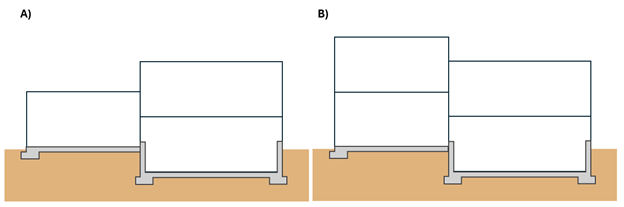
Figure A-1: One storey split (A) and two storey split (B) configurations
In buildings featuring partial storeys, each storey counts as a full storey, irrespective of the amount of floor area associated in that storey. Figure A-2 illustrates three potential arrangements of full and partial second storeys on a two-storey dwelling.
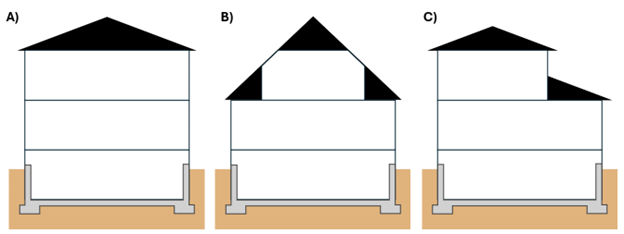
Figure A-2: Different configurations of two storey dwellings with full second storeys (A) and partial second storeys (B and C)
A-6.4 (d): Foundation type
The foundation type input describes the predominant foundation type present in the dwelling. A single dwelling will often feature multiple foundation types – for instance a two-storey home with a full basement may have a one storey extension built on a slab, or over a crawlspace. In these circumstances, the foundation type input should describe the type of foundation associated with the largest horizontal area. Secondary foundations with less horizontal area can be omitted from the model inputs.
A-6.4 (e): Age of primary heating system
The Guidelines recommend using the age of the primary heating system as an approximate indicator of energy efficiency. While virtual energy assessment algorithms will require furnace, boiler or heat pump efficiency to convert space heating loads into energy consumption, most homeowners will not be familiar with these terms. The age of primary heating system input provides an approximate indicator of system efficiency — reflecting the fact that newer heating equipment is generally more efficient.
Table A-1 presents median and minimum efficiency characteristics of different heating systems, according to the year in which it was installed. Median efficiency characteristics were sourced from EnerGuide assessment data, while minimum efficiency levels reflect the minimum equipment performance standards forming Canada’s Energy Efficiency Regulations.
| Heating source | Year of installation | Median efficiency | Minimum efficiency |
|---|---|---|---|
| Gas or propane | 2021-present | 96% AFUE | 95% AFUE |
| 2015-2021 | 96% AFUE | 90% AFUE | |
| 2011-2015 | 95% AFUE | 90% AFUE | |
| Pre-2011 | 90% AFUE | 78% AFUE | |
| Oil | 2020–present | 84% AFUE | 83% AFUE |
| 2017-2019 | 84% AFUE | 83% AFUE | |
| Pre 2017 | 84% AFUE | 78% AFUE | |
| Air source heat pump | 2024-present | 10.38 HSPF (region V) | 6.0 HSPF 2 (region V) |
| Pre 2024 | 10.38 HSPF (region V) | 7.1 HSPF (region V) | |
| Electric Resistance | All dates | 100% Efficient | — |
A-6.4 (f): Solar photovoltaic system terminology
While many members of the building renovation and renewable energy industries will have experience with solar photovoltaic technology, this term will be unfamiliar to many homeowners. VHL services may choose to use alternate terminology such as “solar panels” on dashboards and labels for non-expert audiences. When simpler terms are used, NRCan recommends that VHL services also include explanatory notes to prevent confusion with other types of solar energy systems, such as solar water heaters.
A-6.5: Operating conditions
Occupancy and occupant activity affect household energy use. Asset-based modelling methods use standard operating conditions to ensure that energy labels are comparable, and that results are not affected by occupant lifestyles.
The EnerGuide Rating System provides operating conditions for two types of homes — multi-unit residential buildings (including houses with secondary suites) and other single family homes (including detached, attached and row homes). This distinction acknowledges that MURBS are typically smaller than other housing forms, that MURBs generally have fewer occupants and that MURBs generally have lower occupant-driven electricity use.
However, virtual energy assessments may not have sufficient information to identify MURBs from property databases. EnerGuide technical procedures require Energy Advisors to classify dwellings as MURBs if they are stacked, if they have common spaces (such as shared corridors), and if occupants can pass from one unit to the other without travelling outside (secondary suites). These characteristics are most readily determined by on-site assessments.
In the absence of on-site inspection, these Guidelines use an alternate method for classifying large and small dwellings. Any dwelling smaller than 115m² could be eligible for reduced baseloads similar to those that EnerGuide prescribes for MURBs; all other dwellings should be modelled using the EnerGuide standard operating conditions.
A-6.6: Energy consumption over shorter intervals
Energy consumption estimates may be tabulated at shorter intervals for the purposes of applying monthly or hourly utility rate schedules, or for other reporting and educational purposes. When shorter intervals are used for this purpose, VHL services should still compute the energy consumption over the entire modelling interval for the purposes of annual reporting.
A-7.2 (a): GHG emission factors for electricity
Electricity emission factors vary according to the energy sources that utilities use for generation and the amount of electricity they import from other jurisdictions. In some regions, emission factors exhibit year over year variability. Changes in electrical emission factors reflect changing energy sources that regional utilities use to generate power. Where possible, GHG emission intensity factors should be obtained from provincial or territorial officials, or from regulated electric utilities. These representatives are most familiar with current and future planning for the electric system. They are best positioned to provide electrical emission factors. If emission factors cannot be obtained from government or utility representatives, the Guidelines recommend using numbers from Canada’s National Inventory Report instead. VHL services should use either the most recent regional emission factor, or an average of the emission factors from the current year and the preceding four years.
A-7.2 (b): Calculating emission factors for combustion fuels
Environment and Climate Change Canada provides greenhouse gas emission factors for converting energy consumption estimates into equivalent carbon emissions. These factors are calculated annually and reported two years in arrears as part of Canada’s National Inventory Report.
The Guidelines recommend the same emission calculation approach and emission factors used in the National Inventory Report. The emission intensities of petroleum heating fuels (natural gas, heating oil, propane) should reflect the GHG emissions associated with their on-site combustion from:
- Carbon dioxide (CO2)
- Methane (CH4)
- Nitrous oxide (N2O)
Quantities of these gasses are converted into equivalent carbon dioxide emissions using scaling factors that reflect their global warming potential (1 for carbon dioxide, 28 for methane, and 265 for nitrous oxide).
Consistent with the National Inventory Report’s methodology, the release of biogenic carbon from wood-based heating fuel should not be counted for in residential emission calculations, as this amount is largely reabsorbed in the growth of Canada’s sustainably managed forests. For wood-based heating fuels, only emissions from methane and nitrous oxide are included in the GHG calculation.
In accordance with the conventions established in the National Inventory Report, the natural gas, heating oil, propane and wood GHG emission factors can be calculated by multiplying constituent CO2, CH4 and N2O emission factors by their respective global warming potential:
Where the CO2, CH4 and N2O emission factors are the most recent values published in the National Inventory Report in accordance with the references provided in Table A-2.
| Emission factor | National Inventory Report references | Emission Scope |
|---|---|---|
| Natural gas GHG emission factor |
Table A6.1-1: CO2 Emission Factors for Marketable Natural Gas Table A6.1-3: CH4 and N2O Emission Factors for Natural Gas |
CO2, CH4 and N2O |
| Heating oil GHG emission factor | Table A6.1–6 Emission Factors for Refined Petroleum Products (Light fuel oil, residential) |
CO2, CH4 and N2O |
| Propane GHG emission factor | Table A6-1.5 CH4 and N2O Emission Factors for Natural Gas | CO2, CH4 and N2O |
| Wood GHG emission factor | Table A6.6–1 Emission Factors for Biomass (Residential combustion, Conventional Stoves) | CH4 and N2O |
Effective emission factors for combustion-based fuels are presented in Table A-3. These factors were derived from data in Canada’s 2024 National Inventory Report. This data is the most recent at time of publication.
| Heating fuel | Effective emission factor | |
|---|---|---|
| Natural gas | 1944 g CO2/m³ | |
| Heating oil | 2755 g CO2/L | |
| Propane | 1544 g CO2/L | |
| Pellet stoves | 67 g CO2/kg | |
| Other wood burning appliances | 237 g CO2/kg | |
A-7.3 (a): Effective prices for electricity and natural gas
Canadian utilities use varying rate schedules to set prices for energy. Some utilities provide a single overall price for purchased energy (for instance, $/kWh of electricity or $/m³ of natural gas). Other utilities may provide a breakdown of energy supply, transmission and distribution charges, as well as other riders affecting the customer’s final utility bill. Utilities also offer different price structures. Fixed, tiered, time-of-use and variable rates are common. In some regions, utilities allow customers to choose between different types of rates.
VHL services that elect to include utility bill information should ensure that energy rates represent recent rate schedules provided by local utilities. Assessments should incorporate the most accurate energy prices available, but some rate structures will need to be simplified for inclusion in a virtual home label model. These simplifications may include using an average provincial rate to represent:
- Varying energy prices across regions served with multiple utilities.
- Varying rate schedules offered to residential customers by the same utility.
- Variable, tiered or time-of-use rate schedules where prices vary by season or time of day, or by the amount of energy consumed.
In regions where utilities provide a single aggregated rate, VHL services could use that rate as the effective price of energy. When utilities publish disaggregated rate schedules with separate prices for energy supply, transportation, delivery and other variable charges, VHL services should compute an effective price aggregating all rates and riders that affect customer bills.
A-7.3 (b): Effective prices for heating oil
Heating oil markets are unregulated in Canada. Prices vary according to rates of production and consumption, and may be affected by changes in supply and demand, both domestically and internationally. Given this variability in price, estimating the cost of heating oil consumption implies a greater degree of uncertainty than electricity or natural gas cost calculations.
The Guidelines reference the Statistics Canada survey of monthly average retail prices for gasoline and fuel oil, by geography (Table 18-10-0001-01Footnote 1). That table provides estimates of monthly average heating oil prices by Canadian census metropolitan area. VHL services should reference Table 18-10-0001-01, or averages derived from the Table when estimating heating oil costs.
Values in Table 18-10-0001-01 should be averaged over a 12-month period. VHL services could reference values by metropolitan area, or averaged by province or territory. When estimating heating oil costs in jurisdictions for which the table provides no price data, VHL services may use values from adjacent regions.
A-8.2: Label presentation
Figure A-3 provides an example illustration of the energy profile section of virtual home labels that meet the recommendations of the Guidelines.
Figure A-3: Sample layout for virtual home label
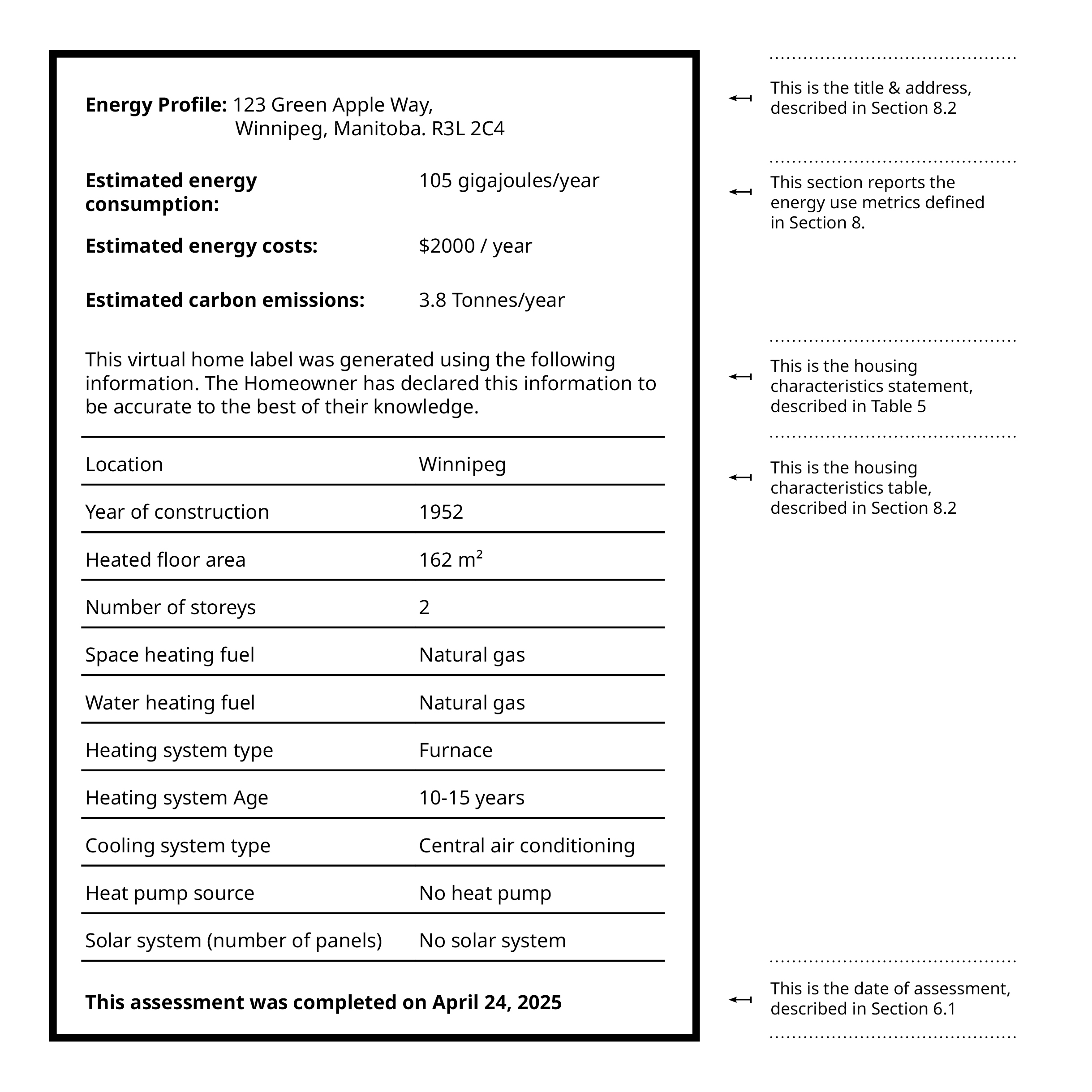
A-9.1: Reference comparisons
Reference comparisons help understand abstract energy estimates by making comparisons to similar homes. Table A-4 provides median values for reference energy use from a sample of on-site EnerGuide assessments conducted between 2020 and 2025. Data is reported by vintage when at least 50 EnerGuide assessments exist. VHL services could use this data, or a similar data table, to describe reference house energy use by province, climate zone and vintage.
| Province | Heating Degree Days | Number of EnerGuide records | All Vintages (GJ) | Pre- 1950 (GJ) | 1950-1969 (GJ) | 1970-1989 (GJ) | 1990-2009 (GJ) | Post- 2010 (GJ) |
|---|---|---|---|---|---|---|---|---|
| BC | 2000-3000 | 35,092 | 102.1 | 132.4 | 109.6 | 110.9 | 101.4 | 67.2 |
| 3000-4000 | 15,639 | 101.6 | 131.5 | 115.1 | 108.2 | 93.9 | 75.0 | |
| 4000-5000 | 1,615 | 115.7 | * | * | 121.6 | * | * | |
| 5000-6000 | 1,687 | 133.0 | * | * | 146.5 | * | * | |
| 6000-7000 | 88 | 164.2 | * | * | * | * | * | |
| 7000-8000 | 60 | 103.4 | * | * | * | * | * | |
| AB | 4000-5000 | 36,451 | 136.7 | 177.5 | 142.9 | 149.8 | 142.8 | 117.8 |
| 5000-6000 | 28,924 | 152.0 | 192.5 | 153.2 | 167.2 | 158.0 | 125.1 | |
| 6000-7000 | 1,437 | 146.3 | * | * | * | * | * | |
| SK | 4000-5000 | 9 | * | * | * | * | * | * |
| 5000-6000 | 6,177 | 144.0 | 186.9 | 153.3 | 140.8 | 146.9 | * | |
| 6000-7000 | 1,123 | 150.4 | * | * | * | * | * | |
| 7000-8000 | 10 | * | * | * | * | * | * | |
| MB | 5000-6000 | 8,718 | 142.2 | 174.1 | 140.5 | 136.8 | 140.3 | * |
| 6000-7000 | 431 | 127.2 | * | * | * | * | * | |
| 7000-8000 | 4 | * | * | * | * | * | * | |
| ON | 3000-4000 | 193,238 | 131.6 | 164.2 | 137.0 | 136.7 | 135.5 | 123.9 |
| 4000-5000 | 63,229 | 134.1 | 192.2 | 141.1 | 134.5 | 130.3 | 112.1 | |
| 5000-6000 | 3,903 | 143.7 | 187.4 | 148.1 | 141.1 | 125.6 | * | |
| 6000-7000 | 945 | 174.8 | * | * | 237.7 | 218.7 | * | |
| 7000-8000 | 7 | * | * | * | * | * | * | |
| QC | 4000-5000 | 192,050 | 111.6 | 171.0 | 126.7 | 105.5 | 97.4 | 86.9 |
| 5000-6000 | 28,678 | 130.2 | 173.1 | 141.6 | 122.5 | 109.1 | 97.6 | |
| 6000-7000 | 946 | 133.9 | 182.4 | 144.0 | 127.8 | 126.3 | * | |
| 7000-8000 | 75 | 170.8 | * | * | * | * | * | |
| 8000-9000 | 5 | * | * | * | * | * | * | |
| 9000-10000 | 3 | * | * | * | * | * | * | |
| NB | 3000-4000 | 62 | 111.3 | * | * | * | * | * |
| 4000-5000 | 42,602 | 99.6 | 161.5 | 115.5 | 99.9 | 85.7 | 73.5 | |
| 5000-6000 | 1,843 | 112.5 | * | 126.3 | 119.9 | 97.4 | * | |
| PE | 4000-5000 | 15,087 | 100.3 | 184.8 | 135.9 | 118.5 | 107.7 | 77.5 |
| NS | 3000-4000 | 16,253 | 107.2 | 152.2 | 126.3 | 99.2 | 93.5 | 65.9 |
| 4000-5000 | 47,316 | 113.3 | 182.0 | 134.1 | 107.0 | 96.5 | 70.1 | |
| NF | 4000-5000 | 8,496 | 114.5 | * | 141.0 | 126.0 | 105.9 | 100.4 |
| 5000-6000 | 372 | 133.0 | * | * | * | * | * | |
| 6000-7000 | 40 | * | * | * | * | * | * | |
| 7000-8000 | 3 | * | * | * | * | * | * | |
| YT | 6000-7000 | 1,494 | 121.5 | * | * | 147.0 | 121.5 | * |
| 7000-8000 | 161 | 117.9 | * | * | * | * | * | |
| 8000-9000 | 56 | 120.6 | * | * | * | * | * | |
| 9000-10000 | 24 | * | * | * | * | * | * | |
| NT | 7000-8000 | 101 | 151.1 | * | * | * | * | * |
| 8000-9000 | 314 | 163.5 | * | * | * | * | * | |
| 10000-11000 | 55 | 159.9 | * | * | * | * | * | |
| NU | 9000-10000 | 24 | * | * | * | * | * | * |
| 11000-12000 | 10 | * | * | * | * | * | * |
VHL Services may also develop their own reference comparisons with greater disaggregation. For instance, anonymized EnerGuide records published on Canada’s Open Government Portal can be used to estimate median energy use at city or forward sortation area resolution.
A-9.2: Terms reserved for on-site assessments
Certain terms relating to a home’s characteristics cannot be verified through a virtual assessment – for example, insulation levels, or air tightness. To ensure that homeowners receive reliable and consistent information, the Guidelines discourage terms in Section 9.2 from being attributed to the subject dwelling.
However, the Guidelines do not discourage a VHL service from using these terms to describe homes in general, or energy efficiency upgrades in general.