
On this page
- At a glance
- From the Minister
- Plans to deliver on core responsibilities and internal services
- Department-wide considerations
- Planned spending and human resources
- Supplementary information tables
- Federal tax expenditures
- Corporate information
- Definitions
Copyright information
© His Majesty the King in Right of Canada, as represented by the Minister of Energy and Natural Resources, 2026
Catalogue Number: [M2-13E-PDF]
ISSN [2561-4029]
Aussi disponible en français sous le titre : Plan ministériels 2026-2027 Ressources naturelles Canada
Portions of this report were drafted with the assistance of generative AI tools, under human supervision, to support clarity and consistency.
At a glance
This departmental plan details Natural Resources Canada’s priorities, plans, and associated costs for the upcoming three fiscal years.
These plans align with the priorities outlined in the Mandate Letter, as well as Natural Resources Canada’s Vision, mission, raison d’être and operating context.
Key priorities
Natural Resources Canada identified the following key priorities for 2026-27:
- Accelerate Major Projects: Advance nation-building energy and natural resource projects to spur economic growth.
- Advance Critical Minerals and Energy Interests: Maximize critical mineral production and processing, as well as conventional and clean energy development for Canada’s economic prosperity and national security.
- Diversify Canada’s Trade Markets: Build international relationships to grow energy and natural resources exports in key markets, attract foreign direct investment and transform the forest sector while supplying new markets for Canadian lumber.
Comprehensive Expenditure Review
The government is committed to restraining the growth of day-to-day operational spending to make investments that will grow the economy and benefit Canadians.
As part of meeting this commitment, Natural Resources Canada (NRCan) is planning the following spending reductions:
- 2026-27: $266,428,023
- 2027-28: $431,717,521
- 2028-29: $557,871,364
It is anticipated that these spending reductions will involve a decrease of approximately 807 full-time equivalents by 2028-29.
Natural Resources Canada will achieve these reductions by doing the following:
- Recalibrating Government Programs by ending programs as planned given goals have been met, ending programs early to redirect resources towards new government priorities, or renewing programs at reduced levels by refocusing them in areas with the greatest benefit.
- Streamlining Program Delivery by scaling down or phasing out support as programs wind-down or are reduced.
- Modernizing Government Operations, focusing on refined science and policy priorities, optimizing organizational structure and improving operational effectiveness by automating, transforming business processes, and consolidating services.
The figures in this departmental plan reflect these reductions.
Highlights for Natural Resources Canada in 2026-27
NRCan’s 2026-27 Departmental Plan positions Canada to thrive in a rapidly shifting global landscape. The Government of Canada is focused on advancing its seven Missions, and NRCan is taking bold actions to make this possible. As a science-based department, NRCan’s labs and research funding underpin innovation and reliable policy advice in the natural resources and energy sectors. NRCan will strengthen Canada’s resource sectors and enhance economic resilience amid geopolitical uncertainty while remaining committed to working with Indigenous rights holders to accelerate nation building projects in a meaningful way that creates prosperity for all communities. To achieve these objectives, the Department will implement key ministerial initiatives focused on critical minerals, electricity, nuclear, forestry, trade diversification, and major projects, including the implementation of the Alberta-Canada Memorandum of Understanding. For example:
- Expanding critical mineral supply chains to support clean technology and energy security through the Critical Minerals Sovereign Fund and related work.
- Advancing Canada’s economic competitiveness by driving sectoral transformation – particularly in forestry to help the industry innovate and compete.
- Diversifying trade to more international markets to grow trade with new partners and strengthen competitiveness through a proactive approach to Canada-United States-Mexico Agreement (CUSMA) negotiations, as well as a Trade Diversification Strategy, in collaboration with Global Affairs Canada.
The Department will also support cross-cutting government priorities such as the Defence Industrial Strategy, the Climate Competitiveness Strategy, the Electricity Strategy, and the Automotive Sector Strategy. In addition, NRCan is committed to delivering efficient and effective public services in alignment with the Government's mission to reduce operational spending.
In 2026-27, total planned spending (including internal services) for Natural Resources Canada is $4,878,808,102 and total planned full-time equivalent staff (including internal services) is 5,401.
Summary of planned results
The following provides a summary of the results the department plans to achieve in 2026-27 under its main areas of activity, called “core responsibilities.”
Core responsibility 1: Natural Resource Science and Risk Mitigation
Departmental Results:
- Cutting-edge research informs the management of natural resources
- Communities and officials have the tools to safeguard Canadians from natural hazards and explosives
- Communities and industries are adapting to climate change
In 2026–27, NRCan will advance Canada’s economic, environmental and security interests through strategic investments in science, hazard prevention and climate resilience.
The Department will strengthen critical mineral supply chains by releasing updated mineral potential maps and leveraging Artificial Intelligence (AI) to accelerate exploration. Arctic science programs will help protect Canada’s North by providing essential research and fostering knowledge exchange to further unlock resources as well as improve surveillance and boundary certainty. NRCan will also continue to make new scientific and regulatory data openly accessible to support transparency and advance major projects of national significance.
To help mitigate the growing severity of natural disasters, NRCan will implement a suite of targeted initiatives that improve community safety and national preparedness. More than $257 million in federal investments will bolster provincial and territorial (PT) aerial firefighting capacity, while ongoing research and use of geospatial data will reduce risks associated with earthquakes, landslides, tsunamis and other hazards.
NRCan will also lead key climate adaptation efforts for coastal communities and businesses. Collaborative projects across Canada’s marine coasts and the Great Lakes–St. Lawrence region will advance wildfire prevention and mitigation, produce over 1,000 new flood hazard maps, and support adaptation measures for vulnerable regions and populations.
- Planned spending: $883,245,174
- Planned human resources: 1,444
More information about Natural Resource Science and Risk Mitigation can be found in the full plan.
Core responsibility 2: Innovative and Sustainable Natural Resources Development
Departmental Results:
- Natural Resource Sectors are Innovative
- Clean technologies and energy efficiencies enhance economic performance
- Canada’s natural resources are sustainable
In 2026-27, NRCan will continue to reduce barriers to innovation and strengthen Canada’s position as an energy superpower by advancing a new electricity strategy and inviting engagement on federal actions, implementing the Clean Economy Investment Tax Credits, which enable major private sector investment in clean energy projects, and drive Research, Development and Demonstration (RD&D) in key areas including critical minerals for energy, defense and carbon management. NRCan’s worldclass labs and strong partnerships with industry and international organizations will help resource industries decarbonize. At the same time, support for Canadian made AI solutions, clean fuel innovation and forest sector transformation will accelerate productivity and strengthen competitiveness. Measures that drive demand for Canadian wood products will support communities where forestry is a key economic driver.
To further drive economic growth, NRCan will continue to advance clean technologies and energy efficiency, including nuclear technology, through the launch of a Nuclear Energy Strategy. To prioritize the development of competitive clean and conventional energy projects, NRCan will implement a $372 million Biofuels Production Incentive, advance LNG projects with PTs and federal partners, and work with provinces as well as pipeline companies and producers to improve market access. NRCan will also expand renewable energy and electricity infrastructure and advance interprovincial electricity collaboration.
NRCan is making natural resources more sustainable while also making energy more accessible and affordable by continuing to deliver key energy-efficiency programs which support energy retrofits, including heat pumps and solar panels. These retrofits improve the performance of homes and buildings while reducing emissions and energy bills. The Department is also developing virtual home energy labelling standards that will enhance consumers’ ability to make informed decisions and accelerate the adoption of energy saving technologies. Together, these measures will reduce costs for Canadians and support a more competitive and climate resilient economy.
- Planned spending: $1,629,289,647
- Planned human resources: 2,028
More information about Innovative and Sustainable Natural Resources Development can be found in the full plan.
Core responsibility 3: Globally Competitive Natural Resource Sectors
Departmental Results:
- Competitiveness of Canada’s natural resources sectors is enhanced through strengthened access to new and priority markets
- Canadians are engaged in the future of the new and inclusive resource economy
NRCan will advance Canada’s trade diversification goals in 2026–27 by strengthening international partnerships, identifying priority global markets, and improving trade and investment analysis to expand energy and natural resource exports. The Department will prepare for the proposed 2026 CUSMA Review, enhance energy security through improved market monitoring, information sharing, and infrastructure development, and diversify natural gas, oil, and value-added exports to Asia and Europe.
To reinforce Canada’s global competitiveness, NRCan will leverage key international fora such as the G7 and APEC and bilateral partnerships, including in Gulf States, to attract investment. To further position Canada as a supplier of choice for minerals essential to economic and defence priorities, NRCan will implement a critical minerals defence stockpiling mechanism, develop the Critical Minerals Sovereign Fund, and leverage international partnerships, including the Critical Minerals Production Alliance. At the same time, NRCan will support forest sector competitiveness through diversified international and domestic markets for wood products and accelerate technologies that enable greater use of mass timber, efforts that will contribute to national housing affordability goals.
Domestically, NRCan is committed to strengthening an inclusive resource economy, accelerating major project approvals and building big things, including the LNG facilities, mining and nuclear projects, and clean energy infrastructure that the country needs. The Department will continue collaboration with PTs, the Major Projects Office, and Indigenous partners, leverage scientific and economic expertise to advance the “One Project, One Review” approach, and meet the two-year impact assessment timeline. Regulatory modernization—including potential legislative and regulatory reform that could streamline approvals and reduce duplication —will improve efficiency in a way that ensures that Indigenous rights are respected and incorporates Indigenous knowledge systems.
NRCan will also support workforce development by contributing to the renewed Youth Employment and Skills Strategy, which will fund green jobs for youth, and by shaping the 2026–2030 Sustainable Jobs Action Plan to support workers through industrial transitions. In parallel, NRCan will advance Indigenous reconciliation by enhancing participation in major projects, supporting Indigenous led capacity building and fostering culturally informed workplaces.
- Planned spending: $2,154,037,990
- Planned human resources: 599
More information about Globally Competitive Natural Resource Sectors can be found in the full plan.
For complete information on Natural Resources Canada’s total planned spending and human resources, read the Planned spending and human resources section of the full plan.
From the Minister
As we enter 2026–27, Canada stands at a pivotal moment.
Global unrest, unjust trade actions, shifting alliances, and rapid technological change have reshaped the world. The old assumptions no longer apply. Canada must act with urgency, ambition, and clarity of purpose.
At Natural Resources Canada, our focus is clear: build, protect, and empower this country for decades to come. We are strengthening economic security, asserting sovereignty, and ensuring Canadians fully benefit from the energy and resources we produce.
Our natural resources form the foundation of Canada’s economic strength and national resilience.
Forestry is part of Canada’s DNA. It is integral to jobs, communities, and housing. It anchors rural and Indigenous communities, supports hundreds of thousands of jobs, and plays a central role in addressing housing affordability. In response to tariffs and shifting global markets, we will stimulate demand for Canadian lumber and engineered wood products, because buying Canadian supports Canadian workers. Working with Build Canada Homes, we will accelerate modern construction methods, including mass timber and modular systems. Through the Canadian Forest Sector Transformation Task Force and a single-window federal service, we will help the sector diversify, innovate, and compete globally.
Critical minerals are equally central to Canada’s economic and national security. They power the technologies of today and tomorrow, from clean energy and electric vehicles to defence systems and carbon management. In 2026–27, NRCan will accelerate secure, vertically integrated supply chains through the Critical Minerals Sovereign Fund and the First and Last Mile Fund. By advancing the Critical Minerals Production Alliance and working closely with partners, we will attract world-class investment, create high-quality jobs, and reinforce Canada’s strategic role in powering the technologies that will drive global prosperity.
As we strengthen the foundation of our supply chains, Canada must also expand where and how our products reach the world. Trade diversification is key to our sovereignty and economic strength. Abroad, Canada will expand engagement with G7, G20, Asia-Pacific, and European partners, while growing exports beyond the United States. At home, we are strengthening the domestic economy through Buy Canadian policies, reducing interprovincial trade barriers, and improving labour mobility. We must be our own best customer at home and trusted partners abroad.
And as we expand the global reach of Canadian products —because Canada has what the world wants — we must also strengthen the energy and resource systems that get them there.
Nation-building projects and energy leadership are our path to a stronger, more resilient Canada. Through the Major Projects Office we will enable Canada to deliver reliable, low-emissions energy to domestic and international markets. This work is anchored in a Climate Competitiveness Strategy that aligns economic growth with emissions reduction and is reinforced through close collaboration with Indigenous partners, provinces and territories, including through the Alberta energy memorandum of understanding.
Electricity fuels modern prosperity. Our electricity systems are the backbone of the Canadian economy. By expanding and modernizing them, we will attract industry, create good jobs for Canadians, secure long-term prosperity for communities, and support the transition to a cleaner energy future. We will advance an electricity strategy to unlock private investment and drive research and innovation in strategic technologies.
Nuclear energy will be central to this long-term competitiveness. Canada’s leadership in CANDU technology, small modular reactors, and emerging microreactor applications positions us as a global energy partner of choice. In 2026-27, we will launch a comprehensive nuclear energy strategy, deepen international collaboration, including in fusion research, and ensure Canada remains at the forefront of safe, non-emitting baseload power.
Natural Resources Canada is grounded in the principle that economic growth, energy security, and responsible environmental action go hand in hand. By building clean, reliable, and resilient energy systems, we are securing Canada’s prosperity for today and for generations to come, while meeting climate goals in a way that supports jobs, communities, and innovation.
This is a nation-building moment.
Now is the time to act. Now is the time to build.
The Honourable Tim Hodgson P.C., M.P.
Minister of Energy and Natural Resources
Plans to deliver on core responsibilities and internal services
Core responsibilities and internal services
- Core responsibility 1: Natural Resource Science and Risk Mitigation
- Core responsibility 2: Innovative and Sustainable Natural Resources Development
- Core responsibility 3: Globally Competitive Natural Resource Sectors
- Internal services
Core responsibility 1: Natural Resource Science and Risk Mitigation
In this section
Description
Lead foundational science and share expertise for managing Canada’s natural resources, reducing the impacts of climate change and mitigating risks from natural disasters and explosives.
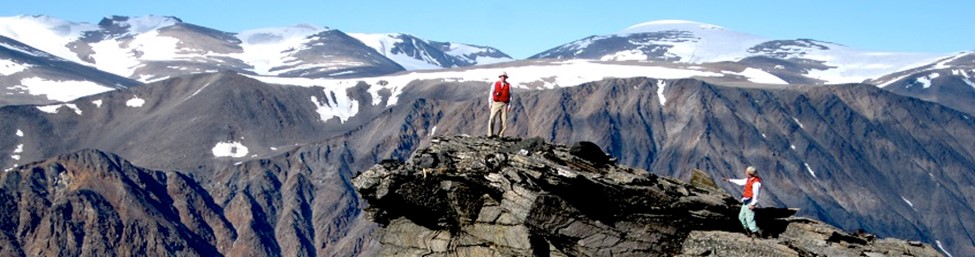
Geologists from the Geo-mapping for Energy and Minerals (GEM) program under the Multiple Metals Cumberland Peninsula Project examine a 1.86-billion years old mountain-building event on eastern Baffin Island, Nunavut.
Quality of life impacts
By supporting Canada’s National Adaptation Strategy and providing data to reduce hazards and risks, this Core Responsibility contributes to the Climate change adaptation and Natural disaster and emergencies indicators under the Environment domain of the Quality of Life Framework for Canada.
Indicators, results and targets
This section presents details on the department’s indicators, the actual results from the three most recently reported fiscal years, the targets and target dates for Natural Resource Science and Risk Mitigation. Details are presented by departmental result.
Table 1: Cutting-edge research informs the management of natural resources
| Departmental Result Indicators | Actual Results | 2026–27 Target | Date to achieve target |
|---|---|---|---|
| Percentage of environmental impact assessments demonstrating use of scientific and technical advice provided by NRCan |
|
100% | March 2027 |
| Number of times stakeholders acknowledge using NRCan’s scientific and technical products in making their decisions |
|
54,000 | March 2027 |
| Number of NRCan agreements that recognize data and/or information derived from an Indigenous Knowledge source and is used to inform NRCan science and/or research |
|
25 | March 2027 |
| Number of new and up to date foundational geospatial data and products |
|
10 | March 2027 |
| Number of projects and initiatives supported or led by NRCan advancing scientific knowledge of the Canadian landmass and/or contributing to the exercise of Canadian sovereignty in the Arctic regionFootnote 2 |
|
Not available | Not available |
Table 2: Communities and officials have the tools to safeguard Canadians from natural hazards and explosives
| Departmental Result Indicators | Actual Results | 2026–27 Target | Date to achieve target |
|---|---|---|---|
| Percentage of hazardous natural events within Canada for which a notification was issued in a timely manner |
|
100% | March 2027 |
| Percentage of emergency geospatial information provided, in a timely manner, to Canadians in response to floods and other natural hazards |
|
100% | March 2027 |
| Percentage uptime of the Canadian Wildland Fire Information System during the wildfire season |
|
100% | March 2027 |
| Average explosives site inspection rating |
|
3 | March 2027 |
Table 3: Communities and industries are adapting to climate change
| Departmental Result Indicators | Actual Results | 2026–27 Target | Date to achieve target |
|---|---|---|---|
| Percentage of Canadian communities and industries that have taken steps to adapt to climate change |
|
|
March 2027 |
Additional information on the detailed results and performance information for NRCan’s program inventory is available on GC InfoBase.
Plans to achieve results
The following section describes the planned results for Natural Resource Science and Risk Mitigation in 2026-27.
Cutting-edge research informs the management of natural resources
Results we plan to achieve
Enhance mineral exploration to strengthen Canadian supply chains
The Critical Minerals Geoscience and Data (CMGD) Initiative unlocks the responsible development of Canada’s critical minerals resources by providing essential knowledge and data to support informed decision-making. In 2026-27, the CMGD Initiative will:
- Release new and updated national-scale mineral potential maps and datasets for six priority critical minerals—copper, cobalt, graphite, lithium, nickel, and rare earth elements.
- Publish an updated national geological compilation map and a national rock nomenclature (WEBLEX) to support artificial intelligence (AI) and advanced analytical applications across provincial and territorial (PT) boundaries.
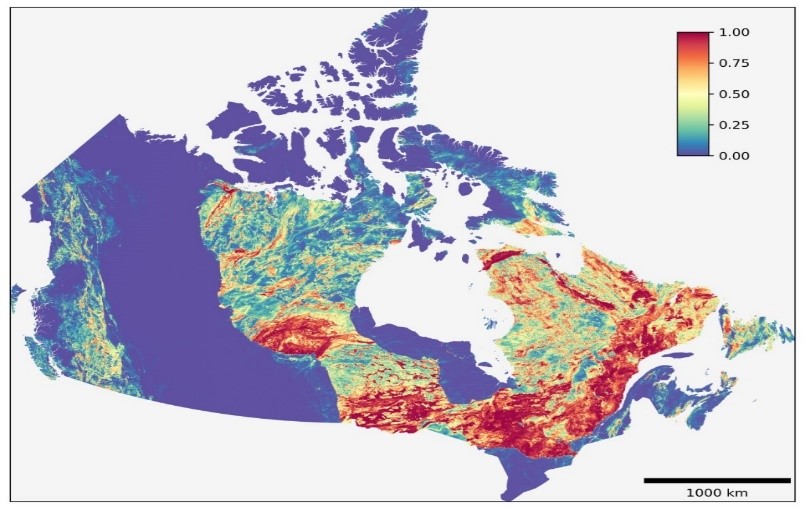
Updated national mineral potential map for magmatic nickel-copper-cobalt and platinum-group element deposits (Zhang and Parsa, in preparation). Areas of highest potential are shown in dark red and areas with the lowest potential in dark blue.
Arctic science and research to protect Canada’s north, foster arctic collaboration and strengthen Canada’s northern frontiers and sovereignty
As part of the government’s priority to protect Canadian sovereignty, the Department will advance strategic geoscience initiatives in Canada’s North through the GEM-GeoNorth Program to strengthen security, resilience, and sustainable development in the Arctic. These initiatives will include:
- A multi-year science collaboration with Defence Research and Development Canada to support infrastructure development at Gascoyne Inlet Camp and in the western Arctic. Data will be collected on surficial and seabed geology, permafrost, coastal change, and sea ice. Satellite imagery will also be analyzed to help identify potential landscape hazards.
- Identifying mineral and energy potential in Canada’s North through geological mapping and airborne geophysical surveys.
- Facilitating international knowledge exchange in mapping, AI, and earth observation monitoring to enhance community resilience, sustainable economic development and surveillance efforts across the Arctic through the North American and Nordic Mapping Agencies Network.

In support of Arctic science and sovereignty, NRCan and DND share resources and expertise to improve efficiency, reduce costs, and strengthen Canada’s research and readiness in extreme northern environments.
Advancing geospatial data related to Canada’s Arctic is also essential for protecting national sovereignty and promoting sustainable resource development in an increasingly contested region. To this end, the Department will continue to provide boundary certainty as well as high-precision GPS services, supporting strategic resource development and Canada's ability to assert sovereignty in the North. Through the Polar Continental Shelf Program, NRCan will also continue to enable more than 1,000 scientists and researchers to expand knowledge of Canada’s landmass.
Deliver open access to scientific data, publications and geospatial information to support informed decision-making
NRCan will continue to make authoritative and location-based science and regulatory data easily accessible through The Open Science and Data Platform (OSDP). The OSDP connects users to thousands of curated datasets, maps, environmental monitoring data, peer-reviewed science articles, impact assessments, and regulatory records.
For proponents and regulators, the OSDP supports early planning and helps align project proposals with regulatory expectations. For the public, including Indigenous communities, it improves transparency, builds trust, and enables more meaningful participation in the regulatory process.
In 2026-27, NRCan will expand the OSDP with new content needed for advancing major projects of national interest, by offering data to facilitate the review of project impacts on themes including the environment, Indigenous communities, and species at risk.
Open access to authoritative geospatial databases, including the Canada Lands Survey Records, which detail legal boundaries in areas such as First Nation reserve lands and National Parks also support land governance, land use planning, land management, and informed decision-making.
Communities and officials have the tools to safeguard Canadians from natural hazards and explosives
Results we plan to achieve
Protect Canadians from natural hazards and explosives
Through a suite of targeted initiatives, NRCan will strengthen Canada’s wildfire resilience by reducing risk, enhancing prevention and response capabilities with provinces and territories, and supporting Indigenous-led stewardship:
- Under the Wildfire Resilient Futures Initiative, fund PT FireSmart governance structures and local FireSmart projects, and projects fostering collaborations for innovation in risk assessment, mitigation, and adaptive forestry.
- Implement the Canadian Wildland Fire Prevention and Mitigation Strategy, manage the Canadian Wildland Fire Information Framework for FPT data and mapping, and deliver wildfire intelligence and predictive services to PTs and other agencies.
- Promote use of the Canadian Forest Fire Danger Rating System, co-fund PT equipment purchases under the Fighting and Managing Wildfires in a Changing Climate Program, and continue supporting the Canadian Interagency Forest Fire Centre as the national and international resource coordinator.
- Enhance aerial firefighting capacity by leasing four aircraft to strengthen provincial and territorial firefighting capacity ($257.6M over four years).
- Advance Indigenous Fire Stewardship under the Indigenous Training Fund; and conduct Indigenous-focused research and engage with stakeholders and rightsholders via the Northern Forestry Centre REDFire lab.
NRCan’s International Leadership in Wildland Fire
Endorsed in 2025 during Canada’s G7 Presidency, the Kananaskis Wildfire Charter identifies priority actions that countries can take individually or collaboratively, before, during, and after wildfires. NRCan is implementing a number of measures under the Charter to strengthen the global approach to wildfire resilience. This includes being a founding member of, and leader in, the United Nations Global Fire Management Hub, the global expansion of the WildFireSat wildfire monitoring satellite constellation (target 2029 launch), and the development of a frontline gear initiative to enhance fire preparedness in Latin America.
In addition, NRCan will leverage geospatial data, operate sensor networks and support emergency preparedness to protect Canadians from destructive floods and other disasters by:
- Undertaking research on the hazards and risks associated with earthquakes, landslides, volcanoes, glacier change, permafrost thaw, coastal change, and tsunamis through the Natural Hazards and Climate Change Geoscience Program.
- Enhancing space weather sensor network coverage in the Canadian High Arctic to improve the reliability of products for operational use by key stakeholders, including the Department of National Defence (DND).
- Providing specialty map products and new satellite-based methods to both mitigate and respond to disasters.
- Working with expert organizations such as the International Organization for Standardization, World Wide Consortium and the Open Geospatial Consortium to develop international standards, and influence adoption of emerging geospatial technology, data and tools to improve public safety and resilience to natural hazards.
NRCan’s Explosives Program will also continue to play a key role in keeping Canadians safe by conducting over 1,400 inspections and outreach visits annually and by monitoring and enforcing compliance with the Explosives Act and Explosives Regulations, 2013.
Communities and industries are adapting to climate change
Results we plan to achieve
Conduct research, support communities and develop knowledge to increase resilience to climate change
Working collaboratively with partners, NRCan will help communities anticipate, plan for, and adapt to climate-related risks through the Climate Change Adaptation Program (CCAP), the Climate Resilient Coastal Communities Program (CRCC) and the Flood Hazard Identification and Mapping Program (FHIMP).
These programs advance whole-of-society objectives as outlined in the National Adaptation Strategy (NAS) Economy and Workers System by framing the economics of adaptation and climate risk and providing guidance on climate resilience for coastal communities and businesses. Early outcomes, as well as gaps, will be reflected in the NAS 2026 Interim Progress Report
The CRCC funds projects across Canada’s three marine coasts and the Great Lakes–St. Lawrence region, which bring together governments, the private sector, Indigenous communities, academia, and NGOs to co-develop short- and long-term adaptation actions and deliver innovative, cost-effective solutions.
The FHIMP produces high-quality flood mapping that is current and accessible to help governments, communities, and individuals understand flood hazards and implement mitigation strategies. The program will deliver over 330 flood mapping projects through $77 million of shared investment with provinces and territories and produce more than 1,000 flood hazard maps across Canada.
Gender-based Analysis Plus
NRCan will integrate GBA Plus into the design and delivery of scientific programs by requiring applicants to consider the barriers, experiences and needs of diverse individuals or groups (e.g., Wildfire Risk Program). Programs like Climate Change Adaptation will include dedicated Indigenous funding streams, while initiatives such as GEM-GeoNorth will promote Indigenous inclusion through collaborative research and support service procurement. In 2026-27, NRCan programs will track impacts and refine program delivery by:
- Tracking Indigenous participation and leadership metrics (e.g., Climate Change Adaptation)
- Applying a self-assessment tool to advance inclusive science
- Deploying anonymous surveys (e.g., Polar Continental Shelf Program)
- Eliciting stakeholder feedback through sign in sheets (e.g., Canada Lands Survey System)
Planned resources to achieve results
Table 4: Planned resources to achieve results for Natural Resource Science and Risk Mitigation
| Resource | Planned |
|---|---|
| Spending | 883,245,174 |
| Full-time equivalents | 1,444 |
Complete financial and human resources information for NRCan’s program inventory is available on GC InfoBase.
Program inventory
Natural Resource Science and Risk Mitigation is supported by the following programs:
- Canadian Geodetic Survey: Spatially Enabling Canada
- Geological Knowledge for Canada’s Onshore and Offshore Land
- Core Geospatial Data
- Canada-US International Boundary Treaty
- Canada Lands Survey System
- Geoscience for Sustainable Development of Natural Resources
- Pest Risk Management
- Forest Climate Change
- Climate Change Adaptation
- Explosives Safety and Security
- Geoscience to Keep Canada Safe
- Wildfire Risk Management
- Polar Continental Shelf Program
Additional information related to the program inventory for Natural Resource Science and Risk Mitigation is available on the Results page on GC InfoBase.
Summary of changes to reporting framework since last year
- Changes to results and indicators were made to refocus and emphasize the use and impact of NRCan’s scientific products.
- An indicator was added to better reflect the contributions of NRCan science to advancing knowledge of the Canadian landmass and Canadian sovereignty in the Arctic.
Core responsibility 2: Innovative and Sustainable Natural Resources Development
In this section
Description
Lead the transformation to a low-carbon economy by improving the environmental performance of Canada’s natural resource sectors through innovation and sustainable development and use.

Canada’s vast and varied energy resources are helping connect Canadians and build a resilient economy. Canada is innovating in how energy is produced, marketed, delivered, and used. Renewable electricity—led by wind and solar, is growing. Oil and gas remain foundational. Clean fuels and technologies like carbon capture, energy storage, nuclear and electrification are reshaping industry and transportation, and attracting investments and new markets.
Quality of life impacts
This Core Responsibility contributes to the Greenhouse gas emissions, Natural Capital, Waste Management and Employment and job quality indicators under the Environment domain of the Quality of Life Framework for Canada, by leading the transformation to a low-carbon economy, including through support for clean technology and innovation, better waste management practices, responsible mining and implementation of the Canadian Sustainable Jobs Act.
Indicators, results and targets
This section presents details on the department’s indicators, the actual results from the three most recently reported fiscal years, the targets and target dates for Innovative and Sustainable Natural Resources Development. Details are presented by departmental result.
Table 5: Natural resource sectors are innovative
| Departmental Result Indicators | Actual Results | 2026–27 Target | Date to achieve target |
|---|---|---|---|
| Percentage of NRCan-funded innovation projects that result in new intellectual property, codes, standards or regulationsFootnote 4 |
|
15% | March 2027 |
| Percentage of innovative forest products and decision tools informed by NRCan research that contribute to the environmental sustainability of Canada's forests |
|
100% | March 2027 |
| Percentage of NRCan-funded clean energy innovation projects advancing along the innovation scaleFootnote 5 |
|
60% | March 2027 |
| Percentage of innovative mining technologies developed by NRCan that move towards being ready for commercial useFootnote 6 |
|
60% | March 2027 |
Table 6: Clean technologies and energy efficiencies enhance economic performance
| Departmental Result Indicators | Actual Results | 2026–27 Target | Date to achieve target |
|---|---|---|---|
| Percentage of NRCan-funded clean technology demonstration projects achieving their economic goals |
|
55% | March 2027 |
| Ratio of partner investment to government spending in NRCan-funded energy innovation projects |
|
1.5:1 | March 2027 |
| Total annual energy savings resulting from adoption of energy efficiency codes, standards and practicesFootnote 7 |
|
275 petajoules | March 2031 |
Table 7: Canada’s natural resources are sustainable
| Departmental Result Indicators | Actual Results | 2026–27 Target | Date to achieve target |
|---|---|---|---|
| Megawatts (MW) of new renewable energy and energy storage capacity deployed by supported projects |
|
7,500 MW | March 2036 |
| Number of renewable energy and capacity building projects in Indigenous, rural, and remote communities and off-grid industrial operations |
|
195 | March 2027 |
| Number of electric vehicle chargers and hydrogen refuelling stations selected for funding or in operationFootnote 8 |
|
|
March 2029 |
| Percentage increase in clean fuels production capacity in Canada |
|
10% | December 2030 |
| Reduction in greenhouse gas emissions resulting from NRCan-funded clean technology demonstrations |
2022–23:
2023–24:
2024–25:
|
Clean Growth Program: Between 0.3 - 0.7 megatons (Mt) of direct annual GHG reduction, dependent on projects received, success of projects and on-going operation at full production capacity by March 2026. Energy Innovation Program: Between 4.25 Mt of direct annual GHG reductions and a combined total 10-16 Mt of GHG direct and indirect reductions per year by March 2030. |
March 2027 (Clean Growth Program) March 2030 (Energy Innovation Program) |
| Percentage of NRCan’s projects that support participation of Indigenous communities, organizations, or governments in innovation and sustainable development |
|
20% | March 2027 |
Additional information on the detailed results and performance information for NRCan’s program inventory is available on GC InfoBase.
Plans to achieve results
The following section describes the planned results for Innovative and Sustainable Natural Resources Development in 2026-27.
Natural Resource Sectors are Innovative
Results we plan to achieve
Reduce barriers to innovation to grow as an energy superpower
NRCan will continue to fulfill its legislated responsibilities to deliver the Clean Economy Investment Tax Credits (ITCs), helping ensure investments flow to projects that help Canada flourish into an innovative energy superpower. NRCan’s role supports investment decisions to help proponents move forward with their projects by:
- Providing timely and accurate project evaluations, where relevant, for the suite of Clean Economy ITCs. This enables taxpayers to file claims with the Canada Revenue Agency (CRA) to receive the credits.
- Responding to taxpayer enquiries on scientific and engineering matters of eligibility and providing taxpayers with technical opinions related to the Clean Economy ITCs.
- Collaborating with the CRA on ITC implementation, taxpayer outreach and legislative interpretations.
- Supporting Finance Canada on the design of Clean Economy ITCs and legislative amendments.
To advance research, development and demonstration (RD&D) of new energy technologies and solutions, NRCan will continue investing in initiatives such as the Energy Innovation Program; the Program of Energy Research and Development; the Carbon Management suite of activities; and the Greener Neighbourhoods Pilot Program. The Department will also continue to:
- Advance RD&D across critical minerals value chains for dual-use (energy and defence) applications as part of the department’s support for Canada’s Defence Industrial Strategy Early Moves Initiative.
- Drive innovation in key focus areas such as carbon management, clean and sustainable fuels, electricity, batteries, smart grids, transportation, buildings, methane, industry and AI. Targeted grants and contributions, world-class research in federal labs such as CanmetENERGY, and collaborations with key stakeholders will help conventional resource industries decarbonize and grow.
- Play an international leadership role through Mission Innovation and the International Energy Agency as well as the Generation IV International Forum through the Nuclear Energy Agency to build collaboration that accelerates energy RD&D globally.
Advance resource and energy innovation and efficiency
During the G7 Leaders’ Summit in Kananaskis, Alberta, June 2025, Prime Minister Carney announced Canada’s commitment to investing in made-in Canada AI technologies and solutions that accelerate energy innovation domestically. In response, NRCan’s Energy Innovation Program launched the AI for Canadian Energy Innovation Call for Proposals that will:
- Support high-impact projects that catalyze national expertise to develop and use novel Canadian-made AI solutions to accelerate domestic energy innovation.
- Bring together AI and energy technology innovators to promote knowledge exchange in Canadian energy data availability, accessibility, and security across the energy innovation ecosystem, while developing and using AI solutions that lower the cost, time and/or energy use of domestic energy innovation.
NRCan will also strengthen energy innovation by continuing to support Innovation, Science and Economic Development Canada’s (ISED) “Sovereign Compute” investments and the Pan-Canadian AI Strategy by providing expertise on energy and natural resource use related to data centres, project investment decisions and the federal AI strategy.
NRCan will continue to drive innovation in clean fuel production, storage and transformation through a series of actions including:
- Continuing the Clean Fuels Fund, launched in 2021 with a $1.5 billion investment to support clean fuel production and biomass supply chains. Initially set to end in 2026, the program was retooled and extended to 2030 in Budget 2024. Funded projects include new production capacity for a diverse mix of clean fuels such as ethanol, renewable natural gas, low-carbon hydrogen, and hydrogen-derived renewable diesel.
- Addressing gaps in codes and standards for clean fuels production, delivery and storage, and end-use in Canada, and implementing recommendations in the Canadian Hydrogen Codes and Standards Roadmap.
- Helping to lower operating costs of freight companies through the Green Freight Program and increasing the competitiveness of the freight sector to help make the movement of goods more efficient, affordable and cleaner for all Canadians.
To advance the transformation of the Canadian forest sector, the Forest Innovation Program (FIP) will expand contributions towards the development of domestic and international codes and standards and further accelerate the growth of new bioproducts and promote market diversification. The FIP provides funding to research organizations to facilitate the development of new bio-based projects and technologies to improve the sustainability and productivity of the Canadian forest sector.
Clean technologies and energy efficiencies enhance economic performance
Results we plan to achieve
Promote economic growth through natural resource projects and technology
NRCan will continue to support nuclear innovation by advancing Canada’s successful CANDU technology, the use of small modular reactors, and fusion development. NRCan is:
- Launching a Nuclear Energy Strategy that presents a vision for maximizing the nuclear sector’s potential and leveraging nuclear energy to address energy security, economic development, and sustainability domestically and internationally.
- Exploring the feasibility of utilizing nuclear microreactors with a study currently in development and anticipated completion by 2027.
- Continuing domestic and international collaboration on fusion, including with the UK.
NRCan will continue to prioritize support for the development of competitive clean and conventional energy projects that have the potential to advance Canada’s economic growth, energy security, climate competitiveness and trade diversification objectives. Specifically, NRCan will:
- Establish a Biofuels Production Incentive, valued at $372M to help create the conditions for the biofuel industry to survive and grow in Canada, of which $175.2M will be repurposed from the Clean Fuels Fund.
- Work closely with proponents, provincial and territorial governments and other federal partners to advance LNG projects that will increase strategic export capacity to countries in Asia and potentially in Europe with the goal of becoming the 4th largest exporter by 2032.
- Work with provinces, pipeline companies and upstream producers on potential egress options to domestic and foreign markets, and provide advice on policy, capital investment and market access challenges to realize these opportunities.
- Support the deployment of renewable energy and electricity infrastructure projects that expand, decarbonize and make more efficient use of the electrical system, through the Smart Renewables and Electrification Pathways Program.
- Support technical and financial assessments of energy projects identified as priorities or referred to the Major Projects Office.
- Support interprovincial transmission projects by working with provincial partners through the Energy and Mines Minister’s Conference and other fora to advance dialogues on interties. This will include the identification of key projects, as well as barriers and possible solutions for these, and could help establish a framework for ongoing FPT electricity collaboration.
Hydroelectricity in the North for Clean Energy
NRCan support for Indigenous-led clean energy projects is key to advancing reconciliation and Arctic sovereignty. The Iqaluit Nukkiksautiit Hydroelectric Project will advance planning for a hydroelectric facility to replace the city's diesel-generated electricity. Working with the Major Projects Office, this project will enhance energy security, build community resilience, reduce emissions, and support local economic growth.
Canada’s natural resources are sustainable
Results we plan to achieve
Make energy and energy products more accessible and affordable for Canadians
Energy efficiency remains a foundational driver of Canada’s climate and economic goals, a key tool to address energy affordability, reduce emissions, improve quality of life and strengthen industrial competitiveness.
In 2026-27, NRCan will continue delivering a series of programs and initiatives that help reduce energy use and bills for Canadians:
- The Canada Greener Homes Affordability Program brings costs down for low-to-median income households, including tenants by offering no-cost home energy retrofits that reduce monthly bills, while lowering greenhouse gas emissions, improving health and safety and making homes more climate resilient. The program will be co-delivered by partners in provinces and territories. Energy retrofits may include heat pumps for heating and cooling, better insulation, solar panels, or improved ventilation.
- The Oil to Heat Pump Affordability program makes heating more affordable for low-to-median income households by providing grants for oil to heat pump transitions, including via eight co-delivery agreements with provinces and territories to increase benefits and streamline access for Canadians.
- The National Approach to Home Labelling seeks to increase Canadians’ information about home energy use, including how to improve its energy performance, climate resilience and affordability. NRCan continues to develop this initiative in collaboration with PTs, municipalities and industry.
Making information on home energy performance more accessible for Canadians
As part of the National Approach for Home Labelling, NRCan is working with the Canadian Standards Association to develop new guidance for companies that are using AI to offer Canadians insights on how their homes use energy. This project will help more homeowners access reliable information about energy efficiency, while encouraging them to connect with programs and energy advisors that can support them on their home improvement journey.
In Budget 2025, the government proposed to modernise the Energy Efficiency Act. With Royal Assent, NRCan will implement proposed amendments to the Act to enable continued energy use reductions in modern marketplaces, bringing down costs for Canadians and businesses, enhancing Canada’s climate competitiveness, while streamlining regulatory processes.
In addition, the Zero Emission Vehicles Infrastructure Program will continue to enable the transition to zero emission vehicles by supporting the deployment of electric vehicle chargers and hydrogen refuelling stations where Canadians live, work, travel, and play.
Support Canadian Sectors Through Economic Challenges
Canada’s forest sector provides thousands of jobs across the country and plays a key role in sustaining communities and delivering affordable housing. To help the forest sector restructure and transform over the long term and reduce the impact of tariffs, NRCan will:
- Stimulate demand for Canadian lumber and engineered wood products, supporting jobs and strengthening communities where forestry is a key economic driver.
- Work alongside Build Canada Homes to help accelerate the adoption of innovative wood products to make building practices more affordable.
- Through the recently launched Canadian Forest Sector Transformation Task Force (Task Force), explore ways to restructure for long-term success. The Task Force will have 90 days to solicit recommendations on how to expand the use of modern construction methods (including mass timber and modular systems), diversify products, identify new markets and enhance productivity.
- Provide a single-window path-finding service to make it easier for forest sector businesses and employees to navigate and apply to federal programs.
The industrial sector is a major energy user, accounting for roughly 40% of Canada’s annual energy use. Energy costs can be significant for the sector, representing almost 50% of overall input costs in certain subsectors.Footnote 9 Improving energy efficiency allows industrial facilities to lower their energy input costs, which can make them more productive and competitive.
In 2026-27, NRCan will continue to deliver a suite of energy efficiency programming including the Green Industrial and Manufacturing Facilities Program (GIFMP), that provides cost-shared financial assistance to drive uptake of energy efficiency and energy management solutions in Canadian industrial and manufacturing facilities. Between now and the program’s end date of March 31, 2027, GIFMP support for the industrial sector will be maximized through new and existing projects.
In parallel, NRCan will work to strengthen industrial energy management across Canada through the development and promotion of updated standards, guidelines, benchmarking, and certification tools. An updated Energy Management Information System Guidance Handbook will help energy professionals apply the latest best practices. Through the Canadian Industrial Partnership for Energy Conservation, NRCan will continue to expand industry engagement and knowledge sharing.
Improve Canadian buildings by enabling retrofits and adoption of codes
The Codes Acceleration Fund (CAF) supports Canadian and Indigenous governments in adopting and in implementing the highest feasible energy performance tiers of the national model energy codes or equivalents. Projects help ensure homes and buildings are built to higher energy-efficiency standards from the start, delivering affordable operations and long-term value. In 2026-27, NRCan will fund new projects and continue to bring nationwide recipients together through the CAF Virtual Conference to share accomplishments, best practices, tools and resources.
The Deep Retrofit Accelerator Initiative funds a network of Retrofit Accelerators across the country, including in Indigenous communities, that help owners of large commercial, institutional, and multi-unit residential buildings undertake deep retrofits. In 2026-27, NRCan will:
- Fund new projects focused on building capacity to address persistent retrofit barriers.
- Work with Retrofit Accelerators to advance the network and to foster collaboration and information sharing.
- Update the Retrofit Hub with a new Retrofit Tool Kit offering up-to-date guidance on retrofits to building owners.
Gender-based Analysis Plus
NRCan will reduce barriers for underrepresented groups while advancing innovative and sustainable natural resource development through targeted funding, training, and streamlined applications. Programs such as Smart Renewables and Electrification Pathways and Integrated Landscape Dynamics (formerly the Sustainable Forest Management Program) embed Inclusion, Diversity, Equity, and Accessibility (IDEA) principles, prioritize Indigenous leadership, and require engagement in project design. NRCan will also advance collaborative research guided by NRCan’s Policy on Ethics for Research Involving Indigenous Peoples and their Traditional Lands. NRCan will also continue to promote international commitments to equity and opportunities for marginalized groups in the energy workforce through the Equal by 30 campaign.
To strengthen tracking of gender and diversity impacts, programs will:
- Encourage IDEA commitments and collect workforce data on Indigenous and women’s representation related to deployment of EV chargers.
- Integrate GBA Plus in energy RD&D policy and program design, including improving knowledge sharing and collecting disaggregated data.
- Sponsor national surveys (e.g., Households and the Environment Survey, Canadian Social Survey) that include GBA Plus variables to enable intersectional analysis of energy efficiency programs by various identity factors.
- Improve labour market data availability and granularity through the 2026-2030 Sustainable Jobs Action Plan, including IDEA and Indigenous metrics.
Planned resources to achieve results
Table 8: Planned resources to achieve results for Innovative and Sustainable Natural Resources Development
| Resource | Planned |
|---|---|
| Spending | 1,629,289,647 |
| Full-time equivalents | 2,028 |
Complete financial and human resources information for the Natural Resources Canada’s program inventory is available on GC InfoBase.
Program inventory
Innovative and Sustainable Natural Resources Development is supported by the following programs:
- Energy Innovation and Clean Technology
- Green Mining Innovation
- Innovative Forestry Solutions
- Integrated Landscape Dynamics
- Lower Carbon Transportation
- Electricity Resources
- Energy Efficiency
- Energy and Climate Change Policy
- Innovative Geospatial Solutions
Additional information related to the program inventory for Innovative and Sustainable Natural Resources Development is available on the Results page on GC InfoBase.
Summary of changes to reporting framework since last year
- The Sustainable Forest Management, Fibre Solutions and Cumulative Effects programs were replaced by two programs, Innovative Forestry Solutions and Integrated Landscape Dynamics to better represent the work of the science programs within the Canadian Forest Service.
- An indicator was added on clean fuels to highlight work NRCan does to support clean fuels production.
Core responsibility 3: Globally Competitive Natural Resource Sectors
In this section
Description
Advance and promote market access, inclusiveness and competitiveness for Canada’s natural resource sectors, in support of jobs and economic growth.

By funding innovative wood technologies, NRCan is supporting the greater adoption and commercialization of wood-based products in the construction of tall and low-rise wood buildings and timber bridges, attracting investments, diversifying markets and reducing the GHG footprints of the forest sector.
Quality of life impacts
This core responsibility contributes to the Indigenous self-determination indicator under the Good governance domain of the Quality of Life Framework for Canada by supporting access to equitable and consistent benefits for Indigenous groups from natural resources development, including equity ownership in major natural resource projects. It also contributes to the Greenhouse gas emissions indicator under the Environment Domain by supporting the transition to a net-zero future and aligning with the Canadian Critical Minerals Strategy.
Indicators, results and targets
This section presents details on the department’s indicators, the actual results from the three most recently reported fiscal years, the targets and target dates for Globally Competitive Natural Resource Sectors. Details are presented by departmental result.
Table 9: Competitiveness of Canada’s natural resources sectors is enhanced through strengthened access to new and priority markets
| Departmental Result Indicators | Actual Results | 2026–27 Target | Date to achieve target |
|---|---|---|---|
| Canada's share of exports of natural resources to the U.S. and global marketsFootnote 10 |
|
|
March 2027 |
| Number of NRCan international engagements that support the development or expansion of trade and investment in natural resources |
|
90 | March 2027 |
Table 10: Canadians are engaged in the future of the new and inclusive resource economy
| Departmental Result Indicators | Actual Results | 2026–27 Target | Date to achieve target |
|---|---|---|---|
| Number of joint products developed in collaboration with provinces and territories and released to Canadians |
|
80 | March 2027 |
| Percentage of NRCan's projects that support participation of Indigenous communities, organizations or governments in Canada's natural resource economy |
|
70% | March 2027 |
| Number of natural resource projects with implications for Indigenous partners, groups or organizations that received analysis, advice and action from NRCan |
|
2 | March 2027 |
| Number and estimated total investment in proposed natural resources projects in Canada |
|
|
March 2027 |
Additional information on the detailed results and performance information or NRCan’s program inventory is available on GC InfoBase.
Plans to achieve results
The following section describes the planned results for Globally Competitive Natural Resource Sectors in 2026-27.
Competitiveness of Canada’s natural resources sectors is enhanced through strengthened access to new and priority markets
Results we plan to achieve
Diversify markets for Canada’s energy and natural resources
In support of Canada’s Trade Diversification Strategy and the Prime Minister’s commitment to double non-US exports by 2035, NRCan will strengthen its international trade and investment partnerships with key Government of Canada partners, including Global Affairs Canada (GAC). Key activities will cover:
- Identifying new and priority international markets for energy and natural resource exports and investment attraction.
- Training GAC’s Trade Commissioner Service in priority global markets on energy and natural resource sectors.
- Analyzing trade and investment data to better target efforts and aligning interdepartmental and intergovernmental strategies to support trade diversification focused on energy and natural resources.
In addition, the Department will advance preparations for, and the execution of, the planned July 2026 Review of the Canada-United States-Mexico Agreement (CUSMA) by:
- Consulting with stakeholders in Canada’s energy and natural resource sectors to identify and establish clear priorities for engagement with the U.S. and Mexico.
- Providing sector-specific insights and expertise on energy and natural resources to Government of Canada negotiating leads throughout the review process.
The Government continues to prioritize Canada’s energy security, and leadership in clean and conventional energy worldwide. To advance these goals, the Department will:
- Report and advise on crude oil, natural gas and refined product markets, and collaborate with industry, the International Energy Agency, and PTs on regional/domestic energy security and response in the event of an energy supply disruption.
- Advance diversification of natural gas, oil and value-added exports to Asia and Europe, including through aligned federal-provincial policies.
- Promote the development of emissions-differentiated markets for natural gas by strengthening measurement, monitoring, reporting, and verification of emissions associated with natural gas exports.
- Strengthen Canada’s profile as a reliable supplier of clean and conventional energy through active engagement in key international fora, such as the G7, G20, APEC, the Clean Energy Ministerial and the International Energy Agency.
- Engage in government-to-government technical knowledge transfer with key developing country partners to ensure policy, regulatory and technical approaches are aligned to reduce/eliminate technical barriers to trade; and continue delivering the Technical Assistance Partnership Program.
To strengthen Canada’s natural resource sectors and internal trade, and to support climate competitiveness, NRCan will lead the following collaborative efforts:
- Engage with provinces, territories, federal departments, key stakeholders, and Indigenous groups to advance shared priorities, including developing and diversifying domestic markets
- Work with ECCC, Finance, and other federal partners to implement Canada’s Climate Competitiveness Strategy (CCS). The CCS aims to strengthen domestic markets by building critical infrastructure projects while creating green jobs and skills and implementing changes to carbon pricing and regulations.
- Support forest sector product and international market diversification through the renewed Global Forest Leadership Program for targeted development of lumber and pulp & paper exports, alongside industry-led strategies to develop markets.
- Coordinate pan-Canadian efforts to accelerate the development of domestic priority codes, standards, and materials in the forest sector to permit trade and support market access for new forest products. Targeted programs will be offered to historically underrepresented groups (First Nations, Métis, and Inuit) to enhance their participation.
- Promote nuclear energy exports and strategic engagement in key export markets
NRCan will continue to drive sustainable construction and forest sector competitiveness by investing in technologies that expand the use of wood-based building materials and strengthen supply chain capacity.
- The Green Construction through Wood Program funds demonstration projects that promote wood-based products, systems and technologies, such as modular and prefabricated mass timber components, and the use of wood in professional design and construction. These projects support forest sector resilience by advancing innovative, low carbon building materials and boosting local demand and markets for Canadian lumber.
- The Investments in Forest Industry Transformation (IFIT) supports projects that help address supply chain bottlenecks. IFIT promotes innovative, scalable, and low-carbon solutions that accelerate construction, enable mid-rise and high-rise residential construction, reduce costs and improve resilience and innovation in supply chains.
Position Canada as a leader and supplier of choice for critical minerals essential for economic security and prosperity
Canada has the critical mineral resources the world and our allies need. To strengthen critical minerals supply chains and Canada’s competitiveness, NRCan will continue to take a strategic approach by leading the Canadian Critical Minerals Strategy (CCMS). The Strategy will unlock potential in mineral-rich regions, expand the entire value chain - from extraction to processing, manufacturing and recycling, and enable meaningful Indigenous economic participation by:
- Advancing projects and partnerships under the G7 Critical Minerals Action Plan and the Critical Minerals Production Alliance to accelerate the development and security of critical minerals supply chains essential for defence, clean energy, and advanced manufacturing.
- Implementing a Canadian critical mineral stockpiling mechanism as part of Canada’s Defence Industrial Strategy, in close collaboration with PSPC, DND and ISED, and in coordination with G7 and NATO partners.
- Developing the Critical Minerals Sovereign Fund to make strategic investments in critical minerals projects and companies, including equity investments, loan guarantees, and offtake agreements.
- Finalizing project agreements under the 2025-26 Critical Minerals Infrastructure Fund (CMIF) calls for proposals and launching the First and Last Mile Fund to support enabling infrastructure projects and mine site development.
- Launching a joint Expression of Interest under the Critical Minerals Research, Development and Demonstration and Global Partnerships Initiative programs to support transformative domestic and international projects that strengthen critical mineral value chains, advance international and defence priorities, and accelerate commercialization.
- Expanding Rare Earth Development and Innovation activities to include innovation projects and developing a Canadian community of practice for the Mining Value from Waste Program.
Canadians are engaged in the future of the new and inclusive resource economy
Results we plan to achieve
Increase economic growth for all Canadians by getting major projects built faster
The Department remains committed to delivering on the government’s objective of accelerating the approvals required to build big things, including the LNG facilities, mining and nuclear projects, and clean energy infrastructure Canada’s economy needs to remain strong, sustainable and sovereign. NRCan is working on a suite of initiatives focused on advancing major projects more efficiently by streamlining regulatory processes, modernizing impact assessments, strengthening Indigenous engagement in major project reviews, and coordinating financing. These include:
- Supporting fast-track decisions and advancement of major projects. This will include working with the Major Projects Office (MPO) where appropriate and leveraging knowledge, expertise, and relationships with project proponents, PTs, Indigenous groups and other government departments, to resolve regulatory or policy challenges, coordinate consideration of federal financial tools, and reduce risks.
- Coordinating project financing considerations, including working with federal investment corporations, funding programs and understanding implications of broader tools in place, (e.g., investment tax credits).
- Supporting Indigenous participation in projects and strengthen Indigenous engagement frameworks to ensure early, consistent, and coordinated participation of Indigenous groups in federal regulatory reviews.
- Working with the Impact Assessment Agency of Canada (IAAC, Canada Energy Regulator, Canadian Nuclear Safety Commission, the MPO, the Privy Council Office, Indigenous groups, and provinces and territories to improve regulatory efficiency for natural resource projects towards the government’s objectives of 2-year review process timelines and “One Project, One Review”, including the implementation of cooperation agreements.
- Advancing regulatory modernization priorities outlined in the Red Tape Review: NRCan’s Progress Report, including potential legislative reform, by providing policy advice and analysis to ensure that regulatory streamlining efforts proceed in a way that respects Indigenous rights and incorporates Indigenous knowledge systems.
Transforming Conventional Energy through Pathways Plus
As one of the largest carbon capture and storage initiatives in the world, Pathways Plus is a transformative project that will help build a strong conventional energy sector while driving down emissions from the oil sands. NRCan is supporting the MPO’s due diligence of the project and helping to advance commitments in the Canada-Alberta Memorandum of Understanding (MOU), signed in November 2025. Under this MOU, Canada and Alberta will work together to build the Pathways foundational carbon capture and storage project, along with a new pipeline capable of delivering one million barrels per day of low-emission Alberta bitumen to Asian markets. The MOU also sets out several joint commitments for both governments to reduce emissions, including a carbon price equivalency agreement to strengthen long-term effective carbon prices.
Support skills development and employment in the natural resources sector
Budget 2025 renewed the horizontal Youth Employment and Skills Strategy (YESS) with $307.9M in 2026-27 and 2027-28 to create 40,000 jobs and skills training opportunities for youth across Canada. As part of the YESS, NRCan’s Science and Technology Internship Program– Green Jobs is expected to receive funding to create employment opportunities for youth (aged 15-30) in the natural resources sector.
As Canada undergoes a major economic transition—driven by global trade shifts, emerging technologies, and the push to reduce emissions—Canadian workers remain essential. Canada’s 2026–2030 Sustainable Jobs Action Plan (to be released in early 2026) outlines the Government’s approach to supporting sectors and workers in transition while building a strong and resilient Canadian economy. The plan will bring together actions to:
- Create economic and employment opportunities across Canada;
- Invest in Canada’s workforce to ensure Canadian workers are equipped with the skills and training needed to thrive; and
- Support workers, businesses and communities navigating periods of economic transformation.
Advance Indigenous reconciliation, including economic inclusion, regulatory efficiency and resource partnerships
The Department will continue advancing a comprehensive approach to ensuring meaningful Crown consultation and inclusive participation in major resource projects through a series of targeted initiatives, including:
- Streamlining regulatory and permitting processes, strengthening collaboration across jurisdictions, partnering with Indigenous communities and facilitating their participation in natural resource projects through funding programs.
- Deepening engagements through participation in the Indigenous Advisory and Monitoring Committees for TMX and Line 3 by supporting Indigenous monitoring, enhancing community capacity in emergency management, and providing advice to government on regulatory matters.
- Supporting Indigenous-led initiatives that build organizational and community capacity for meaningful participation in natural resource development through the Indigenous Natural Resource Partnerships program. These efforts will help foster long-term capacity aligned with Indigenous priorities and aspirations.
- Exploring the possibility of single-window programming by developing more efficient funding processes, and by harmonizing terms and conditions across NRCan programs that support Indigenous participation in natural resource and energy projects.
- Advancing the implementation of the Inuit Nunangat Policy in the design, development and delivery of NRCan policies, programs, and initiatives that apply in Inuit Nunangat.
- Supporting cultural competency training for employees through workshops, Elder teachings, and self-directed learning designed to foster inclusive and culturally informed workplaces, while also supporting Indigenous employees through the Indigenous Career Navigator Program.
NRCan’s Pathways to Reconciliation Action Plan
NRCan will continue to be guided by the Pathways to Reconciliation Action Plan in addressing the Government of Canada’s priorities with respect to the United Nations Declaration on the Rights of Indigenous Peoples Act Action Plan measures, Truth and Reconciliation Calls to Action, Missing and Murdered Indigenous Women, Girls and 2SLGBTQIA+ people Calls for Justice, and Many Voices One Mind Action Plan. Further, the implementation of NRCan’s Policy on Ethics for Science and Technology (S&T) Activities Involving Indigenous Peoples and their Territories will place the pursuit of mutually beneficial relationships with Indigenous partners at the forefront of NRCan’s S&T activities.
Gender-based Analysis Plus
NRCan will support sector competitiveness and IDEA in the workforce through employer funding to promote youth employment and bursaries funding underrepresented groups, including the Science and Technology Internship Program-Green Jobs. The Forest Innovation Program will provide grants to support post-secondary students from underrepresented groups working in forest sector research through scholarships and internships.
NRCan will continue to explore measures to improve the collection of disaggregated data and support a distinctions-based approach that acknowledges the specific rights, interests, priorities and concerns of First Nations, Métis, and Inuit to measure impacts. Activities will include:
- Requiring annual reporting on labour force demographics under the Canadian Critical Minerals Strategy.
- Measuring engagement and access to financial resources, with an emphasis on ensuring Indigenous women and gender-diverse individuals have expanded opportunities to contribute to and benefit from natural resource development (Indigenous Natural Resources Partnerships Program).
- Tracking disaggregated demographic information for youth participants through program reporting, with a focus on employment equity groups (Science and Technology Internship Program – Green Jobs).
Planned resources to achieve results
Table 11: Planned resources to achieve results for Globally Competitive Natural Resource Sectors
| Resource | Planned |
|---|---|
| Spending | 2,154,037,991 |
| Full-time equivalents | 599 |
Complete financial and human resources information for the NRCan’s program inventory is available on GC InfoBase.
Program inventory
Globally Competitive Natural Resource Sectors is supported by the following programs:
- Forest Sector Competitiveness
- Provision of Federal Leadership in the Minerals and Metals Sector
- Clean and Conventional Fuels
- Statutory Offshore Payments
- Indigenous Reconciliation and Regulatory Coordination (Nòkwewashk)
- Youth Employment and Skills Strategy - Science and Technology Internship Program - Green Jobs
Additional information related to the program inventory for Globally Competitive Natural Resource Sectors is available on the Results page on GC InfoBase.
Summary of changes to reporting framework since last year
- Changes to results and indicators were made to refocus the story on competitiveness.
- Two indicators were added to reflect NRCan support for major projects, and resource projects with implications for Indigenous partners.
Internal services
In this section
Description
Internal services are the services that are provided within a department so that it can meet its corporate obligations and deliver its programs. There are 10 categories of internal services:
- acquisition management services
- communications services
- financial management services
- human resources management services
- information management services
- information technology services
- legal services
- material management services
- management and oversight services
- real property management services
Plans to achieve results
This section presents details of the Department’s plans to achieve results and meet targets for internal services.
NRCan is strengthening its internal services to enhance efficiency, leverage technology, and modernize corporate functions. The Department aims to streamline structures, optimize staffing, and support employee performance while advancing Reconciliation and IDEA goals.
To deliver on its mandate, NRCan will continue modernizing its human resources, information technology, finance, and procurement systems to provide faster, more efficient services and enable responsible use of AI. The Department will reinforce cybersecurity and data protection in response to increasing cyber and geopolitical threats, ensuring business continuity and the advancement of its science mandate. It will also promote employee well-being, productivity, and engagement in hybrid work environments, despite fiscal constraints and ongoing organizational transformation. Through a collaborative approach, NRCan aims to strengthen internal services and effectively support its science and policy objectives.
In 2026-27, NRCan will prioritize two key internal services areas:
- Innovation and AI: Expand the Department’s AI Strategy beyond science to drive enterprise-wide efficiencies.
- Budgetary Stewardship: Collaborate across the Department to implement cost-saving measures, monitor results, and ensure savings targets are met under the Comprehensive Expenditure Review.
Improve productivity through innovation
NRCan’s AI Strategy builds on the Department’s established expertise and experience in using AI to support scientific research and innovation. Aligned with the vision of the AI Strategy for the Federal Public Service 2025-27, NRCan is committed to responsible, ethical, and transparent use of AI to improve efficiency, operations, and service delivery. The strategy is organized around four pillars: governance; data and platform foundations; tools and solutions; and change management.
- AI Governance:
NRCan will establish an AI Oversight Board to guide responsible use of AI across the department, manage risks, and ensure alignment with federal requirements such as the Directive on Automated Decision-Making. It will review and approve production-ready AI tools for compliance and contribute to the GC AI Register, reinforcing public trust while enabling safe, innovative AI solutions. - AI-Ready Data and Platforms:
NRCan will leverage GC AI platforms that provide secure access to enterprise large language models. To address risks such as model contamination and prompt injection, the Department will strengthen cybersecurity and staff expertise. NRCan’s updated Data Strategy will define AI-ready datasets, and support interoperability across the government. - AI Tools & Solutions:
The Department will provide enterprise-wide access to AI tools, integrated with NRCan content to enhance productivity. To prevent tool sprawl, support risks, and optimize investments, NRCan will standardize the selection and use of AI tools in line with the GC AI Strategy. NRCan will continue developing solutions tailored to specialized scientific applications, accelerating scientific discovery and innovation. - AI Change Management:
NRCan will foster a culture where employees “Think AI” through training, demonstrations, and AI champions. Change management activities will promote clear expectations and responsible use, with tailored training, demos, workshops and success stories while managers and AI champions guide teams through change. Emphasis on human-centered design, ethical standards and stronger AI skills will help employees manage risks, improve productivity, share knowledge and drive innovation.
Reduce departmental spending
NRCan will work across the department to support the implementation of savings measures, monitor progress against plans and provide recommendations to course correct, as required. Activities will include verifying that reductions align with approved proposals and ensuring savings commitments are achieved. Recognizing potential impacts on employees, NRCan will emphasize clear communication and workforce planning, including support for affected employees.
Planned resources to achieve results
Table 12: Planned resources to achieve results for internal services this year
| Resource | Planned |
|---|---|
| Spending | 212,235,290 |
| Full-time equivalents | 1,330 |
Complete financial and human resources information for NRCan’s program inventory is available on GC InfoBase.
Planning for contracts awarded to Indigenous businesses
Results from previous fiscal years show that NRCan has consistently met the 5% target through its regular departmental work. The Department remains well positioned to continue meeting the commitment of awarding 5% of its annual procurement budget to Indigenous owned businesses. This will be achieved through program work, including activities conducted in Nunavut and other Comprehensive Land Claim areas, as well as through initiatives such as the Polar Continental Shelf Program, the Surveyor General Branch, the Geo-Mapping for Energy and Minerals Program, and the Space-Based Earth Observation Program.
Table 13: Percentage of contracts planned and awarded to Indigenous businesses
| 5% Reporting Field | 2024-25 Actual Result | 2025-26 Forecasted Result | 2026-27 Planned Result |
|---|---|---|---|
| Total percentage of contracts with Indigenous businesses | 8.88% This differs slightly from what was reported in the 2024-2025 Departmental Results Report, where NRCan reported 8%. This preliminary result was further refined as part of the Indigenous Service Canada 2024-2025 Indigenous Procurement Reporting Request. |
As of February 19, 2026, NRCan has awarded 8% of its total procurement budget to Indigenous businesses. NRCan is on course to award the minimum 5% needed to Indigenous Businesses by fiscal year end. | 9%Footnote 12 |
Department-wide considerations
In this section
Related government priorities
United Nations 2030 Agenda for Sustainable Development and the UN Sustainable Development Goals
More information on NRCan’s contributions to Canada’s Federal Implementation Plan on the 2030 Agenda and the Federal Sustainable Development Strategy can be found in our 2023-27 Departmental Sustainable Development Strategy.
Artificial Intelligence
NRCan’s previously described AI strategy outlines overall corporate measures to leverage and promote the use of AI across the department. The following section provides specific examples of how NRCan programs are actively using and promoting AI solutions to enhance productivity and find efficiencies, including through the success of NRCan’s Digital Accelerator (DA).
Examples of deployment and adoption of AI across NRCan include:
- Developing new adaptive critical mineral prospectivity algorithms and public AI-ready datasets in collaboration with Mila (Quebec Artificial Intelligence Institute). This project addresses limitations in critical mineral potential modelling, supporting Critical Minerals Geoscience and Data Initiative objectives of accelerating exploration by identifying areas with higher potential for critical mineral discovery.
- Processing relevant datasets that assist in delivering faster impact assessments and green mining initiatives. This includes predictive analysis for water quality, mine tailings, and related environmental metrics.
- Identifying data-intensive, repetitive tasks suitable for automation through traditional software and AI/ML solutions to increase productivity and reduce operating costs.
- Supporting efficient and timely federal impact assessments through enhanced processes and tools, including AI-assisted analysis to improve the efficiency, consistency, and timeliness of regulatory science and technical reviews.
- Strengthening collaboration and innovation with stakeholders while improving data interoperability and AI potential in the Open Science and Data Platform.
- Leveraging the predictive skill of AI with remote-sensed fire data to enable precision near real time fire mapping, accelerate risk assessments, and enhance situational awareness for fire management.
- Providing guidance to data centres that support AI and other computing workloads to reduce facility energy use through NRCan’s Best Practices Guide for Canadian Data Centres.
Key risks
Natural Resources Canada (NRCan) faces a complex, interconnected and evolving risk landscape that spans geopolitical, technological, economic, and environmental domains. These risks challenge the department’s ability to maintain its role of leading scientific innovation, promoting sustainable development, and ensuring global competitiveness in the Canadian natural resources sectors. Relevant to delivery of its core responsibilities, critical risks at the corporate level include:
- Geopolitical Uncertainty
- volatile commodity demand and pricing driven by inflation, supply chain disruptions, ongoing global conflicts, and geoeconomic fragmentation
- U.S. tariffs, protectionism, and shifting trade agreements disrupting Canadian exports
- Collaborative and Regulatory Complexity
- challenges in aligning with diverse regulatory regimes across jurisdictions, and maintaining effective engagement with Indigenous communities, other stakeholders, industry, and OGDs
- potential misalignment between domestic priorities and global trends, affecting Canada's economy and ability to attract investments in energy and resource projects
- Technological Development, Competitiveness, and Security
- rapid scientific and technological advancements, including AI, require continuous adaptation, collaboration, and investment
- increasingly sophisticated cyber and physical threats demand stronger detection, protection, and secure digital service delivery
- Climate Change, Severe Weather, and Emergency Preparedness
- increasing frequency and severity of extreme weather events affecting ecosystems, infrastructure, public safety, and resource operations
- urgent need to adapt to new and changing conditions and build resilience across all sectors, including coordinated emergency response
- Shifting Operating Environment
- potential for disruption to core business activities due to reduced funding reference levels (e.g., budget restrictions, efficiency measures) and challenges in adapting to changing work environments (transformation initiatives, elimination of non-critical programs, public service workforce adjustment)
To mitigate these risks, NRCan is implementing a range of strategic responses to minimize potential consequences to the department, the economy, and Canadian natural resource sectors. These activities include:
- Investing in cutting-edge R&D for innovative clean technologies.
- Strengthening and diversifying collaborations and trade partnerships with like-minded allies, including new export pathways in the Indo-Pacific and Europe.
- Strengthening partnerships with Indigenous groups, industry, and FPT partners to build a resilient and sovereign economy.
- Supporting major nation-building projects to secure long-term prosperity and strengthen Canada’s position as a clean and conventional energy superpower.
- Enhancing regulatory efficiency to streamline sustainable development and economic resilience.
- Implementing an AI Strategy and cybersecurity enhancements to modernize digital services and protect critical data assets.
- Implementing stronger procedures and policies, including a robust financial and resource management strategy, to maintain business continuity, minimize disruptions to facilities, research, and assets, and promote employee safety and well-being.
- Using risk information to inform departmental planning and decision-making, to effectively prioritize actions under fiscal restraint.
Planned spending and human resources
This section provides an overview of Natural Resources Canada’s planned spending and human resources for the next three fiscal years and of planned spending for 2026-27 with actual spending from previous years.
Spending
This section presents an overview of the department's planned expenditures from 2023-24 to 2028-29.
Graph 1: Planned spending by core responsibility in 2026-27
Graph 1 presents the department’s planned spending in 2026-27 by core responsibility and for internal services.
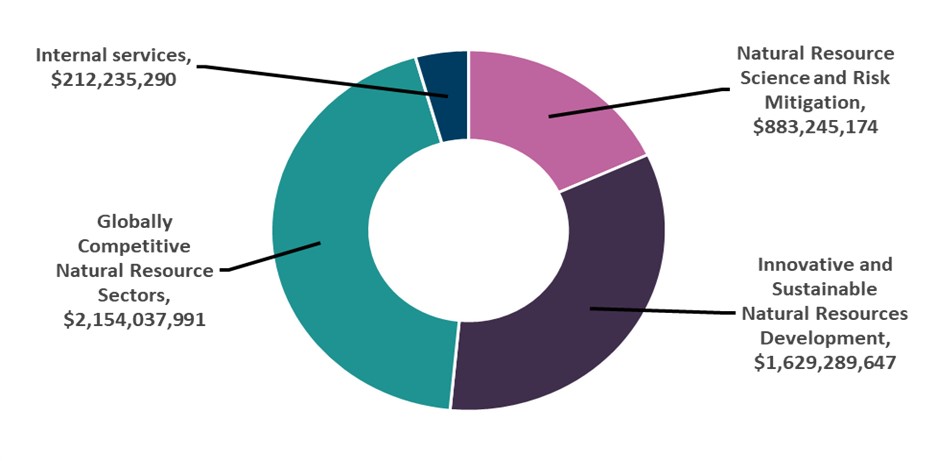
Text description of graph 1
| Core responsibilities and internal services | 2026-27 planned spending |
|---|---|
| Natural Resource Science and Risk Mitigation | $883,245,174 |
| Innovative and Sustainable Natural Resources Development | $1,629,289,647 |
| Globally Competitive Natural Resource Sectors | $2,154,037,991 |
| Internal services | $212,235,290 |
Analysis of planned spending by core responsibility
Natural Resource Science and Risk Mitigation (18%) – provides leadership in foundational science and shares expertise for managing Canada’s natural resources, reducing the impacts of climate change and mitigating risks from natural disasters and explosives. Planned spending within this core responsibility includes programs such as Growing Canada’s Forests (2 Billion Trees), Fighting and Managing Wildfire in a Changing Climate, Wildfire Resilient Futures Initiative, Flood Hazard Identification and Mapping, United Nations Commission on Limits of Continental Shelf.
Innovative and Sustainable Natural Resources Development (33%) – provides leadership in the transformation to a low-carbon economy by improving the environmental performance of Canada’s natural resource sectors through innovation and sustainable development and use. Planned spending within this core responsibility includes programs such as Smart Renewable Electrification Pathways, Oil to Heat Pump Affordability, Energy Innovation Program, Clean Fuels Fund, Zero Emission Vehicle Infrastructure.
Globally Competitive Natural Resource Sectors (44%) – supports the advancement and promotion of market access, inclusiveness and competitiveness for Canada’s natural resource sectors, in support of jobs and economic growth. Also includes statutory payments for offshore petroleum. Planned spending within this core responsibility includes programs such as Newfoundland Offshore Petroleum Resource Board, Critical Minerals Infrastructure Fund, First and Last Mile Fund, Biofuels Production Incentive, and Investments in Forest Industry Transformation.
Internal services (4%) – supports the abovementioned Departmental mandates, help meets corporate obligations and ensure effective and efficient delivery of programs.
Budgetary performance summary
Table 14: Three-year spending summary for core responsibilities and internal services (dollars)
| Core responsibilities and Internal services | 2023-2024 Actual Expenditures | 2024-25 Actual Expenditures | 2025-2026 Forecast Spending |
|---|---|---|---|
| Natural Resource Science and Risk Mitigation | 452,443,201 | 616,951,605 | 838,943,140 |
| Innovative and Sustainable Natural Resources Development | 1,911,951,581 | 2,292,187,099 | 1,765,133,623 |
| Globally Competitive Natural Resource Sectors | 874,439,244 | 1,272,759,815 | 1,738,897,433 |
| Subtotal (s) | 3,238,834,026 | 4,181,898,519 | 4,342,974,196 |
| Internal services | 227,776,297 | 237,730,678 | 213,099,575 |
| Total (s) | 3,466,610,323 | 4,419,629,197 | 4,556,073,771 |
Analysis of the past three years of spending
Actual spending for 2024-25 was $4,420 million, a year-over-year increase of $953 million (27%) from 2023-24 actual spending. The increase is mainly due to:
- Incremental spending of $610 million in grants and contributions for programs aimed at Greener Homes (including Oil to Heat Pumps), Electricity Pre-development Program, 2 Billion Trees (2BT) and Energy Efficiency. These programs experienced increased spending as they mature within their program lifecycle, additional contribution agreements are signed, and as applicants continue to seek reimbursement for eligible expenses.
- Increase of $348 million in Statutory Vote, specifically attributed to the Newfoundland Offshore Petroleum Resource Revenue Fund. The fund recorded an increase in royalty payments and Corporate Income Tax as a result of increased production levels at the Hibernia and Hebron offshore oil fields. NRCan serves as an intermediary, facilitating the flow through of applicable funds to the Province of Newfoundland and Labrador.
These increases in spending were partially offset by reduced spending due to:
- Reduced funding profile for NRCan’s investment in Smart Renewable Electrification Pathways, Zero Emission Vehicle Infrastructure Program and Clean Fuels Fund.
Forecasted spending for 2025-26 was $4,556 million, a year-over-year increase of $136 million (3%) from 2024-25 actual spending. The increase is mostly attributed to additional spending in grants and contributions for programs supporting the planting of new trees (2BT), energy research development and demonstration (Energy Innovation Program), switch from oil heating to new, energy-efficient heat pumps (Oil to Heat Pump), reduction of capital investment risks required to build new or expand existing clean fuel production facilities (Clean Fuels Fund), as well as, higher anticipated royalties from Offshore oil and gas.
These increases were partially offset by reduced planned spending for sustaining the advancement of Canada's Forest Economy, improving energy efficiency in homes (Greener Homes), as well as supporting early-stage activities (planning, studies, design) for large, clean electricity projects (Electricity Pre-development Program).
More financial information from previous years is available on the Finances section of GC Infobase.
Table 15: Planned three-year spending on core responsibilities and internal services (dollars)
| Core responsibilities and Internal services | 2026-27 Planned Spending | 2027-28 Planned Spending | 2028-29 Planned Spending |
|---|---|---|---|
| Natural Resource Science and Risk Mitigation | 883,245,174 | 735,341,556 | 569,901,992 |
| Innovative and Sustainable Natural Resources Development | 1,629,289,647 | 1,231,252,281 | 1,070,057,298 |
| Globally Competitive Natural Resource Sectors | 2,154,037,991 | 2,174,643,708 | 1,867,959,757 |
| Subtotal | 4,666,572,812 | 4,141,237,545 | 3,507,919,047 |
| Internal services | 212,235,290 | 189,633,605 | 171,993,649 |
| Total | 4,878,808,102 | 4,330,871,150 | 3,679,912,696 |
Analysis of the next three years of spending
The overall decrease of $1,199 million (25%) from 2026-27 to 2028-29 is mainly due to a combination of reductions in planned spending and sunsetting of programs such: Fighting and Managing Wildfires in Changing Climate, Clean Fuels Fund, Statutory Offshore Payments, Oil to Heat Pump Affordability, Biofuels Production Incentive and Zero Emission Vehicle Infrastructure. The renewal of some of these programs will be requested in future federal budget exercises.
These reductions were offset by incremental planned spending for supporting the development of critical minerals projects and supply chains at the upstream and midstream segments, focusing on bringing near-term projects into production (First and Last Mile Fund), providing low-to-median-income homeowners and tenants with no-cost home retrofits (Canada Greener Homes Affordability Program), and support the deployment of grid modernization, energy storage and renewable energy technologies in every region of Canada, helping to grow the grid in a sustainable, affordable and reliable manner (Smart Renewable and Electrification Pathways Program).
More detailed financial information on planned spending is available on the Finances section of GC Infobase.
Funding
This section provides an overview of the department's voted and statutory funding for its core responsibilities and for internal services. For further information on funding authorities, consult the Government of Canada budgets and expenditures.
Graph 2: Approved funding (statutory and voted) over a six-year period
Graph 2 summarizes the department's approved voted and statutory funding from 2023-24 to 2028-29.
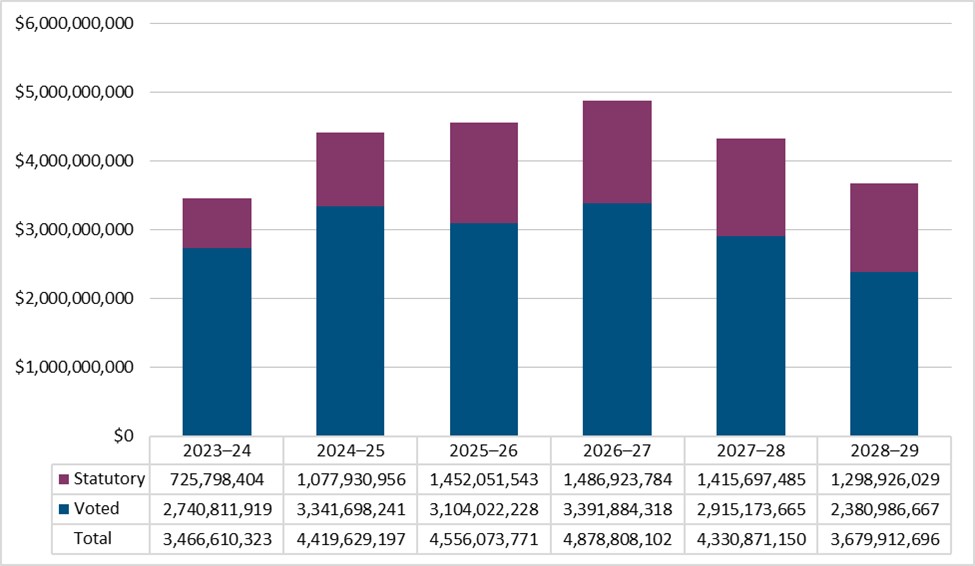
Text description of graph 2
| Fiscal year | Total | Voted | Statutory |
|---|---|---|---|
| 2023-24 | 3,466,610,323 | 2,740,811,919 | 725,798,404 |
| 2024-25 | 4,419,629,197 | 3,341,698,241 | 1,077,930,956 |
| 2025-26 | 4,556,073,771 | 3,104,022,228 | 1,452,051,543 |
| 2026-27 | 4,878,808,102 | 3,391,884,318 | 1,486,923,784 |
| 2027-28 | 4,330,871,150 | 2,915,173,665 | 1,415,697,485 |
| 2028-29 | 3,679,912,696 | 2,380,986,667 | 1,298,926,029 |
Analysis of statutory and voted funding over a six-year period
Planned spending in Voted authorities from 2026-27 to 2028-29 is declining, mainly due to reduced funding profiles for major initiatives and sunsetting programs. Sunsetting programs could be renewed pending future budgetary decisions. Outcomes of such decisions will be reflected in the Department’s future budget exercises and Estimates documents.
Planned spending in Statutory authorities shows a variation from 2026-27 to 2028-29 mainly due to the Atlantic Offshore Accounts. Statutory payment obligations under these accords are largely driven by oil and gas prices, production levels and anticipated corporate income taxes related to offshore operations. The planned spending is based on the Department's economic modeling forecasts prepared in the fall of 2025. In comparison, the 2025-26 forecast for the Atlantic Offshore Accounts is lower due to anticipated lower commodity prices, exchange rates, and increased project expenditures.
For further information on Natural Resources Canada's departmental appropriations, consult the 2026-27 Main Estimates.
Consolidated future-oriented condensed statement of operations
The consolidated future-oriented condensed statement of operations provides an overview of Natural Resources Canada’ s operations for 2025-26 to 2026-27.
Table 16: Consolidated future-oriented condensed statement of operations for the year ended March 31, 2027 (dollars)
| Financial information | 2025-26 Forecast results | 2026-27 Planned results | Difference (Planned results minus forecasted) |
|---|---|---|---|
| Total expenses | 4,549,894,409 | 4,595,148,703 | 45,254,294 |
| Total net revenues | 32,425,042 | 30,233,352 | (2,191,690) |
| Net cost of operations before government funding and transfers | 4,517,469,367 | 4,564,915,351 | 47,445,984 |
Analysis of forecasted and planned results
Total expenses are projected to increase by $45 million, from $4,550 million in 2025-26 to $4,595 million in 2026-27, mainly explained by:
An increase of $298 million in Globally Competitive Natural Resource Sectors mainly related to:
- An increase of $291 million, primarily in the Biofuels Production Incentive Program, the Critical Minerals Infrastructure Fund, Offshore Statutory accounts and the Global Forest Leadership Program, offset by
- A decrease of $23 million related to the Youth Employment and Skills Strategy program and the Indigenous Loan Guarantee Program.
A decrease of $264 million in Innovative and Sustainable Natural Resources Development mainly due to:
- A decrease of $387 million related to the Greener Homes Program, the Clean Fuels Fund, the Electricity Pre-Development Program, the Zero Emission Vehicle Infrastructure Program, and the Energy Innovation Program; offset by
- An increase of $144 million mainly related to the Smart Renewables and Electrification Pathways program.
Net revenues for 2025-26 are reported at $32 million while the net revenues for 2026-27 are estimated at $30 million, reflecting an insignificant variance.
The charts presenting the distribution of Natural Resources Canada’s total forecast expenses for 2025-26 and planned expenses for 2026-27 by Core Responsibility on an accrual basis are available on the NRCan website.
A more detailed Consolidated Future-Oriented Statement of Operations and associated Notes for 2026-27, including a reconciliation of the net cost of operations with the requested authorities, is available on Natural Resources Canada’s website.
Human resources
This section presents an overview of the department’s actual and planned human resources from 2023-24 to 2028-29.
Table 17: Actual human resources for core responsibilities and internal services
| Core responsibilities and internal services | 2023-24 Actual full-time equivalents | 2024-25 Actual full-time equivalents | 2025-26 Forecasted full-time equivalents |
|---|---|---|---|
| Natural Resource Science and Risk Mitigation | 1,430 | 1,527 | 1,536 |
| Innovative and Sustainable Natural Resources Development | 2,152 | 2,342 | 2,302 |
| Globally Competitive Natural Resource Sectors | 613 | 640 | 608 |
| Subtotal | 4,195 | 4,509 | 4,446 |
| Internal services | 1,304 | 1,378 | 1,338 |
| Total | 5,499 | 5,887 | 5,784 |
Analysis of human resources over the last three years
For 2023-24 and 2024-25, the figures represent the FTEs as reported in the Departmental Results Report while 2025-26 represents the forecasted FTEs at year-end.
Increase of 388 from 2023-24 to 2024-25 is mainly driven by investments in new programs and activities to reduce wildland fire risk in our communities and landscapes (Wildfire Resilient Future Initiative), fill gaps in forest and environmental data and improve reporting on forest carbon, forest degradation, and Canadian primary forests (ForSITE), provide financial assistance to help Canadians switch from Oil heating to eligible heat pump systems (Oil to Heat Pump) and enhance Canada’s role in building resilient, secure and sustainable critical minerals supply chains (Global Partnership Initiative).
Decrease of 103 from 2024-25 to 2025-26 is driven by a combination of sunsetting programs and reduction in funding profiles of major initiatives such as securing the critical minerals required to transition to a low-carbon economy (Critical Minerals), advancing clean energy technologies to maintain a competitive, reliable, and affordable energy system while transitioning to a low-carbon economy (Energy Innovation Program), shifting from fossil fuels to electric heating, promoting low-carbon materials via a new Innovation Hub, and updating building codes to require higher energy performance (National Net Zero Buildings Strategy) and providing information, tools and links to support land survey work conducted on First Nations lands (First Nation Land Management).
Table 18: Human resources planning summary for core responsibilities and internal services
| Core responsibilities and internal services | 2026-27 Planned full-time equivalents | 2027-28 Planned full-time equivalents | 2028-29 Planned full-time equivalents |
|---|---|---|---|
| Natural Resource Science and Risk Mitigation | 1,444 | 1,350 | 1,249 |
| Innovative and Sustainable Natural Resources Development | 2,028 | 1,724 | 1,594 |
| Globally Competitive Natural Resource Sectors | 599 | 559 | 540 |
| Subtotal | 4,071 | 3,633 | 3,383 |
| Internal services | 1,330 | 1,321 | 1,310 |
| Total | 5,401 | 4,954 | 4,693 |
Analysis of human resources for the next three years
For 2026-27 to 2028-29, the figures represent total Planned FTEs to support NRCan approved program activities.
Decrease of 708 in FTEs is mostly driven by a combination of sunsetting programs and reduction in funding profiles of major initiatives such as reducing emissions for energy and industrial activities where neither electrification nor low carbon fuels are able to provide technically or economically feasible low-carbon solutions (CCUS), securing the critical minerals required to transition to a low-carbon economy (Critical Minerals), invests in new programs and activities to reduce wildland fire risk in our communities and landscapes (Wildfire Resilient Futures Initiative) and providing scientific expertise, reviewing project components (especially for explosives), and assessing socio-economic effects for major projects (Impact Assessment).
As other new initiatives are undertaken or existing programs are renewed, plans for future FTE requirements will be adjusted accordingly.
Supplementary information tables
The following supplementary information tables are available on Natural Resources Canada’s website:
- Details on transfer payment programs
- Up-front multi-year funding
- Horizontal Initiatives
- Regulatory and Permitting Efficiency for Clean Growth Projects
Information on Natural Resources Canada’s 2023-27 Departmental Sustainable Development Strategy can be found on NRCan’s website.
Federal tax expenditures
Natural Resources Canada’s Departmental Plan does not include information on tax expenditures.
The tax system can be used to achieve public policy objectives through the application of special measures such as low tax rates, exemptions, deductions, deferrals and credits. The Department of Finance Canada publishes cost estimates and projections for these measures each year in the Report on Federal Tax Expenditures.
This report also provides detailed background information on tax expenditures, including descriptions, objectives, historical information and references to related federal spending programs as well as evaluations and GBA Plus of tax expenditures.
Corporate information
Departmental profile
Appropriate minister(s): The Honourable Tim Hodgson, P.C., M.P.
Institutional head: Greg Orencsak
Ministerial portfolio:
- Atomic Energy of Canada Limited;
- Canada Energy Regulator;
- Canadian Nuclear Safety Commission;
- Canada-Newfoundland and Labrador Offshore Energy Regulator ;
- Canada-Nova Scotia Offshore Energy Regulator;
- Northern Pipeline Agency; and,
- Energy Supplies Allocation Board (inactive).
Enabling instrument(s):
- Department of Natural Resources Act;
- Resources and Technical Surveys Act;
- Forestry Act;
- Canada-Newfoundland and Labrador Atlantic Accord and Offshore Renewable Energy Management Act; and,
- Canada-Nova Scotia Petroleum Resources Accord Implementation and Offshore Renewable Energy Management Act.
Year of incorporation / commencement: 1994
Departmental contact information
Address:
Natural Resources Canada
580 Booth Street
Ottawa, Ontario
K1A 0E4
Canada
Email: media@nrcan-rncan.gc.ca
Website(s): https://natural-resources.canada.ca/home
Definitions
List of terms
- appropriation (crédit)
- Any authority of Parliament to pay money out of the Consolidated Revenue Fund.
- budgetary expenditures (dépenses budgétaires)
- Operating and capital expenditures; transfer payments to other levels of government, departments or individuals; and payments to Crown corporations.
- core responsibility (responsabilité essentielle)
- An enduring function or role performed by a department. The intentions of the department with respect to a core responsibility are reflected in one or more related departmental results that the department seeks to contribute to or influence.
- Departmental Plan (plan ministériel)
- A report on the plans and expected performance of an appropriated department over a 3year period. Departmental Plans are usually tabled in Parliament each spring.
- departmental result (résultat ministériel)
- A consequence or outcome that a department seeks to achieve. A departmental result is often outside departments' immediate control, but it should be influenced by program-level outcomes.
- departmental result indicator (indicateur de résultat ministériel)
- A quantitative measure of progress on a departmental result.
- departmental results framework (cadre ministériel des résultats)
- A framework that connects the department's core responsibilities to its departmental results and departmental result indicators.
- Departmental Results Report (rapport sur les résultats ministériels)
- A report on a department's actual accomplishments against the plans, priorities and expected results set out in the corresponding Departmental Plan.
- full-time equivalent (équivalent temps plein)
- A measure of the extent to which an employee represents a full person-year charge against a departmental budget. For a particular position, the full-time equivalent figure is the ratio of number of hours the person actually works divided by the standard number of hours set out in the person's collective agreement.
- gender-based analysis plus (GBA Plus) (analyse comparative entre les sexes plus [ACS Plus])
Is an analytical tool used to support the development of responsive and inclusive policies, programs, and other initiatives. GBA Plus is a process for understanding who is impacted by the issue or opportunity being addressed by the initiative; identifying how the initiative could be tailored to meet diverse needs of the people most impacted; and anticipating and mitigating any barriers to accessing or benefitting from the initiative. GBA Plus is an intersectional analysis that goes beyond biological (sex) and socio-cultural (gender) differences to consider other factors, such as age, disability, education, ethnicity, economic status, geography (including rurality), language, race, religion, and sexual orientation.
Using GBA Plus involves taking a gender- and diversity-sensitive approach to our work. Considering all intersecting identity factors as part of GBA Plus, not only sex and gender, is a Government of Canada commitment.
- government priorities (priorités gouvernementales)
- For the purpose of the 2026-27 Departmental Plan, government priorities are the high-level themes outlining the government's agenda in the 2025 Speech from the Throne.
- horizontal initiative (initiative horizontale)
- An initiative where two or more federal departments are given funding to pursue a shared outcome, often linked to a government priority.
- Indigenous business (entreprise autochtones)
- Requirements for verifying Indigenous businesses for the purposes of the departmental result report are available through the Indigenous Services Canada Mandatory minimum 5% Indigenous procurement target website.
- nonbudgetary expenditures (dépenses non budgétaires)
- Non-budgetary authorities that comprise assets and liabilities transactions for loans, investments and advances, or specified purpose accounts, that have been established under specific statutes or under non-statutory authorities in the Estimates and elsewhere. Non-budgetary transactions are those expenditures and receipts related to the government's financial claims on, and obligations to, outside parties. These consist of transactions in loans, investments and advances; in cash and accounts receivable; ii public money received or collected for specified purposes; and in all other assets and liabilities. Other assets and liabilities, not specifically defined in G to P authority codes are to be recorded to an R authority code, which is the residual authority code for all other assets and liabilities.
- performance (rendement)
- What a department did with its resources to achieve its results, how well those results compare to what the department intended to achieve, and how well lessons learned have been identified.
- performance indicator (indicateur de rendement)
- A qualitative or quantitative means of measuring an output or outcome, with the intention of gauging the performance of an department, program, policy or initiative respecting expected results.
- plan (plan)
- The articulation of strategic choices, which provides information on how a department intends to achieve its priorities and associated results. Generally, a plan will explain the logic behind the strategies chosen and tend to focus on actions that lead to the expected result.
- planned spending (dépenses prévues)
- For Departmental Plans and Departmental Results Reports, planned spending refers to those amounts presented in Main Estimates.
A department is expected to be aware of the authorities that it has sought and received. The determination of planned spending is a departmental responsibility, and departments must be able to defend the expenditure and accrual numbers presented in their Departmental Plans and Departmental Results Reports. - program (programme)
- Individual or groups of services, activities or combinations thereof that are managed together within the department and focus on a specific set of outputs, outcomes or service levels.
- program inventory (répertoire des programmes)
- Identifies all the department's programs and describes how resources are organized to contribute to the department's core responsibilities and results.
- result (résultat)
- A consequence attributed, in part, to a department, policy, program or initiative. Results are not within the control of a single department, policy, program or initiative; instead they are within the area of the department's influence.
- statutory expenditures (dépenses législatives)
- Expenditures that Parliament has approved through legislation other than appropriation acts. The legislation sets out the purpose of the expenditures and the terms and conditions under which they may be made.
- target (cible)
- A measurable performance or success level that a department, program or initiative plans to achieve within a specified time period. Targets can be either quantitative or qualitative.
- voted expenditures (dépenses votées)
- Expenditures that Parliament approves annually through an appropriation act. The vote wording becomes the governing conditions under which these expenditures may be made.