
Fire weather refers to the meteorological conditions that cause wildland fires to start, spread or change behaviour. Metrics used to measure these conditions include:
- temperature
- precipitation
- relative humidity
- wind speed / direction
It also includes surface conditions such as:
- snow cover
- soil moisture
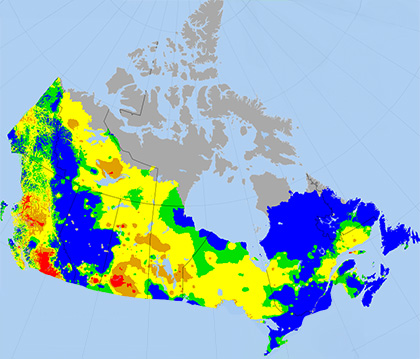
View daily weather observations maps on the Canadian Wildland Fire Information System (CWFIS).
Fire weather can significantly influence fire behaviour and fire regimes.
- High temperatures and low humidity can dry out fuels, increasing their flammability.
- Strong winds can carry embers and flames, accelerating the speed and extent a fire spreads.
- Regional weather conditions can alter rainfall, ice pack, snow melt.
- Unstable atmospheric conditions can amplify lightning strikes, updrafts, downdrafts and wind; thus, increasing fire frequency and fire intensity.
Understanding the impact of climate on fire weather is crucial for predicting, responding and building resilience to wildland fire. To address future challenges, wildland fire management resources are being strengthened and strategies are being adjusted as risks escalate.
Fire Weather Index
The Fire Weather Index (FWI) is a numeric rating of potential fire intensity used as an indicator of fire danger. It is based on weather measurements taken at noon (local time) and can be calculated at an hourly scale. Each provincial and territorial wildland fire agency calculates the FWI at weather stations within their jurisdiction.
Fire danger is an assessment of fixed and variable factors that determines:
- how easily vegetation may ignite
- how quickly a fire might spread
- how difficult the fire may be to control
- how much potential damage may occur
The FWI uses weather observations (temperature, relative humidity, rainfall, wind speed) to track fuel moisture and fire spread potential. These calculations comprise the indexes within Canada’s Fire Weather Index System, a component of the Canadian Forest Fire Danger Rating System (CFFDRS). The CFFDRS is the most widely applied wildland fire danger rating system globally.
Fire weather and climate change
Wildland fire activity fluctuates yearly. However, fire weather conditions across Canada are intensifying due to climate change. Rising temperatures are increasing evaporation, melting the snowpack sooner and worsening drought conditions. The number of extreme weather events (e.g., long-lasting drought; repeated hot, windy, dry conditions) is rising. Larger, more intense wildland fires are occurring. Consequently, more forest area is burning.
Understanding these changes is essential for anticipating the potential impact of future wildland fires. Environment and Climate Change Canada’s Fire Weather Projections application offers projections of long-term changes in the frequency and severity of fire weather conditions (i.e., hot, dry, windy) under a changing climate.
Find out more
- Wildland fire
- Wildland fire monitoring and reporting tools
- Wildland fire research
- Impacts of climate change on forests
- Fighting and Managing Wildfires in a Changing Climate Program
Selected Canadian Forest Service publications
- Climate change more than doubled the likelihood of extreme fire weather conditions in Eastern Canada (2023)
- Trend analysis of fire season length and extreme fire weather in North America between 1979 and 2015 (2017)
- Increasing frequency of extreme fire weather in Canada with climate change (2015)
- Global wildland fire season severity in the 21st century (2012)