
Purpose
This report establishes a foundational understanding of the diverse frameworks currently used to value temporary carbon storage, grounded in climate science, to help NRCan and other federal teams clearly interpret the current landscape and assess options for inclusion in national inventory reporting. It further identifies key areas of alignment and divergence across systems, particularly regarding feedstock growth cycles, time horizons, counterfactuals, and the metrics used to express climate impact, such as radiative forcing and global temperature change.
About Builders for Climate Action
Builders for Climate Action is a dedicated social enterprise at the forefront of meaningful climate action. We collaborate with builders, designers, developers, policy-makers, researchers and manufacturers to tackle the serious impact of buildings on our climate and work toward real zero-carbon buildings. Central to our commitment is the provision of essential tools, cutting-edge research, and valuable resources that empower practitioners and policymakers to realize the vision of genuine zero-carbon buildings.
Table of Contents
Executive Summary
This report examines how biogenic carbon storage is currently represented in life cycle assessment (LCA) and explores how time-based methods can more accurately capture and report its climate value. Conventional “static” LCAs sum emissions across a fixed time horizon, treating all greenhouse gas emissions as equal regardless of when they occur. This simplification masks the benefits of delaying or avoiding emissions through the use of biogenic materials such as timber, straw, or hemp.
Our review of existing methods, including Dynamic LCA, GWPbio, ton-year accounting and others, shows that while debates about dynamic metrics and time horizons remain unsettled, a larger gap persists: inventory completeness. Many carbon flows, particularly those that occur before or after the product system boundary, are not consistently captured by any existing method. Upstream losses such as harvest residues, feedstock regrowth after harvest, and end-of-life storage or decay all strongly influence the climate profile of biogenic materials but are not fully represented in standard or dynamic LCA outputs. Addressing these omissions is more important than refining any single calculation method.
Differences in the time horizons used for LCA assessments often create confusion without improving insight, and the literature reviewed consistently notes that the selection of a time horizon is necessarily a fraught choice. An effective Canadian approach could be designed to calculate impacts over the full lifespan of materials up to potentially 200 years or more, allowing users to understand the climate impact of a scenario at any point along the time horizon. By building on robust inventory completeness rather than fixed time windows, results can act as snapshots through time, accommodating diverse policy and design needs while maintaining transparency about what is included or excluded from each perspective.
To ensure uptake of dynamic assessment, practicality is essential. Even the most scientifically rigorous method will fail if it cannot be applied in practice. A robust dynamic assessment methodology should be transparent, communicable, and compatible with existing Canadian LCA frameworks and leverage existing data from Environmental Product Declarations (EPDs). Results should use comparable CO₂e metrics while allowing complementary metrics such as radiative forcing or global temperature potential. Practitioners should be able to interpret and apply results to directly inform design, procurement, and policy decisions.
By embedding time factors into accounting and using time as a calculation denominator, rather than a boundary, Canada can create a credible, flexible, and internationally aligned framework for valuing stored biogenic carbon. Such an approach would strengthen national policy, support material innovation, and help position Canada as a leader in advancing time-aware carbon accounting for the built environment.
1. Introduction
Buildings are a major source of greenhouse gas emissions (GHGe), and as noted in the Canadian Standard on Embodied Carbon in Construction, “embodied carbon forms a significant proportion of the whole life carbon emissions from construction projects.” This has been confirmed by research such as Natural Resources Canada’s 2021 report Achieving Real Net Zero Emission Homes (PDF, 9.6 MB), which estimated that embodied carbon from new Part 9 home construction may average 19.8 million tons of carbon dioxide equivalent (CO2e) annually, the equivalent of emissions from four coal fired power plants.
Life cycle assessment (LCA) is the most widely used approach for quantifying the emissions associated with building products and buildings. However, LCA not only identifies GHGe, it can also identify and quantify biogenic carbon content in building products. The National Research Council’s National Whole-Building Life Cycle Assessment Practitioner’s Guide (PDF, 836 KB) defines biogenic carbon as “carbon stored in biomaterials through natural processes but not fossilized or derived from fossil resources” and requires LCA practitioners to track biogenic carbon as a distinct metric in embodied carbon reporting.
The principles of LCA acknowledge that biogenic carbon removals from the atmosphere can have a positive impact on the climate because all GHGe, whether from fossil fuel combustion or biogenic withdrawals, alter the carbon cycle and the earth’s radiative balance. Conventional “static” LCA’s, as structured under international standards such as ISO 14040, ISO 21930, and EN 15804, sum emissions across life cycle stages without regard to timing. Within these frameworks, an emission released to (or withdrawn from) the atmosphere today is treated as equivalent to one occurring decades or even a century later. This simplification provides consistency and comparability but obscures the benefits of delayed release, despite the well-documented importance of near-term carbon reductions for avoiding climate tipping points. As Chilton (2025)Reference 4 observes, “standard carbon accounting methods and metrics undermine the potential of fast-growing biogenic materials to decarbonize buildings because they ignore the timing of carbon uptake.” If the purpose of LCA is to guide designers toward choices with better climate outcomes, then accounting methods must reflect the actual climate value of storage and delay.
Dynamic LCA (dLCA) has emerged as one of several responses to this inherent limitation of static LCA, introducing temporal variation into both inventory and impact assessment. Its rationale is straightforward: an emission delayed or released gradually has a different climate impact than the same emission released all at once. By keeping carbon out of the atmosphere, even temporarily, biogenic materials stored durably in buildings can reduce radiative forcing (the excess heat trapped in Earth’s atmosphere) and “buy time” for decarbonization and adaptation efforts. As Chilton (2025)Reference 4 notes, the benefits of storage, “though not ‘permanent,’ include a reduction in cumulative energy input, buying time for longer-term adaptation, delaying or avoiding climate tipping points, and the possibility of permanent storage through future technological changes.”
Canada is fortunate to have ample quantities of biogenic feedstocks for building products, including wood, straw, hemp, corn stover and waste-stream fibers such as cardboard, newsprint and textiles, as documented in the recent NRCan-funded report Building A Low Carbon Future: Exploring Feedstocks & Products For Canada’s Construction Sector (PDF, 1.51 MB). All biogenic feedstocks can provide the type of climate-positive benefits demonstrated by dynamic LCA calculations. The potential for large-scale climate mitigation and adaptation benefits through scaling these products has been demonstrated by the UNEP in their report Building Materials and the Climate: Constructing a New Future, and RMI report Building with Biomass: A New American Harvest. By removing carbon from the atmosphere and delaying its release, these materials provide a positive climate value that conventional LCA methods fail to capture.
Despite the existence of a variety of LCA methodologies intended to quantify the climate benefits of biogenic carbon storage, there has yet to emerge a consensus regarding best practice for doing so. This report does not attempt to select a single “best” framework. Instead, its purpose is to identify the foundational considerations that any credible method must address in order to quantify the time value of biogenic carbon storage.
Our review shows that while debates around dynamic metrics and time horizons remain unsettled, a larger gap persists: inventory completeness. Current approaches, whether dLCA, GWPbio, ton-year accounting, or spatiotemporal models, rarely capture the full set of carbon flows, including harvest losses, regrowth dynamics, and counterfactual fates without which results risk being incomplete or misleading.
The urgency of this work is underscored by the current regulatory context. As Ventura (2022) cautions, “at a time when the dynamic GWP indicator is being considered as a regulatory tool … it seems crucial to consider its scientific relevance, because using the wrong method could lead to an overestimation.” The stakes extend beyond accounting conventions. In Canada, efforts to scale up the use of biogenic materials intersect with pressing housing and infrastructure needs, abundant agricultural and forestry residues, and the potential for new rural and regional economic development. How biogenic carbon storage is valued today will shape not only standards and LCA practice, but also the procurement frameworks, incentive programs, and codes that determine how quickly these materials can reach the market. Ensuring that carbon accounting methods reflect the real climate value of storage is essential to unlocking both the environmental and economic potential of Canadian biomaterials.
The GHG Protocol, a global standard for measuring and managing greenhouse gas emissions, developed to help companies and organizations accurately account for their emissions and report them effectively, provides guidelines and tools for creating a comprehensive greenhouse gas inventory, supporting efforts to reduce emissions and combat climate change. The Protocol currently does not address biogenic carbon and so is not referenced in this report. However, the Protocol is currently drafting a Land Sector and Removals Guidance document that is likely to add insights for the work presented here.
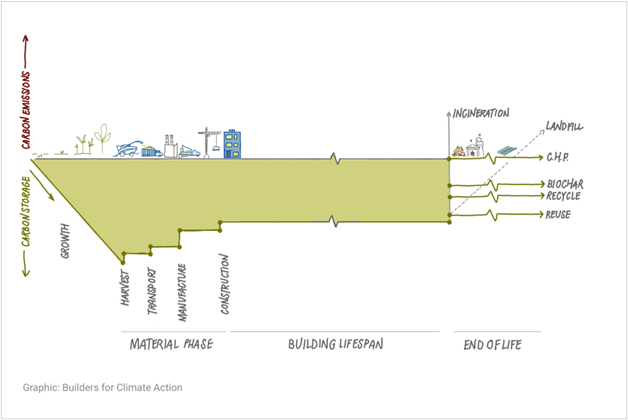
Figure 1: This illustration represents the flow of biogenic carbon through a product and/or building life cycle. Starting on the left, the green line shows carbon being removed from the atmosphere when going downward, carbon being released to the atmosphere when going upward and carbon stored when horizontal. Each dot along the line indicates a process captured in conventional LCA.
The area shaded in green is a representation of the cumulative impact over time. Dynamic LCA, and other methods of incorporating time into life cycle analysis, are an attempt to quantify the climate impact of the shaded area.
This illustration will be used throughout the report to demonstrate how different methods address this lifecycle timeline.
2. Scope and Approach
The purpose of this work is to examine how biogenic materials are currently represented in life cycle assessment (LCA) and related standards, and to explore how time-dependent (dynamic) methods can improve the quantification of their climate impacts.
The report begins by outlining how conventional LCA practice accounts for biogenic carbon, then reviews emerging approaches that introduce a temporal dimension. It then considers factors that no current frameworks fully capture, identifying where methodological gaps remain. The study concludes by distilling the parameters most important for developing a future method that accurately and practically reflects the time value of biogenic carbon storage.
The approach is focused on recommendations that would enable a future dynamic LCA methodology to be practically aligned with existing LCA practice, ensuing that its adoption leverages existing standards and workflows (such as Canada’s National Whole-Building Life Cycle Assessment Practitioner’s Guide) and functions as a straightforward “overlay” for LCA practitioners. With national codes like the National Energy Code for Buildings (NECB) moving toward embodied carbon reporting, this alignment positions dynamic LCA methods to complement current practice while shaping how time-based carbon accounting could be incorporated into future code provisions, thereby reducing barriers to adoption.
The following boundaries were set to provide alignment with existing LCA practice:
- EPDs as the primary data source. Any practical method for quantifying the time value of biogenic carbon must be compatible with the data structures already used in environmental product declarations (EPDs), as these transparency documents have come to underpin LCA practice and typically include biogenic carbon flows across a product’s lifespan as well as information about construction waste and anticipated end-of-life treatment required for dynamic calculations.
- Biogenic carbon flows only (CO₂ and CH₄). This project focuses on methods of dynamically calculating sequestration, storage, and release of biogenic carbon from building products. LCA practice includes a wide range of GHGs, each with its own radiative efficiency and atmospheric lifetime (Chilton, 2025)Reference 4, commonly “bundled” into the GWP100 metric. This can complicate dynamic assessments because accurate climate characterization over time requires each GHG to be tracked individually in the analysis, but reporting on quantities of individual gases is not included in typical LCAs. However, for examining biogenic carbon, only CO₂ and, at end of life, CH₄ from potential anaerobic decomposition are relevant, making it possible to create dynamic assessments using information from EPDs. Narrowing the scope in this way ensures alignment with product-level accounting and enables a practical and implementable dynamic overlay with existing LCA practices.
- Scope exclusions. Soil carbon dynamics are excluded from this analysis. While they are critical to understanding climate impacts from agricultural and forestry systems, they are addressed through dedicated frameworks and attributed to land management rather than downstream building products. Including them here would risk double-counting. This study therefore focuses only on carbon stored within above-grade biomass.
Together, these boundaries set the stage for looking more closely at how biogenic carbon is understood and managed within life cycle assessment. The next section builds a shared foundation for that discussion, beginning with how carbon-storing materials are currently addressed in industry and standards, then tracing what can be learned from both conventional and time-based approaches before identifying what remains unaccounted for.
3. Foundational Concepts
3.1 What are carbon storing materials?
Carbon-storing materials are those that contain biogenic carbon absorbed from the atmosphere during plant growth through the process of photosynthesis and retained within products used in the built environment. These materials act as temporary carbon storage, keeping sequestered carbon out of the atmosphere for the duration of their use phase. As described in Building Materials and the Climate: Constructing a New Future (2023), bio-based materials offer the potential to turn buildings into durable carbon sinks, complementing other emission reduction strategies and helping to close the loop between natural and built carbon cycles.
The treatment of these materials in carbon accounting has been shaped by history. In the early 1990s, the OECD issued guidelines excluding biomass CO₂ emissions from national energy inventories, assigning them instead to land-use and forestry sectors on the assumption that regrowth would offset them. This convention set the stage for industry standards to treat biogenic carbon as effectively climate-neutral Reference 3 Reference 9.
Current standards largely formalize this approach. ISO 21930 and EN 15804+A2, the primary references for EPDs in North America and Europe, both restrict how biogenic carbon can be represented. These standards permit one of two accounting treatments: a 0/0 approach, where no biogenic carbon is recorded at either uptake or release, or a –1/+1 approach, where the amount sequestered during plant growth (and attributed to the product at the harvest phase, or life cycle module A1) is balanced by an equivalent release at end of life (module C4) (Chilton, 2025)Reference 4. In both cases, the storage effect is neutralized within the accounting framework, with removals and releases assumed to balance over time. Regarding end of life, ISO 21930 allows permanent storage to be reported only when carbon remains sequestered for more than 100 years, while EN 15804+A2 reports biogenic carbon separately but does not credit either temporary or permanent storage within the main results.
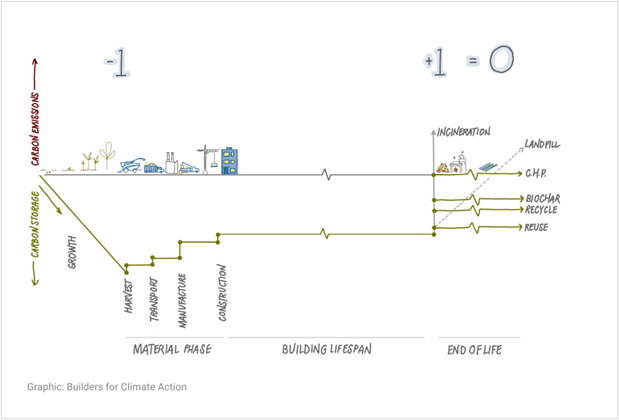
Figure 2: The most typical way to account for biogenic carbon in LCA is to record the flow into the product as a removal from the atmosphere, or a “negative emission.” When the product is assumed to end its useful service life, it is assumed that the total amount of biogenic carbon is fully released back to the atmosphere as a “positive emission.”
The resulting simple equation, -1 + 1 = 0, leads to assumptions that biogenic carbon in buildings is inherently climate neutral.
While this approach ensures consistency and creates a simple mathematical completeness to an LCA study, it effectively erases the climate significance of delaying emissions through long-lived storage. The result is that materials capable of storing carbon for decades are attributed with no climate benefit within standard LCA outputs. The broader ISO 14040 framework does permit the use of dynamic approaches, but because neither ISO 21930 nor EN 15804+A2 provides clear guidance for applying them, they remain largely unused in practice. As Chilton (2025)Reference 4 notes, "there is no standardization or consensus among standards for the evaluation of biogenic carbon … Static approaches ignore both the absolute and relative temporal benefits of biogenic carbon capture and can lead to building design strategies that are unknowingly counterproductive from a climate impact point of view."
There are emerging exceptions. France’s RE2020 regulation integrates a dynamic adjustment into GWP values, assigning some credit for delayed release. In Canada, the City of Vancouver formally distinguishes between biogenic carbon derived from short- and long-cycle plant growth, and recognizes that carbon stored in short-cycle feedstocks can be treated as sequestration and counted toward compliance with embodied carbon limits. These approaches reflect an important step in acknowledging the role of biogenic carbon storage in policy, even if it does not yet capture an accurate quantification of flows over time and across all material sources.
3.2 What can be leveraged from conventional LCA
While conventional LCA has obvious limitations when it comes to valuing biogenic carbon storage, the practice provides a strong foundation on which dynamic accounting methods can build: standardized metrics and EPD documentation, structured reporting, and rules regarding product lifespans and end-of-life scenarios. These structures create consistency which can provide many of the required inputs for robust dynamic calculations and ensure that a dynamic methodology remains aligned with conventional LCA practice.
EPDs are central to this system. They provide baseline GWP values at standardized life cycle stages of a product that can serve as consistent inputs for any time-based storage calculation. An EPD tracks emissions and removals across standardized life cycle modules from A through to C (and sometimes D). For biogenic carbon, the relevant flows are captured in a subsection of those modules, as listed below.
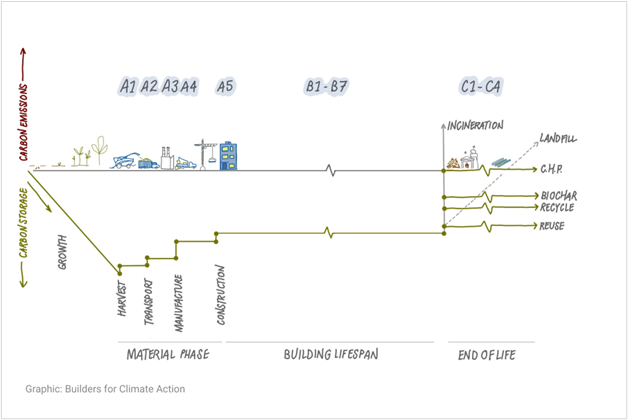
A1 – Sequestration from atmosphere to growing plant, A3 – Emissions from manufacturing losses of biomass feedstock, A5 – Emissions from losses of biomass during construction/installation, B4 – Emissions and/or storage from replacement of biogenic products, C4 – Disposal emissions from incineration or landfill of biogenic material.
3.2.1 Gross vs net carbon
One central question to be answered for a dynamic LCA method is whether calculations will be based on a product’s gross or net biogenic carbon storage.
- Gross storage is the total biogenic carbon stored in the product.
- Net storage is gross storage minus production-stage emissions.
Both values can be derived from EPDs, but the choice strongly influences how products are ranked and results communicated.
The use of gross storage values has several advantages. It is simple to calculate, transparent, and easy to communicate: a building “stores X tonnes of biogenic carbon,” distinct from the embodied emissions it generates. This approach aligns well with the notion of a simple overlay with conventional LCA, since storage is already reported distinctly from emissions. This clarity allows practitioners to see both sides of the “balance sheet” at the whole building level.
However, the use of gross storage values can be misleading at the product scale. A biogenic product requiring emissions-intensive production methods might show substantial gross storage and also high fossil-based emissions. Using net values would make this obvious, as a product with higher emissions than storage would demonstrate net emissions while a product with more storage than production emissions would demonstrate net storage.
| Eelgrass interior boards | Wood wool interior boards | |
|---|---|---|
| Gross Storage | 450 kgCO2e | 1496 kgCO2e |
| Product Emissions | 300 kgCO2e | 1580 kgCO2e |
| Net Storage/Emissions | -150 kgCO2e | 85kg kgCO2e |
Figure 4: This example compares two actual bio-based interior board products modeled in the BEAM software and shows how gross storage and production emissions together determine a product’s net climate impact. Both eelgrass boards and wood-wool boards store biogenic carbon, but their manufacturing emissions differ substantially. When evaluated using gross storage alone, wood-wool boards appear far more climate-beneficial. Once production emissions are included, eelgrass boards demonstrate net carbon storage, while wood-wool boards show net emissions. This distinction would be obscured in a calculation methodology that reports only gross storage, underscoring the importance of providing both gross and net values in product-level assessment.
Net storage reflects the balance between storage and emissions at a product level, enabling products to be ranked by a single value, which can be useful for procurement or policy frameworks. By integrating storage and emissions, net reporting also prevents low storage/high emission products from being misrepresented as wholly beneficial. Yet this approach has drawbacks: it blurs the distinct role of biogenic carbon, can hide important differences between products with similar net values, and is harder to implement as an overlay since it alters the existing LCA balance sheet.
The choice between gross and net values depends on the audience for results. For policy, net reporting may be preferable to avoid overstating benefits. In procurement, either approach could work: gross values highlight storage potential, while net values help avoid misleading positives. For design and communication, gross values are often more compelling for telling the “carbon storage” story, while net values provide clearer trade-off information for decision-making. A credible approach may therefore need both: gross storage for transparency and storytelling, and net values for ranking and policy contexts.
3.2.2 Product lifespan, replacement, and end of life assumptions
Current LCA standards treat the end of life of biogenic products in simplified, static terms. Following standards ISO 21930 or EN 15804, all stored carbon is assumed to be released instantly at disposal. ISO 21930 allows users to classify biogenic carbon as “permanently stored” if it remains stored in a product/building for more than 100 years, whereas EN 15804 does not recognize permanent storage. These conventions keep reporting simple and consistent but fail to reflect the range of real-world outcomes for the climate.
In practice, end-of-life outcomes can differ dramatically. Carbon may be released immediately through incineration, gradually and often incompletely over decades through landfilling (as methane), or fully or partially retained through reuse or recycling. An accurate dynamic approach would account for how these emissions unfold over time, capturing the way storage and release accumulate across the full system life cycle.
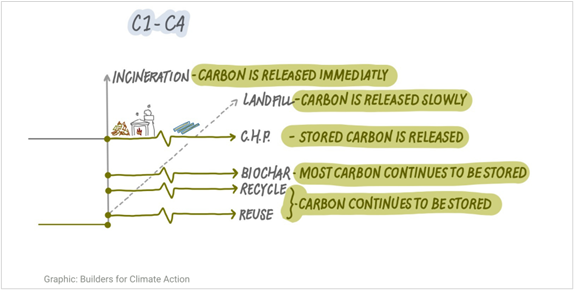
Product replacement cycles add another layer of complexity. Conventional LCAs assume “like-for-like” product replacements within the assessment period, treating each as a separate product with its own emissions and storage. In dynamic models, each replacement is counted as a new storage event while end-of-life emissions from earlier products may still be occurring. When both are captured together, the system begins to show a form of equilibrium: new materials entering the building offset emissions from older ones leaving it. This balance reflects real conditions more accurately and allows the value of cumulative storage to become visible.
Static cutoffs, such as the conventional 60- or 100-year horizon, can distort this picture. They truncate emissions and storage that occur beyond the reporting window, ignoring carbon that may remain locked in materials, landfills, or secondary products. This compression can underestimate the benefits of long-lived storage and exaggerate the short-term impact of eventual release. For example, landfill decay extending over several centuries would appear as an instantaneous release. By forcing all carbon flows into a fixed timeframe, the cutoff obscures differences in longevity and masks opportunities for design or policy to extend storage duration, such as landfill methane capture.
Incorporating wider timeframes into modeling helps reveal that storage and emissions often continue well beyond fixed reporting windows. Accounting methods that reflect this temporal dimension can illustrate how carbon remains stored, released, or reabsorbed across product lifespans, replacement cycles, and end-of-life outcomes. To be credible, future methods need to capture these ongoing flows rather than compressing them into a single instant, arbitrary boundary.
3.2.3 Reporting metrics
A central lesson from conventional LCA is that the choice of reporting metric shapes how results are understood and acted upon. At its foundation, climate science relies on radiative forcing, a measure of the change in atmospheric energy balance caused by greenhouse gases. This can be expressed in watts per square metre (W/m²), or as a change in global mean surface temperature (ΔT in °C). Radiative forcing and ΔT are the most scientifically precise ways of describing climate system response, but they are rarely used in LCA practice. To make results more communicable, a number of metrics have been developed.
Global Warming Potential (GWP) expresses cumulative radiative forcing of a gas relative to CO₂ over a defined time horizon, usually 100 years (GWP100). GWP100 has become the dominant metric across research, practice, and policy, but its dominance stems from convention rather than scientific consensus Reference 2.
Global Temperature change Potential (GTP) estimates the effect of emissions on future global temperature, and may be more policy-relevant, particularly in the context of temperature-based targets like those in the Paris Agreement (Reference 2 ; Chilton, 2025)Reference 4.
AGWP (Absolute Global Warming Potential) and AGTP (Absolute Global Temperature change Potential) are absolute metrics that report cumulative forcing or temperature change without converting to CO₂e. These approaches provide absolute results but are rarely used in LCA.
Global Warming Impact (GWI) similarly reports cumulative radiative forcing in absolute terms, offering a clear view of atmospheric impact but limited comparability to CO₂e-based reporting.
Some metrics capture the physical cause of climate change directly, as with radiative forcing (RF), which measures the immediate change in the Earth’s energy balance. Others, such as AGWP and GWP, capture the cumulative forcing effect of greenhouse gases over time, showing how energy builds up in the atmosphere. Metrics like AGTP and GTP focus on the climatic response, expressing how that accumulated forcing translates into changes in global temperature.
This tension between scientific accuracy (radiative forcing and temperature change metrics) and practical communication (CO₂e reporting through GWP) is exactly the space in which dynamic methods operate. They build on LCA’s reliance on GWP but seek to adjust or complement it in ways that better reflect the temporal profile of biogenic carbon storage and release.
While LCA literature debates the relative importance of one metric over others (Breton, 2018), there is no compelling reason that a dynamic assessment cannot provide results in all of the relevant metrics.
3.2.4 Key insights
Conventional LCA and EPDs provide standardized inputs and reporting structures that a more time-sensitive approach can build on. The opportunity lies in extending, not replacing, these systems with factors that capture the full carbon story.
The structure of life cycle modules already defines where many biogenic carbon flows occur and where time-sensitive climate impacts can be represented. An effective dynamic methodology can build upon existing LCA data while revealing what static approaches obscure about the climate impact of biogenic carbon.
Rather than defining a single correct metric or boundary, a robust dynamic methodology should enable users to test assumptions, adjust timeframes, and present results in multiple forms. Doing so would preserve scientific robustness, maintain compatibility with established frameworks, and make results relevant for both design and policy, while keeping the role of time clearly visible.
3.3 What dynamic LCA methods teach us
3.3.1 Why dynamic methods matter
Static LCAs total all emissions across the life cycle of a product or building and express the result as a single GWP value at the end of the study period. This simplification misses an essential reality: the climate responds differently to an emission released today than to the same emission decades later. As Chilton (2025)Reference 4 explains, "…compared to static LCAs, dynamic LCAs improve accuracy by evaluating the impact on climatic radiative forcing occurring at any given point in time." For example, storing carbon in a building for 50 years reduces near-term radiative forcing compared to releasing it immediately, but static LCAs do not capture that difference.
Studies can incorporate dynamics in several ways (ex temporal, locational, or methodological) but in this project the focus is on temporal dynamics: how emissions and storage are represented over time. A growing body of research now applies temporal modeling to real products, such as fast-growing fibers used in building assemblies, highlighting its value for decision-making (Chilton, 2025)Reference 4. This shift marks an important move beyond hypothetical models toward results that can inform real-world outcomes. The present work builds on this trajectory not by proposing a single dynamic method, but by mapping the foundational considerations that any credible approach to valuing biogenic carbon storage must address.
Dynamic LCA is one family of approaches, but it is not alone. Other methods also attempt to quantify the value of temporary storage, including LCA-based models (Levasseur, Ventura), ton-year accounting Reference 10, and policy and economic frameworks such as the ILCD or U.S. EPA’s social cost of carbon. The central question is how each approach handles the parameters identified in this research – timing, regrowth, counterfactuals, and completeness of flows.
Early comparisons suggest convergence is possible, and that very different approaches can actually produce similar results Reference 5. This demonstrates that it is not necessarily the choice of method that matters most, but whether it captures the right factors and applies them transparently.
3.3.2 Approaches for valuing carbon storage
Several methods have been developed to capture the climate value of delayed emissions or temporary storage, each with its own logic and area of application. While they differ in framing, all aim to move beyond static assumptions and make the role of time visible.
Dynamic LCA (Levassuer, Ventura) tracks when emissions and removals occur and models their changing radiative forcing over time. By using time-dependent characterization factors instead of fixed GWPs, it shows how delayed emissions or temporary carbon storage influence warming throughout a product’s lifespan. Though scientifically rigorous, dLCA is data-intensive and remains used mostly in research rather than routine practice. Various dLCA methodologies select different time horizons and/or report in different metrics, making consistent use of dLCA difficult in practice.
GWPbio Reference 7 adjusts standard CO₂-equivalent values to reflect how fast biogenic carbon is taken up and released. It links carbon cycle models with vegetation growth curves to show how regrowth affects the timing of emissions. Its main strength is compatibility: results remain in CO₂e, making it easy to integrate with existing LCAs, EPDs, and policy frameworks.
Ton-year accounting Reference 10 Reference 11 measures both how much carbon is stored and how long it stays out of the atmosphere, while also accounting for the gradual degradation of CO₂ over time. It compares the cumulative radiative forcing from an immediate emission with the reduced forcing achieved by delaying that emission within a fixed time horizon. The result is expressed as an equivalence factor between tons of CO₂ and “ton-years” of storage, assigning credit in proportion to the avoided climate impact during the delay.
Social Cost of Carbon (EPA) assigns a monetary value to the damages caused by emitting one additional ton of CO₂, linking emissions to future global costs such as health impacts, agricultural losses, and infrastructure damage. It applies a discount rate to express those future harms in present-day dollars.
International Reference Life Cycle Data System (ILCD), (developed by the European Commission) adds a time adjustment to standard LCA by reducing the impact of emissions that occur later. It treats biogenic CO₂ uptake as a negative emission and its eventual release as a positive one, then reduces the impact of delayed emissions using a fixed 100-year window. Each year of delay decreases the impact by about 1%, meaning an emission released 50 years later counts at roughly half its full storage value. Of note: France’s RE2020 regulation uses a time-adjusted method derived from the ILCD framework.
The British Publicly Available Specification (PAS) 2050 method (developed by the British Standards Institute) recognizes the climate benefit of delaying emissions by granting a credit for how long carbon remains stored in a product. Within a fixed 100-year window, longer storage earns proportionally higher credit, reflecting the reduced warming over that period. Designed for product carbon footprinting, it offers a practical and easily communicated way to account for temporary storage, though it omits emissions that occur beyond the 100-year boundary.
Each of these methods highlight different aspects of the time value of carbon but each misses some important considerations.
- Dynamic LCA provides the most scientifically robust representation of how emissions and removals influence radiative forcing over time, but its data intensity and complexity limit its use in practice and different methods prescribe their own time horizons and metrics.
- GWPbio shows how regrowth dynamics can be folded into familiar CO₂e metrics, but it ignores product lifespan and end of life considerations.
- Ton-year accounting highlights the cumulative value of storage based on the degradation of CO₂ emissions in the atmosphere. This is a simple, linear method but can lead to overstatement of storage benefits over longer time horizons because there is no upper limit to the storage benefit.
- The Social Cost of Carbon translates climate impacts into economic terms that support policy and regulation, but the cost can be set arbitrarily with different outcomes depending on the chosen cost.
- The ILCD method offers a simple, transparent way to credit delayed emissions, but it relies on linear approximations rather than real climate physics, truncating at 100 years.
- PAS 2050 provides a practical way to communicate the benefit of temporary storage, but its fixed 100-year horizon ignores long-term emissions and regrowth beyond that window.
While each of these methods can represent the time value of biogenic carbon storage, there are limitations to each. A robust method would need to learn from each of these but not be limited to any one of them to avoid embedding the inventory incompleteness inherent in each.
3.3.3 Temporal considerations and the importance of time horizon
Dynamic methods and related research make clear that time horizons, assessment periods, and life cycle durations must be carefully distinguished and aligned. Breton (2018) identifies three key concepts: the time horizon (the period over which impacts are characterized, often – and problematically – 100 years), the period of assessment (the temporal boundary of the study), and the life cycle duration (how long the product actually exists, such as 60 years for insulation or 200 years for timber). Conventional practice often compresses these distinctions into a fixed 100-year horizon, which creates two problems: impacts that occur beyond the window are excluded, and those that happen sooner are disproportionately emphasized. As Levasseur (2010) notes, the selection of a time horizon is not a neutral scientific step, but rather “equivalent to giving a weight to time.”
Cherubini (2011), when introducing GWPbio, showed that fast-growing crops quickly reabsorb carbon, making storage appear highly effective across all time horizons. By contrast, slow-growing forests take decades to recapture carbon, so storage looks less beneficial – especially at 20 years, when product emissions dominate the picture. Over longer horizons, regrowth balances out these emissions, but the near-term dynamics are hidden. This variability explains why studies using 20-, 100-, or 500-year horizons often reach very different conclusions, even while the IPCC has emphasized that these horizons have no intrinsic scientific significance Reference 3.
The risks of arbitrary cutoffs are well documented. Many studies default to a 100-year Total Observation Duration (TOD) because it aligns with software settings or policy norms, but this truncates flows and ignores what happens after the window closes. The result can be misleading – for example, a product incinerated at year 101 could appear to provide “permanent” storage if its emissions are never counted. Some approaches tilt results further by omitting re-emissions altogether.
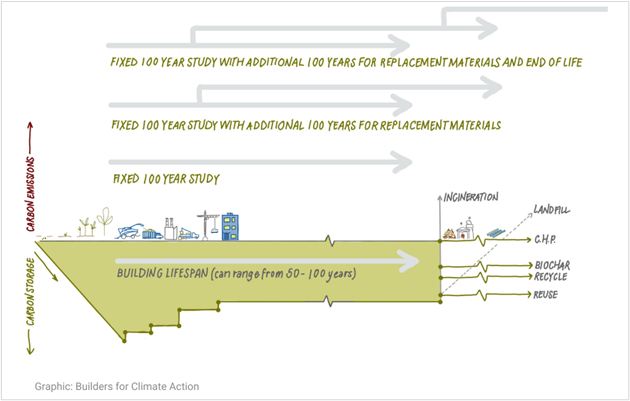
Frameworks such as Levasseur’s dynamic GWP and Ventura’s subsequent refinements attempt to address this. Levasseur applies a fixed TOD (typically 100 years) to improve consistency, but this still truncates flows – like measuring rainfall but putting away the gauge before the storm ends. Ventura (2022) emphasizes that the observation window for a study should not be chosen arbitrarily. Instead, it should be based on two things: how long the product actually exists in the real world, and how long its emissions continue to have an impact in the atmosphere. In other words, if a product lasts 80 years and its emissions continue to matter for another 100 years after disposal, then the study should cover that full 180-year period. This ensures that all storage and emissions are accounted for, rather than cutting off the analysis at an artificial boundary like year 100. By tying the study window to real-world lifespans and climate science, the results become more transparent, consistent, and meaningful, especially for long-lived materials.
In practice, however, most tools and standards still truncate results. ISO 14040 and EN 15804 require all relevant flows to be included unless exclusions are documented, but studies often fall short. France’s RE2020 regulation makes progress by dynamically adjusting GWP values, yet it still caps analysis at 100 years, undervaluing delayed emissions.
The core issue is not which horizon is “correct,” but that truncation distorts results for long-lived materials. As dynamic studies consistently show, delayed emissions and extended storage can persist well beyond conventional reporting windows.
3.3.4 Other methods of incorporating time
Several alternative approaches have been developed to bring the dimension of time into carbon accounting. Unlike dynamic LCA and GWPbio, which are grounded in physical flows of carbon and radiative forcing, the following concepts and methods relate more to economics and policy, applying concepts such as discounting, weighting, or crediting. Their appeal lies in simplicity: they offer an attempt to represent complex climate dynamics with simple factors that can be used in procurement, policy, or investment. As a result, they are often more visible in practice than temporal LCA approaches, even if they capture less of the underlying science.
One such approach is discounting, which reduces the value of future impacts compared to those that occur today. Borrowed from economics, it reflects the idea that societies tend to prioritize near-term outcomes – a logic that underpins the Social Cost of Carbon approach outlined by the EPA Reference 6. A high discount rate heavily devalues the future, while a low or declining rate gives more weight to long-term impacts, as seen in policies in the UK and France (Wild, 2020). Critics, however, argue that discounting is ethically indefensible in LCA, since it effectively devalues the wellbeing of future generations Reference 8.
Another common tool is the use of weighting factors, which attempts to give higher or lower value to the range of impacts across categories such as climate change, toxicity, and resource use. Weighting introduces subjectivity by assigning relative importance to each category, sometimes with simplified temporal adjustments. For example, the British Standards Institution has proposed weighting schemes for long-lived products based on simplified carbon-cycle models Reference 8. These systems help decision-makers by offering comparability across different impacts, but the trade-off is that results embed social and political values, which must be transparent to remain credible and may not be based on real world outcomes.
A third approach is crediting, which integrates temporary storage into life cycle results without changing the emissions math. The PAS 2050 specification does this by granting credits based on the average time carbon remains stored in a product. Carbon kept for the full 100 years of the assessment period is treated as permanent, while shorter storage receives proportionally smaller credits. This system makes temporary storage visible in results and translates it into an adjustment factor that policymakers and practitioners can use. Variations on this logic have been explored by Levasseur (2012) and Reference 15.
Taken together, these methods show that time can be incorporated into carbon accounting in ways that are accessible and easy to apply – but all rely on simplifications and truncations, and underscore the need for methods that capture the full trajectory of carbon flows while still producing results simple enough to guide real-world decisions.
3.3.5 Regrowth profiles
How quickly biomass regrows shapes the climate value of carbon-storing building materials. Modeling studies show that fast-growing fibers (annual crops like straw, hemp, grass) with short rotation cycles recapture atmospheric carbon quickly, allowing them to deliver a net cooling effect relatively quickly. When these materials store more carbon than is released during production, their regrowth rate determines how soon that net benefit is realized. Slow-growing feedstocks such as trees, by contrast, may take decades before their regrowth offsets the initial release, delaying the cooling effect into the future. Non-biogenic products, such as concrete and steel, never provide a comparable benefit ( Reference 3, Chilton, 2025)Reference 4.
Recent research highlights how strongly climate outcomes depend on regrowth rates. As Chilton (2025)Reference 4 explains, "The faster the biogenic materials regrow, the faster the CO₂ is removed from the atmosphere, and the sooner the net cooling effect can occur … the rate of regrowth varies drastically, ranging from less than one year with some agricultural crops to 45–120 years for slow-growing trees." Adding time to life cycle analysis makes it possible to capture these differences in rotation cycles and better reflect the role of feedstock choice in climate performance.
The GWPbio metric, developed by Cherubini and later refined by Guest Reference 7, helps express how regrowth speed affects climate impact. Yet regrowth alone does not determine the climate value of biogenic materials. The outcome also depends on what happens to the biomass over time: how much continues to store carbon in soils or new growth, how much is lost during processing, and how much CO₂ is released through decay, combustion, or reuse. Capturing these regrowth patterns alongside end-of-life pathways and time horizons is essential for methods that aim to describe the complete trajectory of biogenic carbon flows.
3.3.6 Key insights
The central lesson from this review is that time matters. An emission released today does not have the same climate effect as the same emission released decades later. Methods that ignore this temporal reality risk overlooking one of the most important drivers of climate impact.
The speed of regrowth is one of the most significant differentiators among bio-based feedstocks. Fast-growing crops can achieve net storage within years or decades, while slower-growing biomass may take much longer to rebalance its carbon cycle. Static methods cannot capture this distinction, which is why incorporating time into assessment is essential for accurate results.
Equally important is how time is represented. Assessment periods, time horizons, and product lifespans must all be factored, or results can become misleading. A credible approach should not prescribe one “correct” horizon but instead capture the full set of flows and then allow results to be viewed through different TODs, depending on the purpose – policy, procurement, or design. Time horizons are not scientific truths but modeling choices that reflect social and policy priorities, and transparency about those choices is essential.
What stands out most is that many of these methods lead to similar conclusions, even if their framing differs. The real uncertainties lie not in the equations themselves but in the parts of the feedstock life cycle that remain unaccounted for. Addressing those missing flows is more important than refining formulas that already point in the same direction. The next section explores what is still missing from both static and dynamic approaches and how those gaps can be addressed.
3.4 What’s missing from both static and dynamic LCA
3.4.1 Inventory flow completeness
To understand the true climate impact of a product (and by extension, a building), the full story of carbon flows needs to be captured from beginning to end. Many LCAs apply cut-offs that ignore emissions occurring outside the defined time horizon, but similar omissions occur before the product stage, when not all harvested biomass is carried through to the product system. Although standards require all relevant flows to be included, this is not always enforced in practice Reference 14. Upstream losses such as timber slash and other feedstock waste can release significant amounts of CO₂ before the usable biomass enters the LCA boundary. Starting the accounting boundary further upstream would help capture these losses and provide a more complete picture of each material’s carbon cycle.
Not all feedstocks present the same challenge. Agricultural residues and byproducts, such as straw, would have released all their carbon back to the atmosphere shortly after harvest. Incorporating these materials into building products transforms what would otherwise decompose or be burned into a period of measurable carbon storage. These short-cycle materials are far simpler to account for than long-rotation systems because the carbon flows are largely confined to the product module itself.
By contrast, wood products illustrate how complex incomplete accounting can become. About half of a tree’s dry weight is carbon, yet a large portion of that stored carbon never makes it into products Reference 1 . Significant amounts of slash (branches, bark, tops, and roots) remain in the forest, where they are often burned or left to decompose. To get a pile of dimensional lumber out of a round tree, a large portion of the original biomass is lost. Studies suggest that close to half of the harvested forest biomass is left behind, wasted or incinerated during harvest and processing (Corgan, 2022), meaning a substantial share of the tree’s carbon is released to the atmosphere before products even reach the building. Yet not all of these losses are accounted for in product LCAs or EPDs.
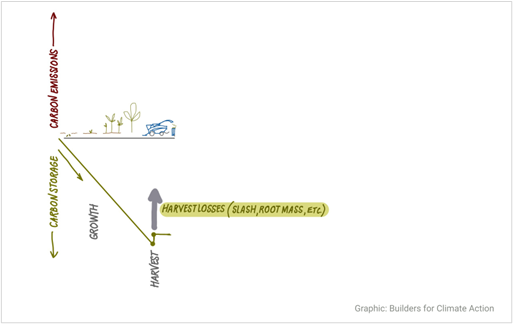
How these residues are managed also matters, especially for timber products. Burning releases emissions immediately, while alternatives such as mulching can reduce impacts. Accurately accounting for these flows at the extraction stage is essential for credible carbon accounting and for comparing materials on an equal basis. Without explicitly modeling these flows, assessments risk overstating the carbon benefit of products and masking important differences between management practices.
Some timber feedstocks can avoid these trade-offs altogether. Wood from thinning operations or urban tree removals, for example, comes from biomass that would otherwise have been burned or left to decompose, releasing CO₂. Using this material in long-lived products turns an inevitable emission into a measurable period of storage.
Land-use dynamics also play a critical role. When increased demand for bio-based materials displaces food production or drives land conversion, the resulting emissions – both immediate (vegetation removal) and long-term (loss of future sequestration potential) – can outweigh storage benefits. By contrast, materials derived from residues or by-products avoid most of these issues, since they make use of material that would otherwise enter short-term carbon cycles. These relationships are well established in the biofuel literature (Levasseur, 2010) but remain largely unexplored in the context of construction materials.
Expanding system boundaries to capture these pre-product and out-of-scope flows does not mean that every model must explicitly calculate them. Rather, credible methods should recognize where these flows exist and, where possible, start the accounting boundary further upstream. This broader framing highlights not just the importance of capturing all relevant carbon movements, but also raises a deeper question about how those movements are assigned in the first place, an issue of directionality.
3.4.2 Directionality
Directionality refers to whether carbon uptake from biogenic feedstocks is accounted for before or after harvest. In other words, it is a modeling choice about when carbon removals are recognized, not a physical property of the system itself.
In a backward-looking approach, the photosynthetic uptake of CO₂ during plant growth is credited as a climate benefit when the feedstock enters the product system. This means that harvested biomass is treated as carbon negative at the point of manufacture. This convention is used in most static LCAs. This approach implies that carbon stored in the product represents a new climate benefit at the time of manufacture, even though the sequestered carbon was already absorbed from the atmosphere prior to harvest. As some authors note, by the time the plant is cut down, the atmosphere has already reflected that uptake, so the climate has not improved further at that moment.
The forward-looking approach, by contrast, attributes sequestration to regrowth that occurs after, and because of, harvest. It treats the harvest as creating a temporary carbon debt that is repaid as replacement biomass grows. As Chilton (2025)Reference 4 explains, “the main carbon benefit of bio-based construction is not the transfer of harvested biogenic carbon from nature to the building stock – it is from the additional CO₂ that is removed from the atmosphere when the biogenic fiber sources regrow. For these reasons, a forward-looking approach is a more appropriate approach for decision-making purposes”. This perspective highlights regrowth as the key differentiator among feedstocks and is often considered more meaningful for evaluating the real climate benefit of bio-based materials.
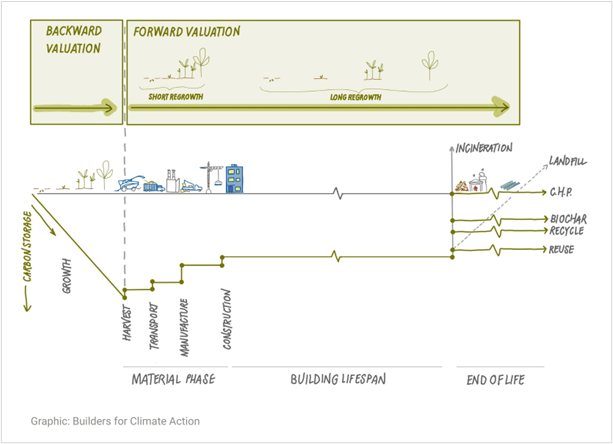
The timing of regrowth matters greatly. Slow-growing trees take decades to rebalance the carbon released during harvest and production, while fast-growing crops such as straw, hemp, or bamboo can recapture emissions much sooner and provide a near-term cooling effect. As Chilton (2025)Reference 4 observes, “EPDs treat all bio-based products the same, regardless of the biogenic fibers’ speed of re-growth (i.e., the speed of carbon removal). This is an inaccurate and unrepresentative way of measuring climate impact and does not convey the realities and tangible benefits of using fast-growing fibers.”
Levasseur (2010) demonstrates the same principle in bioenergy systems. Burning biomass releases more greenhouse gases per unit of energy than fossil fuels, creating a carbon debt that is only repaid as the biomass regrows. Because forests may take a century to recover, releasing the carbon stored in slow growth bio-based materials can worsen near-term warming even if the system eventually reaches balance over time. This illustrates the challenge of forward-looking accounting: the timing of regrowth relative to emissions determines whether a system delivers near-term climate benefits or exacerbates warming. Over very long timescales, these two perspectives eventually converge, but within the shorter timeframes that matter for climate action, they can lead to very different results. Dynamic modeling makes this visible, showing that some fast-growing materials can shift from net emissions to net storage within just a few months, or years – something static methods cannot capture.
3.4.3 Key insights
Across both static and dynamic life cycle assessments, no single method fully captures a complete inventory flow of biogenic carbon. Upstream losses, regrowth timing, and land-use effects are often excluded, while directional assumptions can impact how the outcome is presented. A credible future method must therefore account for all carbon flows, from harvest through regrowth and end of life, so that results reflect the full cycle rather than a partial snapshot.
Completeness, not simplification, should form the foundation. A robust approach would extend beyond the product boundary used in static LCA to include pre- and post-use stages, recognize that regrowth and release unfold over time, and reflect how management practices shape real outcomes. Users should be able to view results across any timeframe: 25, 60, 100, or even 500 years. While modeling should capture the full trajectory of carbon flows, including long-term decay or storage, the reporting window itself should align with the periods most relevant for climate action. Setting that window is ultimately a policy or standard-setting decision, but the calculation tool should allow results to be viewed at any point in time. Only by capturing the full picture can future methods communicate the true climate value of stored biogenic carbon.
3.5 Overlaying with conventional LCA
Accounting for timing of emissions and sequestration in life cycle assessment does not mean abandoning existing methods. A time-based approach can build directly on the structure of conventional LCA, using the same modules as data sources. This overlay with conventional LCA is critical if a new dynamic approach is to achieve substantial uptake in the industry.
A dynamic methodology could draw on established LCA models to provide the data and assumptions from modules A1, A3, A5, B4, C4, and D, along with key product information such as expected lifespan and biogenic carbon content. The additional factors noted in this report – pre-product carbon losses, regrowth cycles and representative end-of-life scenarios – can be added to the core data that comes from conventional LCA. In this way, a robust dynamic methodology could be performed alongside conventional assessments, adding temporal insight to the carbon flows already reported through static methods.
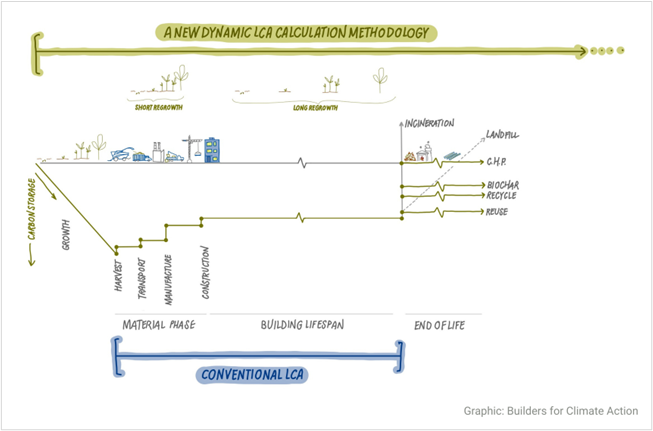
This approach maintains compatibility with existing workflows for LCA practitioners and enables results to remain comparable across tools and standards. It avoids duplicating effort while making time-based effects visible, supporting both scientific accuracy and practical adoption. By building on familiar structures, a dynamic overlay can help integrate temporal accounting into mainstream practice without disrupting the systems already in place.
4. Results and Observations
A relevant and credible Canadian approach to valuing stored biogenic carbon must establish a robust inventory completeness including harvest carbon flows, emission timing, regrowth dynamics, and end-of-life flows. No existing method addresses currently achieves this level of inventory completeness.
Methods differ in how they handle replacements, end of life, and inventory completeness. Some approaches recognize delayed or avoided emissions depending on material use, replacement cycles, or disposal, but none account for losses that occur before the product stage, such as harvest residues. These early flows can release significant carbon and are critical for accurate accounting.
Comparative research shows that delaying emissions by storing carbon changes the timing of atmospheric decay and the resulting radiative forcing trajectory, yet most approaches capture this in similar ways. Whether time is represented through discounting, crediting, or dynamic modeling, results tend to converge when the same parameters are applied. This suggests that consistency in assumptions regarding time horizon in particular, as well as factors such as regrowth rates and end-of-life scenarios, can impact results as much as or more than the specific method chosen.
Differences in time horizons often create confusion without improving insight. An effective dynamic LCA approach for Canada would establish calculation norms that extend across the full lifespan of materials, for example 200 to 500 years, allowing users to view climate impacts at any point along that continuum. The literature consistently notes that selecting a time horizon in LCA is a fraught choice that introduces bias into results. A more credible framework would base calculations on complete inventory flows rather than fixed windows of time. Results could then be viewed as snapshots along a continuous timeline, accommodating diverse policy and design perspectives while maintaining transparency about what each timeframe includes or omits. Together, these findings highlight the need for a practical and transparent path forward, one that builds on existing systems while addressing the gaps identified in this review.
5. Recommendations and Path Forward
5.1 Criteria for considering biogenic carbon storage value appropriately
Time matters: emissions and removals that occur at different points in time have different climate effects. To value biogenic carbon credibly, future Canadian methods must represent the complete temporal picture of biogenic material life cycles.
Inventory completeness is the foundation of credibility. Accounting should include upstream losses such as timber slash and processing residues, track regrowth dynamics, and follow end-of-life pathways through to completion, ensuring no major carbon flow is left unaccounted. Within that full timespan, users should be able to view results at any point in time relevant to their purpose, whether for policy, design, or research.
A practical approach would build on the LCA approaches already in use. This alignment would make it possible to overlay dynamic parameters on existing data and workflows without requiring entirely new infrastructure or datasets. Results should remain expressed in CO₂e while including complementary metrics or indicators.
Usability is essential for adoption. Even the most scientifically robust method will fail if it cannot be applied in practice. Future methods should be consistent, transparent, communicable, and easy to use within existing tool environments. Practitioners should be able to apply them with accessible data and interpret results that directly inform design, procurement, and policy decisions. The objective is to make credible accounting of biogenic carbon both scientifically sound and operationally practical.
5.2 Technical and implementation considerations
User choice of time horizon: Results should be available at multiple time horizons, not just a single 100-year view, allowing for viewing of results at 25, 60, or 500 years within one model. This enables alignment with conventional standards while showing the near-term and long-term values of carbon storage and transparently demonstrating if any significant carbon flows are being omitted.
Product-level calculation: Calculations should be performed at the product level and aggregated to the building level, since each product has its own life expectancy and replacement profile. This supports consistency with current LCA practices.
Scope of assessment: The focus should remain on direct carbon storage, not substitution effects or avoided emissions. The objective is to value the time carbon is physically stored in materials, not to credit hypothetical savings from product swaps.
Reporting both gross and net storage: For transparency and comparability, both gross and net results should be reported. Gross values show the total carbon stored in materials, while net values reflect the balance after accounting for emissions across the product’s life cycle.
End of life and replacement assumptions: End-of-life scenarios must reflect real disposal pathways and delayed emissions from recycling, reuse, or decomposition. Replacement cycles should be modeled dynamically to show how storage accumulates or declines over multiple product lifespans, maintaining consistency with evolving LCA practice.
Multiple metrics: The method could support multiple reporting metrics, such as GWP, global temperature potential (GTP), or radiative forcing (W/m²). This enables alignment with both climate science and existing policy frameworks while keeping the core calculation engine consistent.
5.3 Recommended pathways and practical considerations
Future development should focus on building a method that meets these criteria and aligns with Canada’s broader climate and data ecosystem. The following actions are recommended to advance a credible and practical approach.
Refine and test expanded inventory flows: Future work should test and refine the additional carbon flows identified in this report to confirm completeness and determine where simplifications are possible. This could include a default “worst-case” assumption for unknown factors, such as unmanaged timber slash, alongside improved “best-case” options based on certified practices or verified management systems.
Strengthen biogenic carbon data and transparency: A consistent and transparent approach is needed for how biogenic carbon is represented in Environmental Product Declarations and LCA datasets. When biogenic carbon is not reported separately, a standard calculation method should be based on accepted norms for determining the physical mass of carbon in any feedstock. Product datasets should also include biogenic carbon content, regrowth assumptions, and end-of-life scenarios. Federal coordination could help standardize and maintain these data fields to ensure consistent national use across tools and projects. The Construction Stored Carbon certification in Europe is the “world’s first open certification for carbon storage in buildings; enabling construction companies, governments and the financial sector to transform the built environment into a nature-based carbon sink,” and provides a robust methodology for statically assessing biogenic carbon in buildings.
Evaluate extended time horizons: Future work should evaluate which assessment horizons (for example, 200 or 500 years) best balance completeness with practicality. The goal is to ensure that long-term storage and release are captured as fully as possible without introducing unnecessary complexity.
Align dynamic modeling with Canadian climate scenarios: Existing dynamic modeling frameworks should be reviewed and tested against Canada’s selected climate scenarios to confirm consistency and alignment. This step would help ensure that results are compatible with national policy models and global climate pathways.
Coordinate multi-stakeholder collaboration: Developing a robust and harmonized approach will require coordination across sectors and borders. Industry partners, researchers, and policymakers should collaborate toward a shared framework for valuing biogenic carbon storage in long-lived building materials, ensuring international consistency while meeting Canadian needs.
Integrate with existing tools and workflows: Implementation should follow the lightest-weight path possible, requiring minimal new inputs from users and leveraging existing Canadian LCA tools. The goal is to enhance, not replace, current practice.
Confirm system boundaries: Although transport and installation stages (A4–A5) generally have limited influence on biogenic materials, their exclusion should be tested for sensitivity to ensure that boundaries remain scientifically and practically justified.
6. Conclusions
Climate mitigation efforts over the next 25 to 50 years will be critical to preventing the world from crossing irreversible climate thresholds. Every tonne of carbon kept out of the atmosphere during this period matters. Recognizing and valuing biogenic carbon storage enables the building industry to actively pursue effective strategies for turning buildings into carbon sinks, valuing materials such as timber, straw, hemp and waste-stream fibers as meaningful climate solutions. Embedding these principles in Canadian accounting frameworks would help the climate recover while supporting longer-term transformation.
Ultimately, Canada’s approach should ensure inventory completeness, transparency, and compatibility with existing LCA tools while remaining simple enough for wide adoption. Completeness and flexibility are the cornerstones of a credible valuation method.
Using time as a denominator reframes how impact is understood. It shifts the question from whether storage is temporary or permanent to how long carbon remains out of the atmosphere when it matters most. By embedding time directly into accounting, future methods can reveal how the climate benefits of stored carbon unfold and persist. A framework built on these principles would give practitioners the clarity and confidence to account for biogenic carbon in ways that strengthen both immediate and long-term climate action.