
Project location: CanmetENERGY Ottawa
Timeline: 5 years (2023-2028)
Program: Carbon Capture, Utilization and Storage (CCUS)
Project description
Cement production accounts for about 8% of global carbon dioxide emissions and is considered a "hard to abate" industry because of the very high process temperature, which necessitates the use of fossil fuels. CO2 could be captured but it is costly on the large scale of cement plants. However, there is an opportunity to substantially reduce the capture cost because the calcination process (the decomposition of CaCO3 to CaO and CO2), which is a major component of cement production, contributes 60% of the CO2 emissions, while fuel combustion, which provides the high temperature, accounts for the remaining 40%. Referring to Figure 1, calcination mainly takes place in the ‘pre-calciner’. The CO2 from calcination is produced as a relatively pure stream, which would make it cost-effective to capture except that in current cement production it mixes with the fuel/air combustion gases that contain a large amount of nitrogen, necessitating the costly separation. This mixing occurs because the calcination process is in direct contact with the combustion gases. A method to prevent the process CO2 from mixing with the combustion gases is needed. To be most effective, the method should integrate within the existing cement production process, and it should transfer heat efficiently to make it suitable for large scale production.
The project team has carried out process design and analysis, detailed modeling of three indirect heating methods, and cost analysis. An intellectual property disclosure process is underway.
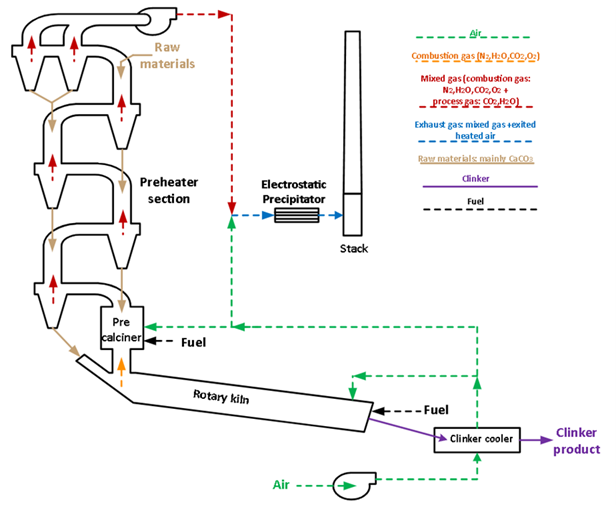
Figure 1: The predominant cement production process. Direct heating in the ‘pre-calciner’ needs to be replaced with indirect heating.