
On this page
Indigenous peoples are recognized as the original ecosystem architects of Turtle Island (now known as North America). As the earliest seed collectors, processors, and distributors, they established and maintained reciprocal relationships with the forest ecosystems for generations. They continue to rely on these lands for food, shelter, medicines, and cultural practices, while also nurturing and sustaining these lands.
The Indigenous Seed Collection Program (ISCP) supports Indigenous communities and organizations in reclaiming these skills and upholding our collective responsibilities in caring for Mother Earth.
About the Indigenous Seed Collection Program
Launched on the spring equinox of 2022 by the National Tree Seed Centre (NTSC), as part of the 2 Billion Trees Program, the ISCP is an Indigenous-led program that supports seed collection capacity and development within Indigenous communities and organizations across this part of Turtle Island (now known as Canada).
Rooted in collaboration, respect, and knowledge-sharing, the ISCP recognizes and respects the essential role that Indigenous values and perspectives play in forest conservation. As forest ecosystems face increasing and unprecedented threats from climate change, invasive species, and development, the ISCP is committed to supporting Indigenous-led efforts to restore, protect, and preserve healthy, resilient forests for generations to come.
By focusing on tree and shrub seed collection, long-term seed banking, and putting species back on the landscape, the ISCP helps protect and preserve Indigenous languages, medicinal and food practices, plant legacies, and cultural memory.
“In some Native languages, the term for plants translates to 'those who take care of us.'”
—Robin Wall Kimmerer, Braiding sweetgrass: Indigenous wisdom, scientific knowledge, and the teachings of plants
Two-eyed seeing and our work
Mi’kmaw Elder Albert Marshall, who conceptualized the term Two-Eyed Seeing explains:
Two-Eyed Seeing refers to learning to see from one eye with the strengths of (or best in) Indigenous knowledges and ways of knowing, and learning to see from the other eye with the strengths of (or best in) Western knowledges and ways of knowing... and, most importantly, using both of these eyes together for the benefit of all
— Marshall M, Marshall A, Bartlett C. Two-Eyed seeing in medicine. In: Greenwood M, de Leeuw S, Lindsay NM, editors. Determinants of Indigenous Peoples’ health: beyond the social. 2nd ed. Canadian Scholars; 2018. p 44.
The ISCP weaves together Indigenous ways of knowing and Western science in our collective effort to preserve and protect our forest ecosystems for future generations. The program holds ethical space for all perspectives and backgrounds, bridging knowledge systems while highlighting connection, communication, and collaboration in our approach to forest gene conservation. Working together through meaningful collaboration strengthens our ability to adapt and respond to urgent ecological challenges while remaining grounded in our shared responsibilities to the land.
Supporting Indigenous leadership in seed conservation
The ISCP aims to support community-specific approaches to preserving genetic heritage through seed collection and storage. This includes, hands-on training, knowledge sharing, and both short- and long-term conservation strategies.
Our key objectives are to:
- Build capacity within Indigenous communities and organizations for seed collection and conservation.
- Where appropriate, integrate Indigenous Knowledge and perspectives into NTSC and ISCP practices and knowledge mobilization efforts.
Hands-on training (field and laboratory)
Introductory field training is typically held within the community/territory when possible and lasts from half a day to a full day. Participants gain practical skills working alongside experienced Indigenous and non-Indigenous NTSC seed technicians. The session covers topics such as seed forecasting, collection techniques, and post-harvest handling and provides a working knowledge of seed ecology and stewardship, which is tailored to species that are of significance to the community.
Laboratory training at the NTSC in Fredericton, New Brunswick, is a week-long, hands-on knowledge exchange focused on key aspects of seed conservation. Participants learn about seed cleaning and processing, storage techniques, viability testing, and germination protocols, all within a collaborative and skill-building environment.
These laboratory training sessions also provide valuable networking opportunities—bringing together Indigenous seed collectors from across Canada and offering connections to researchers at the Atlantic Forestry Centre. This fosters knowledge sharing and helps grow a national network of Indigenous-led seed conservation.
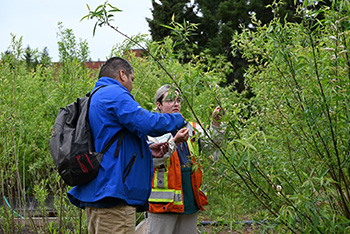
Collecting catkins from a willow tree
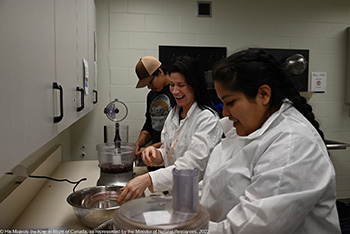
Processing berries in food processors
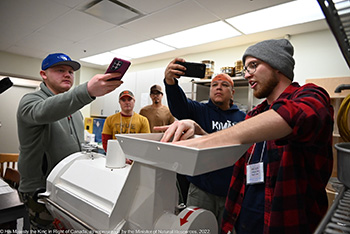
A seed processing machine demonstration
Knowledge sharing
We support Indigenous seed conservation through knowledge sharing using various methods, including virtual gatherings, ongoing technical assistance, and culturally grounded, practical publications co-developed with communities to share seed-handling practices.
- We host virtual network meetings where participants share seed stories and photos to build confidence while forecasting and collecting native seeds, exchange resources and opportunities, and discuss conservation projects across this part of Turtle Island.
- Ongoing technical support via email, phone, sharing of resources, etc.
- The Seeds and Stories pamphlet series is co-developed with the NTSC and ISCP collaborators. This species-specific series highlights the gifts each tree and shrub offer—from seed to other Indigenous and ecological uses—and serves as a quick reference guide on seed collection, handling, processing, germination, and storage practices.
Short- to long-term seed storage
The NTSC offers the option to co-develop a memorandum of understanding (MOU) with partners who choose to participate. Through this agreement, the NTSC can process, test, and securely store seeds on behalf of the partner while fully respecting ownership, confidentiality, intellectual property rights, and cultural considerations. The MOU outlines mutual responsibilities, training, research use, and data sharing, with transparent, community-led protocols for sensitive species.
How to get involved
We look forward to collaborating. If you work with or are a member of an Indigenous community or organization interested in conserving your cultural and plant genetic legacies, please contact the ISCP.
Contact the ISCP
To request more information or to sign up for the newsletter.
Email: iscp-pcsa@nrcan-rncan.gc.ca
Tel: 1 (506) 452-3289
Natural Resources Canada
Atlantic Forestry Centre, National Tree Seed Centre
1350 Regent Street
Fredericton, NB E3C 2G6