
Project location: CanmetENERGY Ottawa, Ottawa, ON
Timeline: 5 years (2023-2028)
Program: Funded by the Program of Energy R&D
Background
Canada is committed to reducing the capital and operating costs of buildings, to reduce building energy use and to reduce emissions. Decarbonizing existing buildings plays a significant role in reducing Canada’s carbon emissions as the building sector contribute to 18% of carbon emissions and many buildings will still exist by 2050. Electrifying buildings is a high potential strategy in decarbonizing existing buildings since 82% of electricity in Canada is produced using clean energy sources. However, electrification will have its adverse effects on the electrical grid. There is limited understanding about how we can use demand-side management (DSM) energy conservation measures (ECM) and emerging technologies to mitigate these adverse impacts on the grid.
We understand energy use patterns in buildings using archetype modelling and simulation. However, there is a difference between the energy use predicted by archetype models and the actual energy use measured in buildings. Also, limited effort has been made to calibrate them against high-resolution data. Analyzing impacts of electrification requires that high-resolution data be used for calibrating energy models. Calibrated models will facilitate evaluation of DSM policies and provide guidance to the stakeholders for effective building electrification.
Project Description
This project strives to mitigate adverse effects of building electrification by identifying DSM ECM for better management of existing buildings’ peak loads in a cost-effective manner. We will develop guidelines on how best to retrofit existing buildings while improving their load balancing. These guidelines will support real estate portfolio managers, utilities, and program managers in managing their electricity loads. Additionally, these guidelines will provide insights for regulators to include peak loads in future building codes.
Our Approach
We are developing DSM ECMs in our Building Technology Assessment Platform (BTAP) as we will be evaluating their impacts on peak loads and energy use of Canadian building archetypes for new construction. We will then develop Canadian building archetype models for existing buildings and evaluate the impacts of DSM ECMs on their peak loads and energy use to develop guidelines for effective building electrification. A summary of our approach is as follows:
- Develop DSM ECMs in the BTAP platform
- Evaluate the impacts of DSM ECMs on new construction
- Modify Canadian building archetypes’ models for existing buildings
- Evaluate the impacts of individual DSM ECMs on existing buildings
- Develop guidelines to transfer the knowledge
Current State of the Project
Residential Buildings
While BTAP provides the necessary time steps for the commercial (Part 3) building archetypes, the residential buildings archetypes have been developed using a software program called HOT2000, which does not provide the time step granularity required for electrification studies.
To remedy this, we are building an exporter from HOT2000 to HPXML/Openstudio to allow sub-hourly simulation results.
Home Performance eXtensible Markup Language (HPXML) standardizes the name, definition, format, and exchange of more than one thousand terms used by the residential energy efficiency industry to describe buildings, energy efficiency and renewable energy features and systems, and energy performance. This format is used by utilities and local authorities in the US to provide a consistent format for housing data for analysis, audits, as well as an input to many data resources and software simulation tools.
U.S. DOE’s Openstudio/EnergyPlus software is a detailed hourly simulation tool that can provide sub-hourly resolution for heating & cooling loads and utility consumption. Openstudio can consume HPXML data to run an hourly simulation.
By building a bridge from HOT2000 to EnergyPlus using HPXML, we will be able to examine the performance of a variety of technologies more accurately than we currently are able to with the current HOT2000 engine. Electrical/thermal storage, thermal resilience measures, and controls-based technologies, are just a few of the strategies we will be able to evaluate. It will also enable us to leverage other tools developed by the U.S. DOE to evaluate community stock modeling.
Residential Buildings - Data Challenges
While we do have access to residential building monitored data through an agreement with Hydro Quebec, we are currently experiencing challenges in accessing detailed data for commercial buildings. Consequently, we have developed a machine learning-based tool, which is designed to overcome data limitations and enable users to quickly and easily evaluate retrofit scenarios. Unlike traditional approaches, such as building simulations, this tool requires minimal expertise and provides faster, more efficient results.
Commercial Buildings - ComStock Database and its Limitations
One of the primary sources of inspiration for this tool is the ComStock database, developed by the National Renewable Energy Laboratory (NREL) in the US. ComStock is an extensive dataset containing detailed information on over 300,000 buildings. It includes calibrated simulation results and incorporates stochastic models that better account for occupant behavior. While this tool addresses many of the data challenges for creating data-driven models, it is geographically limited to the United States. For Canadian buildings, the tool needs to be adapted to account for regional differences and ensure compatibility.
Research Contributions
The new tool developed in the project aims to overcome the challenges of regional data differences by integrating machine learning with data-matching techniques. The key contributions are as follows:
- Improved Data Accuracy with Matching Algorithms
The new tool leverages the ComStock database, alongside Canadian data from the Energy Star Portfolio Manager (ESPM). By using a Euclidean distance-based matching algorithm, the research identifies buildings in the ComStock database that closely match Canadian counterparts. This process addresses the data scarcity issue and ensures accurate inputs for further analysis.
- Scalable Electrification Options Evaluation Framework
The new tool uses a distribution-based method to generalize electrification impacts across a variety of building types, locations, and climate zones. This method provides a robust framework for stakeholders and policymakers to make more informed and data-driven decisions.
- Energy and Environmental Impact Analysis
Key electrification scenarios, such as transitioning HVAC systems to cleaner fuel sources, are evaluated for their potential to reduce greenhouse gas (GHG) emissions, and peak demand impacts. These findings highlight the significant environmental benefits of adopting specific electrification measures.
The Electrification Options Scenario Development Process
The process for developing electrification scenarios from raw data is outlined in the figure below. The workflow starts with data collection from two key sources: real user-input data from the ESPM database (specific to Canadian users) and the U.S.-based ComStock database.
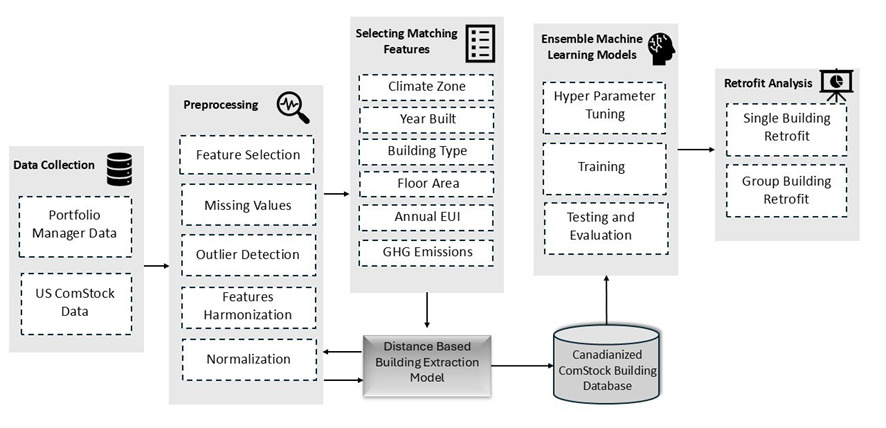
Figure 1. Overall flowchart for developing retrofit scenarios from raw data
Sharing Information
We plan on sharing the tools and related datasets through public websites and reports.