
Great Lakes Forestry Centre (GLFC)
Issue 58, August 2026
- Comings and goings
- Destructive but beautiful!
- Sightings of Spotted lanternfly in southeastern Canada
- NRCan’s Indigenous Forestry Initiative renewed until 2029
- Maps of Organic layer thickness and the Organic Layer Fuel Load developed for forested regions of Canada
- New guide shows how to prepare soil samples for chemical analyses
- NRCan’s Simply Science looks at dark diversity
- Measuring the vulnerability of Canadian forests to invasive insects under climate change
- Publications
- Subscribe/Unsubscribe
Comings and goings
Overview
Congratulations to Dr. Mike Wotton on his retirement!
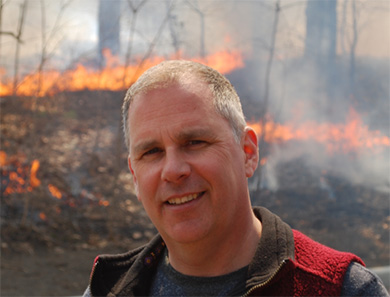
Mike’s career with the Canadian Forest Service (CFS) has spanned more than three decades. He began as a physical scientist in 1990 at the Petawawa Research Forest, advancing through roles of increasing responsibility—including research scientist and ultimately senior research scientist here at the Great Lakes Forestry Centre (GLFC). During his time at CFS, his work focused on forest fire behaviour, fire occurrence modelling, and the impacts of climate change on fire activity.
He served as the lead scientist coordinating the Fire Danger Group since 2009. In this role, he led the development of the Next Generation Canadian Forest Fire Danger Rating System (CFFDRS)—an update to the cornerstone of daily fire management planning across Canada and a tool used nationwide throughout every fire season. The updates advanced under Mike’s leadership represent the first major evolution of the CFFDRS since the early 1990s. He also mentored and trained junior scientists, helping to sustain the longstanding legacy of scientific excellence established by the CFS at both national and international levels.
In addition to his research, he has served as an adjunct professor at the University of Toronto, supervising graduate students, teaching courses in fire behaviour and danger rating, and mentoring the next generation of fire scientists. Throughout his career, Mike has been an internationally recognized leader in wildland fire science. He has contributed extensively through scientific publications, advisory roles, and collaborations with fire management agencies across Canada and around the world. His work has helped translate cutting-edge research into operational tools that are used daily by fire managers.
Mike can still be reached at his University of Toronto e-mail.
Destructive but beautiful!
Overview
Dr. Quentin Guignard’s photo of the Japanese beetle is selected for the cover of the Annals of the American Entomological Society.

Cover: The Japanese beetle (Popillia japonica). Photo courtesy of Quentin Guignard, Natural Resources Canada, Canada.
The cover of the March 2026 issue (Vol. 119, Issue 2) of the Annals of the Entomological Society of America shows an incredible photo of the Japanese beetle, provided by Dr. Quentin Guignard from GLFC. Take a look!
For more information, please contact Quentin Guignard.
Sightings of Spotted lanternfly in southeastern Canada
Overview
Concerns increased as the destructive spotted lanternfly is sighted and intercepted in southeastern Canada.
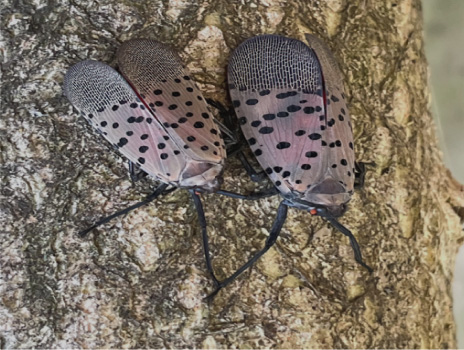
Photo Credit: Anna Turbelin, NRCan
The spotted lanternfly (Lycorma delicatula), which was first detected in the U.S. in 2014, has been sighted and intercepted in southeastern Canada since 2022, but not yet established according to the Canadian Food Inspection Agency (CFIA).
GLFC scientist Dr. Amanda Roe has watched this insect travel further north in the U.S. and says it is common for spotted lanternflies to travel in shipments. They also stick to flat surfaces, such as the vehicles of people coming back from camping trips in the U.S.
Warmer areas can help the insect thrive, but Roe said winter does not appear to deter it either. “Insects often are stopped from coming into Canada because they can’t handle our winters,” she said. “Unfortunately, the spotted lanternfly has lots of ways of surviving winter.” To that end, Roe took part in experiments in Tennessee and Chicago to see how eggs fared over the winter in hotter and colder temperatures. In Chicago, the temperatures got below −20 C many times, but by the end of the winter the eggs had survived.
There are no established populations of spotted lanternfly in Canada—meaning no confirmed reproducing populations in the wild—but experts say the invasive insect still poses a serious threat to vineyards, fruit trees and hardwoods because it feeds on plant sap and can kill grapevines.
For more information contact Dr. Amanda Roe and report possible spotted lanternfly sightings to the CFIA. View the CBC article, Invasive spotted lanternfly found in Ontario. U.S. officials say stomp it
NRCan’s Indigenous Forestry Initiative renewed until 2029
Overview
Indigenous Forestry Initiative (IFI) continues to support projects in First Nations, Inuit and Métis communities.
In August 2025, the Prime Minister announced a $16.9 million renewal of the Indigenous Forestry Initiative (IFI) for 2026–2029 as part of a broader package of measures to transform Canada’s softwood lumber industry. This includes a direct investment of $13 million to advance reconciliation by supporting Indigenous-identified priorities to accelerate First Nations, Inuit and Métis groups’ awareness, influence, inclusion, and leadership in the forest sector.
The program provides funding through two streams: non-repayable contributions and grants.
Under the contribution stream, eligible projects may span multiple years, and support activities related to engagement and consultation, knowledge and science, planning and decision-making, and forest sector development, conservation, and workforce diversification. The most recent call for contribution applications closed on May 13, 2026, and the program received significant interest from communities and organizations across Canada demonstrating the need for this type of support.
To provide more flexible support, IFI also offers an ongoing grant stream that allows communities to access funding as needs arise. Applications are assessed quarterly, with grants of up to $45,000 available to help strengthen Indigenous participation and influence in the sustainable management of Canada’s forests.
At the GLFC, Stephanie Seymour, Indigenous Engagement and Forest Science Policy Advisor, serves as a Regional Liaison Officer for IFI and leads community engagement activities in Ontario.
While much of her work focuses on delivering the IFI program, she also supports GLFC staff in learning about Indigenous cultures and incorporating Indigenous Knowledge into scientific research.
“There is now more movement of bringing Indigenous Knowledge into the science as well, which is really inspiring,” says Seymour.
As the IFI has expanded, Seymour has witnessed a growing diversity of projects that extend beyond economic participation in the forestry sector. In addition to supporting First Nations’ involvement in forest management discussions, IFI funding has helped communities host forest health symposiums, train youth in sawmill operations, and create opportunities for Elders and youth to share land-based knowledge and cultural teachings.
More information about the program, including examples of past projects, eligibility requirements and application materials, is available on the IFI website (IFI Applicant Guide, Contribution Application, and Grant Application), or by contacting Stephanie Seymour.
Maps of Organic layer thickness and the Organic Layer Fuel Load developed for forested regions of Canada
Overview
New maps provide important inputs into the Canadian Forest Fire Danger Rating System and other models.
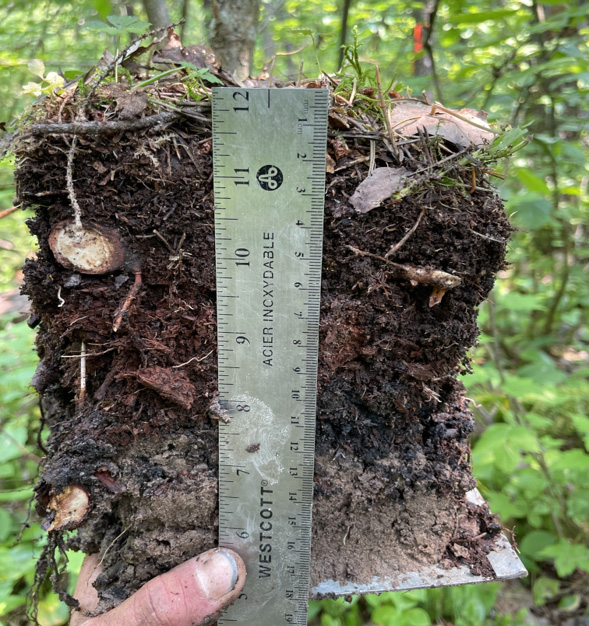
Photo Credit: Patrick Deane, NRCan
Organic layer thickness (OLT), including the F (fermentation) and H (humus) layers and the Organic Layer Fuel Load (OLFL) maps have been developed for the forested regions of Canada and presented in a new publication. The OLFL represents the amount of biomass (kg/m2) in the organic layers that is available to burn. Resultant 30m maps were developed using the methodology established for upland forests, then integrated with wetland mapping and the North American Land Change Monitoring System (NALCMS) for wetland areas.
These maps will provide important inputs into the Canadian Forest Fire Danger Rating System, various carbon emission models and will eventually help differentiate satellite retrievals of soil moisture for organic and mineral soils.
For more information contact Dr. Chelene Hanes and see the publication Organic Layer Thickness and Organic Layer Fuel Load of Canadian Forest Regions, Version 1.
New guide shows how to prepare soil samples for chemical analyses
Overview
Once soil samples have been collected, new guide shows how to prepare them for analysis.
In follow up to “A guide for collecting forest soil samples” (Nelson, et.al, 2025), this guide provides general guidelines on how to prepare forest soil samples for the purpose of chemical analyses following field collection. If the purpose of sample collection is not chemical analyses (e.g., environmental DNA [eDNA], enzymes, trace elements, etc.), processing and storage may need to be modified.
This guide describes processing methods for organic forest floor, mineral soil samples, and bulk density determination. These methodologies are based on those commonly used in the CFS laboratories.
For more information contact Stephanie Nelson and see A guide to soil preparation for bulk density and chemical analysis.
NRCan’s Simply Science looks at dark diversity
Overview
Dark diversity: A new tool for restoration efforts.
GLFC scientists are exploring new ways to help nature bounce back, especially in areas that have been impacted by human activity. One of the tools they are using is something called “dark diversity”—looking at which species should be there but aren’t—to figure out why some plants come back and others do not. This approach can help reveal the hidden effects of human activities, and it is already being used in Sudbury to improve restoration efforts. Join NRCan’s Simply Science as it explores dark diversity in this video, Dark Diversity: A New Tool for Restoration.
For more information contact Élise Deschênes or Kierann Santala.
Measuring the vulnerability of Canadian forests to invasive insects under climate change
Overview
Canadian forests more vulnerable to invasive species under climate change.
Invasive insects threaten the resilience and sustainability of Canadian forests, but a comprehensive national perspective on the extent of this vulnerability is lacking. Canadian forest exposure to invasive pests was assessed by quantifying host biomass intersecting with recent (1981–2010) and near-future (2021–2040) climate niches of 14 invasive insects. Of the 37 most abundant tree species in Canada, 24 were affected by at least one of the 14 focal pests. Spatial assessments of exposure and outbreak severity were combined to create an integrated spatial portrait of vulnerability.
Under current conditions, 3.2 billion tonnes of tree biomass could be exposed to at least one of these pests; this is projected to increase to 13.6 billion tonnes of biomass within two decades. North-central British Columbia (near the BC–Alberta border) and the St. Lawrence Seaway (near the U.S. border) are identified as two vulnerability hotspots.
To highlight the importance of surveillance and early eradication programs, it was shown that a re-invasion of the Asian longhorned beetle (Anoplophora glabripennis) into Canadian forests would put six additional tree species and 3.1 billion tonnes of tree biomass at risk. This nationwide view aims to support risk assessments, guide the prioritization of monitoring efforts, and inform adaptive forest management.
For more information contact Dr. Isabelle Aubin.
Publications
- To order copies of these publications, please contact the Great Lakes Forestry Centre publications assistant.
- Publications are available in English unless otherwise indicated.
Recent publications
Alamanda, K.; Woolford, D.G.; De Jong, M.; Evens, J.; Crowley, M.; Johnston, J. (2026). Exploring patterns and potential impact of cloud cover at public satellite overpass times used for wildfires: a case study of two regions in Canada. International Journal of Wildland Fire, 35, 4, WF25063.
Aubin, I.; Roe, A.D.; Marquis, B.; Boisvert-Marsh, L.; Pedlar, J.; Erni, S.; Hamel, B.; Lawrence, G.; McKenney, D.W.; Scarr, T.A., 2026. Vulnerability of Canadian forests to invasive insects under climate change. Canadian Journal of Forest Research. 56: 1-17.
Hanes, C.C.; Swystun, T.; Brookes, A.; Jurko, N.; Thompson, D.K. 2026. Organic layer thickness and organic layer fuel load of Canadian forest regions, version 1. Natural Resources Canada, Canadian Forest Service, Great Lakes Forestry Centre. Information Report, GLC-X-43. 15.
Lacarte, S.; Guindon, L.; Beckers, J.; Evens, J.; Manka, F.; Correia, D.; Swystun, T.; Smiley, B.; Hanes, C. (2026). Fire behaviour prediction (FBP) forest fuel type mapping. Overview of the methodology, data sources and uses & limitations. Natural Resources Canada. 34.
McFayden, C.B.; Dobbin, J.; De Jong, M.; Crowley, M.A.; Hope, E.; Turbelin, A.; Morton, D.C.; MacPherson, L.; Thompson, D.; Sloane, M.; Sponarski, C.C.; Nadeau, S.; Nason, S.; Johnston, J. (2026). A mixed-methods approach to identify archetypes of wildfire management end-users of active fire Earth observation satellite data. International Journal of Digital Earth, 19, 1, 2640779.
Natural Resources Canada (2026). Carbon of the past, present, and future: Peatland carbon modelling in the Hudson Bay lowlands. Natural Resources Canada.
Nelson, S.A.; Paré, D.; Crumbaugh, J.A.; Dagnault, S.; Dunn, D.; Hazlett, P.W.; Laganière, J.; Michaud, F.; Norris, C.; Webster, K.L. (2026). A guide to soil preparation for bulk density and chemical analysis. 25. Natural Resources Canada.
Stockdale, C.; Uchmanowicz, E.; Dawe, D.; Ladouceur, M.; Johnston, D.; Newman, M.; Wollis, C.; Cox, K.; Gossell, A.; Loewen, P.C.; Murphy, S.; Robinson, B.; Verdiel, S.; Westwick, M.; Boucher, J.; Collins, L.; Forbes, K.; Johnston, L.; Nason, S.; Parisien, M.-A.; Robinne, F.-N.; Zahara, A. (2026). Canadian wildland fire risk assessment framework. 48. Natural Resources Canada.
Syed, M.A.; Melles, S.J.; Smenderovac, E.E.; Emilson, E.; Huang, H.; Mackereth, R.W.; Mitchell, C.P.J. (2026). Evidence of increased mercury methylation in boreal soils following vehicular disturbance by forest harvesting. Forest Ecology and Management, 612, 123701.
Woodman, S.G.; Meadows, E.; Barr, E.; Gunn, J.M.; Beckett, P.J.; Emilson, E.J.S. (2026). LANDSAT satellite monitoring of forest recovery (1984-2025) in the Laurentian University Greenspace (LUGS), Lake Laurentian Conservation Area (LLCA), Daisy Lake Uplands Provincial Park (DLUP), and the Vale Ltd property south of Coniston in Sudbury, Ontario. 3. Natural Resources Canada.
Subscribe/Unsubscribe
To subscribe or unsubscribe to the GLFC e-Bulletin, please send an email to nrcan.ebulletin_glfc-ebulletin_glfc.rncan@canada.ca with your full name, email address, mailing address and organizational affiliation.
A note about third-party information
Information provided by external sources is subject to change at any time. The Government of Canada is not responsible for the accuracy, reliability or timeliness of the information supplied by external sources. If you plan to rely upon this information, you should consult directly with the source of information. Content provided by external sources is not subject to official languages, privacy or accessibility requirements.