

Uranium is a silvery-white metal and a primary energy source. After raw uranium is mined and milled, it is processed to make fuel for nuclear reactors to generate electricity.
Key facts
- Canada is the second largest producer and exporter of uranium in the world, with 24% of global production in 2024.
- Nuclear power generation, which is a source of energy that does not emit greenhouse gases, accounted for approximately 14% of Canada's electricity in 2023.
- Canada has developed a unique nuclear reactor technology, CANDU; there are 16 CANDU reactors in Ontario, 1 in New Brunswick and 9 in operation outside of Canada.
- Under Canada's nuclear non-proliferation policy, Canadian uranium can be used only for peaceful purposes.
- In 2024, 90% of Canada's uranium production was exported for use in nuclear power generation throughout the world.
Learn more about uranium and nuclear power
 Uses and production
Uranium is used primarily as fuel for nuclear power generation, accounting for more than 99% of global demand. The remaining less than 1% is used in research reactors and for the production of medical isotopes.
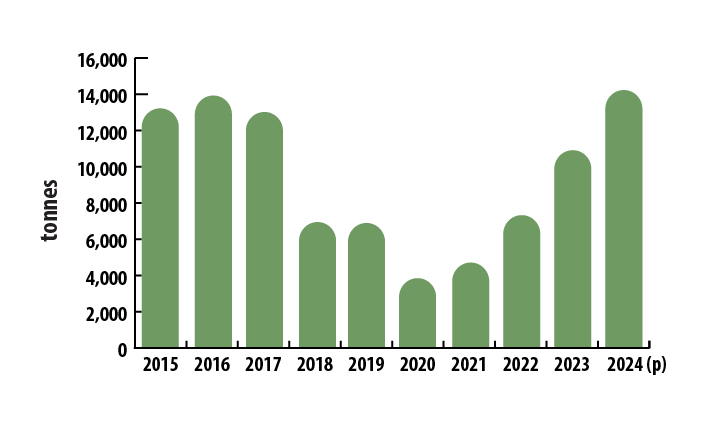
In 2024, Canada produced 14.3 kilotonnes of uranium from mines in Saskatchewan, with a production value of approximately $3 billion. All current production comes from high-grade deposits, where uranium concentrations can be up to 100 times higher than the global average.
Canada’s resources of more than 588,000 tonnes of elemental uranium (tU)—at a price of less than US$50 per pound for tri-uranium octoxide (U3O8)—supports continued production for at least 50 years.
Canadian production of uranium, 2015–2024
Text version
This bar graph shows Canada’s annual uranium mine production from 2015 to 2024. Production rose from 13,311 tonnes in 2015 to a peak of 14,022 tonnes in 2016, before declining over the following years to a low of 3,878 tonnes in 2020. Output then recovered, increasing to 10,986 tonnes in 2023 and 14,327 tonnes in 2024.
Some of Canada’s uranium production is refined and converted in Ontario to produce uranium hexafluoride (UF₆) and uranium dioxide (UO₂).
Approximately 90% of Canada’s uranium production is available for export. Based on long-term commercial contracts—which can fluctuate with regional demand—Canadian uranium is shipped to North and South America (44%), Asia (17%), and Europe (39%). In 2024, Canada supplied 33% of the uranium purchased by U.S. nuclear reactors, making it the largest foreign supplier of uranium to the United States.
Domestic consumption in Canada’s CANDU reactors in Ontario and New Brunswick accounted for roughly 10% of production in 2024.
 Supply and demand
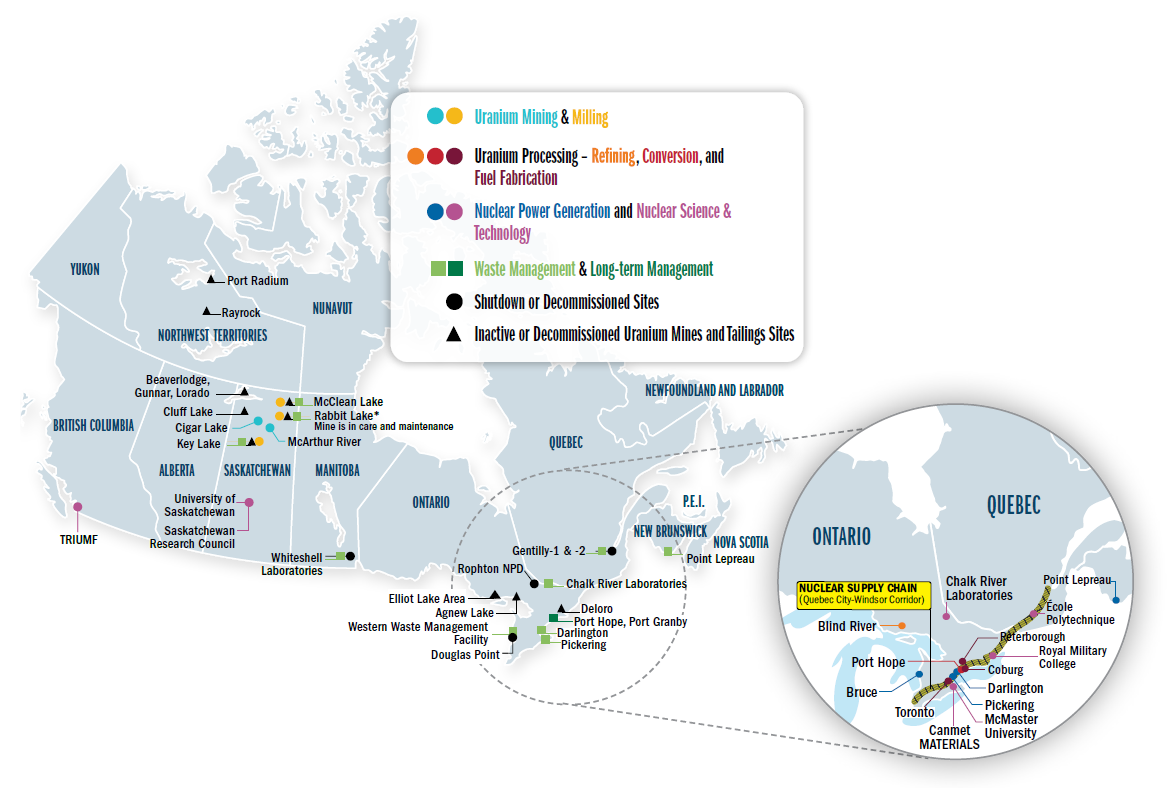
There is a strong nuclear science and technology presence across Canada, including the production of isotopes for medical and industrial applications. All Canadian uranium comes from Saskatchewan, but uranium processing, refining, conversion, fuel fabrication, research, and waste management happens across Canada. Nuclear power stations operate in Ontario and New Brunswick.
Canadian supply and demand
Text version
This map shows that while all uranium production occurs at mines in Saskatchewan, uranium processing, refining, conversion, fuel fabrication, research, and waste management activities take place across Canada. Nuclear power stations are located in Ontario and New Brunswick.
 Gross capacity of nuclear power plants in Canada
The five nuclear power stations in Canada have a combined capacity of 13,545 megawatts. The Bruce generating station in Ontario is one of the largest nuclear power plants in the world.
| Facility | Province | Total capacity (MW) | Units |
|---|---|---|---|
| Darlington | Ontario | 3,736 | 4 |
| Bruce A | Ontario | 3,437 | 4 |
| Bruce B | Ontario | 3,507 | 4 |
| Pickering | Ontario | 2,160 | 4 |
| Point Lepreau | New Brunswick | 705 | 1 |
 International context
Uranium
Find out how Canada's uranium ranks on an international scale:
World production
| Rank | Country | Percentage of Total |
|---|---|---|
| 1 | Kazakhstan | 39% |
| 2 | Canada | 24% |
| 3 | Namibia | 12% |
| 4 | Australia | 8% |
| 5 | Uzbekistan | 7% |
World exports
| Rank | Country | Percentage of Total |
|---|---|---|
| 1 | Kazakhstan | 44% |
| 2 | Canada | 24% |
| 3 | Namibia | 14% |
| 4 | Australia | 9% |
| 5 | Uzbekistan | 8% |
World known recoverable resources
| Rank | Country | Percentage of Total |
|---|---|---|
| 1 | Australia | 28% |
| 2 | Kazakhstan | 14% |
| 3 | Canada | 10% |
| 4 | Russia | 8% |
| 5 | Namibia | 8% |
Nuclear power
Find out how Canada's nuclear power ranks on an international scale:
| Rank | Country | Percentage of Total |
|---|---|---|
| 1 | United States | 29% |
| 2 | China | 16% |
| 3 | France | 14% |
| 4 | Russia | 8% |
| 5 | South Korea | 7% |
| 6 | Canada | 3% |
 Prices
Most Canadian uranium is sold through long-term contracts rather than on the spot market. Canadian uranium is typically exported to North and South America (44%), Asia (17%), and Europe (39%).
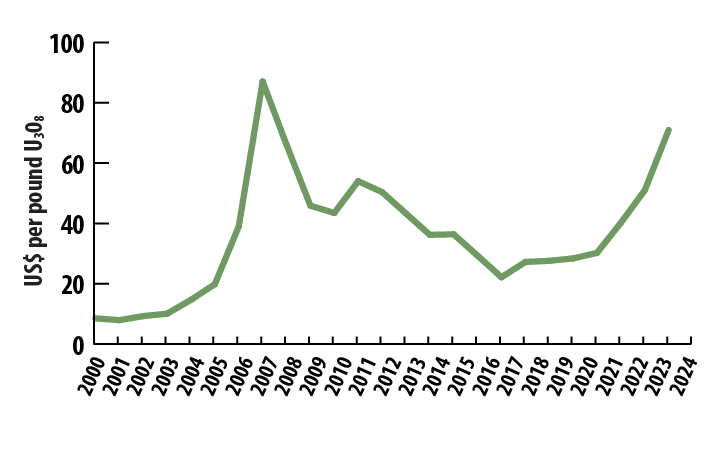
The average uranium spot price peaked at US$88 per pound U₃O₈ in 2007, then declined to US$22 in 2017 before gradually rising to US$72 in 2024. Since 2022, the spot price has remained above the average price of uranium purchased from foreign suppliers (US$53 in 2024).
Uranium Prices, 2000 – 2024
Text version
This line chart shows the weighted-average price of uranium spot contracts (U308) in U.S. dollars per pound from 2000 to 2024.
The price increased from $9 in 2000 to a peak of $88 in 2007. It then gradually declined, reaching $22 in 2017, before rising again to $72 in 2024.
 Canadian nuclear research and development
Canada has nuclear research and development (R&D) capabilities that are supported by academic research centres, the private sector and government laboratories—including Chalk River Laboratories, Canada's largest science and technology complex.
Nuclear energy research is focused on supporting existing reactor technologies as well as next-generation nuclear energy systems. Canada is also a leader in nuclear R&D for areas such as nuclear medicine, pharmacology, environmental protection and wastewater treatment.
Small modular reactors (SMRs) are nuclear reactors that operate at a smaller scale than current nuclear power plants. Although not yet commercially proven in Canada, they may have future applications. SMRs might replace fossil fuel power plants or be used as load-following units equipped with systems for storing excess electricity to complement larger shares of variable renewables.
SMRs may also have applications in the production of heat and electricity at both on- and off-grid industrial sites, and to help off-grid northern and remote communities reduce their reliance on diesel.
 CANDU nuclear reactors
Canada has developed a unique nuclear reactor technology called CANDU and is one of roughly half a dozen countries that offer domestic-designed reactors to the open commercial market.
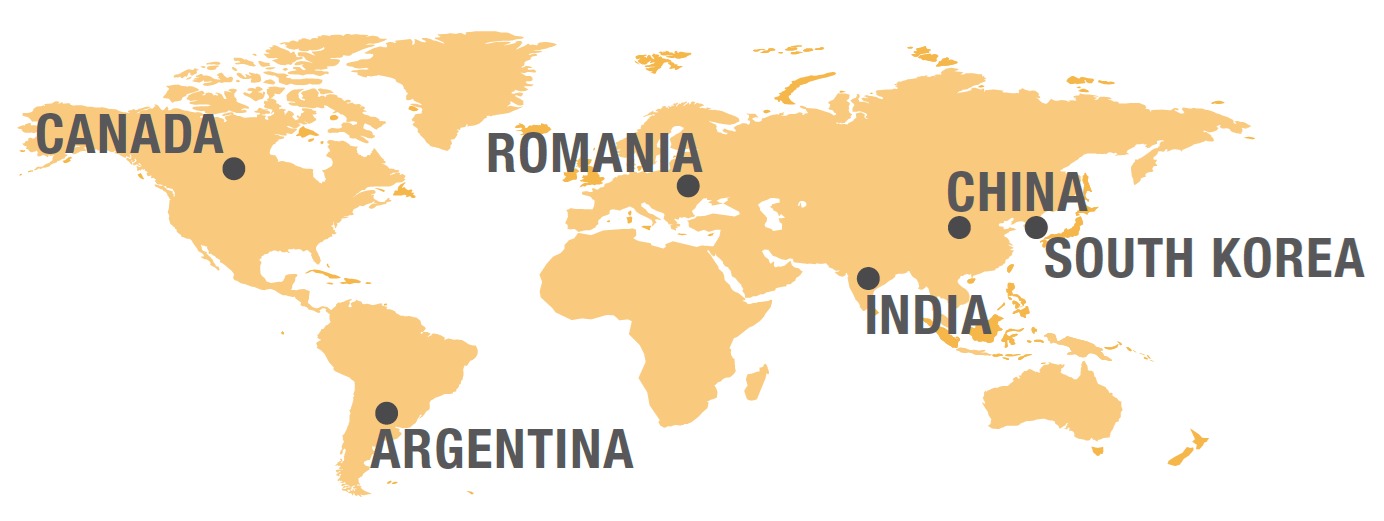
In addition to Canada, CANDU reactors have been sold to India, Pakistan, Argentina, South Korea, Romania and China.
World locations of CANDU reactors
Text version
This map shows that CANDU nuclear power technology, in addition to its use in Canada, is deployed in Argentina, Romania, India, China, and South Korea.
CANDU technology continues to evolve to enable the use of alternative fuels. Work is under way in Chinese CANDU reactors to demonstrate that they can recycle used fuel from other nuclear power plants, reducing the volume of nuclear waste.
Learn more about Canadian Nuclear Energy Technology.
Find out more about minerals and metals facts
Notes and sources
All amounts are in Canadian dollars unless indicated otherwise.
- Supply and demand
- Cameco, 2024 Annual Report; World Nuclear Association, "Uranium in Canada"
- Gross capacity of nuclear power plants in Canada
- International Atomic Energy Agency, "Power Reactor Information System"
- International context
- World production: World Nuclear Association "World Uranium Mining Production"
- World exports: Natural Resources Canada estimate based on the World Nuclear Association, "World Uranium Mining Production" and "World Nuclear Power Reactors & Uranium Requirements"
- World known recoverable resources: World Nuclear Association "World Uranium Mining Production"
- Prices
- United States Energy Information Administration, Uranium Marketing Annual Report
- Canadian nuclear research and development, CANDU reactors
- Based on figures compiled by Natural Resources Canada
- Nuclear power
- World generation: International Atomic Energy Agency, Nuclear Power Reactors in the World