
Seeds, silviculture and renewal after wildfire
May 2026
By Nicole Simmons
This is Part 2 of a two-part Simply Science series exploring how life returns to Canadian forests after wildfire. In Part 1 we spoke with Canadian Forest Service (CFS) scientists to understand how beetles and fungi act as nature’s first responders. In this story, we look at what comes next: how different Canadian tree species are re-established and the role of silviculture in helping new forests regenerate and adapt to changing climates.
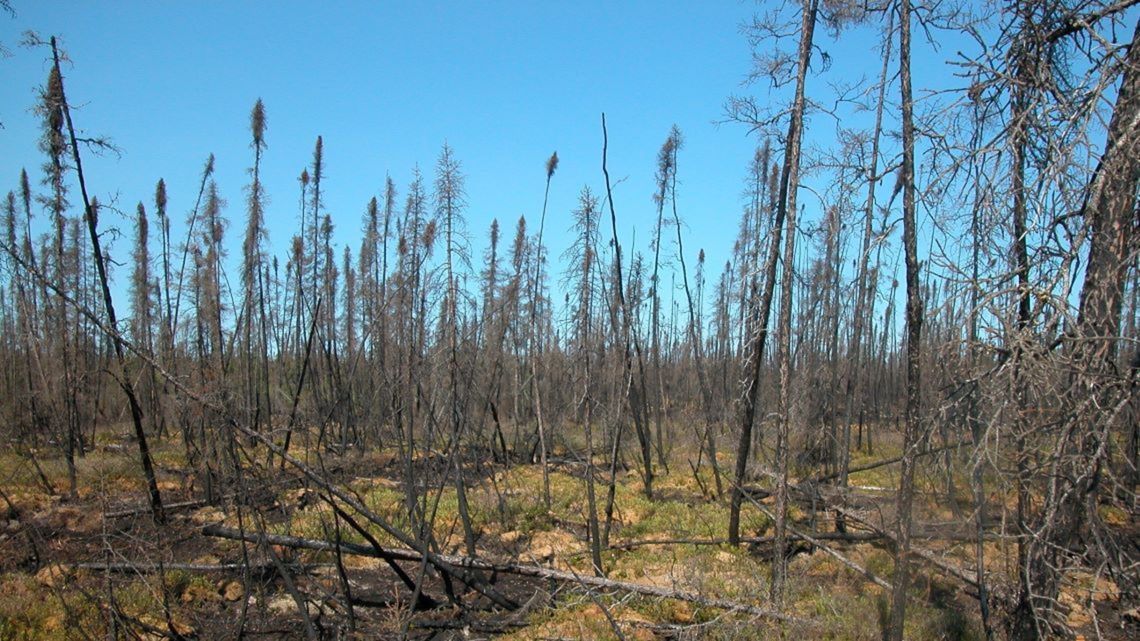
Some tree species rely on wildfires to open up their cones so their seeds can disperse.
Sowing the seeds of renewal
Every year, wildland fires scorch and burn vast areas of Canada’s forests, leaving behind blackened tree trunks, smoke-hazed skies and the crackling sound of smouldering wood. From the sparks and embers of burned landscapes, new opportunities for growth emerge.
While insects and fungi are among the first to arrive, trees and other vegetation are already at work, sometimes even while the flames are still burning. To understand what happens next, we have to look beneath the ashes and into the soil.
“In Canada’s boreal forest, most tree species are well adapted to fire,” says Ellen Whitman, forest fire research scientist with the Canadian Forest Service (CFS).
Species like jack pine and lodgepole pine are uniquely adapted to and even dependent on wildfire to release their seeds and grow new trees. Their cones are serotinous, which means they’re tightly sealed with thick, heat-sensitive resin that bonds the scales of the cone together. As flames rise in the forest, prolonged exposure to intense heat causes the cones to open, releasing their seeds. Seeds rain down from high up in the trees, landing directly on the ash-covered, nutrient-rich soil below.
“Aside from serotinous species, we also have black spruce, which is one of our most widespread and common trees in Canada,” says Ellen, “It’s semi-serotinous and has dense cone balls at the top of the tree. It’s like an aerial seed bank.”
While serotinous and semi-serotinous trees actively release their seeds in response to fire, other species might regenerate in the landscape from undamaged areas, or even from the ground up.

Forests are resilient, and researchers know what steps most landscapes go through during recovery. But every forest and every fire is different, and recovery is not always even.
“Some trees can also re-sprout or sucker,” says Ellen. “So even when the tree has been killed on the surface, it can still have a lot of energy and resources stored in its roots which are insulated from the heat of the fire above, and it can re-sprout over time.”
Not all tree species rely exclusively on heat-activated seeds and resprouting. Broadleaf trees such as birches and aspen produce lightweight seeds that drift into areas from outside the fire perimeter. Some conifers, such as ponderosa pine and Douglas-fir, have winged seeds that catch the wind for dispersal. These species need seeds from live trees untouched by the fire to grow in burned areas.
“In these cases, we can see trees moving in from the edge of the burned area where the fire was lower intensity or the trees were completely unburned, with their seeds being carried by the wind or by returning animals,” says Ellen. “In those types of ecosystems, usually common for fir trees and white spruce, we may have more concerns about a lack of seed sources in high-intensity severe patches with few surviving trees.”
Every tree species responds to fire in different and unique ways, contributing to successful forest recovery over time and eventually helping landscapes return to a mix of tree and vegetation types.
But regeneration doesn’t always unfold evenly. After some wildfires, nature’s ability to recover on its own may be limited and forests need a little extra help. That’s when people step in to help.
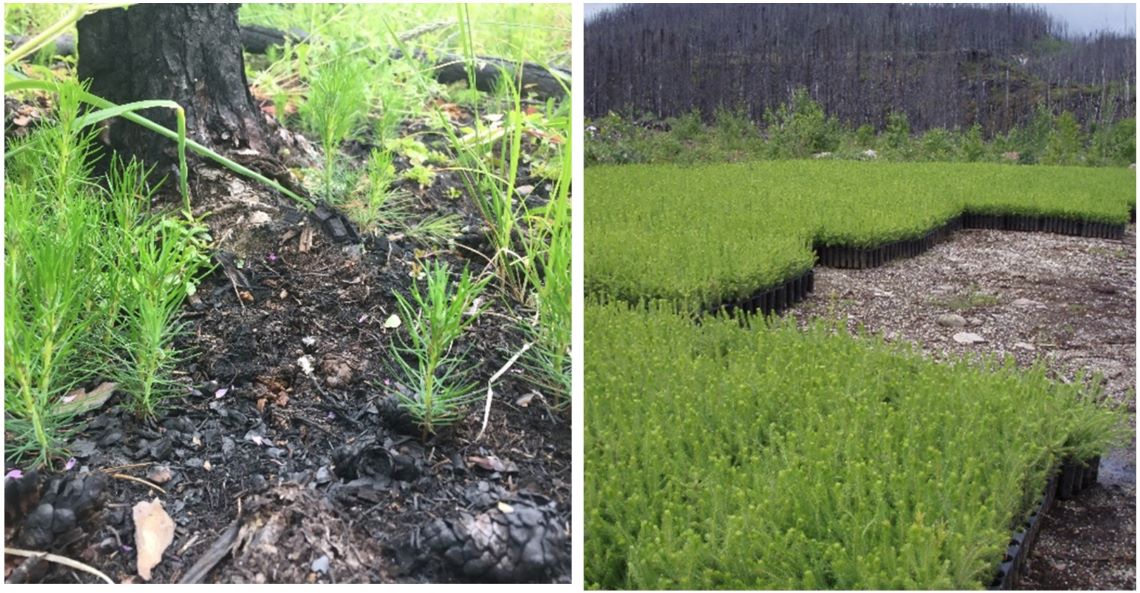
While trees and burned landscapes can eventually come back to life, sometimes they need a little help along the way. That’s where pre-grown seedlings come into action.
Collaborating with the trees: Assisting a forest mosaic
Fire can have both positive and negative effects on seedbeds, says Nelson Thiffault, a forest engineer and silviculture researcher with the CFS.
“On the positive side, fire releases nutrients and helps control competing vegetation, giving tree seedlings a better chance to establish. But depending on the fire’s intensity, some nutrients can be lost as they are burned off.”
When fires burn in the same area multiple years in a row or burn at very high intensity, seed sources may no longer be available, or the conditions of seedbeds might not be right for those species to re-establish. In those cases, natural regeneration needs a helping hand.
That’s where silviculture — the science of growing and tending to forests to achieve a range of objectives — comes in. After a wildfire, reforestation can require preparing the soil, planting seedlings or even introducing different species, once better suited to changing conditions.
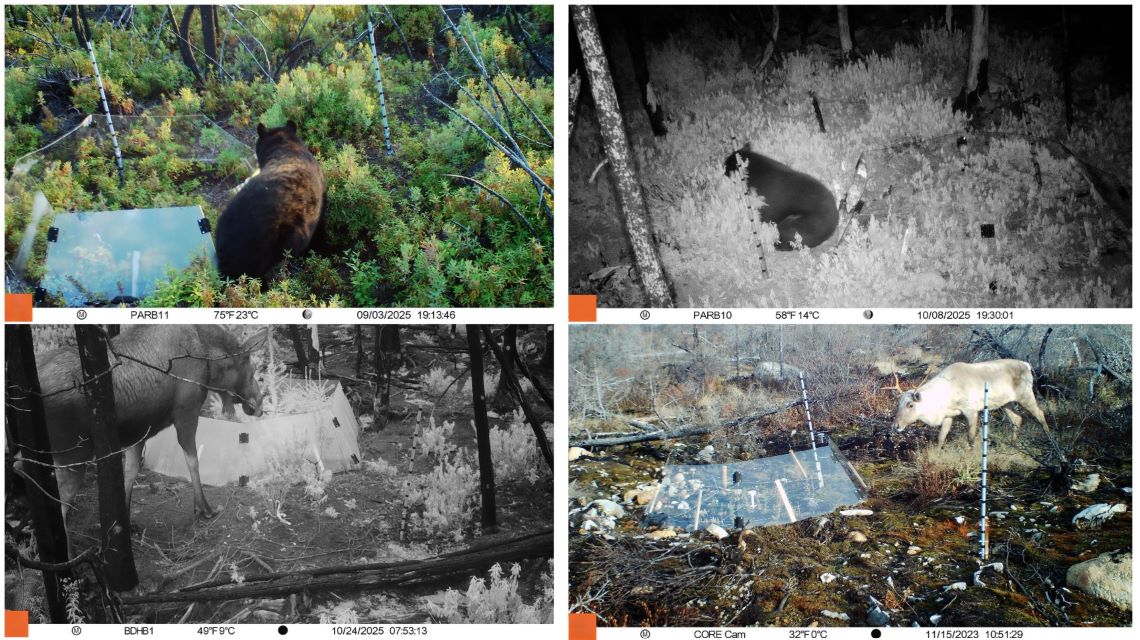
Wildlife such as bears and moose return to the forest after a wildfire, as seen by cameras at an NRCan research site.
“Wildfires create opportunities for what we call adaptive silviculture,” says Nelson. “For example, we can use assisted migration, which involves planting tree species or genotypes that are better adapted to coming changes in climate.”
This approach is already being tested in post-fire research sites across Canada. “We’ve looked at mixed plantations, where we plant species to support other species,” he says. “For example, planting alder can increase soil nitrogen, which might help nearby conifers grow stronger.”
Every site, however, demands a tailored solution, as there’s no one-size-fits-all approach. Soil depth, surface deposits, terrain and other factors influence what kind of treatments can be used. While provinces and forest companies handle most reforestation work, Natural Resources Canada (NRCan) scientists focus on research and best practices.
From coast to coast, collaboration is key. NRCan scientists often work with provincial research branches to test new regeneration methods and climate-adapted species. The results help inform how Canada rebuilds its forests after fire seasons.
Standing in a post-fire landscape dotted with new seedlings, Nelson sees more than just loss — he sees resilience. “When you look closely at a burn site,” he says, “you can see the forest already coming back. Each seedling represents not just recovery but adaptation to the future.”
From insects to fungi, from seeds to silviculture, forest restoration after wildfire unfolds in stages. Each group has a role to play, transforming a charred landscape into a thriving ecosystem, proving that renewal after fire is a natural effort across species — and one that can be supported and guided by science.
Curious about how all this begins? Read Part 1 to meet nature’s first responders: beetles and fungi.