

Nickel is a versatile metal valued for its strength, corrosion resistance, and ability to withstand extreme temperatures. Primarily used in stainless steel production, it supports a wide range of industries and everyday products. More recently, nickel’s role has expanded into advanced technologies, particularly in batteries for electric vehicles (EV), as the market for EVs and renewable energy accelerates. Its growing importance in sustainable technologies has made nickel a cornerstone of the green transition, positioning it at the forefront of innovation and the shift toward a low-carbon economy.
Key facts
- In 2024, Canadian mines produced 125,364 tonnes of nickel, ranking fourth in global nickel production.
- Canada’s nickel and nickel-based product exports were valued at $4.5 billion in 2024.
- A key emerging and growing use of nickel is in the production of lithium-ion batteries for electric and hybrid vehicles, which accounted for 15% of global nickel consumption in 2024.
Learn more about nickel
 Uses
Uses
Stainless steel is the largest end use for nickel, accounting for nearly two thirds of total consumption. Nickel improves stainless steel by increasing its strength, toughness, corrosion resistance, and ability to withstand both high and low temperatures. It is also used as an alloying agent in other ferrous and non-ferrous metals, where it enhances durability, heat resistance, and overall performance in demanding applications such as aerospace, energy, and chemical processing.
Nickel is also used in electroplating, where a thin layer of nickel is applied to a metal object for decorative purposes and to enhance resistance to corrosion and wear.
Although nickel has long been used in nickel-cadmium batteries, its growing role in lithium-ion battery production for EVs is an important shift in its applications.
Nickel, global uses, 2024

Text version
This chart illustrates the major industrial uses of nickel as of 2024. The largest share went to stainless steel production (64%), followed by batteries (15%), non-ferrous alloys (9%), electroplating (5%), and miscellaneous uses, including foundry and alloy steel (7%).
 Production
In 2024, Canadian mines produced 125,364 tonnes of nickel in concentrate, a slight 1% decrease from the previous year. Ontario produced the most (40%), Quebec contributed 37%, Newfoundland and Labrador accounted for 14%, and Manitoba produced 9%.
Canada has three key nickel refineries in Fort Saskatchewan, Alberta; Sudbury, Ontario; and Long Harbour, Newfoundland and Labrador.
Ontario-based Electra Battery Materials is developing a cobalt and nickel sulfate production facility along with a lithium-ion battery recycling plant north of Toronto.
Consult a map of producing Canadian mines
Canadian mine production of nickel, 2015–2024 (p)

Text version
This bar graph illustrates Canada’s annual nickel mine production from 2015 to 2024. In 2015, production totaled 225,351 tonnes, rising to a 10-year high of 230,210 tonnes in 2016. Output then gradually declined, reaching a low of 122,115 tonnes in 2022. Since then, production has stabilized, fluctuating around 125,000 tonnes annually.
| Ranking | Province | Thousand tonnes | Percentage of total |
|---|---|---|---|
| 1 | Ontario | 50.0 | 39.9% |
| 2 | Quebec | 46.5 | 37.1% |
| 3 | Newfoundland and Labrador | 17.2 | 13.7% |
| 4 | Manitoba | 11.6 | 9.3% |
| Total | 125.4 | 100.0% | |
 International context
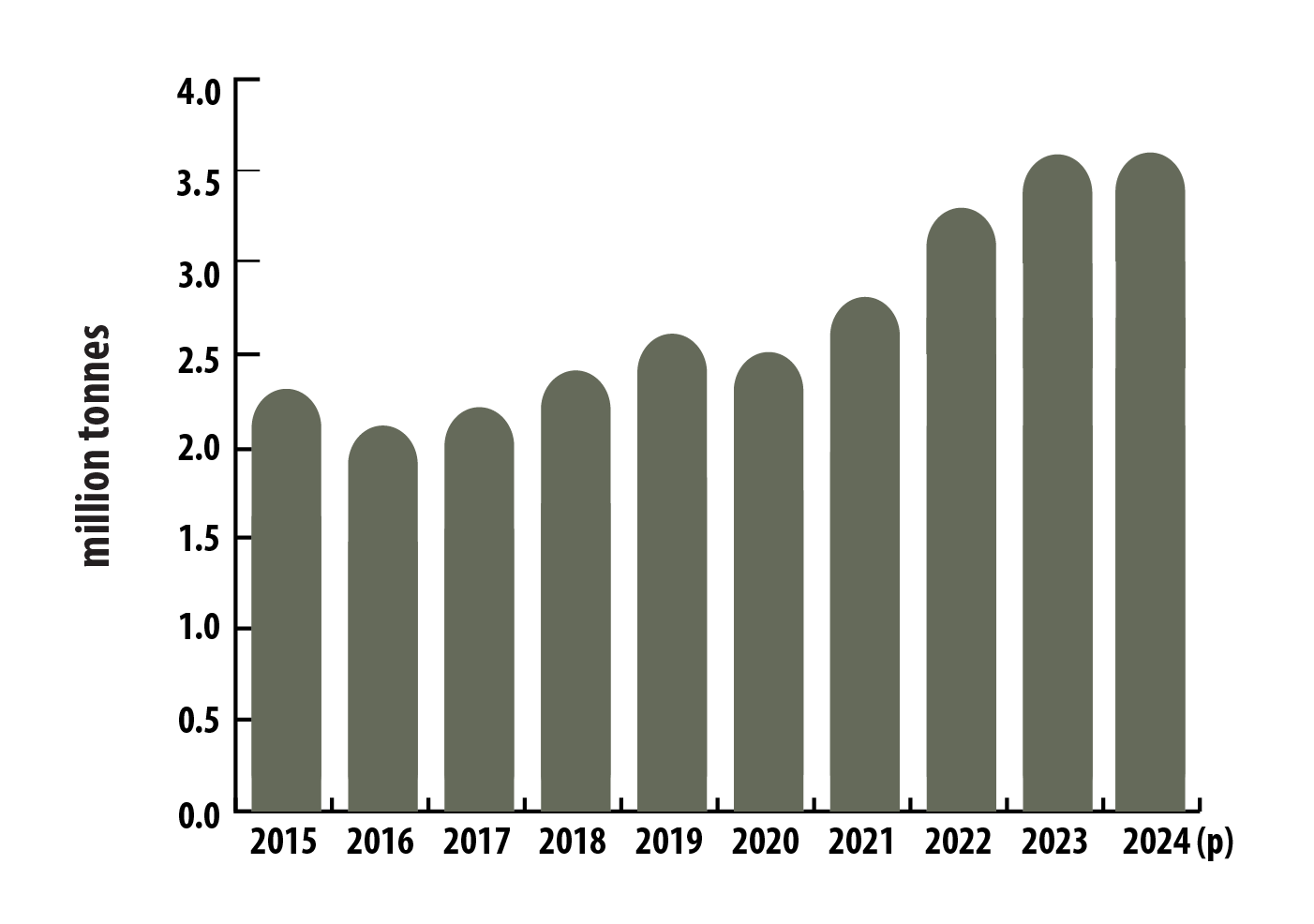
Global nickel mine production in 2024 was estimated at 3.6 million tonnes, a 2% increase from 2023. Indonesia was the largest producer, accounting for 2.2 million tonnes or about 61% of global output. Canada ranked fourth, contributing about 4% of the global total.
| Ranking | Country | Thousand tonnes | Percentage of total |
|---|---|---|---|
| 1 | Indonesia | 2,200 | 61.3% |
| 2 | Philippines | 330 | 9.2% |
| 3 | Russia | 210 | 5.8% |
| 4 | Canada | 125 | 3.5% |
| 5 | China | 120 | 3.3% |
| 6 | Australia | 110 | 3.1% |
| 7 | New Caledonia (France) | 110 | 3.1% |
| 8 | Brazil | 77 | 2.1% |
| 9 | United States | 8 | 0.2% |
| - | Other countries | 300 | 8.4% |
| Total (rounded) | 3,590 | 100.0% | |
World mine production of nickel, 2015–2024 (p)
Text version
This bar graph depicts global nickel mine production from 2015 to 2024. Production declined from 2.3 million tonnes in 2015 to 2.1 million tonnes in 2016, before recovering to 2.6 million tonnes by 2019. After a slight drop to 2.5 million tonnes in 2020, output increased steadily, reaching 2.8 million tonnes in 2021, 3.3 million tonnes in 2022, and 3.6 million tonnes in 2023 and 2024.
World reserves
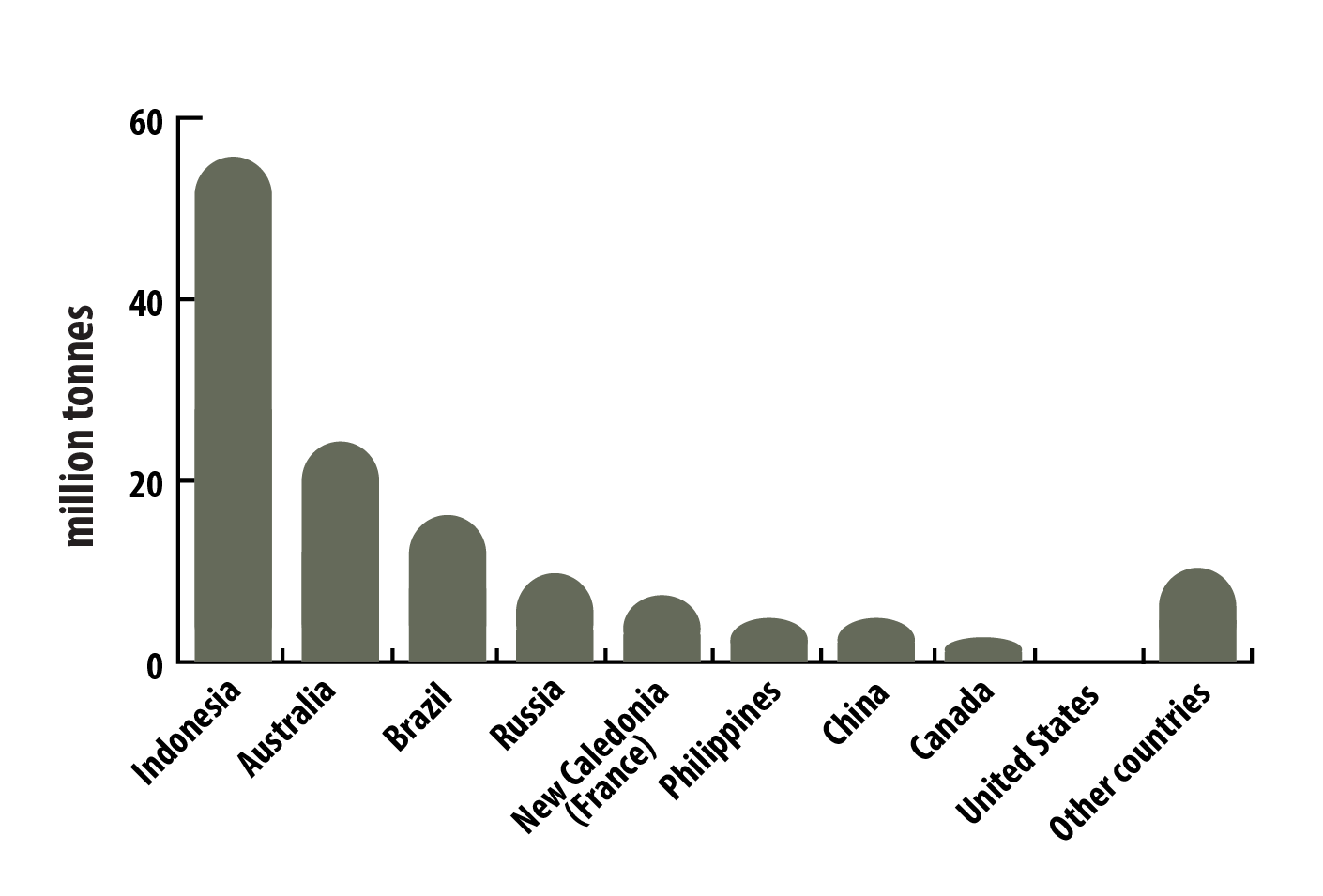
In 2024, global nickel reserves were estimated at over 130 million tonnes. The largest reserves are in Indonesia (42%), Australia (18%), and Brazil (12%). Canada holds an estimated 2.2 million tonnes, representing 2% of global reserves, and ranks eighth globally.
Global nickel resources in 2024 were estimated at more than 350 million tonnes, with 54% found in laterite deposits and 35% in magmatic sulfide deposits. Nickel has also been found in seafloor crusts and nodules.
World reserves of nickel, by country, 2024 (p)
Text version
This bar graph illustrates the estimated world nickel reserves by country in millions of tonnes for 2024. Indonesia has the largest reserves at 55.0 million tonnes, followed by Australia with 24.0 million tonnes, Brazil with 16.0 million tonnes, and Russia with 8.3 million tonnes. New Caledonia (France) has 7.1 million tonnes, the Philippines has 4.8 million tonnes, and China has 4.4 million tonnes. Canada’s reserves are estimated at 2.2 million tonnes, while the United States has 0.3 million tonnes. Other countries collectively account for 9.1 million tonnes.
 Trade
Trade
Canada’s total trade in nickel and nickel-based products was valued at $5.4 billion in 2024, consisting of $4.5 billion in exports and $887 million in imports — a 19% decline from 2023. This decrease was driven mainly by lower nickel prices, as trade volumes remained relatively stable.
Canada exported 98,199 tonnes of unwrought nickel valued at $2.4 billion in 2024. By volume, 43% of these exports went to the United States, 15% to the Netherlands, 9% to Belgium, and 8% to China, with the remaining share distributed among 16 other countries.
 Prices
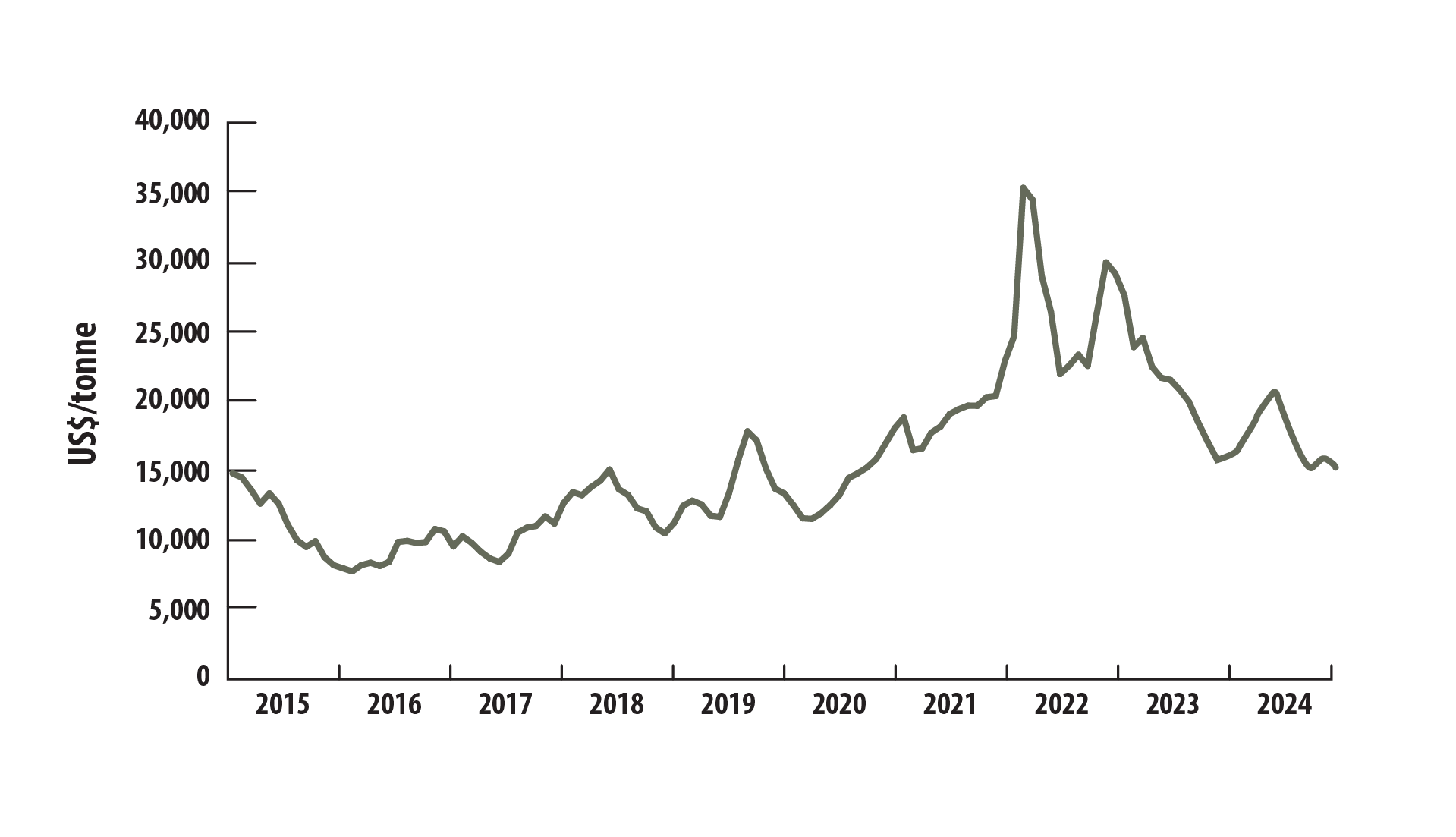
Nickel prices have experienced significant volatility over the past decade. The average monthly price per tonne fell to a decade low of US$8,299 in February 2016, before gradually recovering to US$17,657 in September 2019. Prices then declined because of the impacts of the COVID-19 pandemic but rose again to a decade high of US$25,834 in 2022, before dropping 17% to US$21,521 in 2023.
In 2024, the average monthly price fell a further 22%, reaching US$16,814, the lowest level since 2020. This decline was driven primarily by a growing nickel surplus from Indonesia, continuing a trend that began in 2023. Indonesia has significantly expanded production of nickel intermediates such as nickel matte and mixed hydroxide precipitate (MHP), which are processed into battery-grade nickel sulfate, primarily in China. Indonesia also produces nickel pig iron (NPI) for stainless steel, though demand for NPI has recently weakened.
Nickel, monthly average nominal United States dollars per tonne prices, 2015–2024
Text version
This line graph shows the nominal monthly average price of nickel (in United States dollars per tonne) from 2015 to 2024. In 2015, the average price was $11,863 per tonne, falling to $9,595 in 2016. Prices then gradually increased, reaching $13,914 in 2019, before climbing sharply to $18,465 in 2021 and peaking at $25,834 in 2022. The average price then declined to $21,521 in 2023 and fell further to $16,814 in 2024. Within 2024, prices started at $16,104 per tonne in January and ended the year at a low of $15,445 in December — the lowest monthly price since October 2020.
Notes and sources
(p) preliminary
(e) estimated
Totals may be different because of rounding.
All dollars are Canadian unless otherwise indicated.
Uses
- Nickel, global uses, 2024
- Wood Mackenzie
Production
- Canadian mine production of nickel, 2015–2024 (p)
- Natural Resources Canada, Statistics Canada
- Canadian mine production of nickel, by province, 2024 (p)
- Natural Resources Canada, Statistics Canada
International context
- World mine production of nickel, by country, 2024 (p)
- U.S. Geological Survey, Mineral Commodity Summaries, January 2025
- World mine production of nickel, 2015–2024 (p)
- U.S. Geological Survey, Mineral Commodity Summaries, January 2025
- World reserves of nickel, by country, 2024 (p)
- U.S. Geological Survey, Mineral Commodity Summaries, January 2025
Trade
- Natural Resources Canada; Statistics Canada
- Mineral trade includes ores, concentrates, and semi- and final-fabricated mineral products.
- Unwrought nickel corresponds to HS code 750210.
Prices
- Nickel, monthly average nominal United States dollars per tonne prices, 2015–2024
- World Bank Commodity Price Data (The Pink Sheet)