

Diamonds are best known as gemstones, even though only about 20% of the world's production by weight is used for jewellery. The other 80%, known as bort, is used in industrial and research applications where the unique properties of diamonds are required.
Key facts
- In 2024, Canada was the world's fourth-largest producer of rough diamonds by value (11% of world production) and the fourth-largest producer by volume (12% of world production).
- Canada's domestic exports of diamonds and diamond products were valued at $1.52 billion in 2024.
Learn more about diamonds
 Uses
Uses
As the hardest material known, diamonds have been used for centuries as an abrasive in cutting, drilling, grinding and polishing. This is the dominant industrial use for diamonds.
Diamonds also have the highest thermal conductivity of any material at room temperature and are used as a sink to dissipate heat in electronic devices such as computers and diode lamps.
 Production
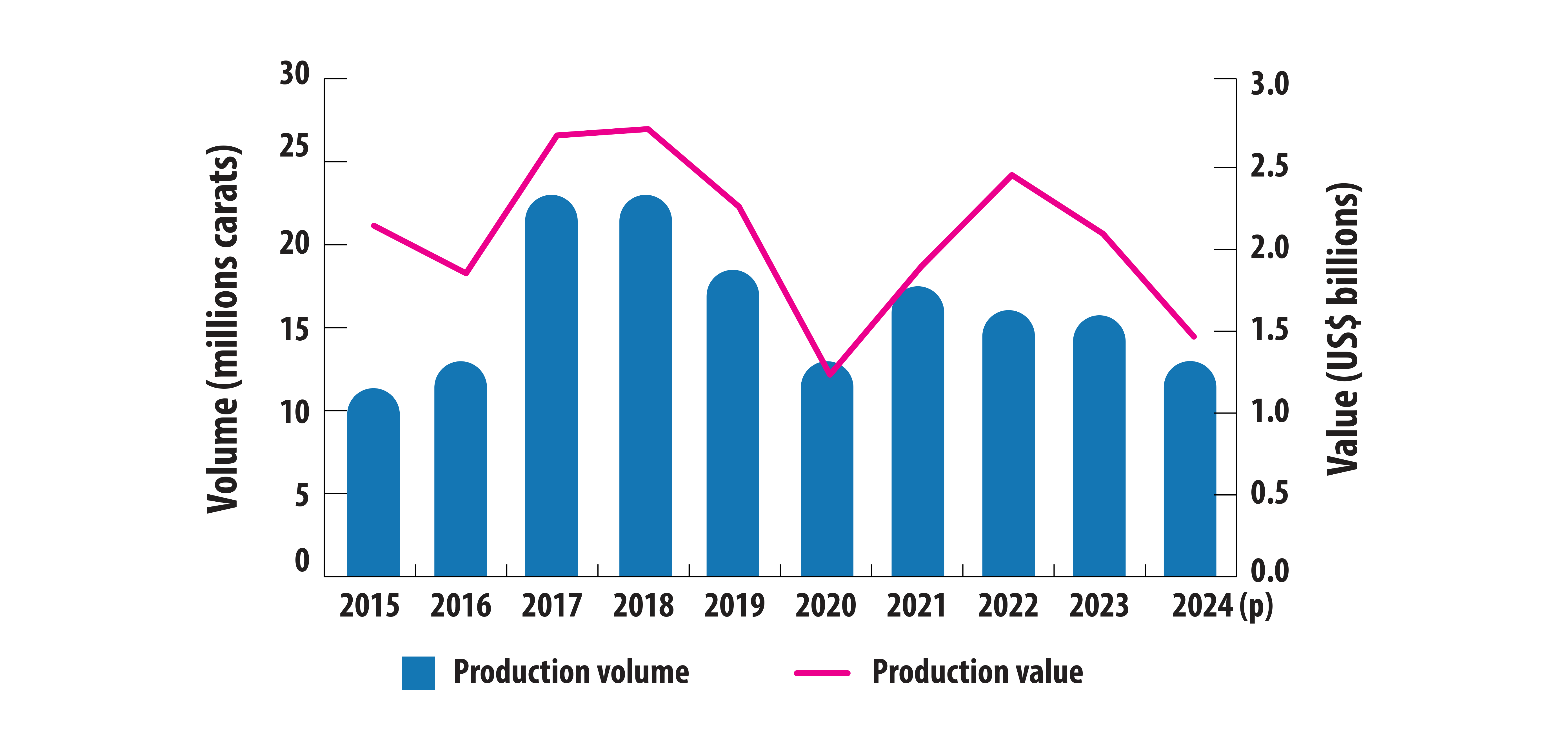
Canadian mines produced 13.3 million carats of rough diamonds valued at $1.47 billion in 2024, representing a 17% decrease in volume and a 30% decrease in value compared with 2023.
Canada’s diamond production has been trending lower largely because of mine closures, the exhaustion of high-capacity sections of mines, and decreasing ore grades. More recent declines also reflect weaker global demand for natural diamonds, driven by shifting consumer preferences, growing competition from lab-grown diamonds, and broader economic uncertainty. Given these challenging market conditions and the fact that Canada’s mines are approaching the end of their operational lives, Canadian diamond production is expected to continue trending down.
Consult a map of producing Canadian mines
Canadian production of rough diamonds, 2015–2024 (p)
Text version
This bar graph shows the yearly volume of Canada's rough diamond production from 2015 to 2024. From 11.7 million carats in 2015, production volume increased to an all-time high of 23.2 million carats in 2017 and 2018 but then fell 20% to 18.6 million carats in 2019, followed by a further 30% decrease to 13.1 million carats in 2020. In 2021, production volume increased to 17.6 million carats and then decreased slightly to 16.3 million carats in 2022 and 16.0 million carats in 2023. In 2024, production volume was 13.3 million carats. Superimposed on the bar graph is a line showing the value of Canada’s annual production of rough diamonds over the same period. From $2.14 billion and $1.85 billion in 2015 and 2016, respectively, the value of Canadian rough diamond production increased to around $2.7 billion in 2017 and 2018, before decreasing to $2.25 billion in 2019. Production value then sharply decreased by 45% to $1.25 billion in 2020, before increasing to $1.90 billion and $2.44 billion in 2021 and 2022, respectively. In 2023, production value decreased to $2.09 billion and then fell 30% to $1.47 billion in 2024.
 International context
Find out more about rough diamond production on an international scale:
World production by country – Carat basis
Worldwide, seven countries accounted for 96% of rough diamond production by volume.
| Ranking | Country | Percentage |
|---|---|---|
| 1 | Russia | 34.6% |
| 2 | Botswana | 16.8% |
| 3 | Angola | 13.0% |
| 4 | Canada | 12.3% |
| 5 | Democratic Republic of the Congo | 9.1% |
| 6 | South Africa | 4.9% |
| 7 | Zimbabwe | 4.9% |
| 8 | Namibia | 2.1% |
| 9 | Lesotho | 0.6% |
| 10 | Sierra Leone | 0.5% |
| - | Other countries | 1.2% |
| Total | 100.0% |
World production by country – Value basis
Worldwide, six countries accounted for 92% of rough diamond production by value.
| Ranking | Country | Percentage |
|---|---|---|
| 1 | Russia | 35.0% |
| 2 | Angola | 14.8% |
| 3 | Botswana | 14.3% |
| 4 | Canada | 11.3% |
| 5 | Namibia | 10.1% |
| 6 | South Africa | 6.9% |
| 7 | Lesotho | 2.4% |
| 8 | Zimbabwe | 1.7% |
| 9 | Congo, D.R | 1.1% |
| 10 | Sierra Leone | 1.1% |
| - | Other countries | 1.3% |
| Total | 100.0% |
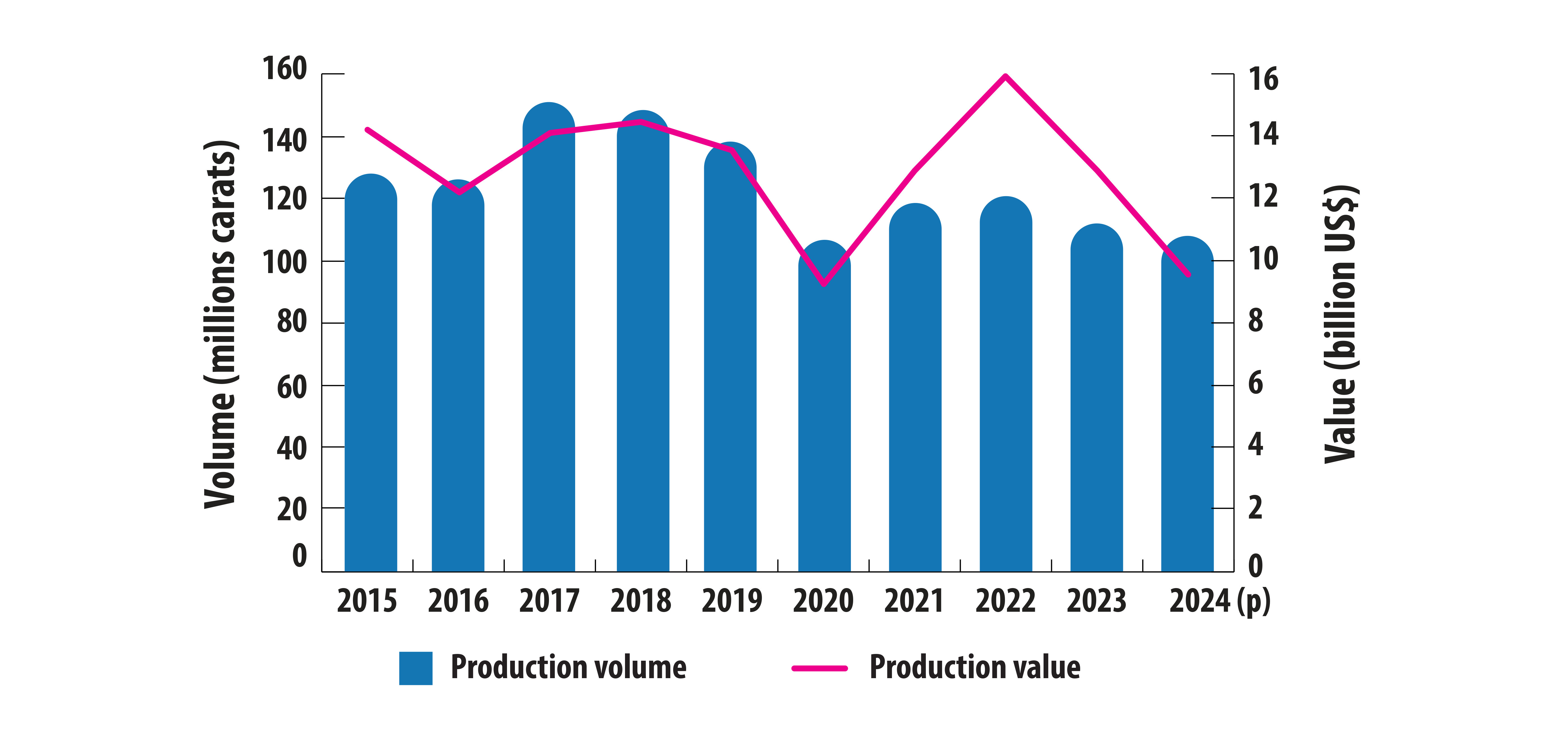
World production of rough diamonds, 2015–2024 (p)
Text version
This bar graph shows the yearly volume of the world’s rough diamond production from 2015 to 2024. In 2015 and 2016, production volume remained steady at 128.3 and 126.4 million carats, respectively, before sharply increasing to a high of 150.9 million carats in 2017. Production volume then decreased slightly to 148.4 million carats in 2018, before falling to 138.2 million carats in 2019. Production volume fell a further 22% to 107.1 million carats in 2020, before rising to 118.7 and 120.7 million carats in 2021 and 2022, respectively. In 2023, production volume was 112.1 million carats, decreasing slightly to 107.9 million carats in 2024. Superimposed on the bar graph is a line showing the value of the world's annual production of rough diamonds, in United States dollars, over the same period. In 2015, world production value was US$14.2 billion, decreasing to US$12.3 billion in 2016. From 2017 to 2019, production value remained steady around US$14 billion, before falling sharply by 32% to US$9.2 billion in 2020. The value of production then rebounded by 40% to US$12.9 billion in 2021, followed by a further 24% increase to US$16.0 billion in 2022. In 2023, production value decreased to US$12.9 billion, falling a further 26% to US$9.5 billion in 2024.
 Trade
Trade
Exports
- Canada's domestic exports of diamonds and diamond products were valued at $1.52 billion in 2024, a decrease of 30% compared to 2023. This decrease in value is primarily due to a 21% decrease in the quantity of rough diamonds exported, together with a 12% decrease in their unit price.
- Canada's most important diamond export items in 2024 were unsorted rough diamonds and gem-quality rough diamonds, together accounting for approximately 95% by value and more than 99% by quantity.
- Exports were shipped mostly to Belgium, Botswana and India.
Imports
- The estimated value of Canada's total imports of diamonds and diamond products was $297 million in 2024, a decrease of 23% compared to 2023. This decrease in value is due primarily to a 28% decrease in the quantity of gem-quality cut diamonds imported, slightly offset by a 5% increase in their unit price.
- The top import item by value in 2024 was gem-quality cut diamonds, accounting for approximately 93% by value but less than 2% by quantity. The majority of imports by quantity consisted of low value natural or synthetic diamond dust and powder, valued at an average of roughly $1 per carat.
 Prices
There are no internationally set prices for rough gem-quality diamonds, as there are for many metal and mineral commodities. Mining companies hold “sights” at regular intervals to market their production. The prices reached at these sights are dictated by supply and demand for each of the many categories of diamonds.
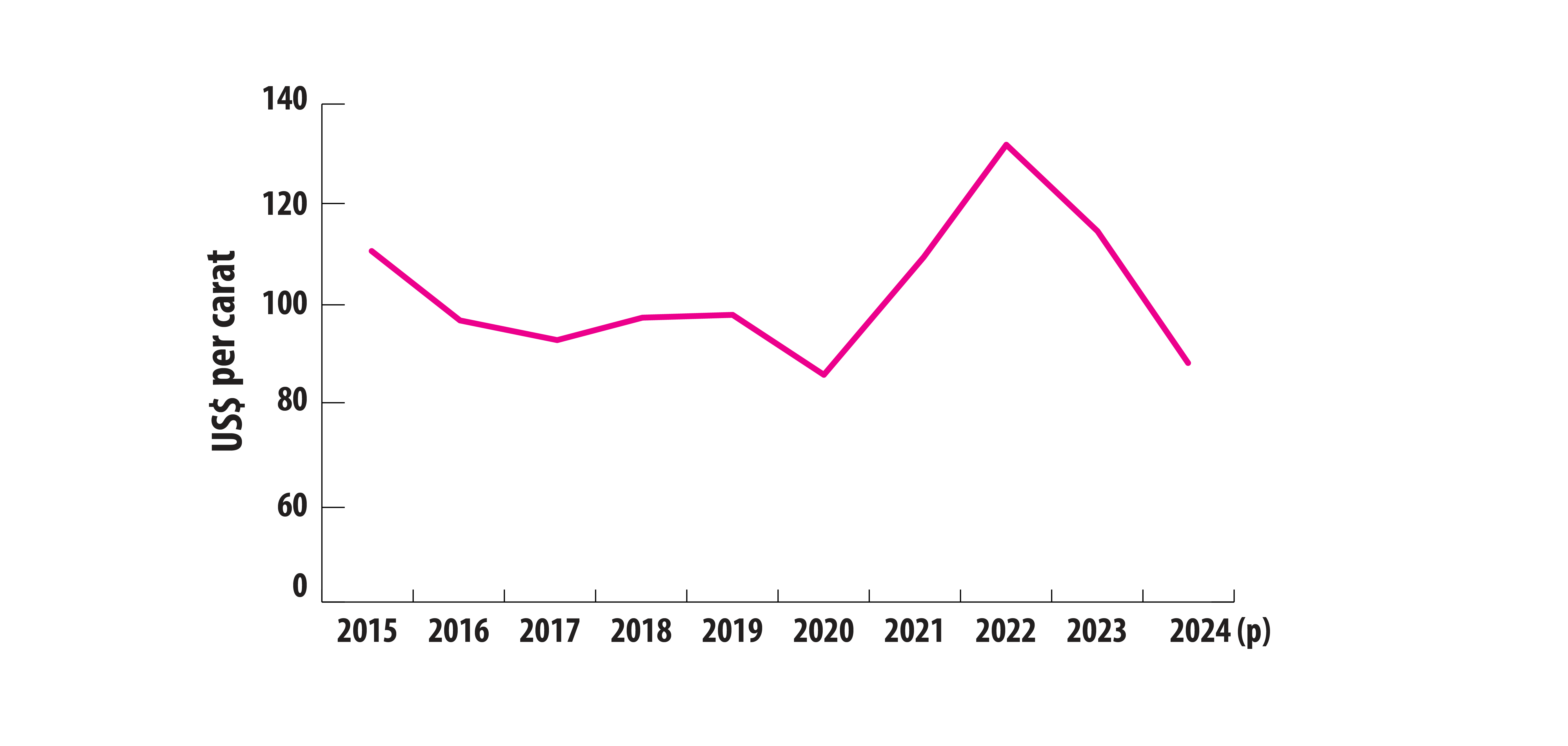
Rough diamonds, average value per carat of world production, 2015–2024 (p)
Text version
This line graph shows the average value per carat of the world's rough diamond production from 2015 to 2024, according to statistics compiled by the Kimberley Process Certification Scheme. From US$111.00 in 2015, the average value per carat decreased to US$97.08 in 2016 and US$93.59 in 2017. In 2018 and 2019, the average value per carat was about US$98, before decreasing to US$86.25 in 2020. In 2021, the average value per carat increased sharply to US$108.83, increasing a further 22% to US$132.30 in 2022, followed by a decrease to US$115.04 in 2023. The average value per carat then fell to US$88.35 in 2024.
Notes and sources
(p) preliminary
Totals may be different because of rounding.
Production
- Diamond mines and advanced projects in Canada, 2024
- Natural Resources Canada
- Canadian production of rough diamonds, 2015–2024 (p)
- Kimberley Process Certification Scheme
International context
- World production of rough diamonds, by country, carat basis, 2024 (p)
- Kimberley Process Certification Scheme
- World production of rough diamonds, by country, value basis, 2024 (p)
- Kimberley Process Certification Scheme
- World production of rough diamonds, 2015–2024 (p)
- Kimberley Process Certification Scheme
Trade
- Natural Resources Canada; Statistics Canada
- Mineral trade includes ores, concentrates, and semi- and final-fabricated mineral products.
- Exports of unsorted rough diamonds and gem-quality rough diamonds include products in the HS710210, HS710229 and HS710231 codes.
- Imports of gem-quality cut diamonds include products in the HS710239 code.
Prices
- Rough diamonds, average value per carat of world production, 2015–2024 (p)
- Kimberley Process Certification Scheme