
Details
- Publication date
- Author(s)
Natural Resources Canada - ISBN
978-0-662-68033-8 - Catalogue number
M4-304/2026E-PDF
On this page
This Request for Information (RFI) was launched to identify opportunities to accelerate the pace of energy innovation using AI.
What we heard
Theme 1: AI can accelerate energy innovation and the path to commercialization through dynamic modelling, advanced materials discovery, and complex data analysis
Overall, respondents agreed that the application of AI would generally accelerate innovation across the energy supply chain, shortening the timelines for design, modelling, prototyping, and testing. More specifically, advanced materials discovery and development were cited as an area to be accelerated by AI. Respondents also highlighted the opportunities presented by AI’s complex data analysis and modelling capabilities to support innovation, including the use of digital twins for optimizing designs and virtual testing to reduce cost and time for prototyping and demonstrations. AI-enabled automation was also cited to reduce the time and costs for R&D, through self-driving labs and automation of repetitive tasks.
AI’s powerful modelling capabilities, not only for technical designs but modelling manufacturing scale up, supply chain optimization, outcomes of energy policy and regulatory changes, and business cases, were also frequently cited by respondents as supporting innovators in the commercialization of new energy innovations. Respondents also linked access to the additional information available through AI-enabled modeling to improving investor confidence and de-risking investments in new energy technologies.
Respondents highlighted the potential use of AI for local adaptation, describing how AI-enabled systems could more quickly adapt designs to local settings, such as in the cases of site selection for renewables or AI-enabled calibration of mobile technologies, reducing cost and increasing the speed of implementation particularly in remote or rural communities. Finally, end-user improvements were also highlighted as a potential application for AI in commercializing energy innovations, as AI-enabled systems were cited as providing end users with better, easier to use systems.
Some respondents did express concern that high energy use needs of AI could supersede any advantages it may present to energy innovation.
Theme 2: AI has many promising applications in the energy sector, including energy efficiency, grid management and planning, and energy infrastructure maintenance
| Response | Mentions |
| Energy efficiency Buildings and industry |
79 |
| Grid management and planning Operations, Distributed Energy Resources (DERs), microgrids, Virtual Power Plants (VPPs) |
65 |
| Energy infrastructure maintenance Monitoring and predictive maintenance |
63 |
| Energy production Including integration of renewables |
62 |
| Energy storage Batteries and others |
33 |
| Policy, procurement, regulation and reporting | 27 |
| Energy infrastructure security Physical and cyber security |
25 |
| Emissions, MMV and carbon management Methane, CCUS, MRV |
20 |
| Remote, indigenous and/or off grid communities | 19 |
| Data centres and AI infrastructure Cooling and power |
14 |
| Transportation and EVs Charging, V2G |
14 |
| Materials discovery and development | 12 |
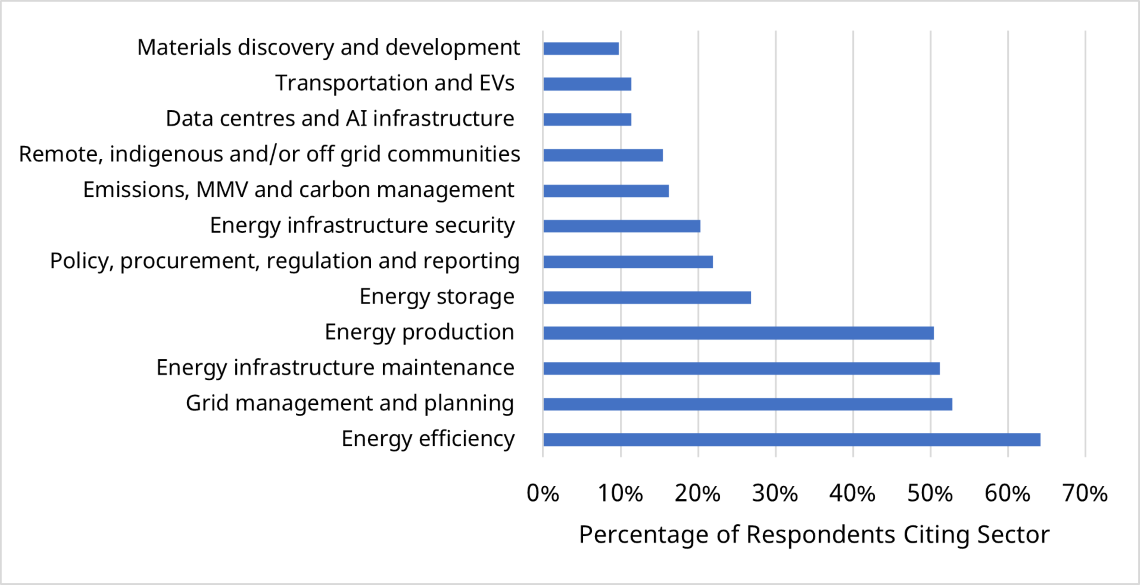
Figure 1: Sub-Sectors with Opportunities for AI Application
Figure 1 - Text version
The horizontal bar chart illustrates the percentage of respondents who identified opportunities for AI applications across 12 sub-sectors. The x-axis, labeled “Percentage of Respondents Citing Sector,” ranges from 0% to 70% in 10% increments, while the y-axis lists the sub-sectors.
- Materials discovery and development: 10%
- Transportation and EVs: 11%
- Data centres and AI infrastructure: 11%
- Remote, indigenous and/or off grid communities: 15%
- Emissions, MMV and carbon management: 16%
- Energy infrastructure security: 20%
- Policy, procurement, regulation and reporting: 22%
- Energy storage: 27%
- Energy production: 50%
- Energy infrastructure maintenance: 51%
- Grid management and planning: 53%
- Energy efficiency: 64%
Respondents most commonly identified energy efficiency as the sub-sector where they saw the greatest potential impact from AI, with regards to both commercial and residential buildings as well as industrial applications. This included building energy systems optimization, home energy automation, and demand side management. Respondents also identified the opportunities presented by AI for increasing the energy efficiency of industrial operations. Other sub-sectors cited included grid management and planning, such as managing distributed energy resources (DER), setting up microgrids, and running virtual power plants (VPPs), and energy infrastructure maintenance, including the use of AI for automated infrastructure monitoring and predictive maintenance planning. The potential benefits of AI applications in energy production were also frequently mentioned, particularly for renewables, including managing the integration of renewable energy into the power grid and optimizing site selection for renewables installations.
Theme 3: Data access, funding constraints and gaps in domain expertise remain barriers to applying AI in the energy sector
| Barrier | Mentions |
|---|---|
| Data access/quality/standardization (siloed/proprietary data; poor standardization/interoperability; privacy/governance barriers; lack of AI‑ready data) |
81 |
| Funding constraints / capital (limited budgets, pilot funding gaps, risk appetite, venture capital shortages, need for patient capital) |
71 |
| Weak linkages/collaboration (AI ↔ energy) (poor connections between AI innovators and utilities/energy actors; limited co‑development/pilots; siloed ecosystems) |
56 |
| Energy–AI expertise gap (domain knowledge) (AI teams lack deep energy context; energy teams lack awareness of AI requirements; need hybrid expertise) |
52 |
| Compute / infrastructure constraints (High Performance Computing/Graphics Processing Unit (GPU) access, sovereign/secure compute, edge/operational constraints, connectivity) |
40 |
| Regulatory / procurement hurdles (compliance and approvals, conservative procurement policies, uncertainty re: AI deployment in energy sector) |
38 |
| Cybersecurity / privacy (security of critical infrastructure; privacy of customer/energy systems/operational data) |
28 |
| Adoption culture / risk aversion (risk aversion, organizational hesitation) |
18 |
| Return on Investment (ROI) / business case and incentives (unclear ROI, weak market signals/incentives, business‑case uncertainty) |
17 |
| Pilot‑to‑scale / commercialization gap (Proof of concepts that don’t scale; “valley of death”; need for post‑pilot integration funding and pathways) |
16 |
| Legacy systems and integration/interoperability (legacy operational technology/information technology; interoperability with older systems) |
15 |
| Standards and benchmarking gaps (performance/assurance standards, model validation/benchmarks, acceptance criteria) |
15 |
| Trust, explainability, assurance (black‑box concerns, hallucinations, need for explainability and auditability) |
14 |
| Talent competition / brain drain (capital flight, competition for hybrid talent, salary differentials) |
8 |
| Indigenous data sovereignty / inclusion (Indigenous legal/data frameworks, sovereignty requirements, multilingual logic models) |
7 |
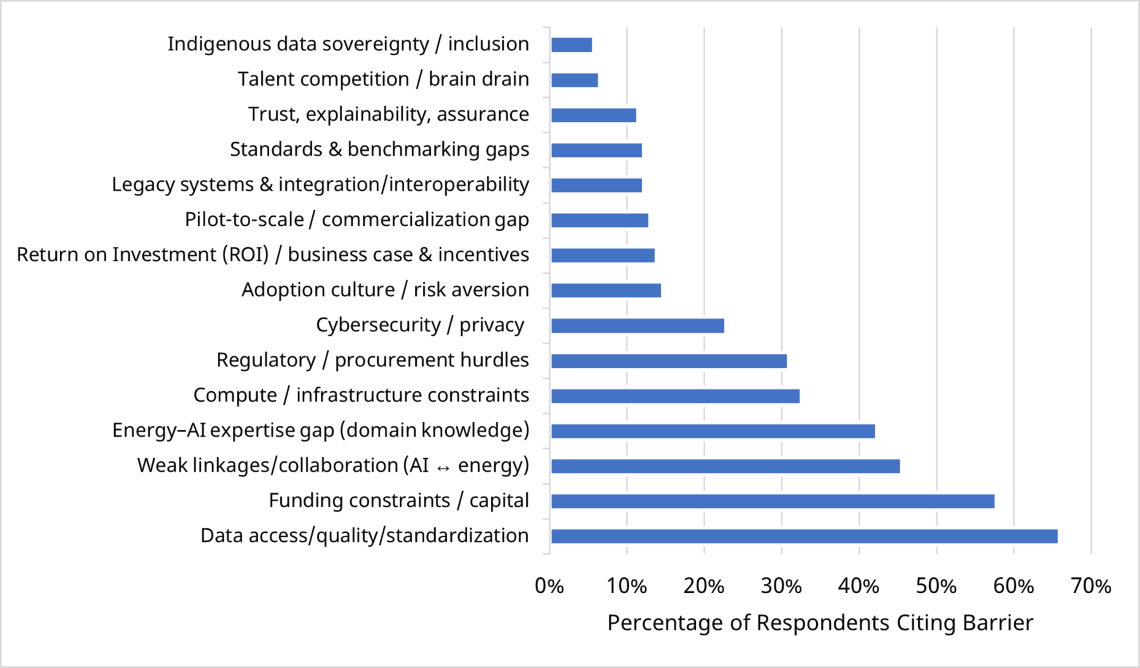
Figure 2: Barriers to Harnessing AI Across the Energy Sector
Figure 2 - Text version
The horizontal bar chart illustrates the percentage of respondents who identified barriers to harnessing AI across the energy sector. The x-axis, labeled “Percentage of Respondents Citing Barrier,” ranges from 0% to 70% in 10% increments, while the y-axis lists the barriers.
- Indigenous data sovereignty / inclusion: 6%
- Talent competition / brain drain: 7%
- Trust, explainability, assurance: 11%
- Standards and benchmarking gaps: 12%
- Legacy systems and integration/interoperability: 12%
- Pilot‑to‑scale / commercialization gap: 13%
- Return on Investment (ROI) / business case & incentives: 14%
- Adoption culture / risk aversion: 15%
- Cybersecurity / privacy: 23%
- Regulatory / procurement hurdles: 31%
- Compute / infrastructure constraints: 33%
- Energy–AI expertise gap (domain knowledge): 42%
- Weak linkages/collaboration (AI ↔ energy): 46%
- Funding constraints / capital: 58%
- Data access/quality/standardization: 66%
When asked about barriers to the application of AI in the energy sector, respondents addressed their responses both in terms of barriers to applying AI for energy, as well as applying AI for energy innovation. Further, some barriers identified relate to both. For example, access to data and concerns around data quality and standardization was the most cited barrier and is applicable to AI for energy innovation use-cases, as well its application in the energy sector more broadly. Funding constraints/capital was the next most common barrier. Responses in this category most frequently cited this as a barrier to conducting research on the use of AI for energy. Respondents highlighted limited funding specifically designated for AI in the energy sector as a gap, Small and Medium Enterprises (SMEs) specifically noted difficulties with the short-timelines on funds where they do exist.
The two next mostly commonly cited barriers are related: weak linkages or low levels of collaboration between the AI and energy ecosystems, and the lack of domain expertise between the two areas, exemplified by AI firms with limited expertise in energy systems and energy firms with limited expertise in AI. Regulatory and procurement processes were also cited. Respondents explained that the complexity of the energy regulatory landscape, alongside uncertainty around compliance and approval processes for AI-driven systems, were a barrier to implementation. Similarly, respondents noted that procurement processes have not yet incorporated AI considerations in their evaluation processes. Cybersecurity and data privacy concerns stemming from AI was another barrier given the important privacy concerns related to energy data, as well as the criticality of energy infrastructure. One related, but less commonly mentioned barrier, was the hesitation around adopting new technologies and risk aversion, particularly when incorporating AI into the energy sector. Commonly cited reasons for risk aversion were the conservative nature of energy utilities, and concerns by energy companies about uncertainties related to AI adoption on legacy systems.
Theme 4: Access to affordable, sovereign AI compute capacity is a growing concern, especially as projects scale up
Respondents were asked specifically if access to sovereign AI compute capacity for the development of new AI applications for energy innovation in Canada was a challenge. 63% of respondents agreed that it was a barrier. Compute affordability in general, regardless of sovereignty, was cited as a barrier, particularly for SMEs and startups. Respondents explained that AI solutions in the energy sector often require large datasets, pulling from a variety of data sources, which adds additional compute demand. Most respondents agreed the barrier was not just access to affordable compute, but access to affordable sovereign compute. This was described as vital given the sensitivity of energy data, the criticality of energy infrastructure, and the need to meet data privacy regulations.
Sovereign compute was also described as an important way to ensure long-term access to processing capacity and was a more stable option.
For some respondents who did not think access to sovereign compute was a barrier, or not currently the biggest barrier, they anticipated it to become a barrier in the future as use of AI in energy innovation grows.
As for solutions, some respondents suggested edge AI as a possibility, whereby AI-enabled data processing occurs on local workstations in distributed systems, thus reducing connectivity issues associated with transferring data to remote services and cloud computing costs.
Theme 5: Government action can lead the way for the application of AI, through investments in pilot projects and demonstrations, improvements to data infrastructure and programs to encourage cross-sector collaboration
When asked for the most impactful investment for integrating AI into the energy sector in Canada, respondents recommended investments to help overcome barriers to implementing AI for energy. Funding for pilot and demonstration projects along with investing in energy data infrastructure were the top responses. These types of projects were specified to address general hesitation about adoption of AI in the energy sector, including energy operators not yet prepared to leverage AI, a lack of baseline data, and uncertainty about AI and compliance concerns. Investment in energy data infrastructure was intended to address some of the previously defined barriers related to interoperable or inaccessible data, as well as data governance concerns. Government investment in demonstration projects or testbeds was also highlighted as ways to de-risk initial adoption investments.
The next most common response was related to programs for fostering cross-sector connections, intended to address the lack of domain expertise and weak linkages between the AI and energy sector that were frequently identified as barriers to AI implementation.
Finally, talent development and workforce upskilling and updating regulatory and procurement were identified as federal investment areas to build up AI capacity in the energy sector.
| Investment area | Mentions |
| Pilot and demonstration projects or testbeds | 47 |
| Open/standardized energy data infrastructure | 43 |
| Programs to encourage cross-sector collaboration | 43 |
| Talent development and workforce upskilling | 40 |
| Regulatory and procurement modernization | 38 |
| Sovereign and/or affordable AI compute | 33 |
| Startup/SME support and commercialization bridging | 29 |
| Grants/incentives/subsidies/tax credits (General) | 28 |
| Funding for foundational R&D | 13 |
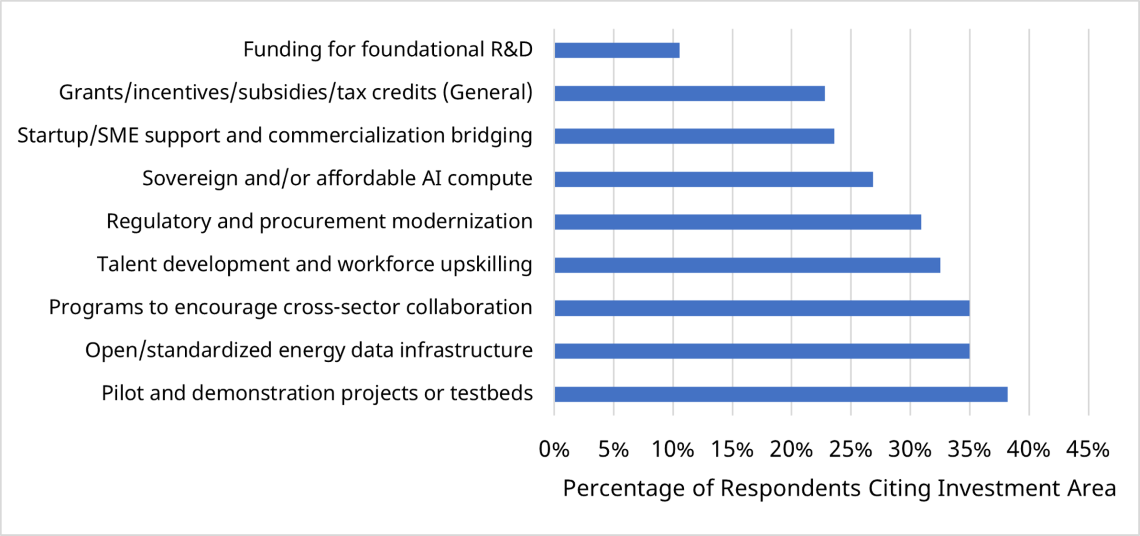
Figure 3: Impactful Investment Areas
Figure 3 - Text version
The horizontal bar chart illustrates the percentage of respondents who identified impactful investment areas. The x-axis, labeled “Percentage of Respondents Citing Investment Area,” ranges from 0% to 45% in 5% increments, while the y-axis lists the investment areas.
- Funding for foundational R&D: 11%
- Grants/incentives/subsidies/tax credits (General): 23%
- Startup/SME support and commercialization bridging: 24%
- Sovereign and/or affordable AI compute: 27%
- Regulatory and procurement modernization: 31%
- Talent development and workforce upskilling: 33%
- Programs to encourage cross-sector collaboration: 35%
- Open/standardized energy data infrastructure: 35%
- Pilot and demonstration projects or testbeds: 38%
Background
Artificial Intelligence (AI) has the potential to quickly deliver technology advances that lower the operational costs of energy, improve energy system effectiveness, accelerate the discovery of new energy materials, and thus support Canada’s energy transition through accelerated innovation.
Canada has already made significant investments, such as through the Pan Canadian AI Strategy and the Canadian Sovereign Compute AI Strategy, to become a global leader in developing next-generation AI solutions. Building on these investments, we are seeking to accelerate the pace of energy innovation using AI.
NRCan’s Office of Energy Research and Development (OERD) issued a Request for Information (RFI) (summer 2025) to identify opportunities to accelerate the pace of energy innovation using AI. The International Energy Agency (IEA), in their 2025 State of Energy Innovation Report recognized three pillars at the nexus of energy and AI to help the sector understand a wide degree of use cases. These include;
- AI for energy, such as the use of AI to optimise energy systems (e.g., AI applications to improve end-use and grid optimization)
- AI for energy innovation, where the application of AI has the possibility of accelerating innovation in the energy sector (e.g., accelerated scientific discovery of materials for energy systems and/or derisk systems design/testing)
- Energy for AI, encompassing topics related to the energy/electricity demands of AI and data centres writ large.
As part of the response analysis, the emerging themes were categorized into cases relating AI for energy or AI for energy innovation.
Summary of respondents
123 responses were received from a variety of organizations (see Figure 4), 92% of which were from Canadian entities.
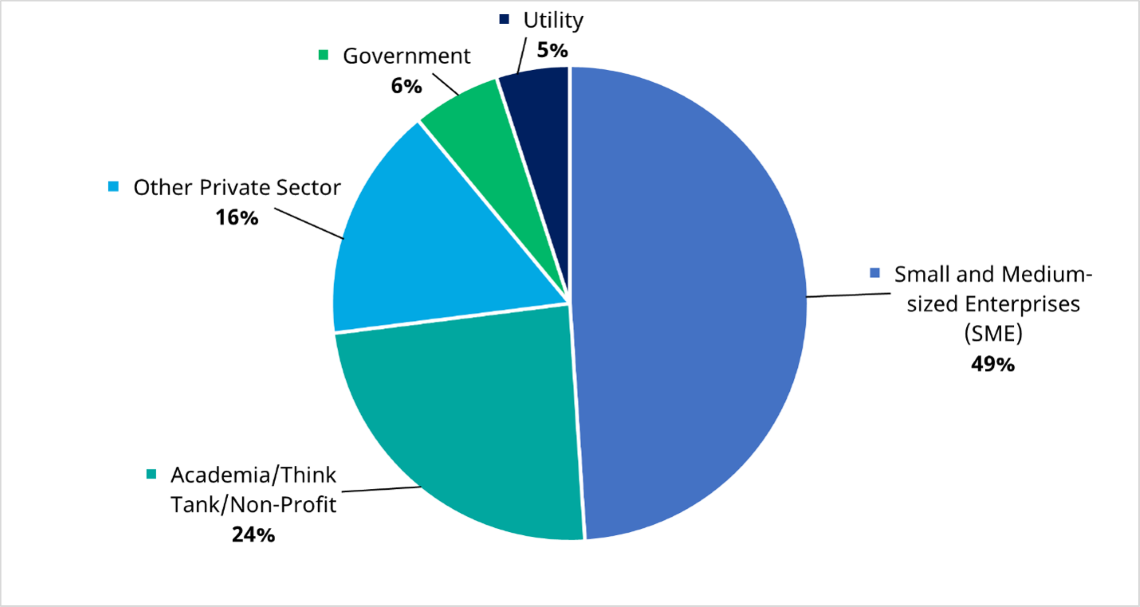
Figure 4: Respondent Types
Figure 4 - Text version
The pie chart illustrates the distribution of the 123 responses across five respondent types:
- Utility (dark navy blue): 5%
- Government (bright green): 6%
- Other Private Sector (light blue): 16%
- Academia/Think Tank/Non-Profit (teal): 24%
- Small and Medium-sized Enterprises (SME) (medium blue): 49%
Analysis method
Responses to the RFI were analyzed by a combination of human analysis and the Government of Canada licensed version of Microsoft’s Co-Pilot tool. All identifying information was removed from the contents of the responses to the RFI prior to Co-Pilot analysis. Any use of the AI tool to tag responses by theme(s) was then reviewed and validated.
RFI timeline
Initial engagement and question design took place from January to July 2025. The RFI was posted and accepted responses from July to August 2025. Response analysis took place from August 2025 to April 2026.
This RFI did not represent a formal consultation for a current or future funding opportunity, and there was no requirement from NRCan to respond to the submissions.
Appendix A: What We Asked
- How do you envision AI accelerating energy innovation in Canada? Are there particular use-cases from other companies or countries that are relevant, or could be adapted to a Canadian context?
- What are some sub-sectors where you expect significant improvement/impact from AI application? E.g., energy efficiency, energy production, energy infrastructure security, energy infrastructure maintenance
- What challenges in bringing new energy innovations to market can AI address?
- What specific opportunities exist for Canada to excel in the use, or development of, AI solutions for energy innovation?
- What is the degree of interest within the Canadian AI ecosystem to tackle energy innovation challenges? Are there current incentives or barriers to support the use of AI in energy innovation?
- What barriers exist to harnessing AI expertise to address energy innovation applications? For example: limited access to data (or unavailable data), lack of energy expertise in AI firms; poor connections between AI innovators and the energy innovation ecosystem, limited funding (from energy innovators) to work with AI innovators etc.
- Do you or your organization already utilize AI to accelerate energy innovation? If so, what areas are you active in? [Please do not provide proprietary information and/or confidential business information in your response. Please see disclaimer for more information.
- What would be the most impactful investment to support advancing AI’s capacity to accelerate energy innovation in Canada? For example, are there specific areas across the sector that are difficult to attract private investment, and require new or sustained government support to accelerate innovation?
- Is access to sovereign AI compute capacity a barrier for the development of new AI applications for energy innovation in Canada?
Disclaimer
Please note this is solely a request for information and does not represent formal consultation for a current or future funding opportunity. NRCan is not obligated to respond directly or indirectly to any of the issues submitted under an RFI.
NRCan will not reimburse any respondent for expenses incurred in responding. Respondents will have no claim for damages, compensation, loss of profit, or allowance arising out of providing comments in response to the RFI.
Please do not include any information you consider proprietary or confidential. NRCan will handle the responses in accordance with the Access to Information Act.
Responses may be shared with other departments within the Government of Canada unless the respondent specifically indicates otherwise.
NRCan may, at its discretion, contact any respondents to follow up with additional questions or for clarification of any aspect of a response.