
Canada's Fire Behaviour Prediction (FBP) System is a series of mathematical equations that relate fire characteristics to wind, fuel moisture and topographic conditions for 16 vegetation fuel types. It is used to assess wildland fire behaviour potential.
FBP fuel type descriptions
C-1 Spruce/Lichen Woodland
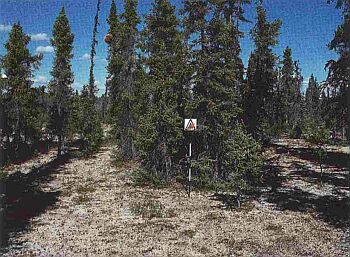
(Spruce/Lichen Woodland)
This fuel type is characterized by open, park-like black spruce (Picea mariana) stands occupying well-drained uplands in the subarctic zone of northern Canada. Jack pine (Pinus banksiana) and white birch (Betula papyrifera) are minor associates in the overstorey.
Forest cover occurs as widely spaced individuals and dense clumps. Tree heights vary considerably, but branches (live and dead) uniformly extend to the forest floor and layering development is extensive. Accumulation of woody surface fuel is very light and scattered. Shrub cover is exceedingly sparse.
The ground surface is fully exposed to the sun and covered by a nearly continuous mat of reindeer lichens (Cladonia spp.), averaging 3 to 4 centimetres (cm) in depth above mineral soil.
C-2 Boreal spruce
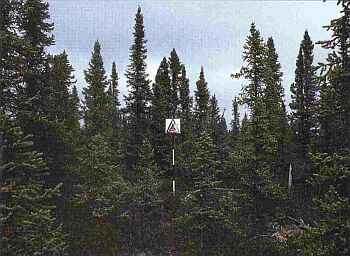
(Boreal Spruce)
This fuel type is characterized by pure, moderately well-stocked black spruce (Picea mariana) stands on both lowland and upland sites. Sites with extensive sphagnum moss surface fuels do not qualify as C-2 fuels.
Tree crowns extend to or near the ground. Dead branches are typically draped with bearded lichens (Usnea spp.). The flaky nature of the bark on the lower portion of stem boles is pronounced. Low to moderate volumes of down woody material are present. Labrador tea (Rhododendron groenlandicum) is often the major shrub component.
The forest floor is dominated by a carpet of feather mosses and/or ground-dwelling lichens (chiefly Cladonia). Sphagnum mosses may occasionally be present, but they are of little hindrance to surface fire spread. A compacted organic layer commonly exceeds a depth of 20 to 30 cm.
C-3 Mature Jack or Lodgepole Pine
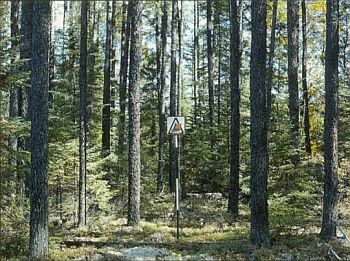
(Mature Jack or Lodgepole Pine)
This fuel type is characterized by pure, fully stocked jack pine (Pinus banksiana) or lodgepole pine (Pinus contorta) stands (1000 to 2000 stems/hectare [ha]) that have matured at least to the stage of complete crown closure.
The base of live crown is well above the ground. A sparse conifer understorey may be present. Dead surface fuels are light and scattered. Ground cover is feather-moss (such as Pleurozium schreberi) over a moderately deep (approximately 10 cm), compacted organic layer.
C-4 Immature Jack or Lodgepole Pine
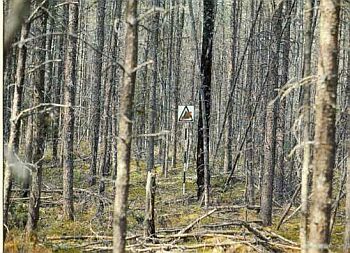
(Immature Jack or Lodgepole Pine)
This fuel type is characterized by pure, dense jack pine (Pinus banksiana) or lodgepole pine (Pinus contorta) stands (10,000 to 30,000 stems/ha) in which natural thinning mortality results in a large quantity of standing dead stems and dead downed woody fuel.
Vertical and horizontal fuel continuity is characteristic of this fuel type. Surface fuel loadings are greater than in fuel type C-3 and organic layers are shallower and less compact. Ground cover is mainly needle litter suspended within a low shrub layer (Vaccinium spp.).
C-5 Red and White Pine
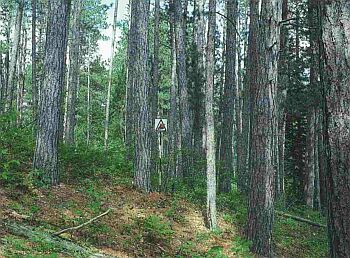
(Red and White Pine)
This fuel type is characterized by mature stands of red pine (Pinus resinosa) and eastern white pine (Pinus strobus) in various proportions, sometimes with small components of white spruce (Picea glauca) and old white birch (Betula papyrifera) or aspen (Populus spp.).
The understorey is of moderate density, usually red maple (Acer rubrum) or balsam fir (Abies balsamea). A shrub layer, usually beaked hazel (Corylus cornuta), may be present in moderate proportions.
The ground surface cover is a combination of herbs and pine litter. The organic layer is usually 5 to 10 cm deep.
C-6 Conifer plantation
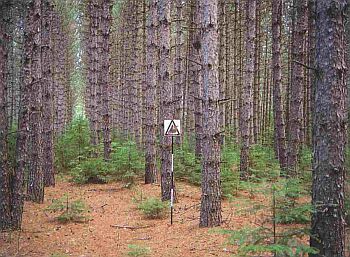
(Conifer plantation)
This fuel type is characterized by pure, fully stocked conifer plantations with closed crowns and no understorey or shrub layer. The forest floor is covered by needle litter with an underlying duff layer up to 10 cm deep.
The crown base height is taken into account in predicting fire spread rate and crowning.
C-7 Ponderosa Pine/Douglas-Fir
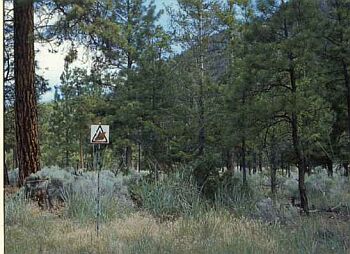
(Ponderosa Pine/Douglas-Fir)
This fuel type is characterized by uneven-aged stands of ponderosa pine (Pinus ponderosa) and Douglas-fir (Pseudotsuga menziesii) in various proportions. Western larch (Larix occidentalis) and lodgepole pine (Pinus contorta) may be significant stand components on some sites and at some elevations.
Stands are open, with occasional clumpy thickets of multi-aged Douglas-fir and/or larch as a discontinuous understorey. Canopy closure is less than 50% overall, although thickets are closed and often dense. Woody surface fuel accumulations are light and scattered.
Except within Douglas-fir thickets, the forest floor is dominated by perennial grasses, herbs and scattered shrubs. Within tree thickets, needle litter is the predominant surface fuel. Duff layers are nonexistent to shallow (<3 cm).
D-1 Aspen — Leafless
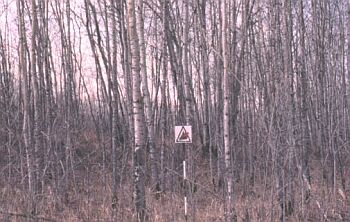
(Aspen — Leafless)
This fuel type is characterized by pure, semimature trembling aspen (Populus tremuloides) stands before bud break in the spring or following leaf fall and curing of the lesser vegetation in the autumn.
A conifer understorey is noticeably absent, but a well-developed medium to tall shrub layer is typically present. Dead and down roundwood fuels are a minor component of the fuel complex.
The principal fire-carrying surface fuel consists chiefly of deciduous leaf litter and cured herbaceous material that is directly exposed to wind and solar radiation. In spring, the duff (F and H horizons) seldom contributes to the available combustion fuel because of its high moisture content.
M-1 Boreal Mixedwood — Leafless
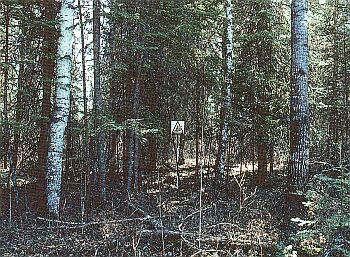
(Boreal Mixedwood — Leafless)
This fuel type (and its "green" counterpart, M-2) is characterized by stand mixtures consisting of the following coniferous and deciduous tree species in varying proportions:
- black spruce (Picea mariana)
- white spruce (Picea glauca)
- balsam fir (Abies balsamea)
- subalpine fir (Abies lasiocarpa)
- trembling aspen (Populus tremuloides)
- white birch (Betula papyrifera)
On any specific site, individual species can be present or absent from the mixture. In addition to the diversity in species composition, stands exhibit wide variability in structure and development, but are generally confined to moderately well-drained upland sites.
M-1, the first phase of seasonal variation in flammability, occurs during the spring and fall. The rate of spread is weighted according to the proportion (expressed as a percentage) of softwood (conifer) and hardwood (broadleaf) components.
M-2 Boreal Mixedwood — Green
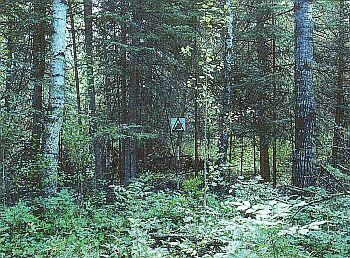
(Boreal Mixedwood — Green)
This fuel type (and its "leafless" counterpart, M-1) is characterized by stand mixtures consisting of the following coniferous and deciduous tree species in varying proportions:
- black spruce (Picea mariana)
- white spruce (Picea glauca)
- balsam fir (Abies balsamea)
- subalpine fir (Abies lasiocarpa)
- trembling aspen (Populus tremuloides)
- white birch (Betula papyrifera).
On any specific site, individual species can be present or absent from the mixture. In addition to the diversity in species composition, stands exhibit wide variability in structure and development, but are generally confined to moderately well-drained upland sites.
M-2, the second phase of seasonal variation in flammability, occurs during the summer. The rate of spread is weighted according to the proportion (expressed as a percentage) of softwood (conifer) and hardwood (broadleaf) components. In the summer, when the deciduous overstorey and understorey are in leaf, fire spread is greatly reduced, with maximum spread rates only one-fifth that of spring or fall fires under similar burning conditions.
M-3 Dead Balsam Fir/Mixedwood — Leafless
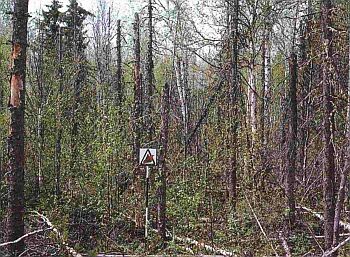
(Dead Balsam Fir/Mixedwood — Leafless)
This fuel type (and its "green" counterpart, M-4) is characterized by mixedwood stands in which balsam fir (Abies balsamea) grows, often as an understorey species, in a heterogeneous mix with:
- spruce (Picea spp.)
- pine (Pinus spp.)
- birch (Betula spp.)
These stands are found in the Great Lakes – St. Lawrence and Boreal Forest regions of Canada and are not to be confused with the pure balsam fir stands typical of Nova Scotia and New Brunswick.
Repeated annual defoliation (due to spruce budworm [Choristoneura fumiferana] attack) causes balsam fir mortality, followed by peeling bark, draped lichen (Spanish moss or old man’s beard, [Usnea spp.]) development, top breakage and windthrow, peaking 5 to 8 years after mortality. The volume of down woody material is initially low but increases substantially with progressive stand decomposition following mortality.
The forest floor is a mixture of feather mosses, conifer needles and hardwood leaves. The organic layer is moderately compacted and 8 to 10 cm deep.
After stand mortality, spring wildland fires behave extremely vigorously in this fuel type, with continuous crowning and downwind spotting.
M-4 Dead Balsam Fir/Mixedwood — Green
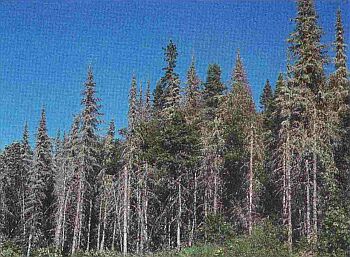
(Dead Balsam Fir/Mixedwood — Green)
This fuel type (and its "leafless" counterpart, M-3) is characterized by mixedwood stands in which balsam fir (Abies balsamea) grows, often as an understorey species, in a heterogeneous mix with:
- spruce (Picea spp.)
- pine (Pinus spp.)
- birch (Betula spp.)
These stands are found in the Great Lakes – St. Lawrence and Boreal Forest regions of Canada. They should not be confused with the pure balsam fir stands typical of Nova Scotia and New Brunswick.
Repeated annual defoliation due to spruce budworm (Choristoneura fumiferana) attack causes balsam fir mortality, followed by peeling bark, draped lichen (Spanish moss or old man’s beard, [Usnea spp.]) development, top breakage and windthrow, peaking 5 to 8 years after mortality. The volume of down woody material is initially low but increases substantially with progressive stand decomposition following mortality.
The forest floor is a mixture of feather mosses, conifer needles and hardwood leaves. The organic layer is moderately compacted and 8 to 10 cm deep.
Summer fires are hampered by the proliferation of green understorey vegetation resulting from the opening of stand canopy. As sufficient surface fuel accumulates through stand decomposition (usually after 4 to 5 years), fires spread through the fuel complex, although not as vigorously as in spring. Wildland fire behaviour potential is greatest 5 to 8 years after mortality, decreasing gradually as surface fuels decompose and understorey vegetation proliferates.
O-1 Grass
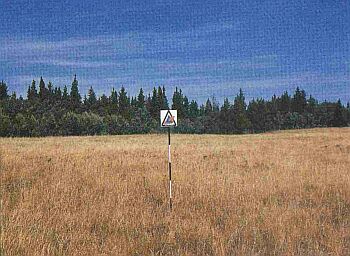
(Grass)
This fuel type is characterized by continuous grass cover, with no more than occasional trees or shrub clumps that do not appreciably affect fire behaviour.
Two subtype designations are available for grasslands:
- O-1-a for the matted grass condition common after snowmelt or in the spring
- O-1-b for standing dead grass common in late summer to early fall
The proportion of cured or dead material in grasslands has a pronounced effect on fire spread and must be estimated with care.
S-1 Jack or Lodgepole Pine Slash
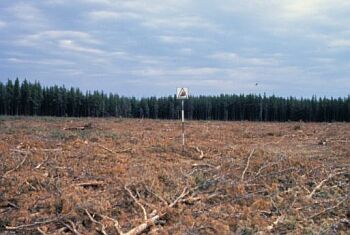
(Jack or Lodgepole Pine Slash)
This fuel type is characterized by slash resulting from tractor or skidder clear-cut logging mature stands of:
- jack pine (Pinus banksiana)
- lodgepole pine (Pinus contorta)
The slash is typically one or two seasons old, retaining up to 50% of the foliage, particularly on branches closest to the ground. No post-logging treatment has been applied and slash fuels are continuous. Tops and branches left on site result in moderate fuel loads and depths.
Ground cover is continuous feather moss (such as Pleurozium schreberi) mixed with discontinuous fallen needle litter. Organic layers are moderately deep and fairly compact.
S-2 White Spruce/Balsam Slash
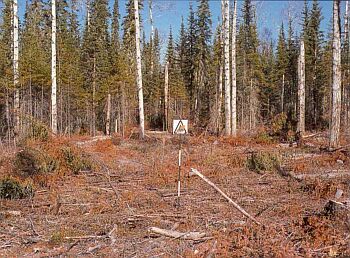
(White Spruce/Balsam Slash)
This fuel type is characterized by slash resulting from tractor or skidder clear-cut logging of mature to overmature stands of:
- white spruce (Picea glauca)
- sub-alpine fir (Abies lasiocarpa) or balsam fir (Abies balsamea)
The slash is typically one or two seasons old, retaining from 10% to 50% of the foliage on the branches. No post-logging treatment has been applied.
Fuel continuity may be broken by skid trails unless the site was logged in winter. Tops have been left on site and most branch fuels have broken off during skidding of logs to landings, which results in moderate fuel loads and depths. Quantities of shattered large and rotten woody fuels may be significant.
Ground cover is feather moss (such as Pleurozium schreberi) with considerable needle litter fallen from the slash. Organic layers are moderately deep and compact.
S-3 Coastal Cedar/Hemlock/Douglas-Fir Slash
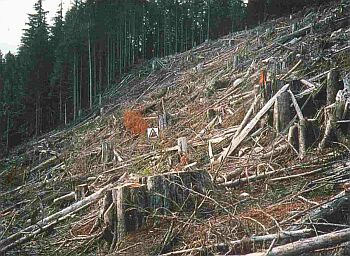
(Coastal Cedar/Hemlock/Douglas-Fir Slash)
This fuel type is characterized by slash resulting from high-lead clear-cut logging of mature to overmature coastal British Columbia mixed conifer stands. Predominant species are:
- western redcedar (Thuja plicata)
- western hemlock (Tsuga heterophylla)
- Douglas-fir (Pseudotsuga menziesii)
Slash is typically one season old, with the cedar component retaining all its foliage in a cured condition on the branches. Hemlock and Douglas-fir components will have dropped up to 50% of their foliage.
Slash fuels tend to be continuous and uncompacted. Very large loadings of broken and rotten unmerchantable material may be present, depending on the degree of stand decadence. Slash fuel depths may range from 0.5 to 2.0 meters.
Ground cover may be feather moss (such as Pleurozium schreberi) or just compact old needle litter under significant quantities of recent needle litter fallen from the slash. Organic layers are moderately deep to deep and compact. Minor to moderate shrub and herbaceous understorey components may be present.
This fuel type designation may also be applied to wet belt cedar–hemlock slash of coastal and interior British Columbia where the Douglas-fir component is absent.
Find out more
- Canadian Fire Effects Model (CanFIRE)
- The Canadian Forest Fire Danger Rating System (CFFDRS)
- Fire behaviour
- Wiland fire monitoring and reporting tools
- Wildland fire