
Canada’s forests face ongoing threats from a wide range of insects and diseases. Early detection, accurate identification and comprehensive surveillance help forest managers:
- monitor forest health
- maintain the resilience of Canada’s natural, rural and urban forests
- make rapid response decisions that can mitigate potential negative impacts to forests and communities
Search our Trees, insects, mites and diseases of Canada's forests database for detailed information on more than 200 native trees and more than 400 insects, mites, pathogens and other damage agents that can affect natural, rural and urban areas in Canada.
The Canadian Forest Service (CFS) conducts research to support forest health monitoring and protection across Canada. It develops and enhances surveillance tools, techniques and strategies that help forest managers detect, identify and monitor forest insects and diseases that pose the highest risks to Canada’s forests and forest sector. This work helps forest managers to protect forest health, as well as track and respond to new and spreading forest pests.
Detection, monitoring and diagnosis
Forest managers use several methods and tools to detect and monitor forest insects and diseases. For example:
- traps using attractants, such as pheromones, for the early detection and monitoring of populations of specific insect species
- aerial surveys or satellite imagery to identify and map widespread tree damage or stress
Identifying forest insects and diseases combines field observations with survey tools, taxonomic expertise (enabling specialists to recognize and classify organisms based on their characteristics) and laboratory testing. When needed, laboratory methods (such as molecular analyses that detect organisms based on their genetic signatures) provide a more accurate identification of the exact cause of forest health problems.
Visible signs of insect problems may include:
- exit holes
- sawdust-like debris
- feeding tunnels under the bark
- leaf loss
Signs of disease may include:
- yellowing or dead tissue
- cankers
- discoloured wood
- visible fungal growth
Together, these approaches support effective detection, monitoring and diagnosis of insects and diseases that affect forest health.
Some noticeable forest pests
Below are examples of some native and introduced forest insects and diseases studied by the CFS. This list does not include all forest pests found in Canada or provide definitive diagnoses. Report sightings to local authorities, who will determine whether reporting to the Canadian Food Inspection Agency is necessary.
Spruce budworm (SBW): a native defoliator of spruce-fir forests across North America.

- ADULTS: mottled brown or grey moths that emerge in midsummer to mate and lay egg masses
- LARVAE: small with brown-green bodies and dark brown heads
- SIGNS OF INFESTATION: Larvae feed on developing buds and leaves in spring, resulting in thin foliage or bare branches.
- WHAT TO DO: Watch for feeding damage on new buds or needles, thinning foliage and the presence of larvae. Report unusual defoliation to local authorities.
Browse Canadian Forest Service publications about the SBW
Emerald ash borer (EAB): a non-native wood-boring beetle now found in many parts of Canada.
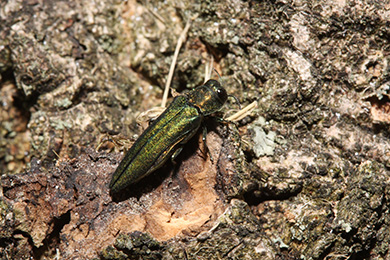
- ADULTS: small (about 8 to 14 millimetres long) metallic green
- LARVAE: white, with flattened bodies and up to 25 to 30 millimetres long
- SIGNS OF INFESTATION: Although adult beetles cause some defoliation, most damage is caused by larvae tunnelling under the bark, interrupting the flow of water and nutrients. Affected trees show yellowing leaves and branch dieback. Infested trees often die within 2 to 4 years.
- WHAT TO DO: Watch for ash trees with thinning crowns and D-shaped exit holes in the bark. Chemical insecticides can be injected into individual high-value trees for protection. Removal of infested trees is the most common method to slow spread. Avoid moving potentially infested wood. In areas EAB is not known to occur, report sightings to local authorities.
Browse Canadian Forest Service publications about the EAB
Mountain pine beetle (MPB): a native bark beetle of pine forests in western North America. MPB carries a blue stain fungus that, together with the insect, blocks the movement of water and nutrients, killing the tree.
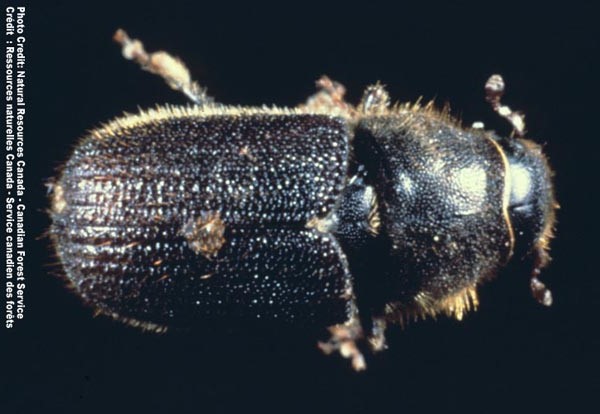
- ADULTS: very small, brown to black in colour
- LARVAE: creamy white, legless grubs with red-brown heads that feed under the bark in the winter
- SIGNS OF INFESTATION: Look for large pine trees with red crowns or crowns fading to red starting from the bottom, boring dust on the trunk and around the base of the tree, and pitch (resin) tubes on the trunk. Large outbreaks can cause wide-spread tree mortality, alter wildlife habitat, increase the risk of wildland fire, and disrupt timber supply and forest management practices.
- WHAT TO DO: Watch for signs of dying pine trees, especially larger trees with pitch globules on the trunk. In areas MBP is not known to be established, report sightings to local authorities.
Browse Canadian Forest Service publications about MPB
Hemlock woolly adelgid (HWA): a non-native piercing-sucking insect present in parts of eastern Canada and continuing to spread.

© Robert L. Anderson, USDA Forest Service, www.forestryimages.org
- ADULTS: tiny (about 1.4 millimetres long) soft-bodied and pear-shaped
- EGGS: laid in similar white, waxy sacs
- SIGNS OF INFESTATION: HWA feeds on new shoots, interfering with photosynthesis, depleting plant reserves and impacting tree health. A white, woolly, waxy material covering their bodies is visible on the underside of hemlock twigs. Infested trees show needle loss, shoot dieback and canopy discolouration. Tree death can occur within 3 years.
- WHAT TO DO: Watch for any white, cotton-like blobs on hemlock twigs. Immediately report sightings of HWA to the Canadian Food Inspection Agency .
Browse Canadian Forest Service publications about HWA
White pine blister rust (WPBR): an invasive disease of white pine that causes serious damage and occurs across Canada. It is the only non-native stem rust affecting white pine.

- SIGNS OF INFECTION: Fungus infects needles in the fall, with many small yellow spots appearing the following spring. Over time, the infection spreads. White fruiting bodies form on the bark and develop into stem cankers. As cankers expand, the flow of water and nutrients within the tree is interrupted and foliage above the affected area turns yellow and then reddish brown. Continued canker growth leads to tree decline, dieback and ultimately death of the upper portions of the tree.
- WHAT TO DO: Watch for signs such as yellowed foliage, reduced growth, branch mortality and top dieback. Prune lower branches, including those without visible infection. This may help limit WPBR in plantations that lack nearby alternate hosts, such as Ribes species, commonly known as currants and gooseberries.
Browse Canadian Forest Service publications about WPBR
Find out more
- Armillaria root rot
- Forest tent caterpillar
- Nectria canker
- Spongy moth
- Spruce beetle
- White pine weevil
- Whitespotted sawyer
- Why forests need fires, insects and diseases
- State of Canada’s Forests annual report - How does disturbance shape Canada’s forests