
Canada’s Fire Weather Index (FWI) System accounts for the effects of fuel moisture and weather conditions on fire behaviour. It is a main component of the Canadian Forest Fire Danger Rating System (CFFDRS).

View daily fire weather information on the Canadian Wildland Fire Information System (CWFIS).
Wildland fire agencies use the codes and indices of the FWI System to guide management decisions such as predicting the potential for daily ignition across the landscape. Fire danger is communicated to the public through roadside signs and online maps.
Components of the FWI System provide numeric ratings of relative fire behaviour in a pine type forest.
Calculations are based on fire weather observations:
- temperature
- relative humidity
- wind speed
- rain
The structured approach of the FWI system helps fire management teams assess wildland fire risk based on current weather conditions.
FWI System components
The first three components of the FWI System are fuel moisture codes. These indicators represent:
- the flammability and ease of fine fuels to ignite
- fuel consumption
- seasonal drought effects and potential smouldering
The other three components are fire behaviour indices, which rise as fire danger increases. These indicators represent:
- the rate of fire spread
- the amount of fuel available for combustion
- fire intensity
Text version
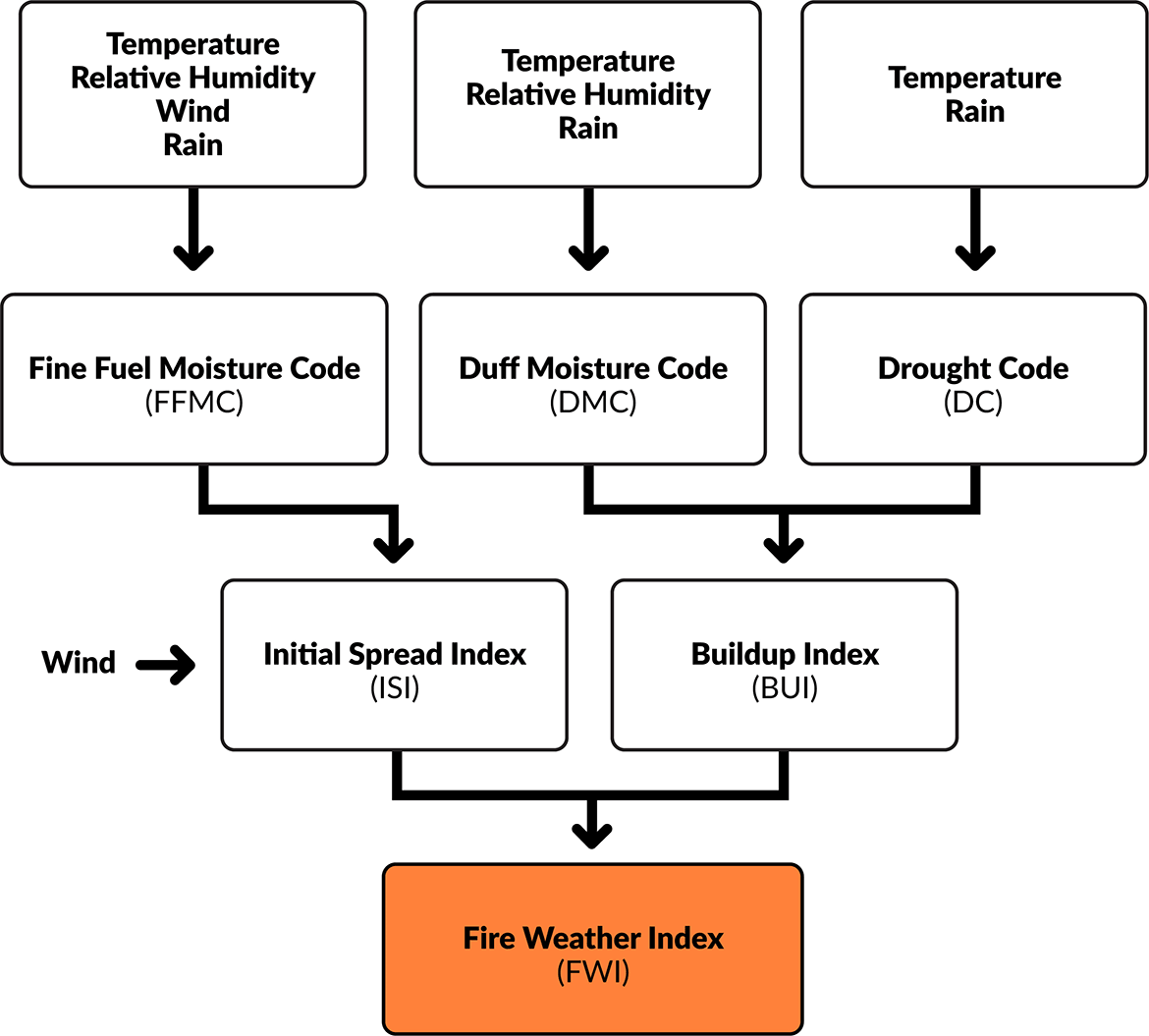
Diagram represents the components of Canada’s Fire Weather Index (FWI) System, which is used to assess wildland fire danger based on weather conditions.
Four weather factors (temperature, rain, relative humidity and wind) contribute to three different moisture codes.
- Fine Fuel Moisture Code (FFMC) is affected by temperature, rain, relative humidity and wind. FFMC represents moisture in small, easily ignitable fuels
- Drought Code (DC) is affected by temperature and rain. DC measures long-term drying conditions.
- Duff Moisture Code (DMC) is influenced by temperature, rain, and relative humidity. DMC tracks moisture levels in decomposing organic matter.
FFMC and wind influence the Initial Spread Index (ISI), which estimates how quickly a fire will spread.
DC and DMC combine to form the Buildup Index (BUI), which indicates the amount of fuel available for a wildland fire to burn.
ISI and BUI determine the Fire Weather Index (FWI), which provides an overall measure of fire danger.
Fuel Moisture Codes
Fuel Moisture Codes (FMC) are numeric ratings of the moisture content of the forest floor and other dead organic matter of a standard pine forest. Values increase as the moisture content decreases. A higher value means drier conditions.
- Fine Fuel Moisture Code (FFMC)
- a numeric rating of the moisture content of litter and other dried fine fuels on the surface of the forest floor
- an indicator of the potential for a fire to ignite from a spark or an ember
- used to represent the potential for human-caused ignition
- Duff Moisture Code (DMC)
- a numeric rating of the moisture content of loosely compacted, decayed organic layers just below the litter (humus layer)
- gives an indication of fuel consumption in moderate duff layers and medium-size woody material
- primary use is in assessing the potential for lightning-caused ignition
- Drought Code (DC)
- a numeric rating of the average moisture content of deep, densely compacted organic layers (fermentation layer)
- gives an indication of potential depth of burn and seasonal drought conditions
- primary use is to indicate seasonal drought effects on forest fuels and potential smoldering in deep organic layers and larger logs on the surface
Fire behaviour indices
- Initial Spread Index (ISI)
- a numeric rating of the expected rate of fire spread through a pine stand (fuel type)
- based on wind speed and the FFMC
- higher values indicate faster spread rates
- therefore the Fire Behaviour Prediction (FBP) System should be used for fuel specific rate of spread values
- Buildup Index (BUI)
- a numeric rating of the total amount of fuel available for combustion
- based on the DMC and the DC, with greater weight given to the DMC
- higher values are indicative of drier fuels overall and more fuel consumption during a fire
- more fuel consumption causes higher fire intensities and lead to more suppression challenges
- Fire Weather Index (FWI)
- a numeric rating of fire intensity associated with a fire spreading through a pine forest
- based on the ISI and the BUI
- higher values indicate higher intensity and larger flames
- primary operational use is to provide a relative estimate of fire intensity related to fire suppression efforts
- also used as a general index to communicate fire danger throughout the forested areas of Canada
- Daily Severity Rating (DSR)
- a numeric rating of the difficulty of controlling fires
- based on the FWI, but more accurately reflects the expected effort required for fire suppression
Daily ignition potential
The potential for daily ignition is anticipated by wildland fire managers in two distinct categories:
- Lightning-caused
- the locations of all lightning strikes are tracked in real time
- this information, along with outputs from the FWI System (primarily the DMC), is used to determine where wildland fire caused by lightning can be expected to grow slowly beneath the surface or in dry rotten logs (“hold over”) and when these fires might begin actively spreading
- Human-caused
- the possibility of wildland fire caused by humans occurring in an area on a particular day can be predicted based on:
- how receptive the small, thin forest fuels are to ignition and spread (based on the FFMC)
- how much human activity is creating ignition sources in or near the forest (for example, clear patterns can appear as clusters close to populated areas, roads and railways)
- the possibility of wildland fire caused by humans occurring in an area on a particular day can be predicted based on:
Find out more
- Wildland fires
- Wildland fire monitoring and reporting tools
- Canadian Wildland Fire Information System (CWFIS)
- Wildland fire research
- Canada’s Fire Behaviour Prediction (FBP) System
- Canadian Forest Fire Danger Rating System
Canadian Forest Service publications
- The 2025 Update to the FWI System: Structure, Changes and Interpretation (2025)
- An approach for defining physically based Fire Weather Index System classes for Ontario (2021)
- cffdrs: an R package for the Canadian Forest Fire Danger Rating System (2017)
- Weather Guide for the Canadian Forest Fire Danger Rating System (2008)
- Development and Structure of the Canadian Forest Fire Weather Index System (1987)