

The Frontier and Offshore Regulatory Renewal Initiative (FORRI) is a federal-provincial partnership working to modernize the regulatory framework for frontier and offshore oil and gas activities in Canada. FORRI is a long-term regulatory modernization program carried out in phases to review, modernize and maintain the regulatory framework.
On this page
- Overview
- Next phase of modernization
- Offshore oil and gas management
- Modernization processes
- Background
- Related information
- Contact us
Overview
Established in 2005, FORRI has strengthened Canada’s regulatory framework while supporting the oil and gas industry’s contribution to the Canadian economy and global competitiveness through strong standards for operational safety, environmental protection and resource management.
Objectives
FORRI aims to modernize the regulatory framework by:
- ensuring an efficient and effective regulatory regime that supports the highest standards of safety and environmental protection
- reducing redundancy across multiple regulations
- using performance-based requirements instead of prescribing specific technologies or approaches that may become outdated
- updating standards, where necessary
Progress to date
-
Modernization of the Drilling and Production Regulations
-
New regulations brought into force under the Energy Safety and Security Act, including:
- Administrative Monetary Penalties
- Cost Recovery
- Financial Requirements
-
Development of the Framework Regulations to consolidate multiple regulations into a single set of operational requirements for the Canada-Newfoundland and Labrador and Canada-Nova Scotia offshore areas:
Next phase of modernization
COGOA Framework Regulations
FORRI’s next focus is developing the COGOA Framework Regulations—a modern suite of operational requirements under the Canada Oil and Gas Operations Act (COGOA). The regulations would apply to Canada’s offshore oil and gas activities outside of the Canada-Newfoundland and Labrador and Canada-Nova Scotia Accord areas.
Engagement
Development of the COGOA Framework Regulations will build on information gathered through the engagement and consultation that took place during the development of the Framework Regulations for the Accord areas. FORRI will engage Indigenous peoples, industry, regulators and other stakeholders to gather further feedback on the COGOA Framework Regulations. This feedback will be considered and incorporated, as appropriate, into the ongoing development of the COGOA Framework Regulations.
This collaborative approach will help ensure that the COGOA Framework Regulations maintain Canada’s high standards for safety, environmental protection and resource management. It will also support greater consistency in operational requirements across Canada’s offshore administrative areas.
Scope of modernization
The modernization will focus on operational and regulatory requirements for conducting offshore oil and gas activities.
The modernization will address matters of:
- safety
- environmental protection
- resource management
The modernization will not:
- approve or authorize specific projects or activities
- issue any land rights, or affect how rights are issued
- alter co-management arrangements under modern treaties
Offshore oil and gas management
Oversight and participation
FORRI is an intergovernmental partnership between:
- Natural Resources Canada
- Crown-Indigenous Relations and Northern Affairs Canada
- Nova Scotia Department of Energy
- Newfoundland and Labrador Department of Eergy and Mines
The following regulatory bodies also participate in this initiative:
- Canada-Nova Scotia Offshore Energy Regulator
- Canada-Newfoundland and Labrador Offshore Energy Regulator
- Canada Energy Regulator
Administrative areas
Canada’s frontier and offshore oil and gas resources are managed through different administrative areas and legislative frameworks, depending on the location of the activity. The map below illustrates these areas:
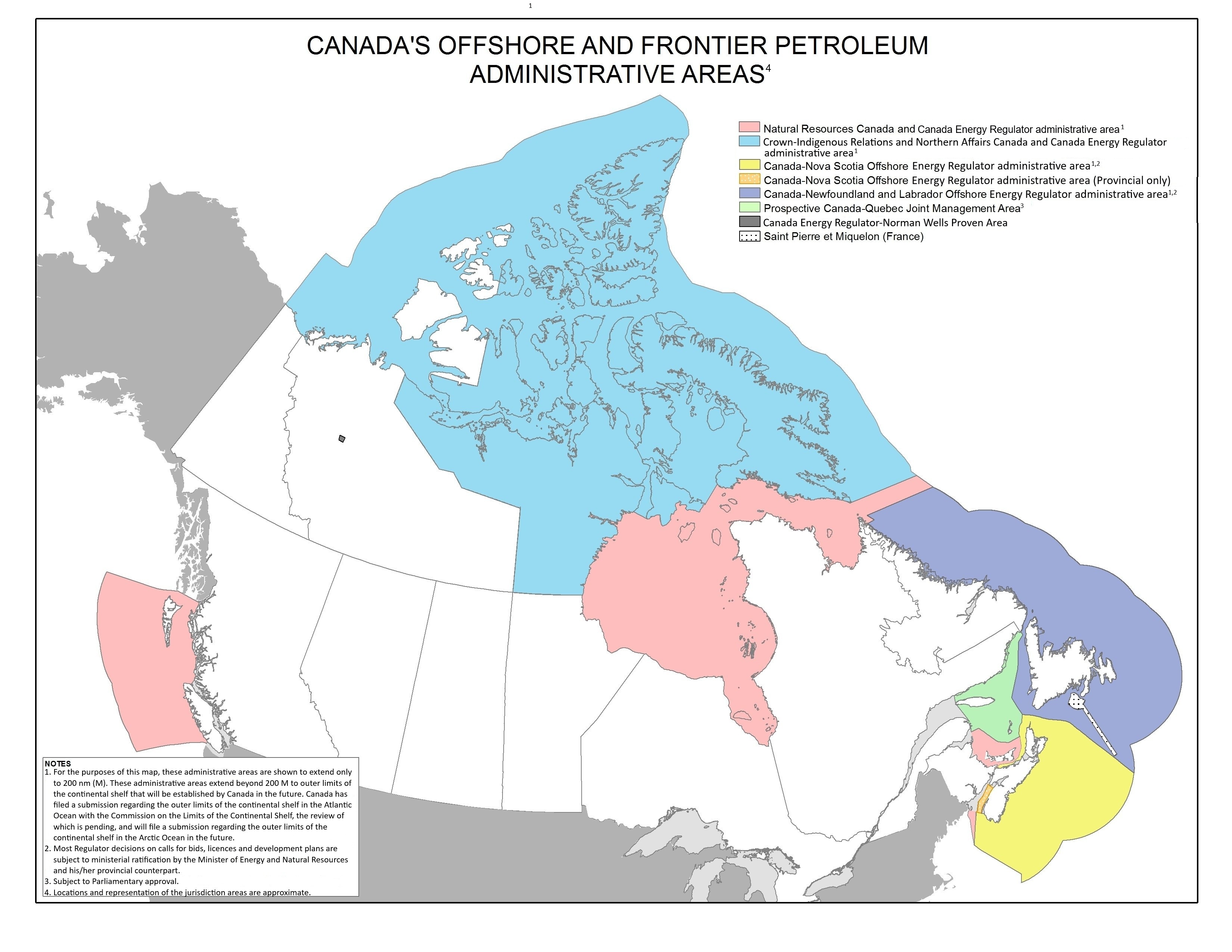
Text version
CANADA'S OFFSHORE AND FRONTIER PETROLEUM ADMINISTRATIVE AREAS
NRCan (CPRA) and CER (COGOA) administrative area
AANDC (CPRA) and CER (COGOA) administrative area
Canada-Nova Scotia Offshore Energy Regulator administrative area
Canada-Newfoundland and Labrador Offshore Energy Regulator administrative area
Prospective Canada-Quebec Joint Management Area
Saint Pierre et Miquelon (France)
NOTES
- For the purposes of this map, these administrative areas are shown to extend only to 200 nm (M). These administrative areas extend beyond 200 M to outer limits of the continental shelf that will be established by Canada in the future. Canada has filed a submission regarding the outer limits of the continental shelf in the Atlantic Ocean with the Commission on the Limits of the Continental Shelf, the review of which is pending, and will file a submission regarding the outer limits of the continental shelf in the Arctic Ocean in the future.
- Most Regulator decisions on calls for bids, licences and development plans are subject to ministerial ratification by the Minister of Energy and Natural Resources and his/her provincial counterpart.
- Subject to Parliamentary approval.
- Locations and representation of the jurisdiction areas are approximate.
Accord areas
The federal government has accords with the governments of Newfoundland and Labrador and Nova Scotia to jointly manage their respective offshore administrative areas.
Federal and corresponding provincial legislation, collectively known as the Accord Acts, establishes the management regimes for these areas.
Canada-Newfoundland and Labrador offshore area
The federal Canada-Newfoundland and Labrador Atlantic Accord Implementation and Offshore Renewable Energy Management Act and its mirror provincial legislation establish the joint management regime.
The Canada-Newfoundland and Labrador version of the Accord Acts and regulations are applied in the Canada-NL offshore area by the Canada- Newfoundland and Labrador Offshore Energy Regulator, an independent joint agency of the federal and provincial governments.
Canada-Nova Scotia offshore area
The federal Canada-Nova Scotia Offshore Petroleum Resources Accord Implementation and Offshore Renewable Energy Management Act and its mirror provincial legislation establish the joint management regime.
The Canada-Nova Scotia version of the Accord Acts and regulations are applied in the Canada-NS offshore area by the Canada-Nova Scotia Offshore Energy Regulator, an independent joint agency of the federal and provincial governments.
Frontier lands and off-shore areas outside the Accord areas
Outside of the Accord areas, offshore oil and gas activities fall under federal jurisdiction and are regulated under the Canada Petroleum Resources Act and the Canada Oil and Gas Operations Act with Ministerial powers as follows:
- Nunavut, and Arctic Offshore – Minister of Northern and Arctic Affairs
- The Pacific, James Bay, Hudson Bay, Hudson Strait, Ungava Bay, and the Gulf of St. Lawrence – Minister of Energy and Natural Resources
The Canada Energy Regulator is responsible for regulating frontier and offshore oil and gas activities outside of the Accord areas.
Evolving jurisdictions
Additional accord and devolution agreements are reshaping federal jurisdiction over oil and gas activity in Canada by transferring greater resource management and decision-making authority to provinces, territories and Indigenous partners. This includes the anticipated devolution of responsibilities in Nunavut in 2027, as well as new arrangements for the shared management of petroleum resources in the Western Arctic.
In the Western Arctic, the Government of Canada, the Inuvialuit Regional Corporation, the Governments of the Northwest Territories and Yukon have entered into an Accord for the shared management and regulation of petroleum resources north of the Arctic Circle, west of Nunavut to the limit of Canada’s jurisdiction in the Beaufort Sea and Arctic Ocean and the equitable sharing of benefits. Legislation for the Western Arctic- Tariuq Accord is expected to implement the new management regime.
Modernization processes
Regulatory development process
FORRI’s modernization of Canada’s regulatory framework for frontier and off-shore oil and gas activities adheres to federal requirements for development, managing and reviewing regulations.
The regulatory development process includes:
- Development of policy intent – Establishing the policy objectives, and instructions that will inform the drafting of the regulations
- Drafting regulations – Preparing the legal text of the proposed regulations.
- Pre-publication in Canada Gazette, Part I – Publishing draft regulations for public review and consultation.
- Public comment period on draft regulations – Gathering feedback from Indigenous peoples, stakeholders, industry, and the public on the proposed regulations.
- Publication in Canada Gazette, Part II – Finalizing and formally publishing the regulations once approved.
Early engagement
Early engagement is an important part of the federal regulatory development process. Departments and agencies are responsible for identifying stakeholders impacted by regulations, and meaningfully consulting and engaging with them throughtout the development, management, and review of regulations.
FORRI has involved extensive engagement with Indigenous peoples, industry, other stakerholders and the public throughout the development of the Framework Regulations. The policy intent for both the COGOA and Accord Act Framework Regulations, as well as the draft regulations for the Accord areas, was informed by comprehensive engagement and consultation during earlier phases of the initiative. Feedback received through that engagement continues to inform the continued development of the COGOA Framework Regulations.
As work on the COGOA Framework Regulations continues, FORRI is undertaking renewed engagement with Indigenous peoples, industry and other stakeholders. This engagement will provide an opportunity to review and provide futher input on the proposed regulations before they are pre-published in the Canada Gazette, Part I.
FORRI is committed to meaningful and transparent engagement throughout the regulatory development process.
Offshore oil and gas policies
The policy intent for the COGOA Framework Regulations is to align with the regulatory frameworks established under the Accord Acts, supporting consistency across Canada’s offshore areas. Where necessary, differences may be introduced for Arctic activities to reflect the North’s unique environmental and operating conditions.
FORRI does not revise or alter existing federal or provincial offshore oil and gas policies or objectives. Separately, the Government of Canada, led by CIRNAC, is undertaking a science-based review of the Arctic offshore moratorium. Established in 2016 and formalized in 2019 through an Order in Council, the moratorium paused new licensing and activities pending periodic review, consistent with the Government of Canada’s commitments to high safety and environmental standards.
Background
Development of the Framework Regulations
The objective of the Framework Regulations is to modernize and consolidate existing regulations governing offshore petroleum activities into a single suite of technical regulations for each offshore administrative area.
These regulations cover:
- drilling and production
- geophysical operations
- certificate of fitness
- operations
- installations
- diving
The Framework Regulations strengthen the existing regulatory framework by aligning safety, environmental protection, and resource management requirements with relevant domestic and international codes and standards.
A more technology-neutral approach allows operators, with the approval of the relevant regulator, to use the best available technologies and methodologies. This supports innovative solutions that can enhance safety and operational performance in the offshore.
The foundational policy intent supporting both the Accord Act Framework Regulations and the forthcoming proposed COGOA Framework Regulations was developed between 2015-2019.
Early engagement documentation
- Proposed policy intentions for phase 1 of the Framework Regulations
- Proposed policy intentions for phase 2 of the Framework Regulations
- Proposed policy intentions for phase 3 of the Framework Regulations
- Revised policy intention for the Framework Regulations (PDF, 1,164 KB)
- Engagement submissions for all policy intentions
Canada Gazette, Part I consultation submissions
- DNV Canada Ltd. (PDF, 149 KB)
- World Wildlife Fund Canada (PDF, 1,899 KB)
- Aker Solutions Canada (PDF, 141 KB)
- Canada’s Oil & Natural Gas Producers (PDF, 248 KB)
- Lloyd’s Register (PDF, 128 KB)
Note
The submissions provided in early engagement and post-publication consultation were provided by external sources. The Government of Canada is not responsible for the accuracy, reliability or timeliness of the information supplied by external sources. Users wishing to rely upon this information should consult directly with the source of the information. Content provided by external sources is not subject to official languages, privacy and accessibility requirements.
Related information
Atlantic Occupational Health and Safety Initiative
Learn how this initiative modernized occupational health and safety regulations for offshore in Atlantic Canada, while supporting the continued advancement of high standards for offshore safety and environmental protection.
Red Tape Review
Learn about NRCan's Red Tape Review —the department's agenda to modernize regulations and reduce regulatory burden—and how FORRI has been identified as one of its priority initiatives.
Contact us
Offshore Management Division (OMD)
Natural Resources Canada
580 Booth Street, 17-A2-1
Ottawa, Ontario K1A 0E4
Email: FORRI-IRRZPE@nrcan-rncan.gc.ca