

Technical Reference
Overview
The ENERGY STAR Score for Supermarket and Food Stores in Canada applies to supermarkets, grocery stores, food sales and convenience stores with or without gas stations. The objective of the ENERGY STAR score is to provide a fair assessment of the energy performance of a property, relative to its peers, taking into account the climate, weather, and business activities at the property. A statistical analysis of the peer building population is performed to identify the aspects of building activity that are significant drivers of energy use and then to normalize for those factors. The result of this analysis is an equation that predicts the energy use of a property, based on its experienced business activities. The energy use prediction for a building is compared to its actual energy use to yield a 1 to 100 percentile ranking of performance, relative to the national population.
- Property types. The ENERGY STAR score for supermarkets and food stores applies to supermarkets/grocery stores, food sales and convenience stores with or without gas stations but does not apply to restaurants. The ENERGY STAR score applies to individual buildings only and is not available for campuses.
- Reference data. The analysis for supermarkets and food stores in Canada is based on data from the Survey on Commercial and Institutional Energy Use (SCIEU), which was commissioned by Natural Resources Canada (NRCan) and carried out by Statistics Canada, and represents the energy consumption year 2009.
- Adjustments for weather and business activity. The analysis includes adjustments for:
- Building size
- Number of cash registers
- Number of computers
- Number of workers on the main shift
- Length of refrigerated/frozen food display cases
- Weather and climate (using heating degree days, retrieved based on postal code)
- Release date. This is the first release of the ENERGY STAR score for Supermarkets and Food Stores in Canada.
This document presents details on the development of the 1 – 100 ENERGY STAR score for supermarkets and food stores properties. More information on the overall approach to develop ENERGY STAR scores is covered in our Technical Reference for the ENERGY STAR Score, available at Technical Reference for the ENERGY STAR Score. The subsequent sections of this document offer specific details on the development of the ENERGY STAR score for supermarkets/food sales.
Reference data & filters
The ENERGY STAR score for supermarkets and food stores in Canada applies to facilities that are used for the retail sale of food and beverage products; this category does not include restaurants.
The reference data used to establish the peer building population is based on data from the Survey on Commercial and Institutional Energy Use (SCIEU), which was commissioned by Natural Resources Canada and carried out by Statistics Canada in late 2010 and early 2011. The energy data for the survey was from the calendar year 2009. The raw collected data file for this survey is not publicly available, but a report providing summary results is available on Natural Resources Canada’s website at http://oee.nrcan.gc.ca/publications/statistics/scieu09/scieu_e.pdf.
To analyze the building energy and operating characteristics in this survey data, four types of filters are applied to define the peer group for comparison and to overcome any technical limitations in the data: Building Type Filters, Program Filters, Data Limitation Filters, and Analytical Filters. A complete description of each of these categories is provided in our Technical Reference for the ENERGY STAR Score, at Technical Reference for the ENERGY STAR Score. Figure 1 presents a summary of each filter applied in the development of the ENERGY STAR score for supermarkets and the rationale behind the filter. After all filters are applied, the remaining data set has 163 observations. Due to the confidentiality of the survey data, we are not able to identify the number of cases after each filter.
| Condition for Including an Observation in the Analysis | Rationale |
|---|---|
| Defined as category 8 in SCIEU – Food and Beverage Stores | The SCIEU survey covered the commercial and institutional sector and included buildings of all types. For this model, only the observations identified as main activity being food stores are used. |
| Building must be at least 70% supermarket |
Building Type Filter – In order to be considered part of the supermarket and food stores peer group, more than 70% of the building must be supermarket/food stores. |
| Must have electric energy data | Program Filter – Basic requirement to be considered a functioning supermarket or food store is that it requires electrical energy. Electricity can be grid-purchased or produced on site. |
| Must operate at least 10 months per year | Program Filter – Basic requirement to be considered as full time operation for this building type. |
| Must operate at least 30 hours per week | Program Filter – Basic requirement to be considered as full time operation. |
| Must have at least 1 worker | Program Filter – Basic requirement for a functioning supermarket or food store, there must be at least one worker during the main shift. |
| Must have at least 1 computer or cash register | Program Filter – Basic requirement for a functioning supermarket or food store, it must have at least one computer or cash register. |
| Must be built in 2008 or earlier | Data Limitation Filter – The survey reported the energy for calendar year 2009. Therefore, if the building was being built in 2009, a full year of energy data would not be available. |
| Must not use any “other” fuels for which the energy is not reported | Data Limitation Filter – No data collected on this energy. The survey asked if additional energy consumption occurred in the building that was not reported. In those occurrences, the cases were removed from the analysis. |
| Must be at least 400 m2 | Analytical Filter – The analysis could not model behavior of buildings smaller than 400m². |
| Must have source EUI that is greater than 0.3 and less than 12 GJ/m2 | Analytical Filter – Values determined to be outliers based on analysis of the data. Outliers are typically clearly outside normal operating parameters for a building of this type. |
| Must have a worker density (Workers per 100 m2) that is less than or equal to 20 | Analytical Filter – Values determined to be outliers based on analysis of the data. Outliers are typically clearly outside normal operating parameters for a building of this type. |
| Must have a refrigerated/freezer food display cases density (length of cases in meters per 100m2) that is less than or equal to 25 | Analytical Filter – Values determined to be outliers based on analysis of the data. Outliers are typically clearly outside normal operating parameters for a building of this type. |
Of the filters applied to the reference data, some result in constraints on calculating a score in Portfolio Manager, and others do not. Building Type and Program Filters are used to limit the reference data to include only properties that are intended to receive a score in Portfolio Manager, and are therefore related to eligibility requirements. In contrast, Data Limitation Filters account for limitations in the data available during the analysis, but do not apply in Portfolio Manager. Analytical Filters are used to eliminate outlier data points or different subsets of data, and may or may not affect eligibility. In some cases, a subset of the data has a different behaviour from the rest of the properties (e.g., supermarkets that are smaller than 400 m2 do not behave the same way as larger buildings), in which case an Analytical Filter is used to determine eligibility in Portfolio Manager. In other cases, Analytical Filters exclude a small number of outliers with extreme values that skew the analysis, but do not affect eligibility requirements. A full description of the criteria you must meet to obtain a score in Portfolio Manager is available at Benchmarking – Frequently Asked Questions.
Related to the filters and eligibility criteria described above, another consideration is how Portfolio Manager treats properties that are situated on a campus. The main unit for benchmarking in Portfolio Manager is the property, which may be used to describe either a single building or a campus of buildings. The applicability of the ENERGY STAR score depends on the type of property. To receive an ENERGY STAR score, a supermarket/food store must be at least 400 square meter. Eligible store configurations include: free standing stores; stores located in open air or strip centers (a collection of attached stores with common areas that are not enclosed); and mall anchors. Restaurants are not considered food stores and therefore are not eligible to receive a score.
Variables analyzed
To normalize for differences in business activity, we performed a statistical analysis to understand what aspects of building activity are significant with respect to energy use. The filtered reference data set, described in the previous section, was analyzed using a weighted ordinary least squares regression, which evaluated energy use relative to business activity (e.g. number of workers, number of cash registers, and climate). This linear regression yielded an equation that is used to compute energy use (also called the dependent variable) based on a series of characteristics that describe the business activities (also called independent variables). This section details the variables used in the statistical analysis for supermarkets and food stores.
Dependent variable
The dependent variable is what we try to predict with the regression equation. For the supermarket/food stores analysis, the dependent variable is energy consumption expressed in source energy use intensity (source EUI). This is equal to the total source energy use of the property divided by the gross floor area. The regression analyzes the key drivers of source EUI – those factors that explain the variation in source energy use per square meter in supermarket/food stores. The unit for source EUI in the Canadian model is the Gigajoule per Square Meter (GJ/m2)
Independent variables
The SCIEU data contains numerous building property operation questions that NRCan identified as potentially important for supermarket/food stores. Based on a review of the available variables in the SCIEU data, in accordance with the criteria for inclusion,Footnote 1 NRCan initially analyzed the following variables in the regression analysis:
- Gross building area (m²)
- Number of workers during the main shift
- Weekly hours of operation
- Months in operation in 2009
- Number of computers and computer servers
- Number of vending machines
- Number of cash registers
- Length of closed refrigerated food display cases
- Length of open refrigerated food display cases
- Length of closed frozen food display cases
- Length of open frozen food display cases
- Presence of commercial food preparation area (y/n)
- Floor space dedicated to commercial cooking area
- Whether the grocery store was a standalone structure, part of a strip mall or part of an enclosed mall
- Number of floors
- Number of elevators
- Number of escalators
- Heating degree days (HDD)
- Cooling degree days (CDD)
- Average outdoor temperature (°C)
- Percentage of floor space that is heated
- Percentage of floor space that is cooled
NRCan and EPA performed extensive review on all of these operational characteristics. In addition to reviewing each characteristic individually, characteristics were reviewed in combination with each other (e.g., Heating Degree Days times Percent Heated). As part of the analysis, some variables were reformatted to reflect the physical relationships of building components. For example, the number of workers on the main shift can be evaluated in a density format. The number of workers per square meter (as opposed to the gross number of workers) could be expected to be correlated with the energy use per square meter. Also, based on analytical results and residual plots, variables were examined using different transformations (such as the natural logarithm, abbreviated as Ln). The analysis consists of multiple regression formulations. These analyses are structured to find the combination of statistically significant operating characteristics that explained the greatest amount of variance in the dependent variable: source EUI.
The final regression equation includes the following variables:
- Number of workers per 100m2 during main shift
- Number of cash registers per 100m²
- Number of computers per 100m²
- Building floor area
- Total length (in meters) of all refrigerated/frozen food display cases per 100m²
- Number of heating degree days (HDD)
These variables are used together to compute the predicted source EUI for supermarket/food stores. The predicted source EUI is the mean EUI for a hypothetical population of buildings that share the same values for each of these characteristics. That is, the mean energy for buildings that operate like your building.
Climate (HDD and CDD)
The analysis looked at the Heating Degree Days (HDD), the Cooling Degree Days (CDD) and the average outdoor temperature. There was a strong correlation between the energy intensity of the building and the HDD observed by the building. This variable is included in the model.
An in-depth analysis was performed on a number of variations of the CDD variables and it was found that the variables were not significant with the supermarket dataset. It is hypothesised that this may be due to the relatively small variations in the number of CDD and the fact that other variables have a much larger impact on the energy consumption than the number of CDD. For example, the total length of refrigerated display cases is a better predictor on the consumption of the buildings compared to relatively small variations in the number of CDD. In addition, CDD values are typically closely correlated to HDD. As a result, CDD or variations of the CDD variable are not included in the model.
The weather data for the Canadian model was taken from the US National Climatic Data Center sources which has 152 Canadian weather stations. This source is also the source of weather data for Portfolio Manager. The weather data is associated to the building using the closest Canadian weather station location based on the postal code of the building.
Property floor area
Several variables that were related to the size of the building were evaluated during the analysis. They included the area and the natural logarithm of area. The variable that was consistently significant was area. It was also noticed that small buildings did not behave the same way as larger ones. After testing various thresholds, it was determined that the source EUI patterns no longer changed with respect to size for buildings over 2,500 m2. Buildings over this threshold are identified as 2,500m² for the area variable before being used as a regressor in the model. However, it is important to note that the actual building size is still used when calculating density variables such as the number of workers per 100m² and energy use intensities.
Length of refrigerated food and frozen food display cases
One of the important predictor of energy consumption in food sales buildings is the presence and quantity of refrigerated/frozen food display cases. There were four data points available for evaluation, length of closed refrigerated, length of open refrigerated, length of closed frozen and length of open frozen food cases. These were evaluated individually, combined as either open/closed or refrigerated/frozen or to include the total length of all refrigerated/frozen food case types. In addition, these were also evaluated as a density in terms of meter length of cases per 100m². It was noticed that there was usually a correlation between the different types of cases for specific buildings. For example, buildings that had a larger amount of refrigerated cases will typically also have a larger amount of frozen cases. As such the regression that yielded the best result was the one that included all types of food cases into one variable. The variable that is included in the model is total refrigerated/frozen food case density which is the total length of food cases in meters per 100m² of floor space.
Cash registers and computers
It was noted that energy consumption was typically correlated with the number of cash registers and the number of computers. NRCan analyzed several combinations of variables using cash registers and computers including: number of cash registers per 100 m² and number of computers per 100 m². The most appropriate equation was deemed to have both the number of cash registers per 100 m² and the number of computers per 100 m². It is important to note that there a minimum requirement for a supermarket/retail food sale building to have at least one computer OR one cash register to be eligible to receive a score.
Number of workers
The worker density (occupants/100m²) was always highly significant during the development of supermarket/food stores model. It is hypothesised that the number of workers during the main shift is a good indicator of activity levels and energy consumption in the building. It was also noticed that there was a significant range in worker density which was typically due to the wide range of building sizes since smaller buildings tend to have higher worker density and vice-versa. As a result of this very large range of values, it was necessary to apply a floor and a ceiling for the worker density calculations. The range has been selected as the ones between the 10th and 90th percentile of the population. As an example, if a building has a very high worker density, that building will be attributed a maximum worker density value. Similarly, a building with very low worker density will be attributed a minimum worker density when calculating the score. The floor and ceiling values are 0.4490 workers/100m² and 3.687 workers/100m² respectively. As was the case with the area variables, the limits are applied to the worker density values before being used as regressor in the model.
Testing
Finally, NRCan further analyzed the regression equation using actual data that has been entered in Portfolio Manager. This provided another set of buildings to examine, in addition to the SCIEU data, to see the ENERGY STAR scores and distributions, and to assess the impacts and adjustments. While Portfolio Manager did not capture some of the new variables required for the Canadian score, and default values were used in their place, this analysis provided a second level of verification to ensure that there was a good distribution of scores.
It is important to reiterate that the final regression equation is based on a nationally representative reference data, not on data previously entered into Portfolio Manager.
Regression equation results
The final regression is a weighted ordinary least squares regression across the filtered data set of 163 observations. The dependent variable is source EUI. Each independent variable is centered relative to the mean value, presented in Figure 2. The final equation is presented in Figure 3. All variables in the regression equation are significant at the 90% confidence level or better, as shown by their respective significance levels.
The regression equation has a coefficient of determination (R2) value of 0.666, indicating that this equation explains 66.6% of the variance in source EUI for food sales buildings. Because the final equation is structured with energy per unit area as the dependent variable, the explanatory power of the area is not included in the R2 value, and thus this value appears artificially low. Re-computing the R2 value in units of source energyFootnote 2 demonstrates that the equation actually explains 84.1% of the variation in total source energy of supermarkets/food stores. This is an excellent result for a statistically based energy model.
Detailed information on the ordinary least squares regression approach is available in our Technical Reference for the ENERGY STAR Score, at Technical Reference for the ENERGY STAR Score.
| Variable | Minimum | Median | Maximum | Mean |
|---|---|---|---|---|
| Source energy per square meter (GJ/m2) | 0.378 | 4.401 | 10.83 | 4.571 |
| Number of workers per 100m2 during main shift | 0.449 | 1.346 | 3.687 | 1.802* |
| Number of cash registers per 100m² | 0 | 0.342 | 1.720 | 0.395 |
| Number of computers per 100m² | 0 | 0.448 | 3.689 | 0.524 |
| Length (in meters) of refrigerated/frozen food display cases per 100m². | 0 | 2.483 | 22.442 | 2.827 |
| Building floor area in m² | 401.0 | 632.0 | 2500 | 1037.46* |
| Heating degree days | 2947 | 4557 | 7323 | 4798 |
| *The centering terms are the weighted mean for each variable. For workers per 100 m² and area terms, the centering terms are calculated using the capped values identified in the section above. | ||||
Figure 3 - Final Regression Results
| Dependent variable | Source energy use intensity (GJ/m2) | |
|---|---|---|
| Number of observations in analysis | 163 | |
| R2 value | 0.666 | |
| Adjusted R² value | 0.653 | |
| F statistic | 51.91 | |
| Significance (p-level) | <0.0001 | |
| Dependent variable | Unstandardized Coefficients | Standard Error | T Value | Significance (p-level) |
|---|---|---|---|---|
| Constant | 4.571 | 0.1261 | 36.25 | <0.0001 |
| C_Number of workers per 100m2 during main shift | 1.571 | 0.1221 | 12.87 | <0.0001 |
| C_Number of cash registers per 100m² | 1.276 | 0.4345 | 2.94 | 0.0038 |
| C_Number of computers per 100m² | 0.6479 | 0.2958 | 2.19 | 0.03 |
| C_Length (in meters) of refrigerated/frozen food display cases per 100m² | 0.0612 | 0.0470 | 1.3 | 0.1947 |
| C_Building floor area in m² | 1.223E-03 | 1.978E-04 | 6.18 | <0.0001 |
| C_Heating degree days | 4.350E-04 | 1.281E-04 | 3.40 | 0.0009 |
Notes:
|
||||
Energy star score lookup table
The final regression equation (presented in Figure 3) yields a prediction of source EUI based on a building’s operating characteristics. Some buildings in the SCIEU data sample use more energy than predicted by the regression equation, while others use less. The actual source EUI of each reference data observation is divided by its predicted source EUI to calculate an energy efficiency ratio:
An efficiency ratio lower than one indicates that a building uses less energy than predicted, and consequently is more efficient. A higher efficiency ratio indicates the opposite.
The efficiency ratios are sorted from smallest to largest, and the cumulative percent of the population at each ratio is computed using the individual observation weights from the reference data set. Figure 4 presents a plot of this cumulative distribution. A smooth curve (shown in orange) is fitted to the data using a two-parameter gamma distribution. The fit is performed in order to minimize the sum of squared differences between each building’s actual percent rank in the population and each building’s percent rank with the gamma solution. The final fit for the gamma curve yielded a shape parameter (alpha) of 7.112 and a scale parameter (beta) of 0.1435. For this fit, the sum of the squared error is 0.2906.
Figure 4 – Distribution for Supermarkets
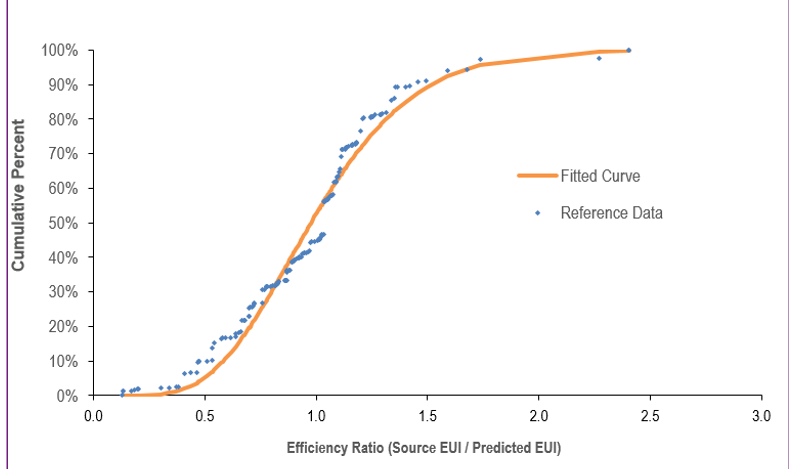
The final gamma shape and scale parameters are used to calculate the efficiency ratio at each percentile (1 to 100) along the curve. For example, the ratio on the gamma curve at 1% corresponds to a score of 99; only 1% of the population has a ratio this small or smaller. The ratio on the gamma curve at the value of 25% corresponds to the ratio for a score of 75; only 25% of the population has a ratio this small or smaller. The complete score lookup table is presented in Figure 5.
Figure 5 – ENERGY STAR Score Lookup Table for Supermarkets and Food Stores
| ENERGY STAR Score | Cumulative Percent | Energy Efficiency Ratio | |
|---|---|---|---|
| > = | < | ||
| 100 | 0% | 0.0000 | 0.3436 |
| 99 | 1% | 0.3436 | 0.3951 |
| 98 | 2% | 0.3951 | 0.4306 |
| 97 | 3% | 0.4306 | 0.4588 |
| 96 | 4% | 0.4588 | 0.4826 |
| 95 | 5% | 0.4826 | 0.5036 |
| 94 | 6% | 0.5036 | 0.5225 |
| 93 | 7% | 0.5225 | 0.5399 |
| 92 | 8% | 0.5399 | 0.5561 |
| 91 | 9% | 0.5561 | 0.5712 |
| 90 | 10% | 0.5712 | 0.5856 |
| 89 | 11% | 0.5856 | 0.5992 |
| 88 | 12% | 0.5992 | 0.6123 |
| 87 | 13% | 0.6123 | 0.6249 |
| 86 | 14% | 0.6249 | 0.6370 |
| 85 | 15% | 0.6370 | 0.6488 |
| 84 | 16% | 0.6488 | 0.6603 |
| 83 | 17% | 0.6603 | 0.6714 |
| 82 | 18% | 0.6714 | 0.6823 |
| 81 | 19% | 0.6823 | 0.6930 |
| 80 | 20% | 0.6930 | 0.7034 |
| 79 | 21% | 0.7034 | 0.7137 |
| 78 | 22% | 0.7137 | 0.7238 |
| 77 | 23% | 0.7238 | 0.7338 |
| 76 | 24% | 0.7338 | 0.7436 |
| 75 | 25% | 0.7436 | 0.7533 |
| 74 | 26% | 0.7533 | 0.7629 |
| 73 | 27% | 0.7629 | 0.7724 |
| 72 | 28% | 0.7724 | 0.7818 |
| 71 | 29% | 0.7818 | 0.7911 |
| 70 | 30% | 0.7911 | 0.8004 |
| 69 | 31% | 0.8004 | 0.8096 |
| 68 | 32% | 0.8096 | 0.8188 |
| 67 | 33% | 0.8188 | 0.8279 |
| 66 | 34% | 0.8279 | 0.8370 |
| 65 | 35% | 0.8370 | 0.8461 |
| 64 | 36% | 0.8461 | 0.8551 |
| 63 | 37% | 0.8551 | 0.8642 |
| 62 | 38% | 0.8642 | 0.8732 |
| 61 | 39% | 0.8732 | 0.8822 |
| 60 | 40% | 0.8822 | 0.8912 |
| 59 | 41% | 0.8912 | 0.9003 |
| 58 | 42% | 0.9003 | 0.9093 |
| 57 | 43% | 0.9093 | 0.9184 |
| 56 | 44% | 0.9184 | 0.9275 |
| 55 | 45% | 0.9275 | 0.9366 |
| 54 | 46% | 0.9366 | 0.9457 |
| 53 | 47% | 0.9457 | 0.9549 |
| 52 | 48% | 0.9549 | 0.9642 |
| 51 | 49% | 0.9642 | 0.9735 |
| ENERGY STAR Score | Cumulative Percent | Energy Efficiency Ratio | |
|---|---|---|---|
| >= | < | ||
| 50 | 50% | 0.9735 | 0.9828 |
| 49 | 51% | 0.9828 | 0.9923 |
| 48 | 52% | 0.9923 | 1.0018 |
| 47 | 53% | 1.0018 | 1.0114 |
| 46 | 54% | 1.0114 | 1.0210 |
| 45 | 55% | 1.0210 | 1.0308 |
| 44 | 56% | 1.0308 | 1.0406 |
| 43 | 57% | 1.0406 | 1.0506 |
| 42 | 58% | 1.0506 | 1.0607 |
| 41 | 59% | 1.0607 | 1.0709 |
| 40 | 60% | 1.0709 | 1.0812 |
| 39 | 61% | 1.0812 | 1.0917 |
| 38 | 62% | 1.0917 | 1.1023 |
| 37 | 63% | 1.1023 | 1.1131 |
| 36 | 64% | 1.1131 | 1.1241 |
| 35 | 65% | 1.1241 | 1.1352 |
| 34 | 66% | 1.1352 | 1.1466 |
| 33 | 67% | 1.1466 | 1.1582 |
| 32 | 68% | 1.1582 | 1.1700 |
| 31 | 69% | 1.1700 | 1.1820 |
| 30 | 70% | 1.1820 | 1.1943 |
| 29 | 71% | 1.1943 | 1.2069 |
| 28 | 72% | 1.2069 | 1.2199 |
| 27 | 73% | 1.2199 | 1.2331 |
| 26 | 74% | 1.2331 | 1.2467 |
| 25 | 75% | 1.2467 | 1.2607 |
| 24 | 76% | 1.2607 | 1.2751 |
| 23 | 77% | 1.2751 | 1.2900 |
| 22 | 78% | 1.2900 | 1.3055 |
| 21 | 79% | 1.3055 | 1.3214 |
| 20 | 80% | 1.3214 | 1.3380 |
| 19 | 81% | 1.3380 | 1.3553 |
| 18 | 82% | 1.3553 | 1.3734 |
| 17 | 83% | 1.3734 | 1.3923 |
| 16 | 84% | 1.3923 | 1.4121 |
| 15 | 85% | 1.4121 | 1.4331 |
| 14 | 86% | 1.4331 | 1.4554 |
| 13 | 87% | 1.4554 | 1.4791 |
| 12 | 88% | 1.4791 | 1.5045 |
| 11 | 89% | 1.5045 | 1.5319 |
| 10 | 90% | 1.5319 | 1.5618 |
| 9 | 91% | 1.5618 | 1.5946 |
| 8 | 92% | 1.5946 | 1.6313 |
| 7 | 93% | 1.6313 | 1.6729 |
| 6 | 94% | 1.6729 | 1.7211 |
| 5 | 95% | 1.7211 | 1.7789 |
| 4 | 96% | 1.7789 | 1.8516 |
| 3 | 97% | 1.8516 | 1.9511 |
| 2 | 98% | 1.9511 | 2.1148 |
| 1 | 99% | 2.1148 | >2.1148 |
Example calculation
As detailed in our Technical Reference for the ENERGY STAR Score, at Technical Reference for the ENERGY STAR Score, there are five steps to compute a score. The following is a specific example for the score for Supermarkets.
1 User enters building data into Portfolio Manager
- 12 months of energy use information for all energy types (annual values, entered in monthly meter entries)
- Physical building information (size, location, etc.) and use details describing building activity (hours, etc.)
| Energy Data | Value |
|---|---|
| Electricity | 950,000 kWh |
| Natural gas | 80,000 m3 |
| Property Use Details | Value |
|---|---|
| Gross floor area (m2) | 3,000 |
| Weekly operating hours | 84 |
| Workers on main shiftFootnote 3 | 35 |
| Number of cash registers | 7 |
| Number of computers | 10 |
| Total length of refrigerated/frozen food display cases (m) | 100 |
| HDD (provided by Portfolio Manager, based on postal code) | 4300 |
2 Portfolio Manager computes the actual source EUI
- Total energy consumption for each fuel is converted from billing units into site energy and source energy.
- Source energy values are added across all fuel types.
- Source energy is divided by gross floor area to determine actual source EUI.
| Fuel | Billing Units | Site GJ Multiplier | Site GJ | Source Multiplier | Source GJ |
|---|---|---|---|---|---|
| Electricity | 950,000 kWh | 0.0036 | 3,420 | 1.83 | 6,258.6 |
| Natural gas | 80,000 m3 | 0.03843 | 3,074 | 1.06 | 3,258.4 |
| Total Source Energy (GJ) | 9,517 | ||||
| Source EUI (GJ/m2) | 3.172 | ||||
3 Portfolio Manager computes the predicted source EUI
- Using the property use details from Step 1, Portfolio Manager computes each building variable value in the regression equation (determining the density as necessary).
- The centering values are subtracted to compute the centered variable for each operating parameter.
- The centered variables are multiplied by the coefficients from the Supermarket regression equation to obtain a predicted source EUI.
| Variable | Actual Building Value | Reference Centering Value | Building Centered Variable | Coefficient | Coefficient x Centered Variable | ||
|---|---|---|---|---|---|---|---|
| Constant | - | - | - | 4.571 | 4.571 | ||
| Number of workers per 100m2 during main shift * | 1.167 | 1.802 | -0.6350 | 1.571 | -0.9976 | ||
| Number of cash registers per 100m² | 0.2333 | 0.3950 | -0.1617 | 1.276 | -0.20633 | ||
| Number of computers per 100m² | 0.3333 | 0.5240 | -0.1907 | 0.648 | -0.124 | ||
| Length (in meters) of refrigerated/frozen food display cases per 100m² | 3.333 | 2.827 | 0.5060 | 6.119E-02 | 0.031 | ||
| Building floor area in m² * | 2,500 | 1,037 | 1,463 | 1.223E-03 | 1.789 | ||
| Heating degree days | 4,300 | 4,798 | -498.0 | 4.350E-04 | -0.217 | ||
| Predicted Source EUI (GJ/m2) | 4.847 | ||||||
| *The number of workers per 100 m² value is subject to floor or ceiling values if applicable. The maximum value for floor area is 2,500 m². If the building is larger than 2,500 m², that value is used. | |||||||
4 Portfolio Manager computes the energy efficiency ratio
- The ratio equals the actual source EUI (Step 2) divided by predicted source EUI (Step 3).
- Ratio = 3.172 / 4.847 = 0.6544
5 Portfolio Manager uses the efficiency ratio to assign a score via a lookup table
- The ratio from Step 4 is used to identify the score from the lookup table.
- A ratio of 0.6544 is less than 0.6603 but greater than 0.6488.
- The ENERGY STAR score is 84.
The ENERGY STAR® and ENERGY STAR Portfolio Manager® names and the ENERGY STAR symbol are trademarks registered in Canada by the United States Environmental Protection Agency and are administered and promoted by Natural Resources Canada.