
The Existing Building Commissioning (EBCx) cycle consists of a series of phases designed to plan, investigate, implement, and maintain measures that enhance the energy efficiency and overall performance of existing buildings. For each project, there are key tasks and deliverables. An example of the EBCx cycle is summarized below, including a suite of potential tools and resources that may be used. Each EBCx cycle may vary depending on the context, so the following information is an example and may not apply universally.
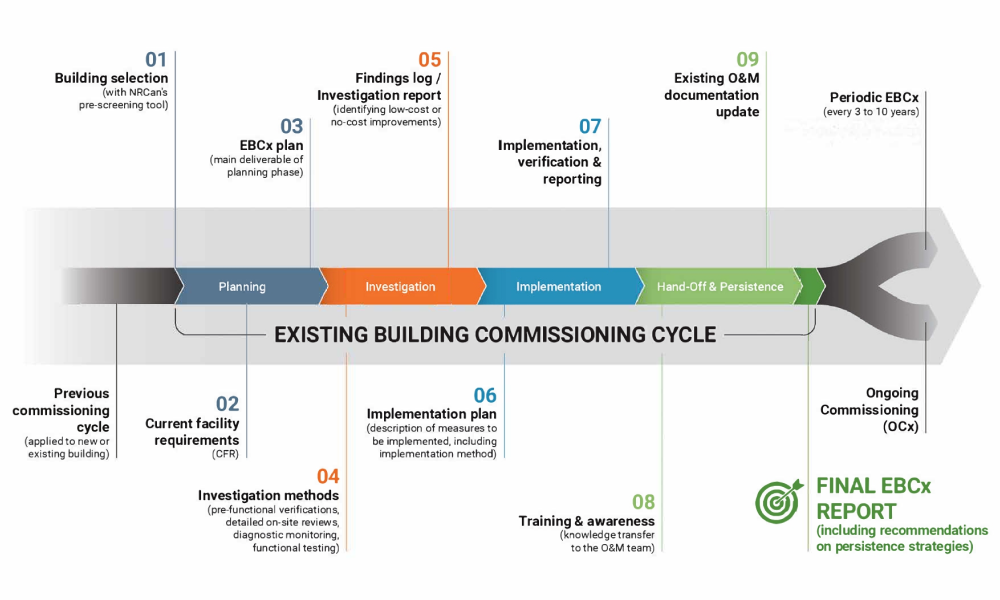
Previous Commissioning Cycle
Before any commissioning work begins, it’s important to understand the history of commissioning activities in the building. If new building commissioning or existing building commissioning (EBCx) has been performed previously—and reports are available—the findings can strengthen the Planning and Investigation phases of the current EBCx cycle. Incorporating this earlier work helps identify known issues, avoid duplicating past efforts, and build on insights already gathered.
Planning Phase
The Planning phase is an essential first step to support the success of an Existing Building Commissioning (EBCx) project. During this planning phase, three specific tasks are accomplished. This includes identifying the buildings that are good candidates for EBCx, defining the current functional requirements (CFR) of the building(s), and developing a formal EBCx plan and business case. This EBCx plan is the primary deliverable of the planning phase and guides the remainder of the project. NRCan EBCx web pages offer tools, resources, and case studies, which can offer valuable support in the planning phase.
A building owner may engage a commissioning provider during the planning phase to define and execute EBCx in collaboration with their internal team. The commissioning provider, in collaboration with building staff assesses opportunities, gathers information, clarifies requirements, and engages with on-site personnel and operators and plans the EBCx approach tailored to the building.
01 Building Selection (with NRCan’s pre-screening tool)
The first step of the EBCx Planning Phase involves selecting the building(s) for EBCx and developing a strong business case to implement EBCx activities. A building’s suitability for EBCx depends on a range of factors, including:
- Building characteristics: type, size, and age
- Building equipment: type, age, and condition
- Recurring equipment issues
- Building Automation System (BAS) or other controls
- Space use and occupancy
- Occupant comfort issues
- Building operators and staff: capacity, training, and engagement
- Building renovation and commissioning history
- Availability of documentation: drawings, manuals, and records
- Future building capital plans: equipment replacement and major renovation plans
NRCan’s EBCx Pre-Screening tool has been designed to help identify and prioritize the most suitable candidates for existing building commissioning. Whether you’re working with a single building or multiple buildings, early screening determines whether EBCx is appropriate, the level of scope needed, and where resources should be allocated to achieve the greatest potential for benefits.
Once buildings have been assessed and selected, a business case can be developed to demonstrate the value and expected outcomes of the EBCx effort. An EBCx business case may highlight:
Potential benefits – expected energy savings, cost savings, emissions reduction, improved occupant comfort, increased equipment uptime and reliability, enhanced building performance, increased asset value, better indoor air quality, extended equipment life.
Financial justification including typically short payback periods and the return on investment.
Risk identification along with strategies for managing risks that could affect the project success.
02 Current Facility Requirements (CFR)
The second step of the Planning Phase is to assess and document the Current Facility Requirements (CFR). This is the current functional requirements of the building(s) and the expectations for how the building(s) should be used and operated. An EBCx project provides an opportunity to reassess these critical requirements based on the unique parameters of the building(s), how they might have changed since original construction, and where improvements can be made.
Clearly identifying the CFR early in the Planning Phase helps to align future work with the needs of the building and its occupants, and to inform decision-making to contribute to efficient use of resources. This step includes engaging building operators who have an in-depth knowledge of the building and its daily operation.
03 EBCx Plan
Once building selection has taken place and the scope for the EBCx process are established, a plan is developed to outline aspects of the project, including, for example:
- Building information and requirements
- Project scope
- Project team resources and roles
- Communications, reporting and documentation requirements
- Investigation methodology
- On-site engagement plan
- Schedule and project milestones
Investigation Phase
The next phase of the Existing Building Commissioning (EBCx) cycle is the Investigation Phase. There are two specific tasks which include assessing and analyzing the building’s existing equipment and operational practices and documenting the investigation results. It is important for building owners to understand the building’s operation and maintenance practices to make informed decisions and identify opportunities for performance improvements.
The Investigation Phase may include reviews of building documentation, energy use data, site conditions, and building control systems. Opportunities and potential measures identified during these investigations are then documented in a Findings Log and Final Investigation Report.
04 Investigation Methods
The first step of the Investigation Phase is to determine the methods, resources, and technologies available that can be used to gather information to support the EBCx project. This can include:
- Building documentation review - reviewing documents such as building drawings, condition reports, balancing reports, utility data, equipment lists, and previous commissioning reports.
- Building operator and occupant interviews - leveraging the in-depth knowledge of building operators and staff who may have identified specific issues or opportunities for improvement.
- Controls system monitoring and testing - conducting diagnostic monitoring and testing that looks at building control sequences, trend logs, and other features to assess how the building systems operate.
- On-site functional tests - testing specific aspects of building operation and performance to investigate the causes of observed issues.
The information gathered during the Investigation Phase is documented in a Findings Log and may be used to develop a more comprehensive Investigation Report.
05 Findings Log and Investigation Report
Following the data gathering during the Investigation Phase, baseline data and findings are documented in a Findings Log. These findings may include details about the specific equipment, processes, and/or controls settings affected by each proposed measure.
The Findings Log can outline information such as:
- Investigation testing undertaken
- Results observed
- Data gathered
- Resultant opportunities identified
In addition to developing a Findings Log, a more comprehensive Investigation Report may also be needed to support the project. This report can help support decision-making for implementation, particularly if some measures will be implemented in the future. A detailed Investigation Report may include detailed information on:
- Building systems
- Historical baseline utility use
- Performance measures identified
- Proposed system changes and initial calculations of implementation costs
- Potential energy and cost savings
- Non-energy related benefits
Implementation Phase
The Implementation Phase involves planning and executing the identified measures and monitoring and verifying building performance after changes are complete. Details of the implemented measures and verification results are documented in an Implementation Report.
06 Implementation Plan
The Implementation Phase of the Existing Building Commissioning (EBCx) cycle involves developing a plan outlining how each measure identified during the Investigation Phase can be implemented in the building(s). An example of an Implementation Plan is available in NRCan’s Existing Building Commissioning Guide (Appendix C). At a minimum, an Implementation Plan should include the following:
- Roles and responsibilities - defined roles, responsibilities, processes, and the work required to implement the selected measures. Building operators and external contractors can play a key role at this step, depending on the implementation approach selected.
- Measure-specific details - the implementation plan typically lays out the identified issues, desired changes, scope of work, and verification approach for each individual measure.
- Implementation approach - depending on the implementation approach selected (that is, work carried out by internal staff versus external contractors), the implementation plan may vary in content or level of detail.
07 Implementation, Verification and Reporting
Once the Implementation Plan has been developed and approved, the next step of the Existing Building Commissioning cycle is to implement the identified measures and conduct the verification and reporting requirements.
- Measure verification - as changes are made; the impact of implemented measures is monitored and verified. Verification can be conducted using similar testing methods used in the Investigation Phase, comparing post-implementation results to baseline data gathered previously.
- New operational baseline - the verification and reporting process helps to contribute to the effectiveness of implemented measures and establishes a new baseline of operation for the building. This new baseline, along with updated operating procedures and performance standards, supports future activities and contributes to the persistence of changes that have been implemented.
It is important to document measures and results throughout implementation. An Implementation Report documents the measures and verification results and identifies any future action required. An example of an Implementation Report is available in NRCan’s Existing Building Commissioning Guide (Appendix D).
Hand-off & Persistence
The final phase of the Existing Building Commissioning (EBCx) cycle is the Hand-Off and Persistence Phase. This is a critical step to ensure that the implemented EBCx measures continue to deliver long-term building performance benefits. Key considerations include:
- Staff training and documentation - activities such as on-site staff training, updates to building documentation and operations procedures, and the development of a final EBCx Report, which documents the overall process and results of the project.
- Long-term strategy - the development of a persistence strategy for conducting future recommissioning cycles or implementing an ongoing commissioning process.
08 Training and Awareness
The benefits realized from the implementation of EBCx measures are maximized by ensuring that the improvements made are sustained over the long-term as part of ongoing building maintenance and operations. To achieve this, it is essential that the building operators, occupants and other staff understand the changes made, the impacts of the changes, and the maintenance needs of newly implemented measures.
In addition to active involvement of onsite staff (for example, building operators) throughout all the phases of the EBCx cycle, providing supplemental training at the end of the implementation phase can reinforce knowledge and support long-term success. This training may cover topics, such as:
- EBCx project goals: initial goals and performance targets
- Investigation findings: referencing the Findings Log and the Investigation Report
- Selected measures and work done during implementation
- Data gathered during verification showing operations improvements
- New operation and maintenance processes: required to maintain performance over time
- Outline of building operator and staff roles pertaining to implemented measures
- Future or ongoing action required as part of the verification and tracking processes
- New training procedures for future new staff
- Resources to support operators and staff
This training represents an important part of transferring responsibility for the measures to the site operators and staff. This transfer of responsibility helps maintain the benefits from the improvements made and sustains the value achieved through EBCx.
09 O&M Documentation Update
Ensuring that all operation and maintenance (O&M) manuals and other documentation are updated and accurate at the end of the EBCx cycle is critical. It provides future building operators and external contractors with the accurate information needed to properly maintain system performance over time.
The EBCx cycle may also present an opportunity to improve existing building documentation, especially when gaps or data was missing during the Investigation Phase. Gaps in building information may be filled to facilitate operations and future commissioning work.
NRCan’s Existing Building Commissioning Guide outlines the recommended documentation that a building should have in place following EBCx implementation.
Final EBCx Report
The final Existing Building Commissioning (EBCx) report is a comprehensive record of the project and should be kept as part of the on-site resources for facility staff. The Final EBCx Report content should include:
- Executive summary
- Owner’s Current Facility Requirements
- Findings Log
- Implementation Report
- Updated savings estimates and actual improvement costs
- Diagnostic monitoring plan
- Completed functional tests and results
- Complete documentation of revised or new control sequences (or where it can be found)
- Recommended persistence strategies
- Training summary including training materials
- A list of capital improvements recommended for further investigation
Periodic EBCx and Ongoing Commissioning (after the completion of EBCx)
Following the completion of the EBCx cycle, periodic or ongoing commissioning should be implemented to address recommendations identified in the Final EBCx Report or to respond to new opportunities as they emerge.
Periodic EBCx is the repetition of the previously outlined EBCx process at defined intervals. Changes to the facility’s use, the quality and schedule of preventive maintenance, and other operational factors may influence the need and timing of subsequent EBCx work. The next EBCx projects generally require less investment since it builds on the information gathered and produced as part of previous EBCx projects, increasing efficiency as they are repeated. Depending on the persistence strategies in place, periodic EBCx could be considered every 3 to 10 years.
Ongoing Commissioning (OCx) is a structured, continuous process designed to optimize and sustain building performance through the ongoing tracking and analysis of system operations. OCx can be implemented through various approaches, ranging from routine system optimization using existing tools, to more advanced Monitoring-Based Commissioning (MBCx), which leverages smart building technologies, and sophisticated Energy Management Information Systems (EMIS).
As part of the OCx approach, monitoring equipment and trending software remain in place to support continuous performance assessment. Maintenance practices are enhanced to include defined operational procedures that enable early detection and resolution of performance issues.