
Details
- Publication date
- Author(s)
Natural Resources Canada - ISBN
978-0-660-79554-6 - Catalogue number
M4-274/2025E-PDF
Table of contents
- Acknowledgements
- List of acronyms
- Executive summary
- Introduction
- What we heard
- Conclusion
- Appendix A: Phase 2 discussion questions (2024-25)
- Appendix B: 2024-2025 engagement activities
- Appendix C: Indigenous groups that participated in 2024-25 Phase 2 engagement
- Appendix D: Written submissions for 2024-25 Phase 2 engagement
Acknowledgements
This report reflects the ideas and perspectives of Indigenous groups located across Canada who participated in engagement sessions and shared knowledge and teachings. We acknowledge the diverse histories, cultures, and experiences shared by First Nations, Métis, and Inuit.
Natural Resources Canada’s (NRCan) headquarters are located in Ottawa, on traditional and unceded Algonquin Anishinaabe territory. The name “Ottawa” is derived from the Algonquin word “Adawe,” which means “to trade,” highlighting the land’s historical significance as a place of exchange. The development of the proposed Indigenous Ministerial Arrangements Regulations relies on an exchange of knowledge, ensuring that all voices are heard and considered equally. We extend our gratitude to the First Nations, Métis, and Inuit that have participated in this process; this collaboration will serve to strengthen and inform the proposed regulations and reinforces the relationships being built.
List of acronyms
- IAA
- Impact Assessment Act
- IAC
- Indigenous Advisory Committee
- IAAC
- Impact Assessment Agency of Canada
- IAMC-TMX
- Indigenous Advisory and Monitoring Committee for the Trans Mountain Expansion Pipeline
- AFN
- Assembly of First Nations
- APM 34
- Shared Priorities Action Plan Measure #34 (of the UN Declaration Act Action Plan)
- Arrangement(s)
- Indigenous Ministerial Arrangements
- CER
- Canada Energy Regulator
- CERA
- Canadian Energy Regulator Act
- IGB
- Indigenous governing body
- IMARs/Regulations
- proposed Indigenous Ministerial Arrangements Regulations
- ITK
- Inuit Tapiriit Kanatami
- Line 3 IAMC
- Indigenous Advisory and Monitoring Committee for the Line 3
- Minister
- Minister of Energy and Natural Resources
- MNC
- Métis National Council
- NIO
- National Indigenous Organizations
- NRCan
- Natural Resources Canada
- UN Declaration Act
- United Nations Declaration on the Rights of Indigenous Peoples Act
- UN Declaration
- United Nations Declaration on the Rights of Indigenous Peoples
Executive summary
Introduction
This report summarizes the input received during engagement sessions and in written submissions from Indigenous groups that have engaged between April 2024 and March 2025 on the development of the proposed Indigenous Ministerial Arrangements Regulations (IMARs).
Natural Resources Canada (NRCan) received comments and feedback on a wide range of issues, including challenges related to jurisdictional overlap, cumulative effects of projects and economic development. We have noted this feedback as it is instructive beyond the limited scope of the proposed regulations.
Background
The Canadian Energy Regulator Act (CERA)Footnote 1 provides the possibility, under sections 77 and 78, of having Indigenous Ministerial Arrangements (Arrangements) between the Minister of Energy and Natural Resources (Minister) and Indigenous governing bodies (IGB)Footnote 2 if enabling regulations are made. Should an Arrangement be reached, there is the potential for powers, duties and functions with respect to matters regulated under the CERA, as provided in the proposed regulations, to be performed by the IGB. This could include a role for an IGB in relation to the CER’s regulated infrastructure such as pipelines and power lines within federal jurisdiction.
The proposed IMARs aim to advance reconciliation and align with the United Nations Declaration on the Rights of Indigenous Peoples Act (UN Declaration Act), specifically Shared Priorities Action Plan Measure (APM) 34, which calls for enhanced Indigenous participation in federal regulatory processes.
Engagement
Natural Resources Canada (NRCan) launched a five-phase National Engagement Strategy, and is currently in Phase 2, entitled Engagement and Regulatory Design, which was launched in April 2024. This phase focuses on gathering input from Indigenous groups through engagement sessions and written submissions to inform a Discussion Paper on the proposed regulations, to be published in fall 2025. The Discussion Paper will guide IMARs engagement sessions and will present new, focused discussion questions in 2025-26. The feedback received from engagement sessions and written submissions will help inform the development of IMARs.
Over 100 Indigenous groups participated across two periods of engagement in 2024-25, which included information sessions, regional NRCan-led discussion sessions, and Indigenous-led sessions.
The first period of engagement occurred between April and December 2024. Discussion questions were designed to raise awareness of the proposed regulations and gather feedback on how Indigenous groups wanted to engage on the proposed IMARs.
The second period of engagement occurred between January and March 2025, and discussion questions were designed to inform the development of a Discussion Paper and the regulatory development phase. This shift in our engagement approach is discussed further in the Engagement process section below.
Terminology used in this report
Should IMARs come into force and Arrangements be reached, Arrangements would enable IGBs to exercise regulatory authority over federal energy infrastructure regulated under the CERA, in accordance with the terms of the specific Arrangement. Federal energy infrastructure regulated under the CERA includes interprovincial and international pipelines, international and designated interprovincial power lines, and offshore renewable projects not covered by the AccordsFootnote 3. The scope of authority that an IGB could possess under an Arrangement was a subject of discussion during engagement sessions. It is important to clarify that any such authority would be those identified in the Arrangements and could only include the powers, duties, and functions outlined within the CERA. Responsibilities assigned to the CER through other legislative frameworks, such as the Canada Oil and Gas Operations Act, or infrastructure under provincial jurisdiction (e.g. pipelines contained within a single province) could not be included in an Arrangement. Additionally, activities related to the ownership of infrastructure, management of resources or negotiation of impact benefit agreements are outside the purview of an Arrangement.
The use of the term “authorize” or “authority” in this report relates to the general process of the Minister entering into an Arrangement with an IGB and transferring and/or sharing responsibilities outlined in the CERA from the CER to an IGB. It is also used to describe the process of an Indigenous group, community or Indigenous rights holder authorizing an IGB to act on their behalf to enter into Arrangements with the Minister. We recognize that the use of this term may not resonate with everyone given the complex relationships and histories between Indigenous groups and the Crown.
For the purposes of this report, the term “Indigenous groups” is used to refer to one or more of First Nations, Métis, and Inuit governments, settlements, associations, communities, peoples, organizations, and corporations.
Themes
The results of the engagement activities through 2024-2025 have been grouped by theme:
Shaping the engagement process
- Theme 1: Ensuring a comprehensive engagement process
- Exploration of feedback and considerations for NRCan to include when holding engagement with Indigenous groups for IMARs.
- Theme 2: Working towards a better understanding of IMARs
- Integration of regulatory knowledge-building opportunities into the IMARs development process, including ideas for future engagement.
- Theme 3: Providing capacity funding throughout the regulatory development process for engagement
- Exploration of the importance of adequate and well-designed capacity funding programs for Indigenous groups to participate in the development of IMARs.
- Theme 4: Issues raised beyond the scope of IMARs
- Exploration of concerns over issues which are beyond the scope for IMARs.
Informing the development of the proposed regulations
- Theme 5: Governance
- Exploration of processes for Indigenous groups that hold rights recognized and affirmed by section 35 of the Constitution Act, 1982 to appoint, form and authorize an IGB for the purposes of entering into an Arrangement.
- Theme 6: Level of authority held by an Indigenous governing body
- Exploration of the responsibilities under the CERA that an IGB would be interested in undertaking, as well as the potential associated benefits and challenges.
- Theme 7: Scope of the Arrangements
- Exploration of how the Arrangements could be applied, including general principles to be considered in the proposed regulations.
- Theme 8: Capacity to support an Indigenous governing body
- Exploration of the resources that could be required for an IGB to undertake responsibilities under the CERA.
Introduction
Purpose
The What We Heard Report summarizes themes identified during 2024-25 engagement on the proposed Indigenous Ministerial Arrangements Regulations (IMARs) with Indigenous groups.
This report presents input gathered in engagement sessions and written submission to Phase 2 discussion questions. The structure of this report separates feedback into two broad categories, including:
- Feedback that helps shape the engagement process:
Feedback that focuses on the structure, design and approach to the engagement process during the development of the proposed IMARs. This provided a better understanding of how best to engage with Indigenous groups while being inclusive on a national level. - Feedback that helps inform the development of the proposed regulations:
Feedback that informs the development of the proposed regulations. This provided a deeper understanding of Indigenous groups’ interests in relation to the proposed regulations.
The concepts and ideas found under the Informing the development of proposed regulations section of this report will be used for subsequent Phase 2 engagement activities with the goal of developing the proposed regulations in Phase 3.
Natural Resources Canada (NRCan) received comments and feedback on a wide range of issues including challenges related to jurisdictional overlap, cumulative effects of projects and economic development. We have noted this feedback as it is instructive beyond the limited scope of the proposed regulations.
Context
In addition to Arrangements with Indigenous governing bodies being referenced in sections 77 and 78 of the CERA, the proposed IMARs is also linked to sections 5 and 6 of Canada’s United Nations Declaration on the Rights of Indigenous Peoples Act (UN Declaration Act) which provides a framework for the implementation of the United Nations Declaration on the Rights of Indigenous Peoples (UN Declaration)Footnote 4.There are three obligations for the Government of Canada: to take measures to ensure the laws of Canada are consistent with the UN Declaration (section 5), to prepare and implement an Action Plan (section 6), and to table an annual report to Parliament (section 7). All these obligations must be in “consultation and cooperation with Indigenous Peoples”.
In June 2023, an Action Plan was published, per section 6 of the UN Declaration Act and includes several Action Plan Measures (APM), including APM 34 which states:
Work in consultation and cooperation with First Nation, Métis and Inuit communities, governments and organizations to (i) enhance the participation of Indigenous peoples in and (ii) set the measures that could enable them to exercise federal regulatory authority in respect of, projects and matters that are currently regulated by the Canada Energy Regulator (CER).
One of the steps to achieve this includes:
Develop regulations respecting the Minister of Natural Resource Canada’s power to enter into arrangements that would enable Indigenous governing bodies to be authorized to exercise specific powers, duties and functions under the Canadian Energy Regulator Act.
Engagement process
The IMARs engagement process is outlined in the IMARs National Engagement Strategy (PDF, 2.1 MB). It is composed of five phases that encompass the activities NRCan will be undertaking to inform proposed IMARs (Figure 1).
During the 2024-25 Fiscal Year, NRCan engaged with Indigenous groups to determine the extent to which they want to be involved in the regulatory development process and to understand perspectives, to inform the development of the proposed regulations. NRCan contacted Indigenous groups who have participated in past CER processes, using NRCan and CER contact lists (e.g. Onshore Pipeline Regulations (OPR) and Filing Manual Updates, Nova Gas Transmission Line (NGTL) Project, Canada Offshore Renewable Energy Regulations, NRCan Partnerships, and First Nations Major Projects Coalition membership). NRCan approached this engagement process in a flexible way so Indigenous groups could engage in a way that supported their internal processes and capacity levels.
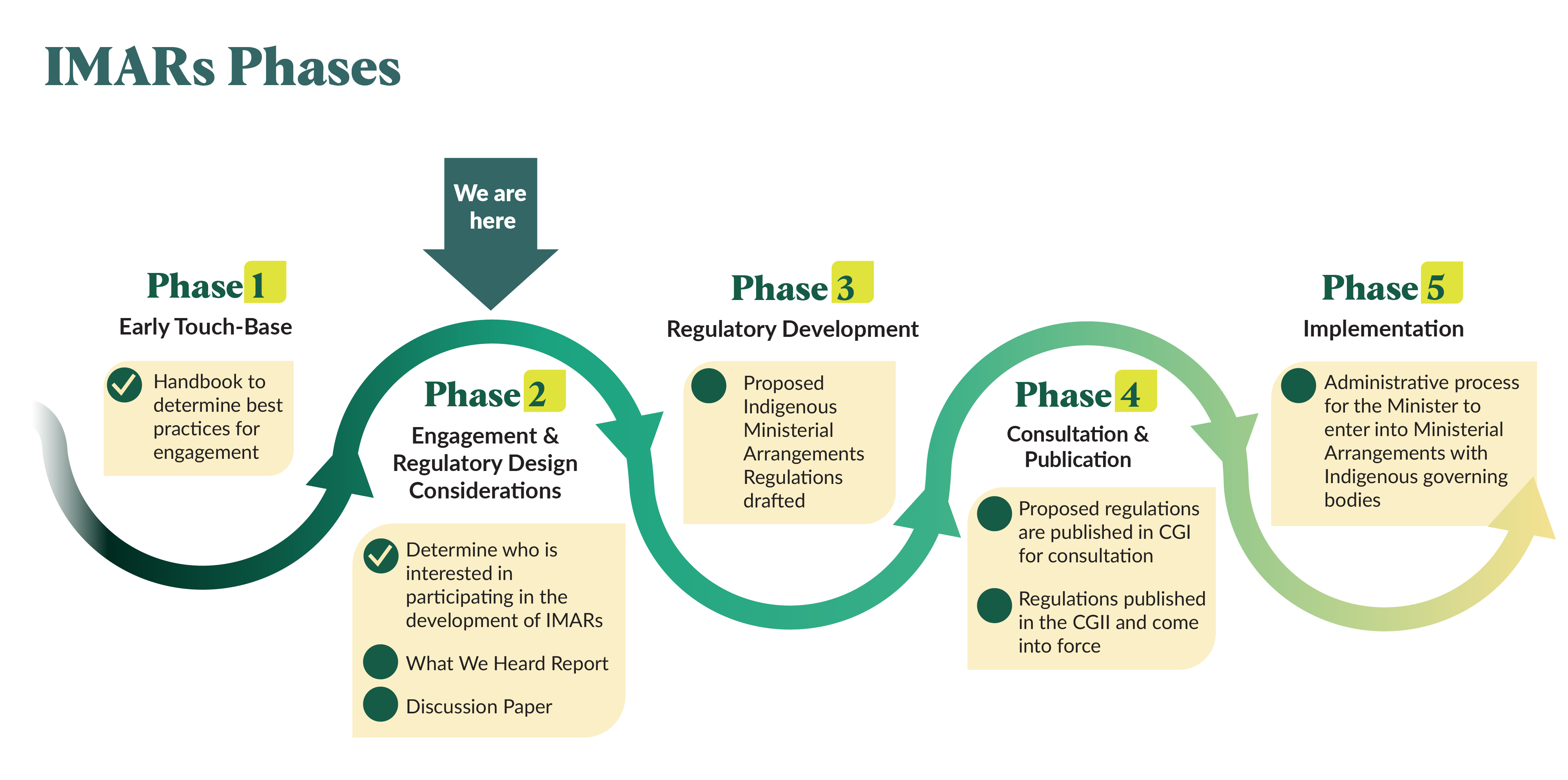
Figure 1. IMARs Phases
Text description - Figure 1
This image outlines the phases being taken to develop the proposed Indigenous Ministerial Arrangements Regulations, including what we’ve done and next steps.
Phase 1 was an early touch-base, where a handbook was developed to determine best practices for engagement.
Phase 2 is where we are currently; it is about engagement and regulatory design considerations. We have determined who is interested in participating in the development of IMARs and will have the What We Heard Report and a Discussion Paper released.
Phase 3 will be the regulatory development. The proposed Indigenous Ministerial Arrangements Regulations are drafted in this phase.
Phase 4 will be consultation and publication. The proposed regulations will be published in Canada Gazette I and Canada Gazette II before coming into force.
Finally, Phase 5 will be implementation. The administrative process for the Minister to enter into Arrangements with Indigenous governing bodies will be developed.
Participant funding was available to enable Indigenous groups to participate in engagement activities and respond to the Phase 2 discussion questions. A total of 40 Contribution Agreements were signed for fiscal year 2024-2025 providing up to $1,168,861.
The first half of the 2024/2025 engagement was focused on information sharing. NRCan launched virtual IMARs 101 sessions over the summer months and held in-person regional engagement sessions to begin the process.
Based on feedback received, winter sessions were lengthened, from half-day informational sessions into full-day sessions with support from representatives of the CER focused on an educational portion in the morning to support facilitated conversations in the afternoon guided by Phase 2 discussion questions. These materials were also posted externally on the IMARs website.
Following each engagement session, a Meeting Report was developed, shared and validated with participants who attended the engagement session to ensure that the discussion was accurately captured.
In total, over 100 Indigenous groups were engaged, including individual communities, associations, settlements and Nations, governments, Tribal and Treaty Councils, and for-profit and nonprofit organizations.
Engagement sessions included:
- 9 regional engagement sessions
- 5 virtual IMARs 101
- 4 Indigenous-led engagement sessions
- 10 Indigenous-led information sessions
- 4 engagement sessions with Indigenous Advisory and Monitoring Committees
- 1 engagement session with the CER’s Indigenous Advisory Committee and Board members
- 6 bilateral meetings with National Indigenous Organizations (Assembly of First Nations, Métis National Council, and Inuit Tapiriit Kanatami)
Not surprisingly, most of the feedback from engagement in 2024-25 came from Indigenous groups in western and central Canada, as most CER-regulated infrastructure are in these regions.
In addition to engagement sessions, NRCan also received written feedback on discussion questions from Indigenous groups. A total of 25 written submissions were received and included in the findings of this report.
What we heard
Shaping the engagement process
Upon the launch of Phase 2 in April 2024, the focus was on raising awareness of the proposed IMARs with Indigenous groups. Apart from a limited number of Indigenous groups who participated in Phase 1, most of the participants that took part in Phase 2 were learning about the proposed regulations for the first time.
Key themes emerging from engagement are outlined below.
Theme 1: Ensuring a comprehensive engagement process
Indigenous groups engagement interests
Most participants in the engagement sessions were interested in IMARs and keen to participate in the development process for the potential regulations. Some Indigenous groups expressed scepticism about the possibilities and the future conditions for developing the potential regulations, while some remained reluctant to engage with Canada.
In some cases, level of interest and participation was shaped by the experience and familiarity that Indigenous groups hold with subject matter. Indigenous groups who expressed a readiness to engage in a conversation were often those who had some regulatory knowledge or experience with the oil and gas sector. Those who were unfamiliar with the topics of IMARs, regulatory oversight, or the authorities under the CERA, sought opportunities to gain sector-specific knowledge.
Recognizing that technical sessions with the CER would be useful for a number of participants, NRCan made improvements to the design of future engagement sessions, including the addition of technical sessions with the CER to better understand the sector and CERA (as discussed in the section titled Theme 2: Working towards a better understanding of IMARs). NRCan acknowledges that the need for specific knowledge created a barrier for some to participate in a fulsome dialogue and will remain open to adjusting the process based on input received going forward.
Mechanisms and Indigenous governance considerations for engagement
Some Indigenous groups preferred to be represented in engagement through a larger entity, such as Tribal and Treaty Councils, while others preferred direct engagement. It was heard that ‘Nation-to-Nation’ or ‘government-to-government’ conversations are critical to building relationships and engaging, and taking a pan-Indigenous approach would not work for this initiative. However, there was interest in a simplified process that seeks commonalities, reduces duplication and allows for a consistent and focused engagement approach.
Self-governance enables Indigenous communities to manage and protect their lands, waters, and natural resources according to their cultural values and priorities. This autonomy is not something bestowed by other governments; it is inherent in their identity as Indigenous peoples. By setting their own policies and procedures, Indigenous communities can ensure that resource development projects are conducted in a manner that respects their cultural identities, traditions, and environmental stewardship practices.
Indigenous groups indicated that they have unique perspectives, and they expressed their views by sharing experiences and knowledge. Some Indigenous groups shared that they have established structures and processes for consultation, engagement and carrying out daily business that should be used by NRCan for engagement. Others communicated that they are working to figure out engagement or consultation processes and need time for process development. Some Indigenous groups have well-developed protocols and procedures and actively support capacity building initiatives to increase knowledge of regulations and ability to navigate these types of processes. For example, one Indigenous group noted that they report directly to the Chiefs of the communities they represent, and work is carried out on a portfolio basis. Procedures like this may differ between Indigenous groups and can be informed by different governance structures between First Nations, Métis and Inuit groups. An initiative such as IMARs could benefit from including sufficient time for Indigenous groups to take information back to leadership to decide how to be involved.
Participants shared the importance of building adequate time into the regulatory development process for IMARs to allow participants to engage locally, have discussions with their communities, within their organizations, and with Chief and Councils or governments. NRCan recognizes the diversity of Indigenous groups across Canada and will continue to strive to follow the governance processes that exist and, on a case-by-case basis, determine how to carry out future engagement following a distinctions-based approach where possible.
NRCan is aware of capacity issues with respect to engagement activities and will work to ensure engagement sessions are scheduled well in advance going forward to address those concerns.
Incorporation of Indigenous Knowledge into the regulatory development process
Questions were raised around how the regulatory development of IMARs, and its implementation, could integrate and respect First Nations laws and natural laws during the process, while also ensuring protections and safeguards of Indigenous Knowledge. Participants noted that they are seeking ways to not only incorporate Indigenous Knowledge into the regulatory development of IMARs and its implementation, but also to give it equal weight to western science and merge both knowledge systems to strengthen natural resource management. Participants spoke of the Seventh Generation Principle, which is the concept that every decision we make today should result in a sustainable world seven generations into the future. Others expressed that their communities continue to practice their way of life and culture, much like the ancestors, steeped in oral traditions and ceremonies. Indigenous groups communicated their profound connection to the land and the spiritual world, and different ‘ways of knowing’ including linkages to Indigenous identity and sovereignty that NRCan should consider when carrying out processes such as the development of IMARs.
Collaborative development of IMARs
Indigenous groups expressed interest in co-developing and/or co-drafting the proposed regulations.
NRCan acknowledges the importance of a collaborative approach to policy analysis and regulatory development for IMARs and is committed to engaging and working with Indigenous groups across Canada throughout the regulatory development process for IMARs in a transparent manner that builds trust.
Before the proposed regulations are developed, a Discussion Paper is targeted for fall 2025 publication, and feedback received on the Discussion Paper will inform the regulatory development process. NRCan will consider input throughout the policy analysis and regulatory development process of IMARs shared in engagement sessions and written submissions.
The development of IMARs will be done in compliance with any applicable legal requirements. In accordance with the UN Declaration Act, NRCan will consult and cooperate with Indigenous Peoples on the development of the IMARs. In addition, consultations will be conducted if the IMARs have the potential to adversely affect section 35 rights. This requirement to fulfill the Crown’s legal duty to consult is explained in the Cabinet Directive on Regulation in section 4.1.2 which states that: Where proposed regulations have the potential to adversely impact potential or established Aboriginal or Treaty rights of the Aboriginal peoples of Canada under section 35 of the Constitution Act, 1982, departments and agencies must satisfy the Crown’s duty to consult and, where appropriate, accommodate those rights.
The regulatory development process includes publication of the proposed regulations in Canada Gazette Part I, with a consultation period for Indigenous groups, stakeholders and members of the public to provide feedback to NRCan. Comments received during the consultation period will be considered prior to finalization of the proposed regulations and publication in Canada Gazette Part II.
Engagement with the Indigenous Advisory and Monitoring Committees (IAMCs)
NRCan presented information about IMARs at the Indigenous Advisory and Monitoring Committees for the Trans Mountain Expansion Pipeline (IAMC-TMX) and the Line 3 (Line 3 IAMC) Indigenous Caucus meetings and line-wide gatheringsFootnote 5.
The TMX and Line 3 IAMCs shared views on the importance of transition planning from the CER being the federal regulator to potentially having IGBs exercising regulatory authority, integrating past learning to inform the development of the proposed regulations, and assist in navigating jurisdictional challenges. It was suggested that regional capacity could be served by the IAMCs while not expecting IAMCs to represent rights holders or any Nation, and that APM 34 was providing promising opportunities to improve regulatory oversight work. Some members commented on the necessity for formal consent while engaging on IMARs. Others expressed that there could be an opportunity to determine the impacts on rights of Indigenous groups at the onset of designing the proposed IMARs, and the importance of understanding the potential for serious and unintended consequences as it relates to those rights.
Generally, IMARs was viewed as a valuable tool and a real opportunity to discuss collaboration and the potential for delegation of responsibilities from the CER to Indigenous governing bodies. Others shared historical insight about effective models of governance, principles of reconciliation, and raised questions about liabilities and costs and the need to strive for regulatory efficiency while building capacity. NRCan heard about the need to use distinctions-based language, recognizing the different capacities between Nations and not taking a pan-Indigenous approach. NRCan heard cautionary warnings about overlapping processes and the use of language and ways to improve engagement approaches for the process of developing the potential regulations. NRCan also heard about the benefits of creating ‘what-if’ scenarios, as useful visuals, for participants to see themselves in the proposed IMARs process.
Participants at the line-wide gatherings weighed in on concepts around IGBs, capacity, training and Indigenous decision-making institutions to exercise regulatory authority on matters regulated by the CER.
Engagement with the CER Indigenous Advisory Committee (IAC)
NRCan presented at the CER-Indigenous Advisory Committee (IAC) and received advice on the need for cultural intelligence and practices to be included in the development of IMARs; the context of APMs and nested elements, encouraging engagement and collaborative initiatives for IGBs; concerns about duplication or alignment with parallel processes; the importance of frameworks; the need to take a distinctions-based approach; and the need to consider the potential for unintended harm to Indigenous Peoples from the proposed regulations. The IAC also promoted the use of best practices and the importance of intertwining cultural matters into the IMARs approach.
Engagement with National Indigenous Organizations (NIOs)
Preliminary information sessions and updates on IMARs were provided to three National Indigenous Organizations (NIOs): the Assembly of First Nations (AFN), Inuit Tapiriit Kanatami (ITK), and the Métis National Council (MNC) via bilateral meetings. All three organizations provided clear direction for NRCan to engage directly with regional organizations, Indigenous groups, Nations, members, and citizens. It was noted that NIOs have a wide range of priorities, varying interests in IMARs and differing capacities to engage. Each NIO expressed appreciation for the information shared and sought clarification on various topics, including the rationale behind IMARs, the relationship to the CER and the CER-IAC, as well as other potential scenarios and challenges that may arise from implementation. Based on their specific interests, some NIO representatives participated in IMARs information and regional engagement activities.
Relationship building
Indigenous groups stressed the importance of nurturing strong relationships throughout the IMARs process. Participants brought forward ideas about potential mechanisms to enhance relationships, such as joint committees, or protocols for dialogue, information sharing and joint problem solving. NRCan also heard that there is an expectation to proactively engage with Indigenous groups, openly, directly and frequently on IMARs to ensure appropriate levels of engagement.
NRCan heard about the expectation to prioritize clarity, accountability and transparency throughout the process. Building and maintaining strong relationships with Indigenous groups is a critical piece of developing the proposed regulations in a way that garners interest to participate and trust that NRCan’s approach to regulatory development is sound.
Ministerial Engagement
Participants emphasized the importance of having the Minister or other senior-level individuals at the table and willing to be part of the engagement process.
NRCan acknowledges the importance of coordinating opportunities for Indigenous groups to share their input and feedback directly to senior-level individuals. NRCan notes that regulatory development processes are delegated to departmental officials (subject matter experts) who are best placed to discuss the details of regulatory development with Indigenous groups and other stakeholders, and thus representation is at the officials level for engagement on IMARs.
Theme 2: Working towards a better understanding of IMARs
[You should not] Ask us to sit at the table without knowledge. How can we develop opinions if we are not given knowledge firsthand? Let’s talk, let’s discuss. Don’t we have to do historical research?
Capacity building and knowledge of regulatory processes for Indigenous groups
Indigenous groups indicated that decision points regarding which powers, duties and functions may be included or excluded in the proposed IMARs is needed early in the process so that participants are fully informed of the potential scope of IMARs. Participants expressed the need for NRCan to provide technical briefings and specific learning opportunities to build capacity to enable informed conversations and input on IMARs. Participants also noted the importance of having access to informational materials about IMARs that are designed to support people with different levels of understanding.
Participants explained that technical documents are important for consultation and supporting deep understanding of the process for and the potential impact of IMARs on Indigenous groups but that it is also necessary to have access to simplified materials that provide a high-level overview of IMARs that can be understood by people who may not have direct sector expertise, such as community members. Participants communicated that engagement with community members and citizens is a critical part of the process of developing perspectives to share input with NRCan and that there are capacity issues when trying to engage and involve community members.
We need to know if we can do this financially. What does it take - what does the CER spend [or] expend in terms of funding and resources. We need these positions to fully understand what the CER is, the [Canadian Energy Regulator] Act and [the relationship with] the [Alberta Energy Regulator] AER. If we don't comprehend the Act how can we know what the responsibilities are.
Participants stressed the importance of needing deeper knowledge of the CER and the contents of the CERA, that these types of learning opportunities are an expectation of the engagement process if NRCan and the CER are aiming to build meaningful and respectful working relationships with Indigenous groups, and more detailed information is needed as the regulatory development process advances.
Ministerial Authorities
Questions were raised regarding the involvement and power the Minister may hold once an Arrangement has been negotiated. For example, would the Minister have the ability to veto or revoke an existing Arrangement, and would Arrangements be time limited. Limiting regulatory authority through the proposed regulations may impact the number of Indigenous groups who are interested in entering into an Arrangement. Some participants noted that the ability to exercise limited forms of regulatory authority is not of interest and is not likely to provide meaningful benefit or change from the status quo.
Theme 3: Providing capacity funding throughout the regulatory development process for engagement
Providing adequate capacity funding is the most important. While money is not the most important part of this process, if Nations can not afford to spend time on this process they won't.
Participants emphasized the importance of building capacity at the outset of IMARs engagement. For Indigenous groups to meaningfully contribute to IMARs, they identified that they require: education (knowledge), time, resources (funding and capacity) and access to relevant professional services. Indigenous groups noted that a lack of adequate funding can put Indigenous groups in situations where they must either stretch already limited resources to participate or risk the ability to engage in an individual process. Indigenous groups want to see a well-designed process for engagement in new initiatives prior to their commencement.
Indigenous groups provided feedback on adjustments to the design and format of IMARs participant funding. NRCan administers IMARs participant funding through one-year, fixed term contribution agreements. In 2024-2025, the funding program was designed to provide flexibility to Indigenous groups who were interested in engaging on IMARs.
Upon launching the funding program in June 2024, it became clear that both the engagement process and funding program would benefit from more structure. While flexibility was appreciated, participants needed clarity around the structure of future engagement sessions and expected commitments of participants. Recommendations from Indigenous groups on funding design included: providing a schedule of engagement sessions as part of the Application Guide, a clear description of the work that is expected to take place during and after engagement sessions, and circulating information on participation funding through multiple mechanisms to ensure that Indigenous groups have the best chance to apply. Participants expressed that NRCan should explore providing long-term funding in future phases of IMARs to ease some of the administrative and capacity burden that falls on Indigenous groups when negotiating participant funding annually.
Indigenous groups recommended that NRCan provide sufficient funding to ensure Indigenous groups could hold local or internal engagement within communities. The ability to provide detailed briefings and pose questions to leadership, community members, Elders and youth was identified as critically important to the process of developing detailed feedback to submit to NRCan and sufficient capacity was required to do so properly. It was heard that sometimes information from meetings was not brought forward by the representative sent (e.g., capacity issues and competing priorities), so it may be necessary for NRCan to engage more deeply at the local level. Future funding programs should provide Indigenous groups with funding to work with legal services and technical specialists as they are developing feedback to close knowledge gaps and ensure informed conversations are taking place during engagement.
Theme 4: Issues raised beyond the scope of IMARs
There were several issues raised by participants that are out of scope for the development of IMARs, but these have been noted here as the purpose of the What We Heard Report is to reflect the information shared.
Indigenous groups raised the jurisdictional overlap between the federal government, Indigenous groups, and provincial and territorial governments, as it pertains to topics like natural resources and energy infrastructure. Indigenous groups spoke to the importance of Treaties, the honour of the Crown, the duty to consult and Canada’s fiduciary responsibilities. Many participants reminded NRCan of the recognition of Aboriginal and Treaty rights, the spirit and intent of Treaties and the obligation to fulfill those promises, and that there is a need to consider the experience of and impact on communities that are not part of a Treaty and ensure that support is available for these groups should they be involved in an Arrangement.
NRCan heard that Indigenous groups want more detailed information regarding what energy infrastructure is regulated federally, what is regulated at the provincial or territorial level and how those decisions are made. Participants noted different ideas around this such as developing maps to clearly outline where existing energy infrastructure is, where new energy infrastructure is being proposed and who is responsible for regulating it. Indigenous groups noted they are also seeking to understand the relationship between the CER and provincial regulators and who holds authority when working together. In some cases, there are questions as to whether the proposed regulations may not be wholly effective, particularly in the case of Indigenous groups that are more impacted by provincially regulated infrastructure.
Cumulative effects of projects
It was noted that the Government of Canada’s approach to discussing different aspects of the regulation of energy infrastructure tends to lead to several discussions that are held in isolation from a broad and more high-level perspective. Some Indigenous groups felt that Canada is not fully considering the importance of cumulative effects and impacts on Indigenous groups when speaking to natural resource development.
Economic opportunities
Throughout the IMARs engagement sessions, many participants voiced their interests in seeing more opportunities for economic development, and revenue sharing. Participants suggested that economic reconciliation is necessary to advance this work. We also heard that in the current context, Nations cannot generate profits from projects in their territories, which creates challenges to make improvements and have their communities (and people) flourish. Some Indigenous groups feel that revenue-sharing opportunities or profits are more important than the development of IMARs and hence are reluctant to engage in IMARs if the potential trade-off is a lost economic opportunity. Feedback included that it may be beneficial for NRCan to share information on other programs and initiatives that are more directly related to economic opportunity, such as the Indigenous Loan Guarantee Program, Indigenous Natural Resource Partnerships Program, and the National Benefits-Sharing Framework.
In response, NRCan shared information regarding federal government programs that offer economic opportunities for Indigenous groups.
Informing the development of the proposed regulations
The themes outlined in this section were derived from written responses received for the Phase 2 discussion questions and reinforced by the feedback heard in engagement sessions. A Discussion Paper is being developed to outline proposed regulatory intent, options for regulatory development, and a model for potential Arrangements. The feedback received below will be considered in the Discussion Paper.
Theme 5: Governance
The conversations surrounding governance were focused on the formation and authorization of IGBs, as the Arrangements would be between the Minister and one or more IGB(s) authorized to represent Indigenous rights-holders.
Definition of Indigenous governing body in the CERA
Some participants expressed disapproval for the definition of the IGB in the CERA. Some participants expressed that it could be interpreted too broadly and that there should be changes to ensure legitimacy of claims of Indigenous status. Others mentioned that the term has been used in other federal legislation (e.g. Impact Assessment Act (IAA) and Act respecting First Nations, Inuit and Métis children, youth and families), and that NRCan should explore how other departments are assessing IGBs.
Given this is a defined term in CERA and amendments to CERA are not within the scope of the IMARs development process, NRCan will continue using the term and its definition; however, we acknowledge the comments expressed and will be conducting policy analysis to determine appropriate guidance on IGBs under the proposed IMARs.
Alignment with other government departments
Participants shared the importance of coordinating similar Government of Canada engagement efforts. There are two regulatory processes like IMARs being led by other federal departments for which there is overlap between the Indigenous groups participating and the regulations being discussed. The CER is leading a process to update its existing Onshore Pipeline Regulations (OPRs) and Filing Manuals in a manner that, among other things, strengthens measures to prevent and address impacts to Indigenous rights and interests. The Impact Assessment Agency of Canada (IAAC) is leading the development of the proposed Indigenous Co-Administration Agreements Regulations, which if enacted would enable negotiated agreements between IGBs and the Minister of Environment and Climate Change, under which IGBs would exercise certain powers, duties and functions under the IAA related to federal impact assessments on specified lands.
Some participants highlighted the importance of ensuring that mechanisms exist to deal with cross-jurisdictional situations or overlapping mandates. NRCan heard that there could be overlap in the federal impact assessment process and the regulation of federal energy infrastructure. Some participants were concerned that a misalignment in how IGBs are assessed or implemented under the two processes could cause complications.
NRCan is actively engaging with the CER and IAAC to ensure alignment for similar regulatory processes and will continue to do so throughout the development of IMARs.
IGB composition and representation
The level of representation sought for an IGB highlighted varied perspectives from Indigenous groups. In some cases, First Nations said that they would prefer to represent themselves as an IGB, whereas others would prefer to appoint a Tribal Council or a similar overarching organization to represent them. Overall, there were hesitancies among most participants to turn towards National Indigenous Organizations as an IGB, as participants emphasized that an IGB should be reflective of the diversity that exists among Indigenous groups. Métis participants also had mixed views, with some wanting to be represented by a regional Métis organization and/or Métis government while others would rather the Arrangements be between the Minister and individual Métis settlements, communities and/or associations.
When presented with the idea of multiple Indigenous groups working together to form a single IGB, NRCan heard a variety of benefits and challenges with this approach. It was noted that a significant benefit of establishing a single IGB is that it could reduce some of the complexities surrounding shared or overlapping territories. Collaboration, resource sharing, and amplifying Indigenous voices were also seen as potential advantages, though many noted that the notion of forming a single IGB would not be practical due to the differences in priorities and views on regulatory oversight. For this same reason, some participants believe that the Arrangements should be distinctions-based and that IGBs should be different for First Nations and Métis. Other potential challenges included cultural differences that could lead to conflicts among groups, frequent changes in leadership could complicate the authorization of an IGB, and difficulties in ensuring that each group is being represented equally on an IGB.
Participants expressed that it would be important for NRCan to provide supports to Indigenous groups to decide on a model for appointing an IGB that works for them but that NRCan should not dictate the process nor create restrictions. On the other hand, some participants noted that there should be some processes in place for NRCan to vet IGBs to ensure that they are representing rights-holders and obtain the necessary consent prior to entering into Arrangements, with mechanisms suggested including the use of Band Council Resolutions, letters of support, and other existing processes.
Theme 6: Level of authority held by an Indigenous governing body
An IGB in an Indigenous Ministerial Arrangement should have the jurisdiction to a) determine (or at least work with the CER to determine) what and how project impacts are assessed according to Cold Lake’s values, concerns, and priorities, b) enforce that its planning, assessment process and decisions regarding it are respected by the proponent, and c) including decision-making.
Regulatory authorities of potential interest to Indigenous groups
A focal point of the engagement sessions related to the potential regulatory responsibilities of an IGB and what may be included in an Arrangement between the Minister and the IGB. The CERA outlines various responsibilities known as powers, duties and functions, from the application phase through to the end of the project (i.e., abandonment or decommissioning), for example, administrative filings, monitoring construction activities, and issuing approvals.
Responses on regulatory authorities of interest depended on the infrastructure found in or around the participants’ territories and their priorities. NRCan heard differing views from Indigenous groups, including that an IGB should have the ability to exercise regulatory authority:
- throughout the entire lifecycle of a CER-regulated pipeline or power line and be able to choose the responsibilities that are the most important to the IGB
- during the assessment phase and in setting conditions (particularly through Indigenous-led impact assessments), as many consider this phase to have the most influence over how the proposed infrastructure may impact Indigenous rights and the environment and to support implementation of the UN Declaration Act
- through enhanced environmental monitoring for projects
- related to inspection/enforcement
- to ensure higher standards for environmental clean-up, restoration and reclamation, linked to spiritual and cultural connections to the land
Participants acknowledged that the level of authority held by an IGB could be dependent on various factors, such as available capacity, training and expertise. As a result, involvement throughout the entire lifecycle may not be feasible for some groups.
Participants stressed the need for accountability and enforcement mechanisms to ensure compliance and proper environmental cleanup, highlighting concerns about the current systems’ limitations and the potential for long-term impacts on their lands and rights. Many groups shared that Indigenous laws, knowledge and teachings should be incorporated and enforceable if an IGB is to assume regulatory responsibilities.
Liabilities and legal risks for IGBs
Some participants shared that there could be varying levels of decision-making throughout the lifecycle, with some having more influence than others, and carrying different levels of capacity requirements and legal risks. Participants further expressed that uncertainty around the level of authority that could be exercised through an Indigenous Ministerial Arrangement may lead to serious concerns around how effective or beneficial IMARs may be for IGBs in implementation. If IGBs are not clear on the level of authority they will be able to exercise, the legal liability and risks involved with being an IGB are not clear. Most participants acknowledged that these factors would be important to consider prior to entering into an Arrangement.
NRCan heard that many participants were cautious about assuming responsibilities, particularly project approvals, until they have a clear understanding of the potential liabilities associated with them. Participants highlighted the need for proper training and capacity to mitigate potential risks and ensure groups are equipped to take on CER authorities agreed upon in Arrangements. Some participants also suggested that the Arrangements include backstop provisions in case one of the parties could not fulfill their commitments to further mitigate potential risks and liabilities.
Indigenous participants also identified questions surrounding liability, with some participants identifying that potentially higher standards held by Indigenous groups in lifecycle regulatory authority administration under the proposed IMARs could lead to legal challenges from proponents. Lack of clarity in these areas is likely to impact both the feedback that Indigenous groups may want to provide and the depth of feedback that NRCan is seeking to gather from Indigenous groups both in Phase 2 and subsequent phases of IMARs.
Conflict of interest considerations for IGBs
We also heard concerns over potential conflicts of interest if an IGB were to assume responsibilities under the CERA. A common example that was provided was an IGB owned a pipeline (or a part of it) and wanted to enter an Arrangement. In this case, a conflict of interest could arise for the IGB in regulating a pipeline it owns. Similarly, concerns were raised about potential conflicts of interest if an IGB, or a community it represents, were to negotiate an Impact Benefits Agreement (IBA) with a proponent.
Potential situations of conflict of interest raised by Indigenous groups highlight the need to ensure proper guidance and mechanisms are in place to assess and address conflicts of interest, prior to them arising.
Varying or excluding provisions of the CERA
Subsection 78(d) of the CERA includes the ability to vary or exclude provisions in the CERA or its regulations within the Arrangements. Participants expressed that the duty to consult should not be carried out by an IGB, as it is the responsibility of the Crown. Some also noted the importance of ensuring that entering into an Arrangement does not absolve the Crown’s duty to consult.
Other considerations shared for varying provisions through an Arrangement included ensuring that adequate timelines are in place for IGBs to carry out regulatory responsibilities, stronger safeguards for Indigenous knowledge, and assurances of data sovereignty.
Theme 7: Scope of the Arrangements
If there are concerns related to overlap in shared territories, it is likely more appropriate for the federal government to continue in its current role to exercise its authority under the CER Act; otherwise, there is a risk of not being objective and favouring the interests of one Indigenous group or IGB over others, especially if an IGB is acting in a decision-making capacity, as this would place the [IGB] in a conflict of interest position.
A key concept that NRCan explored was how to enter into an Arrangement, how it could be applied (geographically or on a project-basis) and the basic principles for negotiating and creating the Arrangements.
Geographic considerations for Arrangements
NRCan heard a variety of arguments for and against implementing Arrangements on a:
- regional (authority attached to a land base)
- national (authority across Canada)
- project-specific (authority over a single project or system) basis
While some participants felt regional Arrangements could address broader issues, such as shared or overlapping territories, others argued for project-specific Arrangements to ensure Indigenous groups could focus on matters related to their rights and interests. Some participants were adamant that Arrangements should be tied to the territory over which the IGB has authority. NRCan also heard that due to the overlap that Arrangements could have with IAAC’s Indigenous Co-Administration Agreements, it may be necessary to tie Arrangements to a geographic locationFootnote 6. NRCan heard that Arrangements could look different depending on the area and Indigenous groups involved; they could be tied to Treaty, reserve, traditional territorial, or provincial boundaries.
On the other hand, NRCan heard that there could be significant barriers to geographically based Arrangements. There were questions regarding the logistics of multiple IGBs regulating different sections of a pipeline that spreads across various territorial boundaries and how those IGBs would coordinate among themselves and with the CER. Some participants raised questions regarding the potential for further jurisdictional conflicts arising from the implementation of Arrangements, as communication dynamics between the CER, provincial regulators, proponents and Indigenous groups can be challenging.
The desire for a national IGB or mechanism to regulate infrastructure across Canada was also expressed by a smaller number of participants, and questions were raised about the complexity of multiple IGBs reaching consensus on large projects that extend beyond their territorial boundaries. Ultimately, the discussions highlighted the need for flexibility and the consideration of various approaches depending on the context and the specific interests of the Indigenous groups involved.
A concern raised by many participants was the diverse range of relationships Indigenous groups currently have with land, including varying levels of recognized authority, shared or overlapping territories, and instances where a defined land base or recognized claim may be absent. In some cases, there are very clear territorial boundaries (e.g. reserves, Treaty lands), however instances of shared or overlapping territories and claims are common and views differed on how to approach this issue. Some believe that the responsibility would be for Indigenous groups to determine a solution prior to entering into an Arrangement, such as negotiating a "shared territory” agreement, and that this should not prohibit participation in Arrangements, while others expressed that the CER should continue its role as the regulator in these areas to avoid conflicts and inequalities among different Indigenous groups. The lack of clear land base was a particular concern for Métis participants who noted that their homelands co-exist between Métis communities or Nations, as well as with First Nations.
Questions were asked regarding how the Arrangements would interact with Treaties (historical and modern) and we heard about the importance of ensuring that Arrangements do not potentially undermine Treaty rights.
Guidance on negotiating and creating Agreements
NRCan heard that if the proposed IMARs are developed, they should include guidance on the negotiation and creation of Arrangements, including basic principles, such as ensuring Free, Prior and Informed Consent is obtained from communities that could potentially be impacted by an Arrangement. Participants also expressed that they would like to see conditions for terminating the Arrangement included, as the CERA does not specify whether the Minister would be able to revoke an Arrangement at any time. NRCan also heard the need for fair timelines to be established for negotiating the Arrangements. It was generally heard that the Arrangements would have to be long-term commitments to justify the additional capacity building IGBs would need to undertake. NRCan also heard that any clauses related to timelines, review periods, or termination should be up to the IGBs to determine themselves.
Lastly, it was mentioned that the CER already offers avenues for Indigenous groups to participate in the regulatory process through hearings and Indigenous monitoring. NRCan heard that it is important for Indigenous groups to have the flexibility to decide how they want to participate. This could involve an Arrangement, an existing CER mechanism, or a combination of both, and the regulations should not restrict these options.
Theme 8: Capacity to support an Indigenous governing body
Capacity funding and capacity building were primary considerations for many participants who highlighted that undertaking responsibilities, such as impact assessments, monitoring, emergency response, and project approvals, would require significant resources. Some participants believed that this funding should come from the federal government (CER or NRCan), while others suggested that proponents should be funding IGB activities in a similar manner that the CER is funded (i.e., through cost-recovery levies). NRCan heard that more funding could be allocated to existing community programs, such as guardian programs, to support capacity building among Indigenous groups. One participant mentioned that a condition of the NGTL system approval in Alberta was to provide funding to Indigenous groups to carry out advisory and monitoring activities and that this was beneficial.
Regardless of the funding source, participants emphasized the importance of long-term financial commitments to ensure that sufficient capacity can be built and maintained over time. Furthermore, views were shared that funding should be provided upfront, prior to finalizing an Arrangement, and be allocated annually instead of on a per project basis to ensure capacity is maintained.
When discussing capacity building and what an IGB might need to begin exercising regulatory authority, participants noted the importance of addressing current gap in knowledge between the CER, proponents, and Indigenous groups, should the proposed regulations be developed and an IGB negotiate an Arrangement. Participants highlighted a need for NRCan to build relationships based on mutual respect and transparency by providing greater access to information held by both the CER and the proponent for the IGB to undertake many of the responsibilities. They shared that IGBs would need a detailed understanding of how the CER operates and regulates infrastructure that is fostered through collaboration on regulatory activities. Participants proposed that the CER’s technical and legal staff be available to them or that the CER should train dedicated staff for the IGB on regulatory activities and the different technologies used. It was expressed by several participants that the existing Indigenous monitors do not always feel welcome or respected by proponents when visiting work sites. NRCan heard that having CER staff work alongside IGB’s in the field (i.e., monitors) could strengthen the IGB’s authority over proponents.
NRCan heard that knowing about upcoming projects would help determine capacity building requirements for an IGB, and that technical information would need to be provided at a level that could be easily understood by community members. Participants highlighted the importance of the IGB sharing this expertise and fostering internal capacity to the Indigenous groups they represent through employment opportunities.
When asked if NRCan could provide any capacity or supports for IGBs to make an informed decision about entering into an Arrangement, most participants stated that NRCan could help facilitate conversations but not be actively involved in the decision-making processes of the IGB. We heard views that NRCan could create avenues for collaboration, such as conferences or workshops, for Indigenous groups to collectively make decisions that support their rights to self-governance.
Conclusion
The purpose of this report is to summarize what was heard during the initial period of engagement.
NRCan appreciates the time and effort made by First Nations, Métis and Inuit in their participation at the IMARs engagement sessions in 2024-25.
The feedback provided in these engagement sessions, and in written submissions, highlighted several ways that NRCan can shape the regulatory development process to prioritize commitments to meaningful collaboration, transparency and respect for Indigenous perspectives. The input received outlined various complexities and the need to adopt a flexible approach for the development of the proposed regulations to ensure that there are equal opportunities for groups to participate in a manner that supports their priorities and processes. NRCan will seek to integrate Indigenous Knowledge and ‘ways of knowing’ into the process of developing the proposed regulations.
NRCan recognizes the value of an inclusive, distinctions-based, meaningful engagement process and will continue to build a process that meets those needs. NRCan will continue to incorporate strategic advice from committees such as the IAMCs, the CER IAC as well as NIOs, given the unique experience those groups can share.
The proposed IMARs are enabling regulations that are not meant to result in undue regulatory burden for Indigenous groups or stakeholders. NRCan will consider input from Indigenous groups and stakeholders on the potential for unintended consequences of the proposed IMARs throughout the regulatory development process.
NRCan will continue to strengthen our relationships with Indigenous groups by adhering to our engagement principles defined in the National Engagement Strategy and to advance reconciliation: transparency, respect, inclusivity and kindness. NRCan remains focused on a collaborative process to understand Indigenous groups’ varying perspectives, while striving to understand and balance viewpoints.
NRCan is committed to continue building capacity and knowledge with Indigenous groups regarding the proposed IMARs and the CERA, in collaboration with the CER, to enable informed engagement as the regulatory development process continues in 2025-26. NRCan intends to include technical knowledge sharing portions within upcoming engagement sessions, and to develop accessible materials for different audiences who hold varying levels of knowledge to be able to meaningfully contribute, including to share within wider communities. NRCan heard the importance of communicating what decision points will be part of the regulatory development process and when those decision points may take place.
Through the engagement sessions held to date, NRCan learned about the need for participants to be afforded time to learn and sessions that incorporated educational pieces on the role of the CER; and NRCan will strive to keep participants informed and create opportunities for capacity and knowledge building. NRCan will continue to provide resources including funding through contribution agreements and sharing educational materials to enable participation of Indigenous groups in the development of IMARs.
While many relevant issues were raised, there were some topics raised that fall outside the scope of the IMARs process and mandate.
Indigenous participants emphasized that this period of engagement should not be rushed. As a result, NRCan is developing a Discussion Paper to be published in fall of 2025 to seek additional input from Indigenous groups and other stakeholders and is extending the timeline for Phase 2 engagement submissions to March 31, 2026 to permit time for input and review of the Discussion Paper.
NRCan understands that more detailed input from First Nations, Métis and Inuit, along with other government departments and stakeholders, is needed to advance the work on policy analysis and regulatory development, and we welcome additional feedback through upcoming engagement sessions or in written submissions.
Appendix A: Phase 2 discussion questions (2024 to 2025)
Discussion questions (April to December 2024)
- How do you wish to be involved in the development of IMARs?
- What is your capacity to be involved in the development and implementation of IMARs?
- How does your community wish to be represented? (i.e., who will be authorized to represent you)
- How would you delegate authority and by what mechanisms (e.g., via Band Council Resolution, other)?
- What could Natural Resources Canada do to support Indigenous governing bodies and/or other Indigenous groups who want to work together during the development of regulations?
- What part of the Canada Energy Regulator process would you and your members like to have a role in, and what kind of arrangement would best support this role?
- What level of authorities or influence is desirable?
- How can Natural Resources Canada support you?
- What types of monitoring activities (if any) do you feel are important, and how should they be carried out?
- What capacity do you need to carry out these activities?
- Ideally, when would you be involved and during which phase of a specific project? Design? Construction? Operation? Post-project life (e.g. reclamation, restoration, abandonment?)
- If regulations are made, would you like to see IMARs be applied regionally or nationally or on a project-specific level?
- Why is this important to you?
- Would you like the regulations to provide for the opportunity for Indigenous governing bodies to work together?
- If Indigenous governing bodies exercise some functions under the Canadian Energy Regulator Act, what type of relationship should be maintained with Canada Energy Regulator and Natural Resources Canada, from your perspective?
Discussion questions (January to March 2025)
Powers, duties and functions
- What part of the lifecycle phase (e.g., approvals/permitting, construction, operation, abandonment) is most important for you to have a role in?
- What part of these phases are most important to have a role in (e.g., monitoring, issuing orders, setting conditions, etc.)?
- How can Natural Resources Canada support Indigenous governing bodies in dealing with challenges related to exercising responsibilities under the Canadian Energy Regulator Act, like higher capacity requirements and/or other implementation issues?
Indigenous governing body
- How do you wish to be represented?
- What would an Indigenous governing body (IGB) look like for you (i.e., who could be authorized to represent you)?
- What are the benefits (and/or setbacks) of multiple Indigenous Nations/groups forming one IGB for the purposes of entering into an Arrangement?
- In what ways could Natural Resources Canada facilitate discussions among Indigenous Peoples regarding IGBs?
Indigenous Ministerial Arrangements
- What information would an Indigenous governing body need to enter into an Indigenous Ministerial Arrangement?
- How would you like to see the Arrangements applied (ex. regionally, nationally or on a project-specific level)?
- How should an Arrangement(s) be entered into if there are concerns related to overlap in shared territories?
Appendix B: 2024 to 2025 engagement activities
NRCan-led sessions
| Location of session | Type of session | Date of session |
|---|---|---|
| Toronto, ON | Engagement | April 24, 2024 |
| Virtual, MS Teams | Information | May 30, 2024 |
| Enoch, AB | Engagement | June 18, 2024 |
| Virtual, MS Teams | Information | June 27, 2024 |
| Regina, SK | Engagement | July 18, 2024 |
| Virtual, MS Teams | Information | July 25, 2024 |
| Virtual, MS Teams | Information | August 22, 2024 |
| Vancouver, BC | Engagement | August 28, 2024 |
| Ottawa, ON | Engagement | September 18, 2024 |
| Virtual, MS Teams | Information | September 19, 2024 |
| Edmonton, AB | Engagement | February 12, 2025 |
| Edmonton, AB | Engagement – Métis | February 13, 2025 |
| Ottawa, ON | Engagement | February 19, 2025 |
| Vancouver, BC | Engagement | March 11, 2025 |
Indigenous-led sessions
| Hosting Indigenous group | Type of session | Date of session |
|---|---|---|
| File Hills Qu’Appelle Tribal Council | Engagement | July 17, 2024 |
| Grand Council Treaty #3 | Engagement | July 30, 2024 |
| Manitoba USKE | Information | September 12, 2024 |
| File Hills Qu’Appelle Tribal Council | Information | September 24, 2024 |
| Six Nations of the Grand River | Information | October 1, 2024 |
| Métis Nation of Ontario | Information | October 18, 2024 |
| Saskatchewan First Nations Natural Resources Centre of Excellence | Information | February 20, 2025 |
| Cold Lake First Nations | Information | February 24, 2025 |
| Saskatchewan First Nations Natural Resources Centre of Excellence | Engagement | February 27, 2025 |
| Ermineskin Cree Nation | Engagement | March 4, 2025 |
| Mountain Métis Community Association | Information | March 6, 2025 |
| Assembly of First Nations | Information | March 13, 2025 |
| File Hills Qu’Appelle Tribal Council | Information | March 20, 2025 |
| Kelly Lake Cree Nation | Information | March 21, 2025 |
Other engagement activities
| Audience | Type of session | Date of session |
|---|---|---|
| Assembly of First Nations | Bilateral meeting | May 22, 2024 |
| Inuit Tapiriit Kanatami | Bilateral meeting | May 22, 2024 |
| Métis National Council | Bilateral meeting | May 28, 2024 |
| TMX-IAMC Members | Information and obtaining advice | September 25, 2024 |
| Line 3-IAMC Members | Information and obtaining advice | September 26, 2024 |
| TMX Line-Wide Gathering | Information | November 13, 2024 |
| CER IAC | Information and obtaining advice | November 27, 2024 |
| Assembly of First Nations | Bilateral meeting | February 4, 2025 |
| Métis National Council | Bilateral meeting | February 4, 2025 |
| Inuit Tapiriit Kanatami | Bilateral meeting | February 14, 2025 |
| Line 3 Line-Wide Gathering | Information | February 6, 2025 |
Appendix C: Indigenous groups that participated in 2024 to 2025 Phase 2 engagement
The following Indigenous groups participated in NRCan and/or Indigenous-led engagement:
- Acho Dene Koe First Nation
- Alexis Nakota Sioux Nation
- Algonquins of Pikwakanagan First Nation
- Anishinabek Nation
- Aseniwuche Winewak Nation
- Assembly of First Nations
- BC Métis Federation
- Beaver Lake Cree Nation
- Bimaadzwin Inc.
- Bingwi Neyaashi Anishinaabek First Nation
- Chard Métis Society
- Cold Lake First Nations
- Cooks Ferry Indian Band
- Délįnę Got’įnę Government
- Dene Nation
- Dene Tha’ First Nation
- Doig River First Nation
- Duncan's First Nation
- Enoch Cree Nation
- Ermineskin Cree Nation
- Montana First Nation
- Federation of Sovereign Indigenous Nations
- File Hills Qu’Appelle Tribal Council
- Foothills First Nation
- Fort McKay First Nation
- Grand Council Treaty #3
- Gwich'in Tribal Council
- High Bar First Nation
- Indigenous Consortium
- Kehewin Cree Nation
- Kelly Lake Cree Nation
- Kelly Lake First Nation
- Kikino Métis Settlement
- Kwilmu'kw Maw-Klusuaqn
- Lac Ste. Anne Métis Community Association
- Lax kw'alaams First Nation
- Lower Nicola Indian Band
- Manitoba Métis Federation
- Manitoba USKE
- Métis Nation of British Columbia
- Métis Nation of Saskatchewan
- Michel Callihoo Nation Society
- Mountain Métis Community Association
- Mushkegowuk Council
- Nadleh Whut'en First Nation
- National Indigenous Elders and Knowledge Keepers Law society
- Okanagan Indian Band
- Onion Lake Cree Nation
- Otipemisiwak Métis Government
- Paddle Prairie Métis Settlement
- Peavine Métis Settlement
- Samson Cree Nation
- Southern Chiefs Organization
- Squamish Nation
- Stoney Nakoda Tsuut'ina Tribal Council
- Sumas First Nation
- Temagami First Nation
- Tribal Chiefs Ventures Inc.
- First Nations LNG Alliance
- White Bear First Nation
- Whitefish Lake First Nation #128
- Zagimē Anishinabēk
Appendix D: Written submissions for 2024 to 2025 Phase 2 engagement
NRCan has received written submissions from the following Indigenous groups in Phase 2:
- BC Métis Federation
- Cold Lake First Nations
- Doig River First Nation
- Ermineskin Cree Nation
- First Nations LNG Alliance
- Grand Council Treaty #3
- High Bar First Nation
- Kelly Lake Cree Nation
- Kelly Lake First Nation
- Kikino Métis Settlement
- Lac Ste. Anne Métis Community Association
- Lax Kw'alaams First Nation
- Manitoba Métis FederationFootnote 7
- Manitoba USKE
- Métis Nation of Ontario
- Mountain Métis Community Association
- National Indigenous Elders and Knowledge Keepers Law Society
- Northwestern Ontario Métis Community
- Otipemisiwak Métis Government
- Southern Chiefs’ Organization
- Squamish Nation
- Zagimē Anishinabēk