
Publication details
- ISBN
978-0-660-79960-5 - Catalogue number
M154-200/2-2025E-PDF
As stated in subsection 127.45(20) of the Income Tax Act, “for the purpose of determining whether a property is a clean technology property, any technical guide, published by the Department of Natural Resources and as amended from time to time, is to apply conclusively with respect to engineering and scientific matters”. This technical guide is with respect to the category of clean technology property that is wind energy conversion systems.
This is the first edition of the Clean Technology (CT) Investment Tax Credit (ITC) Technical Guide: Wind Energy Conversion Systems and it reflects the Income Tax Act and Income Tax Regulations current as of September 29, 2025.
The Class 43.1 and 43.2 Secretariat also maintains the Technical Guide to Class 43.1 and 43.2 and the Technical Guide to Canadian Renewable and Conservation Expenses (CRCE) under separate cover. Taxpayers are advised to consult those guides for specific information on the types of properties eligible for inclusion in Class 43.1 and/or CRCE.
This Guide may be amended from time to time to reflect amendments to the Income Tax Act and Income Tax Regulations with respect to clean technology property. Taxpayers should consult the latest versions of the Income Tax Act and Income Tax Regulations whenever they are considering a project to ensure that decisions are based on the legislation in force at the time.
General description
Wind energy conversion systems (described in subparagraph (d)(i) of the definition clean technology property in subsection 127.45(1) of the Income Tax Act, which references property described in subparagraph (d)(v) of Class 43.1 in Schedule II to the Income Tax Regulations) include a fixed location device that is used primarily for the purpose of converting wind energy into electrical energy.
Eligible properties
Eligible properties for wind energy conversion systems include the following:
- on-shore and off-shore wind-driven turbines;
- electrical generating and related equipment, including control and power conditioning equipment;
- support structures (e.g., foundations and towers);
- powerhouse (e.g., tower-mounted nacelle of wind turbine generators and collector substation enclosures), complete with related ancillary equipment; and
- transmission equipment.
Ineligible properties
Ineligible properties for wind energy conversion systems include the following:
- distribution equipment;
- auxiliary electrical generating equipment (e.g., diesel engine-powered generator sets, main electrical transfer switches or power bars); and
- property that would otherwise be included in Class 10 or certain parts of Class 17 (e.g., certain pieces of moveable equipment and portable tools, certain automotive equipment, electronic data processing equipment and system software, telephone and related equipment and access roads, sidewalks, parking areas, crane pads and other similar surface construction).
Additional guidance
In this section:
- General requirements
- Electrical energy storage equipment
- Fixed location equipment
- De-icing equipment
- Power generation equipment
- Power transmission equipment
General requirements
In order to qualify, in addition to other limitations, clean technology property must:
- Be equipment that is situated in and intended for use exclusively in Canada;
- Not have been previously used or acquired for use or lease, for any purpose before acquisition by the taxpayer; and
- Be acquired and become available for use between March 28, 2023 and December 31, 2034.
Note: Eligible offshore wind energy conversion systems must be installed within Canada (including within Canada’s exclusive economic zone).
Electrical energy storage equipment
Electrical energy storage equipment used to store and discharge electrical energy generated from a wind energy conversion system described in Class 43.1 may also be eligible for the CT ITC (please see Clean Technology (CT) Investment Tax Credit (ITC) Technical Guide: Electrical Energy Storage Equipment).
Fixed location equipment
Eligible wind energy conversion systems must be installed in a manner that causes it to remain in a fixed location relative to the ground. Equipment affixed to a vehicle or other mobile object (like a trailer) is ineligible.
De-icing equipment
To the extent that de-icing equipment is required for the proper functioning of a wind energy conversion system and used for that purpose it may be eligible.
Power generation equipment
Eligible electrical energy generation property includes generators and equipment used at the first level of power transformation. The first level of transformation includes equipment used for phase synchronization and voltage regulation. After the first level of transformation, generation stops, and the electricity is ready for use (e.g., ready to be put on transmission lines). Typically, the eligible system boundary for electrical energy generation equipment is located after the first level of transformation at isolation switches that allow a utility to lock out a generating plant's power production.
Power transmission equipment
Eligible transmission equipment is site specific and is dependent on the electrical grid configuration near the site. In general, it includes transmission lines (and related equipment) from the electrical energy generating equipment up to the interface with the electrical grid or the isolation switch of the local electrical utility, or up to the point where, on an annual basis, more than 75 percent of the electrical energy transmitted by the transmission equipment is electrical energy generated by the photovoltaic electrical generation equipment, whichever point comes first.
Costs typically included in the capital cost of clean technology property
Costs typically included in the capital cost of wind energy conversion systems that is clean technology property include:
- Purchase and installation of wind-driven turbine generator(s) with tower and nacelle and related equipment, including the following: blade pitch and yaw control system, lubrication system, cooling system, icing control system, power regulation equipment, transformer to step up voltage to collector voltage levels, controls and instrumentation.
- Installation of support structures (e.g., concrete foundations, guy wire supports, anchors, moorings and platforms).
- Purchase and installation of powerhouse (i.e., electrical collector substation) complete with fencing, equipment enclosures, switches, central Supervisory Control and Data Acquisition (SCADA) system and ancillary equipment.
- Purchase and installation of collector and control wiring.
- Purchase and installation of power transformer(s) and central power control system for phase synchronization, voltage regulation and frequency control.
- Purchase and installation of electrical transmission line including switches and meters.
Note: The Department of Finance has published draft legislation in August 2024 that included proposed amendments to Section 127.45 that would provide that, for the purpose of computing a taxpayer’s CT ITC, the capital cost of clean technology property would not include any amount that is an expenditure in respect of a “preliminary work activity”. In addition, it published draft amendments to Section 127.45 that would clarify that a test wind turbine (within the meaning assigned by subsection 1219(3) of the Income Tax Regulations would be ineligible for the CT ITC. Once enacted, these amendments would apply retroactively as of March 28, 2023.
Proposed definition
Preliminary work activity means an activity that is preliminary to the acquisition, construction, fabrication or installation by or on behalf of a taxpayer of property including, but not limited to, a preliminary activity that is
- obtaining a right of access to a project site or obtaining permits or regulatory approvals (including conducting environmental assessments);
- performing front-end design or engineering work, including front-end engineering design studies, or process engineering work for the project, including
- collecting and analyzing of site data,
- calculating energy, mass, water or air balances,
- simulating and analyzing the performance and cost of process design options,
- selecting the optimum process design, and
- conducting feasibility studies or pre-feasibility studies;
- clearing or excavating land;
- constructing a temporary access road to the project site; or
- drilling of a well.
Schematics of qualifying systems
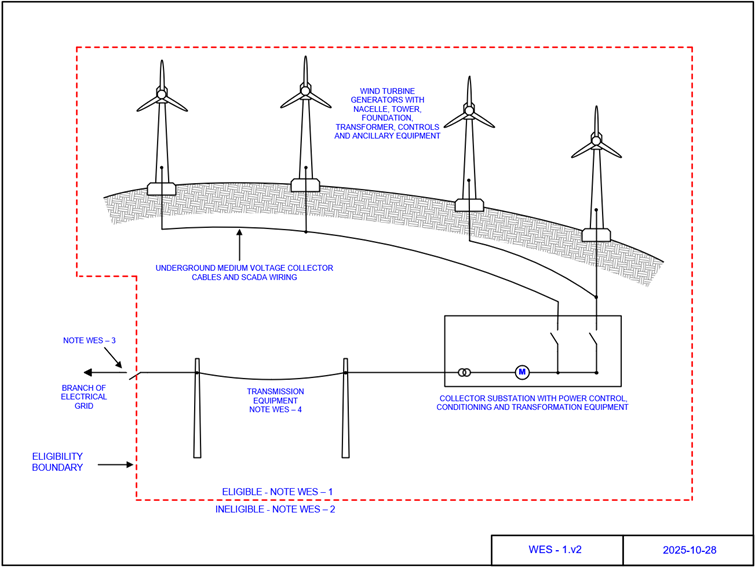
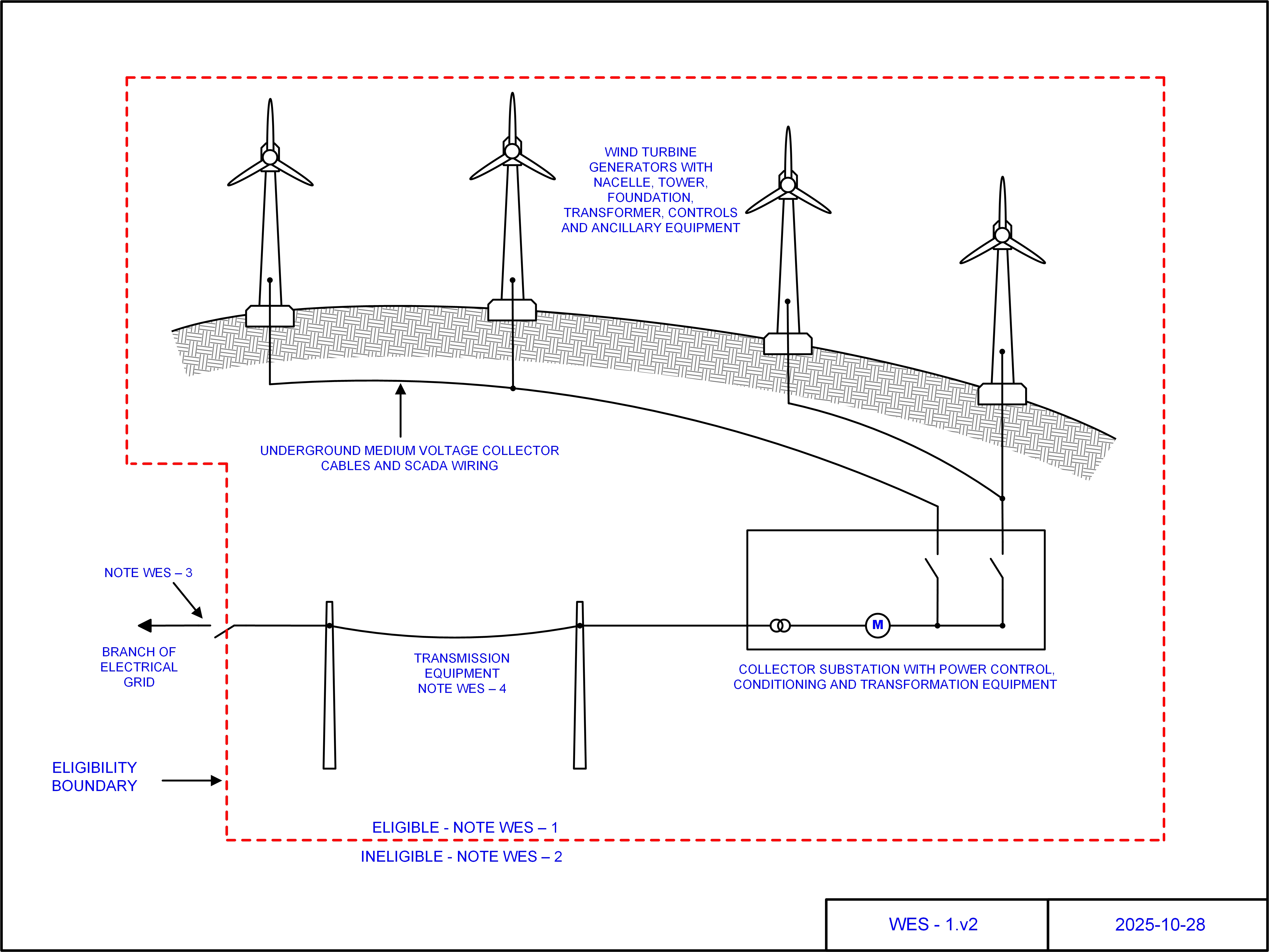
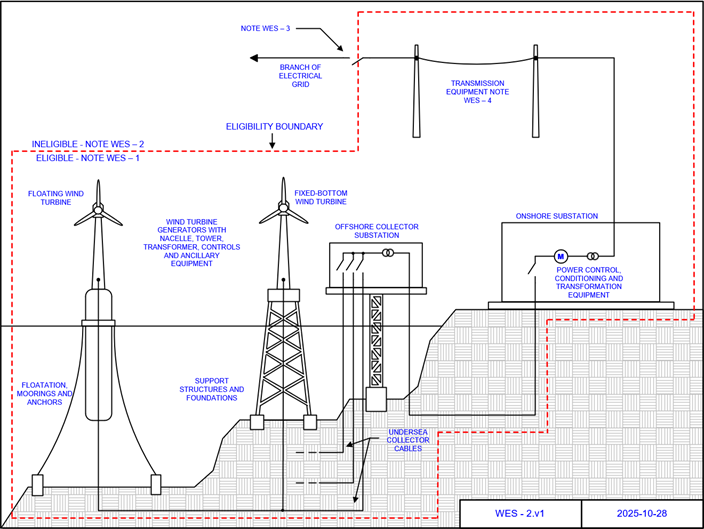
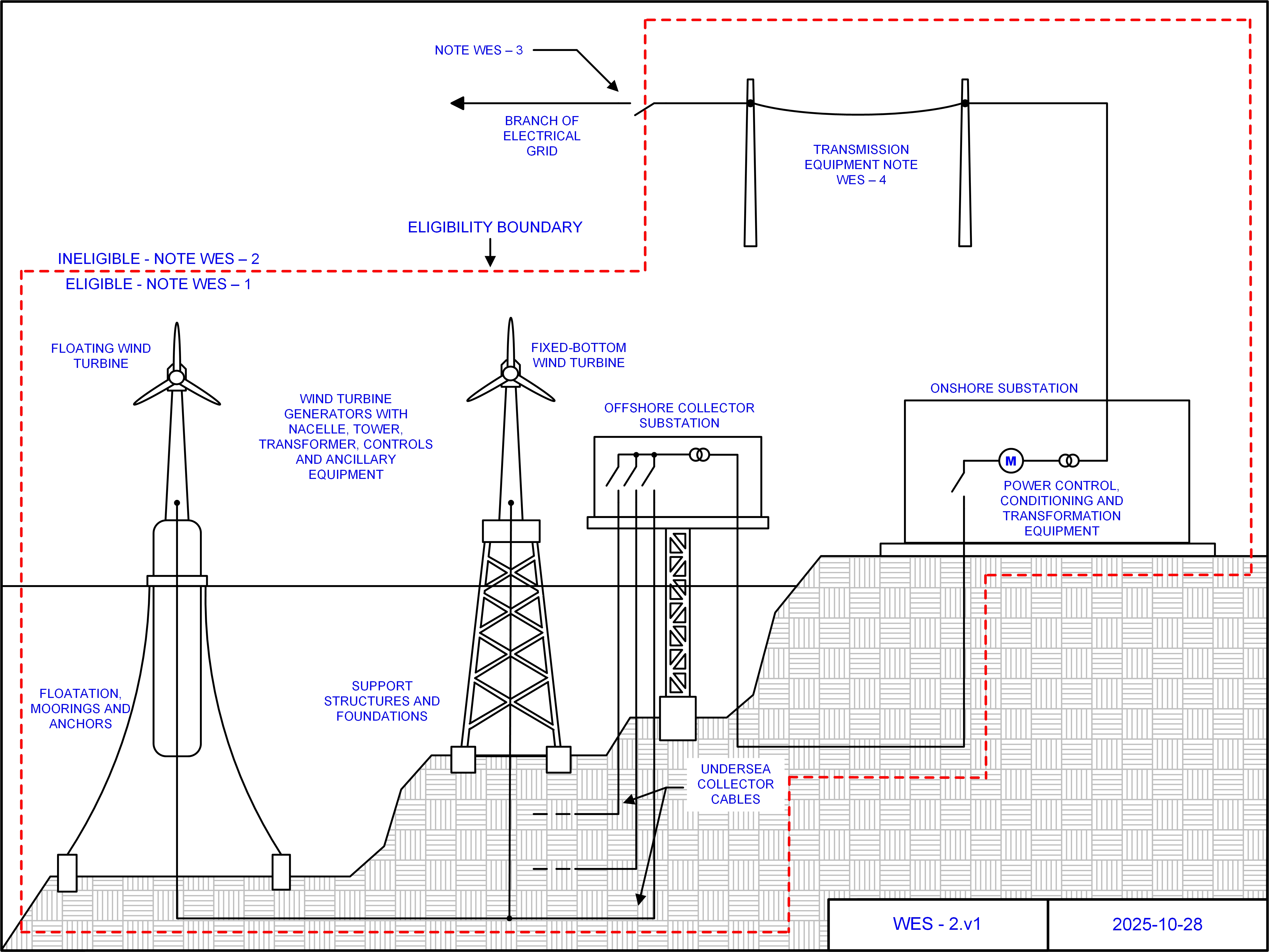
A typical configuration of wind turbine generators and related equipment that would qualify as a wind energy conversion system is shown in the schematics below.
Key to notes on schematics for wind energy conversion systems
- WES-1
- For eligible properties, see Eligible Properties section of this Guide.
- WES-2
- For ineligible properties, see Ineligible Properties section of this Guide.
- WES-3
- Eligible electrical energy generation property for a wind energy conversion system includes one or more wind turbine generators complete with turbine support structures and equipment to collect, condition and transform the electrical energy produced by all wind turbine generators in the system such that it may be placed on the electrical grid through a single point of connection. Typically, the eligible system boundary for a wind energy conversion system is located at the isolation switch that allows a utility to lock out a wind energy conversion system’s electrical energy production.
- WES-4
- Eligible transmission equipment is site specific and is dependent on the electrical grid configuration near the site. In general, it includes transmission lines (and related equipment) from the electrical energy generating equipment up to the interface with the electrical grid or the isolation switch of the local electrical utility, or up to the point where, on an annual basis, more than 75 percent of the electrical energy transmitted by the transmission equipment is electrical energy generated by the wind energy conversion system, whichever point comes first.
Figure 1 - On-shore energy conversion system
Text version of Figure 1
Schematic illustrating the boundary of an on-shore wind energy conversion system. Within this boundary are wind turbine generators with nacelle, tower, foundation, transformer, controls and ancillary equipment with underground medium voltage collector cables and SCADA wiring that connects to the collector substation with power control, conditioning and transformation equipment and transmission equipment. For notes on the schematic in this section, please refer to key to notes on schematics for wind energy conversion systems section.
Figure 2 - Off-shore energy conversion system
Text version of Figure 2
Schematic illustrating the boundary of an off-shore wind energy conversion system. Within this boundary are floating wind turbine or fixed bottom wind turbine wind turbine generators with undersea collector cables connected to offshore and onshore substation and transmission equipment. For notes on the schematic in this section, please refer to key to notes on schematics for wind energy conversion systems section.