
Message
Canada’s prosperity has always been built on the strength of its people, communities, and abundant natural resources. Today, Canada is at a hinge moment as the world around us is changing rapidly. Global volatility, shifting trade relationships, and geopolitical uncertainty are reshaping markets; new technologies are emerging; and the transition to a low-carbon future is accelerating. Our responsibility is clear: to re-tool our economy we must deliver cleaner growth, stronger and more resilient communities, and long-term economic security for all Canadians — while protecting our workers and ensuring no one is left behind.
Meeting this challenge requires a bold new economic strategy. Canada is moving with urgency, starting here at home. We are making generational investments and accelerating nation-building projects — projects that will strengthen our sovereignty, connect regions, diversify our economy, and continue to position Canada as our own best customer for energy and natural resources. These efforts will also expand exports to new partners, reduce vulnerability to global disruptions, and create hundreds of thousands of good, well-paying jobs — including union jobs— across the country. To ensure we are ready, we are investing in skills, training, and workforce development so workers are empowered to succeed in a rapidly changing economy.
The 2026–2030 Sustainable Jobs Action Plan is a cornerstone of this government’s Build Canada agenda and a roadmap to meet the moment in which we find ourselves. Building on strong partnerships with unions, industry, and Indigenous communities, it lays out how we are turning ambition into action and delivering the projects, industries and value chains that will secure Canada’s place as an energy superpower — now and for generations to come.
The Honourable Tim Hodgson,
Minister of Energy and Natural Resources
Opening territorial acknowledgement
The Government of Canada recognizes Indigenous Peoples as the original stewards of the lands and waters across Canada. These lands remain subject to treaties and agreements where the Government of Canada committed to respect Indigenous rights and collaborate with Indigenous Peoples. Federal efforts to promote sustainable jobs through this strategy will connect respectfully to Indigenous-led strategies and systems to learn from First Nations, Inuit and Métis knowledge systems, collaborate toward common outcomes and advance complementary initiatives.
Overview
Canada is undergoing a significant economic transition, shaped by shifting geo-political and global trade dynamics. At the same time, the global shift to a low-carbon, climate-resilient economy is accelerating, changing how growth happens and where capital flows. Canada has the assets to lead and seize the tremendous opportunities of this historic transformation. Workers are at the centre of this transition; it is workers who will undertake the challenge and responsibility of advancing technological innovation, building infrastructure, and deploying projects to advance Canada’s economic objectives. Meeting this challenge requires bold action, and collaboration with workers, to:
- Build Canada Strong: Accelerating nation building projects to connect, diversify, and propel our economy; expand exports to new partners; and create decent work and hundreds of thousands of high-quality jobs.
- Empower workers: Implementing a range of targeted supports to help workers overcome challenges in key industries, today and be prepared to thrive in the future.
- Protect industries: Advancing robust industrial policies to form comprehensive industrial strategies in collaboration with our partners such as unions.
Canada’s 2026–2030 Sustainable Jobs Action Plan, developed in line with the Canadian Sustainable Jobs Act, brings these commitments together with the goal of fostering the creation of and protecting these high-quality jobs for generations to come.
The Canadian Sustainable Jobs Act enshrines principles to guide collective work at the federal level to create an equitable and inclusive future that supports economic development, climate action and energy security. It sets the foundation for a whole-of-government approach, acknowledging the roles of both the Minister of Energy and Natural Resources, and the Minister of Jobs and Families in fostering the creation of high-quality jobs, promoting decent work, and protecting these opportunities for generations to come. As Canada invests in the industries of tomorrow, it’s not just about creating more jobs; Canada continues to ensure decent work and an inclusive labour market.
Decent work is at the core of sustainable jobs. A sustainable job is defined as any job that is compatible with Canada’s pathway to achieving a net-zero-emissions and climate-resilient future and that reflects the concept of decent work, namely work — including a job in which the worker is represented by a trade union that has entered into a collective agreement — that can support the worker and their family over time and that includes elements such as fair income, job security, social protection and social dialogue.
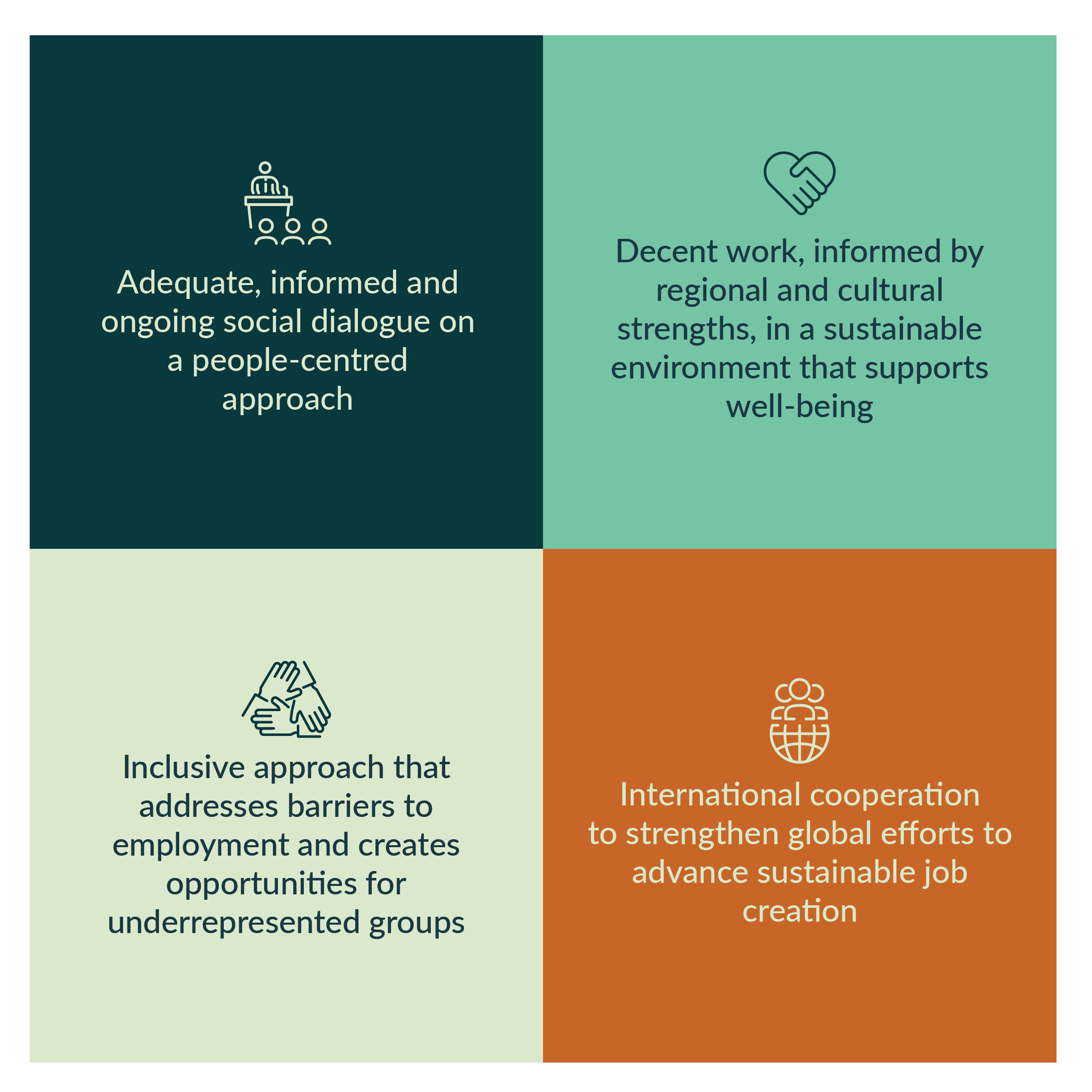
Long description
Image depicting the four sustainable jobs guiding principles across a four-quadrant graphic. The top left quadrant, in dark blue, includes an icon of a person speaking at a podium in front of an audience, with the text: “Adequate, informed and ongoing social dialogue on a people-centred approach”. The top right quadrant, in teal, includes an icon of two hands forming a heart shape, with the text: “Decent work, informed by regional and cultural strengths, in a sustainable environment that supports well-being". The bottom left quadrant, in beige, shows an icon of interlinked hands, with the text: “Inclusive approach that addresses barriers to employment and creates opportunities for underrepresented groups”. The bottom right quadrant, in orange, includes an icon of a globe with three people above it, with the text: “International cooperation to strengthen global efforts to advance sustainable job creation
In line with this definition, the Government of Canada, is working to create high-quality, skilled, sustainable jobs by ensuring its investments include provisions for workers, such as community benefit agreements, prevailing wage conditions, unionized worker and Buy Canadian requirements.
In line with the guiding principles, this Action Plan also takes into account engagement with partners and stakeholders including provincial, territorial and Indigenous governments, and unions and industry; expert advice from the Sustainable Jobs Partnership Council; and input from across the federal government to ensure Canada takes a comprehensive approach and is responsive to the needs of workers and communities from coast-to-coast-to-coast.
- Approximately 80 submissions were received from Indigenous organizations, provincial and territorial governments and other organizations spanning industry, labour, NGOs/ENGOs, municipalities, skills/training, equity-related, and academia on the Action Plan.
- The Sustainable Jobs Partnership Council is responsible for undertaking engagement with people across Canada and providing annual independent advice to the Minister of Energy and Natural Resources and the Minister of Jobs and Families on measures and policies related to Sustainable Jobs. The Council’s advice is found in its first Annual Report available here: Sustainable Jobs Partnership Council – Annual Report - Natural Resources Canada. In line with the Canadian Sustainable Jobs Act, the Minister of Energy and Natural Resources will provide a formal response to the Partnership Council on its annual report.
In line with the guiding principle to advance international collaboration, Canada is working in collaboration with our international partners, academia, and civil society to exchange lessons learned and best practices, helping to level the playing field for businesses and workers by promoting fair standards, inclusive growth, and shared innovation. This Action Plan builds on what we have learned from our international partners.
Finally, the Government of Canada is committed to respecting Indigenous inherent and treaty rights, guided by the legal and policy framework that directs us, including historic and modern treaties and self-government agreements, legal precedents clarifying the Canadian Constitution, the United Nations Declaration on the Rights of Indigenous Peoples Act and its related action plan.
Build Canada Strong: Fostering the creation of good jobs and decent work
In an era of global uncertainty and rapid change, Canada’s strength lies in its ability to build, and to move from reliance to resilience. The Government of Canada is moving forward with generational investments in infrastructure to connect our economy, diversify trade, and position Canada as both a clean energy leader and a conventional energy powerhouse at an unprecedented speed.
Through this Action Plan, the Government of Canada is committed to ensuring that the transition to a stronger, more resilient economy generates high-quality, sustainable jobs in every region of the country. This includes supporting nation-building projects and using proven tools, such as community benefit agreements, prevailing wage requirements, unionized labour provisions, and Buy Canadian policies, to drive inclusive economic growth and ensure that workers share directly in the benefits of public investment.
Accelerating Major Projects
In August 2025, the Government launched the Major Projects Office (MPO) to serve as a single point of contact to advance nation-building projects and streamline regulatory project approval. The Office will help to identify in Canada’s national interest and work to structure financing and simplify and accelerate federal decision making.
In September 2025, the Government referred five projects and six transformative strategies to the Major Projects Office (responsible for advancing nation-building projects) representing over $60 billion in investment and with the potential to create up to 34,000 jobs. A second tranche announced in November 2025, would add more than $56 billion in new investment and could support 68,000 good-paying careers across the country. Many of the projects and transformative strategies proposed to date are in key net-zero enabling sectors such as:
- Darlington New Nuclear Project: Located in Bowmanville, Ontario, this project would make Canada the first G7 country with an operational small modular reactor (SMR). The first of four planned units would supply reliable, affordable, clean power to 300,000 homes, support 200 long-term jobs, and create 1,600 jobs during construction.
- McIlvenna Bay Foran Copper Mine Project: Situated in one of Canada’s richest mineral belts and working in close collaboration with the Peter Ballantyne Cree Nation, this project would supply copper and zinc to strengthen Canada’s position as a global supplier of critical minerals for clean energy, advanced manufacturing, and modern infrastructure. It would create 400 jobs, boost local economies in Saskatchewan and Québec, where the copper will be smelted, and is expected to be the first net-zero copper project in Canada.
- Iqaluit Nukkiksautiit Hydro Project (ᐃᖃᓗᐃᑦᓄᑭᒃᓴᐅᑏᑦᓴᓇᔭᐅᔪᖅ): Located on the Kuugaluk River, 60 kilometres from Iqaluit, this 100% Inuit-owned project proposes to build a 15–30 MW hydroelectric facility to replace imported diesel, cut emissions, create local jobs, and strengthen Arctic sovereignty for generations.
- Wind West Atlantic Energy: This transformative strategy aims to leverage more than 60 GW of offshore wind potential in Nova Scotia and across Atlantic Canada, delivering renewable, emissions free power to meet rapidly growing regional demand. The first 5,000 MW phase could generate 24 TWh of clean electricity annually and attract billions in private sector investment.
- Pathways Plus: An Alberta based carbon capture and storage initiative currently under consideration. If advanced, Pathways Plus would help sustain a strong conventional energy sector while reducing emissions and emissions intensity from the oil sands. At full build out, the project is expected to generate significant economic activity and support thousands of skilled, long- term jobs, while enabling the prospect of lower carbon oil exports and contributing to Canada’s broader energy transition.
- Alto High-Speed Rail: Canada’s first high-speed rail line will span roughly 1,000 km from Toronto to Québec City, reaching speeds up to 300 km/h to cut travel times in half and connect nearly half of Canada’s population. The project targets 25 million tonnes of CO₂ savings and aims to create 51,000 jobs over 10 years.
The Government will continue to make further announcements on major projects across a range of sectors that will drive Canadian economic growth. Recognising that advancing reconciliation with Indigenous Peoples, including economic reconciliation, is critical to accelerating Canada’s economic growth, inclusive and sustainable future, the Government is providing $40 million over two years, starting in 2025-26, to Indigenous Services Canada through the Strategic Partnerships Initiative to support Indigenous capacity building and consultation on nation-building projects prior to designation under the Act.
Canada’s Build Agenda
In September 2025, the Government launched Build Canada Homes, a new federal agency with $13 billion in initial funding, that will build affordable housing at scale. It will leverage public lands, offer flexible financial incentives, attract private capital, facilitate large portfolio projects, and support modern manufacturers to build the homes that Canadians need. Build Canada Homes will harness innovative housing technologies to build faster and more sustainably, prioritizing low-carbon materials, low-carbon technologies and Canadian materials.
The Government of Canada is also launching the Build Communities Strong Fund to provide $51 billion over 10 years starting in 2026-27 and $3 billion a year ongoing, to support a wide range of public infrastructure projects across the country, build stronger and more resilient communities and create thousands of good jobs. Supporting the creation of high-quality jobs, the fund will encourage recipients to consider unionized labour and use Community Employment Benefits Agreements.
This program also adopts the Buy Canadian policy, which includes (effective December 2025) new federal procurement rules to support Canadian workers and industries. These changes will:
- help create a strong Canadian supply chain by prioritizing Canadian suppliers and Canadian-made goods and services whenever possible
- help Canadian industries become more self-sufficient and resilient to changes in the global economy
This policy supports the Canadian construction and defence industries, and applies to projects such as buildings, bridges, aircraft parts, and more. It requires that large federal construction and defence purchases must use Canadian-produced steel, aluminum, and wood products. This helps the Canadian economy grow and secure jobs for Canadian workers.
Investment Tax Credits
In the 21st century, a competitive economy is a clean economy. The federal government is ensuring that Canada is at the forefront of this global race to attract investment, seize a generational opportunity, and create jobs and economic growth while fighting climate change.
The Government of Canada has made significant investments in the low-carbon economy through its historic climate plans, including the recently announced Climate Competitiveness Strategy that will help drive the large-scale investments needed to build a prosperous net-zero future. Key measures include an unprecedented suite of Clean Economy Investment Tax Credits (ITCs) which provides a significant incentive over the next decade towards attracting investment and decarbonizing and modernizing Canadian industry.
The Government of Canada is delivering these credits to attract investment, create good-paying jobs and grow the economy, while fighting climate change.
One of the Clean Economy ITCs being offered by the Government of Canada is for carbon capture, utilization and storage (CCUS) technologies. Also known as carbon management, CCUS includes a broad suite of approaches that capture CO2 emissions – whether from fuel combustion, industrial processes, or directly from the air – to either store the CO 2 underground or in concrete.
The Clean Economy ITCs include Labour requirements that provide an incentive for claimants to meet prevailing wage requirements and the apprenticeship requirements. If the Labour requirements are not met (CCUS ITC, Clean Technology ITC and Clean Hydrogen ITC) then the credit rate is reduced by 10 percentage points.
Building Canada’s Workforce
A resilient economy depends on a diverse and highly skilled workforce. Labour and skills demands are changing in Canada, driven by increasing retirements, worker and skill mismatches, automation, AI and the low-carbon transition. That is why the Government is investing to recruit, train, and upskill Canada’s workforce to ensure we are prepared to meet today’s challenges and future proof Canada’s economy.
The Union Training and Innovation Program - Sustainable Jobs Stream (UTIP SJS), led by Employment and Social Development Canada, is investing in projects that support unions and their partners in leading the development of green training for workers in the trades. The program aims to support a series of projects that will develop and deliver green training for journeypersons and apprentices in Red Seal trades that are key to reducing Canada's emissions and advancing economic resilience.
The UTIP SJS directly advances the Union-Led Advisory Table’s recommendations by delivering measurable results: expanding funding to increase diversity within the skilled trades and creating targeted training benefits that help workers affected by the low-carbon transition secure stable, future-ready employment. Examples of projects funded under the UTIP SJS include:
- The Ontario Masonry Training Centre is delivering a green-skills training initiative to modernize the Bricklayer workforce and strengthen Canada’s capacity to meet its 2030 Emissions Reduction Plan. The project will upskill 350 participants across five provinces with specialized techniques for low-carbon retrofitting of masonry buildings. This project supports Canada’s transition to a low-carbon economy by enhancing Bricklayers’ ability to contribute to largescale retrofitting efforts, and embedding green skills into their apprenticeship pathway.
- Carpenters’ Regional Council is delivering a national green-skills training project to upskill 1,600 apprentices and journeypersons across seven provinces. The project is building capacity in emerging green construction technologies – Mass Timber construction, Building Envelopes, and Rigging & Hoisting – to strengthen Canada’s transition to low-carbon buildings and infrastructure. This initiative will build the supply of job-ready Carpenters to help meet the demands of Canada’s low carbon building agenda and advancing clean technologies in construction.
The Government is also committed to creating apprenticeship opportunities for the next generation of skilled workers through the Apprenticeship Service, which will create critical training placements with small and medium sized employers for apprentices in high growth construction and manufacturing Red Seal trades. Employment and Social Development Canada will soon launch a new Apprenticeship Service to help bring in new apprentices and support their retention and progression.
Canada’s economic future depends on youth. Investing in their skills positions Canada to be competitive by equipping the workforce needed to build a climate competitive economy. That is why the Government is investing $40 million over 2 years (starting 2026–27) to create a Youth Climate Corps (led by Employment and Social Development Canada) for paid climate-related and emergency response skills training and workforce experience opportunities for youth.
Spotlight: Natural Resources Canada’s Science and Technology Internship Program – Green Jobs
About
With critical labour and skills shortages in the natural resources sector, youth are the primary source to replenish the workforce. By funding employers to hire and train youth (aged 15 to 30) across Canada, the Science and Technology Internship Program (STIP) – Green Jobs de-risks hiring and provides youth with hands-on experience and the skills needed to open pathways to careers, while supporting the competitiveness and resiliency of the natural resources sector, and contributing to building Canada into an energy superpower.
Results
As part of the Government’s Youth Employment and Skills Strategy, STIP – Green Jobs has been creating jobs for youth since 1997. The program continues to deliver results for the natural resources sector:
- STIP – Green Jobs has created over 6,000 green jobs for youth since 2017.
- Approximately 80% of youth secure employment after participating in the program, demonstrating a stronger attachment to the labour market.
- Approximately 80% of youth are from an employment-equity group, contributing to maximizing labour force participation.
Employers funded by STIP-Green Jobs are found across all provinces and territories, including small and medium-sized enterprises and Indigenous-led organizations, which are creating jobs that may not otherwise exist and in regions where many natural resources jobs are located (e.g. northern, remote, and Indigenous communities).
For more information on funding opportunities visit Green Jobs in Natural Resources.
Immigration also helps to fill critical labour gaps in priority industries where there is not enough domestic talent. As announced in Budget 2025, the International Talent Attraction Strategy and Action Plan will position the immigration system to meet strategic labour market needs, ensuring Canada has the talent required to drive innovation and growth in our strategic industries, while respecting immigration targets to ensure a sustainable immigration rate.
Furthermore, the Government of Canada is committed to maximizing labour force participation for groups who are underrepresented, marginalized, or equity-seeking in energy, natural resources and other key low-carbon intensity sectors. For example, Canada is working to increase the participation and workplace safety of women, Indigenous Peoples, and new and racialized Canadians in the mining and critical minerals workforce through awareness campaigns and other initiatives.
Employment and Social Development Canada delivers workforce programs that support underrepresented groups, including persons with disabilities, women, newcomers, and youth, to access opportunities in sustainable and low-carbon intensity sectors such as clean energy, sustainable construction, and green technology. These programs reduce employment barriers, support skills development, and promote equitable workforce participation. In addition, Indigenous-led programming helps Indigenous communities support skills and workforce development efforts while also contributing to ongoing reconciliation.
Advancing reconciliation with Indigenous Peoples, including economic reconciliation, is essential to Canada’s economic growth, low-carbon transition, and a more equitable, inclusive, and sustainable future. Indigenous communities already play a central role in energy and natural resource sectors, and their leadership is critical to successful project development. Indigenous governments and organizations are also best positioned to lead workforce development aligned with community priorities. Programs such as the codeveloped Indigenous Skills and Employment Training Program, supported by $2 billion over ten years, show how distinctions-based Indigenous service delivery strengthens skills, employment outcomes, and participation in clean growth and environmental stewardship.
Internal trade and labour mobility
Regulatory differences and labour mobility barriers can limit the movement of skilled workers across Canada, preventing them from accessing suitable job opportunities in other regions. This can create mismatches between skills and vacancies, reducing productivity and slowing the growth of sustainable jobs. By streamlining regulations and improving labour mobility, Canada can foster a truly open national market, reducing costs for businesses and consumers, strengthening supply chains, boosting productivity, and creating new opportunities that help build one economy.
Through the Free Trade and Labour Mobility in Canada Act the Government of Canada is supporting labour mobility, by removing federal barriers so that workers approved by a province or territory can more easily work in the same job under federal rules.
Through the Forum of Labour Market Ministers, federal, provincial and territorial governments are working together to implement a comprehensive Labour Mobility Action Plan. This plan will bring about immediate and long-term changes that will substantially reduce barriers to the mobility of workers in regulated occupations. For example, as directed by First Ministers, provinces and territories are implementing a 30-days service standard for processing labour mobility applications, as well as digital verification tools to support the rapid credential recognition of tradespersons. Altogether, these initiatives will help workers seamlessly fill job opportunities wherever they are across Canada.
Empower workers: Resilience through transition
Whether because of global market changes, technological transformation, or trade disputes, the Government of Canada is taking action to support workers, businesses and communities to adapt quickly in the face of economic change and to build a resilient workforce ready for the future.
Through this Action Plan, the Government of Canada is committed to supporting workers and businesses affected by economic transition, including along the pathway towards a competitive low-carbon economy.
Supporting workers in tariff impacted sectors
Given the urgency of the moment, the government has announced a series of new measures to protect workers and businesses in sectors most impacted by tariffs and trade disruptions. These actions will be undertaken in collaboration with key partners including trade unions, industry and provincial and territorial governments. These actions help to protect workers and sustainable jobs across Canada.
For example, as part of Canada’s new reskilling package for workers, the Government is investing $382.9 million over five years, and $56.1 million ongoing, to launch a new Workforce Alliances (the Alliances) and the Sectoral Workforce Innovation Fund (SWIF) to help address the impact of tariffs on Canadian workers.Footnote 1 Led by Employment and Social Development Canada, the Alliances will bring together employers, labour representatives, training institutions, underrepresented groups, workforce development organizations, Indigenous partners and industry groups to help businesses in adapting to labour market changes. The Alliances will function as a modernized version of sectoral partnership tables, which were recommended in the Union-Led Advisory Table Report. The Alliances will identify and develop plans to address the specific needs of workers in the six priority areas in which they will be established, including housing and construction; transportation and supply chains; advanced manufacturing (including AI); energy and electricity; mining and minerals; and the care economy. The SWIF will support targeted, strategic investments and will prioritize a cost-shared model, leveraging private capital to promote long-term sustainability and maximize investment value, while delivering net benefits to employers, businesses and industry at large. The SWIF would make sector-specific targeted investments to support mid-career workers and those impacted by tariffs to transition into growing industries. Furthermore, SWIF aims at investing in projects that address systemic labour shortages, build talent pipelines and support workforce development in emerging themes, such AI and automation.
Through the Sectoral Workforce Solutions Program, the government is investing $94.5 million over five years to address systemic workforce challenges in key economic sectors, including those impacted by trade disruptions. The program is supporting initiatives that focus on identifying and addressing acute and systemic workforce development needs through the development of labour market information (LMI), workforce tools and resources that increase employer capacity, and industry engagement activities to address workforce development and employer needs.
Through Labour Market Development Agreements with provinces and territories the Government is investing $570 million over three years to support training and employment assistance for workers impacted by tariffs and global market shifts. The funding is helping provinces and territories deliver reskilling and employment supports for affected workers.
To equip companies for growth and diversification, the Government is attributing $5 billion over six years starting in 2025-26 for the Strategic Response Fund (SRF), which aims to support large-scale, transformative projects that build economic resilience in industries affected by trade disruptions. The Fund aims to strengthen supply chains and protect good jobs in key sectors such as steel, aluminum, forest products, automotive and others. The SRF has the mandate of de-risking large-scale innovation across sectors that are fundamental to Canada’s net-zero transition and to ensure climate competitiveness, such as green steel, clean tech manufacturing, and electric vehicles.
Transforming Canada’s automotive sector
Canada has a unique opportunity to transform Canada’s auto industry. This sector supports over 500,000 workers, contributes over $16 billion annually to Canada’s GDP, and is one of the country’s largest export industries. The Government has introduced a new auto strategy that rewards the production of made-in-Canada vehicles and harnesses our world-class capabilities in artificial intelligence and technology expertise to build the cars of the future and positions Canada to become a global leader in electric vehicle (EV) production.
Strengthening the forestry and softwood lumber sector
The Government is also helping the forestry and softwood lumber sector transform to remain competitive. These measures will help unlock the full potential of the industry to keep pace with increased housing and major infrastructure construction.
This includes investing $500 million over three years in programs dedicated to helping develop new products and new domestic and international markets for Canadian forest products, creating a single-window pathfinding service to support forest sector businesses seeking transformation, diversification and other support, and establishing the Canadian Forest Sector Transformation Task Force to develop a high-level road map outlining actions to support, restructure and reposition the industry for the medium and longer term.
Supporting Canada’s steel
Canadian steel producers are highly trade exposed, exporting just over 50 per cent of their annual production in 2024, during which over 90 per cent went to the U.S. Our steel industry is a cornerstone of the national economy, critical to building infrastructure, supporting advanced manufacturing, and securing our future prosperity. Canada is proud of our highly skilled steelworkers and the strong, resilient industry they power.
The Government is investing $70 million over three years for steel workers through Labour Market Development Agreements with provinces and territories.
- Supports will be developed in partnership with workers, employers and provinces and territories to retrain and upskill up to 10,000 steel workers.
- Funding will support access to targeted training, reskilling financial-related supports, and job retention programs to ensure workers can continue contributing to a resilient and competitive steel sector and in-demand jobs.
- These measures will benefit mid-career, long-tenured steel workers affected by U.S. tariffs and global market shifts.
Furthermore, the SRF included $1 billion for the steel industry's transition toward new lines of business and strengthening domestic supply chains.
Through a Skills Partnership Agreement Framework (SPAF), Employment and Social Development Canada is supporting the federal role by providing federal departments and agencies, with language related to workforce planning and development, ensuring these elements are treated as core components of nation-building investments and tariff response initiatives. The SPAF requires employers seeking federal support to identify their own workforce needs early, plan for training, and invest in the skills development required, as integral part of the investment. This ensures that businesses benefiting from SRF funding also invest in growing their workforce at the same time their organization grows through SRF investments in projects.
In the case of a plant re-tooling, while the SRF upgrades the facility to increase production capacity, they need to use the language from the SPAF to ensure the employer simultaneously invests in training initiatives, upskilling existing workers, recruiting new talent, and meeting targets to increase participation from underemployed groups, so they are ready to operate the re-tooled facility. The SRF grows the organization’s infrastructure; the language proposed through the SPAF ensures the organization grows its people.
Building a system to account for shocks
Looking economy-wide, Canada has a strong income-support system, including Employment Insurance (EI), which provides temporary income support to unemployed workers across the economy while they look for employment or upgrade their skills.
The EI Work-Sharing program is a key tool and primary line of defence to help prevent layoffs. The program provides EI benefits to eligible employees who agree with their employer to work reduced hours because of a decrease in business activity beyond their employer's control. This helps employers retain their highly skilled employees and allows workers to keep their job during a temporary downturn in business. In 2025, in order to support businesses and workers affected by tariffs and trade-related disruptions, the Government of Canada introduced temporary enhancements to facilitate access and expand the duration of Work-Sharing agreements.
Furthermore, a new Worker Retention Grant was implemented on February 17, 2026, and will be in place until March 31,2027, to further support worker retention and income adequacy. The Grant is available for eligible employers in all sectors of the economy who have an active Work-Sharing agreement and who commit to supporting training for their employees that are working reduced hours. This Grant allows employers to offer a top-up to EI Work-Sharing benefits for their employees participating in training, on the days they are not working. This measure is expected to help up to 26,000 workers, including those in the steel, softwood lumber, automotive and other high-tariff exposed sectors.
Finally, in 2025 the Government introduced temporary EI flexibilities to ensure that workers affected by tariffs can access the income support they need, including:
- Waiving the one-week waiting period so that workers can begin receiving benefits right away, helping them adjust more easily to a sudden drop in income;
- Suspending some EI rules around the treatment of monies on separation so that workers do not have to use those up before accessing EI benefits;
- Providing 20 extra weeks of income support for long-tenured workers who may need more time to get back to work or to allow time to train or upskill.
Together, these measures ensure that employers and workers have the supports they need to stay resilient as they navigate this period of transition and disruptions.
Powered by advanced artificial intelligence and real-time data, modernization of the Government of Canada’s Job Bank will deliver tailored, accessible tools and services to help Canadians connect to opportunities more quickly, support continuous learning, and strengthen labour market resiliency for workers impacted by tariffs. Key enhancements include:
- For employers, personalized insights and a real-time labour supply dashboard; and
- For job seekers, customized referrals for in person assistance, improved job matching services, and National Training Finder offering an easy, centralized way to search short duration training courses.
To support participation in the low-carbon economy, Job Bank features a green jobs filter and other resources related to green jobs in Canada. It also provides free supports to help specific groups participate in the labour market, including Indigenous Peoples, persons with disabilities, newcomers, and youth.
Supporting workers in the low-carbon transition
These actions help to lay the foundation for how Canada will manage the broader net-zero transition by 2050. As global markets shift, technologies evolve, and industries and their employees strive to decarbonize their operations and workplaces, Canada must build a system that ensures the transition to net-zero is a driver of job quality and growth.
Canada’s Climate Competitiveness Strategy builds on our strengths – our energy and resources industries, advanced manufacturing, services, and building sectors, while expanding into emerging opportunities such as critical minerals, carbon removal, resource efficiency, and high-value manufacturing. By providing predictability and certainty in the development of sustainable jobs and leveraging our talented and skilled workforce, Canada can attract investment, drive innovation and create good jobs in communities across the country, while positioning us as a leader in the global low-carbon economy.
This global shift is creating hundreds of thousands of high-paying careers across Canada. According to Statistics Canada, after a slight dip in 2020 (296,596 jobs), jobs in the Environmental and Clean Technology sector rebounded to 325,567 in 2021 and continued to rise to 359,023 in 2023. By 2024, the sector supported 363,094 jobs, reflecting sustained growth and the important role of clean technology in the broader economy. Looking forward, the low-carbon emissions economy represents a significant job creation opportunity for Canada. In fact, the Centre for Civic Governance estimates that investments to support Canada’s net-zero commitments could generate up to 9.5 million jobs by 2050 in construction work alone.
These opportunities span both skilled technical roles and other supporting roles, requiring a diverse set of skills and educational backgrounds, from vocational training and certifications to advanced degrees.
Figure 1. In-demand occupations
Please see below for highlights of some key occupations that are expected to be in-demand in low-carbon sector, reflecting the urgent need for talent that can design, build, and manage solutions for a strong economy.
Construction roles
- Construction trades helpers and labourers
- Crane and heavy equipment operators
- Industrial and power system electricians
- Professional engineers
- Transport truck drivers
- Construction managers and supervisors
- Steamfitters, pipefitters, and sprinkler system installers
- Welders and related machine operators
- Quality assurance, inspection, and safety specialists
- Construction millwrights and industrial mechanics
Operational roles
- Mechanics (industrial, electrical, HVAC, heavy equipment)
- Power engineers and power systems operators
- Labourers
- Heavy equipment operators
- Senior managers and utility managers
- Central control and plant operators
- Material handlers
- Industrial instrument technicians and mechanics
- Engineering inspectors and regulatory officers
- Industrial and power system electricians
Showcase
Civil engineers plan, design, develop and manage projects for the construction or repair of buildings, earth structures, powerhouses, roads, airports, railways, rapid transit facilities, bridges, tunnels, canals, dams, ports and coastal installations and systems related to highway and transportation services, water distribution and sanitation. They may also specialize in foundation analysis, building and structural inspection, surveying, geomatics and municipal planning. They are employed by engineering consulting companies, in all levels of government, by construction firms and in many other industries, or they may be self-employed.
- Requirements: This occupation usually requires a university degree (bachelor’s, master’s or doctorate).
- Wages: $48.56/hour (median wage in Canada)
- Competencies: time management, quality control testing, product design, operation monitoring of machinery and equipment, preventative maintenance
Heavy equipment operators operate heavy equipment used in the construction and the maintenance of roads, bridges, airports, gas and oil pipelines, tunnels, buildings and other structures; in surface mining and quarrying activities; and in material handling work. They are employed by construction companies, heavy equipment contractors, public works departments and pipeline, logging, cargo-handling and other companies. Apprentices are also included in this unit group.
- Requirements: This occupation usually requires a college diploma, an apprenticeship training of less than 2 years, or more than 6 months of on-the-job training.
- Wages: $32.50/hour (median wage in Canada)
- Competencies: operation and control, quality control testing, operation monitoring of machinery and equipment, troubleshooting, preventative maintenance
To explore more occupations, please visit: Job Bank – Job Profiles.
Many of the skills needed to power Canada’s future economy already exists across industries. Several studies have shown that many workers in Canada are well-positioned to step into clean energy roles with little to no additional training:
- Research from the C.D. Howe Institute found that industrial engineers working in the fossil fuel industry possess many of the skills necessary to facilitate a transition to roles in wind energy.Footnote 2
- A report from the International Energy Agency estimates that, globally, half of all workers in fossil fuel sectors who face redundancy risks this decade have skills demanded by growing clean energy sectors and could switch into new roles with around four weeks of additional training.Footnote 3
- A report published by the Conference Board of Canada in partnership with Future Skills Centre stated that many of the core skills used in current jobs will remain highly relevant in a low-carbon economy. Skills such as effective communication, problem-solving, adaptability and learning how to learn will continue to be vital.Footnote 4
Spotlight: Adaptation skills
A climate-resilient economy and effective climate risk-disclosure rely on key professionals (such as accountants, engineers and planners) having the skills to understand and address climate risks. Building this capacity requires upskilling and reskilling across communities and sectors, as adaptation-related jobs span diverse educational and occupational backgrounds.
Tools such as the Climate Action Competency Framework help workers, service providers, and employers identify the knowledge, skills, and behaviours required to implement climate change adaptation and greenhouse gas mitigation actions effectively.
Development of a climate resiliency training program for building sector professionals
Through the Climate Change Adaptation Program, the Government of Canada is investing $367,000 in a cost-shared project led by Engineers and Geoscientists British Columbia (EGBC) to strengthen the capacity of building sector professionals to integrate future climate change considerations into their practice. By developing and delivering a resiliency training course and associated guidance document, EGBC is expected to train 70 building professionals by March 2026.
Skills needs also vary widely across Canada, shaped by regional, sectoral, Indigenous, and community priorities. For example:
- Northern and territorial communities require expertise in cold-climate infrastructure and remote energy systems.
- Prairie provinces are demonstrating leadership in carbon management and clean energy production such as hydrogen and biofuels, while building capacity in cleantech manufacturing, critical minerals, and nuclear power. British Columbia is building skills in critical minerals, clean energy, bioenergy, wildfire-resilient forest management and emerging sectors.
- Atlantic Canada is developing capacity for onshore and offshore wind power.
- Urban centres such as Ontario and Quebec are seeing growing demand for nuclear power expertise and large-scale green building retrofits.
Spotlight: Community Transformations Project
The Institute for Research on Public Policy’s Community Transformations Project offers detailed insights on communities that may be susceptible to impacts from tariffs and efforts to reduce greenhouse gas emissions in Canada and globally. The project incorporates a multi-faceted approach, including:
- A methodology for measuring community susceptibility related to emissions reductions efforts (with an interactive map) and for measuring community workforce exposure to U.S. exports
- Community profiles based on in-depth research and qualitative interviews in regions across Canada, such as Kitimat, B.C., Yellowknife, N.W.T., Estevan, Sask., Cape Breton, N.S., and more
- Policy briefs on opportunities to support community-led transformation strategies and place-based skills development, with briefs on supporting communities through lay-offs and place-based industrial policy still to come
- International case studies exploring approaches to place-based skills development
Many major projects proposed in Canada will take place in and around rural or remote communities, which have their own unique challenges such as limited access to training and education providers or gaps in digital connectivity, which limit access to online learning. This is why place-based solutions are critical.
Supported by federal investments, provincial and territorial governments are the deliverers of education, skills development, and training, playing a central role in designing programs, setting standards and aligning training opportunities with regional labour-market needs. Some examples of provincial and territorial-led initiatives include:
- British Columbia’s Look West strategy, a targeted economic growth plan that emphasizes workforce development to deliver major projects and diversify trade markets through skilled trades training, advancing skills training for highly qualified professions to drive key economic sectors, and connecting industry to quality training opportunities.
- The StrongerBC Future Skills Grant Program in British Columbia, which supports people living in British Columbia aged 19 and older, in accessing up to $3,500 for short-term skills training opportunities that are aligned with the province’s labour market needs and government priorities, including clean energy, mining and construction.
- NEI Association Inc. (econext) Accelerating Clean Growth: Green Economy Workforce Development Project - Phase 2 aims to ensure that Newfoundland and Labrador’s workforce is fully prepared to support the growth and demands of the clean energy sector. Focus areas include 1) Education and Awareness, 2) Targeted Upskilling, and 3) Addressing Barriers and Gaps.
- The Workplace Innovation and Productivity Skills Incentive (WIPSI) in Nova Scotia provides funding to businesses, industry associations and sector councils to enhance workforce skills and improve innovation and productivity. Projects address critical skills shortages, support underrepresented groups and align with the province's economic and workforce development goals.
More information on the range of initiatives led by provincial and territorial governments can be found in Annex C.
Other actors, including non-profits, labour organizations, industry associations, Indigenous Peoples and organizations, academic institutions, and community-led organizations, also play a role in building Canada’s workforce capacity. For example:
- Dalhousie University delivers the Canadian Battery Innovation Centre (CBIC) at Dalhousie University. Supported by $15.13 million from the Government of Canada, the CBIC aims to accelerate battery innovation and train highly qualified personnel for the sector’s future demands. Through industry-oriented training, the CBIC is expected to produce approximately 25 to 50 highly qualified personnel per year to support the specialized workforce needed in Canada’s growing battery sector.
Engagement and partnerships with key partners will be critical to ensure workers are able to thrive in a low-carbon economy. For example, that is why the Government’s approach, as enshrined in the Sustainable Jobs Guiding Principles, aims to build a net-zero and climate resilient economy through adequate, informed and ongoing dialogue on a labour force and people-centred sustainable economy. Specifically, the Government of Canada is committed to collaborating with Canadian workers, Indigenous Peoples, trade unions, employers, industry, business, communities, non-governmental organizations and the governments of the provinces and territories, which all have a role to play in building a low-carbon economy.
Such a commitment means working with governments, including Indigenous governments, as well as relevant partners and stakeholders, to build strong social consensus in the shift to a low-carbon economy. Enabling ongoing dialogue between these is critical to advance an integrated effort where workers and their communities have a say in decisions that affect their futures.
Protecting industries: Advancing robust industrial policies in Canada
In addition to measures to support workers, Canada is building a comprehensive industrial strategy through industry specific strategies to create high-quality sustainable jobs and build the strongest economy in the G7.
Critical Minerals Strategy
In 2022, Canada released its foundational Canadian Critical Minerals Strategy, designed to increase the supply of responsibly sourced critical minerals for the modern economy. Canada is home to nearly half of the world’s publicly listed mining and mineral exploration companies. In 2023, the critical minerals sector directly and indirectly contributed $40 billion to Canada’s GDP (1% of total GDP) and about 110,000 direct and indirect jobs. Through the Strategy, Canada committed to actions that created good jobs and economic opportunity in every region of the country while achieving Canada’s ambitious climate goals and advancing reconciliation and contributing to global security and supply chain resilience.
The Strategy is designed to be iterative and adaptive to challenges, opportunities, and technological developments. Building on the foundational Canadian Critical Minerals Strategy from 2022, Canada’s current approach to critical minerals focuses on three main pillars:
- Promoting domestic production and processing of critical minerals in strategic areas: Canada is investing in minerals that are key to clean energy and advanced technology and manufacturing, with an increased emphasis on dual-use minerals integral to commercial and defence value chains.
- Protecting Canada’s sovereignty and economic resilience by safeguarding critical minerals value chains: Canada is taking action to protect critical mineral value chains and industry from geopolitical threats, unfair market practices, and risks of foreign control
- Partnering with Indigenous groups, domestic stakeholders and international allies to develop critical minerals: Canada is partnering with provinces and territories, Indigenous groups, industry and other stakeholders to capitalize on strategic opportunities for critical mineral development while bolstering Canada’s strong reputation for responsible mining.
To keep this momentum and reinforce Canada’s world leadership in the responsible production of critical minerals, Natural Resources Canada is implementing several measures announced in Budget 2025 that will leverage partnerships to promote and protect critical mineral value chains in Canada and create good jobs:
- Launch the First and Last Mile Fund, which will build on the Critical Minerals Infrastructure Fund to invest a total of $1.5 billion until 2030 to support strategic mining and infrastructure projects that will bolster Canada's critical mineral value chains and get critical minerals to market, while enabling the capacity of implicated Indigenous nations, communities, and groups.
- Stand up the Critical Minerals Sovereign Fund, which will provide $2 billion over five years to make strategic investments in critical mineral projects and companies through equity investments, debt instruments, and offtake contracts.
- In collaboration with Innovation, Science, and Economic Development Canada, support the Defence Industrial Strategy through $443 million over five years to develop cutting-edge critical mineral processing technologies, partner with allies on joint investments in Canadian projects, and to continue building a critical mineral stockpiling mechanism to strengthen Canadian and allied security.
- In collaboration with Finance Canada, support the renewal of the Mineral Exploration Tax Credit and the expansion of the coverage and eligibility of key critical mineral tax incentives, including the Critical Mineral Exploration Tax Credit and Clean Technology Manufacturing Investment Tax Credit.
- Build on the work of the Critical Minerals Production Alliance to direct additional investments and partnerships from allies to support Canada’s critical mineral value chains.
Electricity and Nuclear Strategies
In 2026 the federal government commits to advance strategies for electricity and nuclear. Both strategies will include consideration of the labour that will be required in the decades to come.
The Electricity Strategydiscussion paper will touch on how governments can actively work to build and modernize electricity systems to make them more sustainable, affordable, and interconnected, for Canadians in all regions. The goal is to double Canada’s electricity systems, substantially increasing affordable supply while pursuing a low-carbon grid by 2050.
The Nuclear Energy Strategy will position nuclear energy as an essential part of a modern, clean, and better-connected grid, as well as a key enabler to advanced manufacturing and other sectors (e.g., medical isotopes). It outlines how Canada’s nuclear industry will contribute directly to economic growth and energy security.
The federal government recognizes the shortage of skilled tradespeople needed to execute the electricity and nuclear energy buildout, and the manufacturing ramp-up required to meet increasing demand. Encouraging apprenticeships and new trades entrants is a key part of addressing this shortage and ensuring Canada has the skilled workforce it needs.
Going forward, the Government of Canada is committed to advance industrial policies, forming a comprehensive industrial strategy, in close collaboration with key partners including labour.
By ensuring that sustainable jobs are created and supported across every sector of the economy, we are strengthening the foundations of communities and giving workers the confidence that they can build their future here at home. As we modernize and expand Canada’s infrastructure, we have the opportunity not only to meet today’s needs but to plan deliberately for the jobs of tomorrow, jobs that are high-quality and reflect the concept of decent work.
Together, these actions position Canada to grow an economy that is competitive, resilient, and inclusive, while ensuring that workers and communities benefit from the transition every step of the way.
Regional and community-led initiatives
Opportunities to drive economic and job growth in energy, natural resources and net-zero sectors are abundant in every region of Canada. To fully realize these opportunities, we must harness our regional advantages, collaborate with Indigenous governments as equal partners, consider place-based approaches that build on local strengths, and collaborate with partners on shared interests to build a stronger, more unified Canadian economy.
Regional Development Agencies (RDA) work closely with businesses and innovators to fuel economic growth that creates more well-paying jobs for people across Canada. As place-based convenors and catalysts, RDAs help translate national priorities into regional opportunities by fostering investment, supporting innovation, and enabling workforce development. RDAs also ensure that the diverse strengths and realities of Canada’s many regions are reflected in federal policy and programming by building strong relationships with local partners and stakeholders. By leveraging their place-based role, RDAs help position Canada’s regions to capture emerging markets, attract capital, and create good-paying jobs, reinforcing Canada’s role as a global leader in sustainable economic development.
The Government is ready to lean in and work with interested provincial and territorial governments on enabling measures to advance their economic priorities.
Support for coal communities
The Government of Canada is taking steps to phase out unabated coal-fired electricity by 2030. Alberta completed its phase-out of coal-fired electricity generation in 2024, and remaining active coal-fired generating stations are located in Nova Scotia, New Brunswick, and Saskatchewan.
Spotlight: Canada Coal Transition Initiative and Canada Coal Transition Initiative-Infrastructure Fund
To mitigate the potential adverse economic impacts of the coal transition, the Government of Canada allocated a total of $185 million to support affected workers and communities through the Canada Coal Transition Initiative (CCTI) and the Canada Coal Transition Initiative-Infrastructure Fund (CCTI-IF). CCTI and CCTI-IF projects have had meaningful successes in creating jobs, providing training and skills development, and fostering economic development, planning, and growth. Examples of projects funded:
- In Leduc County, Alberta: $17.7 million to complete the Nisku Spine Road, which is expected to create approximately 950 local jobs and attract up to 60 new businesses to the region
- In Coronach, Saskatchewan: $1.95 million to install an upgraded fibre optics network in the Coronach region, which replaced antiquated transmission equipment in the towns of Coronach, Rockglen, Bengough, and Willow Bunch. Through this project, 60 businesses were created, maintained, or expanded in the region, and 100 jobs were maintained.
- In Sydney (Cape Breton), Nova Scotia: $4.75 million to scale the industry bioprocessing capacity at the Verschuren Centre biomanufacturing facility. This attracted companies to relocate their headquarters to the area to work with the centre and created new bioprocessing jobs.
- In Belledune, New Brunswick: $1.7 million to the Port of Belledune to produce a master development plan to prepare for the coal phase-out and to position the port as a low-carbon intensity hub for future industrial expansions, creating new sustainable jobs over the next decade
As capacity transitions to lower-emitting sources, Canada has taken action to support affected coal workers and support communities diversify their economies, establish new skills and training, and build the infrastructure needed for future opportunities.
The role of data in Sustainable Jobs
Reliable, transparent, and disaggregated data are foundational to the development and implementation of this Action Plan. As required under the Canadian Sustainable Jobs Act, the Action Plan draws on the best available labour market and economic data to inform its measures, track progress, and uphold principles of equity, regional responsiveness, and worker well-being.
Robust data will allow the Government to act on the right opportunities, measure what matters, and remain accountable to Canadians. Furthermore, in submissions on the Action Plan, data granularity was a frequently cited challenge, with a clear need for disaggregated data to inform workforce planning and identify labour market gaps. Where possible, the Action Plan leverages high-quality data from Statistics Canada, Canada’s trusted national statistical agency known for its methodological rigour. Government of Canada models and forecasts were also used to inform scenario planning and sectoral projections, when available.
To support this work, an environmental scan was conducted to catalogue existing federal data products, models, and frameworks relevant to sustainable jobs. The scan revealed strong demographic coverage and robust indicators of job quality across many data sources, but also highlighted key gaps, particularly in emerging and interconnected sectors. For example, most federal data products rely on 4-digit NAICS codes, which often group net-zero and net-zero enabling activities together with other related industries. This makes it difficult to isolate net-zero enabling sectors, such as distinguishing zero-emission vehicle manufacturing from internal combustion engine vehicle manufacturing, limiting the ability to analyze differences in demographics, job quality, and regional distribution.
While data products exist that focus on net-zero enabling sectors, such as clean technologies and environmental goods and services, they are often limited in what they reveal about the workforce in these sectors. In particular, it is challenging to obtain detailed information on individual subsectors and to disaggregate data to understand characteristics and demographics of workers—such as age, gender, or job quality, within specific clean tech industries. In some cases, this is because certain industries are nascent or relatively small, meaning that disaggregating data by region or demographic group could raise privacy concerns.
The Government of Canada also funds targeted studies to address these gaps and improve understanding of specific industries, such as a 2024 analysis on Energy Efficiency Employment conducted by ECO Canada. The federal data resources identified through this scan are listed in Annex D.
Despite these challenges, the Action Plan draws from a suite of trusted sources, including federally funded research and sectoral expertise, and all data inputs have been reviewed by subject matter experts across government. In developing this Action Plan, we have applied an evidence-informed approach, drawing on available data and research to shape advice and priorities. This includes considering intersecting factors such as region, sector characteristics, and workforce demographics to ensure measures are responsive to diverse realities across Canada. Canada will continue to undertake data collection, modelling, and interdepartmental collaboration to inform future Action Plans, so that they continue to be evidence-based, inclusive, and responsive to Canada’s dynamic labour market.
Conclusion and next steps
The actions outlined in this Plan build on Canada’s 2030 Emissions Reduction Plan released in spring 2022 under the Canadian Net-Zero Emissions Accountability Act (CNZEAA), which outlines a sector-by-sector road map toward Canada’s 2030 emissions reduction target and puts us on a path to achieving net-zero emissions by 2050. The Action Plan ensures climate action and economic growth come with a plan for Canada’s workforce. It does so by identifying opportunities in low-carbon aligned sectors, outlining the skills needed for success and detailing federal supports to help workers and communities thrive.
This Action Plan is also developed in alignment with Canada’s Climate Competitiveness Strategy, released as part of Budget 2025, which is creating the clarity and conditions for the investment needed to build an affordable, net-zero future in which Canadian businesses and industry are well-positioned to compete and lead in the global economy. The strategy is about fostering the predictability and certainty needed to build a strong economy, create good jobs, and secure Canada’s place as a leader in the global clean energy transition. Building infrastructure to support a clean economy, training workers to participate in these opportunities, and supporting clean innovation are investments in long-term prosperity.
Through this Action Plan, the Government of Canada is committed to Build, Empower, and Protect, three pillars that place workers at the centre of the transition:
- Build: Through this Action Plan, the Government of Canada is committed to ensuring that the transition to a stronger, more resilient economy generates high-quality, sustainable jobs in every region of the country. This includes supporting nation-building projects and using proven tools, such as community benefit agreements, prevailing wage requirements, unionized labour provisions, and Buy Canadian policies, to drive inclusive economic growth and ensure that workers share directly in the benefits of public investment.
- Empower: Through this Action Plan, the Government of Canada is committed to supporting workers and businesses affected by economic transition, including along the pathway towards a competitive net-zero economy.
- Protect: Going forward, the Government of Canada is committed to advance industrial policies, forming a comprehensive industrial strategy, in close collaboration with key partners including labour.
In addition to these actions, Annex B outlines the range of Government activities that contribute to sustainable jobs for reference and informational purposes.
Implementation and progress reporting
Transparency and accountability are foundational to Sustainable Jobs. That is why the Canadian Sustainable Jobs Act put in place ongoing and regular reporting requirements. Notably, it anticipates the Government preparing a progress report on this Action Plan by June 1, 2028, midway through its implementation. This report will outline the progress made toward achieving the commitments set out in the Action Plan. Additional progress reports are required to be delivered every fifth year after 2028.
Laying the groundwork for this effort, a progress report on the Interim Sustainable Jobs Plan (refer to Annex A) reflects progress over the 2023 to 2025 period, including establishment of Sustainable Jobs engagement, accountability and transparency frameworks.
As a living document, this Action Plan is meant to be updated every five years, to respond to emerging opportunities and challenges, with the next update scheduled to be published in early 2031, covering the 2031 to 2035 period.
Annex A. Interim Sustainable Jobs Plan – Progress Report
Introduction
The Interim Sustainable Jobs Plan (the Interim Plan) was introduced by the Government of Canada in February 2023 and covers action through 2025. The Interim Plan laid out the initial framework for the Government of Canada's approach to advancing the creation of sustainable jobs and driving clean growth across 10 key action areas:
- Establish the Sustainable Jobs Secretariat
- Create a Sustainable Jobs Partnership Council
- Identify and advance provincial, territorial, and regional priorities and address key issues across energy and resource sectors through established bilateral and regional federal-provincial-territorial collaborative engagement mechanisms.
- Introduce a Sustainable Jobs stream under the Union Training and Innovation Program
- Advance funding for skills development toward sustainable jobs
- Promote Indigenous-led solutions through a National Benefits-Sharing Framework
- Improve labour market data collection, tracking and analysis
- Motivate investors and draw in industry leadership to support workers
- Collaborate and lead on the global stage
- Establish legislation that ensures ongoing engagement and accountability
Since the Interim Plan was introduced, the Government of Canada has established the federal governance, engagement and accountability framework that is supporting effective sustainable jobs action today and into the future. Some highlights include:
- The passing of the Canadian Sustainable Jobs Act in June 2024, which positions the federal government to be more effective in supporting Canadian workers and their communities in the shift to a low-carbon economy and helping to foster the creation of well-paying, high-quality jobs.
- Standing up a Sustainable Jobs Partnership Council to engage with people across Canada at all levels to inform independent, annual advice it provides to the Government.
- Establishing a Sustainable Jobs Secretariat to help implement the Act, support the Sustainable Jobs Partnership Council, coordinate work across federal departments, and serve as a source of information for Canadians, especially workers and employers.
The Interim Plan also included a suite of measures that have reached important milestones over the 2023–2025 period, such as:
- Advancing regional collaboration on energy and natural resources development (led by Natural Resources Canada), with formal engagement mechanisms now in place across 12 provinces and territories.
- Making key investments to enhance workforce skills, including over $75 million allocated through Employment and Social Development Canada’s Sustainable Jobs Training Fund (SJTF) and over $67 million allocated to the Sustainable Jobs Stream under the Union Training and Innovation Program (UTIP).
- Prioritizing Indigenous-led initiatives and helping to advance reconciliation with Indigenous Peoples – including economic reconciliation – which is critical to accelerating Canada’s low-carbon transition and enabling an equitable, inclusive and sustainable future for the entire country.
- Indigenous governments and organizations have played a central role in mobilizing Indigenous youth, aligning workforce development with sectoral priorities, and delivering culturally grounded employment services that contribute directly to shared federal and Indigenous governments’ clean growth and infrastructure goals.
- Flexible long-term investments through Indigenous Skills and Employment Training Program contribute to effective Indigenous-led, designed and implemented workforce development solutions. This foundation is complemented by project-based investments through the Skills and Partnership Fund that respond to emerging workforce needs, including in clean energy.
- Advancing data-driven decision making and accountability through the formation of an interdepartmental federal Data Working Group and efforts to improve labour market tracking of sustainable jobs and skills needs.
- Bolstering investor engagement through Government investments, including tax credits and the Canada Growth Fund, supporting clean technologies.
- Helping to advance global and regional initiatives focused on just and inclusive energy transitions at the international level.
Please see below for a detailed overview of milestones achieved across the 10 actions areas.
Conclusion
Implementation of the Interim Plan remains an ongoing process, as many programs extend beyond the 2023-2025 timeframe. Work to continue to advance these actions and support workers and communities across Canada will continue through the 2026-2030 Sustainable Jobs Action Plan. To ensure ongoing transparency and accountability, the Government of Canda will prepare regular progress reports with the next one due by June 1, 2028.
Progress made on the 10 actions areas of the Interim Sustainable Jobs Plan over February 2023 to December 2025
1. Establish the Sustainable Jobs Secretariat
- The Secretariat was established in June 2024 and is housed at Natural Resources Canada.
- An interdepartmental sustainable jobs governance framework was established in April 2024 to ensure coordination of federal policies and programs among government departments, and design and implementation of Sustainable Jobs Action Plans.
- A dedicated sustainable jobs website was launched in February 2025, providing useful information for workers and employers on sustainable jobs.
- From September 2025 to November 2025, the Sustainable Jobs Secretariat engaged with governments, partners, and stakeholders through a call for submissions on the 2026-2030 Sustainable Jobs Action Plan.
- Lead department: Natural Resources Canada
2. Create a Sustainable Jobs Partnership Council
- The Governor in Council (GIC) appointed the two co-chairs and eight members to the Sustainable Jobs Partnership Council for three-year terms in February and March 2025.
- Lead department: Natural Resources Canada
3. Identify and advance provincial, territorial and regional priorities and address key issues across energy and resource sectors through established bilateral and regional federal-provincial-territorial (FPT) collaborative engagement mechanisms
- To date, formal bilateral mechanisms have been established with 12 provinces and territories (PTs): British Columbia, Alberta, Manitoba, New Brunswick, Newfoundland and Labrador, Northwest Territories, Nova Scotia, Nunavut, Ontario, Prince Edward Island, Quebec, and Yukon.
- Lead department: Natural Resources Canada
4. Introduce a sustainable jobs stream under the Union Training and Innovation Program
- The Union Training and Innovation Program (UTIP) - Sustainable Jobs Stream launched a Call for Proposals (CFP) in June 2024.
- In March 2025, more than $67 million was announced across 10 projects to help equip approximately 29,300 apprentices and journeypersons obtain in-demand skills as industries shift to low-carbon alternatives.
- As of November 2025, ESDC has committed $58.6 million to eight active projects over a five-year period. Negotiations are ongoing for two additional projects.
- Lead department: Employment and Social Development Canada
5. Advance funding for skills development toward sustainable jobs
- Sustainable Jobs Training Fund (SJTF) (formerly Sustainable Jobs Training Centre)
- Launched a Call for proposals on March 8, 2024.
- In February 2025, eight new projects were announced with over $75 million in total funding to help more than 10,000 workers upgrade or gain new skills for low-carbon economy jobs with a focus on three priority areas: 1) low-carbon energy and carbon management, 2) green buildings and retrofits, and 3) electric vehicle maintenance and charging infrastructure.
- Projects launched in 2025 and will run until March 31, 2028.
- Lead department: Employment and Social Development Canada
- Canada Summer Jobs (CSJ)
- In 2023, CSJ funded over 15,000 summer job opportunities for youth within small business and not-for-profit organizations in environmental sectors (approximately $58 million invested).
- In 2024, CSJ funded over 27,000 summer job opportunities for youth related to sustainable jobs that support climate change mitigation and/or adaptation or protect the natural environment (approximately $110 million invested).
- In 2025, CSJ approved over 16,700 summer job opportunities for youth related to sustainable jobs that support climate change mitigation and/or adaptation or protect the natural environment (for approximately $73.2 million).
- Lead department: Employment and Social Development Canada
- Sectoral Workforce Solutions Program (SWSP; concluded March 31, 2024)
- $437.3 million invested, including funding for nine projects that supported workforce development needs in sectors involved in protecting the environment, managing natural resources, and/or contributing to the low-carbon economy.
- 44,874 participants, including 16,115 individuals from equity-seeking groups, benefitted from this program for specific projects contributing to the low-carbon economy.
- Lead department: Employment and Social Development Canada
- Skills and Partnership Fund (SPF)
- Nine SPF projects running from 2022 to 2028 are receiving $86.2 million to train 3,290 First Nations, Inuit and Métis workers in multi-sector projects that include green economy components. These nine projects are expected to lead to 1,480 jobs.
- Among these nine projects, three projects solely target Green Economy initiatives. These three projects receive $10.6 million to train 632 Indigenous workers and are expected to lead to 293 jobs.
- Lead department: Employment and Social Development Canada
- Future Skills Centre
- In February 2023, ESDC approved $72.7 million per year in funding to the Future Skills Centre for 2024-2025 and 2025-2026, and in March 2025, $60.7 million was approved for 2026-27.
- The Future Skills Centre funded 26 research and innovation projects totalling over $19.5 million, focused on sustainable jobs that concluded between 2023 and 2025. These projects ranged from generating knowledge about cleantech, developing resilience, identifying green skills, and disseminating workforce development information, to developing microcredentials and microlearning products, assessing and addressing labour shortages and skills gaps, and supporting small business development.
- Lead department: Employment and Social Development Canada
- Science & Technology Internship Program (STIP) – Green Jobs funded through the Youth Employment and Skills Strategy Program (YESS)
- Invested more than $42 million over FY2022-23 to FY2024-25, creating 1,900 green jobs and training opportunities for youth across Canada in the natural resources sector including energy, forestry, mining and critical minerals, earth sciences, and clean technology.
- About 80% of youth served secured full-time work after the program, and about 80% came from an employment equity group.
- Lead department: Natural Resources Canada
- Upskilling for Industry Initiative
- Palette Skills was selected as a national delivery partner in February 2023.
- Palette Skills launched its Upskill Canada Project and signed 28 delivery partners to meet skills needs in high-growth industries across Canada, including in low-carbon industries.
- The program is expected to help more than 15,000 Canadians, including those from underrepresented groups, connect with new or improved work opportunities.
- Lead department: Innovation, Science and Economic Development Canada
6. Promote Indigenous-led solutions through a National Benefits-Sharing Framework
- National Benefits-Sharing Framework (NBSF) and Indigenous Loan Guarantee Program (ILGP)
- Engagements were held as part of the NBSF from October 2023 to March 2024. Engagement included distinction-based discussions through a series of regional roundtables and bilateral meetings with First Nations, Métis, Modern Treaty and self-governing groups, Indigenous industry associations, the provinces and territories and other industry associations. Inuit engagement included a meeting through one of the Inuit-Crown Partnership Committee’s working groups and Inuit partners decided not to pursue in-depth regional engagement. Discussions throughout these engagements focused on the design and delivery of the ILGP.
- The ILGP, initially launched with a $5 billion commitment in the 2024 Fall Economic Statement on December 16, 2024, was subsequently expanded to $10 billion as of March 26, 2025. The program provides loan guarantees to support Indigenous equity ownership in natural resource, energy, transportation, trade, and infrastructure projects.
- On May 15, 2025, the Government of Canada announced the first loan guarantee under the ILGP: a $400 million guarantee supporting a $715 million, 12.5% equity investment by a consortium of 38 First Nations in Enbridge’s Westcoast natural gas pipeline system.
- A What We Heard report on the NBSF and the ILGP was published in February 2025.
- Lead department: Natural Resources Canada
- Indigenous Community Infrastructure Initiative (ICII)
- Through the ICII and the Canada Infrastructure Bank’s (CIB) other tools including the Indigenous Equity Initiative (launched in November 2023), the CIB surpassed its $1 billion Indigenous investment target in early 2025 and continues to advance its Indigenous investments.
- Lead departments: Canada Infrastructure Bank; Housing, Infrastructure and Communities Canada
- Indigenous Partnerships Office (IPO) and the Indigenous Natural Resource Partnerships (INRP) Program
- Between February 2023 and early October 2025, the INRP Program approved approximately $63 million in capacity development funding for 56 Indigenous-led projects across 11 provinces and territories.
- This funding has provided essential capacity support for increasing Indigenous Peoples’ economic participation in natural resource projects, including participation in the Critical Minerals Strategy.
- Lead department: Natural Resources Canada
- Canadian Critical Minerals Strategy (as of September 2025)
- The Government is partnering with Indigenous communities to increase Indigenous participation and engagement in critical minerals projects through funding initiatives like:
- The Indigenous Natural Resource Partnerships program’s critical minerals envelope, which has announced over $21 million to support Indigenous participation in 14 critical minerals projects.
- The Indigenous Grants stream under the Critical Minerals Infrastructure Fund, which has announced over $1.5 million to support 18 critical minerals projects.
- The Northern Regulatory Initiative, which has announced over $10 million to support northern resource management efficacy, primarily through Indigenous participation.
- Lead department: Natural Resources Canada
- The Government is partnering with Indigenous communities to increase Indigenous participation and engagement in critical minerals projects through funding initiatives like:
- The Canadian Minerals and Metals Plan
- This plan is advancing Indigenous participation in the mining sector, including in critical minerals, by completing a series of jurisdiction-specific mining webinars between 2023 and2024, tailored for Indigenous economic development officers, land managers, and community leadership.
- In March 2025, a Local Procurement Checklist was developed to help Indigenous entrepreneurs identify and seize procurement opportunities, ensuring they benefit from mining activities in and around their communities.
- Lead department: Natural Resources Canada
- Canada’s Indigenous Forestry Initiative (IFI)
- In September 2023, the Government of Canada announced a three-year $17.6 million renewal of the IFI
- Since 2023-24, the IFI:
- Funded 80 projects
- Created 29 jobs
- Trained 31 individuals
- Supported the creation or expansions of five business plans/businesses
- On August 5, 2025, Prime Minister Carney announced a major new investment in Canada’s forestry sector. A total of $500 million will be invested to help the industry grow and adapt for the future by increasing domestic processing, encouraging new technologies, and supporting value-added production. This funding also includes support for Indigenous-led forestry business development and diversification, with the IFI included as part of these efforts.
- Lead department: Natural Resources Canada
- Indigenous Off-Diesel Initiative (IODI)
- Cohort 1 launched in 2019 with 14 energy champions. Phase 4 clean energy projects are underway and will wrap up by 2026.
- Cohort 2 launched in 2023 with 10 additional energy champions. Phase 3 projects are underway and will wrap by 2027.
- IODI uses a phased approach to support cohorts of participant teams, called Energy Champion Teams, in their journey from training through to project planning and development. Energy Champions work closely with renewable-energy leaders and their communities to plan and develop projects that reflect their community’s clean energy priorities.
- Note: IODI is one of a suite of programs providing funding for clean energy projects to reduce the use of diesel for heat and/or power in Indigenous, rural and remote communities, part of the Wah-ila-toos initiative. Other key components include the Clean Energy for Rural and Remote Communities program, Northern Responsible Energy Approach for Community Heat and Energy program, and Strategic Partnerships Initiative.
- Lead department: Natural Resources Canada
- Smart Renewables and Electrification Pathways Program (SREPs)
- As of September 30, 2025, there are 107 deployment projects for "Enabling lower emitting electricity generation”, of which 45 (42%) have Indigenous ownership with over $817 million in SREPs program contributions.
- Engagement with PTs continues as SREPs funds renewable electricity projects identified as critical regional priorities by PT governments.
- Lead department: Natural Resources Canada
7. Improve labour market data collection, tracking and analysis
- An interdepartmental Data Working Group was launched in April 2024 to coordinate relevant sustainable jobs data work across relevant departments.
- The Data Working Group created a compendium of workforce, labour market, and net-zero-related data collection and modelling capacity across federal departments, including data related to inclusion, diversity, equity, and accessibility (IDEA).
- In FY2024-25 Natural Resources Canada funded a study on meaningful indicators to track progress on supporting workers and communities in the low-carbon transition.
- In FY2023-24 and FY2024-25 Job Bank posted over 25,000 ‘green jobs’ on its platform. Between January 2024 and November 2024 over 1.6 million unique visitors viewed a green job on Job Bank. Green jobs are occupational groups that include job titles whose primary duties and responsibilities lead to positive environmental outcomes.
- Lead by Natural Resources Canada, in coordination with Statistics Canada and Employment and Social Development Canada
8. Motivate investors and draw in industry leadership to support workers
- Canada Growth Fund (CGF)
- From June 2023 to December 2024, the CGF conducted nine investment activities totaling $2.1 billion in clean technology and projects that use less mature technologies and processes to reduce emissions across the Canadian economy.
- Lead department: Finance Canada
- Green Shipping Corridors Program (GSCP)
- Funding is provided for projects that advance green shipping corridors and decarbonization of the marine sector along the Great Lakes, the St. Lawrence Seaway, as well as Canada’s East and West Coasts, by removing barriers, incentivizing partnerships, and de-risking investments to accelerate the adoption of greenhouse gas emissions-reduction technologies, infrastructure, and fuels.
- The Program builds capacity among Canadian vessel owners and operators to plan for and adopt next-generation low-carbon and zero-emission ship technologies and marine fuels.
- GSCP allocates funding through two streams focused on the implementation of clean technologies along the shipping value chain – on shore and on vessels. All of these efforts will require new or expanded skill sets across the industry.
- Lead department: Transport Canada
9. Collaborate and lead on the global stage
- Empowering People Initiative (EPI)
- Co-led by Canada under the Clean Energy Ministerial, EPI hosted a 2-day international workshop in May 2025, focused on the Future of Energy Skills, highlighting the central role of people – especially workers and marginalized communities – in achieving a successful and just clean energy transition.
- Lead department: Natural Resources Canada
- Equal by 30
- Since February 2023, the Equal by 30 Campaign has welcomed 42 new organizations and countries to the movement. This growth brings the total number of signatories to over 230, complemented by 300+ collective commitments aimed at advancing inclusion and gender equality in the energy sector.
- Lead department: Natural Resources Canada
- Global Commission on People-Centred Clean Energy Transitions
- Launched in 2024, the Global Commission is an independent body comprising of 25 high-level members convened by the IEA. It aims to develop actionable policy recommendations for energy and climate ministers and international decision-makers on how to fully integrate the principle of fairness into the design of clean energy policies. Alongside other Canadian case studies, Canada’s Sustainable Jobs policies have been featured in three Global Commission reports and corresponding high-level meetings:
- Indicators Handbook for Just and Inclusive Energy Transitions, October 2025
- Blueprint for Action on Just and Inclusive Energy Transitions, June 2025
- Key Policy Design Considerations for Affordable and Fair Transitions, October 2024
- Lead department: Natural Resources Canada
- International Climate Finance
- Canada has demonstrated a strong and sustained commitment to international climate action and sustainable development objectives, providing $9.15 billion in international climate finance since 2010. Through this commitment, Canada is helping drive a global low-carbon transition that fosters job creation, reduces emissions, and strengthens access to clean energy in developing countries.
- Between 2021 and 2025, Canada’s international climate finance has generated 8,277 new formal jobs in the clean energy sector and supported more than 2.3 million micro-, small- and medium-scale entrepreneurs to grow or expand their businesses around the world
- Canada’s public climate finance also promotes inclusive and equitable climate action and places a strong emphasis on gender equality. Reflecting this commitment, Canada is on track to surpass its target of ensuring that at least 80% of projects funded through its $5.3 billion climate finance commitment integrate gender equality considerations. As of April 2025, approximately 90% of planned and funded initiatives are aligned with this goal.
- Canada also supports the Just Coal Transition Platform (JCTP) through its involvement in the Southeast Asia Energy Transition Partnership (SEA ETP). In 2024, the inaugural JCTP Annual Forum gathered over 100 stakeholders, reinforcing regional commitment to inclusive and fair energy transitions.
- Lead department: Global Affairs Canada
- United Nations Framework Convention on Climate Change (UNFCCC)
- Canada collaborates with international partners through proceedings under the Paris Agreement and the UNFCCC, including the United Arab Emirates Just Transition Work Programme dialogues; events hosted by the forum on the Impacts of the Implementation of Response Measures and its Katowice Committee of Experts (KCI); as well as events hosted by the Local Communities and Indigenous Peoples Platform and its Facilitative Working Group, which adopted “Ambitious and just climate action rooted in holistic stewardship” as the Platform’s theme for 2025. Dialogues have offered space to build collective knowledge through sharing experiences, best practices and lessons learned on inclusive climate action among Parties and non-Party actors, including representatives of labour organizations, Indigenous Peoples, and civil society.
- In February 2025, Canada communicated its 2035 nationally determined contribution (NDC) to the United Nations Framework Convention on Climate Change under the Paris Agreement. Building on the 2030 target, Canada’s new NDC aims to reduce emissions by 45-50% below 2005 levels by 2035. The submission highlights Canada’s existing actions and ongoing commitment to ensuring workers, families, and businesses have the tools and support they need to seize opportunities in the clean economy.
- Lead department: Environment and Climate Change Canada
- International Labour Organization (ILO)
- In June 2023, the Government took part in the ILO’s discussions and negotiations on “A just transition, including consideration of industrial policies and technology, toward environmentally sustainable economies and societies for all”.
- Conclusions on this issue were adopted at the end of the Conference which informed the ILO’s Action Plan on Just Transition. The Action Plan will guide the actions of Member States, workers’ and employers’ organizations as well as the ILO Office in advancing a transition to sustainable economies and societies for all in the upcoming years.
- At the International Labour Conference in June 2025, the Deputy Minister of Labour took part in a panel discussion on fostering a just transition through social dialogue, sharing the work that Canada is undertaking to support workers to obtain the necessary skills to adjust to the labour market and foster a just transition.
- Lead department: Employment and Social Development Canada-Labour Program
- Sustainable Development Goals (SDG) Funding Program
- Launched a Call for proposals for the SDG funding program on November 20, 2023.
- On December 11, 2024, 30 new projects were announced for a total of $9.9 million in funding over three years. Of these, 17 projects are aligned with Sustainable Development Goal (SDG) 8 - Decent Work and Economic Growth and SDG 13 - Climate Action. These initiatives support the development of tools and training, while also raising awareness of the SDGs within the private and not-for-profit sectors.
- Canada is also financed three Organisation for Economic Co-operation and Development (OECD) projects:
- “Artificial intelligence and the changing demand for skills in Canada” estimates changes in skills needed in occupations exposed to Artificial Intelligence (AI) in Canada. Project was completed in May 2024.
- “Vocational Education and Training (VET) and the Green Transition” analyzes the impact of the green transition on jobs and skills requirements that can be targeted by apprenticeship programs. Project was completed in June 2025.
- “Generative AI and the SME workforce” examines the potential for generative AI to help SMEs address labour and skill needs. Project was completed in November 2025.
- Lead department: Employment and Social Development Canada
10. Establish legislation that ensures ongoing engagement and accountability
- The Canadian Sustainable Jobs Act received Royal Assent on June 20, 2024, putting in place a framework for accountability, a governance structure and engagement mechanisms to guide effective federal action.
- Lead department: Natural Resources Canada, in close collaboration with Employment and Social Development Canada
Annex B. Federal Programs Supporting Sustainable Jobs Objectives
While several key policies and programs have been highlighted throughout the Action Plan, a broad range of initiatives across the Government, both direct and indirect, contribute to advancing the objectives of sustainable jobs. The following table provides an overview of some of these programs for reference and informational purposes.
2030 Emissions Reduction Plan
Environment and Climate Change Canada
Canada’s 2030 Emissions Reduction Plan outlines a sector-by-sector path toward Canada’s 2030 emissions reduction target to put Canada on the path to net-zero emissions by 2050. Canada’s 2030 Emissions Reduction Plan will likely create new sustainable jobs in clean energy, energy efficiency, clean technology and low-carbon intensity , while requiring strong support for retraining for workers in high-emission industries.
Agricultural Clean Technology Program (ACT) Adoption Stream and Research and Innovation Stream
Agriculture and Agri-Food Canada
The ACT Program launched in 2021 as a $166-million, 7-year program (2021-22 to 2027-28) consisting of 2 streams: Adoption (ACT-A) and Research and Innovation (ACT-RI). Budget 2022 committed an additional $330 million in funding to help Canada achieve its national emission reduction targets. Through its two streams, this program aims to create an enabling environment for the development and adoption of clean technology that will help drive the changes required to achieve a low-carbon economy and promote sustainable growth in Canada’s agriculture and agri-food sector.
Canada–Newfoundland and Labrador Atlantic Accord Implementation and Offshore Renewable Energy Management Act (S.C. 1987, c. 3)
Natural Resources Canada
The Atlantic Accord Acts establish a joint federal-provincial framework between Canada, Nova Scotia, and Newfoundland and Labrador for the management of offshore petroleum — and, following 2024 amendments through Bill C-49, offshore renewable energy as well. These amendments expand the mandate of offshore energy regulators to include renewables, creating opportunities for sustainable jobs in offshore wind development, marine engineering, construction, and environmental management across Atlantic Canada.
Building Canada Act
Major Projects Office
The Building Canada Act (enacted June 26, 2025) provides a streamlined federal approval framework for projects in the national interest (e.g. ports, railways, energy, mines, clean-energy infrastructure), facilitating faster approvals.
Building Retrofits Initiative
Natural Resources Canada (in collaboration with the Canada Infrastructure Bank)
The Building Retrofits Initiative provides federal financing to decarbonize public and private building stock via retrofits, installation of energy-efficiency systems. This creates jobs in trades, project management and green building services aligned with the low-carbon economy.
Canada Growth Fund
Canada Development Investment Corporation (CDEV)
The Canada Growth Fund is a $15 billion investment vehicle created to mobilize private capital into Canadian businesses and projects to help transform and grow Canada’s economy at speed and scale to net-zero. It helps attract private capital to build Canada’s clean economy by using investment instruments that absorb certain risks in order to encourage private investment in low carbon projects, technologies, businesses, and supply chains.
Canada Infrastructure Bank Priority Sectors: Green Infrastructure & Clean Power
Housing, Infrastructure and Communities Canada & Canada Infrastructure Bank
The Canada Infrastructure Bank supports Canada’s clean-growth economy through its Green Infrastructure, Clean Power, and Trade and Transportation (e.g. critical minerals enabling infrastructure) priority sectors. These programs finance projects in energy efficiency, clean power, water and wastewater, critical minerals, clean fuels infrastructure, and climate-resilient infrastructure and mobilize private capital and create skilled construction, engineering, and Indigenous-community-benefiting jobs in the low-carbon transition.
Canada’s Small Modular Reactor Action Plan
Natural Resources Canada
Canada’s Small Modular Reactor Action Plan sets out a roadmap for the development, demonstration, and deployment of SMRs domestically and abroad, supporting innovation, clean energy generation, and long-term skilled employment in the nuclear and low-carbon energy sector.
Canada's Climate Competitiveness Strategy
Environment and Climate Change Canada
The Climate Competitiveness Strategy centres on areas where economic and industrial competitiveness align with climate action, supporting sustainable jobs by creating investment incentives, regulatory certainty, and leveraging Canada’s competitive advantages to attract global capital, drive innovation and create highly skilled jobs.
Canadian Critical Minerals Strategy
Natural Resources Canada
The Canadian Critical Minerals Strategy, backed by $3.8 billion in Budget 2022, aims to increase the supply of reliable and responsibly sourced critical minerals and build domestic and global value chains for the low-carbon and digital economy, creating high-quality, well-paid jobs for Canadians in mining, processing and manufacturing.
Canadian Minerals and Metals Plan
Natural Resources Canada (pan-Canadian initiative)
The Canadian Minerals and Metals Plan is a pan-Canadian collaborative initiative involving participation of federal, provincial, and territorial governments, industry, Indigenous, academic, and other organizations that seeks to drive competitiveness and long-term success in the minerals and metals sector, which includes developing a pipeline of diverse and skilled talent for the minerals and metals sector.
Carbon Contracts for Difference (via Canada Growth Fund)
Department of Finance Canada
The $15 billion Growth Fund’s Carbon Contracts for Difference mechanism provides investors long-term certainty on carbon pricing to de-risk clean-technology and industrial decarbonization projects. This policy stability encourages investment retention and job creation as industries transition to low-carbon operations.
Clean Economy Investment Tax Credits (ITCs)
Department of Finance Canada
The Clean Economy ITCs encourage investments in Canada across a range of technologies to support the transition to net-zero. These measures will help to attract private capital, grow Canada’s economy and create high-paying jobs.
Clean Electricity Strategy (“Powering Canada’s Future”)
Natural Resources Canada
"Powering Canada's Future" is the federal strategy to build a clean, reliable and affordable electricity system, focusing on growing the grid, policy certainty and regional collaboration. A larger, cleaner grid underpins industrial growth and supports skilled, unionized jobs across generation, transmission and manufacturing.
Clean Energy for Rural and Remote Communities (CERRC)
Natural Resources Canada
Launched in 2018, the CERRC program was allocated $220 million over 8 years to reduce diesel reliance for heat and power in Indigenous and remote communities. CERRC received an additional $233 million over 5 years through Budget 2021. The program has supported 111 projects nationally, including capacity building initiatives, large capital projects, innovation projects, and bioheat projects. Community-driven projects build local skills and create sustainable jobs while improving energy resilience.
Clean Fuels Fund
Natural Resources Canada
The Clean Fuels Fund, with $1.5 billion in funding, supports expansion of domestic clean fuel production, distribution and adoption (for example hydrogen, advanced bio-fuels, renewable natural gas), supporting industrial investment and expected job creation while enabling emissions reductions to 2030.
Climate Change Adaptation Program
Natural Resources Canada
Natural Resources Canada’s $39.5 million Climate Change Adaptation Program supports Canada’s regions and sectors to adapt to a changing climate, by enhancing adaptation knowledge and skills among Canada’s workforce, supporting decision-makers in identifying and implementing adaptation actions and increasing access to climate change adaptation tools and resources. It funds projects in sectors such as forestry, mining and energy to build capacity for a climate-resilient economy.
Climate Change Preparedness in the North
Crown-Indigenous Relations and Northern Affairs Canada
The Climate Change Preparedness in the North Program provides project funding and guidance to build Northern adaptation capacity and to implement adaptation measures increasing the climate resilience of existing Indigenous and Northern community infrastructure, in support of self-determined priorities, strengthening local skills and resilient jobs in remote regions.
Climate-Resilient Coastal Communities Program
Natural Resources Canada
The Climate-Resilient Coastal Communities Program provides $41 million in funding to enhance the climate resilience of coastal communities and businesses through regional-scale pilot projects. Innovative adaption actions underway are strengthening regional capacity to reduce climate change risks and mainstream integrated coastal adaptation leading to more resilient supply chains, businesses and communities.
Community Efficiency Financing
Natural Resources Canada
Launched in 2020 as a six-year, $300 million initiative, the Green Municipal Fund’s Community Efficiency Financing program helps municipalities deliver energy-financing programs for low-rise residential properties, supporting jobs in retrofit financing, installation and energy-efficiency markets and building workforce capacity in energy-efficiency and low-carbon construction trades.
Critical Minerals Production Alliance
Natural Resources Canada
Launched by Canada with G7 partners in 2025, the Critical Minerals Production Alliance coordinates efforts among likeminded countries to advance critical mineral projects essential to guarantee a secure supply for advanced manufacturing and defence and to counter the concentration of strategic critical mineral supply chains. By driving investments in strategic projects, including those within Canada, it can help support the development of stable, high-value employment in mining, processing, and advanced manufacturing.
Critical Minerals Sovereign Fund
Natural Resources Canada
The Critical Minerals Sovereign Fund, backed by a $2 billion investment in Budget 2025, will make strategic investments in critical minerals projects and companies, including equity investments, loan guarantees, and offtake agreements. Investments are intended to improve the resiliency of critical mineral value chains which could indirectly support employment in the sector and associated areas like advanced manufacturing, automative, aerospace, and defence.
Deep Retrofit Accelerator Initiative
Natural Resources Canada
The Deep Retrofit Accelerator Initiative builds capacity and reduces barriers for large-scale building retrofits by funding organizations that aggregate and deliver retrofit projects. It creates skilled jobs in energy-efficiency construction and engineering while advancing deep decarbonization of Canada’s building stock.
Empowering People Initiative (EPI)
Natural Resources Canada
The EPI, under the Clean Energy Ministerial, promotes equitable, inclusive, and just clean energy transitions by advancing gender equality, pay equity, and workforce diversity across the global energy sector. It builds capacity and broadens participation in the clean-energy workforce, ensuring no one is left behind in the transition to net-zero.
Enabling SMRs Program
Natural Resources Canada
This program funds research, development, and readiness activities that support provinces and territories in deploying small modular reactors, including supply-chain development, waste management, and regulatory planning. It supports highly skilled employment in nuclear engineering, manufacturing, and operations as part of Canada’s clean-energy future.
Energy advisor recruitment, training and mentorship
Natural Resources Canada
The Energy Advisor Training and Certification program develops a skilled network of certified advisors who assess and guide energy-efficiency retrofits for homes and buildings, directly supporting job creation in construction, inspection, and energy services across Canada.
Energy Innovation Program
Natural Resources Canada
The Energy Innovation Program invests in research, development, and demonstration of clean-energy technologies across industrial, transportation, and community applications. It drives commercialization, creates clean-tech jobs, and strengthens Canada’s industrial capacity for a low-carbon economy.
First and Last Mile Fund (formerly Critical Minerals Infrastructure Fund)
Natural Resources Canada
The First and Last Mile Fund will finance clean energy and transportation infrastructure that connects remote resource sites and industrial projects to power and transportation networks. It will absorb and expand the Critical Minerals Infrastructure Fund (CMIF), which committed to providing up to $1.5 billion in funding for infrastructure enabling sustainable critical minerals development. Together, these initiatives strengthen regional economies and create skilled jobs in construction, engineering, and logistics.
First Nation Adapt
Crown-Indigenous Relations and Northern Affairs Canada
First Nation Adapt funds community-led climate risk assessments and adaptation planning for First Nations south of the 60th parallel. It strengthens community capacity, creates jobs in planning and infrastructure resilience, and supports climate adaptation leadership.
First Nations Infrastructure Fund
Indigenous Services Canada
The First Nations Infrastructure Fund supports upgrades and new construction of essential community infrastructure such as water systems, waste facilities, and buildings, creating local jobs and enhancing long-term resilience and self-sufficiency.
Forest Innovation Program
Natural Resources Canada
The Forest Innovation Program funds pre-commercial, targeted research and development activities required to move innovative technologies and products up the forest sector value chain and maintain skilled employment in sustainable forestry and manufacturing.
Global Forest Leadership
Natural Resources Canada
The Global Forest Leadership program supports international market development efforts for non-traditional and new forest products through targeted, in-country awareness-building, promotion and marketing. The program also advances Canada’s international forest sector leadership by expanding Canada’s international engagement, collaborations and partnerships, and by sharing its forest sector expertise.
Green and Inclusive Community Buildings Program
Housing, Infrastructure and Communities Canada
In 2020, The Government of Canada announced up to $1.5 billion in federal funding over five years to establish the Green and Inclusive Community Buildings program. In 2024, Budget 2024 provided a $500 million top-up and extended the program until March 2029.This national merit-based initiative improves community buildings in underserved communities, including Indigenous communities, by funding energy-efficiency upgrades, emissions reductions and climate resilience projects. It stimulates local economies by creating retrofit and construction jobs while aligning with Canada’s climate and inclusive growth goals.
Green Constructions through Wood (GCWood)
Natural Resources Canada
The (GCWood) program provides dedicated funding to derisk the design and construction of demonstration projects using wood. The renewed program will focus on funding demonstration projects with high potential impact on mainstreaming of residential applications of modern methods of construction with wood. GCWood also supports technical guidance and code development, training, and resources and tools to help mainstream the innovative use of wood in professional design and construction communities.
Green Shipping Corridors Program
Transport Canada
The Green Shipping Corridors Program provides funding for projects that decarbonize the marine sector—supporting technology adoption, infrastructure upgrades and skills development in low-carbon shipping operations.
Greener Neighbourhood Pilot Program (GNPP)
Natural Resources Canada
The GNPP invests $35.5 million over five years in neighbourhood-scale deep energy retrofit programs to generate mass demand for retrofit labour, new skills and jobs in the retrofit supply chain, while increasing access to deep retrofits in underserved communities.
First Nations Youth Employment Strategy
Indigenous Services Canada
This strategy provides short-term employment, skills development and job-transition support to First Nations youth receiving Income Assistance, helping increase workforce readiness and supporting employment pathways in Indigenous communities.
Indigenous Community Infrastructure Initiative (ICII) and Indigenous Equity Initiative
Canada Infrastructure Bank
The ICI) offers low-cost, long-term financing for Indigenous-led infrastructure projects, enabling job creation and Indigenous economic participation across Canada Infrastructure Bank priority sectors including green infrastructure and clean power projects. The Indigenous Equity Initiative provides Indigenous partners with access to capital to purchase equity stakes in infrastructure projects in which the Canada Infrastructure Bank is also investing.
Indigenous Forestry Initiative (IFI)
Natural Resources Canada
The IFI supports Indigenous-identified priorities to accelerate Indigenous awareness, influence, inclusion, and leadership. The IFI provides financial support to inclusive, Indigenous-led activities in the forest sector, such as gathering, developing, using, and protecting Indigenous knowledge and science, Indigenous leadership and participation in forest stewardship, and the identification, consideration, and pursuit of economic development opportunities.
Indigenous Loan Guarantee Program
Department of Finance Canada
The Indigenous Loan Guarantee Program, administered by the newly created Canada Indigenous Loan Guarantee Corporation, provides government-backed loan guarantees to Indigenous groups, improving access to capital for major projects across sectors and promoting economic reconciliation and local employment in sustainable infrastructure. Initially launched with $5 billion in loan guarantee authority focused on the energy and natural resources sectors, the Government of Canada doubled the Indigenous Loan Guarantee Program to $10 billion and extended its scope to major projects across all sectors of the economy, with the exception of gaming, in March 2025.
Indigenous Natural Resource Partnerships Program
Natural Resources Canada
The Indigenous Natural Resource Partnerships Program provides funding for programs that increase the economic participation of Indigenous communities and organizations for the development of natural resource projects that support the transition to a clean energy future.
Indigenous Off-Diesel Initiative
Natural Resources Canada
The Indigenous Off-Diesel Initiative supports Indigenous-led, community-driven clean energy planning and project development in remote communities reliant on diesel power. The program builds local capacity and creates clean energy jobs through training cohorts (“Energy Champions”) and funding for community-driven renewable energy solutions.
Indigenous Skills and Employment Training Program (ISET)
Employment and Social Development Canada
The ISET Program helps First Nations, Inuit, Métis and urban/non-affiliated Indigenous Peoples build skills and secure employment, adapting to the evolving labour market, including clean economy roles. ISET provides funding to Indigenous service delivery organizations that design and deliver job training services to First Nations, Inuit, Métis and urban/non affiliated Indigenous people in their communities.
Innovative Solutions Canada (ISC)
Innovation, Science and Economic Development Canada
ISC is a government-wide innovation program that connects federal departments and agencies with Canadian companies to develop, test and buy technologies that meet their operational needs. The program funds companies through both grants and contracts, with the objectives of adopting home-grown Canadian solutions faster, increasing procurement opportunities for Canadian industry, and strengthening Canada’s technology sectors. The program contributes to job creation, Canada’s economic resilience, and scaling of Canadian innovation to global markets, including in clean technology sectors.
Inuit Mentorship and Pre-employment Training Programs
Environment and Climate Change Canada
Several programs support culturally relevant training and work experience for Inuit in conservation-related fields, including the Inuit Mentoring Program, The Inuit Field Research Assistant Program, Inuit Field Training Program, Inuit Learning and Development Program and the Nunavut Arctic College Work practicum.
Investing in Canada Infrastructure Program
Natural Resources Canada & Housing, Infrastructure and Communities Canada
The Investing in Canada Infrastructure Program is a key component of the federal Investing in Canada Plan, providing long-term, stable funding to provinces and territories to support clean growth, resilient infrastructure, and inclusive communities. Under the program, over $33 billion in funding is being delivered through bilateral agreements between Housing, Infrastructure and Communities Canada and each of the provinces and territories. This generates jobs in low-carbon construction and sustainable infrastructure development. It includes a Rural and Northern Communities Infrastructure stream, which includes the Arctic Energy Fund to support energy security in communities in the North, including Indigenous communities, by investing in upgrades to existing fossil fuel-based energy systems, as well as supplementing or replacing these systems with renewable energy options.
Investments in Forest Industry Transformation
Natural Resources Canada
The Investments in Forest Industry Transformation program supports the forest sector’s adoption and commercialization of transformative technologies and low-carbon products, boosting competitiveness and creating jobs in bio-industry and manufacturing. It helps transition the forest sector toward sustainable and value-added production.
Job Bank
Employment and Social Development Canada
Job Bank is Canada’s national employment service - available as a website and mobile app. Job Bank helps Canadians find work and plan their careers and makes it easier for employers to recruit and hire across the country. Job Bank promotes green jobs and workplaces, and has resource pages to:
- help job seekers find eco-friendly workplaces and jobs that involve responsibilities contributing to the conservation, preservation, or restoration of the environment; and
- help employers learn about hiring for a low-carbon future, adopting eco-friendly business practices, creating low-carbon job opportunities, and contributing to positive environmental outcomes.
Job Bank’s Labour Market News service provides articles about current or upcoming sustainable job opportunities across Canada by occupation and industry.
Low Carbon Economy Fund (LCEF)
Environment and Climate Change Canada
The LCEF supports projects to reduce Canada’s greenhouse gas emissions, generate clean growth, build resilient communities, and create good jobs for Canadians.
Mitacs
Innovation, Science and Economic Development Canada
Mitacs provides work-integrated learning, research, and innovation partnerships between academia and industry, building talent pipelines for Canada’s innovation economy. It supports training and workforce development in research, clean technology, and advanced manufacturing sectors.
National Adaptation Strategy
Environment and Climate Change Canada
Canada’s National Adaptation Strategy sets out a whole-of-society plan to prepare for climate impacts, build climate-resilient communities, and strengthen the economy. Its “Economy and Workers” system focuses on workforce resilience and sustainable job creation in a changing climate. The Strategy emphasizes that for First Nations, Inuit, and Métis, climate change adaptation must be premised on the right to self-determination, recognizing the importance of Indigenous-led action, and advancing federal actions that are developed with full participation of Indigenous rights holders.
National Framework for Environmental Learning (NFEL)
Environment and Climate Change Canada
Developed in collaboration with partners and stakeholders, the NFEL seeks to advance environmental education across Canada. Environmental education is essential to addressing climate change, biodiversity loss and pollution, and is also critical for economic and job growth, mental and physical wellness, social justice and resiliency. Through principles, focus areas and examples to inspire action, the Framework supports educators, policy makers and other leaders in the formal and non-formal education sectors to create or build upon existing environmental learning materials, programs and initiatives.
Northern Responsible Energy Approach for Community Heat and Electricity (Northern REACHE) Program
Crown-Indigenous Relations and Northern Affairs Canada
The Northern REACHE Program aims to reduce Northern communities’ reliance on diesel for heating and electricity by increasing use of local renewable energy sources and energy-efficiency solutions, thereby creating environmental, social and economic benefits and jobs in more sustainable northern communities.
On-Farm Climate Action Fund
Agriculture and Agri-Food Canada
First announced in Budget 2021, the $704.1 million On-Farm Climate Action Fund is an initiative to help farmers tackle climate change. The Fund is part of the Government of Canada's Agricultural Climate Solutions program, which falls under the more than $5-billion Natural Climate Solutions Fund, a 10-year initiative managed by Natural Resources Canada, Environment and Climate Change Canada, and Agriculture and Agri-Food Canada.
Output-Based Pricing System (OBPS) Proceeds Fund
Environment and Climate Change Canada
The OBPS Proceeds Fund returns industrial carbon pollution pricing proceeds to the jurisdictions where they were generated. The OBPS Proceeds Fund has two program streams, the Decarbonization Incentive Program and the Future Electricity Fund, which support projects that improve energy efficiency, deploy cleaner fuels and processes, and expand clean electricity generation in heavy-emitting sectors.
Productivity Super-Deduction
Department of Finance Canada
The Productivity Super-Deduction is a new tax measure that allows businesses to immediately write off or accelerate depreciation of capital investments, including clean technologies and advanced manufacturing equipment. By lowering costs for modernization and cleaner production, it encourages firms to invest in technology and facilities that expand skilled employment opportunities in low-carbon sectors.
Regional Economic Growth through Innovation (REGI)
Regional Development Agencies
The REGI program supports business growth, productivity and competitiveness through innovation, thus contributing to creating and maintaining skilled jobs in all regions.
Regional Tariff Response Initiative (RTRI)
Regional Development Agencies
The RTRI provides $1 billion in targeted support to help businesses adapt to trade and tariff disruptions. It supports productivity improvements, supply chain resilience, and diversification to protect and grow regional jobs.
Roadmap to Net-Zero Carbon Concrete by 2050
Innovation, Science and Economic Development Canada
The Roadmap to Net-Zero Carbon Concrete by 2050 outlines pathways for decarbonizing Canada’s concrete production sector including low-carbon technologies, optimized processes and supplementary materials to align the industry with Canada’s net-zero goals. Cement and concrete play a vital role in building Canada’s infrastructure and the industry is responsible for approximately 28,390 jobs across the country while annually contributing $6.5 billion to Canada’s annual GDP
Rural and Francophone Community Immigration pilots
Immigration, Refugees and Citizenship Canada
The Rural and Francophone Community Immigration Pilots provide pathways to permanent residence for skilled workers who wish to live and work in one of 18 participating Canadian communities. These pilots strengthen regional economies, address labour shortages, and promote Francophone immigration outside Quebec.
Science and Technology Internship Program (STIP) – Green Jobs
Natural Resources Canada
STIP - Green Jobs provides funding to eligible employers across Canada to hire and train youth (aged 15-30) in the natural resources sector, including in energy, forestry, mining and critical minerals, earth sciences, and clean technology.
Smart Grid Program
Natural Resources Canada
The Smart Grid Program accelerates deployment of advanced electricity systems across Canada to modernize the grid, reduce emissions, and improve efficiency. Up to $100 million has been invested for utility-led projects to reduce greenhouse gas emissions, better utilize existing electricity assets and foster innovation and clean jobs.
Smart Renewables and Electrification Pathways Program (SREPs)
Natural Resources Canada
The SREPs is a $4.5-billion program designed to support the deployment of grid modernization, energy storage and renewable energy technologies in every region of Canada, helping to grow the grid in a sustainable, affordable and reliable manner. The program also includes support for transmission and distribution infrastructure. The Indigenous-Led Clean Energy stream is dedicated to increasing meaningful and equitable Indigenous participation in the clean energy transition through the support of Indigenous-led clean energy projects.
Strategic Partnerships Initiative (SPI)
Indigenous Services Canada
The SPI brings together partners and resources to advance Indigenous economic development in areas that existing federal programs do not cover. Until 2027, SPI has an additional $12 million annually to support regional clean energy initiatives that advance economic development opportunities within Indigenous communities across Canada specifically. Starting in 2025-26, the Government will also provide $40 million over two years to support Indigenous capacity building and consultation for nation-building projects.
Strategic Response Fund (SRF)
Innovation, Science and Economic Development Canada
In September 2025, the Government launched the SRF to support large-scale transformative projects and address key market gaps, positioning Canada's industries to compete globally and build lasting resilience. The SRF aims to anchor Canada’s manufacturing capabilities while accelerating the industrial transformation needed to pivot to the evolving new global trade context. The SRF replaces the Strategic Innovation Fund (SIF) under Innovation, Science and Economic Development Canada, and includes $5 billion in dedicated support for tariff impacted sectors and companies. The SRF will also continue to deliver SIF’s mandate of de-risking large-scale innovation and growing domestic Artificial Intelligence (AI) compute capacity
Sustainable Canadian Agricultural Partnership Program
Agriculture and Agri-Food Canada
The Sustainable Canadian Agricultural Partnership is a $3.5-billion, 5-year agreement, between the federal, provincial and territorial governments to strengthen the competitiveness, innovation, and resiliency of the agriculture, agri‐food and agri‐based products sector. The agreement includes $1 billion in federal programs and activities and $2.5 billion in cost-shared programs and activities funded by federal, provincial and territorial governments.
Sustainable Jobs Stream - Canadian Apprenticeship Strategy - Union Training and Innovation Program
Employment and Social Development Canada
Announced in the 2022 Fall Economic Statement, this temporary initiative is supporting unions in leading the development of low-carbon skills training in Red Seal trades that are key to advancing the Government’s Sustainable Jobs Plan to reduce Canada’s greenhouse emissions. This initiative is expected to help develop green skills and benefit over 20,000 apprentices and journeypersons.
Sustainable Jobs Training Fund
Employment and Social Development Canada
The Sustainable Jobs Training Fund supports a series of training projects that will help workers upgrade or gain new skills for jobs in the low-carbon economy. The fund focuses on low-carbon energy and carbon management, green buildings and retrofits, as well as electric vehicle maintenance and charging infrastructure, and will provide training opportunities for over 10,000 workers and individuals.
The Student Work Placement Program (SWPP)
Employment and Social Development Canada
The SWPP supports the creation of work-integrated learning (WIL) opportunities for students of all ages who are enrolled in any post-secondary education program at a college, university or polytechnic in Canada. It helps post-secondary students to develop work ready skills, employers to hire and develop talent, and post-secondary institutions to keep pace with changing on-the-job expectations. SWPP funding recipients are third-party, national organizations, many of which represent key sectors of the Canadian economy. Some of them, such as Electricity Human Resources Council of Canada and ECO Canada, offer WIL opportunities directly or indirectly related to sustainable and low-carbon jobs. Budget 2025 proposes to provide $635.2 million over three years for the Student Work Placement Program. In 2026-2027, the Program has committed to supporting up to 55,000 work-integrated learning opportunities for post-secondary students.
Toward Net-Zero (TNZ) Homes and Communities Program
Natural Resources Canada
The TNZ Homes and Communities Program supports Indigenous and under-resourced communities in their efforts to reduce residential greenhouse gas emissions while lowering energy bills and creating new jobs. It includes a dedicated stream for Indigenous organizations.
Upskilling for Industry Initiative
Innovation, Science and Economic Development Canada
The Upskilling for Industry Initiative enables businesses to identify and address skill gaps in high-growth sectors such as clean growth by partnering with training providers to develop demand-driven short-cycle programs. Delivered by Palette Skills through its “Upskill Canada” project, the initiative provides up to $250 million over four years and aims to train more than 15,000 Canadians, including those from underrepresented groups, by March 2026.
Workforce Alliances
Employment and Social Development Canada
The government is investing $382.9 million over five years, starting in 2026-27, and $56.1 million ongoing, to launch new Workforce Alliances to bring together employers, unions, and industry groups to work on ways to help businesses and workers succeed in the changing labour market and coordinate public and private investments in skills development. Up to five newly created Workforce Alliances will bring together government, employers, unions, and industry organizations to develop and implement tailored workforce development strategies.
Youth Employment and Skills Strategy Program (YESS)
Employment and Social Development Canada
The YESS Program supports youth (aged 15 to 30) in overcoming barriers to employment, with a focus on those furthest from opportunity, such as those not in education, employment or training (NEET). The program provides funding to organizations to deliver individually tailored supports and services with the goal of equipping youth with the tools needed to succeed on their employment journeys. Projects funded under the ESDC YESS Program support youth in a wide range of sectors, including those that directly or indirectly relate to sustainable jobs.
Canada Summer Jobs (CSJ) – CSJ provides youth (aged 15 to 30) with opportunities to develop and improve their skills through quality jobs over the summer. It supports employers from not-for-profit organizations and the public sector, as well as private sector organizations with 50 or fewer full-time employees, to provide quality summer employment opportunities for youth. Since 2023, CSJ has supported sustainable jobs as one of its national priorities for youth job opportunities.
Zero Emission Trucking Program (ZETP)
Transport Canada
The ZETP accelerates the safe deployment of medium- and heavy-duty zero-emission vehicles in Canada through research, testing, and demonstration projects. With $75.8 million in funding, the program supports pilot projects in British Columbia, Alberta, Quebec, and Washington State, gathering real-world data to inform industry adoption and infrastructure readiness for zero-emission trucking.
Zero Emission Vehicle Infrastructure Program (ZEVIP)
Natural Resources Canada
The ZEVIP supports the deployment of electric vehicle charging and hydrogen refuelling stations across Canada, addressing a key barrier to ZEV adoption—the lack of accessible charging infrastructure. With a budget of $630 million through fiscal year 2028–2029, ZEVIP funds projects that install charging stations at workplaces, multi-unit residential buildings, public places, and commercial areas. The program also supports Indigenous participation, including a target of 400 chargers deployed through Indigenous-led or partnered projects. Almost $8 million in Natural Resources Canada funding—$1 million more than initially earmarked—is supporting six Indigenous organizations’ projects representing over 100 chargers across Canada.
Annex C. Provincial and Territorial Submissions
Input on the 2026-2030 Sustainable Jobs Action Plan was sought from every province and territory. Submissions received included information on the range of initiatives led by provincial and territorial governments. This Annex presents the information as submitted by those provinces and territories that approved its inclusion in this report.
British Columbia
Sector development:
- Tech Talent Accelerator
- Tech-relevant Spaces
- InnovateBC pilots
- BC Biomanufacturing Training Facility (partially funded by PacifiCan)
- BC Youth in Manufacturing Initiative
- Workplace Innovation Fund (construction)
- BC Centre for Agritech Innovation (co-funded by BC and PacifiCan) offering workshops, training programs and upskilling opportunities
Trades training:
- TradeUpBC (connects tradespeople to all BC Post Secondary Institutions)
- Skilled Trades Certification
- WorkBC supports for trades training and equity-deserving groups (funded by BC and Canada)
Natural resources sector transition/innovation:
- Forest Worker Transition Support
- Community Workforce Response Grant
- Mass Timber Training Hub
- Manufacturing Jobs Fund
Skilling/Upskilling:
- Skills Training for Employment
- Expanded First Nations/Metis Skills Training and Education programming
- BC Future Skills Grant
- Micro-Credentials
- BC Employer Training Grant
- Employer Training Grant (employer-led upskilling)
Reconciliation with Indigenous Peoples:
- Expanded First Nations/Metis Skills Training and Education programming
- Guardian and Stewardship Training
- BladeRunners
- Pre-apprentice Trades Training for Indigenous and equity-deserving groups
- Indigenous Skills Training & Education (ISET)
Additional initiatives/measures:
- Youth Climate Corps (funded by BC and Canada)
- Skills training and recovery supports were introduced during and after COVID-19 to help manage impacts and support economic recovery
- Sector Labour Market Partnerships projects (funded through Canada-BC LMDA), including Low-Carbon Skilled Trades Workforce Development with Canada Green Building Council; Network for an Inclusive Circular Economy; Pacific Seaweed Industry Association; labour market information research on workforce impacts of EVs, with Automotive Retailers Association of BC.
- Community and Employer Partnerships projects, including Construction and Building Services working training; Agricultural Training; Aquaculture closures response project.
- Through provincial major projects offices, BC is accelerating approvals and permits on major natural resource and infrastructure projects that are ready to move forward and will create many good jobs and economic growth. Major projects also provide training and apprenticeship opportunities in partnership with industry associations and training providers.
Newfoundland and Labrador
Memorial University of Newfoundland (MUN) - Fish Harvesting Education
- Marine Institute is providing Fishing Master IV certification in rural NL to address labour shortages in the fish harvesting sector. Up to 108 fish harvesters will be trained by project completion, supporting workforce development and enhancing the sustainability of the province's fisheries sector.
NEI Association INC (econext) Accelerating Clean Growth: Green Economy Workforce Development Project - Phase 2
- This initiative's goal to ensure that NL’s workforce is fully prepared to support the growth and demands of the clean energy sector. Focus areas: 1) Education and Awareness, 2) Targeted Upskilling, and 3) Addressing Barriers and Gaps.
Marathon Gold Corporation- Driller/Blaster Training Program
- Marathon Gold will recruit and train a total of 9 Drill Operators and 6 Blasters for operations of the Marathon Gold - Valentine Gold project.
Energy NL - Discover Energy Careers NL
- Discover Energy Careers NL will conduct a series of activities to promote future careers/opportunities in the energy sector (renewable and non-renewable) across Newfoundland and Labrador, with focus on youth, Indigenous populations, and rural areas.
NL Federation of Agriculture - Agriculture Sector Work Plan Implementation Project
- NLFA will implement the Agriculture Sector Work Plan that was jointly developed by the Provincial and Federal governments as part of the Government of NL's "Way Forward” initiatives. Includes developing strategies to diversify the province’s agriculture industry and stimulate employment by working to modernize legislation, and updating skills needed by the sector. This also includes profiling opportunities in the sector and contributing to the development of post-secondary education agriculture-related studies with the Grenfell Campus of MUN and the CNA.
College of the North Atlantic (CAN) - Prospector Training Program Development
- As a result of recent consultations with government, the NL Prospectors Association (NLPA) and community partners, priority has been placed on 1) updating prospector training to reflect current industry standards and, 2) creating a more accessible delivery format. Activities include: 1) Develop and update curriculum to reflect industry standards; 2) Development of a more accessible program delivery format (i.e.: Online learning, course materials, etc.); 3) Increase interest and accessibility in the training among prospective students.
Skills Canada NL - Emerging Green Energy Careers
- SCNL will develop new programs for secondary students in grades 7-12 focused on emerging Green Energy careers in Newfoundland and Labrador. The goal is to ensure there is a labour force in Newfoundland and Labrador to meet the needs of this growing sector. SCNL will research emerging green energy careers and their respective required skill sets, design experiential learning opportunities for students, incorporate experiential learning opportunities into SCNL's program offerings, and organize green energy-focused youth and community Skilled Futures events (Skills competitions, etc.).
Mining Industry NL Inc. (MINL) - Workforce and Skills Development Project
- MINL, in collaboration with MINL’s Skills and Workforce Development Committee, will develop and implement a workforce attraction strategy aimed at attracting individuals to careers in the mining and minerals resource sector. Activities include: 1) Develop Labour Market plan to analyze workforce availability, skills gap, industry’s labour requirement, risks and barriers, etc. 2) Develop an outreach program (e.g., Mining Young Minds) targeting K-12 students 3) Increase opportunities for hands-on mineral development experiences as part of attraction, apprenticeship and mentorship.
Nova Scotia
- The Sector Council Program (Labour Market Development Agreement funded) supports fourteen identified sectors through an industry-led approach for human resource development, attraction, retention and training.
- Skills Transfer, Skills Development and Training: Programs provide training and skill development to eligible Nova Scotians to learn additional basic to advanced skills, and to help them obtain the skills they need to find work in Nova Scotia’s labour market with a focus on Nova Scotia’s strategic and emerging sectors, which include natural resources and clean growth.
- Working with employers and encouraging them to continue to train and expand their existing workforce to ensure continued growth, scalability and expansion. Enabling employers to hire unemployed individuals, youth, students and recent graduates to develop a highly skilled workforce. Programs encourage equity, diversity, inclusion and accessibility among tomorrow’s workforce. Programs include:
- Wage subsidy programs (Examples: for students through Cooperative Integrated Learning programs, graduates, unemployed individuals).
- Energy Training Program (ETP) – A curated program addressing employer needs for energy and bioeconomy sectors supporting approximately 20 student or recent graduate placements annually.
- Skills transfer, mentorship, and development of geoscientists and other STEM career pathways through student placements within the NS Provincial government.
- Clean Economy Scholarship and Grant (CES) – Program funds up to 20 scholarships and grants per year: College level (8 at $3,000 each), University undergraduate (8 at $12,000 each), and Masters (4 at $15,000 each).
- Workplace Innovation and Productivity Skills Program (WIPSI) to enhance workforce skills and improve innovation and productivity. Projects are supported that address critical skill shortages, support underrepresented groups and align with the province's economic and workforce development goals.
- Strategic Investments and Partnerships contribute to sustainable job creation and the advancement of energy and natural resource sectors in Nova Scotia. These include but are not limited to:
- Greenspring Bio Innovation Hub: fostering innovation in bio-based technologies.
- Sector partnerships to promote wood construction and sustainable building practices, innovative wood-based products and technologies, advancing applications for wood-heating, and advancing commercialization of bio-based products and materials.
- Mineral Resources Development Fund (MRDF) to support explorationists, researchers, educational institutions, and communities.
- Building to Net Zero Exchange delivers initiatives, including the Codes Acceleration Fund and others, that advance the transition to net-zero buildings.
- Low Carbon Communities provides grant funding for community projects that support cost-effective clean energy and low carbon solutions in the buildings, electricity, and transportation sectors.
- Multiple investments in or with Nova Scotia’s universities and colleges. As a highlight, the province supports Nova Scotia Community College (NSCC) development of curricula and program offerings courses for trades and careers central to energy and natural resource sectors. These are showcased to prospective students at the NSCC Trades Exhibition Hall.
- Evolving Policy, Market Development, and Enabling Investment and Trade: Energy and natural resource sectors demand a robust and experienced workforce across a range of skilled trades, technical expertise and professional and support roles. Growing these sectors through strategic action leads to retention and sustainable job creation and increased GDP.
- Regulatory certainty including modernization measures for environmental approval processes and streamlining permitting and approvals provides greater predictability for review processes and timelines to unlock incremental investment by the private sector. Introduced in October 2025 was the online permitting portal NovaMINE.
- Nova Scotia maintains and builds trusted relationships with industry and industry sector representatives to understand and appropriately respond to challenges while enabling opportunities for growth in trade and private sector investment and to expand market access.
- Targeted investment attraction to optimize exploration, investments in innovation and the responsible development of Nova Scotia’s energy and natural resources.
Ontario
Overview
Ontario has taken actions to leverage regional strengths, invest in workforce development, and support inclusive growth in the energy and natural resources through targeted incentives and strategic programs. The province is supporting regional economic development through initiatives like the Northern Energy Advantage Program, advancing Indigenous inclusion via the Indigenous Energy Support Program, and expanding labour mobility through the Ontario Labour Mobility Act, 2009.
Northern development
Northern Energy Advantage Program (NEAP):
- Since its launch in 2010, NEAP has delivered over $1.7 billion in electricity rate relief to Northern Ontario’s largest industrial customers in the forestry, mining, and manufacturing sectors. This includes approximately $138 million in electricity rebate support in fiscal year 2024–25, with an additional $35 million disbursed in Q1 of 2025–26.
- Under the program’s design, 22 companies located in Northern Ontario receive a rebate of $20 per megawatt hour, up to a maximum based on their 2017–2020 average eligible consumption levels.
- As of March 2025, NEAP has supported approximately 21,000 full-time equivalent jobs across Northern Ontario, underscoring the program’s role in sustaining regional employment.
Northern Ontario Heritage Fund Corporation (NOHFC) People and Talent Program:
- The program plays a vital role in workforce development by helping organizations attract, retain, and develop skilled talent across Northern Ontario. It offers two funding streams:
- Workforce Development Stream – supports internships for individuals who are new to the workforce, transitioning careers, or unemployed/ underemployed. Eligible organizations can receive:
- Up to 90% of an intern’s salary (to a maximum of $35,000 / year) for municipalities, Indigenous communities, and not-for-profit organizations.
- Up to 50% of an intern’s salary (to a maximum of $35,000 / year) for businesses.
- Workforce Development Stream – supports internships for individuals who are new to the workforce, transitioning careers, or unemployed/ underemployed. Eligible organizations can receive:
- Indigenous Workforce Development Stream – supports internships for Indigenous individuals (First Nation, Métis, or Inuit), helping strengthen Indigenous participation in the workforce:
- Up to 90% of an intern’s salary (to a maximum of $35,000 / year) for municipalities, Indigenous communities, and not-for-profit organizations.
- Up to 75% of an intern’s salary (to a maximum of $52,500 / year) for businesses.
Mining
Ontario has adopted a strategic, multi-faceted approach to supporting workers in the mining sector by implementing a mix of funding programs and industry and community partnerships. Emphasis has been placed on labour workforce issues anticipated from increasing job vacancies over the coming years. For example:
The Ontario Labour Market Partnerships (OLMP): OLMPs, delivered through the Ontario Ministry of Labour, Immigration, Training and Skills Development (MLITSD), provide financial assistance to local communities, sector groups, and employers to address and respond to local economic development, labour force adjustments and human resource planning issues.
- Through the OLMP, the Ontario Mining Association launched the This is Mine Life campaign, geared at changing the perception of mining in minds of young people and their parents, including launching the This is Mining podcast.
Ontario Vehicle Innovation Network (OVIN)
- Ontario’s Critical Minerals Talent Strategy was released in Spring 2022.
- Regional Future Workforce – Critical Minerals Pilot Program:
- The program engaged over 5,000 students, primarily in Northern Ontario, introducing them to future careers that will power the province’s electric future.
- The target audience of the program was underrepresented groups, and Indigenous communities.
- Various projects to identify critical mining-related occupations (especially those with greatest likelihood of vacancies) and suitable candidates for those occupations.
Attracting highly trained immigrants: Ontario promotes the Ontario Immigration Nominee Program (ONIP) at several mining-related events and submitted mining-related National Occupation Classifications (NOCs) codes for future ONIP planning draws.
Skills Development Fund: Since 2018, the Skills Development Fund has invested $34 million in 15 projects to support training in the mining and mining supply and services sectors.
Scholarships: Ontario’s Ministry of Colleges, Universities, Research Excellence and Security is developing a $10 million scholarship program for Indigenous students pursuing post-secondary education in natural resource-related fields (announced in 2025 Ontario Budget).
Engagement with the federal government: Ontario supports the Energy and Mines Minister’s Conference (EMMC) Intergovernmental Working Group (IGWG) Communities Task Team (Workforce of the Future and Canadians of Mining). Ontario aims to work with the federal government to support its “one project, one review” goal for major projects to eliminate regulatory duplication, enhance intergovernmental coordination, and establish a streamlined approval process. Supporting timely permitting for mining projects in the province will foster the creation of high-quality, good-paying jobs.
Decreasing mine permitting time (legislative and regulatory changes)
- Through the One Project, One Process, Ontario is reducing permit review times by 50 per cent while also meeting our duty to consult obligations to Indigenous communities.
- The Building More Mines Act, 2023, streamlined mine closure planning, enabling proponents to meet rehabilitation requirements more efficiently while maintaining environmental standards.
- Special economic zones create a process through which proponents and projects can be exempted from certain regulations to encourage investment and development.
Indigenous Opportunities Financing Program (IOFP): In the 2025 Budget, Ontario expanded the Aboriginal Loan Guarantee Program, from $1 billion to $3 billion annually, renamed it the Indigenous Opportunities Financing Program (IOFP), and transferred its administration to the Building Ontario Fund (BOF) (from the Ontario Financing Authority). The scope of eligible projects was also expanded to support Indigenous equity in other sectors, including mining and critical minerals.
Energy
In June 2025, Ontario released Energy for Generations, the province’s first-ever integrated energy plan. The Plan sets out how Ontario will meet rising energy demand by making record investments in energy infrastructure that are helping protect workers in engineering, science, construction, and other skilled trades. Highlights from the plan that relate to Ontario’s efforts to secure sustainable jobs include:
Competitive procurements for new electricity resources
- To meet Ontario’s growing electricity needs while keeping costs down, the government is advancing a series of competitive procurements for new electricity generation and storage. These procurements are designed to attract a diverse mix of technologies through open, transparent processes that secure reliable and affordable power for Ontarians.
- Through the previous Expedited Long-Term (ELT) and Long-Term 1 (LT1) procurements Ontario has secured almost 3,000 MW of battery storage capacity, including the largest single battery storage procurement in Canadian history.
- Looking ahead, the Long-Term 2 (LT2) procurement, launched in 2025, represents the largest competitive electricity procurement in Ontario’s history. LT2 will be technology-neutral, open to resources including energy storage, wind, solar, biomass, biogas, natural gas and energy-from-waste. LT2 will seek to procure up to 14 TWh per year of new energy and 1,600 MW of new capacity resources through four annual procurement windows.
- LT2 includes incentives for projects proposed with Indigenous partners or sited in northern Ontario, protections for agricultural land and a requirement for support from the project’s local municipality. LT2 also includes evaluation criteria that will favour Canadian developers which may lead to more domestic-based job opportunities.
- Ontario’s Ministry of Energy and Mines is working closely with the Independent Electricity System Operator (IESO) to launch further procurements in 2026:
- MEM have directed the IESO to launch the Northern Hydro Program by March 2026 to recontract existing large hydroelectric generation facilities whose installed capacity is greater than 10 megawatts (MW). Around 22 facilities with close to 1,000 MW of installed capacity would be eligible for new contracts through the program.
- MEM is also working with IESO to develop a competitive procurement for long-lead time (LLT) energy resources. The LLT RFP will include separate streams for energy and capacity, aiming to procure up to 1 TWh per year of energy resources and up to 800 MW of capacity resources targeting hydroelectric generation and long-duration energy storage.
- Through these procurements thousands of construction and engineering jobs will be created as the winning proponents build their generation and storage facilities.
Indigenous Energy Support Program (IESP): The IESP provides funding to First Nation and Métis communities to support their participation in Ontario’s energy sector, including energy planning, pursuing equity partnerships, and employment in local projects.
- Ontario recently increased annual funding to the program by $10 million, bringing the province’s total annual investment in the IESP to $25 million, and expanded eligibility to additional technologies and added a new funding stream for remote First Nations to support diesel reduction initiatives.
Indigenous project partnership:
- An example of Indigenous project partnerships and development is the Oneida Energy Storage Project. A 250 MW / 1,000 MWh battery storage facility in Haldimand County, developed in partnership with Six Nations of the Grand River Development Corporation, Northland Power, NRStor, Aecon, and the Mississauga’s of the Credit Business Corporation. The project is currently the largest battery storage project in Canada and commenced commercial operations in May 2025.
- The Watay Power Transmission Project is the largest Indigenous-led grid connection project in Ontario’s history. Watay is majority owned by 24 First Nations, and partnered with FortisOntario and Algonquin Power. Watay Power has built approximately 1,800 kilometres of new transmission lines that will connect more than 18,000 people in 16 remote First Nations communities to the provincial grid, ending their reliance on costly and noisy diesel generators. Construction was completed in 2024.
Nuclear generation: Ontario’s nuclear refurbishments represent one of the largest clean energy infrastructure programs in Canada’s history. Ontario is also undertaking the largest nuclear expansion on the continent. These projects are creating thousands of jobs for skilled tradespeople and professionals and are driving investment into Ontario-based manufacturers and suppliers. The refurbishments are anchoring a domestic nuclear supply chain that supports long-term energy security, economic resilience, and innovation – while ensuring that Ontario continues to benefit from affordable, non-emitting baseload power for decades to come.
- Ontario is at the heart of Canada’s nuclear industry, which currently supports 89,000 jobs across the country and contributes $22 billion to Canada’s GDP.
- The Darlington refurbishment is supporting over 14,000 jobs across Ontario throughout its life, including direct, indirect, and induced employment.
- The Life-Extension Program at Bruce Power is supporting an estimated 22,000 direct and indirect jobs annually across Ontario.
- The full refurbishment of Pickering Nuclear Generating Station’s “B” units is expected to support 11,000 jobs annually during peak construction years.
- Construction and operations of the first grid-scale small modular reactor (SMR) in Canada and the G7 at Darlington will sustain, on average, an estimated 3,700 highly skilled, good-paying jobs for the next 65 years.
- OPG is advancing early-stage planning for new large scale nuclear generation at their existing site in Port Hope, which could support 10,500 jobs across the province over the lifetime of the facility, including 1,700 in Port Hope.
- Bruce Power is advancing pre-development work for new large-scale nuclear generation at their existing site in Bruce County, which could support 10,000 jobs across Ontario over the lifetime of the facility.
Ontario energy efficiency initiatives/measures
- In January 2025, Ontario announced the launch of a new 12-year $10.9 billion Energy Efficiency Framework, the largest investment in energy-efficiency programs in Canadian history, to help homes, businesses and municipalities reduce their energy use and save money on energy bills. This commitment builds on previous frameworks, expanding the annual average investment of $342 million from 2011-2024 to $900 million for the 2025-2036 period. The Independent Electricity System Operator (IESO), through SaveOnEnergy, also offers several energy management training courses and initiatives for workers in the energy and low-emitting sectors (with incentives of up to 50% off for energy professionals).
- In addition, Ontario’s energy efficiency programs support skills development in the energy sector in collaboration with the federal government. For example, under the expanded Energy Management Program, IESO recently secured $20 million in funding from Natural Resources Canada (NRCAN) through the Green Industrial Facilities and Manufacturing Program through to 2027. This funding will improve energy management opportunities for industrial facilities and will be used to support both hiring and training for energy managers and practitioners.
Low-carbon hydrogen initiatives: Ontario is launching a new round of the Hydrogen Innovation Fund, with a call for applications set to open in November 2025. The new call doubles the funding of the first 2023 call, with $30 million in new funding, and expands eligibility to include both electricity-grid focused projects as well as broader sector projects (transportation, industrial uses, hydrogen hubs). The objective of the fund is to spur greater production, deployment, and use of low-carbon hydrogen and related technologies across high-potential sectors in the province.
Natural resources
Sustainable Growth: Ontario’s Forest Sector Strategy: Ontario’s strategy creates jobs and protects economic growth in the forest sector, while supporting the Indigenous, northern and rural communities that depend on it, and ensuring forests are managed sustainably for generations to come. Ontario has provided approximately $6.8 million to partners over the past five years to contribute to key action areas within the strategy.
Forest Biomass Action Plan: The plan is a framework to deliver on forest biomass related commitments made in the Forest Sector Strategy, supporting the development of new markets for sawmill residues and other forms of underutilized forest resources. The $20 million per year Forest Biomass Program is a key component to implementing the Forest Biomass Action Plan.
Forest Biomass Program: Launched in 2023, the program supports initiatives that secure and increase long-term wood utilization across the province, with a focus on underutilized species and forest biomass. To date, Ontario has committed close to $50 million under this program to support more than 55 research, innovation and modernization projects.
Advanced Wood Construction Action Plan: The plan is a framework to deliver on wood construction related commitments made in the Forest Sector Strategy and to grow wood’s market share in the building sector. The Advanced Wood Construction Action Plan has four objectives and a series of 17 associated actions. The use of prefabricated and modular wood-based building materials will help build more homes faster and increase forest sector resilience to U.S. tariffs by attracting investment, increasing revenues and providing economic opportunities that create and sustain local jobs. The province has already made significant investments in advanced wood constructions including over $8 million to establish and scale up production at Ontario’s first state-of-the-art, fully-automated manufacturer of cross-laminated timber. Ontario has committed over $13 million to date to enhance the province’s advanced wood construction capacity.
Support for pulp and paper mills: Ontario has provided significant operational funding and invested in struggling pulp and paper mills that serve as anchor facilities within the forest sector to maintain jobs and allow companies to pivot toward alternative products. For example, since 2024 Ontario has provided Kap Paper Inc. with more than $67.3 million in support in the form of a loan, protecting nearly 300 forestry jobs at the mill along with thousands of indirect jobs in the regional forestry sector.
Forest Sector Investment and Innovation Program: Provides up to $10 million per year for strategic investments in the forest sector that improve productivity and innovation, enhance competitiveness, support new market access, provide benefits to Ontario’s broader forest sector, and strengthen regional economies. Since the program was established in 2016, more than $72 million in funding has been approved to leverage $425 million in new investments.
Geologic carbon storage: Ontario is designing a framework to allow carbon-intensive industries to inject and permanently store carbon dioxide underground while preserving and creating local jobs and investment and maintaining access to international markets. The ministry estimates that outcomes associated with the initial development of commercial-scale carbon storage projects in Southwestern Ontario could include reducing 5-7 million tonnes of greenhouse gas emissions per year, sustaining 2,100 to 2,400 existing jobs in Ontario’s energy intensive industries (e.g., manufacturing, oil and gas, utility sectors), creating 2,000 to 4,000 short term jobs associated with the development of projects, and reducing the price Ontario industries pay on carbon by $850 million to $1.2 billion annually.
Measures taken in cooperation with the Government of Canada: Several projects funded through MNR’s programs also receive funding from the Government of Canada (e.g., Investments in Forest Industry Transformation, Indigenous Clean Energy Program, Clean Fuels Fund, FedDev, etc.).
Labour, immigration, trade and skills development
Ontario is committed to supporting workers and communities in the energy and natural resources sectors, including those transitioning to emerging low-emitting industries. Through targeted workforce development programs, the province is equipping individuals with the skills needed for high-quality, good-paying jobs, while helping employers build a resilient, future-ready workforce. Two key initiatives contributing to this effort include:
In-Class Enhancement Fund (IEF): IEF supports the delivery of high-quality apprenticeship training by providing Training Delivery Agents (TDAs) with the resources needed to offer timely, accessible, and flexible instruction. Between 2023–24 and 2024–25, the IEF supported approximately 22,000 seat placements in apprenticeship programs tied to occupations within the natural resources sector. Of these placements, approximately 15,000 were in programs developing skills applicable to sustainable jobs.
Better Jobs Ontario (BJO): BJO provides financial assistance to unemployed individuals for skills training, up to two years in duration.
- In 2023–24 and 2024–25 fiscal years, BJO supported approximately 1,000 participants in accessing training opportunities aligned with occupations in the natural resources sector. The total investment over this period was approximately $1 million. Nearly 100 participants and approximately $370,000 in funding were directed toward training for sustainable jobs, including roles in clean energy and related skilled trades.
Rural affairs
Rural Ontario Development (ROD) Program: The ROD Program provides cost-share funding for projects that help rural communities (eligibility includes Indigenous community or organization) with labour force issues: address barriers and build capacity for economic development; to attract, retain and expand businesses; attract and retain investment and jobs; strengthen regional partnerships and economic resilience; address workforce development challenges; and transform community assets to drive economic development. The program has been modernized and expanded to offer $20 million in funding over 2 years.
Education
Ontario recognizes the importance of early exposure to skilled trades and hands-on learning to help students enter high-paying in-demand jobs, including in the energy and natural resource sector.
Specialist High Skills Major Program
- The Specialist High Skills Major (SHSM) program enables high school students to build a foundation of sector-focused skills in 19 economic sectors, including Energy, Forestry, and Mining before graduating and entering apprenticeship training, college, university, or the workplace.
- SHSM programs provide students with certifications and training in the relevant sector, experiential and cooperative learning placements, career exploration activities, reach ahead opportunities, and experiences offered in collaboration with sector partners.
- For the 2025-26 school year there are approximately:
- 520 students participating in 21 SHSM-Energy programs running in 16 District School Boards (15 English Language, 1 French Language)
- 45 students participating in 2 SHSM-Forestry programs running in 2 District School Boards (2 English Language, 0 French Language)
- 370 students participating in 16 SHSM-Mining programs running in 10 District School Boards (5 English Language, 5 French Language)
- For the 2025-26 school year there are approximately:
Ontario Youth Apprenticeship Program: The Ontario Youth Apprenticeship Program (OYAP), funded by the Ministry of Labour, Immigration, Training and Skills Development, offers over 25,000 secondary students in Ontario the opportunity to train as apprentices while completing their Ontario Secondary School Diploma (OSSD). Students enrolled in OYAP can specialize in any of Ontario’s 144 skilled trades, including those directly and indirectly related to energy and natural resource sectors.
Dual Credit programs: Dual Credit programs allow eligible students in high school to take college courses or Level 1 apprenticeship training that counts toward both their Ontario Secondary School Diploma (OSSD) and a postsecondary certificate, diploma, degree or a Certificate of Apprenticeship. In 2024-25, more than 24,000 students participated in Dual Credit courses. Approximately 2,000 of those students were also involved in Ontario Youth Apprenticeship Programs (OYAP), enabling them to explore career pathways in the skilled trades.
- A variety of energy, natural resources, and mining-related Dual Credit courses were offered for approximately 352 students in 2024-25 including mining-related courses (e.g. Geology, Introduction to Mining Geotechnical Drilling, Environmental Drilling, Electrical Fundamentals for the Trades/Tech); Energy-related courses (e.g., Green Energy, Energy and Environmental Sustainability, Renewable Energy Basics); and Natural Resources-related courses (e.g., forestry, ecology, and environmental studies).
Colleges, universities, research excellence and security
Skilled trades
- To address labour shortages in the skilled trades, the province is investing up to $75 million, over three years, to train up to 7,800 additional students at postsecondary institutions across the province for in-demand jobs in construction and urban planning.
- Approved construction related programs include welding techniques, electrical engineering Technician and Motive Power Technician – Heavy Duty Equipment.
- Graduates from these programs may be employed in the energy and natural resource sectors.
Work integrated learning
- The ministry is investing $32.4 million over three years ($10.8 million per year) in Mitacs to support 6,500 research intensive work-integrated learning opportunities for postsecondary students.
- The ministry has also invested $5.4 million ($2.7 million in 2023-24 & 2024-25) in Riipen – a technology enabled platform – to provide 2,000 micro-internships to students especially targeted for under-represented groups.
- Internships delivered through Mitacs and Riipen included opportunities in the energy and natural resources sector – equipping postsecondary students with the hands-on experience to land a career.
- Examples include: Internship projects such as nuclear waste treatment and storage; cybersecurity on the power grid; decarbonization; converting waste into fuel; improved underground storage of hydrogen gas; and designing buildings for greater energy efficiency.
Micro-credentials
- Our government has announced more than $60 million over three years to support Ontario’s Micro-credentials Strategy, which helps people retrain and upgrade their skills to find new employment.
- Micro-credentials are complementary to traditional learning and offer learners training focused on specific skill sets or knowledge areas.
- Micro-credentials have been developed that support rapid upskilling in energy and natural resource sectors, such as land surveying techniques, electric vehicles, and hydrogen technologies.
Research funding
- Since 2018, Ontario has invested over $2 billion in funding to drive Ontario-made research which includes investing in over 1,600 research projects across three core competitive research funding programs: the Early Researcher Awards (ERA), the Ontario Research Fund – Research Infrastructure (ORF-RI), and the Ontario Research Fund – Research Excellence (ORF-RE).
- These research programs support research projects from all technology sectors, including energy, auto/electric vehicle, mining and life sciences, which provide high quality personnel (HQP) training and generate economic development in these sectors.
Science, Technology, Engineering and Mathematics (STEM) funding
- Ontario will invest $750 million over five years to support enrolment STEM program at the province’s colleges and universities.
- This investment will fund up to 20,500 STEM seats per year and was implemented as part of the new 2025-30 Strategic Mandate Agreements signed with each publicly-assisted college and university.
Economic development, job creation and trade
Trade
- In June 2025, Ontario passed the Ontario Free Trade and Mobility Act, 2025 which commits to enabling mutual recognition with reciprocating provinces and territories, so that goods, services and registered workers that are good enough for other parts of Canada are recognized as good enough for sale, use or work in Ontario. These priorities were also signalled through the 2025 provincial budget, further emphasizing Ontario’s efforts to protect critical jobs and industries.
- Effective January 1, 2026, Ontario’s new “As of Right” framework under the Ontario Labour Mobility Act, 2009 allows certified non-healthcare professionals from other Canadian jurisdictions to begin working in Ontario within 10 days for up to six months by having their certification recognized faster while completing their full registration. This applies across more than 50 regulatory authorities and 300 certifications, covering in-demand professions such as architects, engineers, geoscientists, land surveyors, and electricians.
- Ontario is also working collaboratively with the federal government at the Canadian Free Trade Agreement (CFTA) Regulatory Reconciliation and Cooperation Table to implement pan-Canadian mutual recognition of all goods (except food).
Investment-related
- Over the past year, Ontario has attracted and supported new investments across the electric vehicle supply chain, strengthening our manufacturing base and reinforcing the province’s position as a critical hub for automotive manufacturing.
- Examples of recent investments include: the planned Electra Battery Materials (Temiskaming Shores) cobalt sulphate refinery dedicated to producing battery-grade cobalt; Frontier Lithium’s (Thunder Bay) lithium chemicals conversion facility that will result in hundreds of new, full-time jobs; Siemens’ (Oakville) Global AI Manufacturing Technologies R&D Center for Battery Production that will create up to 90 new jobs; and Minth Group’s (Windsor) new auto parts manufacturing facility bringing 1,099 new jobs to the local economy.
- To further strengthen the critical minerals sector, Ontario has allocated $500 million to create the new Critical Minerals Processing Fund (CMPF). The fund will provide strategic financial support for projects that accelerate the province’s processing capacity and minerals supply chain, including support to existing mineral processing facilities to maximize production and construction of new processing facilities.
Annex D. Data Scan Results
Summary of findings
Total entries catalogued:
- Data products: 15 (Table 1)
- Models: 5 (Table 2)
- Qualitative resources (frameworks, taxonomies, reports): 11
Strengths:
- Excellent demographic coverage (gender, Indigenous identity, immigration status, education, visible minority status) across most data products.
- Robust indicators of job quality (job security, wages, work-life balance, union coverage) in several surveys.
- Opportunities for geographic disaggregation national, provincial/territorial, economic regions).
Key gaps:
- Industry granularity: Most datasets use 4-digit NAICS, making it difficult to isolate sustainable vs. non-sustainable activities (e.g., EV vs. ICE vehicle manufacturing).
- Limited ability to disaggregate clean technology subsectors and link workforce characteristics.
- Skills data are largely absent from major labour market datasets.
- Privacy safeguards and sample size constraints limit intersectional analysis.
Examples of limitations:
- Labour Force Survey (LFS) offers strong demographic data but cannot distinguish clean tech subsectors.
- Survey of Environmental Goods and Services (SEGS) focuses on clean tech production but provides minimal workforce detail.
- Administrative tax-based datasets (e.g., LWF, BEAM) lack occupation and education variables, limiting analysis of job quality and skills.
| Data Product | Provider | Scope | Frequency | Key Variables | Public Access |
|---|---|---|---|---|---|
| Labour Force Survey (LFS) | Statistics Canada | Measures employment, unemployment, and labour force characteristics across Canada. | Monthly | Jobs, income, hours worked, demographics | Yes |
| LFS Supplements (Quality of Employment) | Statistics Canada | Adds indicators on job quality, work-life balance, safety, and stress. | Monthly/ Quarterly | Job quality indicators | No |
| Census of Population | Statistics Canada | Comprehensive socio-economic and demographic data for all Canadians. | Every 5 years | Jobs, education, income, Indigenous identity | Yes |
| Employment Insurance Coverage Survey | Statistics Canada | Provides data on access to Employment Insurance benefits among unemployed and underemployed individuals, including maternity and parental benefits. | Annual | EI eligibility and coverage | Yes |
| The survey of Employment, Payrolls, and Hours | Statistics Canada | Earnings, number of jobs and hours worked by detailed industry at national, provincial and territorial levels. | Monthly | Earnings, firm size, location, industry | Yes |
| Job Vacancy and Wage Survey | Statistics Canada | Information about job vacancies by occupation, at the national, provincial, territorial and economic region levels. | Monthly and quarterly | Wages, industries, occupations, locations, | Yes |
| Survey of Environmental Goods and Services (SEGS) | Statistics Canada | Tracks production and sales of environmental and clean technology goods and services. | Annual | Sales, limited employment estimates | Yes |
| Environmental & Clean Tech Products Economic Account (ECTPEA) | Statistics Canada | Economic contribution of clean tech products (GDP, jobs, output). | Annual | Jobs, compensation, industry-level indicators | Yes |
| ECTPEA – Human Resource Module | Statistics Canada | Adds demographic detail (age, gender, education, immigration, Indigenous identity). | Annual | Jobs, demographics, wages | Yes |
| Natural Resource Satellite Account (NRSA) | Statistics Canada | Economic indicators for natural resource sectors (GDP, jobs, exports). | Quarterly | Jobs, GDP, output | Yes |
| Natural Resource Satellite Account - Human Resource Module | Statistics Canada | Adds demographic detail (age, gender, education, immigration, Indigenous identity). | Biannual | Jobs, demographics, wages | Yes |
| Indigenous Peoples Economic Account (IPEA) | Statistics Canada | Economic indicators of Indigenous individuals and businesses (gross domestic income, jobs). | Annual | Jobs, GDI, output, worker characteristics | Yes |
| Longitudinal Worker File (LWF) | Statistics Canada | Tracks employment dynamics, earnings, and job mobility using tax data. | Annual | Jobs, earnings, demographics | No |
| Business Employee Analytical Microdata (BEAM) | Statistics Canada | Links employees and businesses for workforce and firm-level analysis. | Annual | Jobs, income, business characteristics | No |
| Canadian Employer-Employee Dynamics Database (CEEDD) | Statistics Canada | Employer-employee linkages with productivity and revenue data. | Annual | Jobs, productivity, demographics | No |
| Name | Owner/Source | Purpose / Scope | Key Features | Public Access |
|---|---|---|---|---|
| EC-PRO | Environment and Climate Change Canada | CGE model for economic and environmental policy analysis; includes emissions and energy projections. | Provincial-level, 52 sectors, jobs estimated post-process | No |
| NRCan IO Model | Natural Resources Canada | Input-output model estimating short- and long-run economic and employment impacts of energy and resource investments. | Provincial disaggregation, NAICS-based, 31 technology areas, employment impacts by industry, occupation, and sociodemographic factor | No |
| Canadian Occupational Projection System (COPS) | Employment and Social Development Canada | Projects labour supply and demand by occupation over 10 years. | 5-digit NOC, national-level projections | Yes (Results) |
| Social Policy Simulation Database and Model (SPSD/M) | Statistics Canada | Microsimulation for tax and transfer policy analysis. | Income redistribution, demographic breakdowns | Yes |
| Fin-Global CGE Model | Finance Canada | Multi-region, multi-sector CGE model for trade and climate policy. | Tracks labour quantity and price by sector | No |