
Earthquake Early Warning system gives millions of people a chance to protect themselves
November 2025
Simply Science, Natural Resources Canada
Did you know more than 5,000 earthquakes occur in Canada every year? Most of them are minor — only about 50 result in the ground shaking vigorously enough to be noticed — and even fewer cause damage. But when the shaking is strong, it can be dangerous.
Now, imagine receiving a warning a few seconds before earthquake shaking begins. With this information you could quickly drop, cover and hold on — protecting yourself from falling debris that earthquakes can commonly produce — and large-scale, automatic public safety measures could be instantly deployed: closing access to bridges, halting trains and sounding alarms in hospital operating rooms.
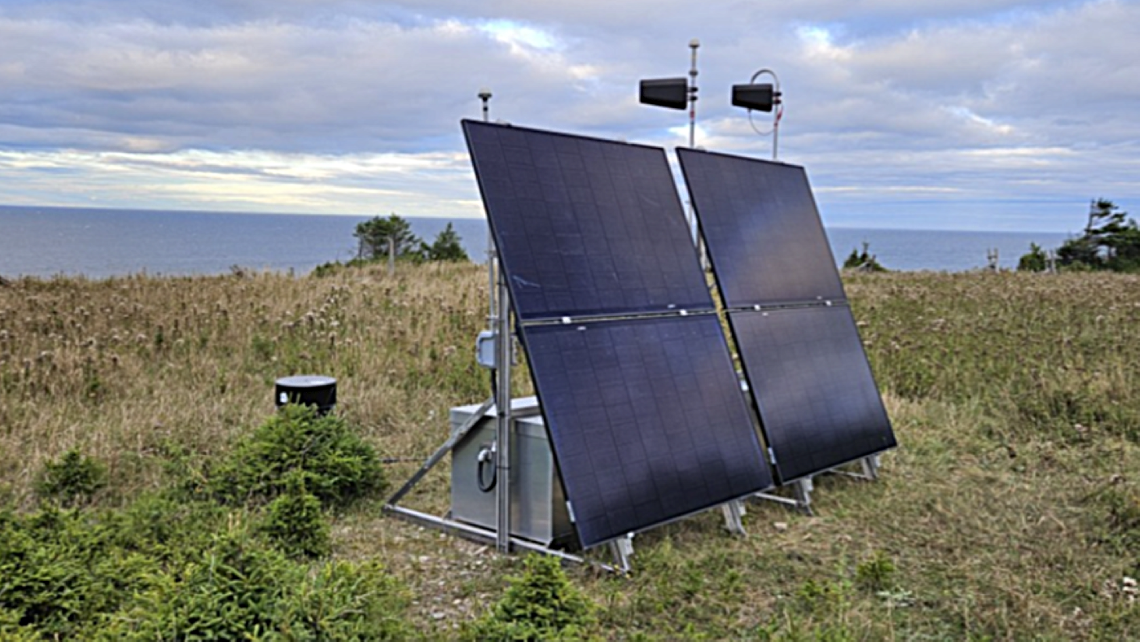
A remote Earthquake Early Warning station in Quebec.
Earthquake Early Warning system, made in Canada
That’s the vision behind Canada’s national Earthquake Early Warning (EEW) system, now operating in British Columbia, Ontario and Quebec.
Its benefits are immediate and can potentially help protect people. "The national system will give advance warning of a few seconds to tens of seconds," says Alison Bird, an earthquake seismologist with Natural Resources Canada (NRCan). "That may not sound like a lot of time, but it’s enough to protect lives and potentially reduce damage."
Alison is part of a small, dedicated team of NRCan scientists and technicians who — working with the help of provincial, territorial and municipal governments, Indigenous Peoples, critical infrastructure operators and other partners — developed the EEW system for use in Canada’s most earthquake-prone regions. The system is composed of regional networks with more than 400 seismic sensors. Using advanced, automated software and the latest technologies, it quickly estimates how severe an earthquake might be and transmits warning alerts of impending shaking.
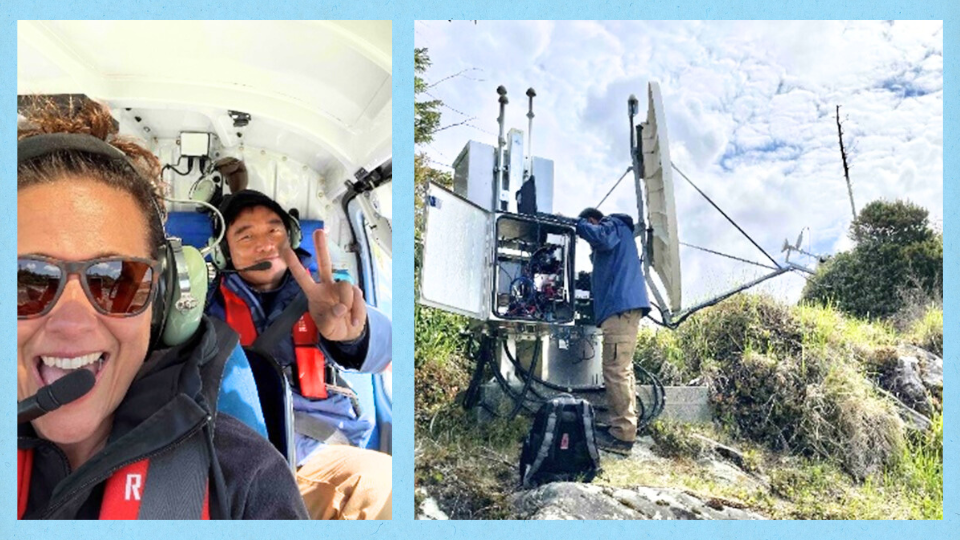
NRCan’s Lisa Nykolaishen and Mingzhou Li on their way to install earthquake early warning stations in B.C.’s North Coast region, where several locations are accessible only by helicopter.
Canada’s major earthquake zones include eastern Ontario and southern Quebec
"Significant seismic risks exist along the Ottawa River valley and the St. Lawrence Seaway," says Alison. "Earthquakes in these regions might not register as high on the magnitude scale as those in British Columbia, but they can cause significant damage, especially to older masonry buildings and poorly reinforced structures. Also, because the Earth’s crust is denser in the east, the seismic waves retain their strength over greater distances and, as a result, impact a larger area. In fact, the earthquake risk in Montreal is about the same as that in Vancouver!"
One of the earliest known records of such an event is the estimated magnitude 7 earthquake that struck the Charlevoix region on the evening of February 5, 1663: records show that chimneys and masonry walls and homes were damaged in Quebec and New England and also suggest that the shaking was felt throughout eastern North America. If a similar size earthquake occurred in this region today, the EEW system would provide precious seconds of warning: approximately 5 seconds for Quebec City, 55 seconds for Trois-Rivières, 80 seconds for Fredericton and 90 seconds for Montreal — in all cases, enough time for protective actions to be taken by people and critical infrastructure facilities.
How the system works
Earthquakes release energy that travels as seismic waves through the Earth’s surface in all directions, much like sound waves or ripples on a pond. The first waves, called primary or P-waves, travel quickly. They’re followed by slower secondary or S-waves, which are generally much more damaging.
To detect these waves, the EEW system relies on sensors, each one about the size of a shoebox. They sense the first P-wave energy radiating from an earthquake’s point of origin and instantly transmit a signal to data centres. Using software from the United States Geological Survey — already proven in the western states of California, Oregon and Washington and adapted for Canadian regions — the system analyzes the seismic data to determine the earthquake’s location and magnitude and to estimate the potential intensity of the shaking. Because the sensors can detect significant earthquakes so quickly — within a few seconds — alerts can reach people before the slower-moving secondary S-waves arrive.
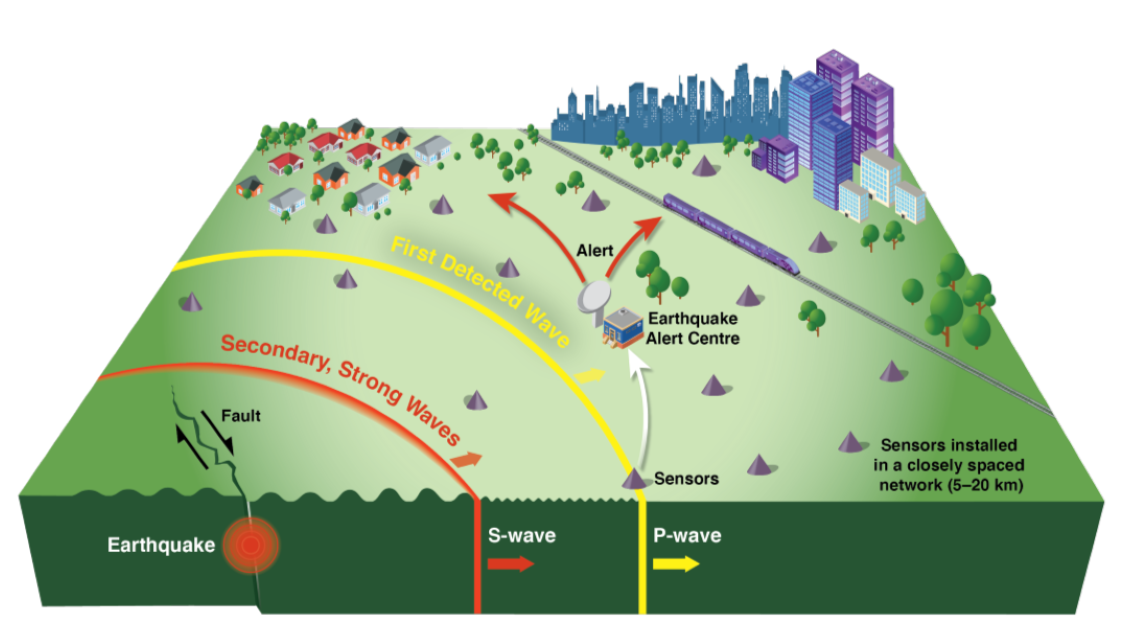
Earthquakes release energy that travels through the earth as seismic waves. Seismic sensors detect the first energy to radiate from an earthquake — the primary or P-wave, which rarely causes damage — and transmit this information to data centres, where a computer calculates the earthquake’s location, its magnitude and the expected ground shaking across the region. This method can provide seconds to tens of seconds of warning before the arrival of the secondary S-waves, which cause the most damage.
Automated alerts could protect thousands of people
Even a few seconds of warning is enough time for people to drop, cover and hold on or, if they’re driving, pull over and apply their parking brake.
More broadly, automated alerts can also help protect buildings, utilities and other infrastructure. "With this system, critical infrastructure operators can have technologies in place whereby the alert automatically initiates protective actions," says Alison. Alerts could prompt a wide range of infrastructure safety systems to respond automatically by, for example:
- slowing or halting trains
- stopping traffic from driving onto bridges or into tunnels
- diverting incoming air traffic
- alerting surgeons to pause surgery
- closing gas valves
- opening fire hall and ambulance bay doors
Recent EEW alerts in action
The system was recently put into action in February 2025, when an alert for a magnitude 5+ earthquake was issued to communities north of Vancouver. The fully automated system functioned exactly as designed: detecting the earthquake, assessing its potential impact and informing Canada’s National Public Alerting System (NPAS), on where to issue alerts on cellphones, radios and televisions advising people in the affected area to take protective actions.
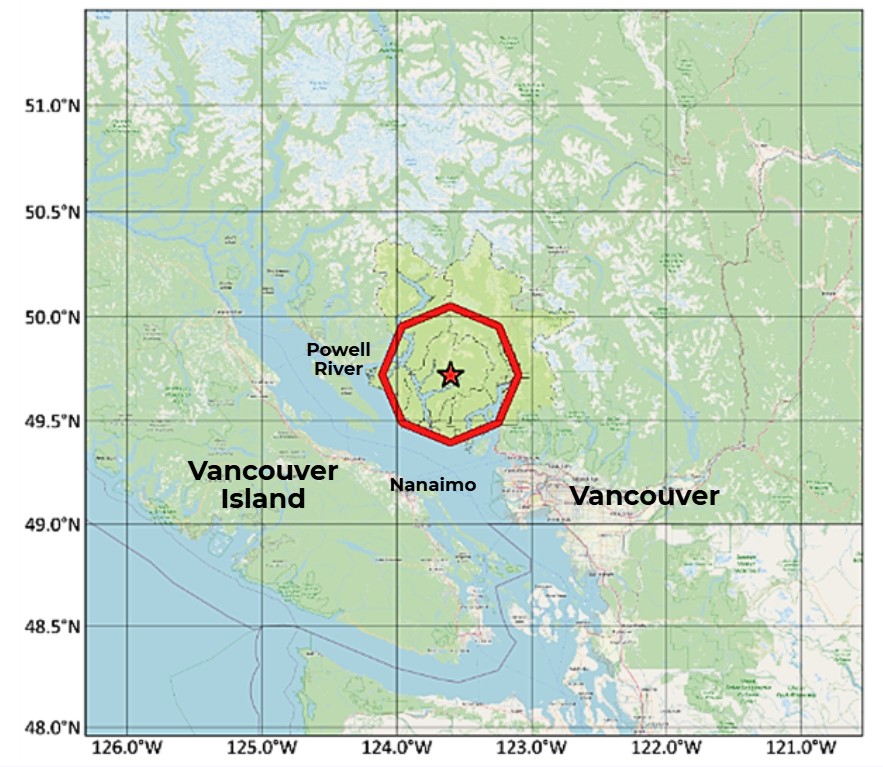
Map of earthquake early warning zone for the February 2025 earthquake.
It’s not a matter of if, but when
For earthquake early warnings to be effective, being prepared to take action in a calm, collected manner is crucial.
"The whole idea is not simply to alert people but to ensure they know the best course of action to take," says Alison. "In stressful situations, it can be hard to think clearly, and it becomes a fight-or-flight reaction. Too often, people try to exit buildings, which is one of the worst things you can do in an earthquake. By practising the drop, cover and hold on technique — like during October’s ShakeOut / La Grande Secousse du Québec earthquake drill — people create the muscle memory that should keep them safer during an earthquake."
Every second counts
Many earthquakes in British Columbia, Ontario and Quebec occur close to populated centres, which means the warning time for nearby communities might be only a few seconds. And in the case of locations very close to the earthquake’s epicentre — known as being within the Late Alert Zone — the warning might arrive after the strong shaking has already begun.
How much warning you receive depends on several factors, including your distance from the earthquake and whether you receive the alert on your private mobile device or through a public radio or TV broadcast. The farther you are from the epicentre, the more warning time you’ll have.
What you can do
If you live in one of Canada’s earthquake zones and receive an EEW alert, always assume that shaking is imminent and take immediate protective actions. Remember this simple piece of advice: drop, cover and hold on. Stay in position until 60 seconds after the shaking stops.
For further information on what to do if an alert occurs — and to learn about provincial and territorial alerting programs or to see whether you can receive National Public Alerting System alerts on your cellphone — visit Alert Ready.
If you’re a member of the media or an educator and would like to learn more, contact us at: sciencecommunications-communicationsscientifiques@nrcan-rncan.gc.ca.
Explore: