
Using AI to assess energy, performance and battery life
May 2026
“This research is about more than batteries: it’s about giving mining operations the confidence and data they need to go electric.” — Zhenhuan Xu, Natural Resources Canada
The seven-second summary:
Battery electric vehicles (BEVs) are transforming mining, but understanding how they use energy and how efficiently they might perform underground is an ongoing challenge.
At CanmetMINING-Sudbury, researchers are using artificial intelligence (AI) to advance work on energy consumption, regeneration and battery performance in these vehicles.
The bigger picture
Canada is a world leader when it comes to underground BEV adoption, but there’s little data on how these vehicles actually perform in real-world conditions. That’s why scientists Zhenhuan Xu and Augustin Marks de Chabris are using AI to model vehicle behaviour during mining operations so they can:
- Predict energy regeneration:
- AI helps estimate how much energy BEVs regenerate during a duty cycle, when braking sends energy back to the battery.
- Estimate battery degradation:
- Since batteries lose capacity over time, the scientists are examining degradation over a battery’s single duty cycle and its full lifespan.
- Analyze performance in harsh conditions:
- AI helps to assess how vehicles perform in extreme mining conditions.
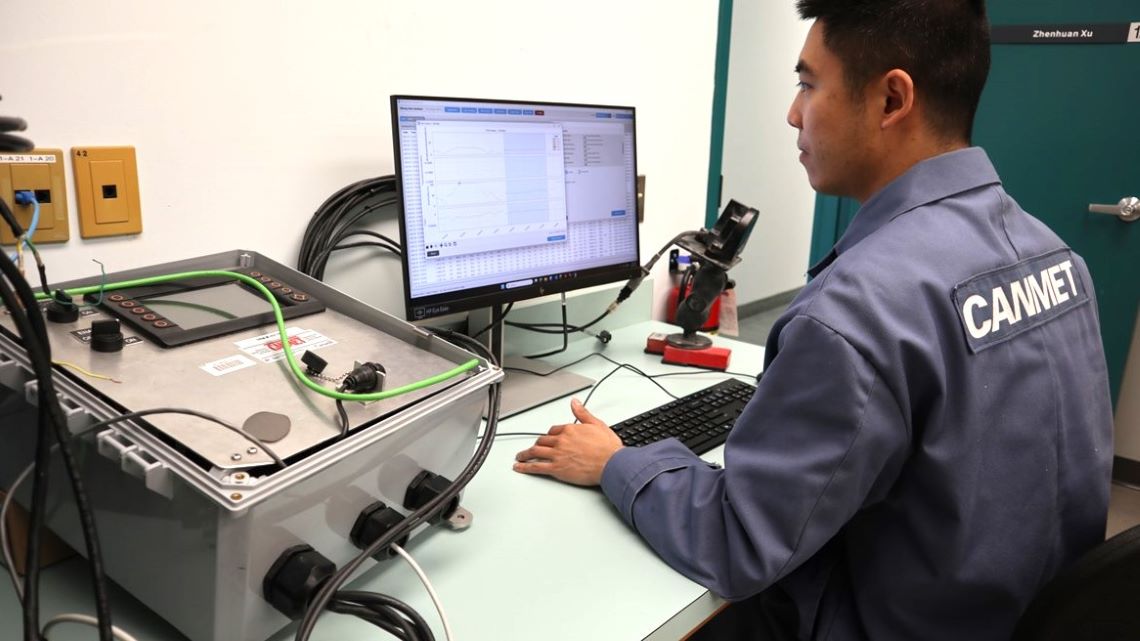
Zhenhuan Xu, scientist with CanmetMINING, analyzing battery life performance.
Extreme mining environments
This research is critical because real-world data is limited. Most battery studies have been based on controlled lab environments and focused on traditional on-road vehicles, which are typically used for short periods and then parked, in what’s known as a stop-and-go cycle. Mining vehicles, on the other hand, undergo a duty cycle during a work shift, which means a vehicle will be continuously running for hours — driving up and down grades, going around corners and stopping and starting.
As a result, studies using traditional on-road vehicles don’t reflect the harsh conditions found underground, such as high humidity, extreme temperatures and the continuous use of heavy-duty mining vehicles like haul trucks and loaders. These real-world conditions impact the time between charges and overall battery life.
To address this gap in our knowledge, Zhenhuan and Augustin feed AI models with data like:
- vehicle speed
- battery charge
- terrain grade
With this information, the models then estimate:
- how long a vehicle can operate before recharging;
- how much energy a duty cycle requires;
- how much energy can be regenerated; and
- how long until the battery reaches 80 percent of its original capacity, marking the end of its first life.
To simulate harsh underground conditions, researchers at CanmetMINING are designing unique, purpose-built environmental chambers so they can expose batteries to extreme temperatures while generating data on how they perform and degrade in these environments.
“Understanding how batteries perform underground is key to helping mines plan, operate and transition confidently to an electric future,” says Augustin. “As the old saying goes, ‘If you can’t grow it, we have to mine it,’ making sustainable innovation in mining essential.”
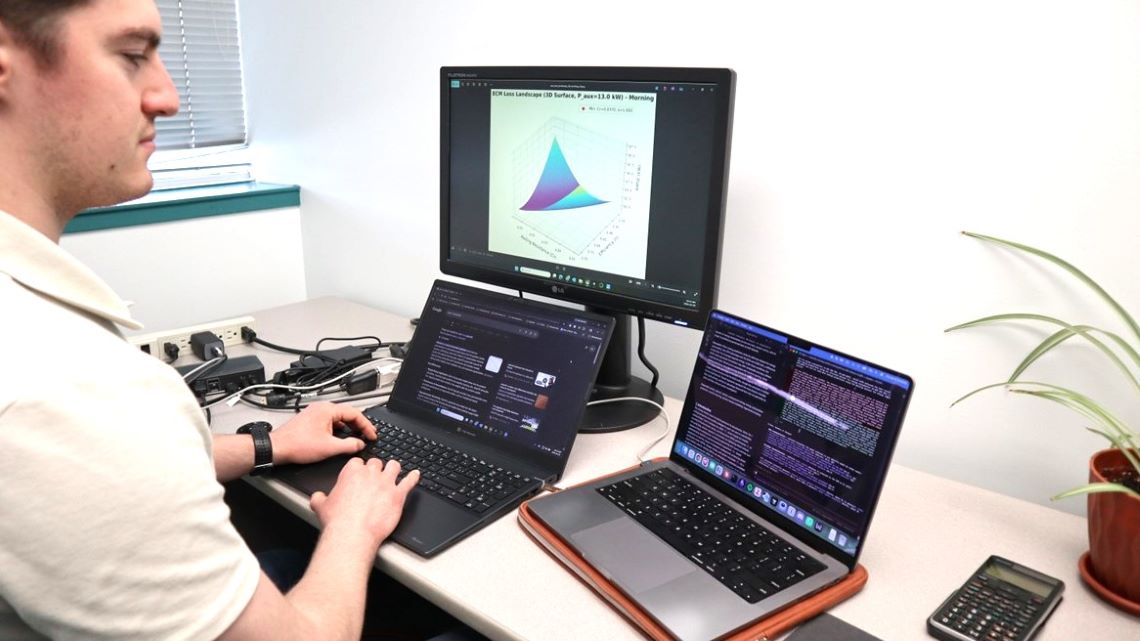
Researcher Augustin Marks de Chabris analyzing his AI battery research.
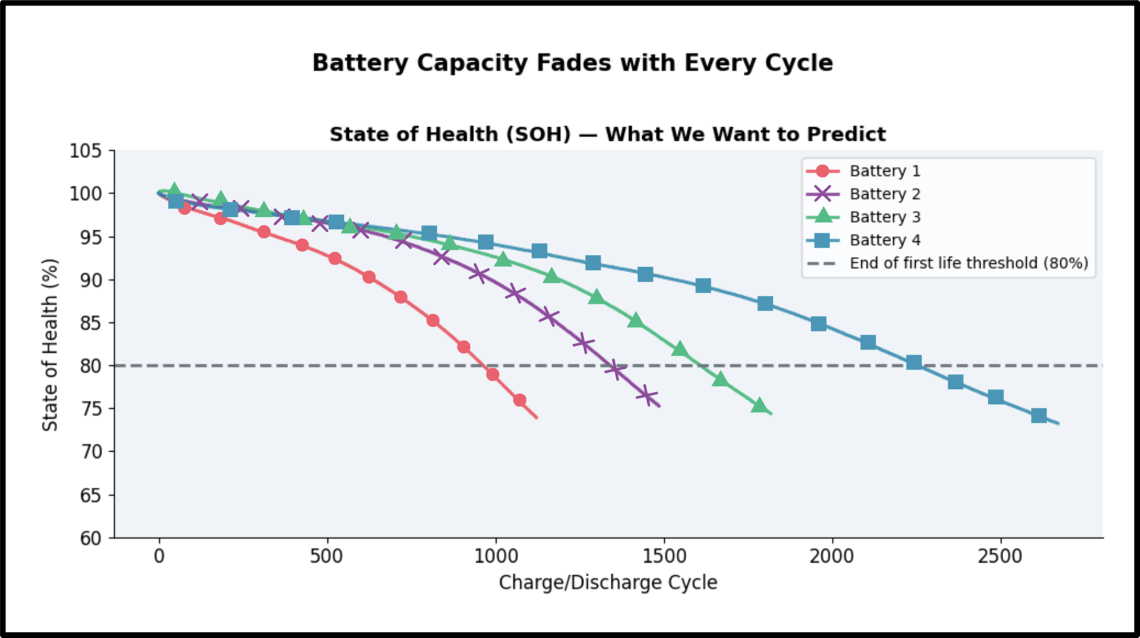
Battery capacity decreases over time as it goes through repeated charge and discharge cycles
How much energy?
Understanding energy use is essential in mining. “Even under identical conditions, batteries of the same type can still age at different rates,” Zhenhuan explains. “An AI-based model learns from each battery’s own history, capturing the differences that are difficult for traditional empirical or physics-based models to reflect.”
Operators need reliable estimates of how much energy is required to extract materials efficiently while also planning for an electric future. While high-quality, real-world battery data remains difficult to capture, AI is helping these NRCan scientists better understand how batteries perform over their lifespan underground.
For more information about this research, contact Simply Science at: sciencecommunications-communicationsscientifiques@nrcan-rncan.gc.ca