
Coal collected decades ago is helping today’s researchers answer new questions
August 2026
Pull open one of the wooden cabinets stored beneath the Geological Survey of Canada (GSC) research centre in Calgary and you’ll find hundreds of carefully labelled coal samples. Some were collected decades ago to support research into fuel resources. Today, scientists are studying these same samples again, but now with the advantage of new technologies. And they’re looking for answers to new questions, ones on matters of urgent importance: critical minerals, energy security and Canada’s energy future.
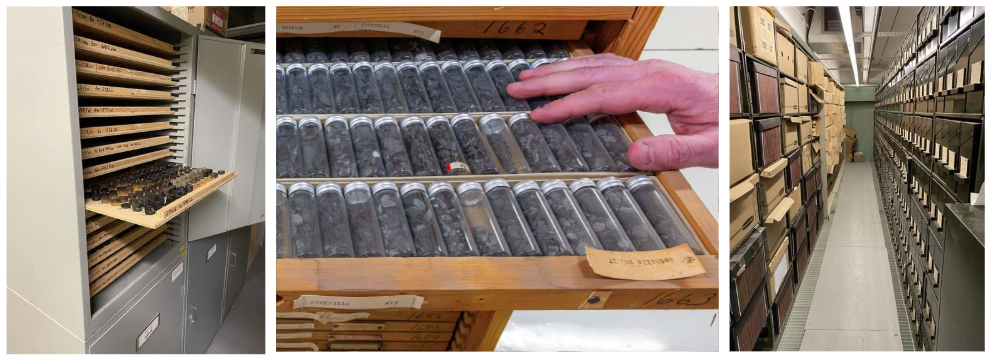
Carefully catalogued, preserved and currently being digitized, GSC Calgary’s geological samples provide researchers with physical records of Canada’s geology that can be reanalyzed to answer new scientific questions.
“The most striking thing about these collections is that the answers sometimes arrive before anyone thinks to ask the question,” says Omid Haeri Ardakani, a geochemist/ petrologist who studies the composition and formation of rocks.
He points to research from the 1980s and 1990s that measured the rare earth element content in coal samples from areas like the Alberta Foothills or the B.C. Interior. Researchers at the time wanted to understand how these elements behaved during coal formation and combustion.
“They weren’t thinking about batteries or magnets for wind turbines, because at the time there was no reason to,” Omid explains.
In other words, the measurements taken then provided answers only to the particular questions of the day. But these same resources can now be used to address the questions of our rapidly changing world.
Old samples, with the answers to new questions
Coal samples are especially revealing because they can contain trace amounts of elements that are now considered critical minerals. Modern analytical tools can detect and measure these elements in ways that weren’t possible when many of the samples were first collected.
The fresh results that can arise from the application of new tools and technologies are one example of how ancient collections can continue to generate new and useful discoveries for the present. “These measurements from the 1980s and 1990s are now an inventory of a resource nobody knew they were cataloguing, and the physical samples are still on the shelf,” Omid says.
Collecting drill cores can be costly, and the sites of historic samples have often been re-mined, reclaimed or built over. That means the samples stored in Calgary may be the only physical record collected that remains from that particular layer of rock.
The ability to re-examine existing samples with modern instruments allows researchers to ask new questions without the costs of drilling again or disturbing the landscape. “Every well-curated sample is an option on a question nobody has thought to ask yet,” says Omid.
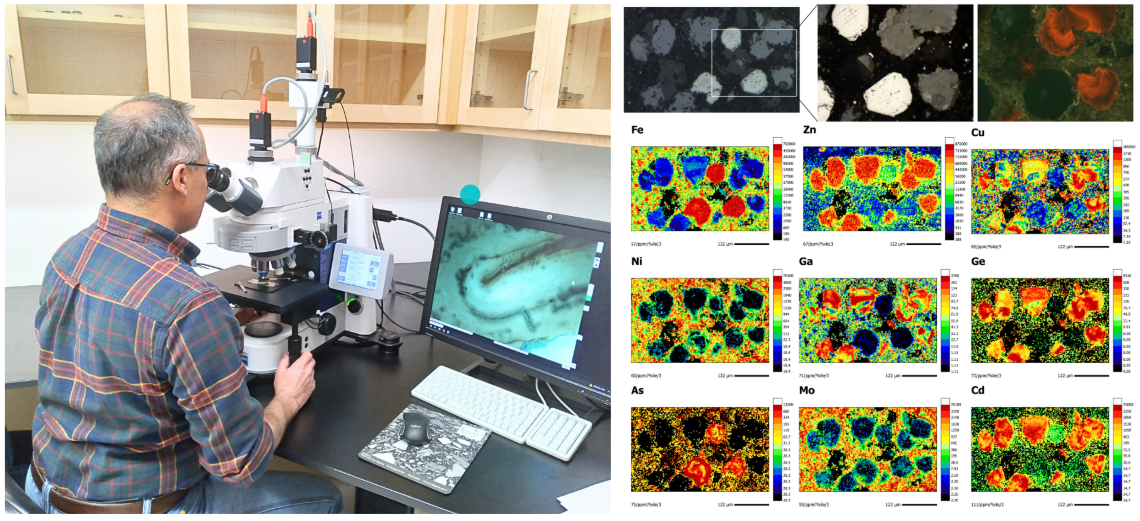
GSC Calgary combines extensive geological collections with advanced laboratory equipment, allowing researchers to revisit samples collected decades ago and examine them in new ways.
Old samples, new tools
Researchers at GSC have always asked sophisticated questions of geological samples, but the analytical tools and techniques available decades ago had their limits. As a result, they often had to draw conclusions indirectly: for example, a sample might be dissolved in a series of increasingly strong solutions so scientists could study what materials were released at each stage.
The outstanding abilities of today’s instruments and methods allow researchers to get a much clearer and more detailed picture. Laser ablation mass spectrometry can vaporize a spot narrower than a human hair to reveal a sample’s full elemental fingerprint; micro-X-ray fluorescence can be used to map a polished sample to show which minerals contain valuable elements; and automated electron microscopy can identify hundreds of thousands of individual grains and show how they fit together.
The result is science that is more reliable and more useful. “What was once a careful deduction is now a direct observation,” says Omid. “And that changes how confidently we can judge whether an element could be extracted, which is ultimately the question that decides whether a resource is real.”
Making the collection easier to access
The simple preservation of samples is only part of a modern scientific collection. Researchers also need to know exactly what is in the collection and where to find it.
“These collections allow researchers to save time and resources by accessing valuable previously collected and catalogued samples that can be re-purposed for current priorities, such as critical minerals and clean energy,” says Krista Boyce, the geological data specialist who is leading the digitization of the GSC samples collection to increase the accessibility, usefulness and value of the data they provide.
A team is busy organizing and curating about 50,000 historic coal samples so they can be reassessed with today’s focus on critical minerals. Researchers are using this evidence to study fundamental questions — on such matters as mineral composition, trace elements and the formation of deposits — without having to go in the field.
The entire database in Calgary holds more than 600,000 records, including the coal samples. These records, including sample information and associated analytical data, can be searched and accessed quickly and efficiently.
Supporting the full spectrum of energy research
The Calgary collection also contains drill cutting and geological core samples from the field. Together, these materials preserve evidence about Canada’s geology that can support both current research and questions that may emerge decades from now.
The collection can also support research into emerging energy technologies, such as carbon capture and storage, geothermal energy and underground hydrogen storage.
“Collections are an essential part of NRCan research activities and science-based policy and decision-making processes,” says Richard Fontaine, manager of Field Collections. “Many of NRCan’s collections act as historical benchmarks at the field level and also as a reconnaissance tool, providing support to research and development efforts for which the field-collecting cost is becoming very expensive, especially in the Arctic.”
Scientists began collecting geological samples as far back as 1842 — 25 years before the creation of Canada and long before the concept of critical minerals existed. Preserving, digitizing and documenting these samples collected almost two hundred years ago ensure they remain safe and available for future generations of researchers.
By the numbers:
GSC Calgary manages one of Canada’s largest and most complex geoscience collections, and the dimensions of these holdings are vast:
- Approximately 25 million drill-cutting samples from more than 107,000 wells
- About 48,000 boxes of core representing 705 wells
- Nearly 287,000 catalogued field sample lots
- More than 28 million individual specimens
A resource for the future
As Canada advances its critical minerals strategy and energy diversification, the importance of trusted, long‑term geoscientific data has never been clearer.
“The geoscientific knowledge housed here — both in our labs and our collections — helps Canada meet its energy needs, support economic growth and make informed decisions about how we develop and manage our resources,” says GSC Calgary executive director Kim Picard. “Our people, our energy research and our world‑class labs and sample repositories are foundational to helping drive Canada’s energy future forward.”
The scientists who collected many of these samples couldn’t have predicted today’s interest in critical minerals or the ongoing shift toward lower-carbon energy systems. Yet the materials they gathered stand ready to continue to provide answers to new questions.
GSC Calgary’s geological collection is part of the GSC’s Earth Materials collections, which include more than 28 million samples maintained in facilities across the country. Together, these collections preserve Canada’s geological heritage while continuing to support scientific discovery for generations to come.
If you’re a member of the media or an educator and would like to learn more about NRCan’s GSC geological collections, contact us at: sciencecommunications-communicationsscientifiques@nrcan-rncan.gc.ca.