
Passion and Patience — A geologist in the field.
By Matthew Gutsch for Natural Resources Canada and Simply Science
March 2026
Makram Hedhli was called to the earth sciences, specifically geology, from an early age. You could even say he was moulded by them, as the world and environment around him literally shaped his love and connection to the Earth and the stories contained in its rocks.
He grew up in near the mountains and sea — the reefs, beach dunes, shells, ripples and life — of Tunisia, where the Mediterranean Sea meets the Atlas Mountains. He was always fascinated by TV documentaries about how our planet evolved and the amazing life forms that once existed.
By the time he went to university and took one geology course, everything clicked.
Simply Science sat down with Makram to learn more about his scientific curiosity, how geology underpins economic activity and his commitment to helping manage natural resources responsibly — for today and for generations to come.
You say everything clicked at university? What pieces fell into place?
I realized that those mountains were once part of an ancient sea floor and the fossils we studied were the record of that life history. Suddenly, what I had only seen on TV became something I could physically hold, study and understand. From that moment, it was a no-brainer: I knew I wanted to understand how the Earth works.
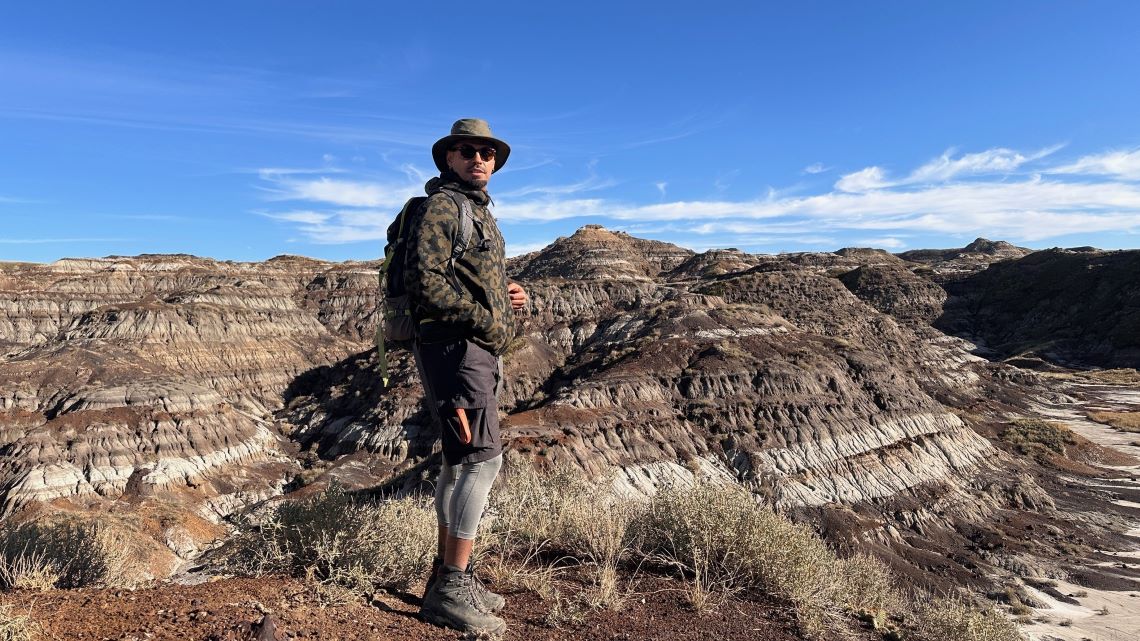
Makram finds inspiration in the world around him through his work as a geologist, but he is always drawn to what he sees close to home, here, in the Western Canadian Sedimentary Basin.
What drew you to Canada? What was your journey to Calgary like?
I moved to Montreal, where I finished my undergraduate and master’s degrees with a focus on the geochemistry of modern fluvial environments — rivers and the landscapes they shape.
But my scientific curiosity and passions were more aligned with sedimentary basins and ancient marine environments.
So, I applied for a PhD at the University of Calgary, where I had the chance to choose my own research topic. I wanted to study the western margin of North America, where the best and most interesting sedimentary rocks are found. It’s also a region that combines great scenery with an incredible rock record.
After finishing my PhD, it was an easy decision to keep my focus right here in my own backyard: the Western Canada Sedimentary Basin.
Plus, the very foundation of our economy — and, really, the future of the next generation —depends on how we manage and develop our natural resources. I wanted to contribute to that with my knowledge and help ensure we do it responsibly and sustainably.
What makes studying sedimentary geology and the Western Canadian Sedimentary Basin unique compared with other geology?
Fundamentally, I think the Western Canada Sedimentary Basin [WCSB] is a fascinating basin. It’s been around for about half a billion years, it’s the second-largest sedimentary basin on the planet, and it’s one of the most well-characterized basins from a geological perspective. Canada is also one of the few countries where all that geological data is publicly available.
In most parts of the world, scientists struggle with not having enough data. But in the WCSB, it’s the opposite: we have so much information to work with!
And yet, despite all that, the basin still holds many unanswered questions and plenty of untapped resources waiting to be explored.
What questions are you looking for answers to?
Fundamentally, I’m interested in how the Earth’s crust has moved, both horizontally and vertically, and how those movements have shaped the sedimentary record. From that record, we can learn so much, about past climates, sea levels and even ancient life.
Then there’s the applied side, which connects directly to energy and resource development. By understanding how the rocks formed and what they record, we can better predict where to find things like reservoirs, source rocks and heat for geothermal energy, as well as precious metals and critical minerals — all key elements for a sustainable energy future.
Answering those questions is really at the core of what we do as geologists. We live on this incredible planet and interact with it every single day through the air we breathe, the water we drink and the resources we use. Our goal is to better understand how the Earth works so that we can take care of it while also meeting the needs of our own species. It’s about finding that balance: learning from the planet so we can live responsibly with it.
What stories does the Western Canada Sedimentary Basin hold, and what do they mean for people in Canada and globally?
The WCSB is vast, rich and full of opportunities, and I’d say it’s the most generous land in Canada. It hosts just about every resource you can imagine, from petroleum to minerals, from the pore space we use to store carbon to the heat we can harness for energy.
But all those resources come from the area’s incredible geological past: a history that includes catastrophic events, mass extinctions, ice ages and even greenhouse periods. So, when we study it, we’re not uncovering just one story, we’re uncovering many.
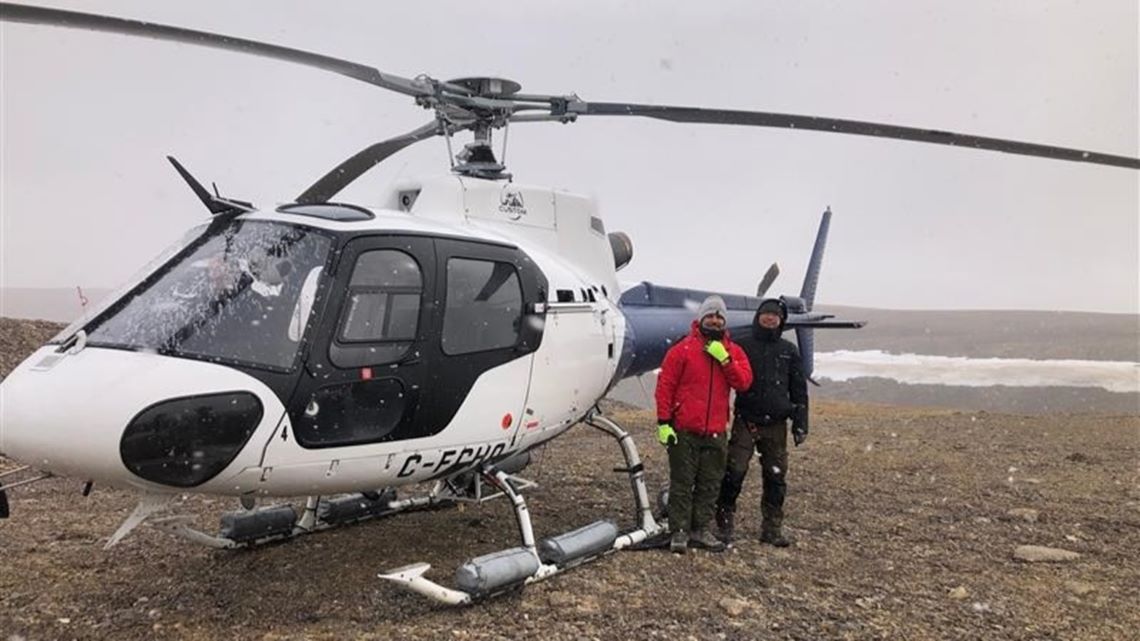
Makram and his colleague Wanju Yuan on Cornwallis Island in the Canadian Arctic at the end of a long day spent sampling for geothermal resource assessment.
What does a typical field research day look like?
Our standards in the field are simple: if you find a section or an outcrop that’s in good shape and not too altered or changed from its original state, that’s already a win. And if the weather cooperates, even better!
You spend the day studying the rocks and making observations, and by the end of it, you often leave with more questions than you came with.
But that’s the beauty of geology: every time you uncover something new, it leads you to something even more intriguing to explore next. It’s hard work, but it’s incredibly rewarding: you’re outdoors, surrounded by amazing landscapes and literally seeing the history of the Earth written in the rocks.
What are some of the biggest challenges facing geologists today?
I think the biggest challenges in geology today are like those in any fundamental science: we’re moving away from hands-on science toward data-heavy approaches.
We sometimes think we know a lot, but there’s still so much we don’t understand. Over time, we’ve drifted away from some of the foundational sciences — things like paleontology, palynology or biostratigraphy — and we’ve started relying more on digital tools. Those tools are powerful, but the challenge is that the data can often be biased or incomplete. In some cases, it takes a lot of effort to go back to the basics and re-examine the real rocks and fossils.
Another big challenge is how geology is perceived and presented. I think people often underestimate how important basic geological knowledge is, whether it’s to mitigate risks like earthquakes in Vancouver, to manage land use wisely or to reduce land abuse or degradation. Geology underpins all of that.
What excites you about the future of geology?
Geology has always stood at the foundation of major economic revolutions, from coal and steam engines, the big oil and gas discoveries and thermal engines and petrochemical industries to electrical power–generation hydro-dams. At the heart of these movements is geological knowledge. Geologists find the raw resource first, then technological advancements make it possible to harness it.
For instance, we’re currently living in an economic revolution requiring new resources — critical minerals and other materials to build batteries for electric engines, which is a priority across governments worldwide. So, there’s plenty of work ahead.
Also, it’s exciting that we’re already exploring other planets, like Mars.
Geologists will always be at the forefront of exploration, studying substrates and the conditions that support life, whether on our planet or beyond, and that’s what excites me the most.
What insights would you share with someone considering a career in geology?
Geology is a world of its own. As a career, it can be incredibly rewarding.
And I’d also say be curious. Curiosity is what drives me. Whether you’re in academia or research, the key is to make sure you have enough curiosity. Wanting to find answers drives everything we do, from understanding Earth’s past to exploring its resources and even beyond.
Following the science
Makram has travelled the world with passion and patience, unearthing the stories locked within Earth’s rock layers. Geology helps us make sense of the ground beneath our feet, where we live, work and play, and many of the great advances in human history have only happened once a geologist has laid the groundwork. From tapping into geothermal and hydrocarbons to power the Industrial Revolution to a lonely remote-controlled rover collecting rock and sediment samples on Mars, geology continues to drive our future forward.
If you’re a member of the media or an educator and would like to learn more about Makram’s research or read his latest paper, contact us at: sciencecommunications-communicationsscientifiques@nrcan-rncan.gc.ca.
Discover more:
Geological Survey of Canada
Geoscience: Labs and the earth material collection
Simply Science: Geosciences