
Overview of the land tenure process
A licence is required to make use of the seabed for offshore renewable energy activities. These licences are awarded through a competitive land tenure process, administered by the Offshore Energy Regulators, in accordance with the Accord Acts. The land tenure process has been designed to ensure the responsible and sustainable development of offshore wind energy projects.
For a visual representation of the land tenure process, please email offshorerenewables-renouvelablesextracotieres@nrcan-rncan.gc.ca
Accord Acts offshore renewable energy land tenure process
- Regional Assessment (RA) or Strategic Environmental Assessment (SEA)
- identify optimal areas for future projects
- identify data gaps relevant to optimal areas, and
- provide recommendations on mitigating potential impacts from projects
Governments support the implementation of, and consider findings from, an RA or an SEA to:
Opportunity for public engagement in this step.
- Wind Energy Area (WEA) designation
Based on findings and recommendations from an RA or SEA, governments evaluate findings, identify and engage on proposed WEAs and then designate WEAs.
Governments may use previous RAs/SEAs or new RAs/SEAs to identify WEAs in the future.
Opportunity for public engagement in this step.
- Strategic Direction from Ministers
Ministers provide joint direction to Regulator to the design and implement a Call for Information process. Details could include WEA(s) to be used to identify licence areas, timelines for the Call for Information, Prequalification Criteria, Call for Bids Criteria, and the purpose for the electricity.
- Call for Information and Prequalification
Regulator engages with stakeholders, fishers, and Indigenous groups on location(s) of potential parcel(s) within WEAs, and proposed criteria and assessment approach used in future Calls for Bids.
Regulator administers a prequalification process to identify eligible companies that can participate in a Call for Bids.
Opportunity for public engagement in this step.
- Recommendation to make a Call for Bids
Regulator makes a recommendation to Ministers to make a Call for Bids. The recommendation will outline the details of the Call for Bids, including bidding criteria and how it will be assessed, terms and conditions for a submerged land licence, and location(s) of parcel(s) that may be available for bid. This is informed by feedback obtained through the Call for Information process.
- Ministerial decision on Call for Bids recommendation
Ministers jointly decide on the Regulator’s recommendation. Ministers’ decisions are made public.
- Call for Bids
Regulator administers a public Call for Bids for developers to bid on identified parcel(s) and the associated submerged land licence(s) in line with its recommendation. As part of its responsibilities, the Regulator also communicates with interested parties to share relevant information and field questions.
- Recommendation to issue submerged land licence(s)
Regulator makes a recommendation to Ministers to issue submerged land licence(s) to the winner(s) of the Call for Bids.
- Ministerial decision on submerged land licence(s)
Ministers make a decision on the Regulator’s recommendation. Ministers’ decisions are public.
- Issuance of submerged land licence(s)
Regulator issues submerged land licence(s) to winner(s) of the Call for Bids. A submerged land licence provides the exclusive right to develop a project in the licence area. It does not allow any work or activity to take place. Developers must first apply for a project authorization under Part 3 of the Accord Acts.
The Accord Acts set out the formal responsibilities of the Regulators and governments in the land tenure process and include timelines for key decisions to support timely and effective decision-making. In certain circumstances, Ministers may also direct the Regulators to administer a land-tenure process for offshore renewable energy projects that are not subject to a Call for Bids where the selection of a project does not warrant a competitive process, such as research-related projects or transmission lines.
Engagement, and consultation where the duty to consult Indigenous peoples has been triggered, is built into the entire process to ensure input and feedback received from Indigenous peoples, the public, and stakeholders can inform the path forward on areas, recommendations, and decisions.
Wind Energy Areas
The identification and designation of Wind Energy Areas (WEAs) in the jointly managed offshore areas is an important step in the land tenure process for offshore wind projects.
WEAs are intended to be large, contiguous, and suitable areas of the offshore where Calls for Bids for offshore wind projects may occur. WEAs will be jointly designated by governments, following a public comment period. Designating a WEA does not necessarily mean that offshore wind development will occur in that area, nor does it mean the entirety of a WEA will be subject to offshore wind development. Rather, WEAs are a planning tool to help guide future development.
In March 2025, Natural Resources Canada and the Nova Scotia Department of Energy jointly published a discussion paper to support a 30-day public engagement period to seek feedback on proposed WEAs.
In July 2025, following review of public feedback, four WEAs were jointly designated by the Ministers of Natural Resources Canada and the Nova Scotia Department of Energy: French Bank; Middle Bank; Sable Island Bank; and Sydney Bight.
For more information on the designated WEAs and how they may support a future Call for Bids, please visit: Governments Designated Offshore Wind Energy Areas
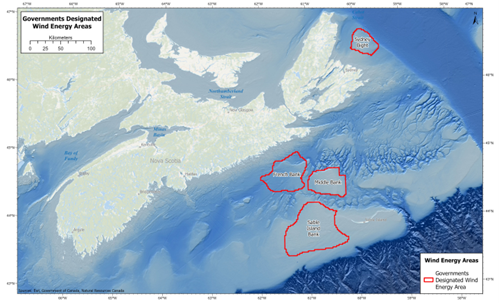
Image Description: A map of designated Offshore Wind Energy Areas off the coast of Nova Scotia
Strategic Direction:
On September 18, 2025, the Government of Canada and the Province of Nova Scotia jointly issued Strategic Direction to the Canada Nova Scotia Offshore Energy Regulator (CNSOER). Strategic Direction outlines governments’ expectations and priorities for a Call for Bids and directs the Regulator to move forward with the next steps – Prequalification and Call for Information – towards making a Call for Bids.
To access a copy of Strategic Direction : https://cnsoer.ca/renewable-energy/offshore-wind-land-tenure-process-ns25-1r/offshore-wind-strategic-direction
The Strategic Direction supports the Government of Canada’s commitment through the Major Projects Office (MPO) to advance work on several strategies for projects that could be transformative for this country, but require further development, including Wind West Atlantic Energy. Governments are targeting the issuing of licences for up to 3000 megawatts distributed across three Wind Energy Areas – Sydney Bight, Middle Bank, and French Bank – and have ambitions to reach 5000 megawatts in the near-term.
To access MPO Initial Projects under consideration: Projects and Transformative strategies map - Major Projects Office - Canada.ca
To access Wind West Strategic Plan: https://novascotia.ca/wind-west/