Details
- Publication date
- Author(s)
Natural Resources Canada - ISBN
978-0-662-41664-7 - Cat. No.
M144-339/2026E-PDF
Table of Contents
- Introduction
- Policy instruments for energy efficiency in the industrial sector
- Canada in the global context
- Evidence-based findings for Canada
- Scaling up proven industrial energy efficiency measures to improve competitiveness
- Conclusion: Advancing industrial competitiveness through energy efficiency
- Case studies
- Success Story #1: Lethbridge Iron Works | 2% facility level energy savings
- Success Story #2: Davey Textile Solutions | 12% facility level energy savings
- Success Story #3: Keyera Gas Plant | 1% facility level energy savings
- Success Story #4: Trans-Atlantic Preforms | 35% facility level energy savings
- Success Story #5: Cemtol Manufacturing | 11% facility level energy savings
Text version
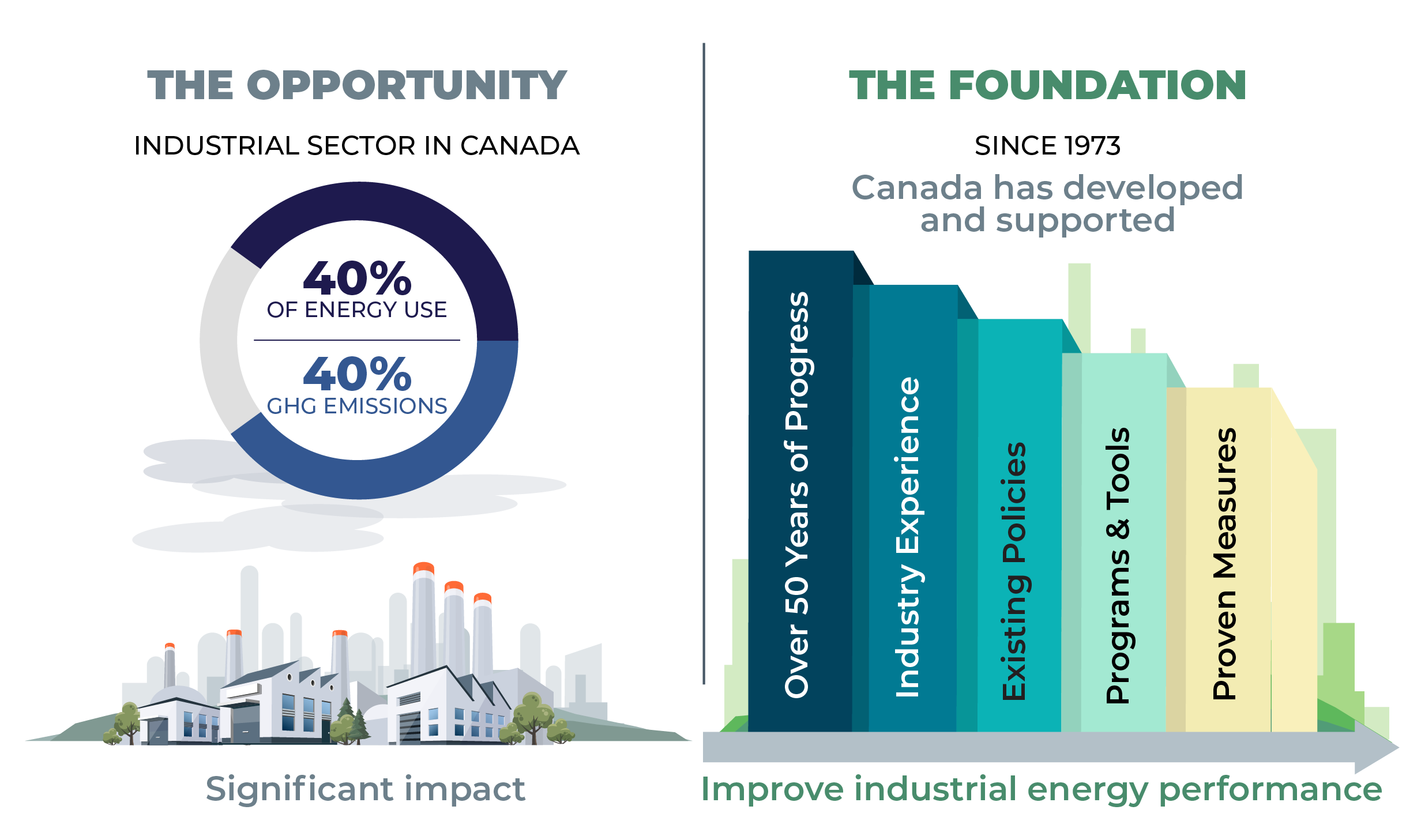
The infographic is split into two panels.
The left panel, titled "The Opportunity — Industry in Canada," features a donut chart showing two figures: industry accounts for 40% of Canada's energy use and 40% of energy-related greenhouse gas emissions. Below the chart, a stylized industrial skyline with smokestacks sits under the caption "Significant impact."
The right panel, titled "The Foundation — Since 1973," is introduced by the line "Canada has developed and supported." Five vertical bars of descending height represent the building blocks of Canada's industrial energy efficiency foundation, labelled left to right: Over 50 Years of Progress, Industry Experience, Existing Policies, Programs & Tools, and Proven Measures. A horizontal arrow beneath the bars points right with the caption "Improve industry energy performance."
Together, the two panels convey that the industrial energy opportunity in Canada is large and that the foundation to act on it is already in place.
Introduction
Canada benefits from a long-established energy efficiency framework that has supported industrial energy performance and competitiveness for decades. Since 1973, the Government of Canada, through the Office of Energy Efficiency (OEE) and its predecessors, has developed and delivered energy efficiency policy, programs, tools and guidance to support Canadian industrial facilities improve their energy performance. The imperative ahead lies in leveraging this robust policy framework to scale up and strengthen industrial competitiveness through energy efficiency to respond to the complex and evolving dynamics of an increasingly interconnected and uncertain global environment.
Canada’s established approach to supporting energy efficiency improvement reflects a distinct policy context compared to other jurisdictions as it operates within a federated system where energy efficiency is a shared responsibility between the federal, provincial and territorial governments.
The framework that underpins industrial energy efficiency improvement in Canada combines regulations and standards, programming, and continued industry collaboration. Canada’s existing regulatory measures ensure a stable efficiency baseline is adhered to, while federal-provincial programming and collaboration create pathways for continuous energy efficiency improvement. Together, these elements position energy efficiency as a practical, near-term lever that can be scaled to improve productivity, reduce operating costs, strengthen operational reliability, support product quality improvements, and ultimately enhance industrial resilience and competitiveness.
Further, Canada’s industrial sector operates within a unique structural context shaped by its resource-based economy, vast geography, and exposure to global markets. Energy-intensive resource extraction activities contribute to the country’s high baseline energy demand across industrial operations. In 2023, the industrial sector accounted for approximately 40% of Canada’s total energy use (~3,738 PJ of 9,093 PJ) and was responsible for about 40% of energy-related greenhouse gas (GHG) emissions (175.7 Mt of 473.1 Mt CO₂eq).Footnote 1
At the same time, Canadian industrial producers compete in internationally traded markets, where margins are shaped by global commodity prices, exchange rate dynamics, and evolving policy frameworks. These pressures are further influenced by structural factors such as geography and industrial composition, which can increase cost pressures such as fuel, heating, infrastructure and equipment charges for some sectors.
In this context, scaling up proven energy efficiency practices through regulations, incentives, information sharing, and industry collaboration represents a strategic and pragmatic pathway to maintaining and enhancing industrial competitiveness.
While energy efficiency and decarbonization are often interconnected, this paper focuses specifically on the role of industrial energy efficiency in improving productivity and enhancing industrial competitiveness. References to emissions reductions, electrification, or clean technologies are included where relevant but are not the primary focus of this paper.
Policy instruments for energy efficiency in the industrial sector
Text version
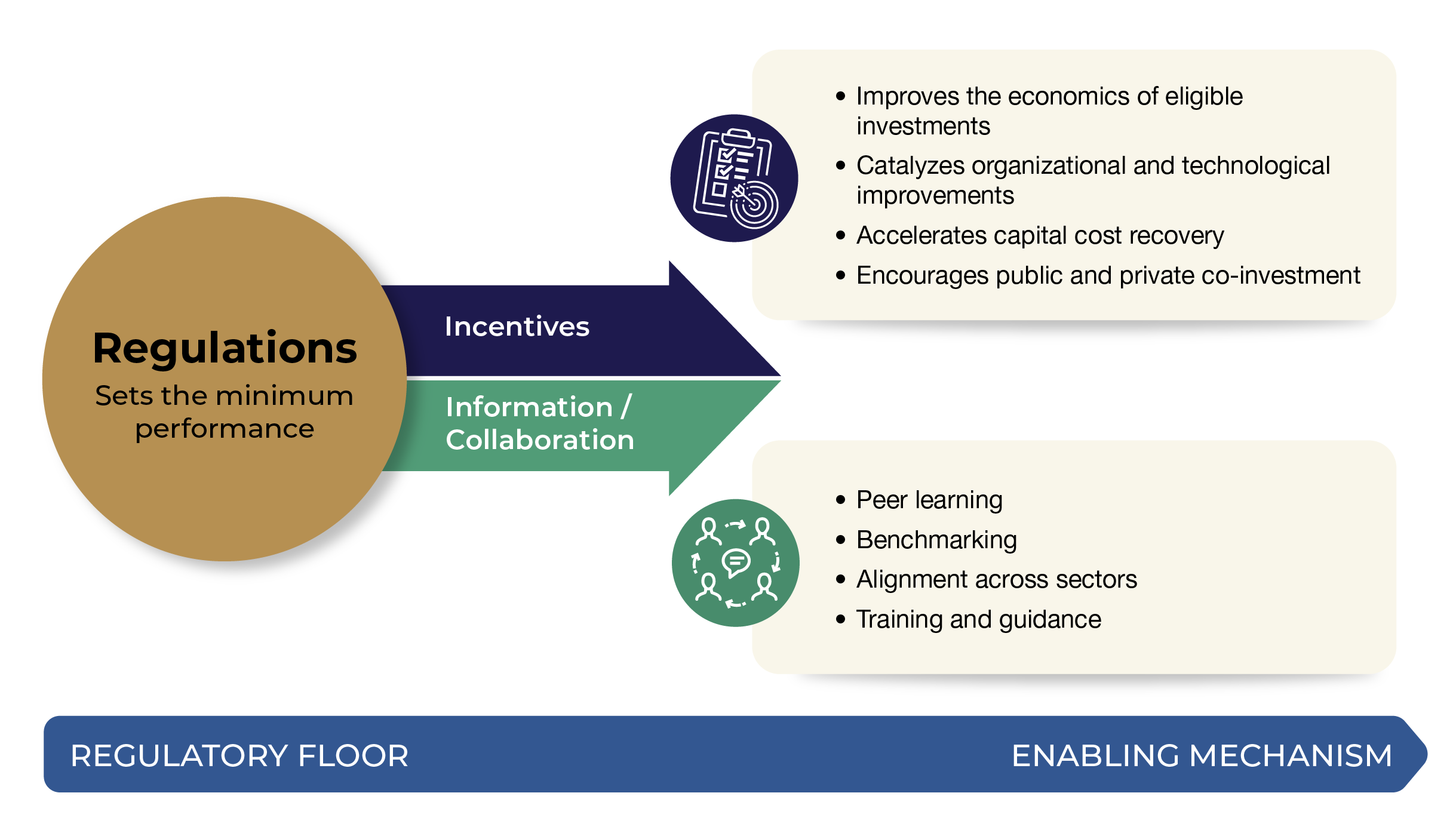
The diagram presents one integrated policy system with a regulatory baseline and two parallel enabling mechanisms.
On the left, a large gold circle is labelled "Regulations — Sets the minimum performance." Two arrows extend from this circle to the right, representing parallel enabling mechanisms rather than sequential steps.
The top arrow, in dark blue, is labelled "Incentives" and points to a panel with a clipboard-and-target icon. The panel lists four functions: improves the economics of eligible investments; catalyzes organizational and technological improvements; accelerates capital cost recovery; and encourages public and private co-investment.
The bottom arrow, in green, is labelled "Information / Collaboration" and points to a panel with a peer-network icon. The panel lists four functions: peer learning; benchmarking; alignment across sectors; and training and guidance.
A horizontal banner runs beneath the diagram, labelled "Regulatory Floor" on the left and "Enabling Mechanism" on the right, reinforcing that regulations set the baseline while incentives and information operate as parallel, reinforcing supports.
Within Canada, responsibility for industrial energy efficiency is shared across federal, provincial and territorial jurisdictions. Across jurisdictions, governments offer a robust array of programs that combine regulatory measures, financial incentives, technical support, energy management tools, and advisory services to support industrial energy efficiency adoption.
While this paper focuses on the federal approach, there exists a whole other suite of actions that are undertaken by provinces, territories, and utilities across Canada. In addition, energy efficiency improvements are also supported through broader industrial programming, clean technology, and sector-specific initiatives that do not focus exclusively on energy efficiency but nonetheless contribute to improved industrial energy performance and productivity outcomes.
The federal approach adopts a multi-pronged strategy, akin to the IEA policy framework, that combines regulations; financial and tax incentives; information-based tools;Footnote 2 and collaboration to support the industrial sector implement energy efficiency measures. Each of these levers is expanded upon in the sections that follow. While federal efforts in industrial energy efficiency rely more heavily on incentives, information sharing, and voluntary collaboration, regulatory measures remain an important lever to drive energy performance in the industrial sector.
Regulations
Canada’s Energy Efficiency Regulations, established under the Energy Efficiency Act, set national minimum energy performance standards (MEP) for select industrial equipment, including air compressors, pumps, motors and transformers. MEPs help improve the baseline energy performance of equipment by removing the least efficient products from the market and ensuring that new equipment meets a minimum efficiency threshold, thereby driving incremental efficiency gains across industrial facilities over time. In addition, broader federal regulatory measures, including air pollutant and emissions reduction requirements, have indirectly supported industrial energy efficiency by encouraging investments in more efficient equipment, process optimization, and technologies that reduce energy consumption per unit of production. The federal government also represents Canada on the International Energy Agency’s (IEA) Energy Efficient End Use Equipment, a global Technology Collaboration Programme. This forum supports coordination and policy development towards improving the energy performance for industrial equipment.
Incentives
Direct incentives
Financial incentives play a central role in supporting industrial energy efficiency adoption. Federal funding programs delivered by the OEE support projects that aim to achieve measurable energy savings and operational improvements across participating facilities through organizational, behavioural and technological improvements. The Green Industrial Facilities and Manufacturing Program (GIFMP) is the most recent effort to accelerate deployment of commercially available energy efficiency technologies and process improvements and drive organizational and behavioural change in industrial facilities. Early results show strong outcomes, and it has been estimated that for every $1 of federal funding through GIFMP, companies are investing an additional $3 demonstrating that federal funding is catalyzing greater private-sector investment.
Tax incentives
Canada has a number of tax measures that it deploys to further support investment in energy efficiency technology. As an example, the Accelerated Capital Cost Allowance (ACCA) and immediate expensing measures both support investments in energy efficient and clean energy equipment, by allowing businesses to deduct capital costs more quickly. Under the ACCA, eligible clean energy and energy efficiency equipment is typically depreciated at accelerated rates of 30% (Class 43.1) or 50% (Class 43.2), while immediate expensing measures allow businesses to deduct up to 100% of eligible costs in the year of acquisition, providing a stronger upfront incentive for investment.Footnote 3
The Clean Economy Investment Tax Credits (ITC) provide refundable tax credits in the range of approximately 15% to 30%, depending on the type of ITC. While they are designed to support the adoption of clean technologies that reduce emissions, they can also deliver improvements in energy efficiency and overall energy performance at the facility level. For example, Canada’s Clean Technology ITC encourages businesses to adopt cutting-edge, energy-efficient technologies, which can create new growth opportunities and improve long-term productivity in the industrial sectors.Footnote 4
Information and collaboration
Information-based tools and collaborative initiatives support industrial decision-making by addressing non-financial barriers to energy efficiency adoption. The Government of Canada promotes internationally recognized energy management standards, benchmarking tools and related resources including the 50001 Ready Canada program, ISO 50001 certification, and the ENERGY STAR Challenge, among others. These resources enable industrial facilities to assess energy performance, track improvements over time, and compare results with sector peers.
The OEE is also leading the development of training and guidance materials for program administrators across the federal government to promote the integration of structured energy management into their respective programs to strengthen outcomes.
Energy management information systems and i-EMIS
The OEE has also developed updated energy management information systems (EMIS) guidelines to support organizations in planning, implementing, operating and sustaining an EMIS. The guidelines provide practical direction to help organizations use energy data in a consistent and structured way to improve performance, reduce operating costs and support informed decision-making across all levels of the organization. They also reinforce a continuous improvement approach by supporting the Plan-Do-Check-Act cycle, ensuring that energy performance is regularly assessed, actions are implemented, and results are monitored and refined over time. Sustained energy monitoring not only helps with identifying new efficiency measures over time, but it also plays an important role in maintaining the performance of implemented measures, helping facilities avoid the gradual loss of savings that can occur without ongoing tracking, verification, and operational oversight.
As industrial systems continue to rely more heavily on data, OEE is also exploring how advanced analytics and artificial intelligence can complement and enhance existing EMIS capabilities through the development of an intelligent energy management information system (iEMIS). This work focuses on strengthening the ability to detect inefficiencies, identify patterns and support more proactive decision-making, while maintaining alignment with established energy management practices. By building on the foundations of EMIS, these approaches aim to help organizations move from reactive monitoring toward more predictive and continuous performance improvement.
Canadian Industry Partnership for Energy Conservation
Canada also has collaborative mechanisms focused specifically on knowledge sharing and improving energy management practices in industry. The Canadian Industry Partnership for Energy Conservation (CIPEC) serves as a voluntary partnership platform between the federal government and industrial associations to promote innovative energy management. Currently, the network includes approximately 1,400 direct contacts with companies in the Canadian industrial sector, with reach expanding to more than 5,000 organizations through Canadian trade associations. The CIPEC Executive Board consists of sector representatives who act as champions for their respective sub-sectors. Through CIPEC, OEE and industry representatives exchange best practices, benchmarking tools, and sector-specific guidance to support improvements in operational performance.
Industry Working Group on Energy Efficiency
At the intergovernmental level, the Industry Working Group on Energy Efficiency (IWGEE) is one of several under the federal-provincial-territorial (FPT) Steering Committee on Energy Efficiency, which facilitates coordination among FPT governments, enabling alignment of industrial energy efficiency policies, programs, and information sharing across jurisdictions. Together, these partnerships provide input into the annual Energy and Mines Ministers’ Conference (EMMC) to support continuous improvement in industrial energy performance across Canada.
Canada in the global context
Canada benefits from relatively low energy costs compared to peer economies. In particular, electricity prices are among the lowest in the Organisation for Economic Co-operation and Development (OECD), reflecting its abundant domestic energy resources.Footnote 5 Nonetheless, energy remains a significant cost driver for industry, with energy expenditures representing up to 45% of operating costs for some companies.Footnote 6 In 2023 alone, Canada’s industrial sector spent approximately $56.8 billion on energy costs.Footnote 7
Canada is also one of the most energy-intensive economies among IEA member countries. This reflects the structure of Canada’s economy, including a relatively large share of energy-intensive industries such as mining, oil and gas, and heavy manufacturing, as well as broader factors such as climate and geography. These conditions contribute to higher baseline energy demand, increasing exposure to energy costs and reinforcing the importance of improving energy productivity across industrial operations.
At the same time, Canada’s overall productivity growth has lagged behind top-performing OECD economies,Footnote 8 pointing to an opportunity to further improve energy productivity as a means of reducing costs and strengthening industrial competitiveness. In this context, Canada’s emphasis on incentives, information sharing, and collaboration provides a practical pathway to accelerate the adoption of cost-effective energy efficiency measures.
Evidence-based findings for Canada
A recently commissioned study on Drivers and Barriers to Industrial Energy Efficiency Footnote 9 found that while many efficiency measures are already cost-effective, adoption is frequently constrained by non-financial barriers such as internal capital allocation processes, operational risk considerations, organizational capacity, and limited access to credible sector-specific information. These findings indicate that one of the primary challenges facing industrial energy efficiency deployment is not the financial business case of a project, but the conditions that enable companies to identify, evaluate, and implement them. In this context, the study underscores the importance of a coordinated policy approach that combines targeted incentives with strengthened information tools, capacity-building efforts, and mechanisms to reduce perceived implementation risks.
Complementary analysis assessing the Canadian industrial energy efficiency potential through 2050 reinforces this conclusion.Footnote 10 The study identified that by 2050, industrial energy efficiency can yield nearly 1,000 PJ of technically feasibleFootnote 11 annual energy savings, which is equivalent to 24% of the total projected industrial sector energy use. While the achievable energy savings could still reach 850 PJ in 2050 under strong policy scenarios, under current measures only a portion (less than 25%) of the technical potential would be captured. This highlights that while financial incentives are crucial, reaching Canada’s full industrial energy efficiency potential requires also addressing non-financial and structural barriers. The study went on to investigate the extent to which industrial energy efficiency is more cost-effective than new energy generation (avoided cost analysis). This analysis found that, by 2030, nearly all opportunities (approximately 99%) are more cost-effective than new energy supply, positioning energy efficiency as a “no-regret” investment from a broader system-cost perspective. Even by 2050, after lower-cost measures are captured, approximately 82% of the remaining technical potential continues to be more economical than expanding electricity supply.Footnote 12 Overall, prioritizing energy efficiency over new supply could avoid roughly $100 billion in electricity system investment, at an estimated cost of $7 billion to $10 billion in efficiency measures – making industrial energy efficiency approximately ten times more cost-effective than new supply.
Additional analysis commissioned by Government of Canada examined the non-energy benefits (NEB) associated with industrial energy efficiency investments and developed a framework to help quantify these impacts. While energy savings are typically the primary metric used to evaluate energy efficiency projects, the study finds that many operational benefits – such as improved equipment reliability, reduced maintenance requirements, enhanced product quality, and increased operational productivity – are often not fully captured in traditional financial assessments. By providing structured approaches to identify and monetize these benefits, the analysis demonstrated that accounting for NEBs can significantly strengthen the financial case for energy efficiency investments. When NEBs are incorporated into project evaluations, investment payback periods can be reduced substantially – by up to half – highlighting the importance of considering broader operational value when assessing industrial efficiency opportunities.Footnote 13
Taken together, these studies highlight a consistent conclusion. While a substantial share of industrial energy efficiency potential in Canada is already technically and economically viable, accelerating adoption will depend on addressing organizational and implementation barriers and enabling companies to deploy proven efficiency practices at scale. Doing so can unlock not only energy savings, estimated at $12 billion to $14 billion in annual energy savings in 2050,Footnote 14 but also broader operational, productivity, and cost-competitiveness benefits that are not always fully reflected in traditional investment decisions. Importantly, these findings reflect decisions made at the executive level, where industrial operators ultimately determine whether and how efficiency measures are implemented in order to proceed.
Several case studies outlined below highlight the success of a range of energy efficiency projects, demonstrating benefits from energy cost savings and GHG reductions to many other benefits.
Scaling up proven industrial energy efficiency measures to improve competitiveness
Text version
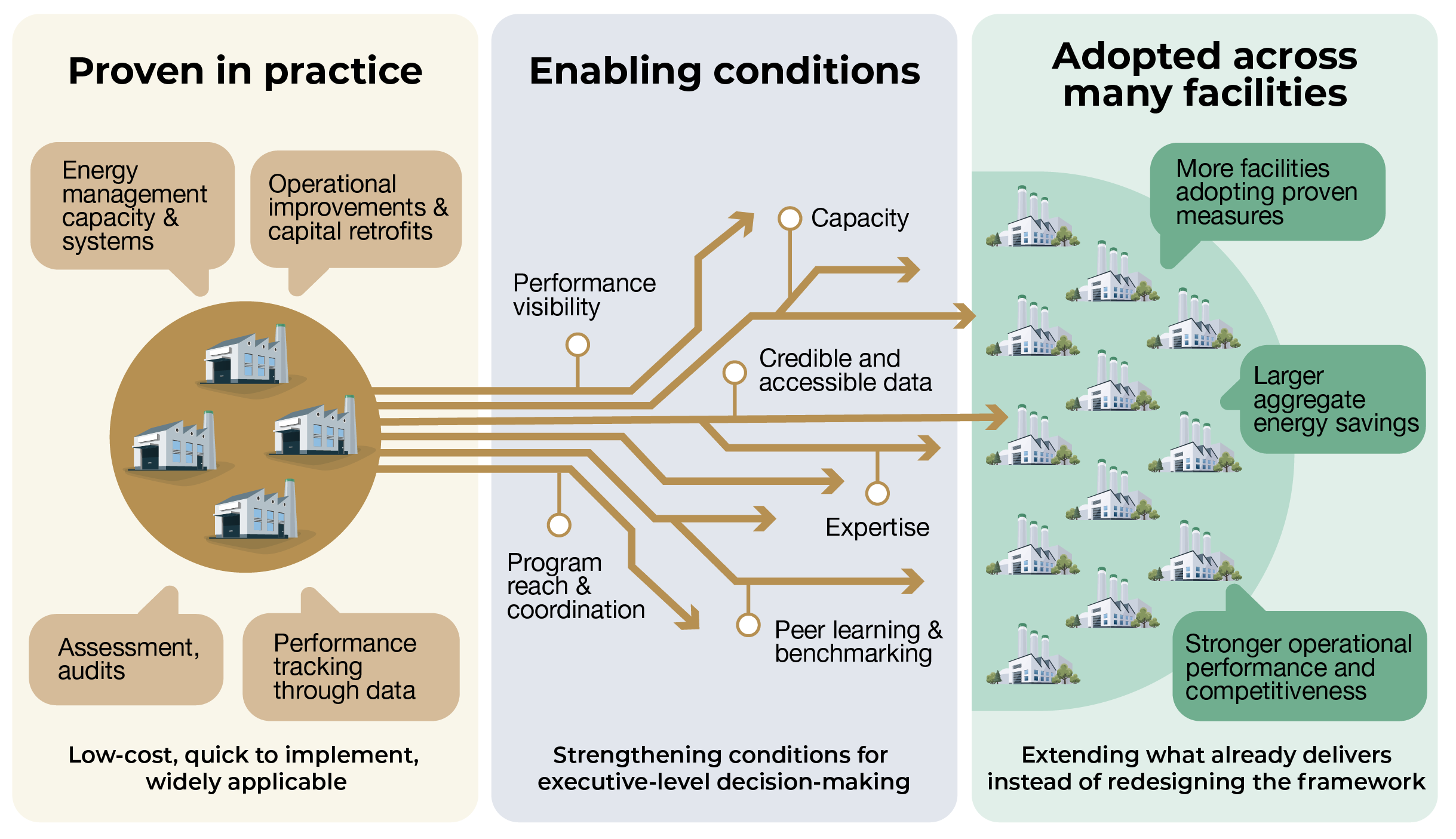
The diagram reads left to right across three panels: Proven in practice, Enabling conditions, and Adopted across many facilities.
The left panel, "Proven in practice," shows a small compact cluster of four industrial facility icons inside a gold circle. Four labelled callouts surround the cluster: Energy management capacity & systems; Operational improvements & capital retrofits; Assessment, audits; and Performance tracking through data. A caption below reads "Low-cost, quick to implement, widely applicable."
The middle panel, "Enabling conditions," shows five gold pathways branching out of the cluster toward the right. Each pathway is labelled with one enabling condition: Performance visibility, Capacity, Credible and accessible data, Expertise, and Peer learning & benchmarking. A sixth label, Program reach & coordination, anchors the bottom of the panel. A caption below reads "Strengthening conditions for executive-level decision-making."
The right panel, "Adopted across many facilities," shows a much larger, expanded field of industrial facility icons inside a green area. Three green outcome callouts emerge from the field: More facilities adopting proven measures; Larger aggregate energy savings; and Stronger operational performance and competitiveness. A caption below reads "Extending what already delivers instead of redesigning the framework."
The overall reading is few-to-many: a small proven cluster expands into broad adoption through enabling conditions that act as branching channels.
What works?
With key institutional and policy mechanisms already in place, the primary opportunity ahead lies in building off this foundation to accelerate and expand uptake of proven industrial energy efficiency practices.
Existing measures are already delivering measurable outcomes. For example, in 2023, OEE’s industrial programming resulted in 28.5 PJ in total annual energy savings, equivalent to nearly 1% of the industrial sector’s total energy use that year.Footnote 15 These results are expected to increase significantly over the coming years as projects funded under the Green Industrial Facilities and Manufacturing Program, such as energy management system implementation and capital retrofit projects, are completed. In addition, evidence from the IEA highlights that improved energy management practices can deliver more than 10% energy savings on average within the first three years of implementation.Footnote 16
In practical terms, broader adoption of regular energy audits, structured energy management systems, performance tracking, and targeted operational and system-level optimization measures are prime options for scaling up as they are low-cost, quick to implement, and widely applicable, offering immediate efficiency gains. Emerging tools such as advanced process controls, AI-enabled energy management systems, waste heat recovery, and enhanced data analytics can further accelerate industrial energy efficiency by improving real time visibility into energy use, supporting faster decision-making, and helping facilities identify additional savings opportunities.
Thus, rather than redesigning the policy framework, progress can be achieved by scaling up established approaches that have already demonstrated results and expanding their reach, consistency, and speed of implementation across industrial facilities.
Why scaling up matters
The value of energy efficiency lies not only in reducing energy consumption, but in strengthening the performance, reliability, and productivity of industrial operations.
In industrial settings, energy efficiency is not solely an energy-saving measure, but a means of improving overall operational performance. Studies indicate that productivity and operational improvements associated with energy efficiency investments can generate benefits worth up to 2.5 times the value of direct energy savings.Footnote 17 When these additional benefits are quantified, the total value of efficiency measures can increase by 40% to 250%, significantly improving project economics and investment returns.Footnote 18 Incorporating operational and productivity gains into project evaluations also has a direct impact on investment outcomes. In some cases, it can shorten payback periods by more than half,Footnote 19 enabling efficiency projects to meet internal financial thresholds and compete more effectively for capital within firms.
Scaling up the above-mentioned approaches will require different levels of effort based on the lever. However, it enables conditions that support executive level decision-making – particularly access to actionable energy data, technical expertise, and coordinated program delivery. This is especially important for expanding adoption among small and medium-sized enterprises and accelerating implementation of proven measures such as energy management systems, audits, and system optimization. Canada’s ability to scale up industrial energy efficiency is also supported by its electricity system – with a significant share of electricity generation coming from non-emitting sources,Footnote 20 Canada is well positioned to support electrification of industrial processes.
By scaling up proven practices and helping firms better assess these broader benefits, Canada can translate existing technical potential into stronger productivity, lower operating costs, and more competitive industrial facilities.
Conclusion: Advancing industrial competitiveness through energy efficiency
Over several decades, Canada has developed a comprehensive policy ecosystem to support the industrial sector through energy efficiency improvement. Within Canada’s federal context, this approach relies not only on regulation, but more prominently on incentives, information sharing, and collaboration to enable informed decision-making across all levels of industrial operations – from executive leadership to implementation on the facility floor.
For policymakers and industry leaders alike, the Canadian experience illustrates that progress depends on aligning policy frameworks, programs, and information with how investment decisions are made in practice. Strengthening this alignment and scaling up action will be critical to unlocking the full potential of industrial energy efficiency, translating technical opportunities into realized outcomes, and supporting productivity growth and enduring industrial competitiveness.
Case studies
The Office of Energy Efficiency Green Industrial Facilities and Manufacturing Program’s (GIFMP) Energy Efficiency Solutions Track delivers funding through contribution agreements administered by third party organizations, such as provinces and territories, utilities, and other non-profits. Through these agreements, funding supports the delivery of industrial energy efficiency programs managed by proponents and tailored to regional and sectoral needs. Examples include:
- Emission Reduction Alberta’s (ERA) Strategic Energy Management for Industry (SEMI) is designed to provide industrial and manufacturing facilities with knowledge, expertise, and training in energy management. The SEMI program helps participants increase profitability by reducing energy costs, grow organizational skills and capacity building, and help cover the cost of capital retrofits.
- Independent Electricity System Operator (IESO) Ontario – Save on Energy Industrial Energy Management Program is designed to support energy managers, practitioner training, strategic energy management cohorts, and EMIS, enabling persistent energy performance improvements across industrial facilities.
- Efficiency Nova Scotia delivers a suite of demand side management programs, supporting energy audits, technical studies, and implementation of facility-level efficiency upgrades. These initiatives help industrial facilities reduce energy costs and improve overall operational performance.
- Newfoundland and Labrador Hydro (NL Hydro) – Isolated Communities Energy Efficiency Program (ICEEP) supports remote communities in Labrador in improving energy use in fish processing plants, with the goal of reducing reliance on diesel generation. By enhancing energy efficiency in these facilities, the program helps lower operating costs, improve local energy resilience, and support communities with significant Indigenous populations.
Case studies highlighted below are examples of projects funded by these organizations with financial support from GIFMP.
Success Story #1: Lethbridge Iron Works | 2% facility level energy savings
How replacing a moulding machine led to increased production and reduced energy consumption
Industry: Foundry
Date: 2025 to 2027
Location: Lethbridge, Alberta
SEMI Participant: Lethbridge Iron Works
Activity: SEMI Capital Retrofits (ERA)
About the project
Lethbridge Iron Works is a foundry in Lethbridge, Alberta, that produces ductile iron castings for various industries including agricultural, rail & automotive. The foundry currently has five Hunter match plate moulding machines that creates sand moulds for castings. Lethbridge Iron plans to install a high capacity new DISA moulding machine that is expected to produce the same number of moulds that are currently produced by three machines while consuming less energy (energy spent per mould). The new machine is also expected to improve the castings quality, finish and reduce the maintenance downtime.
Approach
Lethbridge Iron Works determined that other foundries have been using the DISA machine to increase their production, improve the product quality and reduce downtime. Using its 2024 production data, Lethbridge determined that the selected DISA machine has the potential to replace three of its machines while maintaining output, thereby reducing the overall energy consumed in producing the moulds by up to 11 per cent. The new machine will also improve the product quality, thereby reducing the rework and less scrap being sent back to the furnace.
Key information and outcomes
Natural Gas Consumption:
23,300 GJ/year
Electricity Consumption:
19,085,379 kWh/yr
Total Facility Energy Use:
92,000 GJ/year
Energy Savings:
1,506 GJ/year
GHG Reduction:
75 tCO₂e/yr
Energy Cost Savings:
$1,100,000/yr
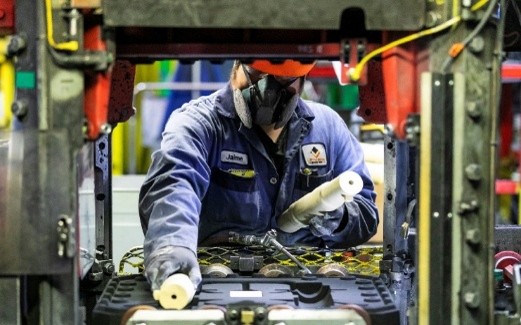
This upgrade will increase efficiency, allowing the output of three machines to be produced faster. The new, high-quality casting process will reduce rejections, in turn lowering furnace raw material requirements and rework. This strategic project ensures our competitiveness in the global market and helps secure manufacturing jobs in Canada.
Success Story #2: Davey Textile Solutions | 12% facility level energy savings
How waste heat recovery and solar PV panels reduce electricity use and emissions
Industry: Textile Mill
Date: 2024 to 2025
Location: Edmonton, Alberta
SEMI Participant: Davey Textile Solutions Inc.
Activity: SEMI Capital Retrofits (ERA)
About the project
Davey Textile Solutions’ facility in Edmonton, Alberta, manufactures high-visibility, flame-resistant retroreflective trim under NAICS 313220 – Narrow Fabric Mills and Schiffli Machine Embroidery. The production process includes warping, weaving, and finishing, followed by either laser processing and lamination or chain stitch sewing before shipping.
To improve energy performance and reduce greenhouse gas emissions, Davey Textile evaluated installing heat recovery units on two electric ovens and rooftop solar PV panels (610 W Thornova modules). The heat recovery system is expected to save 91,520 kWh (329.5 GJ) annually, while the solar PV system will generate 180,425 kWh (649.5 GJ) per year. Together, these measures could lower utility costs by about $39,900 per year and reduce GHG emissions by 48.9 tCO₂e annually, which represents 12% of energy savings for the entire facility.
Approach
The project involves installing one heat recovery unit (MFR HE 600 m³) for each of the two existing electric ovens (MFR 3A IR 50 ST). These heat recovery units will capture waste heat from the oven exhaust air and use it to preheat the incoming air supplied to the ovens. By recovering and reusing this heat, the system will reduce the amount of energy required to heat the ovens and improve overall energy efficiency. The figures below illustrate the existing oven system, the proposed heat recovery units, the exhaust ducts where the heat recovery systems will be installed and proposed solar PV installation.
Benefits
Energy and Cost Savings: Heat recovery reduces electricity needed for oven heating, while solar PV generates on-site power, lowering energy consumption and utility costs.
Improved Efficiency: Preheating incoming air increases oven thermal efficiency and helps maintain stable process temperatures.
Reduced GHG Emissions: Lower electricity use and renewable energy generation reduce the facility’s carbon footprint.
Better Working Environment: Heat recovery lowers exhaust air temperature, improving safety and comfort around the ovens.
Sustainability and Resilience: Solar PV supports long-term sustainability by producing clean energy and reducing reliance on grid electricity.
Potential Production Benefits: Improved heating efficiency may allow faster temperature recovery and support higher production throughout.
Key information and outcomes
Natural Gas Consumption:
5,024 GJ/year
Electricity Consumption:
872,229 kWh/yr
Total Facility Energy Use:
8,164 GJ/year
Energy Savings:
979 GJ/year
GHG reduction:
48.9 tCO₂e/yr
Energy Cost Savings:
$39,000/yr
Success Story #3: Keyera Gas Plant | 1% facility level energy savings
How waste heat recovery reduces fuel use and emissions at sour gas processing facility
Industry: Oil & Gas Processing
Date: 2024 to 2025
Location: Rimbey, Alberta
SEMI Participant: Keyera Corp.
Activity: SEMI Capital Retrofits (ERA)
About the project
Keyera’s Gas Plant in Rimbey, Alberta, processes sour gas and supports natural gas liquids (NGL) processing operations. The facility relies on Boiler B-1D, a natural-gas-fired steam boiler that supplies steam for plant heating and process demands.
Under baseline operating conditions, boiler feedwater entered the boiler without upstream heat recovery. As a result, sensible heat contained in the flue gas was discharged directly to the atmosphere, limiting overall boiler efficiency and increasing natural gas consumption required to meet plant steam demand.
To improve energy performance and reduce greenhouse gas emissions, Keyera evaluated opportunities to recover waste heat from the boiler exhaust stream while maintaining existing plant operating conditions and production capacity. The boiler system baseline energy use is approximately 619,213 GJ/year, with the economizer reducing natural gas consumption by roughly 7%.
Approach
The project implemented a flue-gas economizer integrated downstream of Boiler B-1D.
The economizer is a tubular heat exchanger designed using Babcock & Wilcox boiler efficiency modelling to recover heat from boiler exhaust gases and transfer it to incoming boiler feedwater before entering the boiler.
Key elements of the implementation included:
- Integration of the economizer into the existing boiler exhaust system
- Recovery of sensible heat from flue gas to preheat boiler feedwater
- Maintaining existing steam production rates, boiler firing capacity, and plant throughput
- Avoiding additional electrical loads or process modifications
By preheating the feedwater, the boiler requires less natural gas to generate the same quantity of steam, improving overall thermal efficiency.
Key information and outcomes
Natural Gas Consumption:
4,725,285 GJ/year
Electricity Consumption:
22,247 kWh/yr
Total Facility Energy Use:
4,805,374 GJ/year
Energy Savings:
43,174 GJ/year
GHG reduction:
2,146 tCO₂e/yr
Energy Cost Savings:
$203,870/yr
Success Story #4: Trans-Atlantic Preforms | 35% facility level energy savings
Strategic Energy Management and Energy Manager achieve electricity savings and operational resilience
Industry: Plastics (Food & Beverage Packaging)
Date: 2023 to 2026
Location: Edwardsville, NS
Participant: Trans-Atlantic Preforms
Activity: SEM, Energy Manager, Audit, EMIS, Capital (Efficiency Nova Scotia)
About the project
Trans-Atlantic Preforms (TAP) is a large industrial plastics manufacturing facility producing preforms for food and beverage applications. Prior to this project, the facility lacked visibility into energy consumption by process or equipment.
Through participation in Efficiency Nova Scotia’s Strategic Energy Management (SEM), Energy Manager, and Demand Response programs, TAP implemented real-time metering and data logging to establish verified energy baselines. These enabled upgrades focused on the facility’s largest electricity users, particularly the central chiller system, which received support through Efficiency Nova Scotia’s Custom Retrofit program.
As a result of these measures, TAP has achieved a 35% reduction in energy use since the fall of 2023 which is equivalent to ~3.5 million kWh of energy savings, with a long-term target of 50% total reduction.
Approach
TAP implemented a data-driven energy efficiency initiative supported by Efficiency Nova Scotia’s Roving Energy Manager Service, participation in the SEM Program, and deployment of real-time energy monitoring. Key actions included:
- Facility-wide real-time electrical metering and energy data logging
- A Lean Six Sigma Green Belt project to identify, prioritize, and validate operational efficiency opportunities
- Transition from individual chillers to a centralized chiller system
- Integration of Demand Response capability using real-time data, including participating in curtailment events
- Pursuing comprehensive energy audits, and implementation of EMIS
- Upgrades to resin dryer
Benefits
Energy and Cost Savings: Sufficient to justify reinvestment into further efficiency and productivity improvements
Better Working Environment: improved cooling capacity and system reliability, enhanced comfort and working conditions during hot weather, reduced downtime and lower maintenance requirements
Additional Benefits:
- Greater financial resilience during periods of economic and tariff-related pressure
- No workforce layoffs during reduced production periods; staff redeployed to energy efficiency upgrades
- Strong leadership and employee buy-in driven by transparent, trusted performance data
Key information and outcomes
Total Facility Energy Use:
39,176 GJ/year
Energy Savings:
12,600 GJ/year
GHG reduction:
2,033 tCO₂e/yr
Success Story #5: Cemtol Manufacturing | 11% facility level energy savings
From Ad-Hoc to Strategic: Cemtol’s Energy Management Transformation
Industry: Manufacturing
Date: 2025 to 2026
Location: Guelph, Ontario
Participant: Cemtol Manufacturing
Activity: Expanded Energy Management Program (IESO)
About the project
Cemtol is a manufacturing division of Linamar Corporation, producing automotive parts in Guelph Ontario. Linamar delivers precision-engineered manufacturing solutions across mobility, access, and agricultural industries through globally integrated, evolving operations.
Cemtol has participated in Save On Energy’s Expanded Energy Management (EEM) Program since 2025 and is continuing through 2026. Through participation in EEM’s cohort learning model, Cemtol has developed foundational Strategic Energy Management (SEM) milestones and has seen a transformation from working on ad-hoc energy projects to taking an integrated approach to achieving their energy conservation goals. With the help of EEM’s energy manager funding, they have also established a formal energy manager role for their facility.
Linamar aims to be a net zero carbon organization by 2050. To help achieve that, its facilities have annual energy conservation targets which Cemtol exceeded in 2025. Learn more about Linamar’s sustainability commitments.
Approach
Cemtol’s change management approach resulted in significant energy savings in 2025. By formalizing their energy management program and establishing a role for the energy manager, its reported energy reduction is equivalent to powering 115 Canadian homes for a year. Nearly all the energy savings achieved are through low- and no-cost measures like operational improvements and behavioural changes.
What did Cemtol change to achieve these results?
Improved visibility: Energy mapping shows where energy is used and identified significant energy users to help prioritize projects
Strengthened operations: Reduced waste through air leak prevention, equipment controls and enhanced SOPs for equipment shutdown
Structured approach: Energy performance is now tracked, measured, and reported to key parties, ensuring ownership and accountability
Engaged team: Increased involvement from engineers, maintenance, and operators
Project pipeline: Dozens of projects with estimated savings are prioritized, including opportunities that are underway or on the list for future consideration.
Key information and outcomes
Total Facility Energy Use:
92,912 GJ/year
Energy Savings:
10,041 GJ/year
GHG reduction:
361 tCO₂e/yr
Energy Cost Savings:
>$200,000/yr