
Details
- Publication date
- Author(s)
- ISBN
978-0-660-97549-8 - Catalogue number
M4-276/2025E-PDF
Introduction
In 2018, the Canadian Energy Regulator Act (CER Act) established the Canada Energy Regulator (CER or Regulator) through Bill C-69. The CER provides regulatory oversight over the full lifecycle of federal energy infrastructure including pipelines that cross interprovincial and international borders, international and designated interprovincial power lines, and offshore renewable energy projects.
The CER Act created a modern governance structure for the Regulator, including a Commission of independent adjudicators whose role is to make recommendations and decisions regarding federally regulated infrastructure projects throughout the project’s lifecycle. A Board of Directors provides governance of the Regulator including the provision of strategic direction and advice to the Regulator. A Chief Executive Officer (CEO) is responsible for the management of the Regulator’s day-to-day business and affairs.
Through the CER Act, the majority of the CER’s powers, duties, and functions would be carried out by the Commission. The CER Act also provides authority for the Government of Canada to create regulations that would specify certain administrative and technical decisions that would be carried out by “designated officers” of the CER. The CEO of the CER is responsible for appointing Designated Officers (DOs) and apportioning their work.
DOs would have an important role in the modern governance structure of the CER, contributing to the efficient implementation of its responsibilities. Chiefly, delegating certain tasks to DOs would reduce administrative burden on the Commission, allowing it to focus on matters of broad political and economic import.
A discussion paper was published online in 2018 during Engagement Phase I as part of a broader consultation on the creation of the CER and the passing of Bill C-69. The paper included five discussion questions to guide feedback, and it is presented in Appendix I. Feedback on the paper emphasized the need for decision-making boundaries between the Commission and DOs, with strong support for retaining Commission authority over decisions involving Indigenous rights. While DOs were accepted for routine, technical, or administrative tasks, comments received consistently called for transparent criteria, Indigenous engagement, and safeguards to ensure institutional integrity and accountability.
This Engagement Summary Report Phase I (the Report) was prepared to reflect the feedback received during Engagement Phase I in 2018. It captures the diversity of perspectives shared throughout the process. While the Report does not address every individual comment, Natural Resources Canada (NRCan) has sought to acknowledge the range of viewpoints expressed. Comments have been attributed to the respective groups or organizations that submitted them.
Background
The Designated Officers Regulations
NRCan is undertaking a comprehensive review of the proposed Designated Officer Regulations under the CER Act. NRCan is committed to ensuring that its work, and the decisions it makes, are informed by diverse input from people across Canada. Engagement on federal regulatory development initiatives is informed by the Government of Canada’s Cabinet Directive on Regulation, which calls for meaningful consultation and engagement with Indigenous Peoples and impacted stakeholders throughout the development, management, and review of regulations.
This Report summarizes the comments received during public Engagement in Phase I, as Engagement Phase II is currently ongoing.
During the initial development of the Designated Officer Regulations in 2018, NRCan and CER undertook a broad and inclusive consultation process to gather input from stakeholders and partners across Canada. This process was designed to ensure transparency, accountability, and responsiveness to the diverse interests affected by the proposed regulations.
In 2018, a Discussion Paper on proposed Designated Officer Regulations was posted on NRCan’s website to solicit input from interested parties. This was part of a broader consultation surrounding the creation of the CER and the passing of Bill C-69 (An Act to enact the Impact Assessment Act and the Canadian Energy Regulator Act, to amend the Navigation Protection Act and to make consequential amendments to other Acts) more broadly. At that time, a public notice about the upcoming discussion paper was posted, and letters to specific Indigenous representatives were mailed, seeking input on the paper.
Indigenous partners were issued early notification of the discussion paper a month beforehand, sent to an Indigenous engagement list developed through Canadian Environmental Assessment Agency (CEAA) and NRCan, with National Energy Board (NEB) review, which included over 300 Indigenous organizations, groups and communities across Canada. The list also included the NEB's list of Indigenous communities and groups with an interest in certain of the NEB's regulated infrastructure. The notification contained an offer to meet to discuss Bill C-69 and the regulations.
The discussion paper was published online, and submissions of comments were accepted from October 15 to November 28, 2018. In total, NRCan received 17 submissions from a wide range of respondents, including industry associations, companies, and Indigenous groups/representatives. These submissions were posted publicly in the language of their submission. In addition to written feedback, NRCan and the CER conducted workshops with staff from the NEB, the CER’s predecessor, during Fall 2018. These sessions provided internal perspectives on the practical implications of delegating decision-making authority. An additional 17 industry groups took part in a teleconference led by NRCan and provided comments.
Summary of comments
Who we heard from
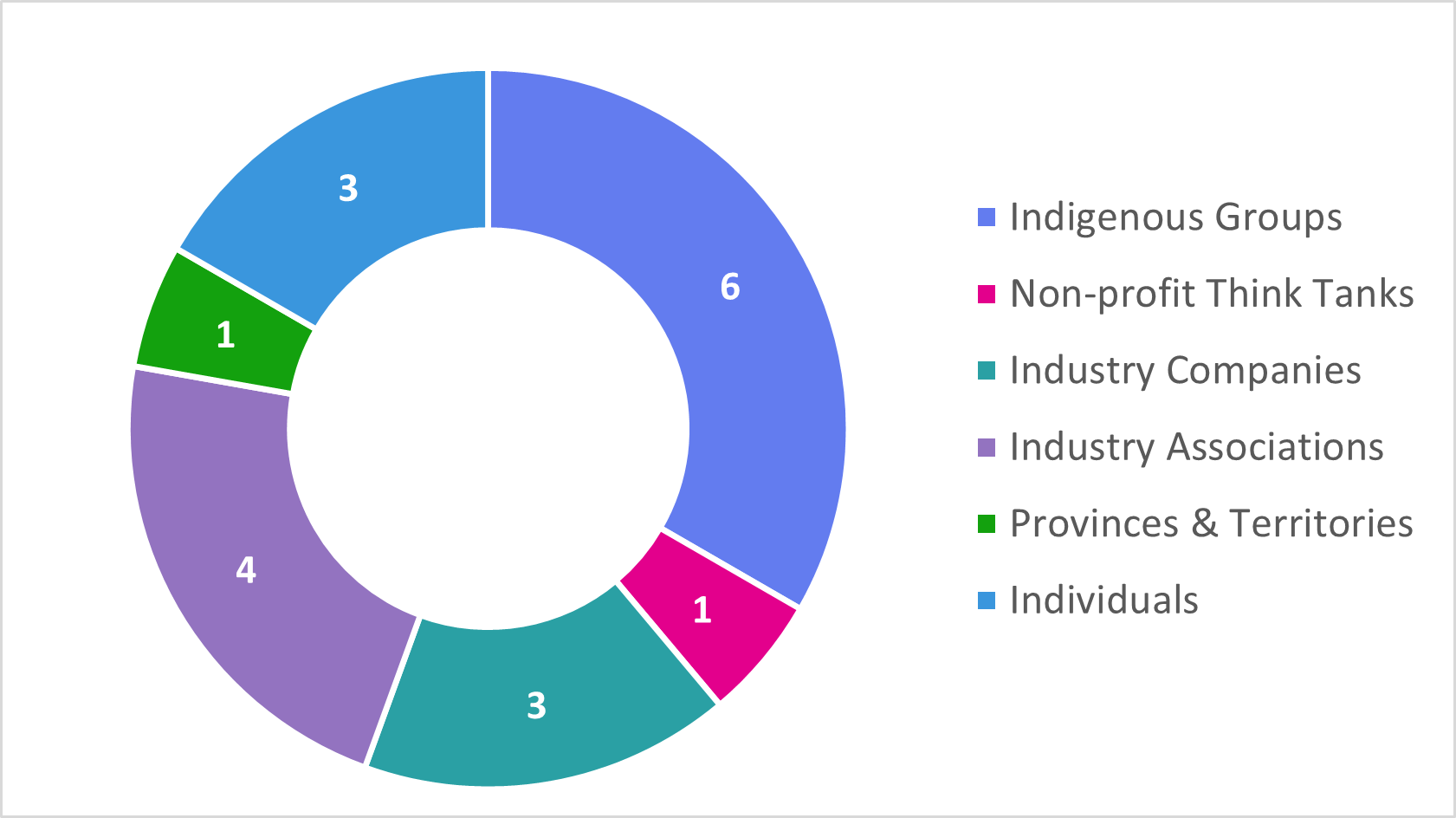
A total of 17 written submissions were received from Indigenous Nations, communities, societies and organizations, think tanks, industry and other interested parties, as shown in Figure 1. An additional 17 groups took part in a teleconference led by NRCan and provided comments. NRCan and the CER conducted workshops with NEB’s staff on the discussion paper and collected their comments. For a complete list of the participants that provided feedback, please see Appendix II.
Figure 1: Comments received during Engagement Phase I
Text version
Donut chart showing responses from engagement: Indigenous Groups = 6, Industry Associations = 4, Individuals = 3, Industry Companies = 3, Non-profit Think Tanks = 1, Provinces & Territories = 1.
As a result of the Engagement Phase I, each group provided distinct perspectives on the regulatory approach, particularly regarding the delegation of decision-making authority from the Commission to designated officers, as described in the paragraphs below. Table 1 summarizes the comments received in response to the Discussion Paper released during Phase I.
Industry stakeholders emphasized the need for efficiency and clarity. They generally supported the delegation of routine, technical decisions to designated officers, especially in emergency situations where delays could pose risks to people, infrastructure, or the environment. However, they expressed concerns about the use of vague criteria to determine which decisions could be delegated, warning that this could lead to regulatory uncertainty, legal challenges, and inefficiencies.
Indigenous organizations raised concerns about the potential impacts of delegated decision-making on Indigenous rights and interests. They stressed that decisions affecting Indigenous lands, rights, or Traditional Knowledge should remain with the Commission and not be delegated. Several groups emphasized the importance of culturally appropriate consultation processes. Some also recommended the inclusion of Indigenous representatives as designated officers.
Provincial and territorial governments expressed interest in improving transparency and coordination. They requested that designated officers be publicly listed to facilitate communication between agencies and the public.
One environmental NGO was the only stakeholder that raised concerns with the intent of the regulations. Its primary concern was the potential interference in designated officer decision-making and the overall impact on the independence and integrity of the Commission.
Internal engagement efforts from the NEB found that staff generally agreed that only procedural or low-impact decisions should be delegated to designated officers, while complex, rights-implicating, or precedent-setting decisions should remain with the Commission. There were mixed views on who should decide when a matter should be “bumped up” referred from a designated officer to the Commission, with some suggesting the CEO and others preferring a collaborative approach.
Table 1: Summary of comments from Engagement Phase I
| Key Requests | Concerns Raised | Preferred Decision-Making | |
|---|---|---|---|
| Indigenous Groups | Commission to handle decisions involving Indigenous rights or knowledge; Indigenous Advisory Groups; Primary notice to affected Nations | DOs may lack Indigenous law/knowledge; Risk of rights being overlooked | Commission for decisions affecting rights, lands, or knowledge; DOs only for non-impactful admin tasks |
|
Non-profit Think Tanks |
Clarify criteria for technical versus administrative decisions; Ensure decisions involving core adjudicative functions remain with the Commission; Reframe criteria to clearly identify decisions that must not be delegated | DOs undermine the Commission’s independence and adjudicative role; Potential erosion of institutional integrity and public trust | Commission should retain authority over any decision involving adjudication, legal interpretation, or stakeholder rights; DOs should only handle decisions that are clearly defined, technical, and non-adjudicative |
| Industry Companies | Activity-based decision list; Emergency decision authority; Defined officer qualifications | Uncertainty in process; Risk of inefficiency | DOs for technical/administrative tasks; Commission for precedent-setting or contested issues |
| Industry Associations | Clear list of delegated decisions; Industry task group for review; Service standards | Subjectivity in criteria; Risk of delays and legal challenges | DOs for routine, technical decisions; Commission for legal/policy matters |
| Provinces & Territories | Public listing of DOs; Continued engagement on future regulations | Lack of clarity on who to contact | Commission for broader decisions; DOs for technical matters |
| NEB staff | Clarify delegated decisions; Clear criteria for procedural decisions; Include legal risk, public interest, compliance history, and multi-stakeholder impact as criteria for Commission-only decisions | Subjectivity in criteria; Risk of delays and legal challenges | DOs for procedural and technical matters; Commission for complex, stakeholder-sensitive or rights-impacting decisions; Collaborative bum-up process |
| Individuals | Clear criteria for technical decisions; Competency-based delegation | Political influence; Consultation process clarity | DOs for well-defined regulations; Commission for complex or delayed decisions |
What’s next?
We would like to reiterate our appreciation to those who participated in Phase I of the Early Engagement for the Designated Officer Regulations under the CER Act, and invite participation in Phase II.
We will continue to assess and consider the input received that aligns with the policy’s objectives for the current regulation. NRCan aims to create efficiency and predictability, while keeping the flexibility that supports continual improvement. Some of the comments raised may not be addressed in the current project but could be appropriate topics for future amendments to the regulation. The next phase of this project will focus on publishing an updated Discussion Policy Paper for public comments.
If you have any feedback, questions or comments on this report, please contact
Veronique Houle, Director
Fuels Sector
Natural Resources Canada
designatedofficer-responsablesdesignes@nrcan-rncan.gc.ca
Appendix I: Designated Officer Regulations - Discussion paper (2018)
Appendix II: Submitters of feedback
NRCan received submissions from the following participants in Engagement Phase I on the Designated Officer Regulations under the CER Act:
- Southern Chiefs Organization
- Métis Nation of Alberta (Region 3)
- Métis Nation of British Columbia (MNBC)
- Inuvialuit Regional Corporation
- File Hills Qu'Appelle Tribal Council
- Grand Conseil de la Nation Waban-Aki (GCNWA)
- Alberta Energy (Energy Alberta)
- Alta Link
- BC Agriculture Council (BCAC)
- Canadian Association of Petroleum Producers
- Canadian Electricity Association (Now Electricity Canada)
- Canadian Federation of Agriculture
- Canadian Energy Pipeline Association
- Daren Arcuri
- Dr. Alan Murray P Eng
- EMPR & OGC - BC
- Enbridge
- Environmental Defence Canada
- Farmers’ Advocacy Office (BC)
- Hydro Manitoba
- Hydro One
- Hydro Québec
- Imperial Oil Ltd
- Nalcor
- NEB Board Members and Modernization Implementation Committee
- Pembina Institute
- PowerexCorp
- Saskpowers
- Teleconferences
- TransCanada (TC Energy)
- UPA - L'Union des producteurs agricoles