
Statement outlining results, risks and significant changes in operations, personnel and programs
1. Introduction
This quarterly financial report should be read in conjunction with the Main Estimates and any Supplementary Estimates approved in a given year by the date of this report. It has been prepared by management as required by section 65.1 of the Financial Administration Act and in the form and manner prescribed by Treasury Board (TB). This quarterly financial report has not been subject to an external audit or review.
1.1 Authority, Mandate and Programs
Natural Resources Canada (NRCan) works to improve the quality of life of Canadians by ensuring that our natural resources are developed sustainably, providing a source of jobs, prosperity, and opportunity, while preserving our environment and respecting our communities and Indigenous peoples.
Further details on NRCan’s authority, mandate and programs can be found in Part II of the Main Estimates.
1.2 Basis of Presentation
This quarterly financial report has been prepared by management using an expenditure basis of accounting. The accompanying Statement of Authorities includes NRCan’s spending authorities granted by Parliament, and those used by NRCan are consistent with the Main Estimates and budget adjustments approved by TB up to September 30, 2025. This quarterly report has been prepared using a special purpose financial reporting framework designed to meet financial information needs with respect to the use of spending authorities.
The authority of Parliament is required before money can be spent by the Government. Approvals are given in the form of annually approved limits through appropriation acts, or through legislation in the form of statutory spending authority for specific purposes.
NRCan uses the full accrual method of accounting to prepare and present its annual unaudited departmental financial statements that are part of the departmental results reporting process; however, the spending authorities voted by Parliament remain on an expenditure basis.
2. Highlights of Fiscal Quarter and Fiscal Year-to-Date Results
This Departmental Quarterly Financial Report reflects the results as of September 30, 2025, which include Main Estimates for which full supply was released as well as TB approved adjustments. The details presented in this report focus on and compare the second quarter results of 2025-2026 with those of 2024-2025.
2.1 Authorities
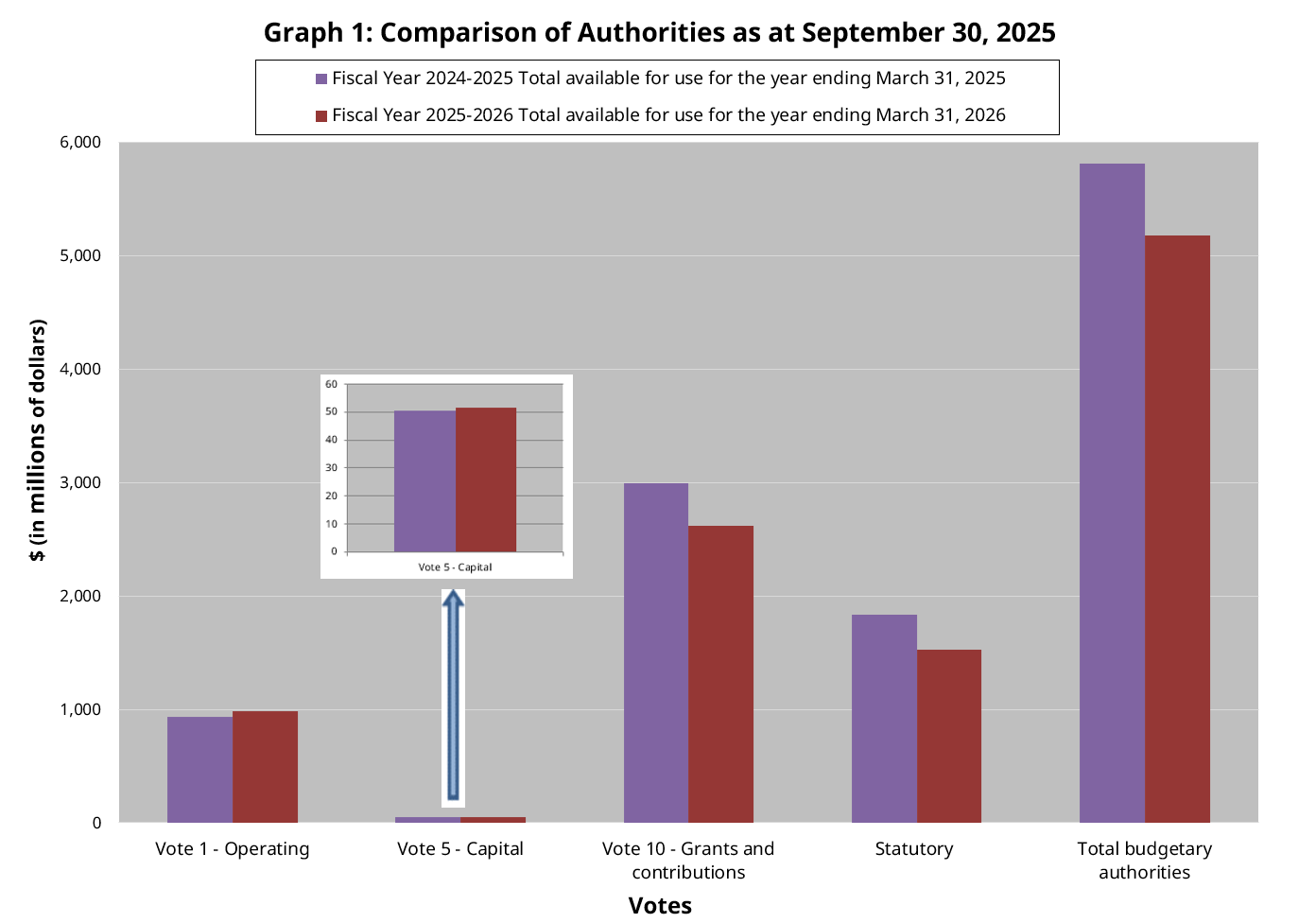
As per Table 1, presented at the end of this document, and on Graph 1 below, as at September 30, 2025, NRCan has authorities available for use of $5,180.3M compared to $5,811.7M in 2024-2025, for a net decrease of $631.4M or 10.9%.
Text Version
| Graph 1: Comparison of Authorities as at September 30, 2025 | ||
|---|---|---|
| (In millions of dollars) | Fiscal Year 2024-2025 Total available for use for the year ending March 31, 2025 | Fiscal Year 2025-2026 Total available for use for the year ending March 31, 2026 |
| Vote 1 - Operating | 934 | 985 |
| Vote 5 - Capital | 50 | 52 |
| Vote 10 - Grants and contributions | 2,997 | 2,620 |
| Statutory | 1,831 | 1,523 |
| Total budgetary authorities | 5,812 | 5,180 |
The decrease of $631,4M in authorities in 2025-2026 compared to 2024-2025 is mainly explained by the decrease within the Vote 10 grants and contributions and Statutory authorities as well as the net effect of smaller fluctuations within Vote 1 operating expenditures and Vote 5 capital expenditures as per the following:
Changes to Voted and Statutory Authorities
2025-2026 compared with 2024-2025
(in $000s)
| Total available for use for the year ending March 31, 2025 | 5,811,672 |
|---|---|
| Vote 1 - Operating | |
| Increase in Collective Bargaining Agreements | 17,643 |
| UNCLOS - Extended Continental Shelf | 16,100 |
| Polar Continental Shelf Program | 11,387 |
| All other net increases less than $10M individually | 5,830 |
| Sub-total Vote 1 - Operating | 50,960 |
| Vote 5 - Capital | |
| Polar Continental Shelf Program | 6,435 |
| Energy Innovation Program | 3,530 |
| Canadian Data Receiving Infrastructure | (4,429) |
| All other net decreases less than $3M individually | (4,121) |
| Sub-total Vote 5 - Capital | 1,415 |
| Vote 10 - Grants & Contributions | |
| Canada Greener Homes Affordability Program (CGHAP) | 44,874 |
| Critical Minerals | 33,110 |
| Decarbonization of On-road Transportation - Zero-Emission Vehicle Infrastructure Program | 25,085 |
| The Sustainable Advancement of Canada's Forest Economy | 20,546 |
| Smart Grids | 20,500 |
| Greener Homes | (183,543) |
| Clean Fuels Fund | (181,115) |
| Smart Renewables & Electrification Pathways | (179,108) |
| Electricity Pre-Development | (26,355) |
| All other net increases less than $20M individually | 50,373 |
| Sub-total Vote 10 - Grants & Contributions | (375,633) |
| Statutory | |
| Newfoundland Offshore Petroleum Resources Revenue Fund (Forecasts are revised annually based on projected oil & natural gas production levels, prices, exchange rates and operator's costs) |
(323,327) |
| All other net increases | 15,244 |
| Sub-total Statutory | (308,083) |
| Total decrease from previous year due to year-over-year changes | (631,341) |
| Total available for use for the year ending March 31, 2026 | 5,180,331 |
2.2 Budgetary Expenditures by Standard Object
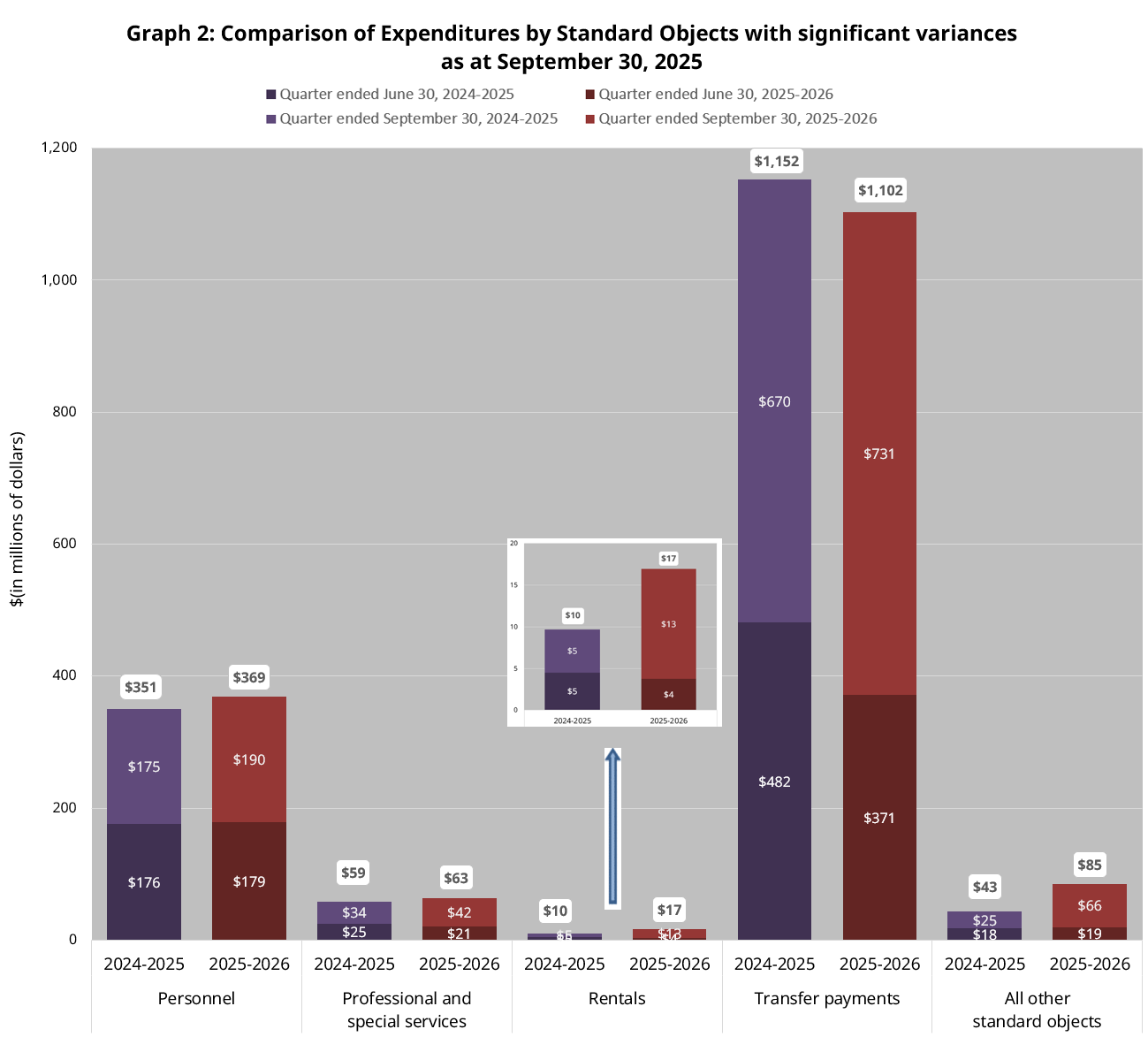
The spending for the quarter ending September 30, 2025 amounts to $1,002.0M or 19.3% of total funding available for the fiscal year, compared to $909.3M or 15.6% for the same quarter last year. The increase of $92.7M in spending is mainly related to an increase in expenditures for transfer payments in the second quarter of 2025-2026 compared to the same type of expenditures in the second quarter of 2024-2025. Year-to-date spending at the quarter ending September 30, 2025 amounts to $1,596.3M or 30.8% of total funding available for the fiscal year, compared to $1,615.1M or 27.8% for the same period last year. Further analysis has been done on standard objects with significant expenses, as noted in Graph 2 below. Table 2 at the end of this document presents the spending for all standard objects.
Text Version
| Graph 2: Comparison of Expenditures by Standard Objects with significant variances as at September 30, 2025 | |||
|---|---|---|---|
| (In millions of dollars) |
Quarter ended June 30 |
Quarter ended September 30 | |
| Personnel | 2024-2025 | 176 | 175 |
| 2025-2026 | 179 | 190 | |
| Professional and special services | 2024-2025 | 25 | 34 |
| 2025-2026 | 21 | 42 | |
| Rentals | 2024-2025 | 5 | 5 |
| 2025-2026 | 4 | 13 | |
| Transfer payments | 2024-2025 | 482 | 670 |
| 2025-2026 | 371 | 731 | |
| All other standard objects | 2024-2025 | 18 | 25 |
| 2025-2026 | 19 | 66 | |
Variance in Budgetary Expenditures by Standard Object
(2025-2026 compared to 2024-2025)
(In $000s)
| Standard Object | Explanation | Variance between 2025-2026 and 2024-2025 Q2 expenditures | Variance between 2025-2026 and 2024-2025 YTD expenditures |
|---|---|---|---|
| Personnel | The variance is mainly due to increases from collective bargaining settlements and the ForSITE program partially offset by the timing of Other Government Departments (OGD) salary transfers for Energy Innovation Program (EIP) occurring later this year. | 14,964 | 18,522 |
| Professional and special services | The variance is mainly due to increases related to the Forest Innovation and ForSITE programs, primarily driven by higher costs associated with research evaluation activities. These increases are partially offset by the delayed timing of OGD operational transfers for the EIP and legal services bills, which are now expected to occur later this year. | 8,518 | 4,583 |
| Rentals | The variance is mainly due to the rental of the Oden icebreaker as part of the UNCLOS 2025 Canada-Sweden Arctic Ocean expedition, focused on mapping the Arctic Ocean seabed. This is the first year of a three-year expedition, which explains why related costs were not incurred in the previous year. | 8,064 | 7,293 |
| Transfer Payments | The quarter-to-quarter variance is mainly due to an increase in statutory payments to the province of Newfoundland and Labrador for offshore activity, partially offset by a reduction in payments for the Canada Greener Homes Initiative. While there is an increase between quarters, the YTD decrease is mainly attributed to the winding down of the Canada Greener Homes Initiative and reduced payments under Smart Renewables and Electrification Pathways. | 61,328 | (49,441) |
| All Other Standard Objects | Minor increases and decreases within the remaining standard objects. | (182) | 194 |
| Total Variance | 92,692 | (18,849) | |
3. Risks and Uncertainties
In a context of heightened risk and uncertainty, NRCan is taking bold steps to proactively advance Canadian energy and natural resource trade and market diversification efforts, while concurrently negotiating a renewed economic and security partnership with the United States. This work includes identifying and mitigating threats, reducing overreliance on single markets, identifying new opportunities that help strengthen Canada’s global competitiveness, and opening new export pathways in key regions such as the Indo-Pacific and Europe. Overall, these actions support the Government of Canada agenda to advance Canadian energy and natural resources as a strategic geopolitical and economic advantage.
NRCan continues to advance initiatives that enhance the economic contribution and competitiveness of the natural resource sectors, while reducing emissions and other adverse environmental impacts. NRCan collaborates with other government departments, provincial and territorial partners, Indigenous groups, and other stakeholders to build a strong, resilient and sovereign economy for all Canadians. NRCan continues to support national and international actions to confront the impacts of climate change and extreme weather events that are becoming more prevalent.
Elevated levels of uncertainty continue to affect the global economy, producing inflationary pressures, supply chain disruptions, and shifting global market dynamics. In Q2, GDP contracted by 1.6% and the labour market softened, particularly for youth and new entrants to the workforce. Commodity demand and price uncertainty are some of the most significant challenges faced by Canadian natural resource sectors. Key contributing factors include U.S. tariff policies that are disrupting global trade and impacting Canadian energy and natural resource exports, increased protectionism and a shift from multilateral to bilateral trade agreements, ongoing conflicts in the Middle East and in Ukraine, as well as natural disasters. In this context, NRCan will maintain a focus on proactive risk management and regulatory efficiency, and the department will also support major nation-building projects to keep pace at the international level and secure the next generation of Canadian prosperity. Additionally, NRCan continues to lead cutting-edge research to inform the sustainable management of natural resources, and to position Canada as a clean and conventional energy superpower. Advancing the principles of inclusion, diversity, equity, and accessibility along with Gender-based Analysis Plus, the Department will advance natural resource science and innovative technologies while maintaining a commitment to Canadian values of respect toward each other and the environment.
NRCan maintains its commitment to reconciliation by promoting an integrated and coordinated approach to strengthening Indigenous partnerships and economic reconciliation-focused initiatives in natural resources sectors. This will be achieved by advancing shared governance of Canada’s resources, implementing the United Nations Declaration on the Rights of Indigenous Peoples Act (UNDA) legislation in operations, and building meaningful relationships and collaborative partnerships with Indigenous organizations and communities. Further, NRCan is developing a new National Benefits-Sharing Framework to ensure that Indigenous communities benefit from major resource projects taking place on or near to their traditional territories.
To maintain a competitive edge in the rapidly evolving digital world, the department will advance work to implement an integrated plan to respond to Canada’s Digital Ambition. NRCan has developed an AI Strategy to enable responsible AI adoption, aligned with TBS expectations that departments advance the use of AI. By investing in the use of AI and other technologies, and with a focus on cybersecurity, research and innovation, and upskilling staff, NRCan will continue to strengthen and modernize delivery of improved and secure digital services. Given the high priority of enhanced cyber security, in response to increasingly sophisticated attacks, ensuring proper actions are taken to secure digital resources and information will increase NRCan’s ability to protect data assets while delivering key programs and services for Canadians.
NRCan continues to strengthen its risk management capabilities and effectiveness, in support of delivering on its mandate and core responsibilities. The Department is moving forward with the integration of risk management with other departmental processes in support of priority setting and decision-making. This ensures mitigation actions are informed by regular assessment of risk information, serving to strengthen NRCan’s capacity to recognize and understand challenges, and to effectively prioritize actions under fiscal restraint.
As outlined in the 2023-2026 Corporate Risk Profile (CRP), the Department is monitoring the following six strategic risks and three operational risks:
Strategic risks
- External Engagement
- Policy, Funding Authority
- Federal Alignment
- Regulatory Regime
- Reconciliation
- Inclusion, Diversity, Equity and Accessibility
Operational risks
- Cyber Security
- Workplace Wellness
- Corporate Service Delivery
Strategic risks threaten the Department as a whole, and its ability to deliver expected outcomes and mandates. Concurrently, operational risks relate to the effectiveness or efficiency of internal-facing activities. As the current CRP will expire in spring 2026, NRCan is working to finalize its renewed CRP for 2027-2030, to ensure the risks monitored at the department-level remain accurate and representative of changes in our operating context. NRCan will closely and routinely monitor and update these key corporate risks to inform leadership on risk status, and to identify if further action is required, while continuing to support Canadians and our natural resource sectors in 2025-26, and beyond.
4. Significant Changes in Relation to Operations, Personnel, Programs
In August, the following significant changes occurred:
- Debbie Scharf returned to the Department to take on the role of Assistant Deputy Minister (ADM) of the Strategic Policy and Innovation Sector (SPI) which includes responsibility for a newly formed Project Office team liaising closely with the Federal Major Projects Management Office in its work to implement Bill C-5, One Canadian Economy Act.
- Frank Des Rosiers joined the Energy Enterprise and assumed the role of ADM for the Energy Efficiency & Technology Sector (EETS).
- Drew Leyburne became the ADM of the Energy Systems Sector (ESS).
- To more fully advance and focus on key government initiatives, the Lands and Minerals Sector divided into two sectors. Isabella Chan (ADM) is leading the refocused Lands and Minerals Sector (LMS), creating a centre of expertise in the areas of critical minerals, Arctic policy and economic analysis to better support government objectives. Rinaldo Jeanty is now ADM for the Geoscience and Earth Monitoring Sector (GEMS).
During the summer, the department completed the review of its programs and operations to ensure alignment with Comprehensive Expenditure Review objectives.
No other significant change in relation to operations, personnel or programs occurred during the second quarter of 2025-2026.
Original signed by:
Michael Vandergrift
Deputy Minister
Date signed
November 18, 2025
Ottawa, Canada
Original signed by:
Francis Brisson
Chief Financial Officer
Date signed
November 18, 2025
Ottawa, Canada
Table 1: Statement of Authorities (unaudited)
| Fiscal Year 2025-2026 | Fiscal Year 2024-2025 | |||||
|---|---|---|---|---|---|---|
| (In thousands of dollars) | Total available for use for the year ending March 31, 2026* | Expended during the quarter ended September 30, 2025 |
Year-to-date used at quarter-end | Total available for use for the year ending March 31, 2025** | Expended during the quarter ended September 30, 2024 |
Year-to-date used at quarter-end |
| Vote 1 - Net Operating Expenditures | 985,179 | 244,275 | 442,435 | 934,220 | 215,453 | 417,135 |
| Vote 5 - Capital Expenditures | 51,731 | 4,780 | 8,054 | 50,316 | 5,638 | 9,555 |
| Vote 10 - Grants and Contributions | 2,620,493 | 145,046 | 322,480 | 2,996,125 | 433,884 | 833,345 |
| Statutory Payments | ||||||
| Minister of Natural Resources – Salary and motor car allowance | 102 | 34 | 51 | 99 | 24 | 49 |
| Contributions to employee benefit plans | 86,261 | 21,565 | 43,131 | 73,038 | 18,168 | 36,335 |
| Contribution to the Canada/Newfoundland Offshore Petroleum Board | 14,028 | 113 | 7,127 | 12,915 | 3,507 | 6,493 |
| Contribution to the Canada/Nova Scotia Offshore Petroleum Board | 4,156 | 1,039 | 3,117 | 2,716 | (66) | 1,412 |
| Payments to the Nova Scotia Offshore Revenue Account | - | - | 1 | - | - | 14 |
| Payments to the Newfoundland Offshore Petroleum Resource Revenue Fund | 1,418,651 | 585,133 | 769,855 | 1,741,979 | 232,679 | 310,757 |
| Geomatics Canada Revolving Fund | (270) | - | - | 264 | - | - |
| Spending of amounts equivalent to proceeds from disposal of surplus moveable crown assets | - | - | - | - | 6 | 5 |
| Total Statutory Payments | 1,522,928 | 607,884 | 823,282 | 1,831,011 | 254,318 | 355,065 |
| Total Budgetary Authorities | 5,180,331 | 1,001,985 | 1,596,251 | 5,811,672 | 909,293 | 1,615,100 |
| * Total available for use includes only authorities available for use and granted by Parliament at quarter-end through the Main Estimates, for which full supply was released, as well as TB approved adjustments. | ||||||
| ** Total available for use includes only authorities available for use and granted by Parliament at quarter-end through the Main Estimate and Supplementary Estimates (A), for which full supply was released, as well as TB approved adjustments. | ||||||
Table 2: Budgetary Expenditures by Standard Object (unaudited)
| Fiscal Year 2025-2026 | Fiscal Year 2024-2025 | |||||
|---|---|---|---|---|---|---|
| (In thousands of dollars) | Total available for use for the year ending March 31, 2026* | Expended during the quarter ended September 30, 2025 |
Year-to-date used at quarter-end | Total available for use for the year ending March 31, 2025** | Expended during the quarter ended September 30, 2024 |
Year-to-date used at quarter-end |
| Budgetary Expenditures: | ||||||
| Personnel | 669,647 | 190,139 | 369,229 | 613,337 | 175,175 | 350,706 |
| Transportation and communication | 23,567 | 5,045 | 7,779 | 16,025 | 5,356 | 8,519 |
| Information | 31,696 | 5,211 | 8,202 | 31,160 | 1,969 | 6,716 |
| Professional and special services | 251,664 | 42,286 | 63,202 | 239,828 | 33,768 | 58,619 |
| Rentals | 30,318 | 13,220 | 16,965 | 42,656 | 5,156 | 9,673 |
| Repair and maintenance | 9,790 | 602 | 1,466 | 12,054 | 527 | 1,335 |
| Utilities, materials and supplies | 44,784 | 5,393 | 8,380 | 46,906 | 5,986 | 9,001 |
| Acquisition of land, buildings and works | 10,324 | 2,681 | 4,088 | 8,868 | 1,258 | 2,815 |
| Acquisition of machinery and equipment | 76,707 | 5,515 | 14,096 | 72,451 | 6,635 | 12,574 |
| Transfer payments | 4,057,328 | 731,332 | 1,102,580 | 4,753,735 | 670,004 | 1,152,021 |
| Other subsidies and payments | 11,236 | 5,446 | 8,674 | 11,493 | 8,359 | 11,991 |
| Total Budgetary Expenditures | 5,217,061 | 1,006,870 | 1,604,661 | 5,848,513 | 914,193 | 1,623,970 |
| Less: Total Revenues Netted Against Expenditures | 36,730 | 4,885 | 8,410 | 36,841 | 4,900 | 8,870 |
| Total Net Budgetary Expenditures | 5,180,331 | 1,001,985 | 1,596,251 | 5,811,672 | 909,293 | 1,615,100 |
| * Total available for use includes only authorities available for use and granted by Parliament at quarter-end through the Main Estimates, for which full supply was released, as well as TB approved adjustments. | ||||||
| ** Total available for use includes only authorities available for use and granted by Parliament at quarter-end through the Main Estimate and Supplementary Estimates (A), for which full supply was released, as well as TB approved adjustments. | ||||||