
Details
- Publication date
- Author(s)
Natural Resources Canada - ISBN
978-0-660-99944-9
Presented to the Departmental Audit Committee (DAC)
April 23, 2026
On this page
Indigenous land acknowledgement
Reflecting Indigenous voices
Executive summary
Recommendations and management response
Introduction
Findings
Governance, oversight and accountability
Pillar 1: Building awareness and understanding
Pillar 2: Engaging to foster relationship building
Pillar 3: Having a voice where it matters
Pillar 4: Increasing our flexibility
Pillar 5: Transforming how we work
Conclusion
Appendix A: Project sub-objectives and criteria
Appendix B: Project limitations and considerations
Indigenous land acknowledgement
The joint project team acknowledges that the land on which they work and live is the traditional territory of diverse Indigenous Peoples, and that the offices of the Audit and Evaluation Branch (AEB) in Ottawa are on the traditional and unceded Algonquin Anishinaabe Territory. We also offer our gratitude to Indigenous Peoples who live in what is now Canada for their stewardship of the land since time immemorial, and honour their enduring relationships with these lands and waters. This acknowledgement reflects our commitment to reconciliation and to incorporating Indigenous perspectives in our work.
Reflecting Indigenous voices
Reconciliation is a complex concept, understood and experienced in diverse ways depending on one’s perspective. To the Truth and Reconciliation Commission of Canada, “reconciliation is about establishing and maintaining a mutually respectful relationship between Aboriginal and non-Aboriginal peoples in this country. In order for that to happen, there has to be awareness of the past, acknowledgement of the harm that has been inflicted, atonement for the causes, and action to change behaviour.”Footnote 1
Natural Resources Canada (NRCan) is committed to working together with Indigenous Peoples to build nation-to-nation relationships founded in mutual respect, partnership, and recognition of rights. Advancing reconciliation means not only transforming our words, but our actions, particularly when it comes to the development of projects related to resource extraction.
To reflect a commitment to the inclusion and integration of diverse perspectives and ideas, the Audit and Evaluation Branch was advised by an Evaluation and Audit Working Group, comprised of Indigenous Elders-in-Residence (Elders), members of the Indigenous Employees Network at NRCan, employees from the Policy Analyst Recruitment and Development Program – Indigenous Stream, and employees representing all sectors across NRCan. The joint project was given the working title of ‘Sharing our Truth, Advancing Reconciliation’ on the recommendations of the Indigenous Elders. This title is intended to recognize that NRCan will be on a continuing journey towards reconciliation for the long term.Footnote 3
“We must talk about truth to achieve reconciliation. This report provided an opportunity for Natural Resources Canada to reflect on how it is doing and the approaches that it is taking to advance reconciliation. Are they beneficial or do they hinder us in any way? Are we doing enough? How do we determine how to move forward in future, to make things better for all people and reach our goals?”
– Grandmother Barbara Bruce, October 2025
“There is a need to honour what is done, what is not done, and what is left to do.”
– Elder Heather Poitras, October 2025
“Reconciliation will take more than just the work of Natural Resources Canada. NRCan cannot chart a path alone. Reconciliation needs to take into account what is done across all of Canada and how this affects how we behave on treaty and non-treaty lands.”
– Elder Vince Teddy, October 2025
Executive summary
This report presents the findings, conclusions, and recommendations for Sharing Our Truth, Advancing Reconciliation. Led by Natural Resources Canada (NRCan)’s Audit and Evaluation Branch (AEB), the purpose of this joint audit and evaluation (joint project) was to assess the preliminary impacts of reconciliation actions and provide a comprehensive understanding of how reconciliation is being advanced within the department. The joint project examines relevant activities from fiscal years 2016-17 to 2023-24, with consideration of relevant activities to 2024-25.
What the joint project found
Alignment and communication of reconciliation priorities
As one of its first steps in its reconciliation journey, in 2021, NRCan finalized a Pathways to Reconciliation Framework to define the department’s priority actions. With the Framework as the baseline, NRCan’s Pathways to Reconciliation Action Plan was developed and formally approved in June 2024. With support from senior leadership, NRCan has also begun to communicate and emphasize the importance of reconciliation priorities to its employees. However, opportunities were identified to improve clarity and accessibility of related communications both internally and externally.
All NRCan sectors have developed a range of initiatives to advance federal and departmental reconciliation priorities. These activities are consistent with NRCan’s broader mandate to support sustainable resource development and foster economic opportunities. Regardless, evidence indicates that there are still systemic barriers that hinder the realization of meaningful and equitable outcomes for Indigenous Peoples. NRCan has recognized that it must continue to integrate Indigenous Knowledge and perspectives into its planning and decision-making processes to foster trust and collaboration and ensure that implemented activities reflect the priorities of Indigenous communities.
Governance and coordination
NRCan emphasizes reconciliation as a shared departmental responsibility with oversight and accountability dispersed across multiple forums. Several governance committees incorporate reconciliation as a lens in support of their mandate. Evidence indicates that this diffuse governance has led to some coordination challenges and unclear accountability.
NRCan has made progress in defining roles, responsibilities, and senior-level accountabilities in support of advancing reconciliation objectives at the strategic level, with visible leadership from the Nòkwewashk sector. However, opportunities exist to clarify Nòkwewashk’s mandate and internal structure, and to define and communicate responsibilities at the operational level.
While NRCan does not have defined processes to increase Indigenous representation on its governance committees, it has implemented processes to ensure that Nòkwewashk, has representation on departmental governance committees.
Evidence indicates that key reconciliation efforts are championed by a few groups or individuals, placing a disproportionate burden on specific people and teams. Interviewees noted that employees in some sectors will defer to Nòkwewashk for guidance instead of building their own internal knowledge and capacity. Employees have expressed a desire for more role-specific guidance to enhance their ability to integrate reconciliation into their day-to-day work.
NRCan has some planning processes in place to enable the planning and implementation of reconciliation-related activities across strategic, operational, corporate and sector levels. The Pathways to Reconciliation Action Plan identifies the key activities required to advance reconciliation, including accountabilities and an estimated timeframe for implementation.
Workforce inclusion
NRCan has implemented several initiatives to promote an inclusive and supportive workplace environment for Indigenous employees, including employee support and career development programs, targeted recruitment strategies to increase Indigenous representation, as well as activities to monitor and report on workforce demographics. Initiatives such as NRCan’s Elders-in-Residence program, Indigenous Career Navigator and Indigenous Employee Network contribute towards the cultural safety and inclusion of Indigenous employees throughout their employment journey.
Despite these efforts, opportunities remain to identify and address the distinct needs and challenges faced by Indigenous employees at NRCan, strengthen current departmental tools and practices to support equitable opportunities throughout the career lifecycle, and improve the utility of Indigenous representation data within NRCan’s workforce.
Increasing cultural competencies
In 2021-22, NRCan made it mandatory for all employees to complete eight hours annually of self-directed Indigenous learning. While most employees are aware of this requirement, there is no mechanism available to report on the extent to which it is being met across the department. However, the number of hours completed may also not be the most relevant metric of learning outcomes.
NRCan has implemented various capacity building activities to increase awareness and understanding of Indigenous culture, history and traditions. The joint project’s survey indicated that most employees agreed that such activities have increased their understanding. Opportunities were identified to better identify competency needs, track employee participation and assess the impact of cultural awareness training.
Coordination of Indigenous engagement and relationship-building
There is no comprehensive data on the history, frequency or distribution of Indigenous groups being engaged by NRCan. Evidence indicates that current approaches to engagement, often consisting of fragmented requests from multiple contacts within and among federal departments, can overwhelm Indigenous communities and limit their capacity for meaningful participation.
NRCan has recognized a need to improve its approach to engagement with Indigenous Peoples and is making ongoing efforts to make these engagements more meaningful and better coordinated. There is evidence of several initiatives implementing culturally responsive approaches.
However, two key issues were identified as ongoing challenges: the absence of a centralized, department-wide system for coordinating Indigenous engagement activities, and insufficient support for the use of existing tools. Some NRCan employees still report lacking the cultural competencies to engage effectively. Restrictions imposed by administrative processes can also hinder the establishment of meaningful relationships.
Best practices and lessons learned from NRCan initiatives
The Pathways to Reconciliation Framework and Action Plan chart a path for transforming how NRCan works. The department has created a sector (Nòkwewashk) to play a leadership role and engaged Elders-in-Residence. NRCan has also formally added reconciliation as one of its core values in its departmental Values and Ethics code. These are positive steps.
Overall, NRCan’s approach to advancing reconciliation can be described as increasingly intentional, evolving, and responsive. Though not yet necessarily consistent across the department, the joint project’s case studies found evidence of the design and delivery of NRCan initiatives being informed by an increased understanding and respect for approaches rooted in reconciliation principles, cultural respect, and shared decision-making.
NRCan is making progress on considering the needs of and actively seeking feedback from Indigenous partners to inform program planning and design. While there are still obstacles to participation (including many external to NRCan), an increasing number of NRCan programs are incorporating flexibilities to better support participation of Indigenous Peoples and communities. Some NRCan programs are also integrating a distinctions-based funding approach. While viewed as a best practice, it is important to consider if this creates barriers for non-affiliated and non-status groups.
As a science-based department, NRCan has also made important efforts to transform the way it conducts science and research activities. With efforts often still developing in maturity, case studies highlight a deliberate shift toward recognizing and respecting Indigenous Knowledge systems, data sovereignty, and cultural identity.
While these examples show that NRCan has made progress, there is still room for improvement. Efforts to systematically include outcome measures and indicators in new and existing policies and programs, including tracking overall NRCan progress on reconciliation, are still in development. Lessons learned from previous or existing processes are also often hard to access, making it difficult to adopt department-wide principles and best practices.
NRCan’s continuing journey
NRCan has already recognized many of the gaps identified in this report and has committed to meaningful change to address these issues through its Pathways to Reconciliation Action Plan, which defines NRCan’s collective priorities for the next five years. These pillars and associated actions are interconnected, with each intended to strengthen and reinforce the others. The department expects the Action Plan to remain evergreen and adjust as required during implementation to the changing environment. However, once implemented, NRCan expects these actions to enable the department to better design, implement and assess the impact of its reconciliation actions, and to do so in ways that better nurture relationships.
Recommendations and management response
In light of these findings, the joint project makes the following recommendations:
| Recommendation | Management response |
|---|---|
|
Management agrees. Updates are underway to the Intranet to bring together the Pathways to Reconciliation Framework, Action Plan, related stories from The Source and implementation updates so all employees can easily access this information. Along with these updates, in 2026-27 the sector will conduct a review of our overall intranet presence and explore the development of a communications plan with the Communications and Portfolio Sector (CPS). Specific timing will be contingent on CPS availability and bandwidth to work alongside KWE Nòkwewashk, this is expected to be completed by end of 2026-27. Position Responsible: Director General, Indigenous Policy and Programs Branch Timing: Pathways Executive-level Forum meets monthly to discuss progress towards meeting goals and deliverables within the Action Plan. In close collaboration with CPS, updates to the Intranet are expected to be completed by National Indigenous Peoples Day (June 21, 2026) and yearly thereafter. |
|
Management agrees. The ADM, Nòkwewashk, commits to incorporating the findings of this audit and evaluation into the next update of the Pathways to Reconciliation Action Plan. The current Pathways to Reconciliation Action Plan covers 2024-29. Since the Action Plan was approved, it has remained evergreen with slight adjustments made to key actions and/or activities based on consultations with activity leads. This continues via the EX-Pathways to Reconciliation Forum. A full review of the Action Plan’s progress is expected in its third year (2027-28), after which updates will be made based on evolving contexts, priorities, and other key considerations. In the interim, activities further to the audit/evaluation will be added into the Action Plan and reflected in the annual update on the Department’s progress on implementing the Pathways to Reconciliation Action Plan. Position Responsible: Director General, Indigenous Policy and Programs Branch Timing: The next review to the Pathways Action Plan is scheduled for 2027-28 with a full update released in September 2028. |
|
Management agrees. Nòkwewashk will utilize existing governance structures – including the Pathways to Reconciliation Executive-level Forum, the Planning and Reporting Committee (co-chaired by Nòkwewashk), and Senior Management Committee – to share best practices and knowledge across all sectors. Through these structures, best practices can be identified for distinct activities or users (i.e. scientists; grants and contributions; engagement), and implementation plans can be developed and/or shared. Annual updates on the Department’s progress on implementing the Pathways to Reconciliation Action Plan could be used as a mechanism to share best practices and lessons learned. Further, Nòkwewashk is working to implement a new client relationship management (CRM) tool that will improve tracking and reporting of Indigenous engagement planning, recipient data and funding. The data can be shared across the department to support improved broader strategic policy and program planning, engagement coordination, and achievement of objectives and results. Nòkwewashk has also established its own sector transfer payment community of practice to identify, share and implement best practices from NRCan and other federal government departments and contributes to broader departmental communities of practice, including ongoing collaboration with NRCan’s Centre of Expertise on Grants and Contributions to identify opportunities to increase our flexibility (Pillar 4) and transform how we work (Pillar 5), as have other federal organizations, with respect to Indigenous funding administration. Position responsible: Director General, Indigenous Policy and Programs Branch Timing: The CRM tool is expected to soft launch in Fall 2026 within Nòkwewashk. Feasibility of scaling department wide will be explored throughout Winter 2027 with possible launch in subsequent fiscal years. |
Introduction
This report presents the findings, conclusions, and recommendations for Sharing Our Truth, Advancing Reconciliation, a joint evaluation and audit of Advancing Reconciliation. This project was designed to take stock of Natural Resources Canada (NRCan)’s actions to date towards advancing reconciliation, to measure their impact and identify best practices and lessons learned that could play a role in guiding the department forward.
Background and context
In fulfilment of its mandate and federal commitments towards reconciliation, NRCan has committed to reflect the department’s interest in advancing reconciliation by supporting a renewed relationship with Indigenous Peoples, based on recognition of rights, respect, cooperation, and partnership.
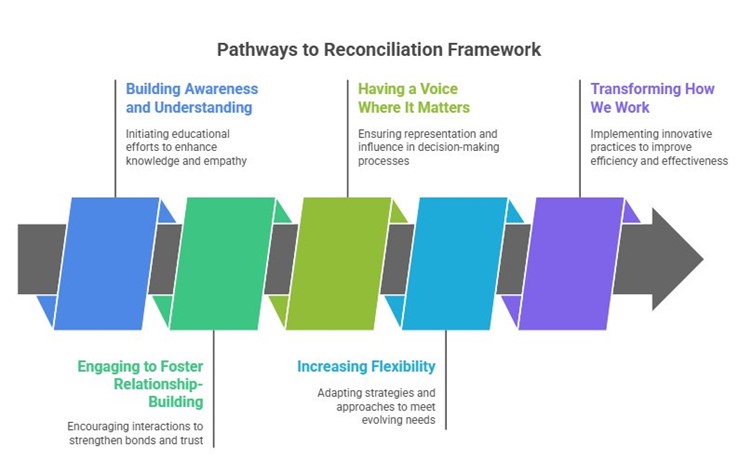
In 2021, NRCan finalized the development of a Pathways to Reconciliation Framework intended to build a lasting, evergreen, and meaningful plan to advance reconciliation with Indigenous Peoples at NRCan. This Framework, created through dialogue with Elders, representatives from across NRCan, and the Indigenous Employees Network, and endorsed by the Deputy Minister, proposed five action pillars (Figure 1).
Figure 1: The five pillars in NRCan’s Pathways to Reconciliation Framework
Text version
The five pillars in NRCan’s Pathways to Reconciliation Framework:
Building Awareness and Understanding: Initiating educational efforts to enhance knowledge and empathy.
Having a Voice Where it Matters: Ensuring representation and Influence in decision-making processes.
Transforming How We Work: Implementing innovative practices to improve efficiency and effectiveness.
Engaging to Foster Relationship-Building: Encouraging interactions to strengthen bonds and trust.
Increasing Flexibility: Adapting strategies and approaches to meet evolving needs.
With the Framework as the baseline, NRCan’s Pathways to Reconciliation Action Plan was developed and formally approved in June 2024. The Action Plan contains employee-identified actions for implementing the Framework’s five pillars and has been shaped through the guidance and direction of NRCan Elders-in-Residence, executives, and other valued partners.
Joint project objectives and scope
NRCan’s Audit and Evaluation Branch (AEB) initiated the joint audit and evaluation (joint project) to assess the preliminary impacts of reconciliation actions and provide a comprehensive understanding of how reconciliation is being advanced within the department. While past NRCan audits and evaluations have focused on individual programs or initiatives designed to advance reconciliation, this is the first focusing on department-wide reconciliation efforts.
The joint project examines relevant activities from fiscal years 2016-17 to 2023-24. The conduct phase was substantially completed Summer 2025, however the joint project considered new or significantly changed information as of December 2025 to ensure continued relevance of the findings against the joint project objectives.
The specific project objectives are:
- To assess the extent to which organizational capacity is in place to prioritize and support NRCan’s reconciliation actions; and
- To assess formative steps taken in building towards reconciliation, including best practices and lessons learned.
The project questions are presented below. Sub-objectives for each question and the detailed criteria applied in their assessment are provided in Appendix A.
- Has NRCan adequately defined and communicated its priorities for advancing reconciliation?
- Has NRCan developed an adequate governance and coordination framework to support the planning, implementation, and monitoring of its advancing reconciliation actions?
- What progress has NRCan made towards full inclusion of Indigenous Peoples within its workforce?
- Does NRCan have effective mechanisms and processes to increase internal cultural competencies?
- Does NRCan have effective and efficient mechanisms for coordination of Indigenous engagement and relationship-building?
- To what extent are select NRCan initiatives advancing reconciliation? Are there best practices and lessons learned from NRCan initiatives that can help NRCan overcome challenges related to advancing reconciliation?
- The scope of the joint project excluded examination of NRCan’s activities in relation to the Crown’s legal Duty to Consult stemming from section 35 of the Constitution Act, 1982. Any references to engagement made in this report refer to interactions outside of the scope of the legal duty to consult. Rather, our examination of engagement pertains to activities pursued with the intention of building relationships, trust and understanding between parties, and to connect and seek feedback or collaborate on issues of mutual interest.
Approach and methodology
The joint project was carried out in a manner that ensures the team’s neutrality and objectivity, as per respective professional requirements and standards, and ensured that observations and conclusions are evidence-based. The approach and methodology used in this project followed the Treasury Board Policy on Results, including related Standards on Evaluation, the Institute of Internal Auditors’ Global Internal Audit Standards (IIA Global Standards), and the Treasury Board Policy on Internal Audit. These standards and policies required that the project be planned and performed in such a way as to obtain reasonable assurance that project objectives are achieved. The joint project included methods considered necessary to provide such assurance.
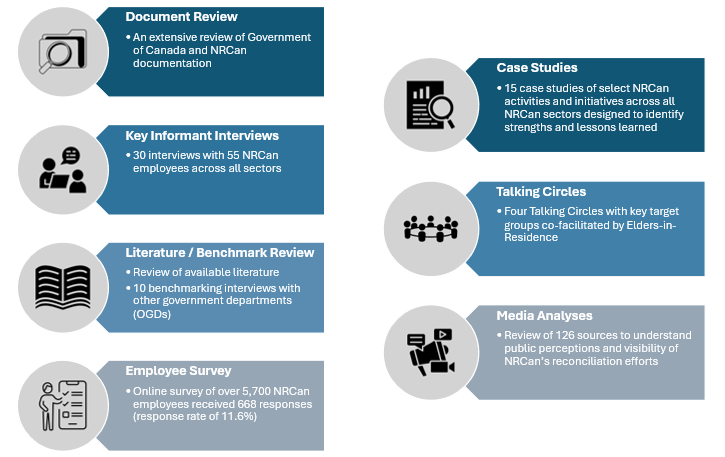
The joint project used seven data collection methods designed to ensure validity of the information collected and allow for the triangulation of evidence. Figure 2 provides a summary of each method. Additional details are provided in Appendix B.
Figure 2: Data collection methods used by the joint project
Text version
Data collection methods used by the joint project:
Document Review: An extensive review of Government of Canada and NRCan documentation
Key Informant Interviews: 30 interviews with 55 NRCan employees across all sectors
Literature / Benchmark Review: Review of available literature. 10 benchmarking interviews with other government departments (OGDs)
Employee Survey: Online survey of over 5,700 NRCan employees received 668 responses (response rate of 11.6%)
Case Studies: 15 case studies of select NRCan activities and initiatives across all NRCan sectors designed to identify strengths and lessons learned
Talking Circles: Four Talking Circles with key target groups co-facilitated by Elders-in-Residence
Media Analyses: Review of 126 sources to understand public perceptions and visibility of NRCan’s reconciliation efforts
The timing of the joint project coincided with NRCan’s development of the Pathways to Reconciliation Framework. Consequently, it was not possible for AEB to assess its implementation. However, where possible, the report has been structured to align its findings and recommendations with the Framework’s five pillars. This approach highlights NRCan’s progress towards achieving the objectives of each pillar and areas requiring further improvement. The joint project’s observations related to alignment of NRCan’s reconciliation priorities and overall governance provide context for the analysis of the findings related to the pillars.
Findings
Alignment of reconciliation priorities
The joint project examined the extent to which NRCan’s priorities for advancing reconciliation are aligned with its departmental mandate, as well as with Government of Canada (GC) and Indigenous priorities.
Alignment with federal and departmental reconciliation priorities
The Government of Canada is committed to achieving reconciliation with Indigenous Peoples through a renewed, nation-to-nation, government-to-government, and Inuit-Crown relationship based on recognition of rights, respect, co-operation, and partnership as the foundation for transformative change.Footnote 4 Indigenous Peoples have a special constitutional relationship with the Crown. This relationship, including existing Aboriginal and treaty rights, is recognized and affirmed in section 35 of the Constitution Act, 1982.
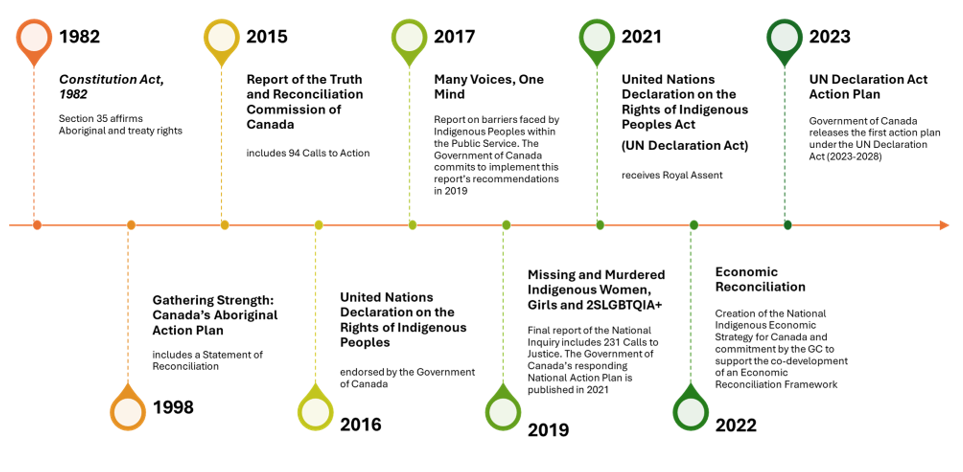
In 1998, the GC issued a statement of reconciliation that acknowledged the wrongs committed against Indigenous Peoples, especially the policies aimed at assimilation and the role of residential schools.Footnote 5 Since then, the GC’s commitments to advancing reconciliation have been reflected in various actions and responses (see Figure 3).
Figure 3: There are many key events in Canada’s recent reconciliation journeyFootnote 6
Text version
There are many key events in Canada’s recent reconciliation journey:
1982: Constitution Act, 1982: Section 35 affirms Aboriginal and treaty rights.
1998: Gathering Strength: Canada’s Aboriginal Action Plan includes a Statement of Reconciliation.
2015: Report of the Truth and Reconciliation Commission of Canada includes 94 Calls to Action.
2016: United Nations Declaration on the Rights of Indigenous Peoples endorsed by the Government of Canada.
2017: Many Voices, One Mind Report on barriers faced by Indigenous Peoples within the Public Service. The Government of Canada commits to implement this report’s recommendations in 2019.
2019: Missing and Murdered Indigenous Women, Girls and 2SLGBTQIA+ Final report of the National Inquiry includes 231 Calls to Justice. The Government of Canada’s responding National Action Plan is published in 2021.
2021: United Nations Declaration on the Rights of Indigenous Peoples Act (UN Declaration Act) receives Royal Assent.
2022: Economic Reconciliation. Creation of the National Indigenous Economic Strategy for Canada and commitment by the GC to support the co-development of an Economic Reconciliation Framework.
2023: UN Declaration Act Action Plan. Government of Canada releases the first action plan under the UN Declaration Act (2023-2028)
Multiple sources of evidence confirm that NRCan’s reconciliation efforts are aligned with relevant GC commitments, including those in response to calls for action (e.g., TRC Calls to Action, MMIWG Calls to Justice). The joint project’s document review identified more than 50 specific actions from the collective recent calls that are relevant to NRCan’s mandate. Comparative analysis revealed at least one ongoing or completed NRCan activity that addresses each of these.
NRCan’s reconciliation efforts are also aligned with its departmental mandate. Staff interviewed within NRCan perceive that the department has positioned reconciliation as a core priority. Document review identified over 70 departmental initiatives related to advancing reconciliation implemented within NRCan since 2016-17. This includes activities designed to address Indigenous economic development and ensure direct benefits for Indigenous communities from natural resource projects as well as internal policies, strategies or initiatives implemented within the department to advance reconciliation goals and outcomes. These activities are consistent with NRCan’s broader mandate to support sustainable resource development and foster economic opportunities.
Alignment with Indigenous priorities
“History has resulted in important differences in the relationship of various First Nations, Inuit and Métis Peoples with Natural Resources Canada. Each look at their relationship with Canada via their own lens. Section 35 of the Constitution holds us all together.”
– Elder Vince Teddy,
October 2025
While the perspectives and priorities of Indigenous Peoples across Canada differ, evidence indicates that NRCan has implemented initiatives that broadly align with Indigenous priorities by focusing on reconciliation, economic participation, environmental stewardship, and cultural respect. Interviewees noted that these efforts are aimed at ensuring that Indigenous Peoples have access to capital for participating in major projects and receive long-term, sustainable benefits from developments on their traditional territories.
Despite this alignment, media analysis also indicated that there are still systemic barriers that hinder the realization of meaningful and equitable outcomes for Indigenous communities. Evidence indicates a need for NRCan to integrate Indigenous Knowledge and perspectives into the planning and decision-making processes for reconciliation-related projects and initiatives to foster trust and collaboration and ensure that implemented activities truly reflect and address the goals and needs of Indigenous communities. This view was emphasized in both the Pathways to Reconciliation Framework and by the joint project’s Talking Circles.
It’s important that Inuit voices be included where policy affecting us is made. Indigenous People will no longer just shake our heads and say, ‘That’s how it is’ — those days are over. We are the first peoples of this great land, and we won’t just stand by and watch.”
– Elder Edna Agnes Ekhivalak Elias, October 2025
Feedback from the online survey also identified opportunities to improve this alignment via NRCan’s processes for engaging with Indigenous Peoples. Specifically, respondents indicated the need for better communication and increased transparency about projects, policies, and decisions affecting Indigenous communities. They also highlighted the importance of building trust and relationships to better understanding Indigenous priorities through regular meetings, community visits, and collaborative initiatives.
Governance, oversight and accountability
The joint project examined whether roles, responsibilities, and accountabilities pertaining to the department’s efforts towards advancing reconciliation are clearly defined and communicated to partners and stakeholders.
The role of Nòkwewashk
Among other actions, Pillar 5 of the Pathways to Reconciliation Framework suggests that NRCan strengthen and further refine the role of an “Indigenous centre of excellence” to guide the department in its work. In March 2022, NRCan merged existing business units to create a new sector named Nòkwewashk. This sector is mandated to deliver Indigenous engagement, program support, and policy leadership on economic reconciliation and regulatory coordination while bringing together Indigenous partners, provinces, territories, and industry representatives to navigate regulatory and development processes more efficiently. The sector also aims to identify opportunities to strengthen Indigenous inclusion in the natural resources sector while supporting meaningful Indigenous participation in the natural resource economy.
As a sector, Nòkwewashk receives funding through various mechanisms comprised of permanent funding, time-limited program funding and supplemented by funding generated by the corporate costing model and from the departmental reserve.
Box 1: The gifting of ‘Nòkwewashk

This name, gifted by Elders, is an Algonquin word for sweetgrass, one of the four sacred medicines in many Indigenous traditions. Nòkwewashk became the first federal department sector to be officially named in an Indigenous language, marking a step forward in Canada’s reconciliation journey.
Nòkwewashk is recognized across the department as the central hub for reconciliation-related guidance, coordination, and leadership. As of Summer 2025, the sector’s four branches, focused on regulatory coordination, reconciliation implementation, partnerships and engagement, and horizontal policy, were defined in internal documentation. Nòkwewashk’s role in guiding and facilitating engagement with Indigenous Peoples, providing advice to staff, and supporting internal capacity-building initiatives (e.g., cultural teachings, sharing circles, and Indigenous recruitment programs) was widely acknowledged and valued by NRCan employees.
While Nòkwewashk is recognized as a key departmental resource, many interviewees and Talking Circle participants expressed difficulties in both understanding the specificities of Nòkwewashk’s mandate as well as identifying key points of contact within the sector. Departmental interviewees cited frequent internal restructuring and turnover within Nòkwewashk as factors that have contributed to these challenges.
Reconciliation as a department-wide responsibility
Whereas NRCan has established Nòkwewashk as a centralized function, key documents and governance structures consistently emphasize reconciliation as a shared departmental responsibility. Though generally recognized internally as necessary to advance reconciliation, evidence indicates the lack of clarity and understanding of roles and responsibilities has led to some coordination challenges and overlapping responsibilities. Overlaps were most evident in areas that include Indigenous recruitment, as well as education and cultural competency development for staff. Interviewees indicated that overlaps in responsibilities have led to inefficiencies and confusion, citing inconsistent collaboration and communication between groups as potential barriers to advancing reconciliation in a coherent and coordinated manner across NRCan.
Further, despite the shared responsibility, interviewees noted that reconciliation efforts are often championed by a few individuals, placing a disproportionate burden on specific people and teams, and may result in in fragmented leadership and inconsistent progress.
Many interviewees and survey respondents reported uncertainty about their individual roles in advancing reconciliation, citing the absence of clear and actionable guidance to operationalize strategic commitments and reconciliation principles within their respective teams. Interviewees noted that employees in some sectors will defer to Nòkwewashk for guidance instead of building their own internal knowledge. While some sectors’ strong relationships with Nòkwewashk and informal communication processes currently bridge these gaps, interviewees expressed the need for more comprehensive and detailed guidance on their roles and responsibilities to ensure consistent implementation and integration.
Governance structures
The joint project examined whether an adequate oversight structure and effective coordination, monitoring, reporting, and communication processes are defined to support the department’s efforts related to advancing reconciliation.
The department has demonstrated an intent to embed reconciliation principles across various levels of governance. NRCan has taken some steps to integrate reconciliation across several governance committees in its formal corporate structure. These committees have included in their mandates an objective to apply a reconciliation lens within their respective oversight, advisory, or decision-making roles. While consistent with NRCan’s view of reconciliation as a department-wide priority, evidence indicates that communication and alignment between these governance bodies on reconciliation-related issues is limited, reducing opportunities for integrated planning.
Previously, NRCan had specific Indigenous-focused governance bodies that supported coordination and oversight of reconciliation-related initiatives, however, neither are presently operational. The Director General Indigenous Priorities and Engagement Committee (DG-IPEC) was dissolved in 2023 and replaced with the Director-led Indigenous Engagement Policy and Programs Committee (Dir-IEPPC), which is now inactive. At present, NRCan does not have an Indigenous-focused governance committee within its formal corporate governance structure.
Other informal governance, advisory and collaborative forums, including internal communities of practice, sector-specific committees and working groups, as well as intersectoral groups, play a role in enabling external Indigenous engagement. For example, though not a part of NRCan’s formal corporate governance structure, a Pathways EX-Implementation Advisory Forum was created to guide and coordinate reconciliation activities across NRCan in support of the implementation of the Pathways to Reconciliation Action Plan. The committee reconvened monthly meetings beginning in January 2025. However, while they can influence progress, these forums operate outside NRCan’s formal governance structure and lack the authority or departmental mandate to drive change across NRCan.
Departmental planning processes
The project examined whether the department has processes in place to support the planning and implementation of reconciliation activities related to advancing reconciliation.
NRCan has embedded reconciliation needs and considerations across the organization, including through strategic frameworks and integrated departmental planning processes that include:
- Pathways to Reconciliation Framework and Action Plan – These documents outline the departmental internal direction for reconciliation, including related objectives and commitments. The key actions and activities required to advance reconciliation are identified in the Action Plan, along with accountabilities and an estimated timeline for implementation.
- Departmental Plan (DP) – This annual plan outlines departmental priorities, planned activities, and core responsibilities. It presents planned budgetary spending and Full-Time Equivalent requirements at the core responsibility level, with performance indicators and targets aligned to key departmental results. While prior iterations recognized reconciliation as a strategic priority, in 2023-24, the DP elevated reconciliation as a horizontal priority across all core responsibilities.
- Financial Planning – NRCan’s Integrated Business Plan (IBP) was an annual exercise that examined the allocation of resources to carry out planned activities.Footnote 7 As of 2024-25, the IBP’s Priorities and Results template served as the primary internal mechanism to identify and allocate resources to departmental priorities, requiring branches to identify and tag reconciliation-specific actions, along with their associated resources. However, as reconciliation is a horizontal priority and every dollar may only be accounted for once in IBP reporting, this process was challenged to obtain a representative estimate of funds allocated specifically to reconciliation efforts. A new financial planning process, led by the Finance and Procurement Branch, has subsequently replaced this process.
Pillar 1: Building awareness and understanding
Understanding the history, protocols, knowledge systems, practices, and expertise of First Nations, Inuit, and Métis—as well as the ongoing impacts of colonialism—is the first step toward meaningful change. Developing cultural competency across NRCan will enable employees to better understand the historical and systemic factors that shape the present, and to identify new ways of moving forward. This is not only about learning the past, but also about repairing harm, supporting healing, and building a stronger path forward.
Source: Adapted from NRCan Pathway to Reconciliation Framework
Internal communication of reconciliation priorities
The joint project examined whether NRCan has defined and communicated, both internally and externally, its priorities related to reconciliation in a consistent and transparent manner.
As one of its first steps in its reconciliation journey, NRCan has defined a Framework to advance its plan for reconciliation. With priority actions established, NRCan has begun to communicate and emphasize the importance of these to its employees.
The joint project found that the department actively communicates its reconciliation priorities through a variety of channels such as emails from the Deputy Minister and regular articles on The Source (NRCan’s Intranet) to inform employees of events or important dates related to Indigenous culture and history. These communications also encourage employee learning and sometimes highlight how they can contribute to advancing reconciliation in their everyday work. Communications from other senior executives, such as Assistant Deputy Ministers and Director Generals, have also been key to advancing awareness and action on reconciliation. These approaches are aligned with best practices observed in benchmark departments.
Overall, survey results demonstrate that there is broad recognition among employees that reconciliation is a fundamental and shared organizational priority. NRCan employees also recognize that the department has made efforts to strengthen awareness and understanding of its priorities and commitments for advancing reconciliation within the department. Interviewees perceived that direct communication from the Deputy Minister shows a positive tone and support towards reconciliation from senior management.
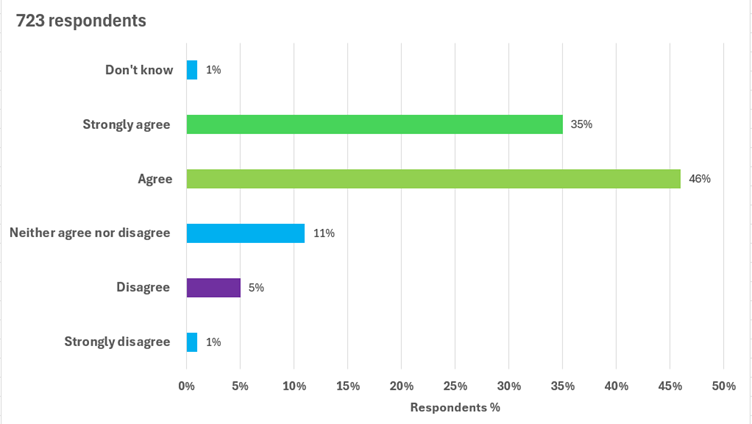
Statement: I am aware of NRCan’s priorities for advancing reconciliation with Indigenous Peoples.
Text version
A chart with horizontal bars that provides (in percentage) the value of each response.
- 723 respondents.
- Don’t know: 1%
- Strongly agree: 35%
- Agree: 46%
- Neither agree nor disagree: 11%
- Disagree: 5%
- Strongly disagree: 1%
However, while a majority of survey respondents (82%) reported being aware of NRCan’s priorities for advancing reconciliation, interview and survey findings suggested an uneven understanding of specific priorities and actionable steps across the department.
Most interviewees and about 50% of survey respondents identified the need for significant improvement in how NRCan reconciliation priorities and efforts are communicated within the department. Accessing up-to-date information and documents about NRCan’s reconciliation priorities remains a challenge, as key information is not easily accessible or digestible for all employees. Employees can consult the information via the Intranet and other internal sources. However, the extent to which they do so is unclear. Nearly half (42%) of survey respondents reported being unfamiliar with the Pathways to Reconciliation Framework. There are also some key documents that remain inaccessible. Notably, while the signed commitment page from the Pathways to Reconciliation Action Plan is displayed in departmental buildings, NRCan has not communicated the contents of the Action Plan to all employees.
NRCan employees also expressed a strong desire for clearer, more accessible, and role-specific communication to ensure that priorities are conveyed in ways that are easily understood. Role-specific communications could make it easier for employees to integrate these priorities as actionable steps in their day-to-day work. Among survey respondents indicating that NRCan could improve its internal communications, 62% were employees at the working level and 16% were managers or supervisors. Data suggests that employees directly involved in Indigenous engagement, policy work, or those more interested about the topic demonstrated a stronger grasp of NRCan's reconciliation priorities than employees in non-policy or in technical roles. Employees also suggested more frequent and concrete communication around reconciliation efforts, along with embedding reconciliation into the employee experience through onboarding materials, performance management processes, and mandatory training modules.
External communication of reconciliation priorities
NRCan uses its official website and leverages various social media platforms to communicate its commitment to advancing reconciliation and showcase related efforts. In addition, more direct methods such as meetings, presentations, and dialogues are used to engage Indigenous partners on reconciliation activities. However, interviewees perceived that NRCan’s reconciliation priorities could be communicated more clearly and broadly to Indigenous communities. In particular, NRCan’s Pathways to Reconciliation Framework and related Action Plan have not been formally shared with external audiences. Interviewees expressed that making these documents more widely available could be beneficial, both for transparency and to strengthen relationships with Indigenous partners and communities.
While NRCan’s communication approaches are broadly consistent with those of other federal departments, some of these have chosen to publicly communicate their reconciliation “pathways” (e.g., Global Affairs Canada’s Action Plan on Reconciliation with Indigenous Peoples – 2021–2025, and the Royal Canadian Mounted Police Path of Reconciliation). Parks Canada has adopted an approach where the public is invited to request a copy of its “Promising Pathways” resource.
Mandatory self-directed Indigenous learning
The joint project examined whether training taken by NRCan employees towards promoting cultural awareness and understanding is tracked.
Reflecting Call to Action #57 of the Truth and Reconciliation Commission, NRCan has implemented various capacity building activities to build awareness and understanding of Indigenous culture, history and traditions. In fiscal year 2021-22, NRCan introduced a mandatory self-directed Indigenous learning requirement to promote and strengthen Indigenous cultural competency across the department. All employees are required to complete a minimum of eight hours annually of Indigenous-related learning activities and track their progress through the Public Service Performance Management application.
‘‘We call upon federal, provincial, territorial, and municipal governments to provide education to public servants on the history of Aboriginal peoples, including the history and legacy of residential schools, the United Nations Declaration on the Rights of Indigenous Peoples, Treaties and Aboriginal rights, Indigenous law, and Aboriginal–Crown relations. This will require skills-based training in intercultural competency, conflict resolution, human rights, and anti-racism.’’
– TRC Call to Action #57
Survey respondents reported that the Indigenous learning requirement was generally well communicated and understood; 94% of respondents are aware of the requirement to complete eight hours annually of Indigenous-related learning.
Managers play a key role in its implementation by guiding learning plan activities, ensuring integration into mid-year and year-end performance evaluations, and assessing progress. However, interviewees indicated that the extent to which managers actively promote learning opportunities varied and largely depended on individual initiative, which may result in inconsistent levels of engagement across the department.
The joint project team also noted while there is guidance on how the self-directed learning should be recorded by employees and monitored by their managers, there is no formal mechanism to aggregate data at the sector or organizational level to enable broader departmental monitoring and oversight.
Capacity-building to increase cultural competencies
The joint project examined whether the department’s needs with respect to the necessary competencies for advancing reconciliation are identified and addressed.
At the time of the joint project, a comprehensive analysis to identify, consolidate, and report on NRCan’s overall competency needs and gaps related to reconciliation at NRCan had not been conducted; however, several individual analyses had been completed independently of one another to identify reconciliation-related competency needs, including surveys, workshops, discussions, assessments, and engagement sessions. In addition to learning products provided by the Canada School of Public Service, NRCan has internally developed various capacity-building initiatives that are intended to contribute toward strengthening awareness and cultural understanding to advance reconciliation.
The joint project team observed that established initiatives are diverse in nature, cover a wide range of topics, and are generally accessible to employees (Figure 4). Specifically, the Circle of Nations and Elders-in-Residence programs were widely recognized for their instrumental role in strengthening Indigenous cultural awareness and understanding, including providing regular learning opportunities to participate in Elders’ Teachings on Indigenous cultures, traditions, history and current realities. Interviewees and Talking Circle participants described these offerings as being particularly impactful.
Figure 4: NRCan offers a range of Indigenous cultural awareness and capacity-building activities
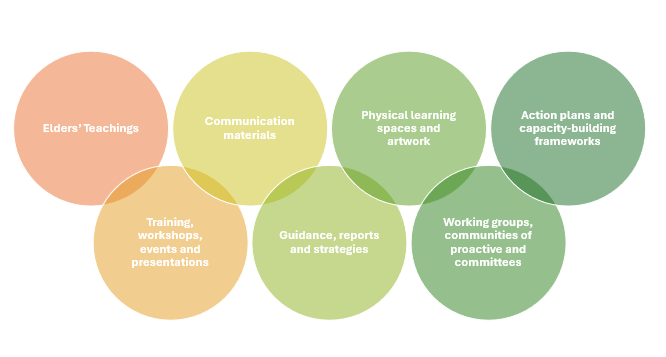
Text version
NRCan offers a range of Indigenous cultural awareness and capacity-building activities:
- Elders’ Teachings
- Communication materials
- Physical learning spaces and artwork
- Action plans and capacity‑building frameworks
- Training, workshops, events and presentations
- Guidance, reports and strategies
- Working groups, communities of practice and committees
Elders’ teachings
The Circle of Nations Elders-in-Residence program regularly offers First Nations, Inuit, and Métis Elders’ Teachings to the department, exploring diverse subject matter including cultural traditions, protocols, history, and contemporary topics, to honour traditional knowledge systems and promote increased awareness and understanding from Indigenous perspectives.
Indigenous learning spaces and artwork
Some NRCan spaces across the country have been dedicated to reconciliation, learning, gathering and displaying Indigenous artwork, to promote shared reflection, creativity and storytelling of Indigenous Peoples and cultures. These include the Circle of Nations Learning Centre, and several Canadian Forest Service spaces.
Blanket exercise
Multiple branches in several NRCan sectors have organized Blanket Exercise workshops for employees, an interactive learning experience, to build awareness of relationships between Indigenous and non-Indigenous People in past and present contexts. NRCan has also offered department-wide Blanket Exercise sessions for National Indigenous Peoples Day and the National Day for Truth and Reconciliation.
While these promising practices were observed to demonstrate meaningful efforts to centre Indigenous ways of teaching, the Action Plan identifies the opportunity to further integrate Indigenous approaches, including land-based, experiential and participatory initiatives as a priority.
Assessing the impact of cultural awareness training
The joint project examined whether cultural awareness training provided by NRCan to its employees is assessed for impact.
The joint project team did not find any evidence to confirm whether the department is assessing the effectiveness of the annual eight-hour Indigenous learning requirement. It was recognized by interviewees that establishing a preliminary benchmark of the current departmental competency level is needed to meaningfully assess impact. However, concerns were raised regarding the requirement itself, citing eight hours of capacity training annually is not necessarily sufficient to equip all staff with the competencies they require to advance reconciliation. Equally, it was raised in interviews and Talking Circles that the number of hours completed may not be an appropriate indicator of learning outcomes or impact of training, instead reducing the commitment to a “check-box exercise”.
At the activity level, NRCan has implemented several feedback mechanisms that enable staff to share their input on departmental and sectoral capacity building and training activities, with some collecting input during design and others following employee participation in the learning activity. These processes varied in formality, with feedback not consistently solicited across activities to support an overall assessment. At the time of writing, while some insights were available from earlier efforts, NRCan had not completed a comprehensive analysis to identify its overall reconciliation-related competency needs and knowledge gaps.
The joint project’s employee survey found that 78% of respondents agreed that their understanding increased after participating in Indigenous-related training or learning activities.
Statement: My understanding of Indigenous history, traditions, cultures, and and/or inclusion/respect for Indigenous Languages increased after participating in the Indigenous-related training or learning activities
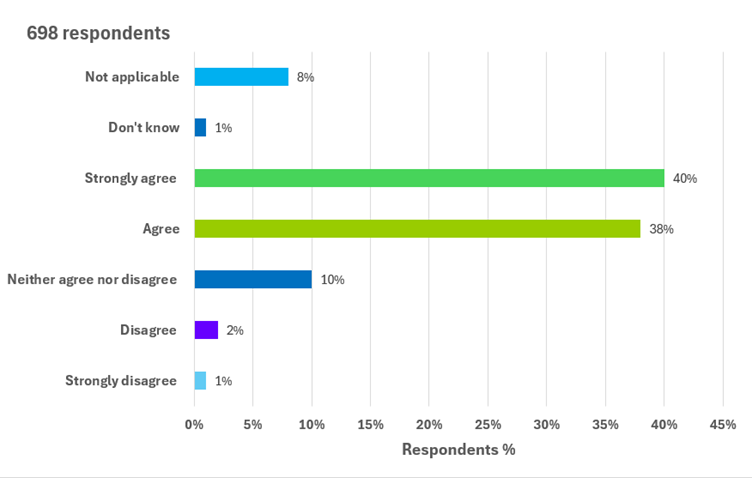
Text version
A chart with horizontal bars that provides (in percentage) the value of each response. 698 respondents.
- Not applicable: 8%
- Don’t know: 1%
- Strongly agree: 40%
- Agree: 38%
- Neither agree nor disagree: 10%
- Disagree: 2%
- Strongly disagree: 1%
While the development of cultural competency was recognized as an essential requirement for all staff, additional learning needs exist for specific groups based on their role and the nature of their work (e.g., employees working directly with Indigenous partners or related files). Interviewees from the People and Culture Branch also indicated that managers must be trained and empowered to fulfill their managerial duties, as they onboard newly hired Indigenous employees. Interviews highlighted that gaps in these areas may contribute to misunderstandings and tensions between non-Indigenous managers and Indigenous members of their team.
Interviewees highlighted the invaluable guidance provided by Indigenous colleagues and communities to staff in support of their continued learning. While Indigenous staff and partners may voluntarily contribute to capacity-building efforts, they should not be expected to assume the responsibility for educating non-Indigenous colleagues. Where Indigenous Peoples choose to participate in these efforts, formal recognition should be provided (noted as a best practice in the Many Voices, One Mind Scorecard Report).
Pillar 2: Engaging to foster relationship building
Transforming engagement means moving beyond transactional partnerships to building long-term, respectful, and flexible relationships with Indigenous communities. Engagement must be consistent, coordinated, and grounded in listening to community priorities rather than overwhelming communities with fragmented requests.
Source: Adapted from NRCan Pathway to Reconciliation Framework
Coordination of engagement
The joint project examined whether NRCan has established a process to ensure coordination of its engagements with Indigenous Peoples. It identified two key issues: the absence of a centralized, department-wide system for coordinating Indigenous engagement activities, and insufficient support and reinforcement for the utilization of existing tools.
Document review found that multiple sectors keep separate contact directories and consultation records to keep track of their engagements with Indigenous Peoples, without sharing this information across the department. Previous efforts to launch a centralized external engagement tracker were not ultimately implemented. Other existing tools are reported to be underutilized due to limited implementation and resource constraints.
Nòkwewashk has established a dedicated engagement team that collaborates closely with National Indigenous Organizations (NIOs) to streamline engagement efforts with Indigenous Peoples. However, with exception of the NIOs, engagement efforts and approaches vary across NRCan as sectors remain responsible for their own engagement with Indigenous partners.
Without a centralized engagement tool, increased reliance is placed on informal networks to share information. There is no comprehensive data on the history, frequency and distribution of groups being engaged by NRCan, with siloed activities leading to overlaps and fatigue in engagement. Evidence indicates that Indigenous communities are generally overwhelmed by numerous consultation and engagement requests, often from multiple departments and multiple contacts within the same department, limiting their ability to participate meaningfully.
Implementing best practices for building better relationships
The joint project examined whether NRCan has identified and integrated best practices to guide its approach to engaging with Indigenous communities.
Evidence indicates that some NRCan sectors have established protocols for planning and conducting Indigenous engagements. Literature shows that these efforts are comparable to those of other municipalities, local governments, and provinces in Canada who are using similar practices to honour Indigenous traditions and cultural practices in their operations. Promising practices include:
- Adopting culturally sensitive practices, such as seeking consent before using or sharing Indigenous Knowledge and use of land acknowledgments in meetings and official communications.
- Offering cultural awareness training and capacity building activities within teams, in addition to training opportunities available department-wide.
- Providing financial compensation to support the participation of Indigenous partners in engagements (e.g., honorariums).
- Seeking support for engagements from Indigenous Elders and Knowledge Keepers. Interviewees and Talking Circle participants commended the increasing practice of consulting Elders-in-Residence as they offer invaluable insights and guidance that can enhance the understanding of cultural protocols among NRCan employees.
Several of these practices require reconciliation to be built into resource allocation and planning processes, including allocating a percentage of funds to support Indigenous engagement and consultation within programs or training for NRCan staff at the branch level. Case studies highlighted that several departmental initiatives have demonstrated intentional approaches to resource planning in support of reconciliation objectives.
Box 2: The example of Wah-ila-toos demonstrates progress towards more inclusive design
Wah-ila-toos, a clean energy initiative designed to support Indigenous communities in transitioning away from diesel energy, stands out for its inclusive and adaptable design. Wah-ila-toos does not impose fixed application deadlines, enabling communities to engage when they are ready. It also offers pathfinding support to help applicants navigate complex federal funding options and provides oral reporting mechanisms that honour traditional knowledge-sharing practices. Program officers work with communities to facilitate meaningful engagement, and an Indigenous Council plays a guiding role in shaping the program’s development to ensure cultural relevance and alignment.
These practices vary greatly across sectors, with some having more structured approaches. Interviewees implementing such measures generally report feeling more equipped and comfortable using their skills and knowledge of Indigenous history, protocols, and engagement practices to effectively and respectfully engage with Indigenous Peoples in their role.
Evidence indicates that achieving meaningful engagement is limited by real or perceived cultural competency among some NRCan employees and access to information on engagement processes. While 59% of survey respondents indicated that they feel comfortable using their skills to engage effectively and respectfully with Indigenous Peoples in their role, 15% of respondents indicated discomfort. About 40% of survey respondents reported not clearly understanding the processes for seeking support from Indigenous Elders and Knowledge Keepers and not understanding or having confidence in applying cultural protocols appropriately.
Some interviewees and survey respondents indicated that information about engagement processes is often hard to access, making it difficult to adopt department-wide principles and best practices. These employees further cited examples of teams that developed successful frameworks for co-development but not having appropriate channels to share such practices across the department, leading to missed opportunities for consistent and improved engagement.
Talking Circle participants perceived that NRCan employees are often not equipped with the necessary training and resources to engage meaningfully. They called for more support from the department to establish protocols that respect Indigenous ways of working, emphasizing the importance of reciprocal and continuous, rather than transactional relationships. Some interviewed employees requested ongoing training and mentorship to ensure cultural sensitivity practices are consistently understood and applied across the department. They also suggested the creation of more opportunities for employees with direct experience in cultural protocols and relationship-building to mentor those who are newer to these roles.
The literature review emphasized that ineffective engagement approaches often lead to hesitancy from Indigenous Peoples, impeding the achievement of intended engagement outcomes. There is some evidence of this impact within NRCan. The document review found instances of feedback from Indigenous partners pointing to cultural insensitivity and the use of culturally inappropriate language during engagement activities as major barriers to effective engagement at NRCan.
Administrative limitations to engagement
Evidence indicates that in-person meetings are not only essential to build trust and show commitment in nation-to-nation relationships but can also increase knowledge of Indigenous cultures and priorities among participating NRCan employees. While document review found evidence of financial commitment to facilitate effective engagement, available funding dedicated to in-person meetings is limited and, when available, is often project-based, short-term and subject to travel caps. High turnover of engagement officers can also erode previously built trust and contributes to uneven capacity to engage with Indigenous groups among NRCan sectors. These factors limit NRCan’s ability to sustain meaningful, long-term relationships.
Overall, employees highlighted the need for more flexibility in related administrative processes. For example, administrative processes and approvals required for compensating engagement with Indigenous partners (e.g., honorariums, tobacco purchase, etc.) were described as often being slow. Interviews with other federal departments found that some departments are employing department-wide strategies to tackle these challenges. For example, one department has utilized grants or contribution agreements to cover the engagement costs assumed by their Indigenous partners, including travel expenses for in-person meetings, honoraria for attendance and travel days, and time invested in review of documents. At the time of the joint project, NRCan was considering options for new approvals authorities to streamline honoraria and gift processes.
Pillar 3: Having a voice where it matters
Reconciliation requires ensuring Indigenous voices are present and influential in NRCan’s decision-making processes. Indigenous perspectives are too often missing at senior tables, and Indigenous staff are overburdened with representing all Indigenous viewpoints across the department. NRCan must create meaningful opportunities for Indigenous leadership, representation, and career advancement.
Source: Adapted from NRCan Pathway to Reconciliation Framework
Creating an inclusive work environment
The joint project examined whether the department has established processes to create an inclusive workplace environment, and to identify, assess and mitigate barriers faced by Indigenous employees.
The Many Voices, One Mind report (2017) and the Clerk’s Call to Action (2024) highlight systemic gaps and barriers faced by Indigenous employees across the federal public service. The joint project found that NRCan has leveraged such government-wide frameworks to develop practices designed to create an inclusive work environment for Indigenous employees.
The Pathways to Reconciliation Framework, its supporting Action Plan, an NRCan Indigenous Inclusion Blueprint (2024), as well as a broader NRCan Employment Equity and Accessibility Action Plan formalize and coordinate NRCan’s departmental commitments and actions to support government-wide strategies and direction. To date, the joint project found that NRCan has established various practices to promote an inclusive and barrier-free environment for Indigenous employees. For example:
- Flexibilities applied under TBS policy to allow Indigenous employees whose location is critical to their identity to work from their home communities.
- The Indigenous Career Navigator, Elders-in-Residence and Indigenous Employee Network contribute towards the cultural safety and inclusion of Indigenous employees throughout their employment journey.
- The creation of learning centres, cultural programs and visual representation through Indigenous artwork and cultural symbols signify recognition and respect for Indigenous cultures and contribute to creating a welcoming environment.
However, Talking Circle participants and interviewees described actions to date as not being fully reflective of the lived realities and operational constraints faced by the Indigenous workforce at NRCan. NRCan has no coordinated internal process to actively review the effectiveness of these actions or to identify emerging barriers and challenges faced by Indigenous employees. Conversations and consultations that take place between key functions (Nòkwewashk, the People and Culture Branch, Indigenous Career Navigator) can help to identify common challenges, but these interactions were described by interviewees in these functions to be informal and infrequent, with no structured processes in place to guide or inform departmental action.
Box 3: NRCan’s Indigenous Career Navigator
The Indigenous Career Navigator program gives Indigenous public servants advice and guidance to navigate recruitment, development, and advancement. The program also supports managers, provides guidance on how best to support Indigenous employees at NRCan, and advises on implementing Indigenous recruitment and retention strategies.
Recruitment, retention and career progression
The joint project examined whether the department has effective policies, tools, and processes in place to ensure equitable recruitment, retention and career progression of Indigenous employees.
NRCan has made progress in supporting the recruitment of Indigenous employees through the development of targeted programs and initiatives. While dedicated efforts to improve recruitment processes have been a key area of focus, interviews and Talking Circles indicated that further work is required to support employees across various stages of their employment journey, including career development, progression and retention.
From 2021-22 to 2023-24, the Policy Analyst Recruitment and Development Program – Indigenous Stream had notable success in increasing Indigenous representation in entry level positions.Footnote 8 While it had reduced initial hiring barriers for Indigenous candidates and provides an opportunity for them to advance relatively quickly from a junior (EC-03) to intermediate (EC-05) position, there is a risk that educational qualifications and second language requirements associated with higher-level positions are barriers that may prevent participants from advancing into more senior roles, if candidates do not meet the qualification requirements. Bilingual requirements in the federal government are specific to English and French and do not recognize language ability in Indigenous languages.
NRCan’s Indigenous Career Navigator plays an important role in providing culturally relevant guidance and support to Indigenous employees across their employment journey. However, interviewees noted the role of the Indigenous Career Navigator is broad and lacks clearly defined priorities to guide its activities, alignment with achievable results, and integration with departmental and HR strategies. It was also noted that limited promotion and visibility of the Navigator, along with its organizational position, may contribute to its underutilization. At the time of the joint project, the organizational position of the Indigenous Career Navigator was in the process of being relocated to within Nòkwewashk.
The NRCan Sponsorship Program, launched in March 2025, is an initiative created to support career development across all Employment Equity (EE) groups through mentorship opportunities over an approximately 18-month period. Given the relative newness of this program the joint project was not able to assess its impact on career progression for Indigenous employees (or other EE groups). Similarly, some tools and guidance materials that exist promote equity in recruitment processes and offer general considerations across EE groups, without clear focus related to the distinct needs of Indigenous employees. At the time of the joint project, HR-related policies, tools and guidance (e.g., Inclusive Hiring Guide, Guidance on Mitigating Biases) remain largely oriented towards the general EE population.
Monitoring and reporting on Indigenous representation in NRCan’s workforce
The joint project examined whether the department monitors and reports on Indigenous representation in its workforce.
NRCan’s People and Culture Branch has processes in place to monitor and report on Indigenous representation within its workforce, supported by the development of internal data visualization dashboards, and communicates these reports across the department and through senior management committees.Footnote 9 Data monitoring includes:
- NRCan Self-Identification (Self-ID) Dashboard - Indigenous representation data is primarily collected through a voluntary self-identification process. The Self-ID Dashboard reports on the total number of employees by sector across the four Employment Equity designated groups, and also includes a distinctions-based breakdown of the total Indigenous population (First Nation, Inuit and Métis). The Q2 2025-26 Self-ID response rate across the department was reported at 55.4%. Recognizing that representation targets should be “a floor, not a ceiling”, the Self-ID Dashboard indicates that at this date Indigenous employees comprised 3.5% of the total NRCan workforce compared to 2.3% workforce availability. Interviewees and Talking Circle participants separately expressed concerns regarding the accuracy of the Self-ID data to provide a complete and accurate picture.
- HR Analytics Dashboard – As of 2025-26, this dashboard reports on the levels of representation across EE sub-groups by sector and occupational category as a positive or negative variance relative to workforce availability census data. Interviewees noted that while data is shared with them, it does not offer a breakdown to the representation of Indigenous sub-groups, which may impede their ability to identify areas where gaps may be occurring.
While these tools reflect meaningful efforts to provide department-wide visibility into Indigenous workforce representation, interviewees noted opportunities to enhance their utility to effectively inform strategies and decision-making. Interviewees reported that it is unclear how representation data is applied to inform recruitment and staffing strategies, and other related decision-making activities. Data users noted a general lack of clarity regarding the frequency in which the data is updated and communicated and were uncertain whether it aligns with their operational needs. Both dashboards were also noted to lack comparative historical information and do not currently identify or report on changes in representation levels over time.
Indigenous representation on NRCan governance committees
Having a voice where it matters also involves ensuring Indigenous voices are not only present but also influential in NRCan’s decision-making processes. As such, the Pathways to Reconciliation recommends that NRCan explore mechanisms for bringing Indigenous voices to decision-making tables at NRCan. The joint project examined whether departmental processes have been defined and implemented to increase Indigenous representation on NRCan’s governance committees.
The NRCan Corporate Governance Secretariat aims to strengthen overall oversight and support the effective function of departmental governance structures. The Secretariat monitors performance through an annual Governance Pulse Check survey which collects data on committee activities and attendance and evaluates sectoral representation across NRCan’s corporate governance framework.
The joint project found that while NRCan does not have defined processes to increase Indigenous representation on its governance committees, it has implemented processes to ensure that Nòkwewashk has representation on departmental governance committees.
Interviewees and Talking Circle participants expressed a lack of communication, engagement and transparency regarding departmental efforts and objectives to increase Indigenous participation on governance committees.
Pillar 4: Increasing our flexibility
Transforming relationships also means creating flexibility in how NRCan works with Indigenous communities. This includes reshaping our timelines, funding approaches, engagement processes, and administrative requirements so they are not barriers, but tools that support meaningful partnership. Flexibility is essential to respect Indigenous ways of planning, implementing, and sustaining initiatives across all stages of work.
Source: Adapted from NRCan Pathway to Reconciliation Framework
Incorporating flexibilities in design and delivery
The joint project included a sub-objective to identify lessons learned and best practices that could support NRCan to overcome challenges related to advancing reconciliation efforts and assess the extent to which these are being effectively leveraged by NRCan.
Central agencies establish the policies and directives that govern how departments like NRCan operate. The rules set in government-wide frameworks define both the constraints and the opportunities available in areas such as funding, procurement, staffing, and program delivery. In 2017, the Treasury Board of Canada updated its Directive on Transfer Payments to include an appendix specific to transfer payments to Indigenous recipients (Appendix K), which allows for departments to increase flexibilities to better meet Indigenous communities’ unique needs. While Appendix K sets the parameters, it is up to NRCan to interpret, navigate, and apply the available flexibilities in ways that support its mandate.
The joint project examined the extent to which NRCan provides Indigenous groups with equitable opportunities to engage in its programs and initiatives, and the extent to which it integrates an understanding and respect for traditional cultural approaches into their development and delivery. It found that the Pathways to Reconciliation Framework’s recommendations for Pillar 4 are being considered through an evolving commitment to incorporate Indigenous considerations into the design and delivery of NRCan transfer payment programs. While not all programs apply the same approach, examples of efforts to increase flexibility include:
- Establishment of separate funding streams for Indigenous-led projects.
- Continuous intake of proposals with no deadline for submissions from Indigenous partners.
- Supporting the preparation of proposals and application packages by making program staff actively available to clarify requirements for Indigenous proponents.
- Implementation of funding strategies that acknowledge the unique needs and contexts of various Indigenous groups, such as advance payments to Indigenous recipients or multi-year funding allocations.
Box 4: The benefits of using GBA Plus to inform program design
Since 1997, the Science and Technology Internship Program – Green Jobs - has provided funding to eligible employers across Canada to hire and mentor youth (ages 15-30) in the natural resources sector. In 2018-19, NRCan updated the design of the program to reflect GBA Plus considerations to increase participation of youth experiencing barriers to employment, including Indigenous youth. The post-secondary education requirement was removed, Indigenous-focused organizations were added and targets for employment equity groups and youth living in Northern and remote communities were set. Following these changes the program reported a significant increase in the representation of Indigenous youth, from just 6% of total participants in 2017–18 to 28% in 2024–25.
In addition, document review found that several NRCan sectors are conducting research internally or through third-party researchers to identify the needs of Indigenous Peoples and communities and how they can address those needs through their programs. For example, comprehensive research was conducted to assess the inclusion of Indigenous women involved at all levels of the mining industry, government and industry stakeholders, and Indigenous representative organizations to support further planning for implementation of the Canadian Minerals and Metals Plan.Footnote 10
Case studies also revealed that considerations for Indigenous data sovereignty can introduce complexities in applying GBA Plus and equity frameworks. Indigenous communities may choose to restrict access to or the use of data for cultural, legal, or governance reasons. Additionally, Indigenous Knowledge is often governed by specific protocols or treaties that determine how, when, and by whom it can be accessed or shared. NRCan must honour these frameworks, which may extend project timelines or necessitate new forms of collaboration and co-governance. As a result, data availability and accessibility may sometimes limit the depth of GBA Plus assessments.
While not yet a consistent practice, evidence indicates that NRCan program teams are now also increasingly seeking direct feedback from NIOs and other Indigenous partners to support the planning and delivery of their programs. Interviewees highlighted the value of inclusive and equitable engagement by hearing all voices within Indigenous communities, including women, Two-Spirit, youth, and Elders. Common focus areas include requests for feedback on programs’ proposal submission process, types of support offered for Indigenous-led projects, timing requirements, budget allocations per project, eligible project activities, and other elements that can help to jointly measure what a successful project looks like from an Indigenous lens. For example:
- The 2 Billion Trees Program, which aims to motivate and support new tree planting projects, engaged with over 40 Indigenous communities and NIOs in bilateral discussions towards co-developing inclusive program governance.
- The Toward Net Zero Program aims to drive deep energy retrofits and emissions reductions in homes and communities to achieve net-zero greenhouse gas emissions by 2050. This program engaged with Indigenous organizations and hosted events featuring Indigenous speakers. The events aimed to shed light on the realities of housing and residential energy efficiency, from an Indigenous perspective, and how the program may support Indigenous priorities in these areas.
Wah-ila-toos has established formal structures such as Indigenous Advisory Councils and Indigenous-led governance committees to ensure meaningful Indigenous engagement.
In addition to program-specific efforts, NRCan has established a formalized process to implement engagement with Indigenous groups through the NRCan Regional Energy and Resource Tables which aim to collaboratively identify and advance many of Canada’s most promising low-carbon opportunities in the energy and resource sectors, including the economic and energy priorities of Indigenous partners.
Evidence indicates that these activities and structures have enhanced responsiveness to Indigenous rights, interests, and worldviews. For example, based on the feedback from Indigenous partners, the Toward Net-Zero Program allowed the incorporation of oral reporting into contribution agreement templates. Case studies noted instances where Indigenous partners, including NIOs, have expressed appreciation for the efforts made by NRCan staff to engage them in the program design phase.
“A shout-out to NRCan for continuously, through the Circle of Elders, working toward the implementation of reconciliation by hearing our stories and trying to incorporate it into your work, program and ideas.”
– Elder Edna Agnes Ekhivalak Elias, October 2025
While noting that early engagement of Indigenous partners is very useful in shaping their program design, NRCan employees explained that finding and encouraging Indigenous representatives to provide their advice is often challenging. The engagement fatigue experience by Indigenous communities can often limit their availability to provide feedback or the extent of feedback received. Once identified, staff also face challenges with administrative processes involved in compensating Indigenous partners for their time and knowledge. Time limits on the design phase of initiatives further impact efforts to adequately involve Indigenous partners.
Distinctions-based approach to program design
Evidence indicates that Indigenous communities and organizations have consistently highlighted a distinctions-based approach in funding as an important step toward reconciliation. There are examples of NRCan programs that include this consideration. For example, the Toward Net-Zero program used the distinctions-based approach to distribute its Indigenous stream funding through distinct streams for First Nations, Inuit, and Métis. Each stream is tailored to the specific governance structures, priorities, and needs of the respective distinction. Literature review also found that other regions and territories in Canada are implementing similar approaches in decision-making when working with Indigenous populations.
It is noteworthy that while NIOs are generally supportive of and advocate for a distinctions-based approach to federal funding programs, some Indigenous partners have expressed concerns that it could create barriers in access for non-affiliated and non-status Indigenous persons. The joint project found that NRCan is making efforts to address this concern. For example, the 2 Billion Trees program distributes its Indigenous-dedicated funding not only to First Nations, Inuit and Métis, but also includes a fourth group named “Unaffiliated and Cross-Distinctions”.
Areas for improvement
Further analysis of the extent to which NRCan provides Indigenous groups with equitable opportunities to engage in its programs and initiatives was impeded by operational gaps in information.Footnote 11 For example, there is no consolidated, up-to-date record quantifying the participation of Indigenous groups in NRCan programs. Analysis of available data is also impeded by the lack of clear and consistent definitions across programs or initiatives of what is meant by “Indigenous-owned” or “Indigenous-led” when describing projects and proponents.
In addition, interviewed NRCan employees pointed to obstacles that continue to make it challenging to sustain engagements needed to incorporate Indigenous perspectives into program design or impact participation of Indigenous Peoples in program delivery. Issues such as a lack of upfront payments, short-term funding, eligibility barriers and perceived cumbersome reporting requirements still pose barriers to facilitating smoother program delivery for and participation of Indigenous recipients. In many cases, these obstacles are shaped largely by external factors, including proponents’ cashflow requirements and government wide funding decisions.
Pillar 5: Transforming how we work
Past actions of government were supported by older ways of thinking and acting; reconciliation requires us to revise our approach moving forward. This includes reforming our practices, policy and program life cycles to incorporate Indigenous ways of knowing and working, and priorities across all stages of work and ensuring that the way that NRCan does research, including field work, is carried out respectfully, and learns to appropriately work with Indigenous Knowledge. It also requires systematically including indicators in new and existing policies and programs to measure the impact and outcomes of NRCan’s efforts in advancing reconciliation.
Source: Adapted from NRCan Pathway to Reconciliation Framework
Establishing the foundations for transformational change
As described in the earlier sections, a significant early action taken by NRCan towards advancing reconciliation was the development of the Pathways to Reconciliation Framework. While some interviewees thought more could have been done to reflect regional and external contexts, evidence confirms that Indigenous voices were included in the development of the Framework by seeking guidance from Elders-in-Residence and involvement of Indigenous designers in developing culturally appropriate communication materials.
“I was asked to give my insight and I expressed my concerns. I explained that approaching reconciliation this way [as a “task force”] would not work. It is because of colonialist systems that we are in the mess we are in today. We needed to be clear on our intentions, and it meant doing things differently, taking our time and honouring Indigenous ways of knowing and doing things. […] Based on my guidance and teachings, this [Framework] encompasses the true spirit and intent of the department’s efforts for reconciliation and is inclusive to all who attended the meetings over many months.”
– Elder Heather Poitras, Elders Reflection in the Pathways to Reconciliation Framework (2021)
To underscore reconciliation as a central pillar of the department’s mandate, NRCan has also formally added reconciliation as one of its core values in its departmental Values and Ethics code, alongside the five foundational Public Service Values. Formally embedding reconciliation as a core value marks a significant shift in how the department approaches its work, particularly in relation to Indigenous communities.
“Reconciliation is an essential fundamental NRCan value that holds immense significance […] An integral aspect of reconciliation involves incorporating Indigenous perspectives into all facets of our work at NRCan.”
– NRCan Values and Ethics Code, 2024
Reconciliation in science and research
NRCan is a science-based department. For this reason, Pillar 5 of the Pathways to Reconciliation Framework puts critical emphasis on transforming the way that NRCan does research including how field work is carried out respectfully and meaningfully blends and connects with Indigenous Knowledge.
In 2020, a group of Canadian scientists and Indigenous Elders and scholars wrote “Towards reconciliation: 10 Calls to action to natural scientists working in Canada”. The authors focused on natural scientists because they argued that a common connection to the land should tie them more closely to Indigenous communities than currently exists and because of the underrepresentation of Indigenous Peoples in this field.
The joint project found that the department is supporting collaborative research by blending and connecting with Indigenous Knowledge in science-based studies and reflecting the above noted Calls to Action. This begins with recognition and communication of the need to change. Signal Fire, that reframes the themes included in the Calls to Action into a 30-minute documentary, was developed with support from NRCan and has been screened and promoted within NRCan.
NRCan has also developed a Draft Policy on Ethics for Science and Technology Activities Involving Indigenous Peoples and Territories. At the time of the joint report’s writing, while already well into its pilot phase, the final version is still awaiting approval. The final Policy is intended to be evergreen and will continue to evolve based on lessons learned. Intended as a guide for NRCan employees, the policy aims to foster reciprocal, respectful, and mutually beneficial relationships and research collaborations with Indigenous partners through science, research, knowledge co-creation and exchange, especially emphasizing Indigenous data stewardship and ethical protocols to avoid harm. The policy is also referenced in NRCan’s 2024–25 and 2025–26 Departmental Plans, underlining its strategic priority and the department’s commitment to its finalization and implementation.
Since 2023, NRCan’s Community of Practice for Bridging, Braiding, and Weaving Diverse Knowledge Systems has brought together natural scientists across the department to advance the connection of Indigenous Knowledge systems with Western science, while maintaining the integrity and distinctiveness of each system.
The document and literature review attest that NRCan has now started to look for Indigenous input and is bringing Indigenous voices to the table, adopting Two-Eyed SeeingFootnote 12 into research studies and developing policies around this type of data. Case studies found that initiatives such as Sistering Indigenous and Western Science (SINEWS) are particularly notable for respecting and blending with Indigenous Knowledge systems. Conducted as a pilot, SINEWS was an internal NRCan mentorship program that paired female students—one Indigenous and one non-Indigenous—to carry out research aligned with NRCan’s mandates and the priorities of Indigenous communities, aiming to enhance the representation of women and Indigenous Peoples in Science, Technology, Engineering and Mathematics (STEM) fields. Interviewed Indigenous partners valued SINEW’s emphasis on community control and alignment with Indigenous needs and the supportive environment created for Indigenous and non-Indigenous participants, particularly in fostering collaboration and understanding.
Several NRCan sectors and programs are also recognizing Indigenous cultural, historical, and governance contexts and creating important platforms for Indigenous voices in federal science and research. The following initiatives highlight examples of cultural practices in Indigenous data stewardship, sovereignty, and validation of Indigenous intellectual property:
- Office of Indigenous Knowledge, Science & Innovation (IKSIO) – plays a central role in advancing the department's Pathways to Reconciliation and the United Nations Declaration on the Rights of Indigenous Peoples Act. This Office engages Indigenous Knowledge Keepers and plans to convene and engage a circle of Indigenous academics on the development of an Indigenous Science and Knowledge curriculum, currently in the planning stage.
- Indigenous Geographical Names dataset contains over 20,000 official place names with origins in First Nations, Inuit and Métis worldviews. The dataset includes names of populated places, water features and many other terrain features in over 60 Indigenous languages. These names are developed by the Canada Centre for Mapping and Earth Observation and the Geographical Names Board of Canada, in close consultation with Indigenous communities who are connected to the land.
- Open Science and Data Platform provides open access to science, data, publications and information about development activities across the country. The platform supports impact assessment, regulatory efficiency, improved understanding of cumulative effects, and greater transparency and access to information for Canadians, including Indigenous peoples and communities.
Measuring progress and using results to inform action
The joint project examined whether monitoring and reporting mechanisms are in place, and the extent to which results information is leveraged to inform future actions.
Performance measurement mechanisms that support monitoring and reporting of NRCan’s reconciliation progress exist at multiple levels: government, department, sector, and program-specific. Evidence indicates that although reconciliation objectives appear across these various reporting frameworks, existing mechanisms and key performance indicators do not fully capture the scope of NRCan’s progress. There is an opportunity to consolidate and streamline the departmental approach by identifying relevant metrics that ensure comprehensive monitoring and reporting across all areas of accountability, ultimately enabling informed decisions and meaningful reconciliation outcomes.Footnote 13
While identifying specific reconciliation outcomes and indicators is a best practice for programs with related objectives, it may not be required or realistic for all programs. Case studies found examples of programs or initiatives with specific outcomes targeting advancing reconciliation. These include:
- The Indigenous Forestry Initiative aims to advance reconciliation in the forest sector by supporting Indigenous awareness, influence, inclusion, and leadership. It has revised its performance indicators to reflect Indigenous communities’ expectations and definitions of success.
- The Climate Change Adaptation Program, which is co-funding projects across Canada that advance adaptation in the natural resource sectors, has introduced key performance indicators related to Indigenous community engagement.
- The Indigenous Natural Resources Partnerships program aims to increase the economic participation of Indigenous communities and organizations in the development of natural resource projects that support the transition to a clean energy future. This program has clearly defined immediate, intermediate, and ultimate outcomes aligned with reconciliation goals.
Reconciliation-related results were observed to inform future actions, support decision-making and strengthen improvements to program design. More specifically, program performance information has been leveraged to help demonstrate the impact of current program funding, substantiate requests for increased investment and guide the design of external-facing programs. In addition, at the program level, qualitative and quantitative data have been leveraged to inform the development of internal reconciliation-related strategies, and priorities such as staffing, resource allocation and risk mitigation needs.
Nonetheless, while efforts to date reflect meaningful progress, case study evidence indicates that continued work is needed to ensure performance measurement practices support departmental accountability, transparency, and advancement in the ongoing journey toward lasting reconciliation outcomes. While NRCan is beginning to transform how it works, it is not yet consistently measuring success differently. Most of the programs and initiatives included in the case studies lack or are still in the process of developing program or initiative-specific performance indicators for reconciliation-related outcomes. While the joint project observed some efforts to engage Indigenous partners in the co-development of metrics, progress tracking more frequently focuses on financial processes rather than reconciliation.
Interviewees and document review identified additional challenges:
- The high volume of indicators and the frequency of reporting cycles were identified as factors that have negatively impacted the prioritization of key reconciliation-related metrics.
- Reconciliation-related indicators used to measure success are often focused on quantitative outputs (e.g., number of meetings held, or number of agreements signed) and not actual outcomes (results) or the human components of reconciliation, including quality of relationships.
- Key performance metrics are often selected under tight timelines, reducing the opportunity to work with Indigenous partners to develop meaningful indicators. Measures of success that have not been co-developed with Indigenous partners may not be culturally relevant.
- Lack of flexibility in standard data collection and reporting processes, which may be burdensome for Indigenous partners.
- Results of successful initiatives are also not consistently shared with Indigenous communities, further limiting opportunities to develop a shared direction towards reconciliation.
While some performance measurement practices are in place that support reconciliation and provide a foundation for measuring and monitoring on progress, opportunities remain to strengthen the quality, completeness and timeliness of the information captured and reported to better enable an informed and evidence-based approach to decision-making.
As NRCan advances its reconciliation efforts, tracking and reporting progress is essential to foster accountability and inform decision-making. Progress reports specific to the Pathways to Reconciliation Action Plan are expected to be shared with the Senior Management Committee (SMC) on a semi-annual basis. The first progress report had not been provided to SMC as of the end of the joint project’s fieldwork but was subsequently presented to the ADM Policy Committee in December 2025.
NRCan’s continuing journey
NRCan has already recognized many of the gaps identified in this report and has committed to meaningful change to address these issues through its Pathways to Reconciliation Action Plan. This plan commits NRCan to specific actions against each pillar to bring the Pathways to Reconciliation Framework to life and define NRCan’s collective priorities for the next five years (Figure 5).
Figure 5: The Pathways to Reconciliation Action Plan includes 12 key actions
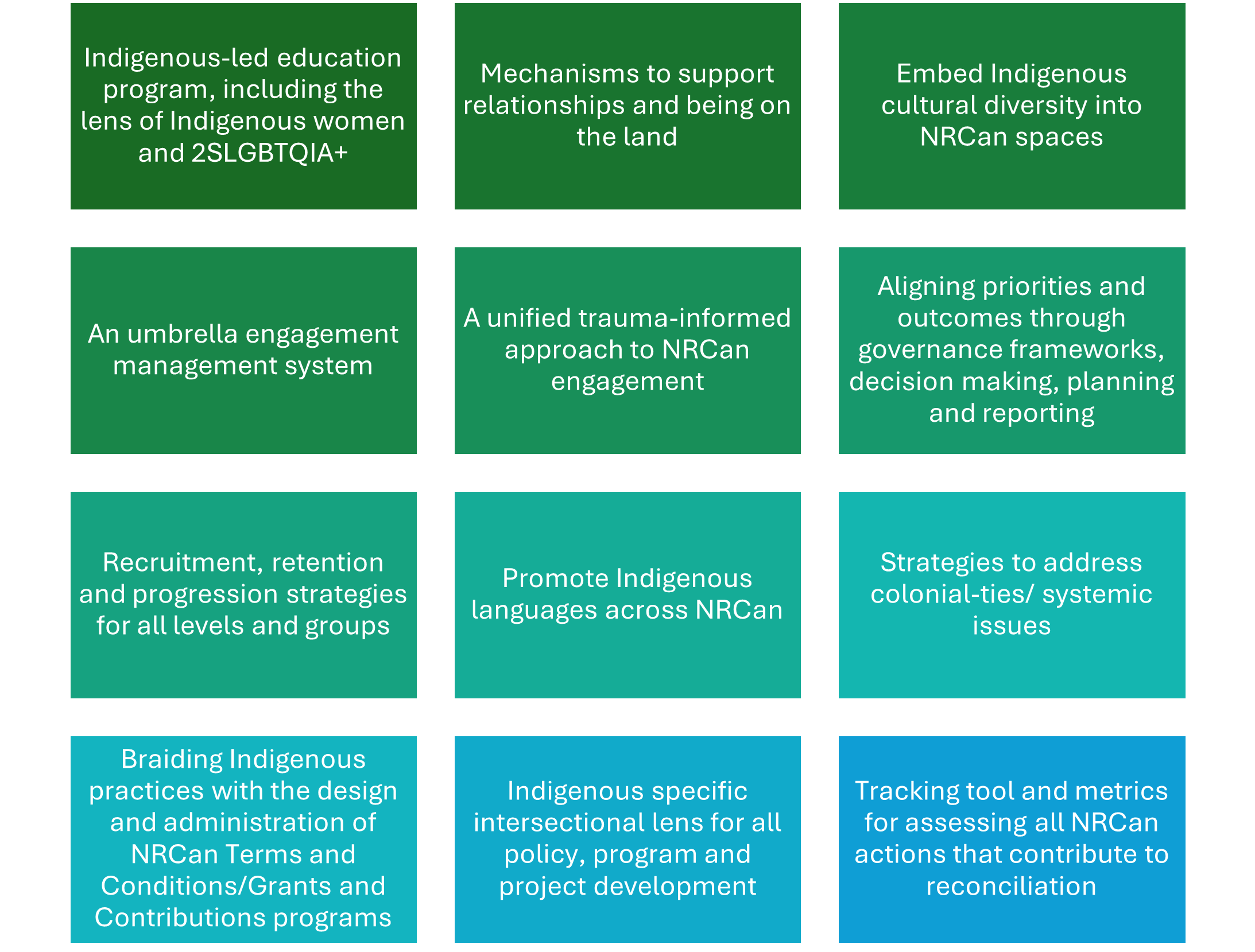
Text version
The Pathways to Reconciliation Action Plan includes 12 key actions:
- Indigenous‑led education program, including the lens of Indigenous women and 2SLGBTQIA+
- Mechanisms to support relationships and being on the land
- Embed Indigenous cultural diversity into NRCan spaces
- An umbrella engagement management system
- A unified trauma‑informed approach to NRCan engagement
- Aligning priorities and outcomes through governance frameworks, decision making, planning and reporting
- Recruitment, retention and progression strategies for all levels and groups
- Promote Indigenous languages across NRCan
- Strategies to address colonial‑ties/ systemic issues
- Braiding Indigenous practices with the design and administration of NRCan Terms and Conditions/Grants and Contributions programs
- Indigenous specific intersectional lens for all policy, program and project development
- Tracking tool and metrics for assessing all NRCan actions that contribute to reconciliation
Specific to Pillar 1: Building awareness and understanding, NRCan has committed to analyze departmental learning needs and evaluate the impact of cultural awareness training, and to implement department-wide tracking and monitoring mechanisms by 2026–27. The project team was informed that Nòkwewashk has work underway to identify and assess areas where capacities can be strengthened. Additionally, at the time of the project, a Braiding Knowledge Systems curriculum was being developed to support the integration of Indigenous knowledge into science and research.
Under Pillar 2: Engaging to foster relationship building. NRCan has committed to develop a consistent engagement approach which strives to continue moving NRCan from transactional engagement to long-term reciprocal relationships. The plan also includes a commitment to reduce duplication and engagement fatigue through better information sharing and a central engagement management system.
Pillar 3: Having a voice where it matters seeks to advance recruitment, retention and career progression strategies for Indigenous employees across all levels and groups, including within executive groups. Planned actions include ensuring the sustainability of the Indigenous Career Navigator program; embedding Indigenous cultural diversity and promoting Indigenous languages within and across NRCan operations; and improving the metrics used to track progress on workforce representation.
Under Pillar 4: Increasing our flexibility, NRCan has committed to establish a department-wide approach for using flexible practices in the design and administration of transfer payment programs. Any such changes must be consistent with the TB Policy on Transfer Payments and its supporting tools, with consideration of the risk-based approaches and flexibilities made available to reflect relationships with Indigenous recipients. While linked to Pillar 5: Transforming how we work, the Action Plan also includes a commitment to transform how NRCan develops policies, programs, projects and make decisions by requiring the incorporation of an Indigenous specific intersectional lens from inception to implementation, and beyond.
Lastly, the department has identified the intent to develop a whole-of-NRCan performance measurement tool to aggregate departmental reconciliation actions and existing metrics. As part of this initiative, NRCan would establish and implement an internal tracking tool to monitor the departmental response to external policy drivers and improve visibility of its progress towards advancing the government-wide reconciliation agenda.
The department expects the Action Plan to remain evergreen and adjust as required during implementation in response to the changing environment. However, once implemented, NRCan expects these actions to enable the department to better design, implement and assess the impact of its reconciliation actions, while coordinating and engaging with Indigenous employees and Indigenous partners in ways that better nurture relationships.
Conclusion
Guided by the Pathways to Reconciliation Framework and its related Action Plan, NRCan has framed its priorities and taken actions in ways that demonstrate a clear commitment to reconciliation, for example, by emphasizing the importance of reconciliation to employees, implementing targeted recruitment strategies to increase Indigenous representation, and increasingly integrating Indigenous voices and considerations in the design of its policies and programs. These actions have begun to set a foundation for change.
To support continued progress, the joint audit and evaluation identified opportunities for improvement across all pillars. These include opportunities to:
- Improve the clarity and accessibility of communications related to departmental reconciliation priorities, both internally and externally.
- Clarify Nòkwewashk’s mandate and internal structure.
- Strengthen current departmental tools and practices to support and advance equitable and culturally responsive engagement, career opportunities, and program design and delivery.
- Improve monitoring and reporting on reconciliation-related activities, including data on development of cultural competency, workforce inclusion, and performance measurement.
NRCan recognizes that advancing reconciliation will take consistent, long-term commitment across all levels of the organization. The “evergreen” nature of its Action Plan reflects an understanding that reconciliation must evolve in response to changing contexts and the voices of Indigenous partners. Reconciliation is not a destination but a continuous journey that requires continuous learning, meaningful relationship building, transformation of departmental practices and sustained effort.
Acknowledgements
We express our sincere appreciation to NRCan’s Elders-in-Residence and departmental employees for their collaboration, guidance, and support.
Appendix A: Project sub-objectives and criteria
The objectives of this project are:
- To assess the extent to which organizational capacity is in place to prioritize and support NRCan’s reconciliation actions; and
- To assess formative steps taken in building towards reconciliation, including best practices and lessons learned.
The following table identifies the questions addressed by the project, as well as the sub-objectives and criteria used to conduct the project:
| Sub-objectives | Criteria |
|---|---|
| Question 1: Has NRCan adequately defined and communicated its priorities for advancing reconciliation? | |
| Sub-objective 1: To assess whether NRCan’s priorities for reconciliation are aligned with the NRCan mandate and Indigenous priorities and are clearly communicated internally and externally. | 1.1 It is expected that NRCan has clearly articulated and effectively internally and externally communicated its priorities for advancing reconciliation. |
| 1.2 It is expected that NRCan’s priorities for advancing reconciliation are aligned with the NRCan mandate, Government of Canada and Indigenous priorities. | |
| Question 2: Has NRCan developed an adequate governance and coordination framework to support the planning, implementation, and monitoring of its advancing reconciliation actions? | |
| Sub-objective 2: To assess whether adequate and effective governance structures, coordination processes, and resources have been defined and implemented to support the planning and implementation of NRCan’s reconciliation actions and provide adequate oversight on the department’s reconciliation efforts. | 2.1 It is expected that the roles, responsibilities, and accountabilities pertaining to the department’s efforts towards advancing reconciliation are clearly defined and communicated to partners and stakeholders. |
| 2.2 It is expected that there are effective processes defined and implemented to increase Indigenous representationFootnote 14 on NRCan’s governance committees. | |
| 2.3 It is expected that adequate oversight structures and effective coordination, monitoring, reporting, and communication processes are defined to support the department’s efforts related to advancing reconciliation. | |
| 2.4 It is expected that NRCan has a process in place to ensure that resources effectively support the planning and implementation of its efforts related to advancing reconciliation. | |
| 2.5 It is expected that NRCan’s performance measurement practices support the effective monitoring and reporting of its progress towards advancing reconciliation, and results information is used to inform future actions. | |
| Question 3: What progress has NRCan made towards full inclusion of Indigenous Peoples within its workforce? | |
| Sub-objective 3: To assess whether effective processes are in place to increase representation of Indigenous employees in NRCan’s workforce and promote an inclusive and supportive work environment. | 3.1 It is expected that NRCan has effective processes in place to create an inclusive, supportive, and barrier-free work environment for NRCan’s Indigenous employees. |
| 3.2 It is expected that the department has effective policies, tools, and processes in place to ensure equitable recruitment, retention, and career progression of Indigenous employees. | |
| 3.3 It is expected that NRCan monitors and reports on Indigenous representation in NRCan’s workforce. | |
| Question 4: Does NRCan have effective mechanisms and processes to increase internal cultural competencies? | |
| Sub-objective 4: To assess the extent to which NRCan has implemented effective processes to build awareness and understanding towards Indigenous history and respect of traditional and cultural approaches. | 4.1 It is expected that the department’s needs with respect to the necessary competencies (such as cultural competency, history, Elders teachings, protocols, etc.) for advancing reconciliation are identified and addressed. |
| 4.2 It is expected that training taken by NRCan employees towards promoting cultural awareness and understanding is tracked. | |
| 4.3 It is expected that cultural awareness training provided by NRCan to its employees is assessed for impact. | |
| Question 5: Does NRCan have effective and efficient mechanisms for coordination of Indigenous engagement and relationship-building? | |
| Sub-objective 5: To assess the extent to which NRCan has effective and efficient processes for conducting and coordinating Indigenous engagement and relationship-building. | 5.1 It is expected that NRCan has identified and incorporated best practices to conduct engagements with Indigenous Peoples. |
| 5.2 It is expected that NRCan has a process for effective coordination of engagements with Indigenous Peoples | |
| 5.3 It is expected that NRCan provides Indigenous groups with equitable opportunities to engage in its programs and initiatives. | |
| Question 6: To what extent are select NRCan initiatives advancing reconciliation? Are there best practices and lessons learned from NRCan initiatives that can help NRCan overcome challenges related to advancing reconciliation? | |
| Sub-objective 6: To identify lessons learned and best practices that could support NRCan to overcome challenges related to advancing reconciliation efforts and assess the extent to which these are being effectively leveraged by NRCan. | 6.1 It is expected that select NRCan initiatives have been appropriately defined and are making progress towards their initiative-specific objectives for advancing reconciliation. |
| 6.2 It is expected that the design and delivery of select NRCan initiatives is informed by increased understanding and respect of traditional and cultural approaches. | |
| 6.3 It is expected that select NRCan initiatives have contributed towards building meaningful relationships and partnerships with Indigenous Peoples. | |
| 6.4 It is expected that there are best practices identified and lessons learned through efforts taken towards advancing reconciliation within the department, and that these are being documented and disseminated. | |
| 6.5 It is expected that programs are designed and reviewed based on Indigenous and gender-based analysis, evidence, and shared Indigenous knowledge. | |
Appendix B: Project limitations and considerations
The joint project employed multiple lines of evidence to mitigate against limitations associated with individual methods. Evidence collected was largely consistent across lines of evidence, with only minimal contradictions observed. These minor variations, attributable to the inherent characteristics of different data collection methods, did not affect the overall results or the validity of the project’s findings and conclusions.
| Description | Limitations and considerations | Mitigations |
|---|---|---|
| Document review | ||
| An extensive review of GC and NRCan documentation, including commitments made by the GC that are applicable to NRCan, relevant Calls to Action, NRCan mandate, along with NRCan process and program records related to operations, outcomes, administration, financial management, performance management, etc. The document review gathered information on context, and assessed planning, implementation, outcomes, and impacts of reconciliation-related activities. | Reconciliation is not managed as a coordinated program. Hence, there were gaps and limitations in available program, project management, and financial information from participating sectors. While all sectors provided documents for review, there is no certainty that all relevant and available documents were provided, particularly given the wide time period for the joint project scope (starting in 2016-17). Even in cases where the employees remain the same, there is a natural risk of loss of corporate memory of all activities that have been performed. Some sectors may have only provided documents based on individual or team priorities and may have missed relevant documents. |
While there is no way to assess the comprehensiveness of the documents received from sectors, the joint project team issued multiple rounds of document requests to program managers, progressively refining them to target specific gaps in the information received. To support this process, the team provided clear guidance, including detailed explanations and concrete examples of the types of reconciliation-related documents being sought. Triangulation compensated for gaps in certain sources and served to validate information across multiple lines of evidence. |
| Key informant interviews | ||
| A total of 30 interviews were conducted with 55 key informants, including one-on-one and small group discussions. Interviewees were NRCan employees across all sectors and representatives from relevant stakeholder groups or committees. The interview questions gathered in-depth information and valuable insights as well as lessons learned and best practices on reconciliation-related efforts, activities and processes within NRCan. | Interviewees may not fully represent the diverse perspectives of all NRCan employees, and their responses may be based on personal experiences and perceptions, which could lead to partial or incomplete insights into NRCan’s reconciliation efforts. Also, responses provided to interview questions may have been influenced by current levels of knowledge, awareness, and/or the extent of established processes and mechanisms. | Efforts were made to include participants from various sectors and levels to capture diverse perspectives. Where gaps or ambiguities were identified, additional clarification was sought through follow-up conversations or supplementary data collection. Responses were triangulated with other lines of evidence to ensure a complete, accurate and comprehensive assessment. |
| Online employee survey | ||
| An online survey obtained information about employee awareness of and perspectives on NRCan reconciliation efforts. Survey questions were sent to all NRCan employees (over 5,700 people) and 668 responses were received (response rate of 11.6%). | The overall survey response rate is considered adequate for purposes of this project; it slightly exceeded the targeted minimum response rate of 10%. It is possible that employees working closely with reconciliation related files were more likely to respond, which could have biased results. Additionally, there was variability in the number of responses received for individual questions, potentially skewing interpretation of the overall survey responses. |
Analysis of employees’ responses to the survey considering the potential for respondent bias, particularly among individuals closely involved in reconciliation-related work. The fact that some respondents provided more informed responses was viewed positively, as it offered the team more specific and detailed insights to enrich the analysis. To strengthen the reliability of this line of evidence, the data was triangulated with additional sources, enhancing the depth and credibility of the analysis. |
| Case studies | ||
| A total of 15 case studies of select NRCan initiatives or activities across all NRCan sectors were conducted to provide rich and detailed insights into program processes, outcomes, and unique contextual factors. The case studies employed a mix of document review and key informant interviews with internal and external partners and stakeholders. The primary focus of these case studies was to identify strengths and lessons learned that could be leveraged department-wide to help NRCan overcome challenges related to advancing reconciliation. Case studies:
|
Only four of the fifteen case studies included interviews with external stakeholders (i.e., participants or proponents of the program or initiative). As a result, most case studies reflect primarily internal perspectives from NRCan staff, which may have influenced the findings toward internal views. The depth and completeness of each case study varied due to differences in documentation availability and interview participation. The selected case studies span a broad set of programs and initiatives but do not capture all reconciliation-related work at NRCan. Hence, findings may not fully reflect efforts and progress across the whole department. |
The analysis explicitly acknowledged the limited external input and interpreted findings primarily as reflections of internal perspectives. The team contextualized each case study individually, noting the level of detail available and avoiding direct comparisons where data was uneven. The case studies enabled the joint project team to confirm and strengthen the major patterns identified in other sources throughout the triangulation process. |
| Literature review / benchmarking interviews | ||
| To identify best practices, gaps, and areas for improvement, the joint project reviewed existing literature and information from external sources and a conducted a total of 10 benchmarking interviews with other federal departments reported to have with comparable experience working with Indigenous Peoples. | Departments and agencies selected for benchmarking, and responses from interviewees within these organizations, may not capture the full complexity of experiences or diversity of viewpoints across the federal government. Comparators selected for the literature review may miss valuable insights from other jurisdictions with different but relevant reconciliation experiences. |
The joint project team tailored questions to federal departments to focus on specific elements for comparison. Open-ended questions were employed to encourage honest, detailed responses and allow for uncovering richer insights. Broader insights were also obtained by leveraging related benchmarking analyses that have already been completed by these other federal departments. Findings were triangulated with additional lines of evidence to enhance the overall reliability and validity of the research. |
| Talking circles | ||
| Four Talking Circles were held with key target groups (namely Indigenous Employees Network, Policy Analyst Recruitment and Development Program – Indigenous stream, United Nations Declaration Act (UNDA) Community of Practice, and the Bridging Braiding and Weaving Community of Practice). Elders-in- Residence co-facilitated each of the circles and also shared their perspectives during the discussions. The goal of the Talking Circles was to acquire a deeper understanding of experiences, opinions, and perceptions, particularly related to NRCan’s workforce and workplace actions in a culturally sensitive and appropriate setting. | Attendance levels varied across the different Talking Circles, which may have impacted the breadth and diversity of perspectives gathered. As individuals who are more actively involved in or passionate about advancing reconciliation within the department may have been more inclined to participate, the findings could be slightly skewed toward the perspectives of those more engaged with the topic. Also, while the sessions were structured to allow open dialogue, the allotted time may have limited the depth of discussion and the ability for all participants to contribute equally, particularly in larger Talking Circles with more participants. | The joint project team chose target groups for Talking Circles to collect specific information and capture stories from the unique perspectives of a small but well-informed group of participants. Both invitees and participants were given the opportunity to submit written responses. Some individuals chose to provide their input in writing, and these contributions were incorporated into the overall analysis alongside the verbal discussions from the Talking Circles. This approach helped ensure that a broader range of perspectives was reflected in the findings. Triangulation of these data was carried out to nuance, enrich, and critically assess the information obtained through the talking circles. |
| Media analysis | ||
| The media analysis included review of a wide range of documents, including press releases, statements, news articles, social media engagement, and Indigenous media, with information cross-verified across sources to identify consistencies and discrepancies. This analysis was conducted as a proxy to understand the perceptions of Indigenous Peoples regarding NRCan’s activities related to advancing reconciliation, as well as the visibility and impact of these efforts in the public domain. | The media analysis was restrained by limited availability of media outlets covering NRCan reconciliation efforts, which restricted the diversity and breadth of perspectives captured in analysis. Indigenous voices were also fairly limited in media sources, potentially leading to an incomplete view of Indigenous perspectives. |
The joint project team adapted its research strategy by looking at themes like Government of Canada instead of NRCan; substituted “natural resources” for more specific terms related to NRCan’s mandate (e.g., “forest”, “energy”, “climate change”, “major project”, “mining”). The team also identified a few key Indigenous news outlets and searched their archives for articles that discuss issues related to the federal role in natural resources. The joint project team expanded the range of media sources to include:
|