
Audit and Evaluation Branch
Natural Resources Canada
October 24, 2025
On this page
- List of acronyms and abbreviations
- Executive summary
- Introduction
- Relevance
- Design and Delivery
- Results
- Appendix A: Description of FSCP components
- Appendix B: FSCP results chain
- Appendix C: Reported list of preconditions and assumptions and associated risks
- Appendix D: FSCP Partners and stakeholders
- Appendix E: Summary of results based on 2020 indicators
- Appendix F: Past Evaluation recommendations and their outcomes
- Appendix G: Evaluation Team
List of acronyms and abbreviations
- AMI
- Agreements Module Interface
- CA
- Contribution Agreement
- CFS
- Canadian Forest Service
- CMSS
- Corporate Management and Services Sector
- CRM
- Client Relationship Management
- CWFC
- Canadian Wood Fibre Centre
- EDI
- Equity, Diversity and Inclusion
- EMO
- Expanding Market Opportunities program
- FIP
- Forest Innovation Program
- ForSITE+
- Forest Systems Information and Technology Enhancement
- FSCP
- Forest Sector Competitiveness Program
- FTE
- Full Time Equivalent
- GAC
- Global Affairs Canada
- GBA+
- Gender Based Analysis Plus
- GCWood
- Green Construction through Wood
- GDP
- Gross Domestic Product/dd>
- GHG
- Greenhouse Gases
- GloFor
- Global Forest Leadership Program
- GC
- Government of Canada
- Gs & Cs
- Grants and Contributions
- HQP
- Highly Qualified Personnel
- IFI
- Indigenous Forestry Initiative
- IFIT
- Investments in Forest Industry Transformation
- NBCC
- National Building Code of Canada
- NRCan
- Natural Resources Canada
- NSERC
- Natural Sciences and Engineering Research Council of Canada
- O&M
- Operations & Maintenance
- R&D
- Research and Development
- RD&D
- Research, Development and Demonstration
- STEM
- Science, Technology, Engineering, and Math
- TBS
- Treasury Board of Canada Secretariat
- Ts & Cs
- Terms and Conditions
- TOC
- Theory of Change
Executive summary
Background
This report presents the findings, conclusions, and recommendations from the evaluation of the Canadian Forest Service’s (CFS) Forest Sector Competitiveness Program (FSCP). The objective of the evaluation was to assess the relevance, effectiveness, and efficiency of the FSCP. The evaluation covers the period from 2018-19 to 2023-24. During this period, actual expenditures for these programs were approximately $564 million (M).
The umbrella of the FSCP currently encompasses the following components: Forest Innovation Program (FIP); Investments in Forest Industry Transformation (IFIT); Green Construction through Wood (GCWood); Indigenous Forest Initiative (IFI); Global Forest Leadership (GloFor); and the Forest Systems Information and Technology Enhancement (ForSITE) program. The Expanding Market Opportunities (EMO) program, which sunset in 2023, was also included in this evaluation. Collectively, the suite of programs is designed to support the forest sector’s transformation and ensure its competitiveness by investing in innovative research and development, first-in-kind demonstrations, market access measures, Indigenous participation, and promotion of Canada’s international reputation.
What the evaluation found
Overall, the evaluation found that the FSCP continues to be relevant, and it has made progress towards achieving its immediate and intermediate outcomes.
Overall, the FSCP has remained relevant, flexible, and adaptive in meeting the continued needs of key stakeholders while supporting departmental and Government of Canada (GC) priorities. The FSCP’s integration of science, economics, and policy approaches make it well-positioned to contribute towards competitiveness through global leadership in sustainable forest management, innovation, environmental performance, and strengthening the supply chain. There is a compelling case for federal forest sector leadership in these areas both domestically and internationally, and the FSCP demonstrates that it is responding to market expectations in the evolving context.
The evaluation found the design and delivery of the FSCP’s suite of programs to be adequate. There is no duplication of activities across the FSCP. Close complementarity exists between innovation, demonstration, and adoption activities, across three of the core innovation program components (i.e., FIP, IFIT, GCWood). By contrast, some newer program components (e.g., GloFor and ForSITE) have been more challenged to communicate their contributions to outcomes of the FSCP. Leveraging the theory of change to explain the FSCP’s success stories could help CFS report its performance in a more integrated fashion.
There are indications of progress on FSCP outcomes from 2019-20 to 2022-23. However, while most targets are reported as having been met or exceeded, performance measurement was not adequately robust for the evaluation to fully conclude on results achieved over this period.
Revisions to the Program’s performance measurement framework completed in 2024 improved its coherence but more time is required to fully test its new results metrics and standardize data collection. While it is too soon to conclude on the likely achievement of many of the FSCP’s revised outcomes, with most targets for intermediate and ultimate outcomes set to be achieved between 2025 and 2030, the data that is available indicates that the FSCP is mostly on track to meet all its immediate outcomes by end of 2025-26 and has advanced efforts to increase diversity and inclusion in the forest sector. It is also making progress towards many of its intermediate outcomes. However, achievement of the FSCP’s ultimate outcome will depend on a substantive number of external factors that may impede forest sector sustainability.
Decisions on financial expenditures for the FSCP are made at the program component, rather than the DRF Program level. This limited the ability of the evaluation to assess efficiency for the FSCP as a whole. However, we found that the FSCP was able to spend most of its funds on the activities for which they were allocated, with some underspending or reprofiling noted in some of the components from 2020 onward due mainly to the effects of the COVID-19 pandemic. Some underspending issues were created by the inability of the ForSITE component to rapidly staff up and acquire high data capacity IT infrastructure, for reasons outside of the program’s control. Further administrative integration of program components may increase efficiency but could be challenging to implement.
Recommendations and management response and action plan
Based on the evaluation findings, a single recommendation is presented, targeting the area identified as having the greatest need for improvement. CFS has responded with a management action plan to address this recommendation. Additional opportunities for improvement are noted where relevant throughout the report, and AEB encourages CFS to reflect on these insights when making future decisions related to program design and delivery.
| Recommendation | Management response and action plan |
|---|---|
|
Management response: Management agrees Government priorities focus on building new economic relationship with reliable trading partners and facilitating the transition to a modern, competitive forest sector that supports product and market diversification. In August 2025, the government announced the renewal of Forest Sector Competitiveness programs to support market diversification measures. In response to the recommendation and government priorities, the renewed Global Forest Leadership program will expand on the current program by re-introducing international market and product development and diversification activities into Canada’s international forest sector programming. To support this expansion the program will:
Position responsible: ADM, CFS Timing: One year after all authorities in place (No later than October 2026) |
Introduction
This report presents the findings, conclusions, and recommendations from the evaluation of the Forest Sector Competitiveness Program. The evaluation approach and methodology followed the Treasury Board of Canada (TB) Policy on Results (2016) and related Directive on Results. This is the first evaluation of the FSCP as a grouping of program components; previous evaluations focused on separate transfer payment programs or activity clusters within its program grouping.
Program profile
The FSCP is a Program in NRCan’s Departmental Results Framework (DRF). Within the DRF, this program aligns with Core Responsibility 3, “Globally Competitive Natural Resource Sectors.” It contributes to the Departmental Result “enhanced competitiveness of Canada’s natural resource sectors (R9).”
This DRF Program has existed since NRCan completed the transition to its first DRF in 2017. However, many of its program components pre-date this transition. The funding for each of these program components is time-limited and must be periodically renewed or the component will sunset. Within its current three-year funding envelope (FY 2023-2026), the umbrella of the FSCP includes four pre-existing program components: 1) the Forest Innovation Program (FIP) and the Canadian Wood Fibre Centre (CWFC); 2) Investments in Forest Industry Transformation (IFIT); 3) Indigenous Forest Initiative (IFI); and 4) Green Construction through Wood (GCWood). It also includes two evolved program components, Global Forest Leadership (GloFor), and the Forest Systems Information and Technology Enhancement (ForSITE) program.
Box 1 presents an overview of the FSCP as outlined in its public-facing program description. Appendix A provides a detailed description of each FSCP component.
Box 1: Overview of the Forest Sector Competitiveness Program
This Program responds to cyclical and structural downturns and trade irritants that threaten the forest sector. The Program seeks to diversify markets, products, and processes. These outcomes are essential to the long-term viability and growth of Canada's forest sector. This Program addresses forest industry challenges/needs through initiatives that advance Canada's bioeconomy and create/maintain market opportunities. Program success is also supported by work that advances favourable international forest policies and increased Indigenous participation in natural resource development. Initiatives include the delivery of transfer payment programs, the development of strategies, advocacy/advice, and international policy work that together advance Canada's priorities on trade, jobs, the economy, climate change and other environmental issues.
Source: GC InfoBase
Operational context
Canada has 9% of the world’s forests. Its forests are a major source of revenue, offering significant economic, environmental, and social and cultural benefits for all Canadians (see Box 2). As of 2023, Canada is a global leader in the production of newsprint, northern bleached softwood kraft pulp (NBSK), and softwood lumber. Canada continues to maintain a strong forest product trade balance.
Box 2. Contribution of Canada’s forests to employment and revenue
Forest sector contribution to Canada’s nominal GDP (2023): $27 billion
Total revenue from goods manufactured (2022): $97.6 billion
Total wages and salaries (2022): Over $12 billion
Total people employed in the forest
sector (2023): 199,345 (a 1.6% decrease from 2022)
Total Indigenous people employed in forest sector (2021): Over 11,000.
Diversity in the forest sector: According to the last census (2021), approximately 19% of forest sector workers are women, 13% are immigrants, 12% are visible minorities and 6% are Indigenous.
Source: Adapted from: State of Canada’s Forests Annual Report 2024.
In Canada, there are three main forest product sub-sectors:
- Solid wood product manufacturing: Firms in this area engage in both primary (i.e., softwood lumber and structural panels) and secondary (i.e., millwork and engineered wood products) manufacturing for domestic consumption and export.
- Pulp and paper product manufacturing: Companies in this area produce a wide range of products, covering everything from newsprint and household tissues to dissolving pulp for rayon production.
- Forestry and logging: Firms in this area are responsible for field operations and harvesting of timber, including felling and hauling it to the mill.
The Minister’s message from the State of Canada’s Forests Annual Report 2024 states that Canada’s is at a pivotal moment – i.e., with wildfires increasing in frequency and severity across Canada, and trade measures on softwood lumber exports continuing, purposeful forest leadership is more important than ever.
During the conduct phase of this evaluation, approximately 20% of forest sector exports were subject to trade tariffs, primarily from the USA. The Canada–U.S. softwood lumber dispute is one of the largest and most enduring trade disputes between both nations and continues to affect exports. The dispute is expected to continue to have increasingly severe impacts on the entire Canadian forest sector.
NRCan’s Overview of Canada’s forest industry states that Canada’s forest industry has also recently undergone an especially deep cyclical decline, coupled with structural changes in world markets. In particular, the rise of electronic media has resulted in a deep decline for paper-based communications products – including several products (i.e., newsprint) that have traditionally been critical to the Canadian pulp and paper subsector. Furthermore, climate change impacts on forest disturbances (i.e., pests and wildland fires) threaten public safety, forest health, industrial infrastructure and future wood fibre supply. Access to skilled workers and growing transportation bottlenecks are further challenging traditional models of forestry across the country. The situation is resulting in communities reliant on the forest sector for jobs and overall prosperity being increasingly vulnerable. In response to challenges facing Canada’s forest sector, it has begun to transform itself along four distinct lines: market development, operational efficiency, business process changes and new product development.
Structure of the Forest Sector Competitiveness Program
NRCan has developed a suite of programs designed to accelerate forest sector transformation and competitiveness (see Appendix A). These programs were initially funded between 2010 and 2017, and most were renewed in 2020, under the umbrella of the FSCP.
In 2023, FSCP renewal made adjustments to its mandate to include more environmental considerations, focus on international reputation rather than market diversification, and further support Indigenous participation. Facilitating and enhancing the competitiveness of Canada’s forest sector has always been the core mandate of the Program, and it is strategically pursuing forest solutions to advance federal objectives through the six program components. These programs seek to collectively support a resilient, innovative and environmentally sustainable forest sector by catalyzing innovation from seed to market (FIP and IFIT), encouraging meaningful participation of Indigenous peoples (IFI), improving climate-related knowledge around forests and environmental performance of forestry (ForSITE), enhancing the forest sector’s reputation (GloFor), and expanding innovative use of wood in construction as a low-carbon-building material (GC Wood).
Program governance
All FSCP program components are under the responsibility of the Assistant Deputy Minister of NRCan’s CFS. While under the umbrella of a single DRF Program, program components are administered separately. FIP, IFIT, GCWood, IFI and GloFor are under the responsibility of the Director General of the Trade, Economics and Industry Branch, while ForSITE falls under the responsibility of the Director General of the Science and Policy Integration Branch. ForSITE is a science-focused program and is delivered in collaboration with researchers located across regional branches (research centres), each led by a separate Director General. Research centres are where most of the science/research staff work, while branches in Ottawa take on most of the policy, economic analysis, and program management functions.
To ensure the success and reach of the FSCP’s suite of programming, the FSCP also actively works with implementation partners within the federal family, arm’s length organizations, and external partners and stakeholders (see Appendix D).
Program resources
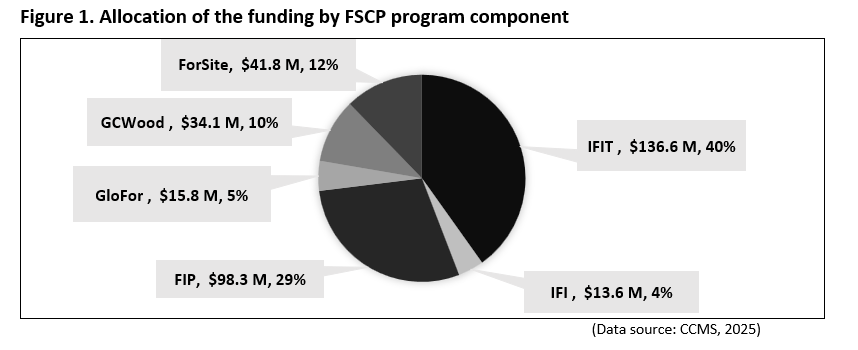
NRCan was allocated a total of $340M (C-base) funding over the period of three years (2023-24 to 2025-26) to support the FSCP.Footnote 1 The allocation of the C-base funding per FSCP program component is shown in Figure 1.
Figure 1. Allocation of the funding by FSCP program component
Text version
Allocation of the funding by FSCP program component (C-base) funding over the period of three years (2023-24 to 2025-26). Investments in Forestry Industry Transformation (IFIT) $136.6 million, 40%. Forest Innovation Program (FIP) $98.3 million, 29%. Forest Systems Information and Technology Enhancement (ForSite) $41.8 million, 12%. Green Construction through Wood (GCWood) $34.1 million, 10%. Global Forest Leadership Program (GloFor) $15.8 million, 5%. Indigenous Forestry Initiative (IFI) $13.6 million, 4%. (Data source: CMSS, 2025)
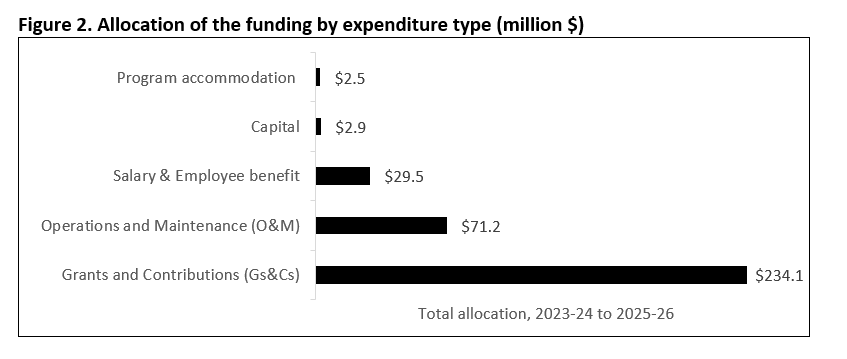
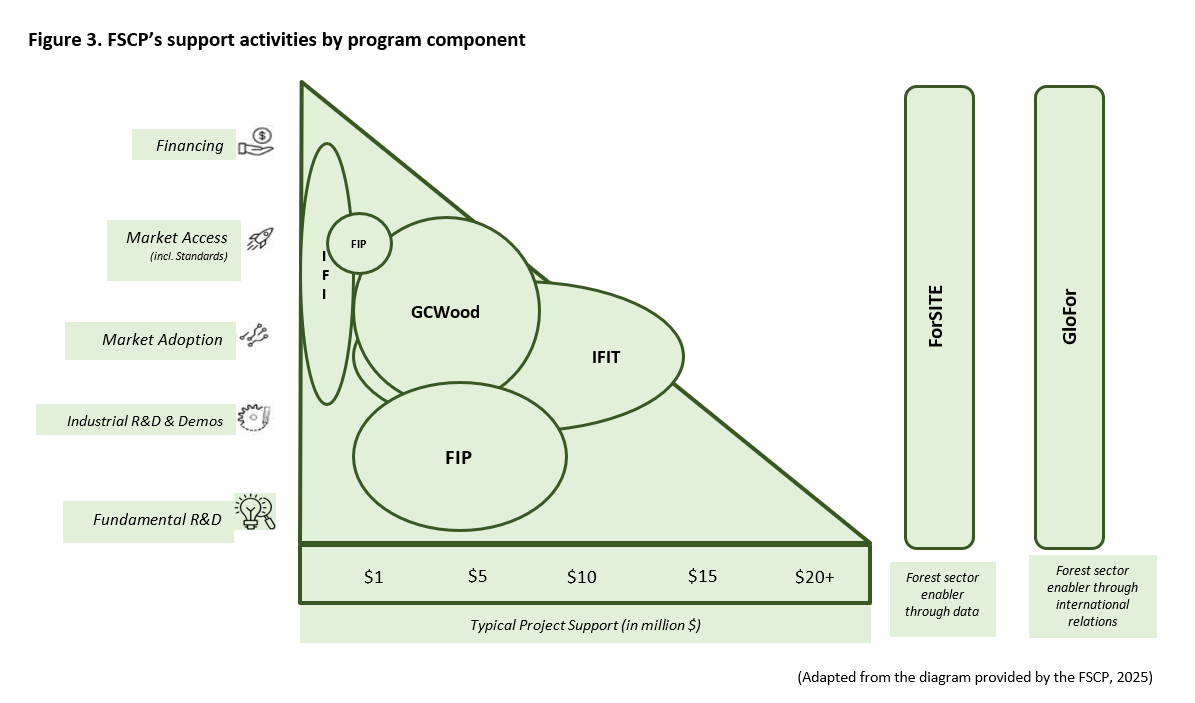
The majority of this funding (69%) is allocated to grants and contributions (Figure 2). These resources are used to support activities across the spectrum of the FSCP’s objectives for forest sector innovation and competitiveness (Figure 3).
Figure 2. Allocation of the funding by expenditure type (million $)
Text version
Allocation of the funding by expenditure type (million dollars). Total allocation, 2023-24 to 2025-26. Grants and Contributions (Gs and Cs) $234.1 million. Operations and maintenance $71.2 million. Salary and employee benefit $29.5 million. Capital $2.9 million. Program accommodation $2.5 million. (Data source: CMSS, 2025) Note: (1) Salary expenditure includes a peak number of 79 full time equivalent (FTEs) staff from 2023-24 to 2025-26. (2) Program accommodation is comprised of workplace related costs specifically Public Service and Procurement Canada overhead costs.
(Data source: CCMS, 2025)
Note: (1) Salary expenditure includes a peak number of 79 full time equivalent (FTEs) staff from 2023-24 to 2025-26. (2) Program accommodation is comprised of workplace related costs specifically Public Service and Procurement Canada overhead costs.
Figure 3. FSCP’s support activities by program component
Text version
FSCP’s support activities by program component. The diagram depicts the program components as shapes (ellipses or circles of various shapes and sizes). The type of intervention is shown on the x-axis, ranging from fundamental research and development at the bottom, followed by industrial research development and demonstrations, then market adoption, market access including standards, and finally financing at the top. The Y-axis shows typical project support in millions of dollars, ranging from less than $1 million to $20 million plus. Two components sit to the right of the diagram, Forest Systems Information and Technology Enhancement, which is labelled as a forest sector enabler through data, and the Global Forest Leadership Program, which is labelled as an enabler through international relations. The IFI component spans industrial research development and demonstrations, market adoption, market access, and financing. Typical support is less than one million dollars. The FIP component is represented by two separate shapes, the smallest being a circle next to market access in approximately the $1million range. A larger FIP ellipse is also situated near the bottom of the diagram, spanning from fundamental research and development to industrial research development and demonstrations, in the $1 million to $10 million range. An ellipse for Green Construction through Wood spans from market adoption to market access, and from $1 million to less than $10 million. An Investments in Forestry Industry Transformation ellipse spans from industrial research development and demonstration, through market adoptions to market access, in the $1million to less than $15 million range. (Adapted from the diagram provided by the FSCP, 2025). Note: Forest sector wide support: FIP, IFIT, ForSITE and GloFor. Wood based construction support: GCWood. Indigenous forest sector support: IFI.
Note:
- Forest sector wide support: FIP, IFIT, ForSITE and GloFor.
- Wood based construction support: GCWood.
- Indigenous forest sector support: IFI.
FSCP theory of change
An outcome map for the FSCP linked to this most recent funding was approved by TBS in May 2024 (Table 1).
Table 1. FSCP outcome map
| Ultimate Results | The forest sector is competitive, contributes to Canada’s net-zero future, and provides socio economic value to Canadians. |
|---|
| Intermediate Outcomes | Intermediate outcome 1: | Intermediate outcome 2: | Intermediate outcome 3: | Intermediate outcome 4: |
|---|---|---|---|---|
| The Canadian Forest Sector has tools to support sustainable forests, forest industry market acceptance in Canada and forest leadership internationally. (Links to immediate outcomes 1 and 2) | The forest sector is innovative and contributes to Canada’s economic development. (Links to immediate outcomes 1 and 2) |
Increased opportunities for historically underrepresented groups to participate in forest sector based economic development. (Links to immediate outcomes 2 and 3) |
The Canadian Forest sector contributes to Canada’s environmental objectives. (Links to immediate outcomes 1 and 3) |
| Immediate Outcomes | Immediate outcome 1: | Immediate outcome 2: | Immediate outcome 3: | Immediate outcome 4: |
|---|---|---|---|---|
| Accurate information, advice, guidance, scientific data, tools, and/or knowledge is available to stakeholders (Links to FIP, ForSITE outputs) |
Stakeholders are implementing projects, domestically and/or internationally. (Links to IFIT, GloFor, IFI outputs) |
Stakeholders are aware of, and engaged with, programs. (Links to IFIT, GCWood, GloFor outputs) |
Construction industry stakeholders have the information and tools necessary to pursue wood-based building projects. (Links to GCWood outputs) |
(Source: FSCP, 2024)
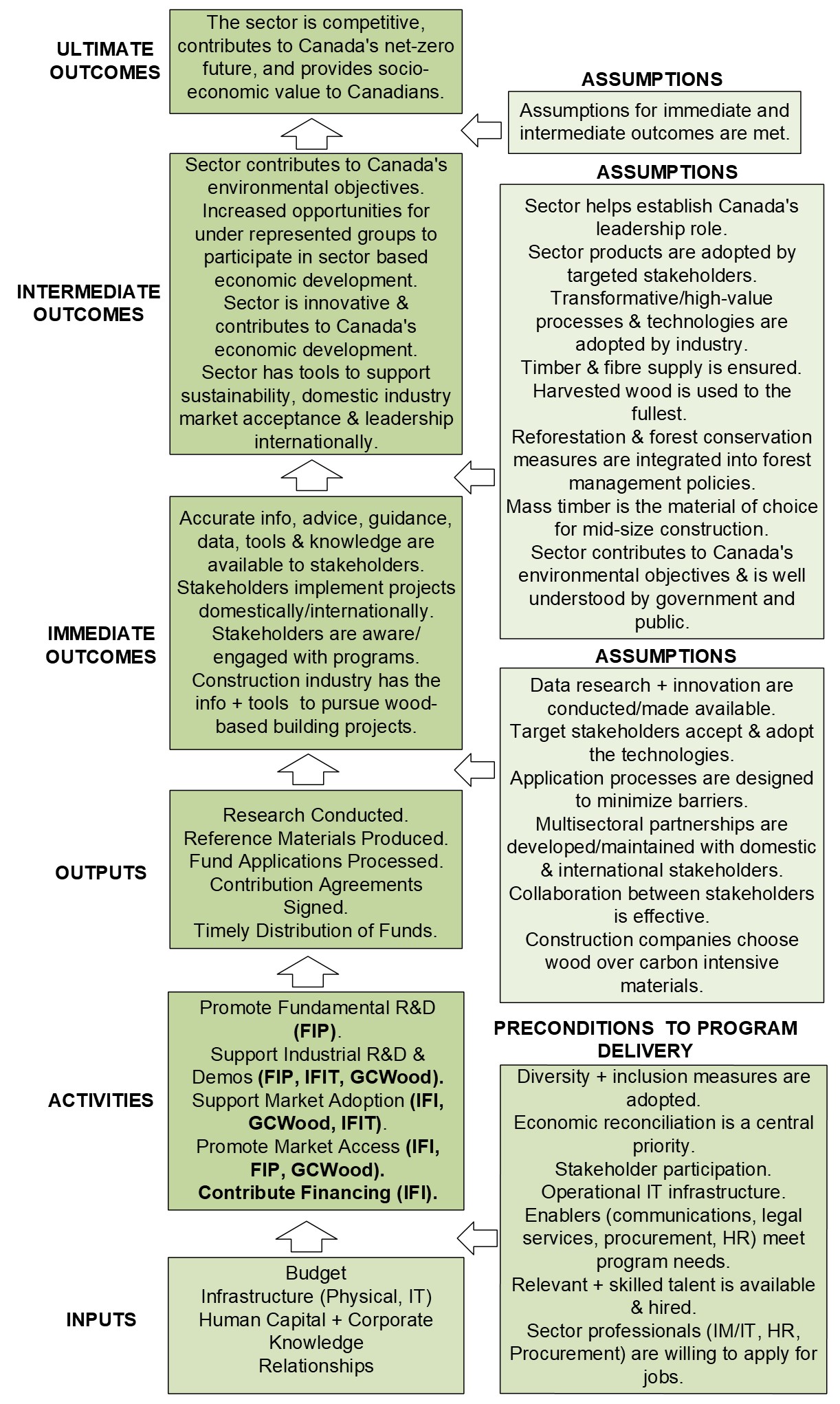
During the planning phase of the evaluation, this outcome map was used to develop a theory of change for the FSCP as a standalone document that was shared with CFS. Figure 4 summarizes this in a visual representation of the theory of change. For full details, refer to Appendix B (results chain), Appendix C (preconditions, assumptions and associated risks) and Appendix D (partners and stakeholders).
Figure 4. Visual representation of FSCP’s theory of change
Text version
Visual representation of FSCP’s theory of change. A flow diagram is shown comprised of two parallel columns of boxes. The boxes in the left column are connected upward to the next one starting at the bottom. Most gaps between the boxes in the left column have an arrow leading from a box in the right column. Column one, box one. Inputs: budget, infrastructure (physical, information technology), human capital plus corporate, knowledge relationships. Column two, box one has an arrow pointing the gap between column one boxes one and two. Preconditions to program delivery between inputs and activities. Diversity and inclusion measures are adopted. Economic reconciliation is a central priority. Stakeholder participation. Operational information technology infrastructure. Enablers (communications, legal services, procurement, human resources) meet program needs. Relevant and skilled talent is available and hired. Sector professionals (information management information technology, human resources, procurement) are willing to apply for jobs. Column one, box two. Activities: promote fundamental research and development (Forest Innovation Program). Support industrial research and development and demonstrations (Forest Innovation Program, Investments in Forestry Industry Transformation, Green Construction through Wood. Support market adoption (Indigenous Forestry Initiative, Green Construction through Wood, Investments in Forestry Industry Transformation. Promote market access (Indigenous Forestry Initiative, Forest Innovation Program, Green Construction through Wood. Contribute financing (Indigenous Forestry Initiative). Column one, box three. Outputs. Research conducted. Reference materials produced. Fund applications processed. Contribution agreements signed. Timely distribution of funds. Column two, box two. Assumptions between outputs and immediate outcomes. Data research and innovation are conducted and made available. Target stakeholders accept and adopt the technologies. Application processes are designed to minimize barriers. Multi-sectoral partnerships are developed/maintained with domestic and international stakeholders. Collaboration between stakeholders is effective. Construction companies choose wood over carbon intensive materials. Column one, box four. Immediate outcomes. Accurate information, advice, guidance, data, tools and knowledge are available to stakeholders. Stakeholders are aware/engaged with programs. Construction industry has the information and tools to pursue wood-based building projects. Column two, box three. Assumptions between immediate and intermediate outcomes. Sector helps establish Canada’s leadership role. Sector products are adopted by targeted stakeholders. Transformative high value processes and technologies are adopted by industry. Timber and fibre supply is ensured. Harvested wood is used to the fullest. Reforestation and forest conservation measures are integrated into forest management policies. Mass timber is the material of choice for mid-size construction. Sector contributes to Canada’s environmental objectives and is well understood by government and the public. Column one, box five. Intermediate outcomes. Sector contributes to Canada’s environmental objectives. Increased opportunities for underrepresented groups to participate in sector based economic development. Sector is innovative and contributes to Canada’s economic development. Sector has tools to support sustainability, domestic industry market acceptance and leadership internationally. Column two, box four. Assumptions between intermediate and ultimate outcomes. Assumptions for immediate and intermediate outcomes are met. Ultimate outcomes. The sector is competitive, contributes to Canada’s net-zero future, and provides socio-economic value to Canadians.
About the evaluation
Objective
The objective of the evaluation was to examine the relevance, effectiveness, and efficiency of the FSCP’s design and delivery. This is the first evaluation of the FSCP as a suite of program components; previous evaluations focused on separate transfer payment programs or activity clusters within its program suite.
Scope
The evaluation examined program activities within the five-year period (2018-19 and 2023-24), with special attention to the first fiscal year of delivery under the FSCP’s revised program structure (i.e., 2023-24). Changes in program delivery and performance measurement meant that results from the past four fiscal years (i.e., 2019-20 to 2022-23) were reviewed separately. Given that an evaluation of GCWood was completed in 2023, covering fiscal years 2018-19 through 2021-22, only one year of its results under the previous performance framework were examined for this current evaluation (i.e., 2022-23).
Approach
The evaluation approach was collaboratively developed with CFS to ensure that it meets its information needs for future planning. The evaluation was conducted using a theory of change (TOC) approach that entailed two steps:
- Preparation of an FSCP theory of change, in close collaboration with CFS. The TOC was finalized as a standalone document and was shared with the FSCP. An outcome map was used to finalize the TOC, based on the FSCP Results Appendix approved by TBS in May 2024. This TOC adds inputs, activities and outputs to the logic model, while also identifying the assumptions and risks that exist within the program theory. This collaborative exercise helped the evaluators understand how the FSCP is expected to produce its intended results (i.e., its outcomes and conditions for success) and thus finalize evaluation questions.
- Examination of progress towards outcomes at each level of the theory of change. Guided by the evaluation questions (Table 2), this examination highlighted both the early indications of progress towards expected results and integration among program components in terms of planning, delivery and data tracking.
Table 2. Evaluation questions
| Questions |
|---|
Relevance; Design and Delivery
|
Effectiveness and Efficiency
|
Methods
Methods used for the evaluation are presented in Table 3.
Table 3. Evaluation methods
|
Document Review |
Tracking System Demonstrations |
Survey |
Key Informant Interview |
Case Study |
|---|---|---|---|---|
|
A document review was conducted to provide an overall understanding of the program, its reported results, and its efficiency. The document review also provided information on performance, governance, priorities and planning, resource allocation, decision-making processes, operational structures and challenges. Foundational and strategic documents, project and program files, and reports on program results were reviewed. |
Tracking system demonstrations provided insight into how the FSCP collects, stores, and tracks data across program components as well as reports findings. This evaluation included three demonstrations to examine the relationship between, data tracking and reporting system and the FSCP mandate:
|
This evaluation administered a survey to NRCan employees directly involved with the design and delivery of the FSCP. The objective of the survey was to elicit qualitative and quantitative data regarding the FSCP’s performance for the fiscal year 2023-24. It was conducted from September to November 2024. With a response rate of about 25%, it captured the views of 17 FSCP managers and program staff on questions related to progress towards achieving FSCP indicator targets, and general activities and outputs of FSCP program components. The survey allowed participants to provide suggestions for additional outcomes and indicators required to adequately capture FSCP activities. |
Key informant interviews were used to answer evaluation questions about relevance and performance. Interview topics included: 1) The extent to which the FSCP is on track toward achieving its outcomes; and 2) Perspectives on program design, delivery, implementation, evolution, and reach. The interviews were also used to corroborate details that surfaced from the document review. A total of 35 interviews were conducted from June 2024 to December 2024. This included 16 interviewees from the FSCP (e.g., program representatives and senior management), 11 interviewees from enabling functions within NRCan (i.e., finance, communications, legal), and 8 proponents (including industry, nonprofit, etc.). |
A case study approach was used to provide an in-depth understanding of the effectiveness of the FSCP suite of programming by closely examining the process involved in implementation. The evaluation undertook six comprehensive case studies to showcase some of the funded projects under the FSCP. The cases specifically looked at examples of outcomes achieved, their contribution to FSCP’s immediate, intermediate, and ultimate outcomes, and areas for improvement. |
Limitations
Performance measurement. The FSCP’s approach to performance measurement changed significantly in 2023-24. Before 2023-24, the performance measurement strategy for all pre-existing program components (i.e., FIP, IFIT, IFI, EMO and GCWood) was generally component specific, except at the ultimate outcomes level. Overall, these program components lacked consistent and complete result tracking that would facilitate reporting on their effectiveness or the effectiveness of FSCP as a whole. Methods for target results or baseline data were often unclear. Results against the larger DRF Program’s new results matrix could be analysed from only a portion of the first year (i.e. 2024-25). More details about this limitation are provided in the Results section of this report.
Stakeholder participation. This evaluation incorporated several methods (i.e., interviews, case studies) through which the evaluation connected with FSCP stakeholders. While the overall participation rate was generally adequate and the efforts of the evaluation team were positively received by most of the FSCP stakeholders, there were some stakeholders (i.e., Indigenous proponents, other federal departments, etc.) that did not respond and/or declined to participate. This impacted data collection, especially the development of the case studies.
Financial analysis. While program staff noted having the data they require for decision making, we found that the financial management system used by NRCan was not organized in a way that facilitated analysis of links between expenditure and results data for the purposes of this evaluation. For example, expenditures are usually tracked by administrative unit. The FSCP’s complex governance structure involves a large number of different branches, divisions, and offices within CFS and the multiple overlapping cost centres. Expenditures for some components, particularly ForSITE, are also provided in part by programs outside the FSCP. These issues make integrated financial reporting for the Program as a whole challenging to interpret. As a result, financial analysis was limited to examining the FSCP’s ability to effectively use its financial resources during the evaluation period (2018-19 to 2023-24).
Relevance
The FSCP aligns with and is responsive to stakeholder needs
All lines of evidence confirm that there is an ongoing need for the FSCP suite of programming. Collectively, these programs aim to increase the forest sector’s competitiveness while supporting the transition to the bioeconomy and a low-carbon economy future. The internal and external stakeholders interviewed confirm an ongoing need for the FSCP programming to address challenges to Canada’s forest sector competitiveness, and to contribute to sustainable development goals and climate change adaptation and mitigation efforts. It is required to derisk research and development and foster innovation and economic growth.
A key element of this transition has been the new and innovative products, materials and services being produced in Canada’s forest sector. Support from the FSCP has contributed to the development of new building materials, biofuels that can substitute for fossil fuels, and biochemicals that can be used to produce bio-based pharmaceuticals, biodegradable plastics, personal care products and industrial chemicals. One example is cellulosic fibrils and nano-crystalline cellulose – next-generation pulp-based products with the potential to revolutionize the pulp and paper sector.
These and other emerging technologies and business processes offer new ways of generating social, economic and environmental values for Canadians from our abundant forest resources. They generate value from a wider range of forest products and processes than traditional milling and pulping and increase overall industry productivity: additional revenue streams are available from each log harvested, diversifying product lines to stabilize economic performance and boosting the share of renewable products in the marketplace. These new technologies will also create opportunities for new entrants, enhancing competition and entrepreneurialism in the sector.
There is a strong relationship between data, research and development, and competitiveness. The evaluation team’s review of academic literature concluded that digitalization, data integration, and artificial intelligence (AI) across processes and operations is necessary to transform the precision of the state of knowledge on Canada’s fibre supply, and delivery of information to improve the flow of resources between the various stages of the forest value chain. Optimization of the value chain will rely on the forest sector’s ability to develop pathways to facilitate adoption of these processes and technical systems.
There may be unmet needs, particularly for international market development.
A survey of CFS managers and analysts revealed that respondents were very confident (100%) that the FSCP suite of programming is relevant to its stakeholders. Industry respondents confirm that FSCP is responsive to their needs on upstream innovation and testing technologies but indicate unmet needs in the international marketing of products. Interviewees noted that there is a continued need to demonstrate federal leadership to respond to geopolitical barriers, including non-tariff-oriented trade barriers.
Some federal officials and industry professionals suggested a need for activities in developing and maintaining international market-to-market relations, indicating that the sunset of the EMO program left a gap in international market development efforts. While the role previously played by EMO has been assumed in part by other programs and other departments (e.g., GCWood has since assumed the domestic work of EMO), respondents perceived that this programming has not been as effective in maintaining relationships and regular touchpoints with forest sector contacts in international target markets. Industry respondents were also appreciative of the pan-Canadian leadership embodied by EMO operations and noted that some provinces may be unable to replicate these efforts.
The evaluation noted that the sunsetting of EMO has allowed some funding to be retargeted to other relevant areas, such as GloFor’s efforts to promote Canada’s environmental reputation. While bringing back a delivery component similar to EMO could be challenging, federal and industry representatives expressed that, without a comparable alternative, Canada’s competitors may be positioned to step into target markets and take advantage of the relationships and increased demand for wood that were cultivated by the EMO. However, these interviewees also noted that the administration of a renewed approach must be fiscally sound. There may also be alternative approaches that can be used to develop and maintain international market-to-market relations without in-country presence.
Other unmet needs for industries may include:
- Targeted support for small and medium-sized (SME) industries. To diminish barriers to entry and enhance active participation in the forest sector, some interviewees argued that funding should afford flexibility for SMEs, especially those based in jurisdictions where there is no equivalent provincial/territorial funding available. This could be achieved by calibrating the levels of support required, for example, by reducing the industry contributions from 50% to 30% or less for small organizations. Industry respondents also suggested reducing reporting burden, while international recipients raised concern about the delay in disbursal of payments.
- Evidence-based approaches for new products and markets. Access to more comprehensive data on markets, including both traditional and new products, would enhance the understanding of supply chains, especially for new products where Canada has the potential to make significant contributions to the global market (i.e., cellulose nanocrystals). This could also help eliminate market barriers and improve market opportunities.
The FSCP aligns with and is responsive to departmental and governmental priorities, frameworks and strategies.
The innovation and competitiveness activities being conducted through the FSCP are consistent with the federal government’s role in the forest sector. The Natural Resources Act states that the Minister of Natural Resources shall “seek to enhance the responsible development and use of Canada’s natural resources and the competitiveness of Canada’s natural resource products.” The FSCP is also consistent with the Forestry Act, which states that the Minister “shall provide for the conduct of research relating to the protection, management and utilization of the forest resources of Canada.”
Past evaluations have found that Government of Canada leadership nationally and internationally is critical to the success of the forest sector. This view was also supported by interviewees for this current evaluation. Through the FSCP, the federal government effectively leverages its influence in developing and sharing new knowledge, promoting policy coherence, facilitating private sector alignment with net-zero objectives, securing and expanding market access, and advancing Indigenous inclusion in the forest sector. Interview respondents acknowledged that the provision of the programs at the federal level helps to ‘even the playing field’ in situations where there is variation in provincial and/or territorial capacities to support forest sector innovation, market acceptance and trade, and provides a high-level overview of the opportunities and threats affecting the national forest sector.
The FSCP is aligned with recent mandate commitments for the Minister of Natural Resources to support forest sector competitiveness and build a strong economy. While other federal government departments also support market development and innovation programs, NRCan is the national and international voice for Canada’s forest sector.
The FSCP is also aligned with the Government of Canada’s commitments to advance reconciliation with Indigenous Peoples. This includes supporting commitments under the United Nations Declaration on the Rights of Indigenous Peoples Act by prioritizing the advancement of reconciliation and funding Indigenous leadership in the forest sector through its Indigenous Forestry Initiative. Through this program, NRCan has demonstrated that it is advancing work towards reconciliation by building meaningful partnerships and ensuring Indigenous peoples benefit in developing Canada’s natural resources. The evaluation found that the IFI is strengthening support for Indigenous businesses and workers involved in the forest sector through funding forest-based economic development for Indigenous communities across Canada.
The FSCP suite of programming is aligned with several GC commitments to mitigate the effects of climate change, including the 2030 Emissions Reduction Plan, net-zero emissions by 2050, and the UNFCCC Paris Agreement. A review of program documents found that the program aligns with the transition to a low-carbon economy by identifying opportunities to produce bioproducts and bioenergy, supporting innovation for sustainable forest operations and high-value forest products, and facilitating market adoption of environmentally friendly wood construction and bioproducts. GCWood has been advancing the adoption of low-carbon construction materials under the Canada Green Buildings Strategy. ForSITE is also well positioned to improve forest carbon reporting through better monitoring and reporting on the state of Canada’s forests, including the state of forest degradation.
FSCP programming is aligned with the Canadian Council of Forest Ministers’ 2021 Renewed Forest Bioeconomy Framework. The framework’s goal is to advance the next generation of forest sector transformation and diversification efforts in Canada by responding to the critical need for improved policy coherence. It represents an opportunity to better collaborate and mobilize initiatives, identify and address knowledge gaps, and measure progress.
The programming is also reflective of commitments for advancing Goals 8, 10, 12, 13 and 15 of the Sustainable Development Goals under Canada’s 2022 to 2026 Federal Sustainable Development Strategy.Footnote 2
FSCP programs are aligned with several other domestic and international forums that the GC is a member or party to, including:
- Glasgow Declaration on Forests and Land Use (COP 26, 2011).
- Kunming-Montreal Global Biodiversity Framework (COP 15 to the Convention on Biological Diversity, 2022).
- United Nations Strategic Plan for Forests (2017-2030).
- The Montreal Process; and
- The International Model Forest Network.
Overall, the CFS leadership role in facilitating the sector’s transformation is appropriate, particularly in the context of the collaborative approach used by the FSCP. Given its mandate, experience, and expertise, CFS is well positioned to deliver research, innovation, and capacity building programs aligned with industry needs. External stakeholders interviewed expressed confidence that NRCan has the appropriate expertise and experience to support forest sector programming.
Design and delivery
FSCP improved its performance measurement framework, but integration of some program components has been challenging.
The performance measurement framework for the FSCP has evolved considerably over the period of evaluation. Prior to 2023-24, the performance measurement strategy for all pre-existing program components (i.e., FIP, IFIT, IFI, EMO and GCWood) was generally component specific (other than at the ultimate outcomes level). Some CFS interviewees suggested that FSCP program components had been grouped somewhat arbitrarily for the purposes of reporting on NRCan’s DRF. Taken as a suite, this framework included 50+ indicators as numerous indicators sought to measure program impacts for the specific stakeholder groups that were targeted by each component. Overall, the program components that constituted the FSCP lacked consistent and complete result tracking that would facilitate reporting on their effectiveness or the effectiveness of FSCP as a whole.
Under the 2023 renewal, the FSCP redeveloped its results matrix to incorporate program changes and develop appropriate indicators. This was completed as required before March 2024, reducing the total number of FSCP indicators to 33 and improving the coherence of its performance measurement strategy. While the new results matrix is perceived by staff to better represent the intended positive change leading to the ultimate outcome, CFS will still need some time to fully test its new metrics and standardize data collection.
Given that program components are administered separately under the umbrella of a single DRF Program, the FSCP’s performance tracking and reporting system also remains siloed. Consequently, some of the FSCP components were challenged to meaningfully identify specific indicators and targets. Regardless, FSCP staff perceive the Program’s theory of change to be sound. FSCP staff and management perceived that the outcomes present a logical representation of what the FSCP is intended to achieve and did not suggest additional outcomes or indicators.
The evaluation found strong indications that previous pre-existing elements (i.e., FIP, IFIT, GCWood, and IFI) contributed a solid foundation for effectiveness based on many years of refinement of CFS program design and delivery. ForSITE and GloFor also have important influences on competitiveness, although less direct. Evidence points to changing global priorities, the demand for greater supply-chain transparency in the forest sector over climate change, biodiversity loss and pollution concerns, and the continued push for digitalization of the forest sector as a strong justification of the need for these components under the umbrella of forest sector competitiveness. However, it could be of value for both ForSITE and GloFor to strengthen their communication of the positive contributions they make to the outcomes of the FSCP.
ForSITE staff expressed that this component has the most difficulty communicating how its activities contribute to FSCP outcomes for competitiveness. This is a new component for the FSCP; Canada’s carbon budget modelling and enhanced forest inventory activities were previously aligned with program inventory items associated more closely with climate change and forest science. However, ForSITE appears to be well positioned to contribute to areas where stakeholders have identified increased needs for science and policy integration in the forest sector to respond to market demands. These needs include traceability measures being adopted for the European Union, and an increased need to identify the environmental attributes of wood products (sustainable harvesting measures, embodied carbon in wood products, etc.) so that market access can be maintained. Similarly, stakeholder interviews and program documentation indicate that GloFor is expected to contribute to competitiveness by advancing Canada’s reputation as a global forest sector leader.
The benefits of the FSCP occur in several areas, including socio-economic (e.g., reconciliation and rural development) and environmental (e.g., climate change adaptation and mitigation, biodiversity protection and conservation). The case studies conducted by the evaluation confirmed that some projects worked across this spectrum, enabling them to access more than one FSCP funding instrument. Following a similar forest sector life cycle approach to explain the FSCP’s success stories could help CFS report its performance in a more compelling fashion. It could be impactful to draw more direct linkages between the economic value of carbon sequestered, environmental disasters avoided or mitigated, and various other benefits and their impacts on Canadian livelihoods.
FSCP has made progress on diversity and inclusion.
In 2018, the Government of Canada introduced a new Gender Results Framework. This framework recognizes that women’s economic participation drives economic growth, while boosting the income of Canadian families. The same could be said for participation of other diverse groups of Canadians, including Indigenous Peoples and new Canadians. The renewed funding for programs under the Forest Sector Competitiveness Program was contingent on the development of EDI based measures in program delivery. The sector offers quality jobs, with above average earnings compared to the entire manufacturing sector.
While some interviewees stated that Equity, Diversity and Inclusion (EDI) is not the primary focus of most of the FSCP program components, there are indications that FSCP has contributed to GBA+ and EDI measures. FSCP programming encourages project proponents to reflect on their efforts to ensure diversity as part of the conduct of their projects, and encourages organizations to have EDI policies, plans, or committees. Some proponents are supported by the overall policies of their industry associations. For example, the Forest Products Association of Canada maintains an EDI Committee that is responsible for implementing its Equity Diversity and Inclusion Policy.
Approximately 10% of the evaluation’s survey respondents affirmed that FSCP components were among the first in the department to start asking for information from project proponents on representation and inclusivity in decision-making roles like boards of directors or executive positions; the other 90% did not comment on this topic. As part of FSCP reporting, several components are surveying proponents on their workforce diversity. The evaluation confirmed this practice through the case studies for proponents with biochar and cellulose nanocrystals projects under the IFIT funding program. All the case study proponents selected by the evaluation completed an EDI survey that gave insights into the diversity of the teams involved with the funded projects.
Though it does not involve contribution agreements, the ForSITE component’s design and delivery also incorporates diversity and inclusion principles by applying GBA+ analysis to ensure equitable access to its tools and data for all stakeholders. Accessibility is addressed by ensuring that its tools and data are available to a wide range of stakeholders, regardless of their technical or physical capacity.
These efforts have contributed to concrete results. For example, the Silva21 initiative brings together over 50 collaborators, including a consortium of five universities, five private forestry companies, a First Nations community, five provincial government agencies, as well as the CWFC and FPInnovations, a national research organization. Through this initiative, highly qualified personnel (Master and PhD students) are working collaboratively with CFS researchers and industry to provide data, tools and practical solutions to improve the resilience of Canadian forests contributing to the health of these ecosystems and the well-being of the communities. An interviewee stated that Silva21 has reached gender parity effective for the 2023-24 fiscal year, which is a positive result for a traditionally male dominated research field.
Case study proponents for the GloFor component’s efforts in the International Model Forest Network noted that Canada’s EDI content related to applying for the International Model Forest Network funding motivated the partner countries of Poland and Costa Rica to consider EDI issues in the roll-out of their activities.
The most direct contribution of the FSCP to EDI is through the IFI component. The objective of the IFI is to advance reconciliation in the forest sector by supporting Indigenous-identified priorities to accelerate Indigenous awareness, influence, inclusion, and leadership. By specifically targeting Indigenous communities, the IFI component is encouraging economic development and capacity building within underserved forest-based communities. Interviewees felt that the IFI’s expansion to include grants and advance priorities beyond economic development (previously only funded through contributions) has enhanced participation levels and rates from lower-capacity applicants and applicants with diverse interests. These respondents communicated that there has been a growing interest in the IFI programming amongst Indigenous communities and businesses; and the financial capacity of the IFI programming is insufficient to meet this growing demand.
The evaluation also found that the IFI could benefit from better coordination and collaboration with NRCan’s other Indigenous programming to improve stakeholder communication, engagement, and/or relationship management. Regional liaison officers work to build and maintain relationships with Indigenous communities, perceived to be a critical element for positive and productive engagement. However, evidence indicates that the demand for engagement with regional engagement officers may now exceed their capacity. Better coordination may also help to reduce overlap in recurring requests for participation, which could be more efficient for both communities and the federal government.
More generally, a review of academic literature concluded that current labour shortages in the forest sector could be a barrier to competitiveness. There is also an increased need to attract workers with more specialized skills in areas such as digitalization, data integration and AI. FIP provides funding for scholarships and grants to promote the forest sector to students and recent graduates of post-secondary institutions in Canada. These scholarships and grants, delivered through the Natural Sciences and Engineering Research Council of Canada (NSERC), are designed to attract youth, women, Indigenous peoples, visible minorities, and immigrants to research and careers in related fields to improve diversity and representation within the Canadian forest sector. Outside of the FSCP, the Science and Technology Internship Program (STIP) delivered by NRCan’s Office of the Chief Scientist also encourages talent development and training across natural resource sectors. As has been positively demonstrated by STIP, efforts to address labour shortages should be purposefully designed to consider the importance of increased participation of underrepresented groups.
Conditions assumed in the theory of change will likely be met.
The theory of change developed for the FSCP by the evaluation includes a number of assumptions about the conditions necessary for the success of program outcomes (see appendices). The evaluation conducted a survey of FSCP program managers and staff selected for their in-depth knowledge of the program, to test their perceptions of the extent to which these conditions are being met.Footnote 3 There were 19 responses received from a total of approximately 70 selected individuals. The results are presented in Tables 4 and 5.
Table 4. FSCP staff perceive that conditions for success of immediate outcomes will likely be met
| Order | Assumption |
Average score |
|---|---|---|
| 1 | Programs are relevant to stakeholders. | 2.59 |
| 2 | Multisectoral partnerships and relationships are developed and maintained with domestic and international stakeholders. | 2.50 |
| 3 | Collaboration between stakeholders is effective. | 2.36 |
| 4 | Application processes are designed to minimize barriers to access. | 2.27 |
| 5 | Construction companies are keen to use wood as opposed to carbon intensive materials. | 2.13 |
| 6 | Data research and innovation are conducted and made available. | 2.07 |
| 7 | Targeted stakeholders are willing to receive and adopt the technologies. | 2.06 |
| 8 | Relevant and skilled talents are available and hired. | 2.06 |
| 9 | Programs’ IT infrastructure is up and running. | 1.86 |
(Source: FSCP Evaluation Survey, 2024)
Survey results indicate that program managers and staff are somewhat to very confident that most of the nine conditions assumed to be required to achieve immediate outcomes were being met. Two areas that appear to be the most challenging include the suitability of IT infrastructure and finding highly qualified personnel (HQP) to run FSCP programming. These challenges are confirmed by other evaluation evidence. For example, the evaluation found that recruitment of relevant skilled talent to support the forest carbon reporting and forest degradation assessments and reporting work of ForSITE has been a ‘pain point’ for the FSCP (see Factors). Unlike the other programs in FSCP, ForSITE supports internal scientific activities and as such requires the involvement of highly qualified personnel with specialized skills such as ecological modellers or geospatial analysts specialized in forestry.
Evaluation evidence indicates that innovation takes time, ranging from a few years to decades, meaning that conditions related to development and adoption of innovative forest sector technologies are more likely to occur in the medium-term. It is thus not unexpected that survey respondents would have lower confidence that these conditions are being realized to support immediate outcomes (Table 4). By contrast, respondents were more confident that conditions related to innovation were being met in support of intermediate outcomes (Table 5).
Table 5. FSCP staff perceive that conditions for success of intermediate outcomes will likely be met
| Order | Assumption |
Average score Very confident: 3, Somewhat confident: 2 Not at all confident: 1 |
|---|---|---|
| 1 | Transformative and high-value processes and technologies adopted by industry. | 2.36 |
| 2 | Forest sector products are adopted by targeted stakeholders. | 2.25 |
| 3 | Reforestation and forest conservation measures are integrated into forest management policies. | 2.33 |
| 4 | Diversity and inclusion measures are adopted in the Canadian forest sector. | 2.14 |
| 5 | Program’s ability to produce and have the right tools to support sustainable forest management and forest sector that is accepted as valuable helping establish Canada’s leadership role. | 2.13 |
| 6 | The Canadian Forest sector’s contributions to Canada’s environmental objectives are well understood by government and public. | 2.12 |
| 7 | Economic reconciliation is central to program priorities. | 2.08 |
| 8 | Indigenous perspective and knowledge system are recognized and amplified. | 2.00 |
| 9 | Mass Timber will be material of choice for mid-size constructions. | 2.00 |
| 10 | Harvested wood is used to the fullest. | 1.83 |
| 11 | The timber and fibre supply are ensured. | 1.69 |
(Source: FSCP Evaluation Survey, 2024)
Other key observations related to survey results for conditions supporting intermediate outcomes:
- Sector Reputation. The Canadian public’s understanding of the forest sector’s contributions to environmental objectives are rated in the ‘middle-of-the-pack’ perhaps indicating that staff may regard that more work is required to promote Canada’s environmental reputation and the positive contributions of the forest sector in Canada. In both the survey and interviews, CFS staff mentioned that communication to the public of the important roles played by CFS and forestry in pursuing Canada’s climate and environmental goals may be inefficient or insufficient. The evaluation noted that high-profile ‘flagship’ projects, such as the Limberlost place at George Brown College in Toronto, with its innovative use of mass-timber construction, have great potential for exposing urban residents and those involved with the educational institution to building with wood, especially as this type of construction has not previously been highly promoted in Toronto.
- Economic reconciliation. Conditions related to issues of interest to Indigenous communities were associated with somewhat low staff confidence rates. FSCP staff interviews confirm that there is more work to be done in Indigenous partnerships and reconciliation. While most staff were not precise about what specific types of work could be done to further reconciliation, examination of the Indigenous Forestry Initiative component suggests that what constitutes reconciliation, and ways of measuring progress on related outcomes are more valuable when there is significant and meaningful Indigenous input into government processes.
- Challenges in the forest sector. There was relatively low confidence related to rankings for ensuring the fibre supply, using harvested wood to the fullest, and making mass timber a material of choice for the building industry. Evidence indicates that the changing climate that may negatively affect fibre supply, which amplifies concern for continuation of ‘business as usual’ practices in which waste wood is underutilized. While efforts to promote wood as a building material continue, to date, concrete and steel maintain dominance for intermediate to larger construction projects.
There are factors that both facilitate and limit the FSCP’s implementation.
Key factors that facilitate FSCP implementation and/or outcomes are summarized in Table 6.
Table 6. Factors that facilitate implementation and/or outcomes of the FSCP
| Factors | Description |
|---|---|
| Internal CFS collaboration | Interviewees generally agreed that internal collaboration and good governance helped CFS facilitate effective mobilization for new challenges without disrupting existing strengths. For example, the management of the three forest sector innovation program components (i.e., FIP, IFIT and GCWood) by a single Director enhances connections and flow of key areas of development and projects from basic R&D through to studies, capital investments, and demonstrations. Cross-team coordination and leveraging linkages between operational data and research capacity has also facilitated smoother workflows and the integration of information, which helped accelerate progress toward intended results. |
| Long-standing relationships | Relationships, chiefly those with provinces and territories, industry, and Indigenous communities, facilitated progress due to the shared federal-provincial jurisdiction of the forest sector in Canada. Canada’s forest sector benefits from federal leadership and the collaboration that is occurring between partners. According to CFS staff, there has also been a significant shift from a top-down approach to one that increasingly respects traditional territories and engages with communities about their scientific needs. |
| Shared purpose in international fora | Strong ties to the international community have helped Canada to bolster its program engagement activities with an international audience. The case studies conducted on International Model Forest Initiatives and activities undertaken in Poland and Costa Rica demonstrated the positive impacts of these relationships.Footnote 4 |
| Regulatory environment in Canada for wood construction | Codes and standards development and policy measures to support new types of wood construction that can replace more emissions-intensive materials (i.e., cross-laminated timber replacing cement and concrete in mid-rise and high-rise buildings) appear to be gaining traction. This will have a positive effect on wood utilization in Canada and, to a lesser degree, abroad. |
| External demand for CFS expertise | There is currently a demand for information related to forest degradation and forest carbon modelling. This is evidenced by, for example, international use and requests for training on the use of Canada’s Carbon Budget Model. Interviewees stated that CFS is in a good position to exert Canadian leadership both nationally and internationally. |
The factors that limited program implementation and/or outcomes are summarized in Table 7. Some factors, like the cyclical nature of the forest industry, are outside the Program’s control. Others are internal factors over which NRCan and CFS have more control or influence.
Table 7. Factors that limited the implementation and/or outcomes of the FSCP
| Factors | Description |
|---|---|
| Limited ability to rapidly scale-up current IT infrastructure | This factor presents challenges particularly for the ForSITE component, which planned on conducting a rapid scale-up of IT infrastructure and associated staffing to allow CFS to handle forest inventory and spatial data at an order of magnitude greater than previous efforts. IT procurement took much longer than anticipated due to policy changes for IT specific procurement of infrastructure and architectural design services, which led to changes in planned activities and added further delay in the design and deployment of IT solutions; procurement was still in progress at the time of report writing. |
| Challenges in attracting and retaining appropriate talent |
CFS has experienced challenges in staffing highly qualified personnel, particularly in the IT and Physical Science categories. Interviewees suggest that the rapid pace of technological advancement (i.e., artificial intelligence, blockchain for traceability, etc.) is outpacing the ability of educational institutions to graduate students with both IT and forestry expertise. The effects of these limitations are most pronounced for ForSITE, where CFS must compete with other employers for a relatively limited pool of talent with advanced remote sensing, machine learning, and forest carbon modeling expertise. Beyond CFS, the reported skills shortage may also be limiting the sector's ability to fully leverage new tools for sustainability and market competitiveness. Silva21, a successful model of collaboration among FSCP, NSERC, universities and research institutions to help train HQP could be considered for developing and recruiting staff, especially for ForSITE. Expansion of ForSITE’s mandate to include two-way talent development and training – i.e., engagement with colleges and universities to both communicate the science being generated by the program and promote careers in forestry – could potentially help increase the available talent pool required to ensure its short to medium-term success. |
| Limited funding window | The Government of Canada allocates resources based on an analysis of its priorities and spending needs. However, both internal and external interviewees expressed that the transition towards a shorter funding window for components of the FSCP (from a five-year to a three-year allocation) has increased risks for effective delivery. For example, the shorter funding window has increased the risk of selecting projects based on ability to meet timelines (projects that are lower risk or have shorter timelines) as opposed to the best projects. Particularly where program components include cost-share requirements, this has also decreased the certainty required by proponents and their partners to invest in innovation and market transformation (both of which may require years of sustained effort). |
| Cyclical nature of the forest industry and economic difficulties | The forest industry in Canada is currently being challenged by a combination of geopolitical, trade, and climate factors that all play a role in creating a difficult economic landscape. For some companies, especially in traditional areas of the forest industry like production of dimensional lumber, the reduced viability of business makes it difficult to invest in innovation and make changes to increase efficiency, which further limits the long-term viability of the businesses. Losing company operations in the forest sector can create job and economic loses to vulnerable rural and remote communities that have limited capacity to diversify or find alternatives to generate economic activity. |
| Softwood lumber duties | At the time of the conduct phase of the evaluation, approximately 20% of forest sector exports were subject to trade tariffs, primarily from the USA. The ongoing softwood lumber dispute is expected to continue to have increasingly severe impacts on the entire Canadian forest sector. |
| Limitations to fibre and timber supply | The extent to which provinces allow companies to harvest may be a factor that can potentially impact the economic performance of the forest sector. The amount for the “allowable cut” may also be affected by climate change, with disturbances due to wildland fires and pests affecting the amount that can be sustainably harvested. The decreasing fibre supply caused by past wildfires and climate change adds complexity to the challenges faced by the Canadian forest sector. Canada’s reliance on natural forests also results in a comparatively higher cost of fibre production, as compared to countries that extract significant portions of fibre from plantation forests. |
Apart from ForSITE, FSCP program components have used most of their allocated budget.
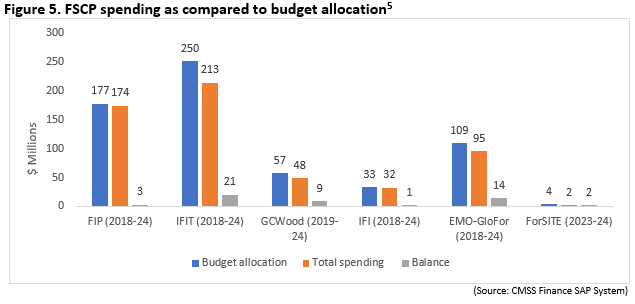
We examined the extent to which the FSCP was able to effectively use its allocated resources during the evaluation period (2018-19 to 2023-24). Figure 5 presents the program spending by component as compared to the allocated budget. Overall, from 2018-19 to 2023-24, the FSCP spent approximately 89.6% of its allocated budget.
Figure 5. FSCP spending as compared to budget allocationFootnote 5
Text version
FSCP spending as compared to budget allocation. The graph shows millions of dollars on the x-axis, and the y-axis is divided into the six FSCP components. A series of three parallel bars is shown for each component’s spending. Bar one. Budget allocation, Bar two. Total spending, and Bar three, balance. Forest Innovation component 2018 to 2024 budget allocation $177 million, total spending $174 million, balance $3 million. Investments in Forestry Industry Transformation component 2018 to 2024 budget allocation $250 million, total spending $213 million, balance $21 million. Green Construction through Wood component 2019 to 2024 budget allocation $57 million, total spending $48 million, balance $9 million. Indigenous Forestry Initiative component 2018 to 2024 budget allocation $33 million total spending $32 million, balance $1 million. Expanding Market Opportunities/Global Forest Leadership Program component 2018 to 2024 budget allocation $109 million, total spending $95 million, balance $14 million. Forest Systems Information and Technology Enhancement component 2023 to 2024 budget allocation $4 million, total spending $2 million, balance $2 million. (Source: CMSS Finance SAP System).
Some program components received transfers from other components or other programs that required adjustment in the initial allocation amounts. In some cases, unspent funds were reprofiled to subsequent fiscal years. Likewise, some conversion of funds from one line of expense to another, for example, from operations and maintenance to salary, was reported. However, Table 8 shows that some program components did not spend their allocated budget.
Table 8. Percentage of spending as compared to allocated budget
| Program component | 2018-19 | 2019-20 | 2020-21 | 2021-22 | 2022-23 | 2023-24 | Overall % |
|---|---|---|---|---|---|---|---|
| FIP | 99 | 98 | 98 | 99 | 98 | 97 | 98 |
| IFITFootnote 6 | 99 | 70 | 96 | 95 | 91 | 93 | 85 |
| GCWood | 93 | 82 | 81 | 99 | 75 | 90 | 84 |
| IFI | 99 | 99 | 97 | 99 | 97 | 93 | 98 |
| EMO-GloFor | 97 | 93 | 80 | 82 | 86 | 89 | 87 |
| ForSITE | - | - | - | - | - | 48 | 48 |
| Total for FSCP (2018-24) | 90 | ||||||
(Source: CMSS Finance SAP System)
The largest percentage of underspend was by the ForSITE component, which only spent about 48% of its allocation in 2023-24. ForSITE faced challenges in ramping up its activities according to the planned timelines in this first year of program delivery. It experienced delays in the procurement of large and complex new information technology infrastructure and in hiring highly qualified personnel to conduct the scientific activities required under the program. These factors were largely outside of the control of the program.
IFIT spent only 70% of allocated funds in 2019-20. The funds it received from another department for the Southern Mountain Caribou Conservation Agreement could not be used on time, as it needed time to clarify funding terms and conditions.
GCWood spent less than 85% of the allocated funds in three fiscal years. For 2020-21 and 2022-23, program managers indicated that this was largely due to COVID-19. Specifically, the pandemic impacted the program primarily in the form of project delays due to labour shortages, price escalations and supply chain interruptions; delays in research and testing due to the closure of labs; and delays to the project permitting process, which has slowed approval for, and caused delays to, construction of some innovative projects. Additionally, program operation was impacted by pandemic-related travel bans and the procurement of restrictions on in-person professional services. A reasonable explanation for the 18% underspend in 2019-2020 was not provided.
EMO-GloFor spent less than 90% of allocated funds in some fiscal years due to restrictions on international travel imposed by the Government of Canada during the pandemic. In-market travel restrictions in Asia also caused many tradeshows and educational seminars to be postponed or cancelled, starting in the last quarter of the fiscal year 2019-20. As a result, in-market offices costs were reduced. Additionally, some advanced payments were not reflected in NRCan’s financial system under FY 2023-24 but appeared in the following year.
Conversely, IFI and FIP had consistently high spending ratios (both spending between 97-99% of their allocated budget on an annual basis). These program components work with a limited number of proponents who receive funding under grants and contributions, and hence, the allocated budgets were more fully utilized.
Further administrative integration of program components may increase efficiency but could be challenging.
The FSCP achieved some success in improving the integrated administration of program components. For example, CFS has made efforts to standardize FSCP information technology and information management, including through the adoption of Client Relationship Management (CRM) systems. While many programs already had online intake processes, having proponents apply digitally and report end-to-end in an online CRM system has long been a goal of FSCP programs. This can offer an efficient and consistent interface for the GC programming and potentially promote the efficient collection and processing of information. At the time of writing, IFIT and GCWood had started to use a CRM, with FIP and IFI in line to adopt the same system. Interviewees suggested that it will need to be supported by staff training on both the CRM and its related graphic reporting interface.
Going forward, FSCP could consider further enhancing integration of operations in cases where this is likely to yield efficiencies and positive results from a cost-benefit perspective. However, further integration of systems has been challenging. Many of these issues are largely outside of direct program control. For example, ‘off-the-shelf’ CRM solutions are not usually tailored to the unique needs of government, while custom ‘in-house’ solutions are usually neither feasible nor cost-effective to develop. Also, the need to maintain legacy systems and procedures for consistency and accountability limits the potential for related systems to “talk to each other” and align content and formatting. Considerations must also be made for program effectiveness. For example, while CRM can contribute to program efficiency, an alternative to online application is also needed for low-capacity groups in the short to medium-term; CRM-only access could create inequity that enable high-capacity proponents to access funding while low-capacity stakeholders could be left behind.
Results
Given the important change in program design and delivery that occurred with program renewal in 2023, FSCP’s performance measurement changed significantly in 2023-24. Therefore, this evaluation’s findings related to program effectiveness are divided into two parts:
- ‘Backward-facing’ results for the first four fiscal years covered in this evaluation (2019-20 to 2022-23), and
- Results for the first fiscal year of program delivery using the FSCP’s most recently approved Results Appendix (2023-24).
There are indications of progress from 2019-20 to 2022-23, but results measurement was not adequately robust for evaluation.
Table 9 summarizes results reported by program components from 2019-20 to 2022-23. A detailed analysis is presented in Appendix E.
Though senior managers indicated that they generally had the information needed to effectively manage their program activities on a ‘day-to-day’ basis, the evaluation identified several issues in data quality. For example, available data contained discrepancies that made the information difficult to interpret for evaluation purposes. Assumptions used to estimate progress against targets and methods for calculating and projecting impacts, especially on newer environmental metrics, were not always well documented. Managers of the program components agreed that systematic data collection and calculations had room for improvement over these four years. The results presented here thus suggest good progress, with most targets reported as having been met or exceeded but cannot be used to definitively conclude on outcomes achieved.
Table 9. Summary of results reported by program components (2019-20 to 2022-23)
| Program component | Outcome level | Result status | Description of results |
|---|---|---|---|
| FIP | Immediate | 2 out of 3 targets met/exceeded |
|
| Intermediate |
2 out of 3 targets met/exceeded Other targets were either not applicable or could not be assessed. |
|
|
| Ultimate | 4 out of 4 targets met/exceeded |
|
|
| IFIT | Immediate | 2 out of 3 targets met/exceeded |
|
| Intermediate | 2 out of 4 targets exceeded; 1 target is on track; and 1 target was not met |
|
|
| Ultimate | 2 out of 3 targets met; 1 target was not met |
|
|
| GCWood | Immediate | 4 out of 4 targets met/exceeded |
|
| Intermediate | 6 out of 8 targets met/exceeded |
|
|
| Ultimate | 1 out of 2 targets on track |
|
|
| IFI | Immediate |
1 out of 2 targets exceeded The other target could not be assessed. |
|
| Intermediate | Partially tracked |
|
|
| Ultimate | 1 out of 1 target met |
|
|
| EMO | Immediate | 1 out of 1 target met |
|
| Intermediate | 2 out of 2 targets exceeded |
|
|
| Ultimate | 1 out of 1 target met |
|
NRCan’s Audit and Evaluation Branch completed three recent evaluations of program components that constitute the FSCP suite, namely: Evaluation of GCWood (2023); Evaluation of the Forest Sector Innovation Programs (2019); and Evaluation of the EMO Program (2019). These evaluations provide a more in-depth analysis of program impact than the results reporting completed by CFS. Though these evaluations mostly focused on results that pre-date the scope of this evaluation, they found mostly positive results across all programs with limited opportunities for improvement. The evaluations resulted in a total of 13 recommendations spanned the following four areas: program objectives/program delivery (6); partnerships (3); communication (1); and performance measurement (3).
We found that the program components have since implemented all previous evaluation recommendations (see Appendix F). Many of the related actions have helped to improve program planning and delivery, reach and overall performance. However, assessment of their impact on longer-term outcomes will require additional time, especially considering the time lag between innovation, technology adoption and realization of benefits.
FSCP’s results during 2023-24 to mid 2024-25 are generally on track.
The evaluation used the data that was available under the FSCP’s new performance framework (approved March 2024) to examine early indications that program components were on track to achieve the expected results. At the time of writing, results data were only available to the middle of 2024-25.
It is too soon to conclude on the likely achievement of many of the FSCP’s revised outcomes, with most targets for intermediate and ultimate outcomes set to be achieved between 2025 and 2030. The evaluation’s survey of FSCP staff revealed that, based on the first year of implementation, the majority of staff are confident that the program is on track to meet all of its intended outcomes. However, as would be expected, this level of confidence is slightly higher for immediate outcomes. Where staff did not report being confident that the program was on track, most indicated “don’t know/not applicable”. There were also a small number of “not at all confident” responses (i.e., 6%-12% for intermediate outcomes and just one for the ultimate outcome). Regardless, these results demonstrate high staff confidence that the FSCP is designed and delivered in a way that is facilitating the achievement of outcomes.
Overall, respondents were least confident that the FSCP was on track to achieve its intermediate outcome related to “increased opportunities for historically underrepresented groups to participate in forest sector-based economic development”; only 59% of respondents reported being somewhat or very confident that this result would be achieved. While this does not necessarily mean that the program is not on track to meet its goals, making progress on reconciliation is a challenge across government. There is also a growing recognition that Indigenous input is necessary to help define reconciliation outcomes. While the recent renewal of IFI expanded its scope beyond economic development to include reconciliation, there is still room to improve reporting on related objectives with some interviewees noting that the IFI is challenged to identify meaningful performance metrics. Staff noted that Indigenous communities’ definitions of success could be very different from those usually employed by the Government of Canada, and were difficult to capture, mainly because standard government metrics (e.g., revenue generated and jobs created) were not the only focus considered important by communities. More work will likely be needed to develop metrics suitable for projects and initiatives involving Indigenous people and partners.
FSCP is mostly on track to meet all its immediate outcomes by end of 2025-26.
A review of the FSCP’s reported results indicates that FSCP was on track to meet most of its immediate outcomes by 2025-26. As of mid 2024-25, a couple of activities had already exceeded targeted results. While most others were reported to be on schedule, a couple had not yet collected related results information. Table 10 presents a summary of results by immediate outcome.
Table 10. Progress on FSCP immediate outcomes, as of mid 2024-25
| Immediate outcome | Program component | Result status | Description of results |
|---|---|---|---|
| Accurate information, advice, guidance, scientific data, tools and/or knowledge is available to stakeholders | FIP | Target 1: Exceeded | The CWFC reported producing 69 of 50 targeted technology transfer products. |
| Target 2: On track | FIP completed 33 information sharing activities in 2023-24. (Target: 50 per year). | ||
| ForSITE | Target 1: On track | Completed 2 out of 5 targeted data products. | |
| Target 2: On track | About 16% of Canada’s forested area was associated with more accurate information on forest carbon and forest condition. (Target: 30%). | ||
| Stakeholders are implementing projects, domestically and/or internationally. | IFIT | Target: On track | The ratio of IFIT’s partner contributions to federal funding was reported at 2.3:1 but is expected to increase as projects continue. (Target: 3:1). |
| GloFor | Target: Exceeded | GloFor reported 24 arrangements with G&C recipients, and 19 arrangements with International Model Forest Network recipients, with the outcome exceeding the total target by 16 arrangements. | |
| IFI | Target 1: On track | IFI reported signing 155 G&C agreements with Indigenous communities. (Target: 200). | |
| Target 2: N/A | Data on the number of collaborative sessions held was not yet available. | ||
| Stakeholders are aware of, and engaged with, programs. | IFIT | Target: On track | IFIT completed 3 out of 5 targeted EDI outreach activities. |
| GCWood | Target: On track | Data indicates zero of 10 targeted EDI outreach activities expected to be led by funded recipients had yet been completed by end of 2023-24. It was not mandatory for the proponents. | |
| GloFor | Target: N/A | No outcome data was yet available to inform results. GloFor targets a number of public engagement activities to be fulfilled by social media posts. | |
| Construction industry stakeholders have the information & tools necessary to pursue wood-based building projects. | GCWood | Target 1: On track | GCWood reported reaching a total of 5,784 construction industry stakeholders (Target: 15,000). |
| Target 2: On track | Five of a targeted 60-70 information products had so far been made available to construction industry stakeholders. |
While data indicates some progress, it is too soon to report on close to half of the FSCP’s intermediate outcomes.
Table 11 presents a summary of reported results per intermediate. Most targets are set to be achieved between 2025 and 2030. By the end of 2023-24, two indicators with nearer-terms results had already exceeded their targets, and another 10 indicators were reported to be on track. However, data was still missing to inform nine of the 21 indicators at the intermediate level.
Table 11. Progress on FSCP Intermediate Outcomes, as of mid 2024-25
| Intermediate outcome | Program component | Result status | Description of results |
|---|---|---|---|
| The Canadian Forest sector has tools to support sustainable forests, forest industry market acceptance in Canada and forest leadership internationally. | FIP | Target: Exceeded | Eight certifications or codes and standards reported as developed. (Target: Six by 2025-26) |
| GloFor | Target: Exceeded | 100% of Canadian global forest-related commitments actioned by March 31, 2024. (Target: 60% by target; date not specified). | |
| ForSITE | Target 1: N/A | Information not yet available on next-generation spatially explicit open data sets made available by NRCan. (Target: 50 by target date not specified). | |
| Target 2: Exceeded | ForSITE reported 10 citations from stakeholders that accessed or used NRCan’s scientific data. (Target: Five per year). | ||
| The forest sector is innovative and contributes to Canada’s economic development. | FIP | Target 1: On track | FIP reported two transformative forest sector products developed with program support scaled up or commercially available through one or more forest sector companies. (Target: Three by March 31, 2026). |
| Target 2: On track | FIP reported one transformative and high-value process and technology was reported to have been adopted by industry. (Target: Six by March 31, 2026). | ||
| IFIT | Target 1: On track | IFIT reported an estimated 36 jobs created and 1,000 jobs maintained. (Target: 250 new jobs created by 2028). | |
| Target 2: On track | IFIT reported one new product as anticipated from contribution agreements signed in 2023-24. (Target: 25 by March 31, 2028). | ||
| GCWood | Target 1: N/A | Results were not yet available to inform the number of innovative wood-based building systems/technologies and advanced building bioproducts demonstrated or related replications. (Target: 10-16 by March 31, 2026) | |
| Target 2: Not met | Results for the number of innovative wood-based systems/technologies and advanced building bioproducts projects replicated is 0. (Target 30-40 replications by March 31, 2028). | ||
| Target 3: On track | An estimated 8.4% of Canadian firms could provide architectural engineering and construction services to design and build with wood. (Target: 12% by March 2026) | ||
| IFI | Target 1: On track | IFI created 387 jobs, on a target of 900 (target date not specified). | |
| Target 2: N/A | IFI created 387 jobs, on a target of 900 (target date not specified) | ||
| Target 2: On track. | IFI reported 50 business start-ups or expansions funded that are fully capitalized, in construction, and/or operational, on a target of 60. (target date not specified) | ||
| Increased opportunities for historically underrepresented groups to participate in forest sector based economic development. | FIP | Target: On track. | Awarded 30 forest-sector based scholarships for individuals from underrepresented groups from 2023-24 to 2024-25. (Target:146 by March 31, 2026). |
| IFIT | Target: N/A | IFIT targets 75% of the workforce diversity plans it reviews receiving a score of 75% or above by March 31, 2028. It reported being on track, with six plans having been reviewed by CFS. Data was not available to align this result with the target. | |
| IFI | Target 1: N/A | Data are not yet available to inform the number of projects funded that support the creation, safeguarding, and use of Indigenous knowledge in the forest sector. (Target: 25%; target date not specified) | |
| Target 2: N/A | Data not yet available to inform the number of trainees in IFI funded projects. (Target: 1.319 by March 2026) | ||
| Target 3: On track. | Awarded 33 grants that increase inclusion in forest management. (Target: 60; target date not specified) | ||
| The Canadian Forest sector contributes to Canada’s environmental objectives. | FIP | Target: N/A | Data not available to inform the number of projects leading to positive environmental outcomes. (Target: Six by March 31, 2026) |
| IFIT | Target: N/A | Data not available to inform the number of projects leading to positive environmental outcomes. (Target: 20 by March 2028) | |
| GCWood | Target: N/A | Data not available to inform the cumulative impact of carbon dioxide equivalent (CO2e) stored or sequestered and avoided or mitigated. (Target: A cumulative impact of 0.24 to 0.42 million metric tonnes of carbon dioxide equivalent (Mt of CO2e) stored/ sequestered and 0.1 to 0.17 Mt of CO2e avoided/mitigated, totaling 0.34 to 0.59 Mt of CO2e between 2025 and 2030). |
(Source: FSCP program data, 2024)
The FSCP is likely to contribute to its ultimate outcome, but not before the current funding cycle ends in 2025-26.
All FSCP program components share the same ultimate outcome, i.e., “The forest sector is competitive, contributes to Canada's net-zero future, and provides socio-economic value to Canadians.” While this outcome statement was redeveloped in 2024, it is aligned with ultimate outcomes previously targeted by several program components which targeted the sustainable development of forest resources.
Targets for the FSCP’s ultimate outcome are not expected to be achieved until 2026 to 2028. It is thus too early to fully assess the progress of the FSCP against its ultimate outcome. For most program components, information was not yet available to report against new metrics developed in 2024.
The evaluation confirmed that the FCSP’s activities are likely to contribute to Canada’s net-zero future, while providing socio-economic value to Canadians. However, direct attribution of results is not possible. As with all programs, as one moves along the results chain, control over achievement of results weakens and it becomes harder to attribute results directly to program interventions. The sustainability of the forest sector also requires support from other programs within NRCan (e.g., scientific programs focused on pest and fire management), other federal departments (e.g., GAC), and the programs and decisions of other partners and stakeholders, including provinces and territories. As noted, to succeed, the FSCP must also fight against a substantive number of external factors that can impede forest sector sustainability (e.g., climate change and structural changes in world markets).
At a macro level, economic trends reported for the forest sector indicate that the forest sector contributed $27 billion (0.9%) to Canada’s nominal GDP in 2023, which represents a reduction of 22% compared to 2022 (Figure 6).Footnote 7 Real GDP for the forest sector also contracted 8% year-over-year. These trends are influenced by various external factors, including but not limited to prices and production trends for key forest sector products, and trends in consumer demand both domestically and abroad.
Figure 6. Canadian forest sector’s contribution to gross domestic product, 2013–2023
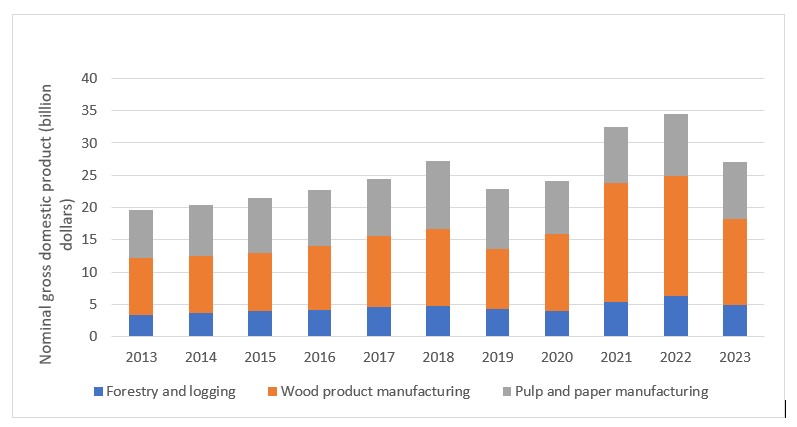
Text version
Canadian forest sector’s contribution to gross domestic product, 2013–2023.
The bar graph shows nominal gross domestic product in billions of dollars on the x-axis, against the years 2013 to 2023 on the y-axis. Each bar is made up of three segments proportional to the GDP contribution. One, forestry and logging. Two, wood product manufacturing, and three, pulp and paper manufacturing. Yearly totals. 2013,19.5 billion dollars. 2014, $20.38 billion. 2015, $21.53 billion. 2016, $22.69 billion. 2017, $24.48 billion. 2018, $27.15 billion. 2019, $22.84 billion. 2020, $24.03 billion. 2021, $32.51 billion. 2022, $34.51 billion. 2023, $27.02 billion. Pulp and paper manufacturing. 2013, $7.42 billion. 2014, $7.93 billion. 2015, $8.58 billion. 2016, $8.61 billion. 2017, $8.84 billion. 2018, $10.47 billion. 2019, $9.22 billion. 2020, $8.11 billion. 2021, $8.69 billion. 2022, $9.67 billion. 2023, $8.81 billion. Wood product manufacturing. 2013, $8.79 billion. 2014, $8.72 billion. 2015, $8.96 billion. 2016, $9.99 billion. 2017, $11.12 billion. 2018, $11.86 billion. 2019, $9.34 billion. 2020, $11.88 billion. 2021, $18.42 billion. 2022, $18.62 billion. 2023, $13.33 billion. Forestry and logging. 2013, $3.39 billion. 2014, $3.73 billion. 2015, $3.99 billion. 2016, $4.09 billion. 2017, $4.52 billion. 2018, $4.82 billion. 2019, $4.28 billion. 2020, $4.04 billion. 2021, $5.41 billion. 2022, $6.22 billion. 2023, $4.88 billion.
Source: The State of Canada’s Forests Annual Report 2024
Interviewees were positive on the value of wood products for sequestering carbon, which offers Canada a pathway to its net zero future in building construction, and in other areas. By the end of 2023-24, GCWood reported being on track to achieve its expected results in this area, with an estimated cumulative impact of between 0.54-4.6Mt of CO2e expected to be mitigated between 2020 and 2030. Its data also shows that 11 building and infrastructure projects will have been replicated by 2030, against a target of 10-15. Cross laminated timber building techniques employ significant amounts of engineered wood, which can replace more carbon intensive materials such as concrete made with highly emissions intensive cement. By displacing concrete, mass timber construction has the potential to lock away naturally sequestered carbon for a significant amount of time in the built environment, while reducing the GHG construction footprint of buildings.
The evaluation’s case study of biochar provided another example of how FSCP supported projects contribute to this result. Production by a proponent in Ontario also showed potential for sustainably harvested low-value forest resources such as branches, and other ‘slash’ materials (previously waste resources) to sequester carbon once turned into biochar. This carbon can remain in soils possibly for hundreds or even thousands of years when used as a soil additive, and it is also being used in automotive foam where the biochar displaces the material ‘carbon-black’ derived from fossil hydrocarbons, helping to green automotive manufacturing.
At the macro-level, tracking progress in the bioeconomy sector is challenging due to fragmented information spread across various sectors like chemicals, construction materials, and bioplastics. The quantity of information is so small, and its concentration so diffused, that it does not appear in broad statistics from sources like Statistics Canada. The FSCP team has attempted in-house surveys to gather project-level data, but these are resource-intensive endeavours. Therefore, it is difficult to single out FSCP achievements.
No unintended outcomes were identified by interviewees or by the evaluators conducting the engagement. Some interviewees identified surprises or items that went better or worse than expected, e.g., demand for IFI’s grant program was higher than expected. However, these effects were judged by the evaluation to be broadly within the program’s range of expected results.
Conclusion
The FSCP has undergone continual evolution as it adapts to Canada’s forest sector’s changing context. Overall, the evaluation found that both the FSCP and its related program components continue to be relevant to the needs of the forest sector and in responding to government priorities. However, there may be needs that are not being met, particularly for international market development.
The performance measurement framework for the FSCP has also evolved considerably over the period of evaluation. The FSCP theory of change that was developed and tested as part of this evaluation was found to be sound. The Program’s outcomes present a logical representation of the FSCP’s targeted results for forest sector innovation and competitiveness. Conditions assumed to be necessary for the success of program outcomes in the theory of change will likely be met. Leveraging this theory of change to explain the FSCP’s success stories could help CFS report its performance in a more compelling fashion.
There are indications of progress on FSCP outcomes from 2019-20 to 2022-23, with most targets reported as having been met or exceeded, but results measurement was not adequately robust for evaluation. Revisions to the Program’s performance measurement framework completed in 2024 improved its coherence but more time is required to fully test its new results metrics and standardize data collection. It is too soon to conclude on the likely achievement of many of the FSCP’s revised outcomes, with most targets for intermediate and ultimate outcomes set to be achieved between 2025 and 2030. The data that is available indicates that the FSCP is mostly on track to meet all its immediate outcomes by end of 2025-26 and has advanced efforts to increase diversity and inclusion in the forest sector. It is also making progress towards many of its intermediate outcomes. Achievement of the FSCP’s ultimate outcome will depend on a substantive number of external factors that may impede forest sector sustainability.
Related to program efficiency, we found that FSCP program components have generally used most of their allocated budget. However, the newest program component (ForSITE) experienced significant challenges in ramping up operations in its first year of delivery due to the distinctive nature of its delivery mechanism. The COVID-19 pandemic also impacted other program components’ ability to make full use of their funds in some fiscal years.
While under the umbrella of a single DRF Program, program components are administered separately. The evaluation found that the FSCP has achieved some success in improving the integrated administration of program components (e.g., adoption of Client Relationship Management (CRM) systems. Going forward, while further integration may be challenging, the FSCP could consider further enhancing integration of operations in cases where this is likely to yield efficiencies and positive results from a cost-benefit perspective.
Appendices
Appendix A. Description of Forest Sector Competitiveness Program (FSCP) components
| Component | Description |
|---|---|
| Forest Innovation Program (FIP) |
Since 2012, FIP has supported the forest sector’s innovation agenda and priorities to enable transformation in the Canadian forest industry. It is designed to improve long-term forest sector competitiveness by accelerating the development of clean growth technologies and products, supporting R&D and pilot projects that are aligned with future market demands and consumer preferences, and helps the sector be well equipped to face current and future challenges related to fibre supply.
|
| Investments in Forest Industry Transformation (IFIT) | Since 2010, IFIT has worked to accelerate the adoption and diffusion of innovation in the forest sector by bridging the gap between the development and commercialization of innovative products and processes. It supports the forest sector and forest-dependent communities to bring about innovation and transformation that has diversified markets with new, higher value products, increased competitiveness, economic sustainability, and environmental performance. IFIT seeks to facilitate the implementation of innovations that result in a more optimal utilisation of tree fiber, supports a sector that is facing a declining timber supply, and accelerates the commercial deployment of these innovations which will lead to a sector that can diversify away from traditional products. The objective of IFIT is to support forest industry transformation that will make the forest industry more commercially and environmentally sustainable. |
| Green Construction through Wood (GCWood) | Since 2017, GCWood has sought to encourage the increased use of wood products in construction, including through updated building codes, advanced education and building capacity, and demonstration projects. It promotes the use of low-carbon and sustainable building materials to support Canada’s priorities and commitments to decarbonize the built environment, meet targets of greenhouse gas (GHG) emissions reductions by 2030 and reach net zero by 2050. GCWood facilitates market uptake for wood products by funding demonstrations of innovative wood-based systems and technologies, and advanced bio-products used in the construction of buildings that have low GHG emissions, are regionally representative, and are highly replicable. It also funds wood education, technology transfer, R&D, and supports building code revisions to increase the innovative use of wood in construction, including mass timber. |
| Indigenous Forestry Initiative (IFI) | Since 2017, the IFI has worked with Indigenous partners to support economic development, encourage Indigenous participation, and ensure that Indigenous Peoples receive the training required for their meaningful involvement in the forest sector. These outcomes are achieved through investments in Indigenous-led capacity-building activities, the provision of grants and contributions to Indigenous proponents for forest sector activities that span the business development continuum. IFI invests in three key areas of the forest sector: Indigenous knowledge/science, economic development, and Indigenous forest stewardship. The program also incorporates diversified decision making by establishing a gender and regionally balanced, majority-Indigenous expert review panel. |
| Global Forest Leadership Program (GloFor) | First funded in 2023, GloFor seeks to advance Canada’s forest sector leadership through international engagement, partnerships, collaborations, and sharing expertise. It is a redesigned successor to the Expanding Market Opportunities program,Footnote 9 which operated from 2012 to 2023. GloFor looks to increase global markets for Canada’s sustainable and responsibly sourced forest-based products. It also aims to advance Canada’s international forest leadership by strengthening Canada’s collaboration and approach to forest sector leadership with international and domestic partners, defending Canada’s environmental reputation, guarding against barriers to trade, and providing Canadian expertise internationally, particularly in relation to forest practices, products, and technologies. |
| Forest Systems Information and Technology Enhancement (ForSITE) |
Funded for three years, beginning in 2023, ForSITE seeks to deliver publicly accessible data on forest carbon and forest inventories to produce enhanced, scientifically defensible, high spatial resolution forest assessment data and maps, reports, and policies. It seeks to produce more accurate and precise climate change-informed and verified forest carbon accounting data and maps for Canada’s forests at a spatial resolution of one hectare. ForSITE activities are delivered under two key streams:
|
Appendix B. FSCP results chain
Successful completion of activities by program components can be expected to produce outputs such as:
- research conducted.
- reference materials produced.
- funding applications processed.
- contribution agreements (CAs) signed; and
- funds distributed in a timely manner.
Funding recipients implement projects as outlined in their proposals, monitor results, and report them to the CFS. The time range for output delivery can vary from one to three years with some exceptions for research activities that can take several years.Footnote 10
When immediate outcomes are delivered, the FSCP’s intermediate outcomes should be realized. The intermediate outcomes relate to the change in knowledge and practices of the intended users of deliverables, which can take five years (with anywhere between five to ten years for complex research/technologies).
When intermediate outcomes are delivered, the FSCP’s ultimate outcome should be realized. The FSCP’s contribution is reliant on the ability of the stakeholders, namely, provinces and territories, industry, along with other interdependent federal programs to deliver on their assumed contributions to the ultimate outcome. If all contributions align, the realization of the ultimate outcome can take more than ten years with some exceptions for complex research/technologies that can take more than fifteen years.
Appendix C. Reported list of preconditions and assumptions and associated risks
| Level of outcome | Expected outcome | Preconditions/AssumptionsFootnote 11 | Hypothetical risks if assumptions not met (counterfactual) |
|---|---|---|---|
| Immediate |
|
|
|
|
|
|
|
|
|
|
|
|
|
|
|
| Intermediate |
|
|
|
|
|
|
|
|
|
||
|
|
|
|
|
|
|
|
| Ultimate |
|
|
|
Appendix D. FSCP Partners and stakeholders
To ensure the success and reach of the FSCP’s suite of programming, the FSCP actively works with implementation partners within the federal family, arm’s length organizations, and external partners and stakeholders. They are listed as follows:
- NRCan works with several federal government departments and/or crown corporations to advance Program outcomes and increase the reach of the FSCP, including Global Affairs Canada (GAC), Business Development Canada, and Export Development Canada. In recent years, with the removal of market development and the sunsetting of EMO, NRCan has increased reliance on GAC expertise, market access programs and personnel in that space while increasing NRCan’s own focus on the advancement of Canada’s forest sector leadership through international engagement, partnerships, collaborations, and sharing expertise.
- The federal, provincial, and territorial governments maintain a shared responsibility for Canada’s forest sector and work in close collaboration to support them. ForSITE subject matter experts collaborate with provincial and territorial governments on forest sector data collection. Ongoing efforts and cofounded projects help to ensure Canadian wood and forest products remain competitive on the international market, and Canadian positions are advanced, such as defining and reporting on forest degradation.
- NRCan collaborates with several forest industry associations including the Forest Products Association of Canada, Canadian Wood Council, BC Forestry Innovation Investment, the National Aboriginal Forestry Association, Conseil de l’industrie forestière du Québec, and others.
- GCWood works with industry, academia, forest sector associations, and other government departments to support research, education and market acceptance and growth for mass timber and other wood-based building systems that represent the interests of the forest industry and engage in collaborative initiatives.
- FIP has a long history of supporting the activities of FPInnovations, which is a private not-for-profit R&D organization specializing in the creation of solutions that accelerate the growth of the Canadian forest sector. FIP also works with federal laboratories and other research organizations, and in partnership with affiliated industries, to enhance the global competitiveness of the Canadian forest sector.
- IFIT engages with forest companies involved in forestry operations, manufacturing, and processing of forest products, which are key stakeholders with vested interests in the sectors’ competitiveness.
- ForSITE engages Indigenous partners, industry, and Universities and research institutions to identify information gaps and priorities for improvement related to forest information systems.
- Universities and research institutions play a crucial role in conducting research and developing new technologies for the forest sector. They also support Highly Qualified Personnel (HQP) in the forest sector by providing opportunity for researchers, HQP and partners to meet, network and connect.
- Indigenous groups and communities have a significant stake in forest management and resource use, and through IFI programming and activities their interests are supported, and Indigenous knowledge is included in the forest sector.
Appendix E. Summary of results based on 2020 indicators
Table 12. FIP results (2020-21 to 2022-23)
| Outcomes | Indicators | Target | AchievementFootnote 13 | Rationale if the target was not achieved |
|---|---|---|---|---|
| Immediate – Decision makers have access to timely and accurate advice, guidance, knowledge and information. | Number of science-based and peer reviewed research/technical reports produced and/or published. |
|
|
Met / Exceeded. |
| Percentage of recipients providing workforce statistics that support the tracking of workforce diversity. |
|
|
Met / Exceeded. | |
| Immediate – Stakeholders are engaged and implementing projects. | Ratio of funds leveraged by other funding partners (industry, other federal, provincial, non-profit and research organizations). |
|
|
Did not meet. |
| Intermediate – Canada leverages positive reputation for sustainable forestry practices to strengthen partnerships and competitiveness. | Number of Gender and Diversity Work Plans that support workforce diversity in the forest sector. |
|
|
In clarification of the 2019 Budget readout, TBS had identified certain National Occupational Classifications (NOC), where TBS wanted targeted measures. Given that FIP targets R&D which are not part of the NOC categories above, no diversity work plans were required. To ensure that FIP was also contributing to diversity and inclusion in the forest sector, FIP started funding the Natural Sciences and Engineering Research Council of Canada Canadian Forest Sector Workforce Diversity undergraduate supplement. |
| Intermediate – Innovative Products and Market Development. | Number of new higher-value Canadian forest processes and technologies adopted by industry. |
|
|
Met / Exceeded. |
| Number of transformative forest sector products developed with support of the FIP and have been scaled up or are commercially available through one or more forest sector companies. |
|
|
Met / Exceeded. | |
| Number of certifications, codes and standards developed or being developed because of FIP partnership or funding. |
|
|
N/A. | |
| Ultimate Outcome – Sustainable Forest resources contribute to environmental, social, cultural and economic sustainability. | Number of collaborative activities/events with other governmental or non-governmental organizations. |
|
|
Met / Exceeded. |
| Percentage of forest sector-based scholarships and internships awarded to individuals from targeted underrepresented groups (women, Indigenous people, and immigrants). |
|
|
Met / Exceeded. | |
| Proportion of women and people from minority groups working in the Canadian Forest Sector. |
|
|
2/3 Met. 1 No Data. | |
| Number of forest sector jobs per million dollars of value added compared to other natural resources sectors. |
|
|
|
Table 13. IFIT results (2020-21 to 2022-23)
| Outcomes | Indicators | Target | Achievement | Rationale if the target was not achieved |
|---|---|---|---|---|
| Immediate – Decision makers have access to timely and accurate advice, guidance, knowledge and information. | Percentage of recipients providing workforce statistics that support the tracking of workforce diversity. |
|
|
Not met. |
| Immediate – Stakeholders are engaged and implementing projects. | Ratio of funds leveraged by other funding partners (industry, other federal, provincial, non-profit and research organizations). |
|
|
Met. |
| Applicants have clear understanding of program eligibility and application requirements. |
|
|
Note: IFIT used an online portal for application submission. Applicants were not able to submit an application past the deadline, so target was rendered unmeasurable.
The metric was replaced with the G&C service standards related to applications, as these are standardized for G&C programs across NRCan, and it shows the strategic outcome that IFIT staff is engaged with the applicants and projects are being implemented. For initial and new metrics, the result was 100% (met / exceeded). Acknowledging receipt of proposal (Five business days) and providing funding decision (75 calendar days). |
|
| Number of unique hits to the IFIT website. |
|
|
Met / Exceeded. | |
| Intermediate – Canada leverages positive reputation for sustainable forestry practices to strengthen partnerships and competitiveness. | Number of Gender and Diversity Work Plans that support workforce diversity in the forest sector. |
|
|
The measure is new and there are no formally established targets. D&I plans are required twice per applicant (application and final report). |
| Intermediate – Innovative Products and Market Development. | Number of IFIT contribution agreements signed. |
|
|
Met / Exceeded. |
| Number of new partnerships between forest product producers and other industry sector firms (e.g., chemical energy, etc.) funded by the program. |
|
|
Met / Exceeded. | |
| Intermediate – Stakeholders are engaged and implementing projects. | Number of IFIT projects funded to develop new forest bioproducts or processes. |
|
|
Not met. The target was supposed to be amended to 14 (not 40) smaller projects during COVID-19, but due to timing, ran non-solicited call and instead funded larger projects. |
| Ultimate Outcome – Sustainable Forest resources contribute to environmental, social, cultural and economic sustainability. | Number of collaborative activities/events with other governmental or non-governmental organizations. |
|
|
Met / Exceeded. |
| Percentage of forest sector-based scholarships and internships awarded to individuals from targeted underrepresented groups (women, Indigenous people, and immigrants). |
|
|
Met / Exceeded. | |
| Proportion of women and people from minority groups working in the Canadian Forest Sector. |
|
|
2/3 Met. 1 No Data. | |
| Number of forest sector jobs per million dollars of value added compared to other natural resources sectors. |
|
|
|
|
| Ultimate – Markets and products are diversified, and market access is enhanced. | Number of jobs created. |
|
|
|
| Number of new products and/or processes created that could lead to more diversified and resilient forest products. |
|
|
|
|
| Number of mandatory or voluntary sustainability standards in place at the facility or product levels (e.g., ISO 50001 Energy Management Systems standards, Forest Stewardship Council certification) or public facing sustainability reports published by applicants during the project execution and reporting period. |
|
|
|
Table 14. GCWood results (2020-21 to 2022-2023)
| Outcomes | Indicators | Target | Achievement | Rationale if the target was not achieved |
|---|---|---|---|---|
| Immediate-Regulatory agencies and specifiers have the information they need to determine product, performance, and environmental credentials. | Number of science-based information products produced and made publicly available to stakeholders |
|
|
|
| Immediate-Architects, specifiers, and builders have the information and tools necessary to pursue wood-based building projects | Number of advanced education and training modules developed |
|
|
|
| Number of design and life-cycle assessment tools created |
|
|
||
| Number of education and training events |
|
|
Due to COVID-19 and the learning curve and lead time required to move events online | |
| Intermediate-Regulatory acceptance/recognition of wood products and building systems in building codes, standards, and policies. | Number of authorities having jurisdiction for codes and standards that accept new wood products and building systems in their regulations and codes. |
|
|
|
|
|
Due to GCWood efforts and funding to the National Research Council, have supported the development of performance-based design and codes allowing them to become a priority for the 2025 code cycle.
Performance based codes are expected to be more fully developed for the 2030 code cycle as transforming the code to become performance based is an incremental process due to its complexity. |
||
|
|
Note that jurisdictions include PTs and cities as code adoption is decentralized in Canada | ||
| IntermediateFootnote 14-Builders, architects and specifiers have the capacity to use wood products. | Number of academic institutions which now include wood-based elements in their course curriculum |
|
|
|
| Number of professionals reached with education products |
|
|
||
| Number of hours delivered on implementing of wood-based buildings and infrastructure |
|
|
||
| Intermediate- Demonstration of advanced wood use in the construction of low-rise commercial buildings, high-rise buildings, and timber bridges. | Number of wood-based buildings and infrastructure projects demonstrated |
|
|
While the overall target of funding 9-13 demo projects was exceeded, the targets for the high rise and bridge project demos were not met for the following reasons. The fourth high-rise project did not go ahead to construction due to re-zoning of Broadview Avenue, Vancouver and market challenges, making the design unattainable. The program had four bridges shortlisted, however a competition for HICC (then INFC) was run at the same time. As the competition was material neutral shortlisted projects chose to take HICC funding and use a different material (concrete) for construction. |
| Volume of wood products consumed in new wood-based buildings and infrastructure activities |
|
|
The target was based an estimation provided in close consultation with industry partners who completed market research. Partners in 2016-2017 looked at the current construction market and provided estimates for March 2025. The construction market is very dynamic, and the pandemic and supply chain affected accurate forecasts. Direct and indirect volumes of wood construction estimates were affected by the dynamic market. | |
| Ultimate/final- Canada addresses climate change through the carbon being sequestered in the increased amount of wood used in the construction industry. | Annual GHG emission avoided (Mt) |
|
|
The results are below target levels as fewer demonstration buildings and infrastructure were constructed. Also, due to COVID-19, fewer replications and estimates of indirect benefits from program activities were realized. |
| Ultimate/final- Adoption and commercialization of wood in the construction of low-rise commercial buildings, high-rise buildings, and bridges.Footnote 17 | Number of wood-based buildings and infrastructure projects replicated |
|
|
On target to meet. The indicator and achievement is still under review. The program signed a contract in 2025 with a third party to research replications of GCWood funded wood-based technologies and systems. Results will be available by 2030. |
Table 15. IFI progress (2019-20 to 2022-23)
| Outcomes | Indicators | Target | Achievement | Rationale if the target was not achieved |
|---|---|---|---|---|
| Immediate – Decision makers have access to timely and accurate advice, guidance, knowledge and information. | Percentage of recipients providing workforce statistics that support the tracking of workforce diversity. |
|
|
Note: This measure was not tracked. |
| Immediate – Stakeholders are engaged and implementing projects. | Number of proposals received from Indigenous communities and entrepreneurs for IFI. |
|
|
In 2022, the IFI did not host a call for proposals due to the large inventory of strong applications received in the previous fiscal year.
Breakdown is not available for multi-year. |
| Intermediate – Canada leverages positive reputation for sustainable forestry practices to strengthen partnerships and competitiveness. | Number of Gender and Diversity Work Plans that support workforce diversity in the forest sector. |
|
|
Note: There is no mandatory requirement for this measure to be tracked under IFI. As a result, the IFI program has supplied data from partial tracking of this measure. |
| Number of milestones (tasks) met that advance Indigenous participation in natural resource development opportunities. |
|
|
||
| Ultimate – Sustainable Forest resources contribute to environmental, social, cultural and economic sustainability. | Number of collaborative activities/events with other governmental or non-governmental organizations. |
|
|
This metric was not tracked during the requested fiscal years (only started post 2023). |
| Number of Indigenous led business start-ups or expansions funded by the IFI that are fully capitalized, in construction, and/or are operational. |
|
|
||
| Proportion of women and people from minority groups working in the Canadian forest sector. |
|
|
*Note: The IFI program is specifically geared for Indigenous peoples only. All jobs resulting from project activities would be for an Indigenous person. | |
| Number of forest sector jobs per million dollars of value added compared to other natural resources sectors. |
|
|
Table 16. EMO results (2020-21 to 2022-23)
| Outcomes | Indicators | Target | Achievement | Rationale if the target was not achieved |
|---|---|---|---|---|
| Immediate- Partners engage in market development | Number of applicants in 2020-2021 compared to 2019-2020. |
|
|
Targets were met for each year. |
| Intermediate- Target markets consider Canadian forest products to be a preferred and environmentally responsible choice | Percentage of targeted stakeholders who have a positive perception of Canadian forest practices and products. |
|
|
The EMO program works with the Forest Products Association of Canada and Leger to conduct a survey of global wood buyers.
The study was done in 2020 and 2022. Targets were met for each year of the study. |
| Intermediate – Partners create an enabling environment for use of Canadian forest products in target markets. | Results that demonstrate the ability to address market access and regulatory issues in international markets limiting trade of Canadian forest products. |
|
|
The EMO program will track the number of regulatory and related meetings with Canadian representation on issues pertaining to codes, standards and certification systems or market access issues through EMO program and recipient reports.
Targets were met for each year. |
| Ultimate- Growth and diversification of markets and market segments for Canadian wood products. | Trends (dollar value of wood exports) in targeted offshore markets (China, Japan, South Korea, EU-28, India, Middle East and Southeast Asia). |
|
|
Targets were met for each year. |
Appendix F. Past evaluation recommendations and their outcomes
| Area of recommendation (numbers) | Recommendations | Evaluation (year) | Action(s)/Implementation | Outcomes/ status |
|---|---|---|---|---|
| Program objective/ program delivery (6) |
|
Evaluation of GCWood (2023) | The program shifted its demonstration stream focus from building types to innovative building technologies like prefabrication and modular construction, supporting a wider range of building types and heights. | The evaluation of project proposals was ongoing during the conduct of this evaluation, so the full distribution of funding wasn’t disclosed. However, the proposals were well-distributed across focus areas and infrastructure categories, with the majority in prefabrication and institutional or multi-unit residential projects. |
|
Evaluation of the EMO Program (2019) | The Recommendation resulted in the creation of a Bioproducts Report, which provides a brief overview of the novel forest bioproducts sector in Canada while exploring how the EMO program can support the development of this sector. The report had several recommendations including working with eligible applicants to see where international projects could be pursued and continuing to monitor bioproducts and considering further action leading up to renewal. | Ultimately, many novel bioproducts were not yet at the stage where exporting internationally was being considered, and there were not many eligible industry organizations dedicated to bioproducts. Notably, EMO did provide funding to NanoCanada for work on Standards and Market Research in this area. | |
|
Evaluation of the EMO Program (2019) | A report titled Impact Analysis of the Wood Products Trade Commissioner position, Embassy of Canada, Abu Dhabi, United Arab Emirates was completed in September 2019. | Over the time period, EMO funding dedicated toward the position, to recipients a did not produce the intended outcomes. The costs and work that went into creating and keeping the position staffed, and managing the annual workplan, outweighed the benefits. The lessons learned were summarized and included in verbal briefings for senior management as part of the departmental discussions for future offshore NRCan TCS positions. | |
|
Evaluation of the Forest Sector Innovation Programs (2019) | In 2020, FPInnovations revamped the Transformative Technologies program to collaborate with diverse stakeholders and promote new bioproducts and bioprocesses. This approach operates independently from the traditional RD&D program. Since 2021-22, initiatives like the Hybrid Electric Tractor Semi-Trailer, Lignin in Asphalt, cellulose-based bio-composites, and truck platooning have been included in the annual FIP funding. | The new innovations have been accepted as Transformative Technologies within the forest sector, leading to the adoption of resulting products by stakeholders. For example, greener asphalt solutions have gained traction in Quebec. | |
|
Evaluation of the Forest Sector Innovation Programs (2019) | In 2020, the program introduced expanded funding stream for studies to support the early adoption of innovative technologies in the Canadian forest sector, complementing the existing focus on first in-kind innovations. | The impact of the action on bridging innovation gaps can be fully examined in the next five to 10 years. | |
|
Evaluation of the Forest Sector Innovation Programs (2019) | As a part of the current FSCP renewal, the two rounds of funding (2020-2023 and 2023-2026) have incorporated flexible models of funding intake, identified strategies that enhance funding flexibility as well as novel strategies to encourage high-risk project. | The impact of the action on the management of complex innovation projects can be fully examined in the next five to ten years. | |
| Partnerships (3) |
|
Evaluation of the EMO Program (2019) | The CFS funded a new Communication Manager position which will be critical to expanding nationally coordinated communication to target audiences as well as to industry. The CWC has increased its online presence exponentially through a series of virtual offerings across the country and have been working with partners in professional design and construction associations to push out the promotion of these virtual events on social media. In addition, the CFS is working with British Columbia Forestry Innovation Investment Ltd. (BCFII) to create and amplify Canadian content, leaning heavily into digital and online tactics. | The impact of the action on program effectiveness can be fully examined in the next five to 10 years. |
|
Evaluation of the Forest Sector Innovation Programs (2019) | IFIT introduced the Outreach stream in addition to the Capital Investment and Studies streams to support the forest industry’s transformation by sharing best practices. In 2021-22 and 2022-23, the program expanded its terms to include municipalities and community organizations as eligible recipients and to support the early adoption of emerging processes. | IFIT maintained its three funding streams, allocating approximately the same proportions: 88% for capital investment, 10% for studies, and 2% for outreach. The impact of the changes is still to be demonstrated. | |
|
Evaluation of the EMO Program (2019) | The CFS is working with BCFII to undertake a national communications campaign to promote understanding of how forests are managed sustainably for the benefit of future generations of Canadians and Indigenous peoples in Canada and to promote the use of Canada’s forests to fight climate change. Many activities are covered by the current FSCP program components, namely, GCWood and ForSITE. | Increased communication of the forest industry’s environmental performance within Canada and the domestic marketing. | |
| Communication (1) |
|
Evaluation of GCWood (2023) |
GCWood has established the following:
|
|
| Performance measurement (3) |
|
Evaluation of GCWood (2023) | Work is already underway to revise and make more robust the current performance metrics and the methodologies and assumptions behind them. |
2020-2023: IRIPD put a new manager and team together to strengthen policy, reporting, data, and communications capacity. 2023-2026: Reports following the new Results Appendix approved in May 2024. GCWood is using external review to ensure methodology is sound and to justify the targets; 1. For GHG methodology, GCWood has used a 3rd party (Mantle), as well as being validated by ECCC for the Integrated Climate Lens, and 2. A contract with a 3rd party (Scius) has been established for an external review on replicability, both of GCWood program’s as well as market potential. |
|
Evaluation of the EMO Program (2019) | The program replaced its 11-year old Funding Management System (FMS) with a new version for the 2020-21 fiscal year. It also revised its metrics in 2021-22 to reduce and consolidate the performance indicators and deliverables. Furthermore, it provided a template to the recipients to report on deliverables. Performance metrics were inputted/updated by recipients in their interim reports along with their narrative reports. The performance metrics were consolidated and streamlined as per the renewal process for Budget 2019, which also included new gender and diversity considerations. The metrics were tracked within the new financial reporting system. | The new financial reporting system was better designed. It served recipients better and greatly reduced reporting time. Unlike the old system, it required all performance metrics to be entered generating error messages if users attempted to leave a blank entry and would not let the user submit until entries were fully complete. Also, GBA+ work started, but was cut short with the end of the program. | |
|
Evaluation of the Forest Sector Innovation Programs (2019) | The program has committed to strengthening and streamlining its performance measurement system and performance metrics, including GBA+ considerations. A CRM tool should have been implemented to enhance performance tracking. | While all program components include GBA+ measures for greater inclusion, senior management stated in interviews that EDI is not the primary focus of their components. Contribution program calls consider EDI, but funding decisions are not based on EDI metrics. The CRM tool was deployed, but not all program components use or have access to the tool. |
Appendix G. Evaluation Team
- Michel Gould, Chief Audit and Evaluation Executive
- Stephanie Kalt, Director of Evaluation
- Ajoy Bista, Evaluation Manager
- Edmund Wolfe, Senior Evaluator
- Leonne Valantin, Evaluator
- Melisa Tica, Evaluator
- Nicola Tabata, Evaluator
The Evaluation Team would also like to acknowledge the contribution of those individuals who contributed to the evaluation of the Forest Sector Competitiveness Program, particularly members of the Evaluation Working Group, as well as those who provided insights and comments as part of the evaluation.