
Audit and Evaluation Branch
Natural Resources Canada
April 16, 2026
On this page
- Executive summary
- What the evaluation found
- Recommendations and management response
- Introduction
- Evaluation objectives and methods
- Findings
- Relevance
- Effectiveness
- Efficiency
- Conclusions
- Appendix A: EEP logic model
- Appendix B: EEP programs – Progress against expected results
- Appendix C: Project team
Executive summary
This report presents the findings, conclusions and recommendations for the evaluation of the Natural Resources Canada (NRCan)’s Energy Efficiency Program (EEP). In response to commitments made to Treasury Board (TB) and in accordance with the TB Policy on Results (2016) and Section 42.1 of the Financial Administration Act, the purpose of the evaluation was to examine a cluster (or set) of five programs under the EEP supporting energy efficiency across residential, building, and industrial sectors. These include the Canada Greener Homes Grant (CGHG) and the Oil to Heat Pump Affordability Program (OHPA), which target low-rise residential buildings; the Codes Acceleration Fund (CAF) and the Deep Retrofit Accelerator Initiative (DRAI), which support larger residential, commercial, and institutional buildings; and the Green Industrial Facilities and Manufacturing Program (GIFMP), which focuses on energy efficiency and energy management improvements in industrial facilities. All five programs are delivered by the Office of Energy Efficiency (OEE) in the Energy Efficiency and Technology Sector (EETS).
The evaluation examined the relevance and performance (effectiveness and efficiency) of the five programs with the objective of:
- Assessing the extent to which the EEP programs focus on relevant needs and priorities towards achieving their objectives.
- Evaluating the progress made towards achieving the EEP programs’ immediate and intermediate outcomes, examining the factors that facilitate or hinder success, and identifying any unintended positive or negative outcomes; and,
- Examining the effectiveness and efficiency of the EEP programs’ design and delivery in achieving its objectives and identifying lessons learned from its implementation to inform future programs.
What the evaluation found
Relevance
The evaluation found that the EEP programs are aligned with NRCan and Government of Canada objectives and priorities. There is a continued need for federal funding to support energy efficiency, as federal investments remain essential to addressing barriers to adoption and advancing market transformation. The EEP programs are also complementary to other energy efficiency initiatives across jurisdictions, supporting other federal, provincial, and territorial efforts on energy efficiency.
Effectiveness
The EEP programs have achieved positive results at varying outcome levels (immediate, intermediate, and ultimate), given their different implementation stages. Overall, engagement and outreach activities conducted by the EEP programs were effective in reaching a broad range of target groups. The programs also engaged Indigenous peoples and communities through targeted outreach and participation in energy efficiency initiatives, supporting Indigenous involvement and contributing to reconciliation objectives.
At the program level, performance varied by design and implementation stage, with some external factors influencing their capacity to respond to stakeholder needs. The Canada Greener Homes Grant exceeded targets for awareness, retrofit uptake, energy savings, and Indigenous participation; however, rapid uptake also created delivery pressures, market volatility for home retrofits products such as heat pumps, and capacity constraints. Evidence suggests that effectiveness of the CGHG could have been further enhanced by more explicitly prioritizing high impact retrofit measures in the allocation of grant amounts. Aligning funding more closely with measures that deliver the strongest energy-savings and decarbonization outcomes would help maximize results achieved with available resources. The Oil to Heat Pump Affordability Program has been effective in reaching low- to median-income households and delivering affordability, energy savings, and emissions reductions, with recent Indigenous engagement enhancements still too early to assess. The Deep Retrofit Accelerator Initiative is showing promising early results in building deep-retrofit market capacity through concierge services, collaboration, and Indigenous carve-outs, though outcomes remain preliminary. The Codes Acceleration Fund has made strong progress toward immediate outcomes by advancing readiness for higher-performance energy codes, while longer-term results depend on provincial and territorial adoption. The Green Industrial Facilities and Manufacturing Program has made early progress in engaging industrial stakeholders and leveraging private-sector participation, with energy-savings outcomes expected later due to long implementation timelines.
Efficiency
Program efficiency varied across the EEP programs over the evaluation period. This efficiency was influenced by implementation and delivery challenges, including administrative and coordination bottlenecks. While evidence from financial data and interviews suggests the programs could improve efficiency, variances observed in expenditures appear to have little impact on achieving results for most of the EEP programs as most immediate outcomes were still achieved. Evidence indicates that delays in contribution agreement approvals, capacity constraints among certain provincial delivery partners, and internal administrative and reporting requirements (including factors related to internal services that are outside the control of OEE) contributed to inefficiencies, particularly during early implementation. These challenges affected both internal program workflows (e.g., lengthy internal review and approval processes for contribution agreements) and external delivery processes (e.g., delay in signing contribution agreements). As programs matured, the introduction of standardized processes and improved coordination helped mitigate these challenges, highlighting opportunities for further efficiency gains through continued process streamlining and strengthened collaboration.
Recommendations and management response
In light of these findings, the following table presents the evaluation’s recommendations along with the management response and action plan. Where specific programs examined have already or will soon sunset, the recommendations should be considered on a forward-looking basis for any new or follow-on program initiatives.
| Recommendation | Management response |
|---|---|
|
Recommendation 1: The Office of Energy Efficiency (OEE) should strive to improve the effectiveness of any future home retrofit programs by:
|
Management agrees. OEE will continue to leverage its program experience to update its evidence-base and improve future program design, engagement, and delivery speed. Including documenting and integrating lessons learned from its programs into future proposals for home retrofit programs. OEE will conduct a quantitative impact analysis when the Canada Greener Homes Grant (CGHG) and Oil to Heat Pump Affordability (OHPA) home retrofit programs end. The analysis will assess and document incentive levels and results achieved, including which retrofit measures were chosen by Canadians, their relative impacts on home energy efficiency, cost savings or emissions reductions. Potential future home retrofit programs will be able to apply learned experiences and use them to improve effectiveness early in the program and will be in a better position to prioritize the highest impact measures to achieve desired results. OEE’s technological infrastructure and tools will also support potential future retrofit programs, while recognizing that consumer choice will ultimately drive which retrofits are selected. Position Responsible: Directors of HPDD with the support of EHD and SPAD on behalf of the OEE DG and the EETS ADM. Date to achieve: March 31, 2027 |
|
Recommendation 2: The OEE should improve operational efficiency and reduce administrative burden across delivery streams by:
|
Management agrees, but notes that resources through departmental internal services sectors have a role in addressing this recommendation. OEE’s digital infrastructure, teams and tools are indispensable in delivering programs in an efficient and modern way. Going forward, keeping these teams within OEE is essential to continue improving efficiencies, reduce administrative burden, and the success of program design and delivery improvements such as the use of a dedicated grants and contributions platform that facilitates application, data collection and reporting processes. a) OEE will complete a mapping exercise to identify internal dependencies such that they can be integrated into planning and risk management for future programs. Through this exercise, OEE will improve operational efficiencies and reduce administrative burden overall. b) OEE will leverage its governance committees to develop and maintain centralized repositories of internal training and onboarding guides for new program officers. These products will support consistent delivery and effective knowledge transfer for business continuity and consistency in program development and delivery. Furthermore, OEE has initiated work to standardize program documentation (e.g. application guides, evaluation matrices, etc.) to improve consistency in program delivery and efficiency across all programs irrespective of the target audience. OEE regularly consults with other program areas within the Department on best practices, when consolidated departmental internal service groups’ guidance is unavailable. Position responsible: OEE DG on behalf of the EETS ADM. Date to achieve: March 31, 2027 |
Introduction
This report presents the findings, conclusions and recommendations for the evaluation of the Energy Efficiency Program (EEP). The evaluation examined the design and delivery of the EEP from 2020-21 to 2024-25.
Natural Resources Canada (NRCan)’s Audit and Evaluation Branch (AEB) conducted this evaluation in response to commitments made to Treasury Board (TB), and in accordance with the TB Policy on Results and Section 42.1 of the Financial Administration Act.
Program description
The objective of the EEP is to encourage and enable the adoption of cleaner and more energy-efficient technologies, products, and practices through a range of activities and outputs targeting energy consumers, industry, the housing and building sectors, and equipment manufacturers (see logic model in Appendix A).
The evaluation examined the relevance and performance (effectiveness and efficiency) of five new grants and contributions (G&C) programs introduced since the last evaluationFootnote 1 of the EEP in 2020, as described below.
Canada Greener Home Grant (CGHG)
The Canada Greener Homes Grant (CGHG) was designed to help homeowners improve energy efficiency (including adjacent benefits such as increasing climate resiliency and uptake of renewable energy) to save homeowners money and reduce greenhouse gas (GHG) emissions. The program also aimed to support a green COVID-19 economic recovery by sustaining jobs and strengthening the domestic building and retrofit supply chain associated with home energy efficiency upgrades.
The program included two delivery streams:
- Co-delivery with partners: In Ontario (ON), Nova Scotia (NS) and Quebec (QC), the CGHG program was implemented through formal agreements with provincial delivery partners.
- Nationally delivered program: In provinces and territories where no separate delivery agreement is in place, NRCan delivered the CGHG program directly through a national online portal.
To deliver on energy savings and GHG reductions, eligible measures included retrofits to the building envelope, such as improving insulation or replacing windows, and installation of high efficiency heat pumps. To increase production of renewable energy, photovoltaic solar panels were also eligible for grants. To promote resiliency, grants were available for a limited number of resiliency measures that could be undertaken in conjunction with an energy efficient retrofit (e.g., waterproofing while improving the installation of foundation walls).
Announced in Budget 2021, the CGHG program was initially allocated $2.6 billion over seven years (2020-21 to 2026-27). In 2023, the program’s grant budget was reduced by $250M for a revised budget of $2.24B after conversions and reprofiles. This funding was divided among three funding streams:
- Stream 1 - Funding for retrofit grants: Support the delivery of up to 700,000 (later revised to 510,000) grants with up to a maximum of $5000 for the reimbursement of eligible energy efficiency retrofit measures. This was the largest stream, allocated close to 81% of program funds.
- Stream 2 - Funding for EnerGuide energy evaluations: Support the reimbursement of up to 700,000 (later revised to 510,000) pre-and post-EnerGuide energy evaluations to a maximum of up to $600 (at an average of $400 for pre and $200 for post), for homeowners that completed recommended and eligible energy efficiency retrofits. EnerGuide energy evaluations were provided by NRCan-certified Energy Advisors. This stream was allocated an estimated 17% of program funds.
- Stream 3 - Funding for Energy Advisor capacity building: To ensure that there was sufficient capacity to support Stream 2, a small percentage (0.6%) of program funds was allocated to support training, certification and recruitment initiatives to upskill existing Energy Advisors, and increase their numbers.
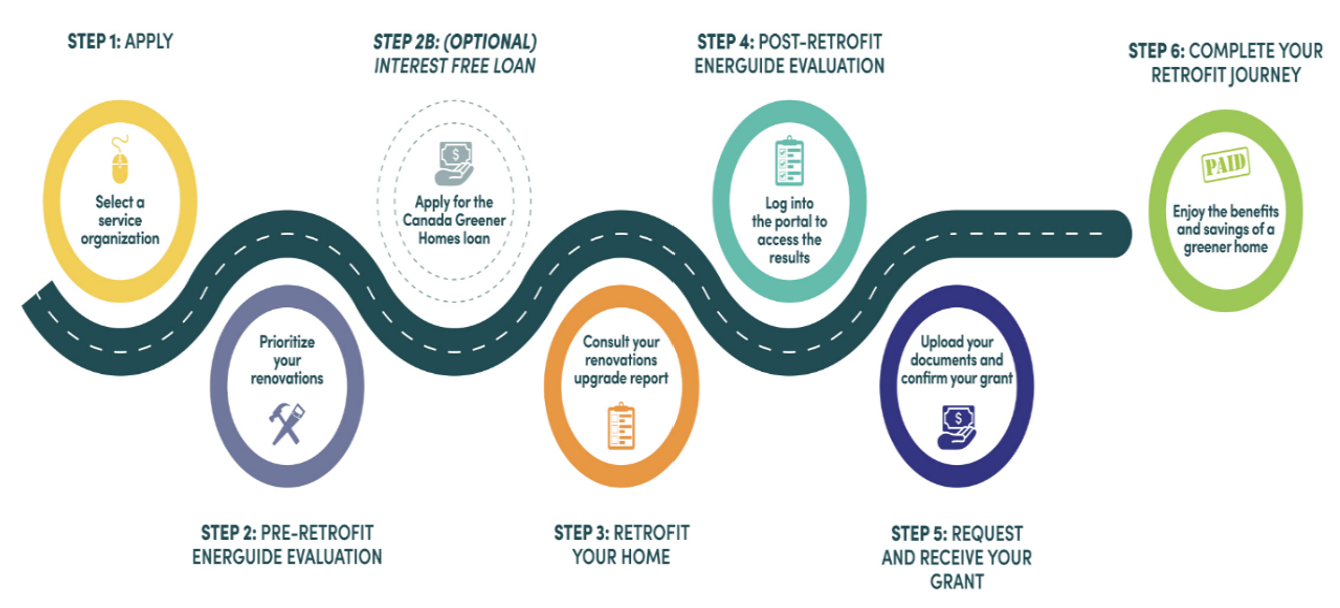
In February 2024, the program announced that it was closed to new applicants. This was sooner than originally planned, as forecasted grants from registrations was equal to available funding. The deadline for existing participants to complete their retrofit journeyFootnote 2 and request a grant was December 31, 2025 (see Figure 1).
Figure 1: Canada Greener Homes Grant: The homeowner journey (for existing applicants)
Text Version
Long description – Figure 1: Canada Greener Homes Grant: The homeowner journey (for existing applicants)
This figure presents a process diagram illustrating the steps a homeowner follows when participating in the Canada Greener Homes Grant program, specifically for individuals who have already submitted an application. The diagram is organized as a sequential flow, with a dotted line indicating the direction of progress from one step to the next.
Step 1: Apply. Select a Service organization. This step marks the entry point into the grant process.
Step 2: Pre-retrofit EnerGuide evaluation. Get an EnerGuide assessment before renovating – prioritize your renovations.
Step 2B: (Optional) Apply for an interest-free loan through the Canada Green Homes Loan.
Step 3: Retrofit your home. Consult and review your renovations report.
Step 4: Post-retrofit EnerGuide Evaluation. Get an EnerGuide assessment after renovations - log in to the Grant portal to access and view your results.
Step 5: Request and receive your grant. Upload the required documents and confirm your grant amount.
Step 6: Complete your retrofit journey. Enjoy the benefits and savings of a greener home.
Oil to Heat Pump Affordability Program (OHPA)
Since March 2023, the Government of Canada (GoC) has supported low- to median-income households relying on home heating oil to transition to electric heat pumps through the Oil to Heat Pump Affordability (OHPA) program. At its outset, the program was allocated $250 million over four years (2023-24 to 2026-27). The program provides up-front grants of up to $10,000 to help applicants across Canada offset the costs of purchasing and installing eligible electric heat pump systems. In October 2023, the GoC enhanced the OHPA program to make the switch even easier and more affordable and the budget was increased to $750 million. In provinces and territories with co-delivery agreements (eight jurisdictions across Canada), eligible households can receive up to $15,000 in federal grant funding under the enhanced program, reflecting the availability of an additional provincial or territorial top-up of at least $5,000. In jurisdictions without co-delivery agreements, the maximum federal grant remains $10,000. Eligible applicants also receive a $250 upfront incentive. In many cases, these combined supports covered the full cost of conversion to a heat pump. The program aims to help up to 50,000 financially vulnerable households save $1,000 to $5,000 annually on heating bills while reducing GHG emissions by 0.125 to 0.384 megatonnes (Mt) annually by 2030.
OHPA offers two delivery streams:
- Co-delivery with partners: in Prince Edward Island (PEI), Newfoundland and Labrador (NL), New Brunswick (NB), British Columbia (BC), the Yukon Territory (YT), Manitoba (MB), ON and NS, OHPA is delivered formal agreements with provincial/territorial delivery partners.
- Nationally delivered program: in provinces and territories where no separate delivery agreement is in place, NRCan delivers the OHPA grant directly through a national online portal (same as used for the CGHG program). Due to grid requirements, homeowners in remote areas of Canada that are not connected to an integrated electricity grid (e.g., remote areas of Quebec, Nunavut), are ineligible for the program.
Deep Retrofit Accelerator Initiative (DRAI)
Announced in Budget 2022, the Deep Retrofit Accelerator Initiative (DRAI) received $200 million over five years (2022–23 to 2026–27) to advance deep retrofits in Canada’s buildings sector. DRAI is primarily delivered as a Grants and Contributions (G&C) program through negotiated contribution agreements under Stream 1. Under Stream 1A, funding supports the delivery of “deep retrofit concierge services”- helping building owners and industry navigate complex steps in planning and preparing deep retrofit projects (e.g., guidance, resources, linkages to tools and expertise that reduce barriers. Stream 1B supports capacity-building and market transformation activities to strengthen the broader retrofit ecosystem. DRAI also delivers complementary federal initiatives under Stream 2, including the Retrofit Accelerator Network (RAN) and the online Retrofit Hub. These initiatives provide shared tools, data, and guidance to increase market readiness and support the scaling up of deep retrofits across Canada.
Ultimately, DRAI provides funding to organizations (i.e., “retrofit accelerators”) and to other projects that facilitate the development of deep retrofits in commercial, institutional, and mid- or high-rise multi-unit residential buildings in Canada. The program aims to build capacity for deep retrofit projects and support retrofit market transformation, including:
- The identification and/or aggregation of deep retrofit projects including the development of customer, project and supply chain databases, client outreach, project pre-screening, virtual audits and lists of identified/ aggregated deep retrofit projects.
- Guidance for building owners in the process of developing and implementing specific deep retrofit projects including the identification of funding and financing opportunities, development of databases of available public and private financing, guidebooks, technical reports, energy audits, business cases/plans and proposals, benchmarking, deep retrofit project tendering, commissioning and recommissioning.
- Capacity building activities including conferences, information sessions, training event and programs, webinars and technical studies.
Codes Acceleration Fund (CAF)
Budget 2022 allocated $119 million over five years (2022–23 to 2026–27) to the Codes Acceleration Fund (CAF). The CAF program consists of the following components: contribution agreements with jurisdictions with the authority to adopt energy codes or other mandatory energy regulations for homes and buildings (e.g. provinces and territories) (Stream 1); contribution agreements with organizations without the authority to adopt energy codes or other mandatory energy regulations for homes and buildings to support code adoption and compliance (Stream 2); and complementary federal actions to support code adoption and compliance. The three objectives of the CAF are to:
- Accelerate the adoption and implementation of the highest feasible energy performance tiers of the national model energy codes or other high-performance building codes, such as net-zero emissions codes
- Promote higher rates of compliance with adopted codes
- Build capacity and support market preparedness for ambitious codes adoption
Green Industrial Facilities and Manufacturing Program (GIFMP)
The Green Industrial Facilities and Manufacturing Program (GIFMP) builds on and expands the Industrial Energy Management Program. With a total budget of $194 million over five years (2022–23 to 2026–27), the GIFMP provides $161 million in cost-shared financial assistance to advance energy management and efficiency across Canada’s industrial sector.
As a cost-shared financial assistance program, the GIFMP supports the implementation of energy-efficiency and energy-management solutions designed to maximize energy performance, reduce greenhouse-gas emissions, and enhance the competitiveness of Canada’s industrial sector through collaborative partnerships and project support. The program’s $161 million in contributions is delivered through two funding streams:
- Track 1 - Energy Efficiency Solutions: Supports energy efficiency initiatives implemented by initial recipients including provincial and territorial governments and other organizations, that may further distribute funding to ultimate recipients) industrial and manufacturing facilities). Track 2 - Industrial Facility: Provides cost-shared financial assistance directly to industrial and manufacturing facilities (e.g., energy audits, energy managers, energy management systems, training and energy efficiency-focused capital projects, etc.).
Program governance and resources
The EEP programs are managed and delivered by NRCan’s Office of Energy Efficiency (OEE), leveraging existing governance structures, financial authorities, and experience administering G&C agreements. Program elements are developed and delivered by the OEE and include engagement activities, contribution agreements with provinces, territories, and utilities, and ongoing monitoring and results reporting.
Evaluation objectives and methods
This evaluation is identified in NRCan’s planned evaluation coverage for the period 2024-25 to 2028-29 and is being undertaken to fulfill commitments made to the Treasury Board, as mandated by Section 42.1 of the Financial Administration Act (FAA) and in compliance with the Treasury Board Policy on Results (2016).
While there have been past evaluations of the EEP, the evaluation of these five new programs is formative in nature and examines the core issues of relevance, effectiveness and efficiency.
The objectives of the evaluation are to:
- Assess the extent to which the EEP programs focus on relevant needs and priorities towards achieving their objectives;
- Evaluate the progress made towards achieving the EEP programs’ immediate and intermediate outcomes, examining the factors that facilitate or hinder success, while also identifying any unintended positive or negative outcomes; and,
- Examine the effectiveness and efficiency of the EEP’s design and delivery in achieving its objectives, while identifying lessons learned from its implementation to inform future programs.
Evaluation methods
This is a cluster evaluation that adopts a systems perspective to assess five related programs delivered under the EEP. Evaluating the programs collectively enables assessment of their fit at the DRF level and how, together, they contribute to the overarching objectives of the EEP. Cluster evaluation is particularly useful when projects share similar objectives or themes as it enables a clearer understanding of shared outcomes, and facilitates the identification of synergies, overlaps, and lessons learned.
The evaluation used five lines of evidence to collect pertinent data as follows:
- Key informant interviews: The evaluation team interviewed 59 stakeholders comprised of program staff, external representatives, industry associations and recipients/proponents.
- Document review: The evaluation team completed a review of hundreds of public and non-public program related documents.
- Data review and analysis: Review of program files, financial and human resources data, and performance data across EEP programs was undertaken to support triangulation of evidence and assess progress toward intended outcomes.
- Environmental scan: Review and analysis of the international energy efficiency landscape was carried out by the evaluation team. This encompassed a wide range of sources, including NRCan reports, International Energy Agency publications, international government documents, and peer-reviewed studies.
- Surveys and Public Opinion Reports: A Survey of Energy Advisors (313 respondents) was administered by the evaluation team. The evaluation also reviewed five existing Public Opinion Research (POR) studies and six internal survey reports to inform triangulation of findings.
Evaluation challenges and limitations
The evaluation employed multiple lines of evidence to reduce limitations associated with individual methods. Triangulation across the various lines of evidence ensured credible findings and sound conclusions for the evaluation. Nevertheless, the following limitations should be considered when reviewing the findings from this evaluation:
- Timing of the evaluation and program maturity: Data collection for this evaluation occurred while the EEP programs were at different stages of implementation. Some were in their early stages. At the time of data collection, some EEP programs were still working with proponents to finalize contribution agreements. Consequently, while some early results are beginning to emerge, the achievement of many of the EEP programs’ longer-term outcomes is not expected until 2027 for some of the programs and 2030 for others.
- Bias in interview results: As with any qualitative method, the findings should be considered in light of inherent limitations associated with interviews, including potential biases and the contextual nature of participants’ perspectives. Responses may be shaped by factors such as recall bias, social desirability bias, or interviewer influence. The sample of participants may not fully represent the full range of stakeholder views.
Mitigation
To reduce these risks, the evaluation team implemented several strategies. Standardized interview guides were developed and applied consistently across stakeholder groups to ensure comparability of responses and minimize interviewer influence. In addition, the qualitative findings were systematically triangulated with other lines of evidence, including document reviews, survey results, and program data, to validate observations and strengthen the conclusions for this evaluation.
Findings
This section presents the key findings of the evaluation, organized under the themes of relevance, effectiveness, and efficiency.
Relevance
Alignment of the EEP with NRCan and Government of Canada priorities
Findings from document reviews, interviews and the environmental scan found that the objectives of all five programs are closely aligned with the Government of Canada’s advancement of climate and economic priorities, as well as contributing to advancing the Government’s Indigenous reconciliation agenda.
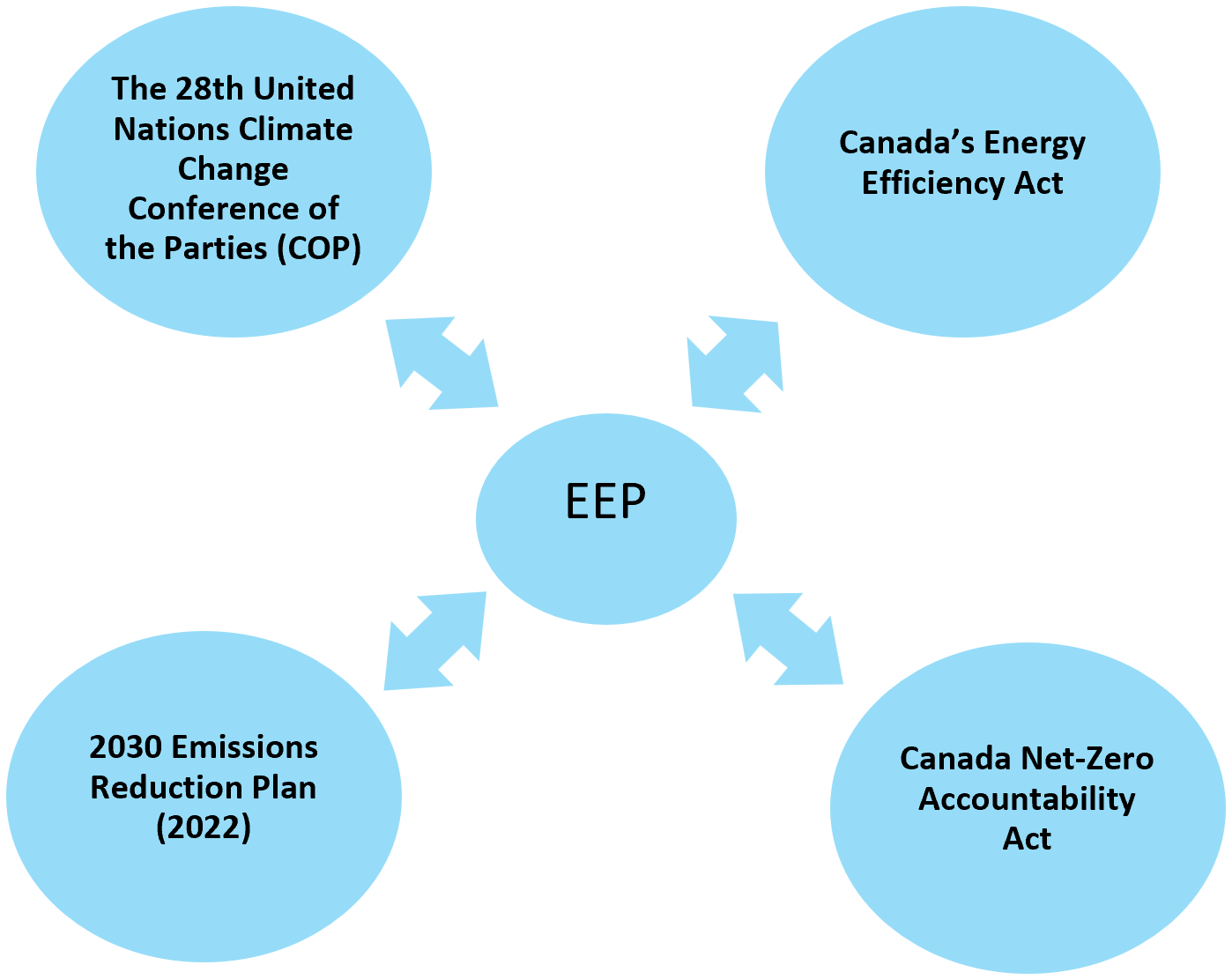
Climate Priorities: The EEP programs seek to reduce greenhouse gas (GHG) emissions and improve energy efficiency across residential, commercial and industrial sectors, supporting net-zero targets and international climate commitments (see Figure 2).
Figure 2: Climate Priorities
Text Version
Long Description – Figure 2: Climate Priorities
Figure 2 presents a conceptual visual titled “Climate Priorities.” The figure appears to highlight key legislative frameworks, policy instruments, and international commitments that collectively guide Canada’s climate change and energy efficiency efforts.
The visual is composed of a set of four primary elements arranged as a grouped list or cluster, formatted as labeled headings. Each element represents a major policy or commitment related to the Energy Efficiency Program (EEP), formatted with a double arrow. The items are presented with strong visual emphasis, using bold text and a contrasting colour scheme (including white text over a darker background for some elements), indicating their importance within the figure.
The four climate priority elements shown in the figure are:
- Canada’s Energy Efficiency Act
This component refers to federal legislation aimed at improving energy efficiency standards for products and equipment. Its inclusion suggests a focus on reducing energy consumption and improving performance standards as part of Canada’s climate strategy. - Canada Net-Zero Accountability Act
This element highlights Canada’s legislative framework for achieving net-zero greenhouse gas emissions by 2050. Its presence in the figure signals the importance of long-term accountability, emissions targets, and transparent progress reporting in national climate policy. - 2030 Emissions Reduction Plan (2022)
This item refers to Canada’s national plan outlining measures to reduce greenhouse gas emissions by 2030. The reference to the year 2022 indicates the version of the plan being cited. Its placement in the figure suggests it serves as a key operational or implementation framework supporting climate objectives. - The 28th United Nations Climate Change Conference of the Parties (COP)
This component represents Canada’s engagement in international climate negotiations. It signals the importance of global collaboration and commitments made through multilateral forums such as the United Nations Framework Convention on Climate Change (UNFCCC).
Economic priorities: The EEP Programs were designed to stimulate the retrofit and industrial economy, expand skilled workforce capacity, and enhance industry and market readiness for energy-efficient technologies. The CGHG program aligned with these priorities by supporting workforce development and increasing capacity within the retrofit sector, reinforcing market growth for energy-efficient technologies. The OHPA program contributes to supporting longer-term market adoption of heat pumps. The DRAI program fosters an ecosystem of skilled organizations capable of delivering large-scale retrofit projects and sustaining a specialized workforce in design, project management, and performance verification. This capacity building is intended to position Canada to scale deep retrofits nationwide, addressing both current and future emissions in the building sector. While evidence varies across the EEP programs, all initiatives contribute to advancing economic priorities more broadly by improving energy affordability for Canadians and supporting market readiness and transformation in Canada’s building and industrial sectors.
Reconciliation priorities: The EEP programs also contribute to advancing the Government of Canada’s priorities for reconciliation with Indigenous Peoples. This occurs through the inclusion of dedicated funding allocations and application flexibilities within programs such as the CGHG and OHPA, which aim to enhance accessibility and participation for Indigenous governments, organizations, and communities. DRAI, CAF, and GIFMP also provide application flexibility and funding considerations to encourage participation of Indigenous partners and communities in EEP programs.
NRCan priorities: The EEP programs align directly with NRCan’s Departmental Results Framework related to Core Responsibility 2: Innovative and Sustainable Natural Resources Development to lead the transformation to a low-carbon economy by improving the environmental performance of Canada’s natural resource sectors through innovation and the sustainable development and use of natural resources. The EEP programs also supports key strategic priorities identified in NRCan’s Departmental Plan (2025-26), directly contributing to NRCan’s priorities for Clean Energy and Climate Mitigation.
The EEP program also supports the 2025 Minister of Energy and Natural Resources’ mandate letter to “build a strong economy that works for everyone” by advancing clean energy and energy-efficient infrastructure that reduces costs for Canadians and “helps build our economy.” In a context where Canada “must build an enormous amount of new infrastructure at speeds not seen in generations,” the EEP programs contribute to building-sector decarbonization, stimulating skilled trades and retrofit employment, and catalyzing investment in energy-efficient technologies. This aligns with the government’s priority to “bring down costs for Canadians,” “build one Canadian economy,” and leverage climate action as part of a modernized, productive economy.
Continued need for federal funding to support energy efficiency
Evidence suggests an ongoing rationale for federal funding to support energy efficiency needs based on the following:
Strong legislative context
Canada maintains a robust legislative and policy framework for advancing energy efficiency across sectors. Key instruments such as the Energy Efficiency Act, the Canada Net-Zero Emissions Accountability Act, and the Sustainable Jobs Act establish a clear federal mandate and reinforce the ongoing rationale for federal involvement to meet national climate objectives and ensure that Canada’s workforce and economy are prepared for the net-zero transition.
High demand and uptake
Since 2021, household energy costs have risen by approximately 40%, with pronounced regional and income-based disparities. In this context, the EEP programs have experienced consistently high demand. The strong uptake indicates that the EEP programs have addressed stakeholder needs across multiple sectors, revealing both the depth of public awareness in energy efficiency initiatives and the continued need for federal investment. Evidence suggests that the scale of demand has surpassed available resources, underscoring the continued need for support.
Moreover, evidence from survey and public opinion research findings indicated a strong interest among Canadian homeowners in reducing their environmental impact, as well as a clear need for support for building codes to build better from the start as well as additional financial incentives to support energy-efficient home improvements. Respondents also reported regional and income-based disparities in energy expenditures, with some households on average spending more than $200 per month on energy. These findings underscore the continued need for programs such as the CGHG and the OHPA program to reduce household energy costs and advance national energy efficiency objectives.
Critical role of federal leadership
Evidence indicates that the primary objective of the EEP programs is to improve energy efficiency, while also delivering climate-related co-benefits that contribute to Canada’s progress toward its 2030 emissions reduction target of 40–45% below 2005 levels.
As of 2026, Canada is projected to achieve a 16% reduction in GHG emissions below 2005 levels. This underscores the continued importance of emissions reductions in the buildings and industrial sectors, which together account for nearly one quarter of national emissions. Achieving additional reductions will require continued investment in new net-zero buildings, retrofits of existing building stock, and industrial energy management systems, including an estimated $5.4 billion in retrofit investment needed in Indigenous communities to help address infrastructure gaps. Home energy efficiency retrofit programs have been implemented repeatedly in Canada over the past several decades. The existence of multiple distinct programs over the last 30 years demonstrates the need for more consistent and sustained federal support in this sector, as in the absence of a long-term retrofit program, the sector has experienced multiple boom-and-bust cycles. A lack of sustained funding impacts market stability, limits long-term capacity-building, and reduces predictability for industry and households.
Within this context, NRCan plays a federal leadership role by providing programs and services that support other orders of government, organizations, and industry. OEE programs remain relevant in supporting Government of Canada and NRCan priorities. OEE has implemented various iterations of home energy retrofit programs over the decades. This has enabled them to develop the experience, expertise, and technical infrastructure to effectively anticipate and respond to both current and evolving market needs. Programs such as DRAI and CAF continue to support early-stage market development and capacity-building, and evaluation findings suggest that these supports remain necessary until market conditions can sustain activity without federal intervention. Similarly, although demand for GIFMP funding was high, some industrial facilities were unable to advance applications within the program’s funding period, reflecting the longer timelines typically required to develop and implement complex industrial energy efficiency projects. This is consistent with program design considerations that identified the need for extended delivery timelines and significant lead time for project preparation. Stakeholders noted that sustained federal policy direction and program funding contribute to continued momentum in these sectors, while reductions in federal programming could affect the pace of progress toward Canada’s longer-term emissions reduction objectives.
Complementarity of EEP programs
Findings indicate that the EEP programs complement existing federal, provincial, territorial, municipal, programs, extending program reach while minimizing duplication. Each program addresses a specific need within Canada’s energy efficiency and climate strategy.
CGHG: There are currently no complementary grant programs at the federal level. The Canada Greener Homes Loan was a complementary loan program administered by Canada Mortgage Housing Corporation (CMHC), which closed to new applications in October 2025.Footnote 3 In addition, CMHC’s Housing Accelerator Fund indirectly supports energy-efficient construction and code adoption. However, with applications now closed and funding set to end in 2027-28, its future contribution may be limited. The program also interacts with Environment and Climate Change Canada (ECCC)’s Low Carbon Economy Fund which finances large-scale, multi-partner emissions-reduction projects that expand impact beyond individual households, helping scale and accelerate the outcomes EEP targets in the buildings sector. At the provincial, territorial, and municipal level, however, a wide range of complementary programs existFootnote 4 (see some examples in Box 1). To leverage this complementarity, NRCan established co-delivery agreements for the delivery of the CGHG with three jurisdictions (Ontario, Nova Scotia, and Quebec).
Box 1: Examples of co-deliver and complementary programs - CGHG
AB: Heat Smart and Clean Energy Improvement Program
BC: The Clean BC Better Homes and Home Renovation Rebate Programs, The Regional Energy Efficiency Program (Formerly Ecosave)
MB: Efficiency Manitoba’s Home Energy Retrofit program, Home Energy Efficiency Loan, Efficiency Manitoba’s Building Envelope Program (BEP)
NL: Home Energy Savings Program (HESP)
NT: Arctic Energy Alliance
ON: Better Homes Kingston, Home Renovation Savings Program, Home Energy Loan Program (HELP), Better Homes Ottawa Loan Program
PEI: The Energy Efficiency Loan Program (EELP), The Residential Home Heating Loan Program (RHHP)
QC: Energy Efficiency Retrofit Program for Low-Income Households, Rénoclimat
YT: Good Energy Program
OHPA: The OHPA program complements existing federal, provincial, and territorial energy efficiency initiatives by addressing gaps in oil-to-heat-pump transitions. It is designed to stack effectively with other federal initiatives, including the Canada Greener Homes Loan and the Low Carbon Economy Fund, thereby enabling combined funding. This complementary design allows the OHPA program to leverage existing programming, maximize participation, and strengthen the overall federal–provincial energy efficiency landscape, particularly in regions with limited local initiatives (see Box 2). To help leverage this complementarity, NRCan has established co-delivery agreements for delivery of the OPHA program with eight jurisdictions (i.e., British Columbia, New Brunswick, Newfoundland and Labrador, Nova Scotia, Prince Edward Island, Yukon, Ontario, and Manitoba).
Box 2: Examples of co-delivery and complementary programs - OHPA
AB: Town of Banff Residential Environmental Rebates Program
BC: Energy Savings Program (co-delivery with OHPA); Heat Pump Financing Program
MB: Efficiency Manitoba’s Heat Pump Program (co-delivery with OHPA)
NB: Enhanced Energy Savings Program (co-delivery with OHPA); Total Home Energy Savings Program (co-delivery with OHPA).
NL: Oil to Electric Incentive Program (under the Take Charge Program, co-delivery with OHPA); Energy Efficiency Loan Program (EELP, under the Take Charge Program)
NS: Home Heating System Rebates; Home Warming Program (co-delivery with OHPA)
ON: Home Renovation Savings Program; Better Homes Ottawa Loan Program; Independent Electricity System Operator (IESO) programs. Save on Energy (co-delivery with OHPA)
PEI: Residential Home Heating Loan Program; Energy Efficiency Equipment Rebate; Free Net Zero Program (co-delivery with OHPA).
QC: LogisVert Efficient Homes Program
YT: Good Energy Program (co-delivery with OHPA)
CAF: The Codes Acceleration Fund (CAF) is a distinct and unique program that does not overlap with other provincial, territorial or federal funding opportunities. It complements other initiatives that advance energy-efficient building practices and can support the uptake of enhanced building codes and standards. At the federal level, programs such as the Green Municipal Fund (GMF) support sustainable municipal projects including new construction and retrofits that meet ambitious energy targets while ECCC’s Low Carbon Economy Fund funds projects that reduce GHG emissions, including through energy efficiency improvements. Although these programs do not directly target code development or adoption, they create enabling conditions for stronger building performance and may indirectly encourage the uptake of codes and standards.
At the provincial and municipal levels, initiatives such as the BC Energy Step Code, Québec’s Transition énergétique Québec, and Ontario’s Building Code Enhancements (SB-12) promote the adoption of higher energy performance standards in buildings. Municipal programs, including the Toronto Green Standard, Edmonton’s Building Energy Benchmarking Program, and BC’s Climate-Resilient Home Program, further encourage sustainable design and construction practices. In addition, several municipalities have implemented innovative financing mechanisms—such as Toronto’s Home Energy Loan Program, Halifax’s HaliPACE, and Edmonton’s Clean Energy Improvement Program that promote investments in high-performance buildings and enabling conditions for broader adoption of energy-efficient building codes.
DRAI: DRAI is a unique program in the retrofit funding landscape, as it specifically addresses upfront costs and complexities that take place prior to a retrofit. DRAI complements federal programs such as ECCC’s LCEF, supporting retrofit initiatives across building sectors and the Green Municipal Fund’s Community Efficiency Financing program, which provides capital and capacity funding for local retrofit financing models. The Canada Infrastructure Bank’s (CIB) Building Retrofits Initiative provides repayable financing for deep energy efficiency and decarbonization projects in existing commercial, industrial, and multi-unit residential buildings. Through this initiative, the CIB has advanced over $1 billion in financing across multiple projects and partnerships, supporting market-scale retrofit investments. At the provincial and regional levels, initiatives such as BC Hydro’s Energy Conservation Assistance Program (ECAP), Ontario’s Save on Energy Program, Alberta’s Emissions Reduction Alberta (ERA), Efficiency Manitoba, and Nova Scotia’s Efficiency One advance retrofit markets through financial incentives, technical assistance, and capacity building for residential, commercial, and industrial buildings.
GIFMP: This program has a distinct role and complements federal programs and initiatives such ECCC’s LCEF, and the Climate Action Incentive fundFootnote 5. GIFMP also complements provincial programs like Ontario’s IESO Save on Energy Program, BC’s Industry Energy Efficiency Program, and Québec’s ÉcoPerformance, to provide funding, incentives, and partnerships to advance industrial energy efficiency.
Overall, the EEP programs and complementary initiatives enhance Canada’s collective impact on energy efficiency and emissions reduction through strengthened coordination, capacity building, and financial support.
Effectiveness
Achievement of expected results
This section on results achieved will be discussed using the general logic model (results chain) for the EEP programs. The logic model for the EEP Program is presented in Appendix A.
At the immediate outcome level, the programs aim to raise awareness of energy-efficient solutions, engage target groups in their application, and build the capacity required to adopt new technologies, products, and practices. Moving to the intermediate outcomes, behavioural shifts are anticipated, whereby producers, service organizations, and jurisdictions expand the availability of energy efficiency options and regulate energy use, while consumers adopt and implement these options. The EEP is designed to achieve the ultimate outcome of improved energy efficiency across the residential, commercial, and industrial sectors. Taken together, the general logic model illustrates a coherent pathway of change.
Overall, the EEP programs included in the scope of this evaluation are making contributions at each outcome level (see summary of progress against targets for each program in Appendix B). However, the pace of progress varies among programs due to implementation timing and delivery challenges (see Table 1).
Table 1: EEP Program Maturity and Progress on Expected Results
| Program | Progress on Outcomes and Expected Date to Achieve Target(s) | ||
|---|---|---|---|
| Immediate | Intermediate | Ultimate | |
| CGHG | Achieved |
Achieved (preliminary results) |
Achieved |
| OHPA | Achieved |
In progress (Target: 2027) |
In progress (Target: 2028) |
| DRAI |
In progress (Target: TBD) |
In progress (Target: 2027) |
TBD (Target: 2030) |
| CAF |
Achieved (preliminary results) |
TBD (Target: 2027) |
TBD (Target: 2030) |
| GIFMP |
Achieved (preliminary results) |
TBD (Target: 2027) |
TBD (Target: 2030) |
|
Notes:
|
|||
Immediate outcomes
Overall, the EEP programs are demonstrating steady progress toward their immediate outcomes. Most component programs have met or exceeded their targets ahead of schedule, particularly in areas related to awareness and capacity building. Collectively, the programs show progress in advancing energy efficiency across residential, commercial, and industrial sectors through coordinated outreach, engagement, and partnerships. While awareness and participation levels generally surpassed expectations, the scope and depth of engagement varied across programs, reflecting differences in delivery models, partner capacity, and target audiences.
- Awareness and outreach: Awareness of energy-efficiency solutions, especially heat pumps, expanded among homeowners, industry, and jurisdictions, supported by extensive outreach campaigns, multi-channel communication strategies, and cross-sector partnerships.
- Program engagement: Programs successfully engaged large numbers of target groups, with demand and participation generally exceeding expectations. However, under the CGHG program, some external stakeholders noted they were not engaged early in program design despite their role in supporting homeowners through the retrofit process.
- Adoption capacity: Target groups demonstrated increased capacity to adopt energy-efficient technologies, particularly heat pumps in residential programs and energy management systems in industrial sectors.
CGHG: The immediate outcome for CGHG focused on two areas: program awareness and the capacity for EnerGuide evaluations. Awareness targets have already been exceeded, with program awareness reported by over 80% of Canadian homeowners between 2021–22 and 2024–25. This percentage reflects cumulative awareness and exceeds the 2027 target of approximately 50% (8.3 million). The capacity for EnerGuide evaluations has also increased, with the number of Energy Advisors growing from 936 in 2021 to over 1,300 licenced as of January 2026. At the height of the Canada Greener Homes Initiative, there were close to 2,000 Energy Advisors licenced to deliver EnerGuide, exceeding the 2027 target of 1,500. However, with the program entering its completion phase and Energy Advisor numbers declining, it may be appropriate for OEE to revisit the relevance of the current target, given evolving delivery needs and the transition to the Canada Greener Homes Affordability Program (CGHAP).
Engagement and collaboration activities between NRCan, service organizations, and Energy Advisors supported program effectiveness and implementation. However, survey and public opinion research identified challenges such as homeowner confusion (e.g., eligibility requirements or differing application processes in some provinces), administrative hurdles, delays, and technical difficulties. Despite these issues, interventions such as creating detailed guides, webinars, and effective collaboration with partners helped increase program awareness and broaden outreach to homeowners and other target audiences.
OHPA: The OHPA program has been successful in achieving its immediate outcome. Eligible low- to-median-income Canadian households are increasingly aware of the program. Evidence from interviews with program representatives indicates that partnerships with insurers, service organizations, and utilities strengthened program credibility and expanded its reach. So far, the initiative has reached 38,724 eligible households that submitted applications for OHPA grants through direct delivery and co-delivery. This is well above the immediate outcome, target of 17,000 applications received for heat pumps by March 2024, demonstrating strong outreach and effective targeting of the intended population group.
In addition, program enhancements to OHPA’s co-delivery model, including integration with similar provincial programs, helped reduce upfront financial barriers for homeowners, particularly in Atlantic Canada.
DRAI: Preliminary results indicate that the DRAI program has made progress toward achieving its immediate outcome of ensuring that Deep Retrofit Accelerators have the capacity to deliver concierge services to clients. Early evidence suggests positive momentum, with nearly 1,900 owners (representing more than 22,000 buildings), having received guidance or concierge support between 2023-24 and 2024-25. A baseline and target against which to assess this progress has not yet been set.
DRAI fostered collaboration among retrofit accelerators through the Retrofit Accelerator Network (RAN) which meets on a quarterly basis to exchange best practices and data and foster collaboration. NRCan has also created the online Retrofit HubFootnote 6, which hosts a collection of resources to help plan, finance, and implement retrofit projects across commercial real estate, institutional and public buildings, and multi-unit residential buildings. Evidence suggests that these collaborative approaches have contributed to accelerating retrofits across Canada.
CAF: As an immediate outcome, the program expects that jurisdictions with the authority to adopt energy codes or other mandatory energy regulations for homes and buildings (e.g., provinces and territories) have capacity to adopt the higher performance tiers of the 2020 model energy codes. Progress is evident on two fronts. CAF has made progress against one target, with preliminary numbers indicating 12 roadmaps either completed or initiated (two existed prior to CAF funding and 10 under development) against a five-year target of 13 roadmaps by March 31, 2027. The program has also already surpassed its second target, with over 90 solutions developed by 31 project recipients, far exceeding the five-year target of 15 solutions.
Evidence showed that, through CanmetENERGY activities, CAF program staff engaged technical experts (e.g., RWDI, RDH, Hydro-Québec) to review building codes and model cost-effective solutions. While collaboration with provinces, territories, and municipalities ensured that adoption strategies were adapted to local contexts. Outreach through newsletters, social media, and conferences broadened awareness and participation, with dedicated measures such as flexible timelines and targeted engagement enhancing inclusivity for Indigenous communities. In addition, virtual conferences and working groups improved coordination and reduced duplication, while partnerships with utilities and professional associations expanded the program’s reach and training opportunities.
GIFMP: Preliminary results indicate that GIFMP has made progress toward achieving its immediate outcomes. One of the program’s immediate outcomes focuses on increasing awareness of energy management practices among federal departments and agencies. Progress to date indicates strong engagement, with targeted departments and agencies confirmed as actively participating in energy management practices.
Results indicated that the GIFMP leverages the Canadian Industry Partnership for Energy Conservation (CIPEC), a collaboration between private industry and the federal government that promotes industrial energy efficiency and reduces GHG emissions to reach their target audience. CIPEC brings together over 1,400 companies and trade associations, fostering best practices through its Executive Board, Task Force Council, and sector task forces. Industry Officers support CIPEC leaders by organizing meetings, benchmarking energy intensity, developing guidebooks, and delivering workshops. While CIPEC engagement is not identified as a standalone immediate outcome, evidence suggests it functioned as a key delivery mechanism supporting program awareness and access among industrial stakeholders. Evidence from interviews indicated that the program also engages industrial associations and uses platforms such as LinkedIn to support broad outreach, while participation in trade shows and webinars further expands engagement across industrial sectors.
In addition, GIFMP is progressing towards meeting its immediate outcome which targets applications (project proposals) from industrial facilities representing a combined minimum of 500 PJ of annual energy use. Results from the program’s Industrial Facility Track (i.e. Track 2) alone show a combined total energy use of facilities is 492 PJ between 2023-24 and 2024-25. Program representatives noted that they have likely met this target given that facilities that applied to third parties for funding under GIFMP’s Energy Efficiency Solutions Track (Track 1) also had significant baseline energy use, but this data is not available to them.
Intermediate outcomes
Overall, while some EEP programs have made progress toward their intermediate outcomes, others are still in early stages. More results will become available as programs approach intermediate outcome targets closer to 2027–2030.
CGHG: The program measures home retrofits through two indicators: one for pre-retrofit evaluations and another for completed pairs of pre- and post-retrofit evaluations, signaling completion of the retrofit process.
The program exceeded its interim target of 450,000 retrofits by March 2024, with 674,199 homes having completed pre-retrofit evaluations. Not all homeowners who complete a pre-retrofit evaluation proceed to the post-retrofit stage. However, the program is on track to meet its target of 510,000 completed retrofits by March 2027, with 434,355 homes having already completed both evaluations and receiving a post-retrofit EnerGuide label indicating their home’s energy performance.
In February 2024, the program closed intake of applications sooner than originally planned, as forecasted grants from registrations became equal to available funding. As of September 9, 2025, 56,673 applications were still in the queue. Homeowners were advised that the deadline to complete the process and request their grant was December 31, 2025.
OHPA: Program has been progressing towards set goals. Between 2023-24 and 2024-25, approximately 14,800 heat pumps had been installed, against a target of 50,000 heat pumps installed by April 2027. Data indicates that other commitments, including the development of Indigenous community-level agreements and targets for reducing oil use in Atlantic Canada, are progressing with final results expected by April 2027.
In October 2023, the Government of Canada announced enhancements to OHPA. At that time, it was estimated that approximately 25% of households in Atlantic Canada heated with oil, compared to approximately 6% across the rest of Canada.Footnote 7 Of those households in Atlantic Canada that heated their homes with oil, nearly two-thirds fall at or below the median income level.Footnote 8 Recognizing a particular need for the program in Atlantic Canada, OHPA earmarked a higher percentage of program funding to support grants in this region. The most recent data indicates that there are approximately 125,000 OHPA-eligible homes in Atlantic Canada (owner-occupied, median-or-below income, oil-heated). Of these, 26.7% had applied to OHPA by March 31, 2025. Between 2023-24 and 2024-25, 12,040 grants (equivalent to 10% of total grants issued) were issued to eligible Atlantic households, demonstrating an advancement toward the program’s target of 26% (based on approximate funding allocations to Atlantic provinces, relative to the number of eligible oil-heated homes in the region) by April 2027. Atlantic households accounted for approximately 74.9% of OHPA grants issued ($112 million of a total of $150 million grants issued).
DRAI: The program has been demonstrating promising early results, with 10 regions engaged to date, surpassing the initial target of 7. Targets for low-income units and buildings are not expected to be achieved until the end of 2026-27. Results data related to these outcomes are not yet available, making it too early to assess progress of the program.
CAF: This program’s intermediate outcomes focus on having all provinces and territories adopt the higher energy performance tiers of the 2020 model energy codes and their increased compliance with the national model energy codes. Targets related to these outcomes are not expected to be achieved until the end of March 2030.
GIFMP: The intermediate outcome for GIFMP is for targeted facilities to improve energy efficiency through implementation of energy management practices, with a target of 25 PJ of total annual energy savings by March 31, 2027. Data to assess progress is not yet available.
Ultimate outcome
Overall, the EEP programs have made progress toward their ultimate outcomes for improved energy efficiency in their target sectors. CGHG has made positive progress toward its key targets, while OHPA is advancing toward achieving its expected results. DRAI, CAF, and GIFMP remain in the early stages of implementation, with outcomes expected to be assessed between 2027 and 2030 as data become available.
CGHG: As of March 31, 2025, the program achieved a cumulative annual energy savings of 12.31 PJ from retrofits in Canada’s homes, exceeding its target of 10 PJ in cumulative annual energy savings. The target was amended in 2024 (decreased from 16 PJ in cumulative annual energy savings) in response to budget reductions and the consequent reduction in the ultimate number of homes retrofitted.
In addition, homeowners who undertook retrofits incented by the program are realizing financial benefits, with average annual energy bill savings estimated between $553 and $825 per household, surpassing the target of $490 per year. These results indicate that CGHG is effectively contributing to improved home energy performance and cost savings for Canadians. Evidence from interviews and document review indicates that CGHG could have further enhanced its effectiveness by adjusting funding levels to better reflect the relative performance of different retrofit measures. Placing greater emphasis in allocating grant amounts to measures with the strongest energy-savings and GHG emissions reduction potential, such as insulation and building envelope improvements, could have incentivized greater uptake of these high-impact retrofits.
OHPA: The program is progressing toward its ultimate outcome of helping low-to-median-income households save money on their heating bills while improving energy efficiency and reducing greenhouse gas emissions. The program has achieved its affordability targets: households that completed OHPA-funded retrofits are saving an average of $1,377 per year on heating bills, meeting the expected range of $1,000 to $5,000 annually.
Progress toward the program’s energy efficiency and emissions reduction targets continue. Cumulative annual energy savings achieved currently range from 0.369 to 1.31 PJ moving toward the 2028 target of 1.16 to 4.125 PJ, while cumulative greenhouse gas emission reductions stand between 0.045 and 0.141 Mt against a target of 0.139 to 0.445 Mt. If trends continue in a positive direction, the program is likely to achieve its target by October 2028.
DRAI: This program targets improved energy efficiency in target sectors (buildings) greater than or equal to 2.5 PJ of cumulative energy savings by March 31, 2030. Data to assess progress are not yet available.
CAF: The program’s ultimate outcome aims to improve energy efficiency in Canada’s homes and buildings, with a target of achieving an estimated 11.0 PJ of cumulative annual energy savings by March 31, 2030. Data to assess progress are not yet available.
GIFMP: The program’s outcome aims to improve energy efficiency in the industrial sector, with a target of 53 PJ of total annual energy savings by March 31, 2030. Data to assess progress are not yet available. Program representatives noted that the industrial projects supported under GIFMP, particularly capital-intensive retrofit projects, typically require longer implementation timelines due to their technical complexity, procurement requirements, and integration with ongoing industrial operations. As a result, GIFMP remains in the early stages of delivery, and the achievement of expected results is anticipated to occur primarily following project completion over the next two years.
Indigenous engagement
In 2022, EEP programs conducted a Gender-based Analysis Plus (GBA+)Footnote 9 assessment to inform program design and decision-making. This identified potential barriers to access and participation. In response, NRCan committed to inclusive engagement, alignment with Indigenous Climate Leadership in accordance with Crown-Indigenous Relations and Northern Affairs Canada’s decision-making guidance, the application of affordability as a guiding principle—particularly in remote and northern regions—and targeted grant and contribution funding to support under-represented applicants, including Indigenous governments and other equity-deserving groups. Overall, the EEP programs, as part of their GBA+ considerations, have supported Indigenous engagement by providing funding for energy-efficiency activities in Indigenous communities through flexible and tailored applications and contribution agreements with Indigenous governments, organizations, and communities. Within this broader context, the OHPA program launched a dedicated Indigenous stream designed to meet an Indigenous-engagement target established in the program’s expected results.
Evidence indicates that Indigenous community participation in the EEP programs was higher where dedicated funding allocations were available (e.g., OHPA Indigenous stream, CAF, DRAI); where application intake processes incorporated flexibility (e.g., DRAI, CAF, and GIFMP extended application deadlines to support Indigenous community participation; and CGHG included a dedicated Application Guide for Indigenous Governments and Organizations Retrofitting Multiple Homes through the Greener Homes Program); and where specific initiatives were established to support engagement (e.g., under the CGHG, the Energy Advisor Recruitment, Training, and Mentorship initiative aimed to increase Indigenous participation).
CGHG: In 2023–24, the CGHG received 49 applications from Indigenous communities to retrofit up to 9,748 homes, with a total funding value of $61.4 million. In addition, CGHG adapted its delivery approach to better support Indigenous governments, organizations, and delivery partners in implementing community-scale retrofit projects. The program also invested in training, hiring, and retaining Indigenous energy advisors to strengthen local capacity. During the same period, 38 contribution agreements were signed with Indigenous community-scale applicants, including 32 agreements to retrofit up to 6,107 homes. In 2024–25, an additional six agreements were signed with Indigenous governments and organizations to retrofit up to 783 homes.
OHPA: In July 2025, the OHPA program launched an Indigenous community-scale application stream to facilitate and encourage participation from Indigenous communities. It is still too early to report on the number of Indigenous residences receiving support through community- or organization-level contribution agreements, or through provincial and territorial co-delivery agreements, given that these program enhancements to the Oil to Heat Pump Affordability Program are still being implemented.
The following contribution programs (DRAI, CAF, and GIFMP) include Indigenous carve-outs and flexibilities for Indigenous applicants.
DRAI: DRAI has exceeded the 10 percent carve-out for Indigenous projects by funding two Retrofit Accelerators focusing on Indigenous communities in Alberta, the Prairies, and Northwest Territories.
CAF: As of September 2025, the CAF has signed one contribution agreement with an Indigenous community (i.e., Elizabeth Métis Settlement project). In addition, the CAF supports an ECO Canada project (not Indigenous-led) to help Indigenous communities adopt, comply with, and enforce building codes.
GIFMP: As of September 2025, the program had finalized at least one direct contribution agreement with an Indigenous applicant (application received March 31, 2025). While the number of finalized agreements remained limited at that time, the program had established flexibilities to reduce participation barriers and support Indigenous engagement, including extended application timelines. In addition, under Track 2, Indigenous-owned facilities are eligible for up to 100 percent cost-sharing, compared to a maximum of 50 percent for non-Indigenous facilities.
Unintended outcomes
Overall, the EEP programs generated both unexpected positive and unintended negative impacts. High demand and some of the results achieved to date demonstrate their relevance and effectiveness in advancing energy efficiency, while also contributing to broader outcomes such as capacity building. However, the rapid uptake and delivery pressures for CGHG have led to unintended effects, including market fluctuations, supply chain challenges, and capacity constraints.
Program uptake: For most EEP programs, uptake exceeded expectations, reflecting high demand from both the public and industry for energy efficiency measures. While this demonstrates the relevance and the need for the programs, it also placed strain on delivery capacity and contributed to market disruptions such as Energy Advisor (EA) capacity constraints due to sudden increases in demand exceeding existing capacity, and supply chain pressures, as reported by program representatives and external stakeholders.
Broader impacts: Beyond direct energy efficiency outcomes, the EEP programs contributed to a wider set of benefits. In addition to achieving their core objectives, they also generated several unintended but beneficial outcomes. Establishing energy efficiency in buildings and homes improves indoor health conditions, greater community-level climate resilience, and enhances resiliency of homes and buildings. Such broader impacts reinforce the role of these programs in advancing multiple federal policy objectives beyond energy savings alone.
Each EEP program also generated its own set of unintended outcomes—both positive and negative.
CGHG: The CGHG achieved national visibility and contributed to noticeable market transformation by increasing awareness and uptake of residential retrofits. At the same time, positive outcomes included the integration of resiliency measures for homes at the federal level, which enhanced household preparedness for climate impacts. The program generated higher-than-anticipated uptake of retrofits and deep retrofits, particularly heat pumps. While this accelerated progress toward emissions reductions, it also contributed to inflated contractor pricing, placed strain on the availability of energy advisors, and contributed to a “boom-and-bust” cycle within the residential retrofit economy with the early winding down of the program. Stakeholders reported that sudden program change and funding adjustments also created uncertainties. These challenges affected the confidence of some market actors and raised concerns about the predictability and stability of program delivery.
OHPA: Although increased heat pump uptake was an intended program outcome, the broader market transformation effects—including rapid supply-side adjustments and some cost impacts were not explicitly anticipated at the time of program design.
DRAI: Evidence from interviews with program representatives indicated that the amount of investment capital attracted by the program is significant. DRAI was recognized by stakeholders as novel internationally, with no external model for guidance. The program’s design encouraged innovative partnerships between retrofit accelerators and financial institutions, helping establish new financing models for deep retrofits.
CAF: While dissemination of best practices and improvements in retrofit readiness were intended outcomes of CAF, the program also generated unanticipated positive outcomes, including diffusion of technical knowledge across jurisdictions and strengthened climate resilience beyond the program’s immediate energy-efficiency objectives.
GIFMP: While leveraging private-sector investment is an intended feature of GIFMP’s cost-shared design, program staff identified that the scale and mechanisms of private-sector engagement exceeded initial expectations. In particular, collaboration with the Canadian Industry Partnership for Energy Conservation (CIPEC) strengthened industrial sector engagement, facilitated peer learning, and encouraged broader uptake of energy management systems, extending program influence beyond directly funded projects.
External factors
EEP outcomes were influenced by several external factors that affected program implementation, delivery, and overall performance:
- Economic stimulus and industry impacts: The CGHG provided significant economic stimulus by strengthening the retrofit industry, creating employment opportunities, and expanding market capacity. This stimulus contributed to increased program uptake and sector growth but also placed additional pressure on administrative and delivery systems as demand exceeded initial projections.
- COVID-19 supply chain pressures: Program delivery across the EEP programs were affected by global supply chain disruptions and delays linked to the COVID-19 pandemic. Limited availability of building materials, heat pumps, and skilled labour (e.g., for CGHG and OHPA) constrained program timelines and contributed to cost fluctuations, which in turn influenced the pace of implementation and achievement of results.
- Shifting government priorities: Changes in priorities at federal, provincial, and municipal levels impacted progress in adopting higher tiers of energy codes, particularly for CAF, and created uncertainty for stakeholders across EEP programs. These shifts affected interjurisdictional coordination and alignment, leading to delays in expected outcomes and challenges in advancing harmonized energy efficiency outcomes.
Efficiency
Program efficiency varied across the EEP programs over the evaluation period. Evidence from financial data and interviews suggests the EEP programs could improve efficiency.
Program expenditures
To better understand the EEP’s financial performance, the program’s budget (planned and committed) was compared to actual expenditures to identify the proportion of committed funding each fiscal year that was spent to support the achievement of outputs and outcomes.
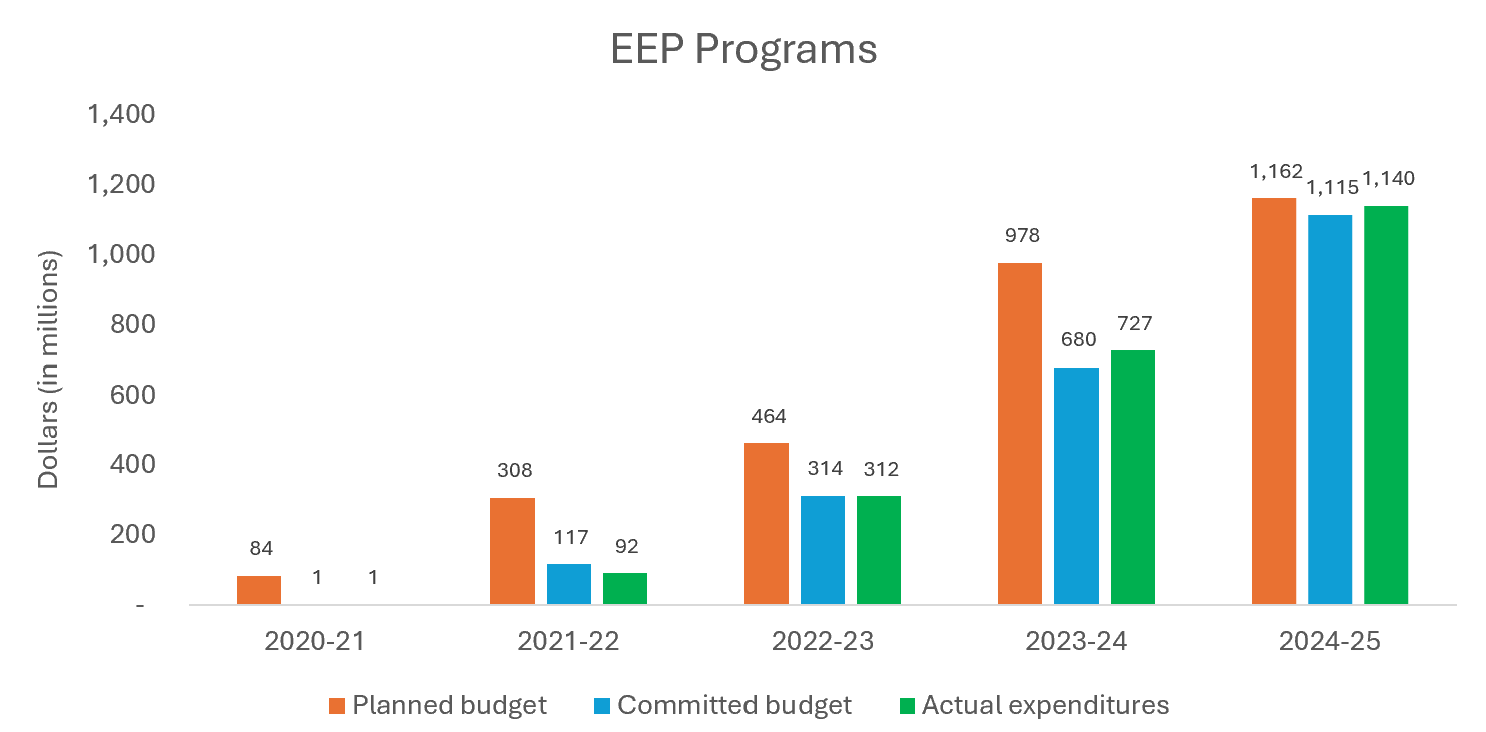
As shown in Figure 3, the planned budget totalled $2.99 billion over five years between 2020-21 and 2024-25, of which 74.3% was committed (i.e., funds approved for spending). The EEP programs later adjusted these allocations through reprofiles, reductions, recapitalization, and internal cash management to better align with forecasted demand and expected expenditures.
Total actual program expenditures totalled $2.27 billion over the period with 95.1% directed to grants and contributions across the EEP programs. Overall, spending exceeded the committed budget of $2.22 billion by 2% ($44 million). While most program areas underspent against their commitments, immediate outcomes were largely achieved, suggesting that these variances had little impact on results.
Figure 3- EEP Programs - Planned Budgets vs Committed Budget vs Actual Expenditures
Text Version
Long Description – Figure 3: EEP Programs – Planned Budgets vs. Committed Budget vs. Actual Expenditures
Figure 3 is a multi-year clustered bar chart presenting financial data for the EEP programs across five fiscal years, from 2020–21 through 2024–25. The chart compares three categories of funding: planned budget, committed budget, and actual expenditures.
The fiscal years are displayed along the horizontal axis (x-axis), with each year showing three bars side by side. The vertical axis (y-axis) represents dollar amounts in Canadian currency displayed in millions, ranging from zero to approximately $1.2 billion.
Planned Budgets
- In 2020–21, the planned budget is approximately $84 million.
- In 2021–22, the planned budget is approximately $308 million.
- In 2022–23, the planned budget is approximately $464 million.
- In 2023–24, the planned budget is approximately $978 million.
- In 2024–25, the planned budget is approximately $1.16 billion.
Committed Budgets
- In 2020–21, the committed budget is approximately $1 million.
- In 2021–22, the committed budget is approximately $117 million.
- In 2022–23, the committed budget is approximately $314 million.
- In 2023–24, the committed budget is approximately $680 million.
- In 2024–25, the committed budget is approximately $1.12 billion.
Actual Expenditures
- In 2020–21, actual expenditures are approximately $1 million.
- In 2021–22, actual expenditures are approximately $92 million.
- In 2022–23, actual expenditures are approximately $312 million.
- In 2023–24, actual expenditures are approximately $727 million.
- In 2024–25, actual expenditures are approximately $1.14 billion.
Source: Financial data from OEE, October 2025.
Note 1: Program expenditures do not include funding for SSC core information technology services and PWGSC accommodation premium.
In discussions with program representatives, interviewees noted that these variances in spending can be explained given program-specific context and challenges as highlighted below. For example, as new programs, the EEP program areas required time (sometimes up to 12 months) to ramp up activities before the programs could become operational and grants and contributions funds could be spent to support achievement of outputs and outcomes.
CGHG: CGHG committed a budget of $1.73 billion over five years (2020-21 and 2024-25). While the program ultimately overspent its committed budget by 13.5% ($235 million), this variance reflects significant demand and evolving program conditions.Footnote 10 In the early stages of implementation, CGHG required time to ramp up operations for both national delivery and provincial co-delivery. Before its launch in May 2021, the program invested in building critical infrastructure, such as the national portal, to enable effective delivery.
These changes allowed the program to continue accepting new applications until February 2024. However, due to higher-than-expected demand and subsequent budget reductions, available funds were exhausted earlier than anticipated. As a result, the deadline for homeowners to complete their retrofit journey and submit a grant request was set at December 31, 2025—earlier than the originally forecasted program end date of March 31, 2027.
Once fully operational, combined with a lower budget and surging demand for home retrofits, CGHG experienced significant spending pressures, with forecasted grant demand exceeding the original budget by a cumulative 20.1% ($262 million) in 2023–24 and 2024–25. This pressure was driven by homeowners undertaking deeper retrofits than anticipated beyond windows and doors, resulting in increasing average grant amounts each year. To manage demand within existing authorities, CGHG internally reallocated funds and borrowed from other program areas, ensuring that all grants issued were supported by available funding and signed contribution agreements.
Figure 4: CGHG - Planned Budget vs Committed Budget vs Actual Expenditures
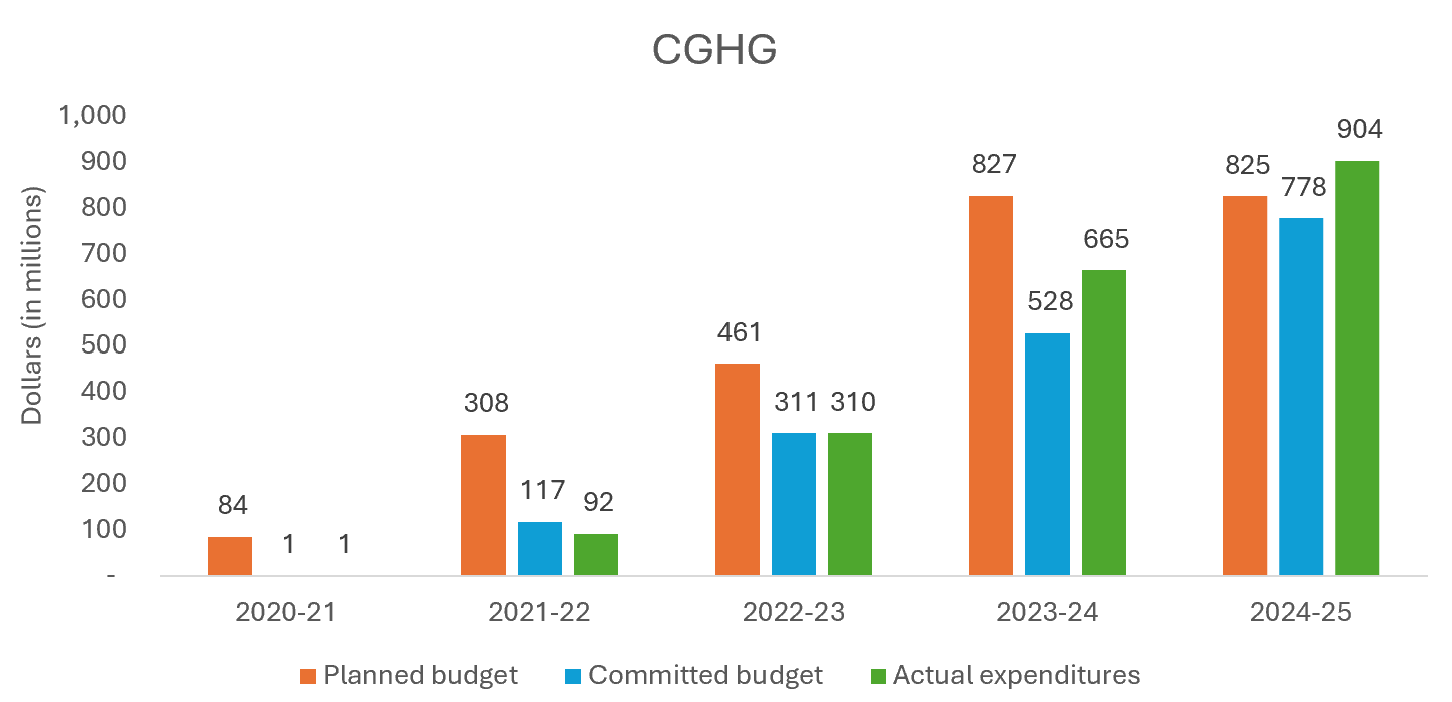
Text Version
Long description - Figure 4: CGHG – Planned Budget vs Committed Budget vs Actual Expenditures
Figure 4 is a clustered vertical bar chart titled "CGHG" that displays three data series — Planned Budget, Committed Budget, and Actual Expenditures — across five fiscal years from 2020–21 to 2024–25. The vertical axis measures dollars in millions.
2020–21: Planned Budget is approximately $84 million. Committed Budget is approximately $1 million. Actual expenditures is approximately $1 million.
2021–22: Planned Budget is approximately $308 million. Committed Budget is approximately $117 million. Actual Expenditures is approximately $92 million.
2022–23: Planned Budget is approximately $461 million. Committed Budget is approximately $311 million. Actual Expenditures is approximately $310 million.
2023–24: Planned Budget is approximately $827 million. Committed Budget is approximately $528 million. Actual Expenditures is approximately $665 million.
2024–25: Planned Budget is approximately $825 million. Committed Budget is approximately $778 million. Actual Expenditures is approximately $904 million.
Source: Financial data from OEE, October 2025.
Note 1: Program expenditures do not include funding for SSC core information technology services and PWGSC accommodation premium.
OHPA: OHPA funding of $750 million over five years (2023-24 to 2026-27) includes its original budget of $250 million and the additional budget of $500 million received in 2023 for program enhancements used to further support the co-delivery of the program with provinces and territories.
OHPA planned and committed a budget of $304 million between 2023-24 and 2024-25. The program underspent its committed budget by 29.6% ($90 million). To better align funds with expected future years’ spending, program representatives internally cash managed funds.
Figure 5: OHPA - Planned Budget/Committed Budget vs Actual Expenditures
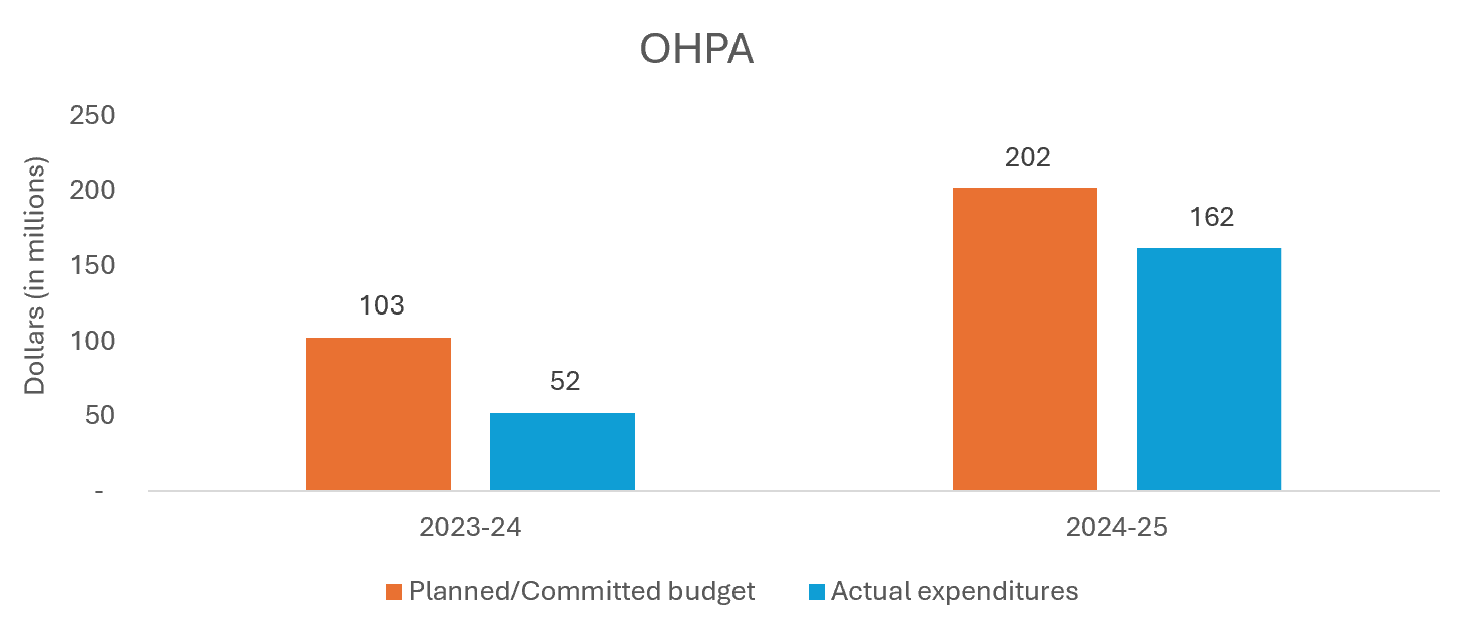
Text Version
Long description - Figure 4: CGHG – Planned Budget vs Committed Budget vs Actual Expenditures
Figure 4 is a clustered vertical bar chart titled "CGHG" that displays three data series — Planned Budget, Committed Budget, and Actual Expenditures — across five fiscal years from 2020–21 to 2024–25. The vertical axis measures dollars in millions.
2020–21: Planned Budget is approximately $84 million. Committed Budget is approximately $1 million. Actual expenditures is approximately $1 million.
2021–22: Planned Budget is approximately $308 million. Committed Budget is approximately $117 million. Actual Expenditures is approximately $92 million.
2022–23: Planned Budget is approximately $461 million. Committed Budget is approximately $311 million. Actual Expenditures is approximately $310 million.
2023–24: Planned Budget is approximately $827 million. Committed Budget is approximately $528 million. Actual Expenditures is approximately $665 million.
2024–25: Planned Budget is approximately $825 million. Committed Budget is approximately $778 million. Actual Expenditures is approximately $904 million.
Source: Financial data from OEE, October 2025.
Note 1: Program expenditures do not include funding for SSC core information technology services and PWGSC accommodation premium.
Note 2: Planned budget includes the original and expanded program budget between 2023-24 and 2024-25.
Note 3: The OHPA program was not allocated budget in 2022-23 but received $15,000 toward Vote 10 from cash managed funds from the CGHG program in that fiscal year. This was used to pay three claims that resulted from pre-registration for OHPA that began in February 2023.
DRAI: DRAI planned and committed a budget of $63 million over three years between 2022-23 and 2024-25. The program underspent its committed budget by 35.3% ($22 million). Program representatives indicated that they needed time to ramp up operations before the program could be operationalized, and contributions funds disbursed. Unspent funds were due to lengthy approval timelines for contribution agreements, which in some cases extended to six months. Interviewees acknowledged improving internal processes could shorten these timelines, while highlighting that certain delays were outside their control (see section 4.3.3).
Figure 6: DRAI - Planned Budget/Committed Budget vs Actual Expenditures
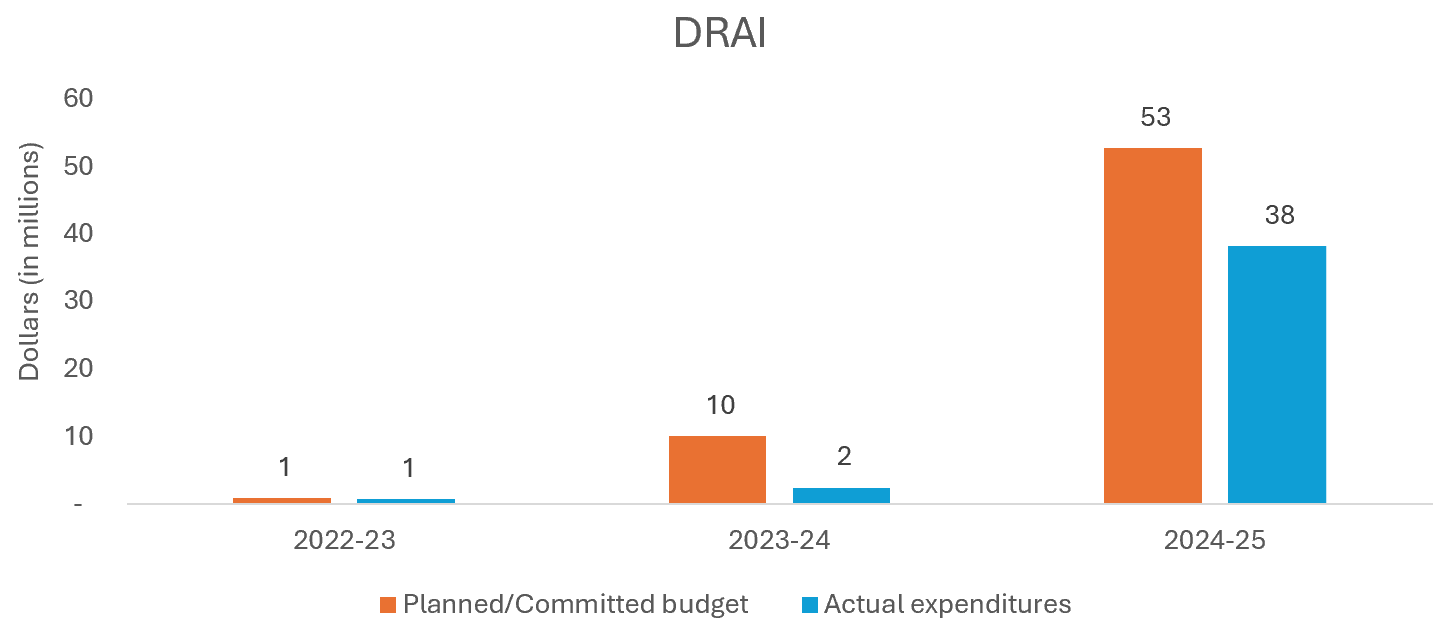
Text Version
Long description - Figure 6: DRAI – Planned/Committed Budget vs Actual Expenditures
Figure 5 is a clustered vertical bar chart titled "DRAI" that displays two data series — Planned/Committed Budget and Actual Expenditures — across three fiscal years, from 2022-23 to 2024-25. The vertical axis measures dollars in millions.
2022-23 Planned/Committed budget is approximately $1 million. Actual expenditures is approximately $1 million.
2023–24 Planned/Committed budget is approximately $10 million. Actual expenditures is approximately $2 million.
2024–25 Planned/Committed budget is approximately $53 million. Actual expenditures is approximately $38 million.
Source: Financial data from OEE, October 2025.
Note 1: Program expenditures do not include funding for SSC core information technology services and PWGSC accommodation premium.
CAF: CAF planned and committed a budget of $42 million over three years between 2022-23 and 2024-25. The program underspent its committed budget by 41.6% (17 million). Similar to DRAI, this initiative faced delays in contribution agreement approvals, which affected spending. Again, these delays (sometimes up to six months) were partly due to factors beyond program control. However, in interviews, program representatives expressed perceived value in improving internal processes to reduce delays.
Figure 7: CAF - Planned Budget/Committed Budget vs Actual Expenditures
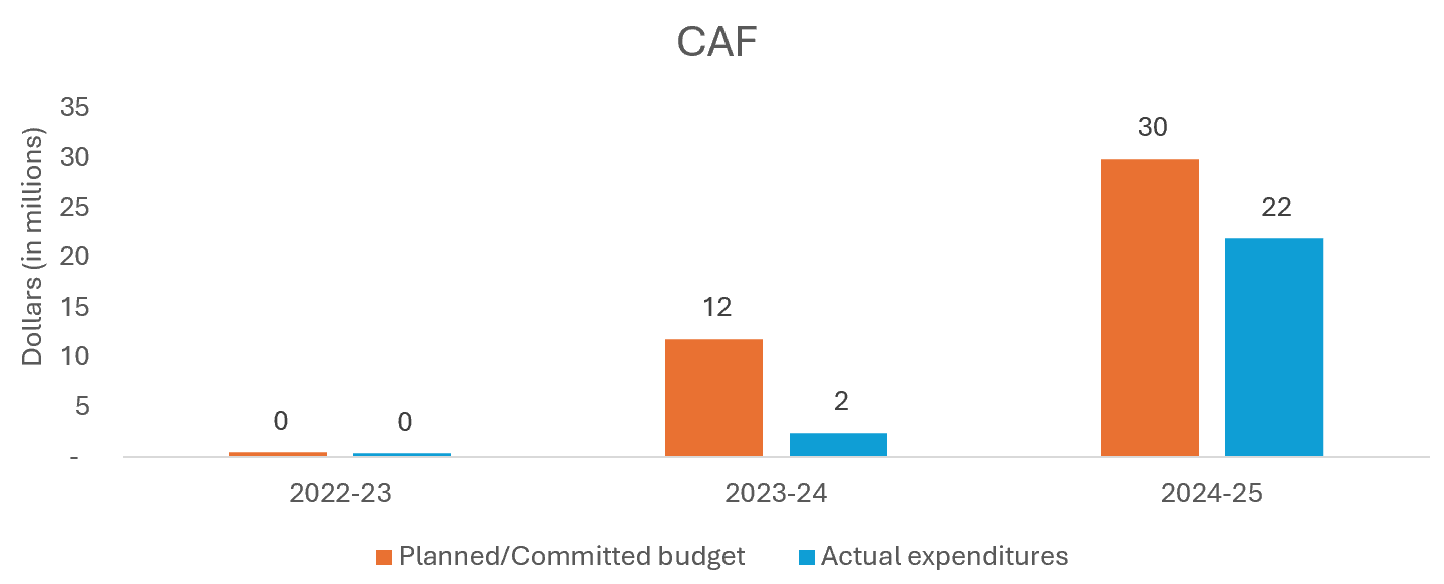
Text Version
Long description - Figure 7: CAF – Planned/Committed Budget vs Actual Expenditures
Figure 7 is a clustered vertical bar chart titled "CAF" that displays two data series — Planned/Committed Budget and Actual Expenditures — across three fiscal years, from 2022-23 to 2024-25. The vertical axis measures dollars in millions.
2022–23: Planned/Committed Budget is approximately $0.4M. Actual expenditures is approximately $0.3M.
2023–24: Planned/Committed Budget is approximately $12M. Actual expenditures is approximately $2M.
2024–25: Planned/Committed Budget is approximately $30M. Actual expenditures is approximately $22M.
Source: Financial data from OEE, October 2025.
Note 1: Program expenditures do not include funding for SSC core information technology services and PWGSC accommodation premium.
Note 2: Program expenditures include OEE-CAF budget component, not including CANMET budget component.
GIFMP: GIFMP planned and committed a budget of $81 million over the first three years of the program between 2022-23 and 2024-25. The program underspent its committed budget by 74.9% ($60 million). Just like DRAI and CAF, the program required additional time to establish delivery systems before contribution funds could flow. Spending was further constrained by prolonged approval timelines for contribution agreements, which in some cases extended up to 12 months. In addition, certain delays were outside the program’s control. For example, in March 2024, new requirements were introduced by TBS, which required adjustments to the GIFMP design and co-delivery approach. As a result, calls for applications under Track 1 of GIFMP were limited to the first call completed in 2023-24. Consideration for any further calls under Track 1 were delayed by nearly a year to allow sufficient time to seek interpretation and clarification from NRCan’s Grants and Contributions Centre of Expertise and Treasury Board to ensure alignment with the TBS guidance, at which point timelines were too short to entertain additional co-delivery projects in the time remaining.
Figure 8: GIFMP - Planned Budget/Committed Budget vs Actual Expenditures
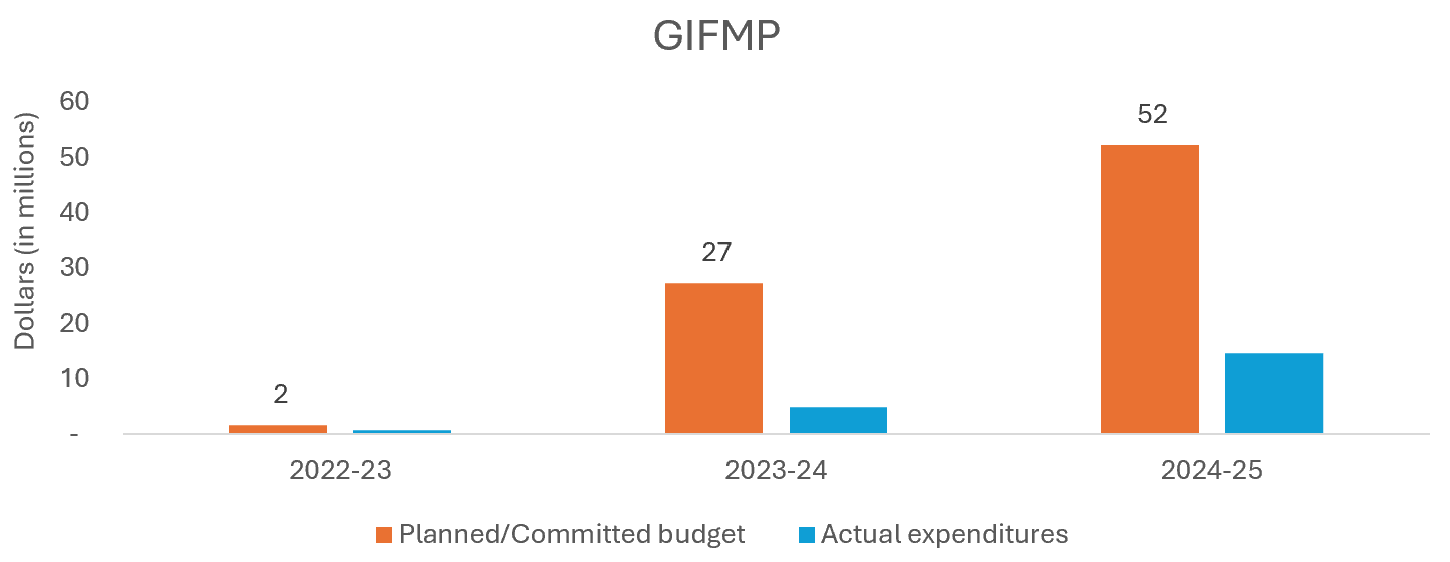
Text Version
Long description – Figure 8: GIFMP Planned/Committed Budget vs. Actual Expenditures
Figure 8 is a clustered vertical bar chart titled "GIFMP" that displays two data series — Planned/Committed Budget and Actual Expenditures — across three fiscal years, from 2022-23 to 2024-25. The vertical axis measures dollars in millions.
2022–23: Planned/Committed Budget is approximately $2M. Actual expenditures is approximately $1M.
2023–24: Planned/Committed Budget is approximately $27M. Actual expenditures is approximately $5M.
2024–25: Planned/Committed Budget is approximately $52M. Actual expenditures is approximately $15M.
Source: Financial data from OEE, July 2025.
Note 1: Program expenditures do not include funding for SSC core information technology services and PWGSC accommodation premium.
Administrative cost ratio
Another measure of efficiency is the administrative cost ratio, calculated as the percentage of Operations and Maintenance (O&M) costs relative to total grant and contribution disbursements. While informative, this ratio is sensitive to program size and funding structure and may not fully capture the complexity of program administration. As demonstrated in Table 3, which presents rolled-up results across all EEP programs, analysis of administrative and financial data shows that the ratio of O&M costs to contributions disbursed declined for the EEP programs from 7.9% percent in 2022-23 to 3.3% in 2024–25. This downward trend is observed over the three-year period, largely driven by the CGHG given its scale and implementation stage compared to the other programs.
Between 2022-23 and 2024-25, CGHG’s administrative costs (Vote 1) remained relatively stable, while the number of grants (Vote 10) issued to households increased substantially via the national delivery portal and co-delivery partners. This growth lowered administrative cost ratios for the CGHG, reflecting operational improvements such as the implementation of a national delivery system and increased staffing to meet rising demand for home retrofit grants under the CGHG.
Table 2: EEP Programs - Administrative Cost Ratio (%)
| ACTUAL EXPENDITURES | 2020-21 | 2021-22 | 2022-23 | 2023-24 | 2024-25 |
|---|---|---|---|---|---|
| Salaries and EBP | 64,765 | 5,150,050 | 11,377,362 | 17,969,556 | 17,064,038 |
| Other operating costs | 1,151,943 | 12,903,521 | 11,366,369 | 15,095,447 | 19,133,744 |
| Total Vote 1 (O&M) | 1,216,708 | 18,053,571 | 22,743,731 | 33,065,003 | 36,197,783 |
| Total Vote 10 (G&C) | - | 73,477,487 | 289,204,283 | 693,663,809 | 1,104,206,535 |
| Administrative Cost (%) | N/A | 24.6% | 7.9% | 4.8% | 3.3% |
Source: Financial data from OEE, October 2025.
Note 1: Administrative cost ratio (%) is calculated as actual expenditures of Total Vote 1 (O&M) divided by Total Vote 10 (G&C).
Note 2: Administrative cost ratios (%) were not applicable for the CGHG in 2020-21 as no grants had yet been issued. The higher ratio reflects the fact that the program was still in a ramp-up period.
Across the EEP programs, data to support analysis of the administrative cost ratios were limited given the early stages of implementation for most of these programs (e.g., year-over-year data were not available). As illustrated in Figure 9 below, available data show that these ratios have to date varied between 1.9% and 24.6% over the evaluation period.
Figure 9: EEP Programs - Administrative Cost Ratio (%)
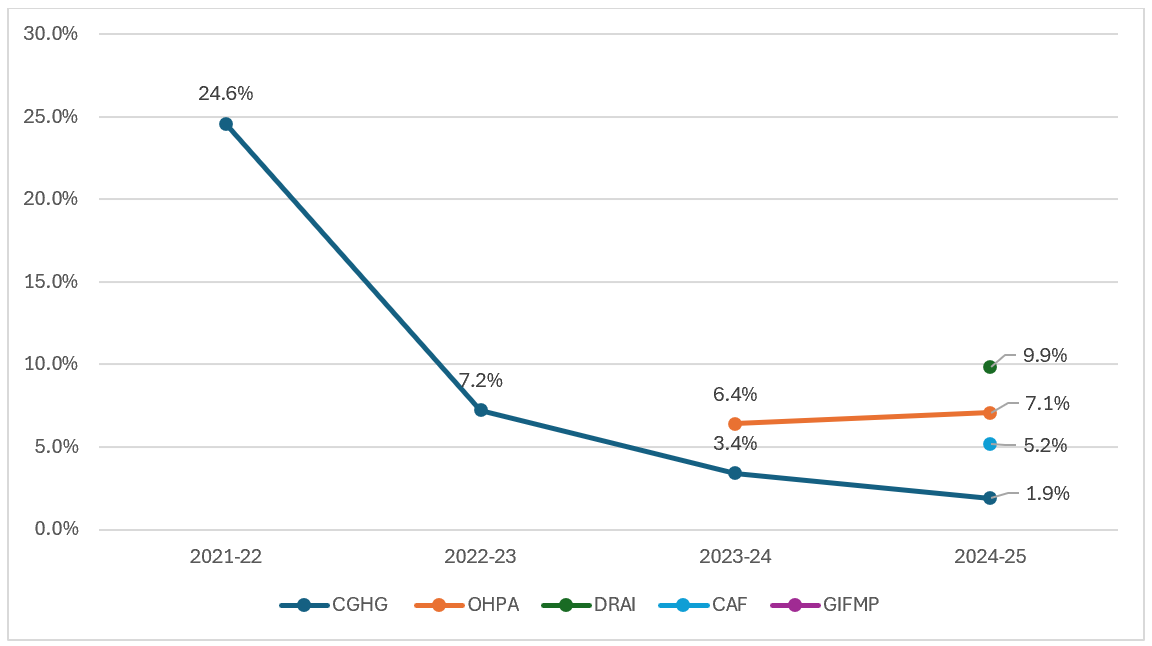
Text Version
Long description – Figure 9: EEP Programs – Administrative Cost Ratio (%)
Figure 9 presents a chart showing the administrative cost ratio (expressed as a percentage) for the Energy Efficiency Programs (EEP) across four fiscal years: 2021–2022, 2022–2023, 2023–2024, and 2024–2025. The administrative cost ratio is defined as Total Vote 1 (Operations and Maintenance) expenditures divided by Total Vote 10 (Grants and Contributions).
The chart includes five program categories listed in rows: CGHG, OHPA, DRAI, CAF, and GIFMP. Data are available for some programs only in specific years.
CGHG is the only program with values reported across all four fiscal years. It shows a consistent downward trend over time. The administrative cost ratio starts at 0.246 (24.6%) in 2021–2022, decreases substantially to approximately 0.072 (7.23%) in 2022–2023, then declines further to about 0.034 (3.42%) in 2023–2024, and reaches its lowest value of approximately 0.019 (1.89%) in 2024–2025. This indicates a steady reduction in administrative costs relative to program spending over the period.
OHPA has no reported values for the first two fiscal years (2021–2022 and 2022–2023). Data appear beginning in 2023–2024, where the administrative cost ratio is approximately 0.064 (6.40%), followed by a slight increase to about 0.071 (7.09%) in 2024–2025. This indicates a modest rise in administrative costs relative to program expenditures between the two years reported.
DRAI only reports data for 2024–2025, with an administrative cost ratio of approximately 0.099 (9.88%). No data are available for earlier years, so no trend can be determined.
CAF also has data reported only for 2024–2025, with an administrative cost ratio of approximately 0.052 (5.17%). No data are available for earlier years, so no trend can be determined.
GIFMP appears in the table but contains no data for any of the four fiscal years.
Source: Financial data from OEE, October 2025.
Note 1: Administrative cost ratio (%) is calculated as actual expenditures of Total Vote 1 (O&M) divided by Total Vote 10 (G&C).
Note 2: Administrative cost ratio (%) was not applicable for the GIFMP in 2024-25 as limited grants had been issued.
Human resources allocation
To assess human resources allocation and utilization for EEP program delivery over the evaluation period, planned human resources were compared to actual human resources used to achieve outputs and outcomes. As presented in Table 4, this analysis reflects rolled-up planned and actual full-time equivalents (FTEs) across all EEP programs, providing an aggregate view of resource at the program cluster level.
Interviews with program representatives provided context for these variances, highlighting program-specific context and challenges as discussed below.
Table 3: EEP Programs – Number of Planned and Actual FTEs
| 2020-21 | 2021-22 | 2022-23 | 2023-24 | 2024-25 | |
|---|---|---|---|---|---|
| Planned FTEs | - | 43.00 | 55.75 | 102.00 | 116.00 |
| Actual FTEs | - | 33.52 | 79.49 | 124.86 | 133.06 |
| DIFFERENCE | N/A | 9.48 | - 23.74 | - 22.86 | - 17.06 |
Source: Financial data, October 2025.
CGHG: The CGHG required more FTEs than originally planned due to an unexpectedly high demand for the program. To manage this surge, program representatives increased staffing levels to support operations and meet program objectives. As a result, FTEs increased from 33.52 FTEs in 2021-22 to 90.45 FTEs in 2023-24, well above the planned level of 48.
OHPA: Following program enhancements in 2023 (i.e., increased grant funding from $10,000 to $15,000 for co-delivery with PTs), OHPA required significantly more FTEs than planned in 2024-25 due to a higher than anticipated demand for heat pump grants. Applications surged by 76.8%, rising from 13,989 applications in 2023-24 to 24,735 applications in 2024-25. To manage this growth across the national portal and six co-delivery partners, NRCan’s program representatives increased staffing levels to support operations. As a result, FTEs jumped from 11.04 FTEs in 2023-24 to 52.69 FTEs in 2024-25.
DRAI, CAF, and GIFMP: Though fewer FTEs were used than planned over the period, program representatives noted that work was undertaken to ramp up operations and resources before full program delivery could begin. Further, the GIFMP program leveraged human resources from other areas and prioritized critical work areas to be able to deliver with fewer resources than planned.
Implementation and delivery challenges affecting efficiency
Several operational challenges affected program delivery and, by extension, efficiency.
Delays in contribution agreement approvals
During the early implementation for some EEP programs (CGHG, OHPA, DRAI, CAF, GIFMP) delays were noted in preparing and approving contribution agreements, with timelines ranging from approximately one month to as many as twelve months in some cases due to the complexity of negotiating co-delivery contribution agreements with PTs redistribution. However, improvements were observed as internal processes and templates were streamlined. Internal interviewees indicated that further improvements were coordinated through OEE’s Grants and Contributions Community of Practice forum enabling program areas to share lessons learned and best practices across the EEP programs.
Co-delivery capacity challenges
Limited capacity among certain provincial partners, including IT infrastructure constraints, created inefficiencies and additional workload for NRCan, particularly under the CGHG and OHPA programs. For instance, the co-delivery model was not implemented in some provinces but was successful in others. Lessons learned from the experience of the CGHG have demonstrated that effective co-delivery requires clear national guidance, early PT engagement, proactive support for varying partner capacities, and coordinated consumer communication. Applying these lessons learned could contribute to the successful implementation of the Canada Greener Homes Affordability Program (CGHAP).
Administrative and reporting burdens, including internal collaboration challenges
Complex requirements and coordination with internal services slowed processes, and certain efficiency challenges were influenced by dependencies on internal service areas operating outside of the program’s control, as noted by program staff, including contracting, corporate approvals, and financial management practices.
NRCan’s Service Standards for Transfer Payment Programs outline expected performance under normal circumstances. For the EEP programs, the service standard for funding decision timelines is expressed in business daysFootnote 11. In 2023–24 and 2024–25, funding decision timelines generally ranged between approximately 80 and 100 business days for EEP programs. However, program staff highlighted that, in some cases, decision timelines were significantly longer extending up to approximately 12 months due to identified challenges affecting timeliness.
Program staff reported that variability in the timing and sequencing of internal service processes contributed to delays in program launch and affected delivery timelines. For example, program staff noted challenges related to process alignment and coordination across internal service functions. In some cases, programs within the same division had different experiences with certain internal services (e.g., documentation requirements), which affected approval timelines.
In addition, changes to external financial flexibilities such as the elimination of reprofiling options by TBS/Finance in 2022 —required interpretation and operationalization by internal services, which introduced additional implementation pressures. In response, some programs relied on internal cash management processes to manage spending pressures and remain close to approved allocations.
HR classification processes also influenced implementation timelines for several EEP programs, particularly during the launch of the CGHG, where developing distinct HR profiles for similar positions extended staffing timelines and thus slowed program implementation. Engaging earlier in the process could help propose and implement structures and develop staffing strategies.
While these factors were external to the programs themselves, they played a significant role in shaping operational efficiency and should be considered when interpreting performance. Early engagement and improved coordination with internal service areas, streamlined internal review and reporting requirements, and the application of Lean methodology could help reduce administrative bottlenecks. This may include documenting standard operating procedures, maintaining centralized guidance materials, and streamlining the preparation and approval of contribution agreements.
Conclusions
Overall, the EEP programs continue to be relevant, have achieved some positive results at the immediate and intermediate outcome levels, and continue to play a key role in advancing Canada’s climate and energy efficiency objectives.
Relevance
The EEP programs are aligned with the Government of Canada priorities including climate goals and NRCan’s departmental results. The programs address critical needs in improving energy efficiency across residential, commercial, and industrial sectors and improving affordability for Canadians. The programs also complement existing federal, provincial, territorial, municipal and utility programs, extending program reach and minimizing duplication to enhance collective impact on energy efficiency and emissions reduction.
Stakeholders emphasized that sustained federal policy direction and funding are needed if Canada is to achieve the 2030 and 2050 emission reduction targets. Evidence from the evaluation confirms a continued need for federal funding to support energy efficiency initiatives given the strong legislative context for advancing energy efficiency. High public demand and uptake driven by rising energy costs and regional disparities underscore this need. In addition, several programs generated tangible cost savings for Canadians through reduced household energy bills and improved energy performance.
Effectiveness
The EEP programs have achieved some positive results at varying outcome levels (immediate, intermediate, and ultimate), given their different implementation stages – particularly in raising awareness and capacity building. Engagement, collaboration and outreach activities were effective in reaching a broad range of target groups leading to program awareness and participation levels that generally exceeded expectations. However, the scope and depth of engagement varied by program, reflecting differences in the delivery models, partner capacity and target groups.
CGHG exceeded awareness and capacity targets and delivered 12.31 PJ in energy savings and energy cost reductions for Canadian households, thereby surpassing its ultimate outcome targets ahead of schedule.
OHPA achieved its affordability results, with average household savings of $1,377 annually. However, program representatives noted that uptake remains below expectations, which may limit progress toward longer-term energy savings and GHG reduction targets.
DRAI, CAF, and GIFMP show promising early results but remain in early stages, with most intermediate and ultimate outcomes expected closer to 2027–2030.
Through the programs, Indigenous engagement was meaningful where dedicated funding, flexible intake processes and tailored supports were provided to Indigenous peoples and communities to better reflect their realities.
The programs also generated unintended outcomes both positive (e.g. improved indoor health conditions, market transformation, and private sector investment) and negative (e.g., increasing supply chain pressures, administrative bottlenecks, and market volatility).
The programs’ capacity to respond to stakeholder needs were impacted by some external factors. The economic stimulus created by the CGHG resulted in rapid demand and sector growth while placing additional pressure on the program’ administrative and delivery systems. COVID-19 supply chain pressures resulted in the limited availability of building materials, heat pumps and skilled labour which impacted program timelines and caused price fluctuations, particularly for CGHG and OHPA. Shifting government priorities at multiple levels were especially impactful for CAF as these shifts slowed the adoption of higher tier energy codes and created uncertainty for stakeholders. Limitations in the capacity of some co-delivery partners also impacted program delivery in certain jurisdictions.
Efficiency
Efficiency varied across the EEP programs. CGHG and OHPA required significantly more human resources than originally planned to deliver their programming, reflecting higher-than-anticipated demand. In contrast, other EEP programs utilized fewer human resources than planned, reflecting differences in program design, implementation stage, and delivery models rather than demand levels. While some gains in program delivery efficiency were achieved over the evaluation period, all programs experienced delays in contribution agreement approvals and underspending due to ramp-up challenges. Most programs underspent their committed budgets during this period and compensated by adjusting allocations through reprofiling and internal cash management. As a result, variances in expenditures appear to have little impact on achieving results for most of the EEP programs as most immediate outcomes were still achieved.
Appendix A: EEP logic model
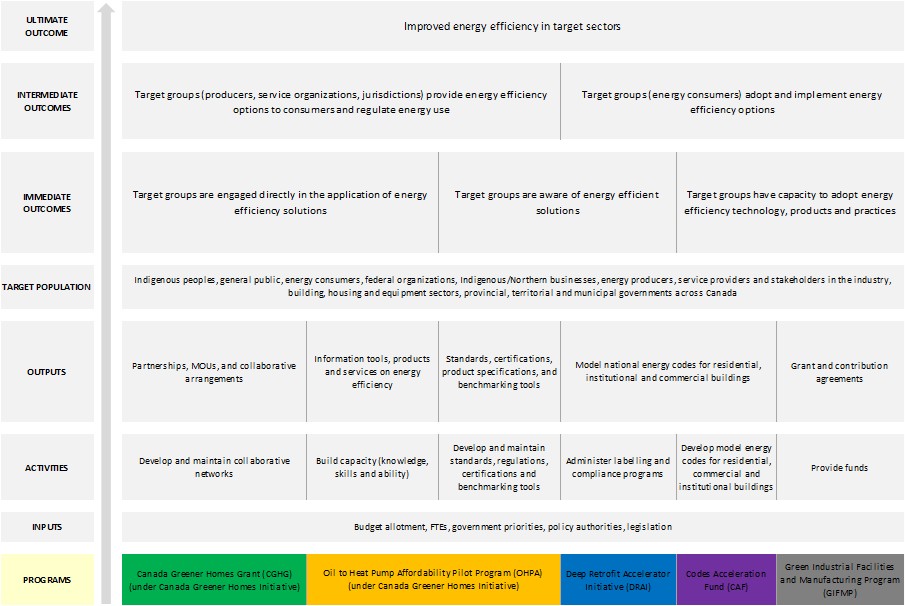
Text Version
Long Description: Appendix A – EEP Logic Model
The figure presents a logic model for the Energy Efficiency Program (EEP). The diagram is structured as a series of connected columns that illustrate the logical flow from program inputs and activities to outputs and intended outcomes over time.
Overall Structure
The logic model is organized horizontally from left to right into the following main components:
- Programs
- Inputs
- Activities
- Outputs
- Target population
- Immediate outcomes
- Intermediate outcomes
- Ultimate outcome
Programs
This first column identifies five specific programs delivered under the EEP. Each program is represented as a separate box:
- Canada Greener Homes Grant (CGHG) (under Canada Greener Homes Initiative)
- Oil to Heat Pump Affordability Program (OHPA) (under Canada Greener Homes Initiative)
- Deep Retrofit Accelerator Initiative (DRAI)
- Codes Acceleration Fund (CAF)
- Green Industrial Facilities and Manufacturing Program (GIFMP)
Inputs
The second column identifies the key resources required to deliver the program. These include:
- Budget allotment
- Full-time equivalents (FTEs)
- Government priorities
- Policy authorities
- Legislation
These inputs support the implementation of all subsequent activities.
Activities
The third column outlines the main actions undertaken by the program. These activities may include:
- Develop and maintain collaborative networks
- Build capacity (knowledge, skills and ability)
- Develop and maintain standards, regulations, certifications and benchmarking tools
- Administer labelling and compliance programs
- Develop model energy codes for residential, commercial and institutional buildings
- Provide funds
These activities represent the core work performed using the program’s resources.
Outputs
The fourth column presents the direct products resulting from the program’s activities. Outputs may include:
- Partnerships, MOUs, and collaborative arrangements
- Information tools, products and services on energy efficiency
- Standards, certifications, product specifications, and benchmarking tools
- Model national energy codes for residential, institutional and commercial buildings
- Grant and contribution agreements
Outputs are tangible and measurable deliverables that result directly from program activities.
Target Population
This fifth column is a single wide cell describing the full range of people and organizations the program is designed to serve:
- Indigenous peoples, general public, energy consumers, federal organizations, Indigenous/Northern businesses, energy producers, service providers and stakeholders in the industry, building, housing and equipment sectors, provincial, territorial and municipal governments across Canada
Immediate Outcomes
The sixth column identifies the short-term results expected from the outputs. These outcomes typically occur within a relatively short timeframe and may include:
- Target groups are engaged directly in the application of energy efficiency solutions
- Target groups are aware of energy efficient solutions
- Target groups have capacity to adopt energy efficiency technology, products and practices
Immediate outcomes reflect changes in knowledge, awareness, and capacity.
Intermediate Outcomes
The seventh column outlines the medium-term results that build on immediate outcomes. These may include:
- Target groups (producers, service organizations, jurisdictions) provide energy efficiency options to consumers and regulate energy use
- Target groups (energy consumers) adopt and implement energy efficiency options
Intermediate outcomes represent behavioral or systemic changes influenced by the program.
Ultimate Outcome
The eighth column describes the long-term impacts the program aims to achieve. This outcome occur over an extended timeframe and include:
- Improved energy efficiency in target sectors
The ultimate outcome reflects the program’s intended contribution to national priorities related to energy efficiency and environmental performance.
Source: Energy Efficiency Indicator Retirements, Consolidations, Amendments - DG approved May 2025
Appendix B: EEP programs – Progress against expected results
IMMEDIATE OUTCOMES
| PROGRAM | IMMEDIATE OUTCOME | TARGET | RESULT | PROGRESS |
|---|---|---|---|---|
| CGHG | Homeowners are aware of the Canada Greener Homes Grant | 8,300,000 by March 2027 | 13,113,255 homeowners were aware of CGHG between 2021-22 and 2024-25. | Target achieved. |
| Sufficient capacity to conduct EnerGuide evaluations through the Home Energy Retrofit Initiative | 1,500 new Energy Advisors by March 2027 | Energy advisor (EAs) capacity increased significantly from 936 EAs in 2021 to 1611 EAs in 2025. At its peak, there were 1907 EAs in 2023-24. | Target achieved. |
| PROGRAM | IMMEDIATE OUTCOME | TARGET | RESULT | PROGRESS |
|---|---|---|---|---|
| OHPA | Eligible low-to-median-income Canadian households are aware of the Oil to Heat Pump Affordability program (OHPA) (GBA+) | 17,000 eligible low-to-median-income Canadian households by March 31, 2027 | 38,724 applications received for OHPA grants (including direct delivery and codelivery) from eligible low-to-median income Canadian households between 2023-24 and 2024-25. | Target achieved. |
| PROGRAM | IMMEDIATE OUTCOME | TARGET | RESULT | PROGRESS |
|---|---|---|---|---|
| DRAI | Deep Retrofit Accelerators have capacity to deliver ‘concierge services’ to clients | Target to be established following development of baseline | 1,835 building owners (representing over 22,000 buildings) received guidance (pertaining to any part of the deep retrofit process) between 2023-24 and 2024-25. | Preliminary results. |
| PROGRAM | IMMEDIATE OUTCOME | TARGET | RESULT | PROGRESS |
|---|---|---|---|---|
| CAF | Authorities having jurisdiction (AHJ) have capacity to adopt the higher performance tiers of the 2020 model energy codes | 13 roadmaps over five years by March 31, 2027 | Total of 12 roadmaps including 2 existing (prior to CAF funding) and 10 under development. | Preliminary results. |
| 15 solutions over five years | Over 90 solutions developed by 31 project recipients. | Preliminary results. Target achieved. |
| PROGRAM | IMMEDIATE OUTCOME | TARGET | RESULT | PROGRESS |
|---|---|---|---|---|
| GIFMP | Federal departments and agencies are aware of energy management practices | Fifteen federal departments and agencies by March 31, 2025 | Twelve federal departments and agencies (including NRCan) can be documented. Almost certainly more than twelve and likely meet target of fifteen. Additional engagement with representatives from most or all PTs. | Target (likely) achieved. |
| Targeted facilities apply to the Green Industrial Facilities and Manufacturing Program. | Facilities that apply together use 500 PJ of energy annually by March 31, 2025 | Combined total energy use of facilities that submitted Track 2 project proposals between 2023-2025 is 492 PJ. Almost certainly exceeded through facility applications to third parties under Track 1 (data currently unavailable). | Target (likely) achieved. |
Intermediate outcome
| PROGRAM | INTERMEDIATE OUTCOME | TARGET | RESULT | PROGRESS |
|---|---|---|---|---|
| CGHG | Homeowners’ complete retrofits and receive an EnerGuide label | 450,000 by March 2024 (interim) |
674,199 homes with completed pre-retrofit evaluations Note: Homeowners who complete a pre-retrofit evaluation do not necessarily go on to complete the post-retrofit evaluation. |
Target achieved. |
| 510,000 by March 2027 |
434,355 homes with completed pairs of pre- and post-retrofit evaluations and labelled with a post-retrofit EnerGuide label (completed retrofit journeys) Note: As of 9 September 2025, there were 56,673 applications still in the queue. Homeowners have been advised that the deadline to complete the process and request their grant is December 31, 2025. |
Preliminary results. |
| PROGRAM | INTERMEDIATE OUTCOME | TARGET | RESULT | PROGRESS |
|---|---|---|---|---|
| OHPA | Eligible low-to-median-income Canadian households have installed a heat pump under the Oil to Heat Pump Affordability program (OHPA) (GBA+) | 50,000 households by April 2027 | 14,817 heat pumps installed | Preliminary results. |
| GBA+ / Indigenous residences receiving support via community/organization-level contribution agreements or PT co-delivery agreements | 7500 residences by April 2027 | - | Results not yet available. | |
| GBA+ / eligible Atlantic Canadian households reducing heating oil use through OHPA | 26% (based on approximate funding allocations to Atlantic provinces, relative to the number of eligible oil-heated homes in the region) by April 2027 |
10% represents 12,040 grants issued to Atlantic households between 2023-24 and2024-25. Note: Of the 125,387 Atlantic households identified as potentially eligible for OHPA, 4% represents 4,665 homes and 6% represents 7,375 households. |
Target not yet achieved. |
| PROGRAM | INTERMEDIATE OUTCOME | TARGET | RESULT | PROGRESS |
|---|---|---|---|---|
| DRAI | Deep Retrofit Accelerators deliver ‘concierge services’ to clients | Over 7 regions supported by the Deep Retrofit Accelerator Initiative by end of FY 2026/27 | 10 regions | Preliminary results. Target achieved. |
| Over 500 low-income units have received support from Deep Retrofit Accelerator services by end of FY 2026-27 | - | Results not yet available. | ||
| Over 1000 buildings supported have received support from Deep Retrofit Accelerator services by end of FY 2026-27 | - | Results not yet available. |
| PROGRAM | INTERMEDIATE OUTCOME | TARGET | RESULT | PROGRESS |
|---|---|---|---|---|
| CAF | AHJ adopt the higher energy performance tiers of the 2020 model energy codes | 13 provinces and territories adopt minimum Tier 2 of the NECB and NBC 9.36, or equivalents March 31, 2027 | - | Results not yet available. |
| Increased AHJ compliance with the national model energy codes | Average national compliance rate of AHJ increased by up to 20 percentage points from baseline, once established March 31, 2027 | - | Results not yet available. |
| PROGRAM | INTERMEDIATE OUTCOME | TARGET | RESULT | PROGRESS |
|---|---|---|---|---|
| GIFMP | Targeted facilities improve energy efficiency through implementation of energy management practices. | 25 PJ of total annual energy savings by March 31, 2027 | - | Results not yet available. |
Ultimate outcome
| PROGRAM | ULTIMATE OUTCOME | TARGET | RESULT | PROGRESS |
|---|---|---|---|---|
| CGHG | Improved energy efficiency in Canada’s homes | Up to 10 PJ of cumulative annual energy savings by March 2027 | Cumulative annual energy savings is 12.313 PJ | Target achieved. |
| Homeowners save money on their energy bills | Save $490 per year per household that undertook retrofits incented by CGHG by March 2027 | Estimated average annual savings (in dollars) on energy bills per household of $553.46 to $824.82 | Target achieved. |
| PROGRAM | ULTIMATE OUTCOME | TARGET | RESULT | PROGRESS |
|---|---|---|---|---|
| OHPA | Low-to-median-income households save money on their heating bills | $1000 - $5000 per year per household that undertook retrofits incented by OHPA by October 2028 | $1377 per year per household saved on heating bills | Target achieved. |
| Over $3500 per year per household that undertook retrofits incented by OHPA in jurisdictions with the highest oil costs by October 2028 |
2023-24: BC: $3429; ON: $5003; and NB: $6035 2024-25: BC: $3368; ON: $4919; and NB: $5903 |
Target achieved for ON and NB but not achieved for BC. | ||
| Improved Energy Efficiency | Between 1.16 and 4.125 PJ of cumulative annual energy savings by October 2028 | Cumulative annual energy savings of 0.369 to 1.31 PJ | Target not yet achieved. | |
| Reduced greenhouse gas emissions | Between 0.139 and 0.445 megatonnes (Mt) of cumulative annual greenhouse gas emission reductions by October 2028 | Cumulative total of 0.045 to 0.141 Mt based on 15,968 houses | Target not yet achieved. |
| PROGRAM | ULTIMATE OUTCOME | TARGET | RESULT | PROGRESS |
|---|---|---|---|---|
| DRAI | Improved energy efficiency in target sectors (Buildings) | Greater than or equal to 2.5 PJ of cumulative energy savings by March 31, 2030 | - | Results not yet available. |
| PROGRAM | ULTIMATE OUTCOME | TARGET | RESULT | PROGRESS |
|---|---|---|---|---|
| CAF | Improved energy efficiency in Canada’s homes and buildings | Estimated 11.0 PJ of cumulative annual energy savings by March 31, 2030, | - | Results not yet available. |
| PROGRAM | ULTIMATE OUTCOME | TARGET | RESULT | PROGRESS |
|---|---|---|---|---|
| GIFMP | Improved energy efficiency in the industrial sector | 53 PJ of total annual energy savings by March 31, 2030 | - | Results not yet available. |
Appendix C: Project team
Chief Audit and Evaluation Executive
Michel Gould
Evaluation Team
Stephanie Kalt – Director of Evaluation
Adaku Echendu – Evaluation Manager
Mom Yem – Senior Evaluator
Parastoo Emami – Evaluator
Nessan Akemakou Njinga – Evaluator (PARDP)
Amanda Klassen – Evaluator (PARDP)