
Fall 2025
In November and December 2025, Natural Resources Canada (NRCan)’s Youth Council members shared their perspectives on the topic of artificial intelligence (AI) and its potential impact on youth employment in the natural resources sector. This consultation included a one-hour online discussion session and a detailed follow-up survey. Questions focused on how AI can act as an enabler of and barrier to youth employment. Six Youth Council members participated. The Youth Council Secretariat analyzed the results using descriptive statistics and thematic analysis.
AI is rapidly transforming the natural resources sector and reshaping how people work. These changes particularly affect young people entering the workforce as they face shifting skill requirements, employment uncertainty, and increasing competition. Amidst these shifts and challenges, NRCan engaged the Youth Council to help inform future policies and programs.
Summary of Results and Discussion
Overall, Youth Council members expressed mixed feelings about AI. They discussed hope for innovation and efficiency, but they also expressed concerns about job losses, limited training opportunities, and weak policy protections. Most disagreed that current laws and policies sufficiently address youth employment needs in a new AI-driven economy.
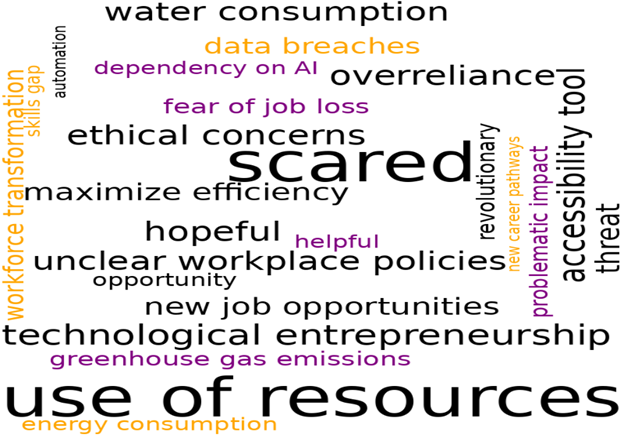
Members (6) shared five words or phrases to describe how they feel about “AI and youth employment.” The word cloud below highlights their contrasting feelings about hopes or opportunities and fears or concerns.
Text version:
Youth Council members’ feelings about Artificial intelligence presented in a word cloud. Words shown include: scared, use of resources, ethical concerns, overreliance, maximize efficiency, water consumption, data breaches, dependency on AI, automation, workforce transformation, greenhouse gas emissions, technological entrepreneurship
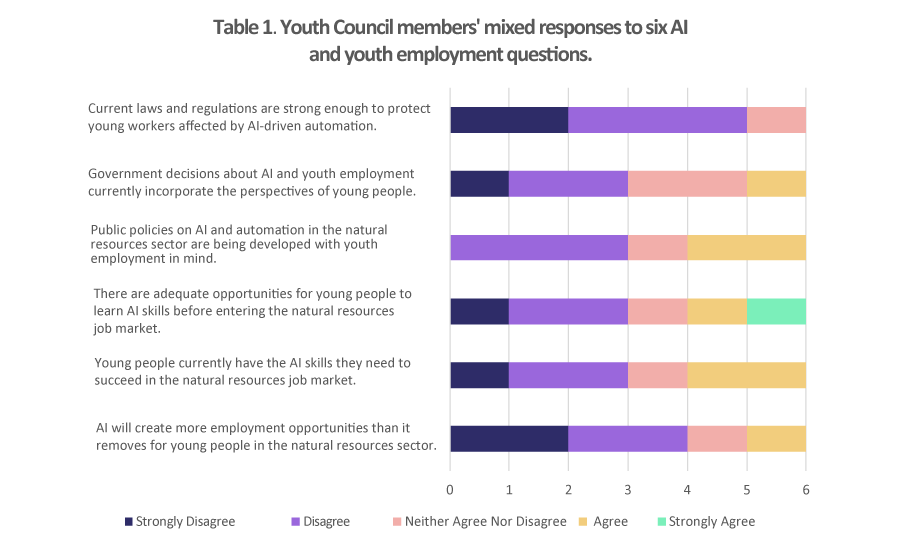
Youth Council members also recorded their level of agreement with six statements related to AI and youth employment. They shared mixed responses, as highlighted in Table 1. Some members (2) agreed or strongly agreed that young people currently have the AI skills they need to succeed, there are adequate opportunities for young people to learn AI skills, and relevant public policies are being developed with youth employment in mind. However, other members (3) disagreed or strongly disagreed with the same statements. In general, members disagreed or strongly disagreed that AI will create more employment opportunities than it removes for young people (4), government decisions about AI and youth employment currently incorporate the perspectives of young people (3), and current laws and regulations are strong enough to protect young workers affected by AI-driven automation (5). Their responses indicate a desire for more proactive intervention by the federal government in the area of AI and youth unemployment.
Text version:
A horizontal stacked bar chart titled “Youth Council members’ mixed responses to six AI and youth employment questions.” Each of the six questions has a bar divided into five color‑coded response categories: Strongly Disagree, Disagree, Neither Agree nor Disagree, Agree, and Strongly Agree. The x‑axis shows counts from 0 to 6 respondents. Across all six questions, responses are widely distributed, with no statement receiving strong consensus. Several questions—such as whether current laws protect young workers affected by AI, whether government decisions include youth perspectives, and whether youth have the AI skills needed for natural resources jobs—show clusters of disagreement and neutrality. Questions about opportunities to learn AI skills and whether AI will create more jobs than it removes show mixed responses across all five categories. Overall, the chart conveys that Youth Council members hold varied and often uncertain views about AI’s impact on youth employment in the natural resources sector.
Three themes emerged from the consultation: the need for youth to build essential skills, the need to avoid an overreliance on AI, and the need for AI policies to focus on youth and the future. The Government of Canada could play a role in addressing these issues, as suggested by the Youth Council.
Build Essential Technical and Interpersonal Skills
Youth Council members (6) heavily emphasized that youth must develop AI-specific and human-centric skills to be successful in the natural resources job market. They discussed the necessity of developing technical AI skills, such as by completing micro-certificates or specialized cooperative education jobs. They also highlighted the need to build interpersonal skills, including critical thinking, oral and written communication, and relationship building via mentoring and networking. Building skills can be a valuable tool to help address the fear of job losses that members (3) revealed during the online discussion.
Members (5) also emphasized the importance of the federal government partnering with educational institutions as well as non-profit and Indigenous organizations to help prepare youth for the future of AI. For example, one member said:
"NRCan can support youth by creating accessible learning pathways, such as short courses and workshops on AI, data literacy, and digital tools. It can partner with schools and youth organizations to provide hands-on projects using real natural resources data and technologies. [It can provide] mentorship and networking opportunities with professionals who use AI in the sector [to] help youth understand career pathways. NRCan can also expand paid internships that expose young people to AI-enabled roles in areas like mining, forestry, and energy. Ensuring equitable access to training and resources will help youth from all backgrounds benefit from an AI-driven natural resources job market."
Youth Council members (5) advocated for the inclusion of marginalized communities in skills-building opportunities, including Indigenous, remote, and rural communities. As one youth said, “Marginalized communities may feel the changes in this sector more strongly. … However, with proper support, training programs, community partnerships, and accessible learning pathways, all these same communities could benefit. … Inclusion has to be intentional.”
Avoid Overreliance on AI
Although youth must develop AI skills to succeed in the natural resources job market, members (5) mentioned that young people must also avoid an overreliance on AI. For instance, one person stated that “young people can avoid depending too heavily on AI by strengthening their own judgment first.” Strengthening one’s judgment requires “learning how to question information, compare sources, and understand the limits of [digital and non-digital] tools.” This member also discussed the importance of strong communication, problem-solving, and numeracy skills, as well as “using technology as a helper, not a replacement.”
Regarding the Government of Canada’s role, one member argued that the government should not implement AI-by-default communication policies. They said, “I want to have a choice when I engage with AI. … I would advise our government [to] not sew it into Canadian lives without consent.” Another person said that the government should proactively warn youth about the “dangers of AI use and overreliance.” These responses highlight how the government could both protect youth from AI and help them understand how to best utilize it.
Create AI Policies with Youth and Future-Oriented Focuses
Finally, members (4) emphasized the need for robust, future-oriented AI policies that address youth concerns and youth employment considerations. As evidenced in the Likert scale responses, half or more of the Youth Council do not agree that current laws and regulations will protect young people from AI-driven automation or that public policies on AI are being developed with youth employment in mind. These gaps matter because they can directly affect young people’s job security and ability to plan for their careers. Members (3) expressed concern about their future job prospects, despite having university degrees, because there is a gap in youth-specific guidance for them.
During the discussion session, two members stated that Canada is “lacking rules in important places” and “ethics regulations.” They argued that a lack of rules and regulations is causing fragmented approaches to AI inclusion in hiring and jobs and enabling potentially harmful outcomes for young people. Members (4) also connected these ethics issues with potential environmental damage caused by AI, which may disproportionately impact marginalized communities and exacerbate the long-term effects of climate change. Proper consultations with young people and proactive policymaking could help address these concerns.
Conclusion
The consultation revealed that AI is creating both opportunities and challenges for youth employment in the natural resources sector. Participants recognized AI’s potential benefits, but they expressed concerns about job displacement, limited training, and a lack of legal protections. Three key themes emerged, including the need for youth to develop technical and interpersonal skills, the importance of avoiding overreliance on AI, and the urgency of future-oriented policies that incorporate youth perspectives. Overall, findings point to a desire for proactive government action. Federal government departments can help directly or with partners by expanding accessible AI learning pathways, internships, and partnerships, while advancing policies that balance innovation with social responsibility to ensure that youth are prepared for the future of AI.
Winter 2025
In February 2025, the National Assessment Secretariat at NRCan invited the NRCan Youth Council to share their perspectives on the Canada in a Changing Climate: National Assessment Process. Youth Council members had the opportunity to weigh in on draft chapter topics for the NRCan-led Living in Canada’s Changing Climate Report, which has a planned release date of 2028.
This consultation built on a previous Youth Council engagement with the National Assessment Secretariat in June 2024, where members participated in the scoping phase of the assessment cycle.
The Living in Canada’s Changing Climate Report is part of the Canada in a Changing Climate: National Assessment Process. This process assesses how and why Canada’s climate is changing; the impacts of these changes on Canadian communities, Canadians’ health, the environment, and the economy; and how Canadians are adapting.
The process relies on the collaboration of a broad partnership of subject-matter experts and assessment users from all levels of government, Indigenous organizations, universities, professional and non-governmental groups, and the private sector. Youth engagement throughout the assessment process is a key priority.
The Youth Council consultation gathered feedback from members to help shape individual chapter content for the Living in Canada’s Changing Climate Report. The consultation included two virtual sessions on February 26 and 27, 2025. All Youth Council members attended one of the two sessions led by the National Assessment Secretariat.
During the sessions, members responded to an interactive live-polling app called Mentimeter to provide feedback on several questions about the assessment process and suggestions for report chapter subthemes and case stories.
Results
Members first discussed how to make the assessment process for the report series more accessible to encourage youth engagement. They made several suggestions, including creating and sharing social media posts such as infographics and short videos to reach a youth audience.
Additionally, they suggested hosting in-person and virtual workshops, including focus groups and short workshops, and collaborating with academic institutions while continuing to seek opinions from diverse groups. Finally, they discussed the importance of offering financial incentives for youth to dedicate their time and energy to climate change engagement.
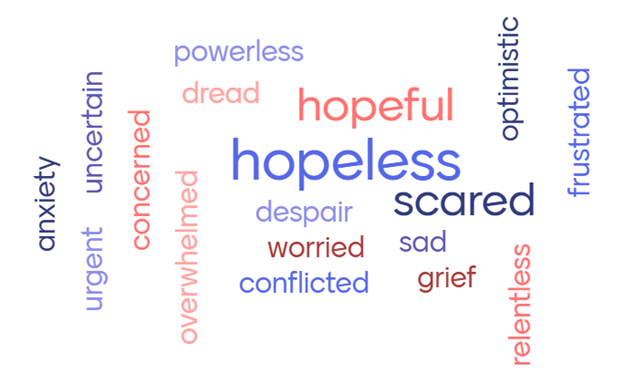
Members were then asked to share one word to describe how they feel about climate change. The word cloud below provides a snapshot of the emotional impact of the climate crisis on the NRCan Youth Council.
Text version:
Youth Council members’ feelings about climate change presented in a word cloud. Words shown include: frustrated, conflicted, powerless, worried, despair, grief, anxiety, dread, optimistic, uncertain, sad, scared, hopeful, overwhelmed, hopeless, scared, concerned, urgent, and relentless.
Next, the National Assessment Secretariat shared a draft report outline for the Living in Canada’s Changing Climate Report. The outline currently includes seven thematic chapters: Energy, Food Security and Sovereignty, Infrastructure, Healthy Ecosystems, Resilient Economies, Water Security and Sovereignty, and Canadians and the World. Members were asked to propose various subthemes and case stories for each of the seven thematic chapters. The Youth Council suggested several potential subthemes and case stories for the chapters.
Proposed subthemes and case stories for the Living in Canada’s Changing Climate Report
Energy
Proposed subthemes
- Microgrids and energy efficiency
- Artificial intelligence, the digital world, and energy consumption
- Interprovincial connections and energy sovereignty
- Nuclear and emerging technologies
Proposed case stories
- The Apuiat wind project
- The Atlantic Loop
- Community solar initiatives and other community-based energy projects
- Offshore renewable energy development
- EverWind Fuels
Food security and sovereignty
Proposed subthemes
- Food waste reduction
- Urban, regenerative, and sustainable agriculture and aquaculture
- The impact of extreme weather on food supply
- Protection of Indigenous foods and medicines
- Food pricing and Arctic food sovereignty
Proposed case stories
- Local community food centres and fridges
- Native food plants
- Yukon Food Security Network
- Wabanaki Tree Spirit Tours
- 3 Paniers alternative grocery store
- Growing Chefs! Vancouver
Infrastructure
Proposed subthemes
- Electrification of transportation (e.g., railways)
- Attracting investment and investment tax credits
- Sustainable building practices
- Climate- and disaster-resilient infrastructure
Proposed case stories
- Northern and region-specific infrastructure
- Retrofitting cases
- Preparing costal communities for floods
- Limitations on funding for infrastructure operations and maintenance
Healthy ecosystems
Proposed subthemes
- Disaster resilience
- Biodiversity and invasive species
- Ecosystem management and conservation
- Urban ecosystems, rivers, and green spaces
- Indigenous knowledge systems
Proposed case stories
- B.C. heat dome, forest fire recovery and reforestation, and melting permafrost
- Parks Canada work on invasive species
- Impact of aquaculture on wild fish ecosystems
- First Nations Comprehensive Community Planning
Resilient economies
Proposed subthemes
- Interprovincial free trade and cooperation
- Circular economy, clean tech, and renewables
- The care economy
- Climate change’s impact on affordability
- Equitable green and sustainable jobs
Proposed case stories
- The localization of industries
- Recycling renewable technologies
- Concerns about funding for the fossil fuel industry (e.g., Trans Mountain Expansion)
- President Donald Trump’s impact on the Canadian economy
Water security and sovereignty
Proposed subthemes
- Indigenous water keepers and water access
- Influence of invasive species and pollution
- Community-led water testing
- Perfluoroalkyl and polyfluoroalkyl substances
- Glacier melt, drought, and water restrictions
Proposed case stories
- Wellington Water Watchers
- Le centre d’interprétation de l’eau
- Revegetation of the St. Lawrence River
- Cleanliness of water in Indigenous communities
- Industrial water releases
Canadians and the world
Proposed subthemes
- International trade and responsible tourism
- Climate migration and resource scarcity
- A globally equitable renewable transition
- Indigenous knowledge and practices shaping sustainable resource management
- The impact of climate change on national security and human rights
Proposed case stories
- Climate diplomacy in the Arctic Circle
- Canadian researchers and leaders in the international community
- Global climate funds for renewable energy
- International climate commitments
- NRCan Youth Council
Finally, members were asked to suggest youth-led initiatives related to the chapter themes that NRCan could uplift within the report. They shared examples such as SevenGen Energy, Mathur et al. v. His Majesty the King in Right of Ontario, Student Energy, and La planète s’invite à l’université.
Next steps
The NRCan Youth Council provided valuable advice and feedback on the Canada in a Changing Climate: National Assessment Process and the draft chapter themes of the planned 2028 Living in Canada’s Changing Climate Report. The National Assessment Secretariat will share the Youth Council’s perspectives with future chapter lead authors of this climate report after the authors are selected and move into the chapter outline phase.
NRCan is also interested in showcasing the Youth Council consultations as a case story in a future Canada in a Changing Climate Report and invited Youth Council members to act as co-writers. Additionally, the department invited members to apply to be future authors of the reports by March 31, 2025.
Fall 2024
In Fall 2024, the second cohort of Natural Resource Canada’s (NRCan) Youth Council presented a series of recommendations on the topic of Helping communities overcome energy, infrastructure and employment challenges to the department. The Youth Council made recommendations in three thematic areas: Clean Energy, Sustainable Jobs and Employment and, Indigenous Reconciliation and Regulatory Compliance..
The NRCan Youth Council conducted their own research (including a review of existing programs and policies), spoke to departmental officials, and drew from their lived experience to develop recommendations that include ideas of potential activities which could contribute to helping communities across the country, particularly northern, Indigenous, and remote communities.
In general, NRCan is fully supportive of the Youth Council’s recommendations that fall under the department’s mandate, and in many cases, work is already underway.
Clean Energy
The NRCan Youth Council examined the challenge of providing clean, reliable and cost-effective electricity to Canadians, recognizing differences in jurisdictional responsibilities and variations in access for lower-income households, as well as remote, northern and Indigenous communities.
The Youth Council’s recommendations align with several NRCan initiatives and long-term objectives. For example:
- NRCan leads on the Regional Energy and Resource Tables which are joint partnerships between the federal government and individual provincial/territorial governments, in collaboration with Indigenous partners, designed to improve planning across all of Canada’s regions.
- NRCan is committed to strengthening partnerships and building capacity in Indigenous communities, integrating capacity-building supports into many program frameworks, while engaging Indigenous governments, communities and organizations, as well as industry partners, to develop a National Benefits-Sharing Framework. This Framework will set forward a path to reducing the barriers Indigenous Peoples face in receiving consistent and equitable benefits from major natural resource projects on their territories.
- As a science-based department, NRCan supports technological leadership and will continue to investigate opportunities as highlighted by the Youth Council to expand its leadership in technological, educational, and economic areas related to natural resource and energy sectors.
Sustainable Jobs and Employment
The NRCan Youth Council examined the issue around addressing employment and career development barriers faced by Indigenous, northern, and remote communities in Canada.
In alignment with these recommendations, NRCan is advancing Indigenous reconciliation and participation, as well as supporting education and employment in the natural resources sector. For example:
- NRCan is working with other federal departments to identify investment opportunities for training, reskilling, and upskilling of Canadians choosing to enter low-carbon industries or jobs industries through the development of the Sustainable Jobs Action Plan, as well as through the Science and Technology Internship Program (STIP) – Green Jobs, which provides funding to eligible employers across Canada to hire, train, and mentor youth in the natural resources sector.
- NRCan is committed to advancing reconciliation and strengthening partnerships with Indigenous People, as demonstrated through the leadership of Nòkwewashk, a sector within NRCan that guides the department in ensuring meaningful Indigenous participation in natural resource sectors. The Department is also guided by the Pathways to Reconciliation Framework and corresponding Action Plan, an internal reconciliation strategy that outlines principles and action areas to be embedded as part of the department’s activities, including weaving Indigenous knowledge into practice and highlighting the success of Indigenous partnerships.
Indigenous Reconciliation and Regulatory Compliance
The NRCan Youth Council examined the impact of natural resource extraction, development and regulatory processes on Indigenous communities in Canada, including the scope of involvement of Indigenous communities on decision-making related to resource development projects.
NRCan fully supports these recommendations, engaging with Indigenous partners to ensure that Indigenous Reconciliation and inclusivity are meaningfully linked to the Department’s initiatives. For example:
- NRCan, through the Government of Canada’s Building Canada’s Clean Future action plan, is leading actions related to advancing economic reconciliation, empowering Indigenous communities, and collaborating with Indigenous Peoples to develop a framework for clean growth projects.
- Through the implementation of Action Plan Measures 32 and 34 in the United Nations Declaration on the Rights of Indigenous Peoples Act Action Plan, NRCan is working in collaboration with Indigenous peoples to both develop guidance on engaging with Indigenous peoples on natural resources projects.
- NRCan is developing the Indigenous Loan Guarantee Program, which acts as a cornerstone of the National-Benefits- Sharing Framework mentioned above, by identifying opportunities to improve the quality and consistency of benefits that Indigenous communities derive from natural resource projects.
NRCan expresses their gratitude and appreciation to the Youth Council for encouraging the Department to consider ideas outside the norm, pushing the boundaries of thought moving forward.
Fall 2023 (Previous cohort)
In November of 2023, the 2023 cohort of Natural Resource Canada’s (NRCan) Youth Council presented a series of policy recommendations across 5 themes: Indigenous Partnerships, Tree Planting, Sustainable Jobs, Zero-Emission Vehicles (ZEVs), and Green Buildings to the Minister of Energy and Natural Resources.
Following this presentation, NRCan experts performed a thorough review of the Council’s recommendations, assessing how and if they could be applied to current and future departmental activities. For those recommendations which fall under the department’s mandate, NRCan is fully supportive, and in many cases, work is already underway.
Indigenous Partnerships
Under the theme of Indigenous partnerships, the Youth Council made recommendations such as providing reconciliation education to participants in youth-focused programs, creating a pathfinder service for Indigenous-target programs and providing funding for Indigenous youth to access certain skills training.
NRCan fully supports the recommendations and work is already underway in several areas. For example:
- Implementing the Indigenous stream of the Policy Analyst Recruitment and Development Program (PARDP) and the Indigenous Career Navigator service for Indigenous public servants.
- A pathfinder program is currently in development by NRCan; and
- Programs and strategies across NRCan sectors have Indigenous skills training components
Tree Planting
Under the theme of Tree Planting, the Youth Council made recommendations such as creating a pan-Canadian data hub of green spaces and the development of a centralized, cross-jurisdictional coordinative body for tree planting activities and the evaluation of related grant programs.
NRCan fully supports these recommendations and work is already underway. For example:
- NRCan continues to expand the volume of and access to its geospatial data on green spaces; and
- Leveraging existing networks to coordinate tree planting activities and funding.
Sustainable Jobs
Under the theme of Sustainable Jobs, the Youth Council made recommendations such as creating a Sustainable Jobs Hub, new funding streams for not-for-profits, and an interdepartmental Sustainable Jobs Education Funding Program for those pursuing a career in a related field.
NRCan fully supports these recommendations and work is already underway, particularly through the Science and Technology Internship Program (STIP) - Green Jobs and the Sustainable Jobs Secretariat. These:
- Provide funding to employers in the natural resource sector, including not-for-profits; and
- Engage with partners in developing policies leading to the 2025 Sustainable Jobs Action Plan.
Zero-Emissions Vehicles
Under the theme of Zero-Emissions Vehicles, the Youth Council recommended the creation of a roundtable where representatives from federal, provincial, territorial and Indigenous governments can collaborate on addressing the infrastructural challenges of their respective jurisdictions.
NRCan fully supports this recommendation, with the Regional Energy and Resource Table (RERT) and its participation in the Federal-Provincial-Territorial (FPT) ZEV Working Group, led by Transport Canada, bringing together representatives from all provinces and territories, and many Indigenous governments, to identify and accelerate shared economic priorities for a low-carbon future.
Green Buildings
Under the theme of Green Buildings, the Youth Council recommended the implementation of an incentive framework to encourage landlords to invest in energy efficiency retrofits for their properties.
The Office of Energy Efficiency encourages homeowners – including those renting out their homes - to make energy-efficient decisions through their existing programming.