
Publication details
- ISBN
978-0-660-79964-3 - Catalogue number
M154-200/4-2025E-PDF
As stated in subsection 127.45(20) of the Income Tax Act, “for the purpose of determining whether a property is a clean technology property, any technical guide, published by the Department of Natural Resources and as amended from time to time, is to apply conclusively with respect to engineering and scientific matters”. This technical guide is with respect to the category of clean technology property that is air source heat pump systems.
This is the first edition of the Clean Technology (CT) Investment Tax Credit (ITC) Technical Guide: Air Source Heat Pump Systems and it reflects the Income Tax Act and Income Tax Regulations current as of September 29, 2025.
The Class 43.1 and 43.2 Secretariat also maintains the Technical Guide to Class 43.1 and 43.2 and the Technical Guide to Canadian Renewable and Conservation Expenses (CRCE) under separate cover. Taxpayers are advised to consult those guides for specific information on the types of properties eligible for inclusion in Class 43.1 and/or CRCE.
This Guide may be amended from time to time to reflect amendments to the Income Tax Act and Income Tax Regulations with respect to clean technology property. Taxpayers should consult the latest versions of the Income Tax Act and Income Tax Regulations whenever they are considering a project to ensure that decisions are based on the legislation in force at the time.
General description
Air-source heat pump systems (described in subparagraph (d)(iii) of the definition clean technology property in subsection 127.45(1) of the Income Tax Act, which references property described in subparagraph (d)(i) of Class 43.1 in Schedule II of the Income Tax Regulations) includes property that is used primarily for the purpose of heating an actively circulated liquid or gas by transferring heat from the outside air.
Eligible properties
Eligible properties for air-source heat pump systems include the following:
- Equipment that transfers heat from the outside air (e.g., heat pumps and other equipment that is part of the system – see below under “Types of air-source heat pump systems”);
- refrigerant piping;
- energy conversion equipment;
- thermal energy storage equipment;
- control equipment; and
- equipment designed to enable the system to interface with other heating and cooling equipment.
Ineligible properties
Ineligible properties for air-source heat pump systems include the following:
- equipment that provides back-up for the property described in the Eligible Properties section above;
- a building or part of a building; and
- equipment that distributes heated or cooled air or water within a building.
Types of air-source heat pump systems
Further to the description of eligible and ineligible property above, the following explains some of the terminology used in respect of air-source heat pump systems.
The main components of an air-source heat pump system are a compressor, condenser coil and (indoor air) fan(s), expansion valve, evaporator coil and (outside air) fan(s), interconnecting refrigerant piping and controls. Outside air is used as a heat source to evaporate refrigerant in the evaporator coil and the temperature of the evaporated refrigerant is increased by raising its pressure with the compressor. The heated refrigerant then delivers heat to an “actively circulated gas” (e.g. indoor air) “or liquid” (e.g. domestic hot water) with the air-source heat pump’s condenser coil. For some air-source heat pump systems that include a reversing valve, the direction of refrigerant flow can be reversed so that the system is able to provide cooling like a typical air conditioner. When in cooling mode, the function of the ‘evaporator’ and ‘condenser’ coils is reversed.
These components are often split between an "outdoor unit" (including the evaporator coil in heating mode, fan and compressor) and one or more indoor units (including the condenser coil, fan, etc.). These are sometimes referred to as “mini-split” systems (single indoor unit) or “multi-split” systems (multiple indoor units).
In some cases, these components can also be combined into a single “packaged rooftop unit” but there are many other configurations of eligible air-source heat pump systems, such as variable refrigerant flow (VRF) systems that can simultaneously provide heating and cooling to different areas of a building.
Additional guidance
In this section:
- General requirements
- Power supply
- Support structures
- Equipment that is a building or part of a building
- Air-source heat pump systems
- Equipment that distributes heated or cooled air or water in a building
General requirements
In order to qualify, in addition to other limitations, clean technology property must:
- Be equipment that is situated in and intended for use exclusively in Canada;
- Not have been previously used or acquired for use or lease, for any purpose before acquisition by the taxpayer; and
- Be acquired and become available for use between March 28, 2023 and December 31, 2034.
Power supply
On-site equipment that is used solely for the purpose of delivering power to eligible equipment (motor control centre, power cabling, local disconnect etc.) is generally considered eligible equipment that is part of the air-source heat pump system. Shared electrical equipment, such as a power distribution panel that supplies power to both eligible and ineligible equipment is ineligible.
Support structures
Concrete pads or frames used to support air-source heat pump systems may be eligible.
Equipment that is a building or part of a building
The cost of reinforcing a building’s existing roof structures or walls, such that they can support the weight of an air-source heat pump system is ineligible.
Air-source heat pump systems
Whether an air-source heat pump system that exchanges heat with the outside air as well as other sources of heat or cooling (e.g., indoor air, process exhaust) is an air-source heat pump system for the purposes of the CT ITC will depend on the particular facts and circumstances of the project. Taxpayers should contact the Class 43.1/43.2 Secretariat for technical guidance.
Equipment that distributes heated or cooled air or water in a building
Fans that pass air over an air-source heat pump system’s condenser coil such as the indoor air fan in the indoor unit of a “mini-split” system, or the indoor air fan within the casing of a packaged rooftop unit are considered part of an eligible air-source heat pump system.
However, any downstream ducting, diffusers, fans used to distribute indoor heated or cooled air are ineligible. Similarly, ineligible equipment would include piping used to distribute heated or cooled water in a building.
Costs typically included in the capital cost of clean technology property
Costs typically included in the capital cost of an air-source heat pump system that is clean technology property include:
- Purchase and installation of air-source heat pump supports (e.g. concrete housekeeping pads, roof curb mounts, support frames or snow stands).
- Purchase, installation, flushing and charging of refrigerant piping including associated wall penetrations.
- Purchase and installation of dedicated power supply equipment (e.g. dedicated wiring, panels, fusing, breakers, local disconnects).
- Purchase and installation of related controls and instrumentation (e.g. thermostats, equipment used to interface with other heating/cooling systems).
Note: The Department of Finance has published draft legislation in August 2024 that included proposed amendments to Section 127.45 that would provide that, for the purpose of computing a taxpayer’s CT ITC, the capital cost of clean technology property would not include any amount that is an expenditure in respect of a “preliminary work activity”. Once enacted, these amendments would apply retroactively as of March 28, 2023.
Proposed definition
Preliminary work activity means an activity that is preliminary to the acquisition, construction, fabrication or installation by or on behalf of a taxpayer of property including, but not limited to, a preliminary activity that is
- obtaining a right of access to a project site or obtaining permits or regulatory approvals (including conducting environmental assessments);
- performing front-end design or engineering work, including front-end engineering design studies, or process engineering work for the project, including
- collecting and analyzing of site data,
- calculating energy, mass, water or air balances,
- simulating and analyzing the performance and cost of process design options,
- selecting the optimum process design, and
- conducting feasibility studies or pre-feasibility studies;
- clearing or excavating land;
- constructing a temporary access road to the project site; or
- drilling of a well.
Schematics of qualifying equipment and systems
Typical configurations of systems that would qualify as an air-source heat pump system are shown in the schematics below.
Key to notes on schematics for air-source heat pump systems
- ASHP-1
- For eligible properties, see Eligible Properties section of this Guide.
- ASHP-2
- For ineligible properties, see Ineligible Properties section of this Guide.
- ASHP-3
- Equipment that distributes heated or cooled air or water in a building is not eligible.
- ASHP-4
- Energy equipment that backs up the air-source heat pump system is not eligible.
- ASHP-5
- Buildings or parts of buildings are not eligible.
Figure 1 - Air-Source Heat Pump System – Mini-split System in Heating Mode

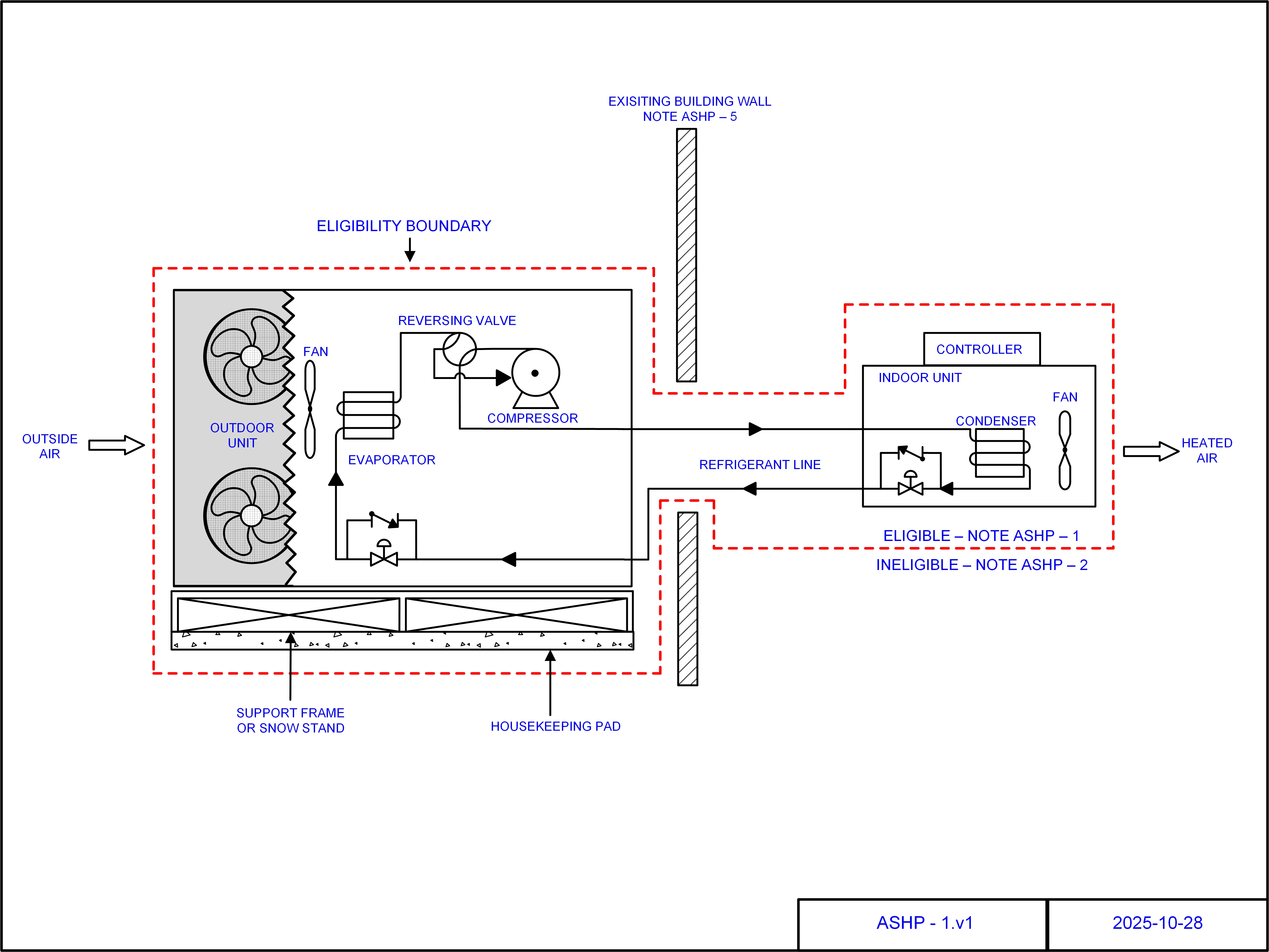
Text version of Figure 1
Schematic illustrating the boundary of a mini-split air-source heat pump system. Within this boundary are an outdoor and indoor unit of a mini-split. For notes on this schematic (ASHP-1 and ASHP-2), please refer to key to notes on schematics for air-source heat pump systems section.
Figure 2 - Air-Source Heat Pump System – Ducted Unit with Natural Gas Furnace


Text version of Figure 2
Schematic illustrating the boundary of a ducted air-source heat pump system with natural gas furnace. Within this boundary are an outdoor and indoor unit. For notes on this schematic, please refer to key to notes on schematics for air-source heat pump systems section.
Figure 3 - Air-Source Heat Pump System – Packaged Rooftop Unit


Text version of Figure 3
Schematic illustrating the boundary of a packaged rooftop air-source heat pump system. Within this boundary are packaged rooftop air-source heat pump and curb adapter above the roof. For notes on this schematic, please refer to key to notes on schematics for air-source heat pump systems section.